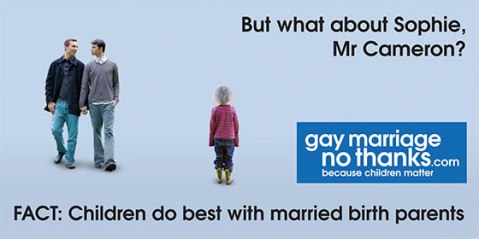
Deacon Nick Donnelly has reported on a campaign conducted by a pro-marriage group which has been stopped due to vandalism, abuse and threats of violence. I can well believe it. The repercussions of my tweeting in support of traditional marriage in February 2012 still rumble on to this day – a horrific sexual threat was made against me, evidence of which is contained in a comment on this blog and of which the author is wholly unrepentant and still engages in sporadic bouts of social media bullying.
I am also very aware that I am a semi public figure who lives in an area noted for its tolerance (unless you are homeless) and no doubt it could be claimed that by posting in support of this campaign I am being reckless and putting my family at risk.
Surely this is the only bigotry at work here – people who are ideologically opposed to a traditional view of marriage are determined to impose their version of marriage and beliefs upon us, by fear and threats.
The government may be imposing this new definition of marriage upon us but they fail to understand that there are many who will not accept this and who will refuse to refer to gay relationships as marriage – certainly the definition is not anything that I had previously understood as marriage and not what I consented to when I got married. If any further proof were needed, we can see how the government has changed the understanding of the word and institution by its continued tortuous attempts at formulating the correct legal wording.
Numerous studies show that the best outcomes are achieved by children who are brought in a relationship where their birth parents are married. All other studies use marriage as a benchmark and attempt to prove that a same-sex relationship is as good. (The Iona Institute has much definitive research and evidence based peer-reviewed studies on this matter.)
Now one can deny evidence, or argue the toss over it as much as you like, but doesn’t democracy allow us to express our views, no matter how deluded and demented that others might think them. To attempt to prevent a campaign group from stating that they do not want a new vision of marriage imposed upon them is the only bigotry at work. Although of course bigot is becoming an impotent and redundant term.
It could be argued that posting this link is provocative and confrontational, but it perfectly expresses the views of this household. To refuse to post it accepts the climate of fear attempting to be imposed upon us. Time to batten down the hatches.
A little late in posting this – taken from the Catholic Universe dated Sunday July 7
The news that the UK looks set to become the first country to allow the creation of babies using DNA from three people, has caused many of us to instinctively shudder with horror and not simply because of the obvious contravention to Catholic ethics.
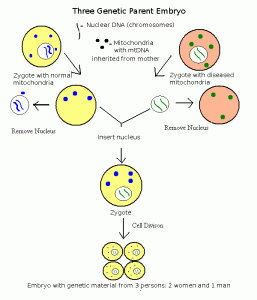
The concerns about this new technology go way beyond the creation of human life in a laboratory, which infringes a child’s right to be ‘the fruit of the specific act of conjugal love of his parents’ (CC2378). The mooted technique aims to eliminate mitochondrial disease, an inherited genetic conditions that occurs due to mutations found in the mother’s DNA. Whereas most DNA is located inside the nucleus of a woman’s egg, mitochondria is found in the surrounding material, hence the therapy aims to transplant the healthy nucleus from the egg of a woman with mitochondrial abnormalities into that of a second woman who is unaffected, or alternatively transplant the nucleus of an already fertilised embryo, into another. In both cases, the existing nucleus will have been removed, but in the case of transplanting cells from fertilised embryos, it will entail the destruction of two human lives, in order to create a third.
This wholesale discarding of human life is an issue that is frequently overlooked when discussing IVF treatment. According to statistics released by the Human Fertilisation and Embryology Authority (HFEA) in December 2012, 3.5 million embryos have been created in the UK over the past 21 years of which only 6% have resulted in pregnancies. A staggering 1.7 million embryos have been thrown away – it is no wonder that Lord Alton, a crossbench peer, describes this as the creation and destruction of life as being in ‘industrial numbers’.
The commodification and destruction of life is not the only human issue at stake. A substantial number of human eggs will be required to be harvested for this therapy, a process that is often painful and risky, also occasioning potential future psychological effects. It is likely that it will be vulnerable and desperate women who are cash-strapped, perhaps students struggling under a mountain of debt as well as those already experiencing infertility who will be lured into egg donation in return for a free cycle of IVF treatment.
And that’s before we get to the core of the issue as to whether or not it is ethically acceptable to be genetically engineering human life and altering the genetic code of future generations? What will be the long-term physical and psychological impact upon those conceived by three parents? Attempts at cloning using nucleus transfer have proven unsuccessful in humans and highly dangerous in animals with a high proportion of spontaneous abortions and offspring born with abnormalities and limited life spans. Any unpredicted genetic problems would then be passed on to future generations. A baby born with three sets of DNA is still a human being of equal dignity and worth and yet will be treated and regarded as an anomaly or human guinea pig requiring lifelong monitoring.
When focusing upon the potential benefits of this technique, the geneticists involved have been very swift to point out the devastating consequences for those affected with mitochondrial disease with a succession of women who have tragically suffered multiple miscarriages or lost babies in infancy, being paraded in the press, who would avail themselves of the procedure were it to be available. It would take a heart of stone not to feel for these women or those individuals who are living with the daily consequences of mitochondrial disease, but genetic engineering is of scant comfort to existing sufferers. It does nothing to cure these illness or alleviate their symptoms. Researching treatments and supporting families of sufferers would be a more appropriate use of funds. The possibility of three parents embryo won’t help new parents who have just received a devastating diagnosis.
Given that it is estimated that around ten couples a year would use the procedure, it raises questions as to whether or not there is some other agenda at work here, as scientific pioneers are dependent upon being able to promote their work to those funding them, the public and decision makers, in order to obtain the regulatory changes and grants to continue and extend their work. The heart-rending cases that we are presented with as a justification are thankfully rare, but even if they were not, we should not allow disability to act as a barrier to being born, especially when it comes with such a high human price tag.
In common with other life issues, we are being sold a treacherous slippery slope, one that opens up the possibility of genetically modifying pre-born human beings on the grounds that this will affect a tiny proportion of people and as being necessary on the grounds of compassion. How long before other genetic traits are able to be identified and modified before birth? We are not yet in Brave New World territory, but legislation to approve 3 parent embryos takes us another step towards it.
This post should be subtitled ‘in which I upset and offend everyone.’ Plus ca change.
Not snapped outside Brighton Pavillion…
It says much that I am writing this post with much trepidation as nothing seems to cause so much division and animosity on the Catholic internet as the topic of Mass in the Extraordinary Form.
I abhor this whole business of labelling people, but in order to give readers some idea of where I’m coming from, I guess the most accurate label one could give to me in terms of my faith is that I’m a Neo Con, I generally support the reforms of Vatican II but believe them to have been widely misapplied to the liturgy and would advocate a reform of the reform. Interestingly, I find myself far more closely aligned to the traditionalist wing on the internet but contrary to popular belief, I am not a traddie with a capital T and despite my blog header, don’t have pretensions to swan about Oxford clutching a stuffed Aloysius. * see note
But in any event, this whole business of pretentious trads with a capital T, completely eludes me, every time I’ve been to the local Latin Mass I’ve not worn a mantilla (I don’t possess one), I’ve worn normal clothes usually consisting of jeans and a top in which I can discreetly breastfeed and a coat if it’s been winter. To be honest, given that the service is in the evening, I count it as something of a bonus if my clothes don’t have unidentifiable stains on them deposited by at least one child. No-one has ever looked at me askance in disgust or in shock and neither have I felt as though I stuck out like a sore thumb. I’ve always been taught to cover up inside a Church, no bare arms, no acres of cleavage or thigh and so would apply this rule regardless of the type of liturgy. Now in all probability I ought to procure a mantilla and probably will at some stage, but not possessing one or not dressing like Lady Mary Crawley (I wish, maybe when I’ve stopped having children) or a member of the Amish, has never led to me feeling uncomfortable.I’ve never experienced post-Mass naval-gazing from fellow parishioners either. Any conversation has revolved around how adorable my children are, (naturally) or generic chit-chat along the lines of ‘how is your husband’ or what do you think of ‘xyz in the media this week’ from those who know me.
Is going to the EF making a political statement with which I feel uncomfortable? No, not really. One of the reasons I go is that sometimes my daughter is away on a Sunday, misses Mass, comes back in the evening and thus the local EF is the only one which either of us can take her to. Or it might be that the children have led me a right merry dance in the family Mass in our parish, I’ve spent the entire service trying to stop one toddler from demolishing the candle stand, the other from escaping up the aisle, whilst giving a nine year old the glad eye if she’s getting distracted, all while jiggling a baby. Put quite simply it’s nice to take one or maybe two manageable children to a Mass where I can get a little bit of piece and quiet and a chance to focus on the Lord on the altar.
No doubt there are places where it’s all terribly formal and I’d get the lips pursued like a cats backside for not wearing a mantilla and the fact that my children are often woefully noisy and I struggle to control them (hey, you try a 9 year old, a 3 year old, a 2 year old and a baby on your own) but it’s not something I’ve noted and I’m not (ahem) known for having skin like the hide of a rhinoceros.
Actually I tend to get the black stares as a result of the children, no matter where I attend Mass and I guess this is really my main barrier to attending the EF, in that the silent canon means that the children can’t get away with much. It is so hard with multiple young children, particularly when often they are the only ones there, no longer are children expected to be seen and not heard and so getting them to suddenly pipe down for Mass is a Herculean task, although to be fair, the three year is slowly beginning to improve. I think this is one of the greatest barriers to the EF for many newcomers with children, because not only does one have to get to grips with an entirely new and admittedly foreign way of worship (even though deeply contemplative and spiritually enriching) but there’s the issue of the noisy and multiple children.
So, if I’m being brutally honest (and don’t flame my comments to tell me what a heretic or how misguided I am) I prefer the NO, simply because a) it’s what I’m used to and b) it’s easier with the children. But there is a huge dilemma or dissonance here because intellectually, having read all of the many many learned and erudite liturgical blogs, I am increasingly convinced of the importance of regularly attending the EF and ensuring my children have access to it also. But if I don’t take them, then how on earth are they ever going to get used it? I’ve experienced firsthand how children, right from before they are even born, soak up the sights, sounds and smells of Mass, all of mine used to kick wildly in utero whenever the organ sounded or something was sung in Church. They know the format of the Mass, what happens, what is said and done in what order and what is going on. The three year old, as happened with the eldest, will seem like she’s in a world of her own, ensconced in a book or trying to empty out the lady in front’s handbag, then all of a sudden will join in with a known prayer or response. At moments like that, your heart leaps, you know that the formation that you are attempting to give them is having some effect. The two year old will happily point to Our Lady and say “Mary” (and to St Therese of Liseux but never mind the thought counts) and she can also identify and regularly point out Jesus, although I’m not sure “Naughty Jesus, naughty step” is the exact response one would hope for.
So just as I still feel uncomfortable in the EF, not 100% sure of what’s happening or what I should be saying or doing at any given moment, then how on earth can I expect my children to have the foggiest in terms of what’s going on? It’s something of a vicious cycle. And the EF, the Latin is important, because if nothing else, it is mine and their patrimony.
It’s better if I don’t go into an extended rant explanation of my woeful lack of catechesis at school Catholic education, suffice to say, despite attending a Catholic boarding school, I emerged never having learnt how to pray the rosary, without a word of Latin outside of GCSE that had passed my lips in a liturgical or prayerful context, we had five years of being called to urgent choir practice because Christopher Walker had sent Sister Mary Mark his latest chant or setting, five years of Inwood, Go Tell Everyone and so on. To put things into context (apologies if I’ve said this before) our school chaplain was one Fr John Glyn of I watch the Sunrise fame, who used to lean his guitar against the altar. Lovely jovial chap who spent his entire time smiling and singing.
Now all that’s fine, I like smiley priests, we should after all be joyful, it did come as something as a shock on attending our first school Mass to my sister and I who had, up until that point been regularly worshiping at the C of E church where my father was the organist. I remember the occasion clearly, Sister Mary Francis impressed my mother by launching into her best Joyce Grenfell ‘come on gels’ act and coaxed everyone into a bouncing and effervescent rendition of Our God Reigns. We lost the plot. My sister started making the funny big hand gestures of Kenny Everett’s Evangelical preacher character and my father held his nose and belted out “down the drains” before collapsing into loud hearty guffaws.
Amusing though that might be, we were also mightily embarrassed. We were English, worship didn’t look like this loud happy clappy business, it was all serious hymns sung in a serious fashion. Then my mum said ‘this is what Catholicism is now, it’s rather jolly I suppose, we have to get used to it and Sister Mary Frances is rather great’, being carried away by the undoubted charisma that the former headmistress possessed. Because my mother hadn’t really been to Church regularly for twenty years, aside from our regular holidays to see my Nana who lived in Devon and worshipped weekly at Buckfast where the community had kept pretty much to plainsong and incense, this was all a massive shock to both her and my father. And it didn’t seem to be confined to school either, if on the odd occasion we did visit the local Catholic church exactly the same type of thing seemed to be going on there.
So little wonder, as soon as we left our Catholic school where we attended Mass on a weekly basis, my mother lapsed too. What’s interesting about this, is that my mum is what one might call a typical post Vatican II Catholic. She won’t mind my saying that she regards herself as Catholic, gets into long fruitless and heated debates with my father over whether Elizabeth or Mary was the worst monarch, but she doesn’t avail herself of confession and feels that the Catholic Church is entirely wrong/misguided about the issue of both contraception and abortion. And before we all lay into my mum, (none of that on here thanks) it’s because like many she was led to believe pre Vatican II, pre Humanae Vitae that everything wouldchange; rules on celibacy, contraception, all of that was up for grabs. And when it didn’t happen, she’s found it extremely difficult to reconcile.
But the great thing (and I’m getting to the point here hopefully, these tangential rambles satisfy me even if no-one else) is that since my Nana died in December, the whole experience of organising a Catholic funeral, burial etc as well as the prospect of having a Catholic priest as a son-in-law (how many women think that’s every going to happen) seems to have awoken something and she’s started going back to Mass on a weekly basis. So. Baby steps here. But the REALLY interesting thing (unless I’m over-egging this) is the way she has repeatedly been saying how nice it is that suddenly everything is returning back to being sung in Latin, at her parish. Of course this could be nostalgia, but it shows that there is, even in quite lapsed Catholics, this yearning for the solemn as well as the familiarity. My parents regularly go to France and so to Mass at St Malo Cathedral and have reported the sea-change there also. Whereas apparently ten years ago, all the Masses were all in the vernacular, again all the commons and some of the Propers are now back to Latin and chants have made a return. Which in turn pleases my dad, who for all his “Martin Luther was the finest man to walk the planet” bluster, adores a bit of Gregorian plainsong.
This certainly tallies with what I am seeing in most parishes (and I’ve worshipped at quite a few over the past few years) is that there is most definitely a grassroots revival and this is good. I still feel quite cross that I was robbed, I’ve had to learn basics like the Salve Regina from scratch as well as the Ave Maria and Pater Noster and so we are singing and saying these regularly with the children, in order that they become everyday, familiar and trusted, not some alien old gobbledegook. My preference would still I think be for the NO, but with all the commons in Latins and the priest Ad Orientem at least for the Eucharistic Prayer, and I suspect this would be more in keeping with the reform of the reform.
Where it leaves me with the EF I don’t know. It’s this ever-decreasing circle of wanting to go, wanting to be familiar, wanting my children to be familiar and happy and yet unless I regularly go, it’s never going to happen. My spirituality is, I’ve discerned of a more mystic, sensual nature, the bells, the smells, the richness, the contemplation, but it all seems like something of a pipe dream until the children are older.
I said at the beginning I was writing this with some trepidation. (If you’ve got this far, well done. Brevity can go hang). That’s the most telling thing. Nothing seems to cause so much angst as the subject of the EF, which to this onlooker seems crazy. Most of it seem to emanate from what I can gather from the jolly rousing hymn camp who seem to be terrified that the Extraordinary Form is suddenly going to be imposed at will on everyone again, by a bunch of crazed red trouser wearing young Traddies. Most of the jolly hymn brigade, it needs to be said, are ageing, the last time I saw someone muttering, pointedly leaving Mass and sadly the parish as a result of the Latin, he was in his seventies and wearing a hearing aid.
Everything seems to be borne out of fear, the ‘liberals’ being scared that they will be forced to have the EF imposed on them and the Traddies are very defensive (and they have been very unfairly demonised and pilloried, I know through having been accused of being one just through expressing an interest in Home Ed) and terrified that the reforms of Pope Benedict and Summorum Pontificum arbitrarily rescinded and the grassroots revival reversed. Again, I think that’s unlikely, despite the casual liturgical style of Pope Francis – he’s got bigger fish to fry than to be alienating a vast new swathe of Catholic youth and born-again reprobates like me. Although obviously there appears to be difficulty in terms of access to the Latin Mass for those who desire it. If a group of people feel a pastoral need for the EF, then provision needs to be made for them.
Which really sums up the entire issue for me. Why can’t people from all sides accept both the NO and the EF are equally valid and allow them to peacefully co-exist? Why do we need to perceive a mission creep from either camp in terms of reforming the liturgy? The Benedictine reforms seem to be taking root and flourishing at grass roots. No doubt the New Translation has helped. But ultimately our children deserve their patrimony and solemnity, they should at the very least experience both forms on a regular basis. Whether the NO or the EF Christ comes to us in the Eucharist. Why can’t we all focus on that instead, and the rest should surely follow?
But those wanting to see more flourishing of the EF need to court those like me, parents of young children, who have been failed by 30 years of dire dismal banality. That’s the key to breaking out of the whole labelling issue or perceived perverse desire to be counter-cultural. Somehow a way needs to be found to ignite the interest of those in their 20s, 30s and 40s who were denied their heritage, to extend the appeal of the traditional, aged and sacred so that it no longer appears to be an insular cult. How that is done is another matter. The reintroduction of Latin has to be a starting point. But those serious about lasting liturgical reforms have to look to assisting my generation to reclaim and be enthused to pass on to our children. That’s the real challege of Summorum Pontificum.
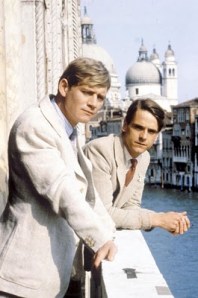
*(Actually if anyone is interested in the reasons behind the header, it’s as banal as the fact that when my eldest child was newborn, I had hours to kill sat in my nursing chair feeding her. As any breastfeeding mother will tell you, those breastfeeding marathons can get rather monotonous and in the era before smartphones, I decided to catch up on reading those classics that I had never previously got round to. Brideshead Revisited was one such tome, I was too young for the iconic Thames TV series when it first came on, but my father was always urging me to read Waugh and so I decided to give Brideshead a whirl. When I read the closing moments, it was literally my Damascene moment. Tears were pouring down my face, I had a deep longing and thirst to reconnect with my discarded faith that I’d never previously known much about, thought that I was a miserable sinner, that it was too late for me to be saved but I was going to jolly well save my daughter from my miserable damned fate and determined that I was going to get her baptised, regardless of the fact I’d not been to church since leaving school. So I started attending baptism classes and my journey began).
Over the weekend my Irish pro-life colleagues thanked those of us in the UK who have been supporting their efforts to keep Ireland one of the safest places in the world for the unborn. All the tweets, blogposts and prayers have really helped to sustain them throughout their campaign; it has apparently been a source of comfort to see people from all over the globe uniting behind Ireland’s pro-life lobby in the face of Enda Kenny’s determination to steamroller abortion on demand into a country that boasts the lowest rates of maternal mortality in the globe.
Tomorrow is an extremely significant day for Ireland with the Dail due to vote on the bill that will introduce abortion up until term for mothers deemed to be suicidal, despite the fact that every single medical expert who testified to the Oireachtas committee stated that abortion is never an appropriate treatment for suicidality. The Irish government is acting purely on the basis of ideology and against all medical evidence and international experience for treating suicide ideation.
Minister of State, Lucinda Creighton has put her political career on the line, by not only proposing a series of amendments designed to adequately assess and treat a pregnant woman presenting as suicidal, but has also pointed out how Enda Kenny has misled Fine Gael voters, as their election manifesto in 2010 did not commit the party or their TDs to the introduction of abortion. If Miss Creighton votes against the bill, alongside 4 other TDs who have already signified their intent, then they will lose the party whip. It is thought that had Enda Kenny allowed a free vote then between 20 and 30 TDs would have voted against the bill, however Kenny is not prepared to risk his party’s political stability, deeming victory more important than the conscience of its TDs who are being forced to break any previous pro-life promises to voters. Any votes in favour will be made out of fear, not conviction.
Those of us who have regarded Ireland’s example as an inspirational model of maternal healthcare have been looking on in despair as a deeply ideological bill which will lead to abortion on demand is imposed upon the country, despite overwhelming public opposition to a liberal abortion regime.
For years the line of argument has been that Irish women seeking abortion are forced to come to England, in a bitter and grim irony the proposed bill will mean that heavily pregnant English women will now be able to travel to Ireland for a late-term abortion if they claim that they are suicidal.
Here’s the words of Dr Bernard Nathanson, one of the foremost pro-abortion activists in the USA, who helped found the National Association for the Repeal of the Abortion Laws, (and later converted to the pro-life cause) on the best mechanism for liberalising abortion law. For anyone following developments in Ireland, from the tragic case of Savita Halappanavar to the hatred shown towards Ireland’s Youth Defence group who have been subject to gross smears and allegations, had their headquarters smeared with human excrement and this morning had their website hacked with details of the names, addresses and phone numbers of their supporters published on line, much to the glee of certain pro-choicers, all of this will seem very familiar:
1. Find a hard case, even if not fully relevant
2. Create fear, doubt and confusion and even grossly exaggerate or lie about the facts
3. Find a convenient, pro-life easy to hate group to demonise or scapegoat
4. Legalise abortion on mental health or suicide grounds
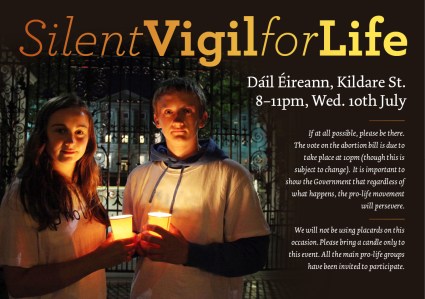
Tomorrow – Wednesday July 10, a silent vigil will be held together with the Good Counsel Network outside the Irish embassy in London, at 17 Grosvenor Place, SW1x 7HR between 4;30 and 7:30pm (nearest tube Hyde Park corner) in solidarity with Ireland’s pro-life campaign and in prayer for their unborn. This will be a wholly peaceful and prayerful event, attendees are asked only to bring a candle, no placards please. You don’t have to be Irish – anyone can pray for the sanctity of life.
This is to coincide with and add prayers to the vigil that will be being held outside the Dail tomorrow night as the bill is voted upon. Apologies for the late notice, please do your best to either attend or spread the word far and wide and above all pray for Ireland.
I wrote in this week’s Catholic Universe column about the unholy trinity of three parent embryos ushering in a Brave New World in terms of reproductive ethics and genetically modified human beings.
One of the many disturbing facets of these advances in technology is the way in which the media reports them through an uncritical filter, as if all scientific and technological progress is automatically a positive development requiring much jubilation, without considering the wider ethical and scientific issues at stake. So today we see the BBC hailing the advance which means that the cost of IVF may be able to be drastically reduced to a mere £170 meaning that not only will it become affordable and open up the market to thousands more infertile couples, but also rolled out to developing countries in Africa who currently do not have access to IVF technology.
Not once does the BBC attempt to acknowledge let alone unpack the ethical difficulties in IVF and I don’t mean the obvious objection that we all have as Catholics. According to figures from the HFEA, since 1991 3.5 million embryos have been created, of which only 6% have resulted in pregnancies. Even if one doesn’t agree with the scientific evidence that a fertilised egg with its own unique DNA constitutes human life, that’s still a staggering amount of wastage. What are the environmental effects of this technology, which as the BBC reports, requires a large amount of carbon dioxide to be manufactured as well as large amounts of energy. Is this really a responsible use of our resources, especially when we know that IVF does absolutely nothing to diagnose or treat the underlying problems that are causing the infertility, it merely sticks a costly sticking plaster over the problem. Where is the drive to create a holistic solution, one that works with the body to heal and cure whatever it is that is causing the issue, something that doesn’t involve hyperstimulating the ovaries with synthetic hormones, overriding the body’s natural endocrine system, painful and invasive egg harvesting and the creation and destruction of embryos in a laboratory on an industrial scale.
It’s also wishful thinking that by dropping a few alka-selter tablets or whatever one has in one’s kitchen cupboard to manufacture cheap carbon dioxide that the cost savings will automatically be passed onto the client. This is all very dependent on the goodwill and charitable inclinations of companies who are assumed to want to avail themselves of the technology, re-equip their labs (which will come at a cost) and slash their profit margins. Only a few weeks ago, it was announced that time-lapse imaging can potentially dramatically improve the chances of a successful IVF cycle. Presumably this will come at a cost, so it’s naive to think that we’ll all be able to have IVF for the price of a return Easyjet flight to Rome.
We see almost everything that’s wrong with benevolent patronising Western attitudes towards our brothers and sisters in developing countries in the idea that by making IVF cheaper it may then be given to poorer nations and people, who are obviously in dire need of being able to manufacture babies in a laboratory. How does this fit in with the popular narrative that actually what we need to do is introduce and promulgate contraception into poorer nations in order to stop women from breeding and having vast numbers of children whom they are unable to feed, clothe and shelter.
Have we seen countries such as Ghana, Uganda and Cape Town crying out for assisted reproduction technology – where is the demand? How does the ability to manufacture babies actually help solve the causes and symptoms of poverty? How does growing embryos in a petri dish solve the problems of corrupt governance, of war, of terrible infrastructure, lack of decent transportation, medical care, supplies equipment and so on?
It’s almost as if we want to stop people from natural reproduction and to encourage them to use manufactured methods of contraception, buying into the Western notion that it’s better to delay motherhood. With cheap IVF it doesn’t matter if one has missed the window of natural fertility via contraception, it can easily be overcome and any abnormalities that may result in a less than perfect human being, be easily engineered away. Because recourse to IVF is going to the first thing on the mind of a unmarried childless African woman living in conditions of poverty, or an ageing married couple working every hour God sends in the slums, who have been persuaded that contraception couched in the terms of ‘reproductive freedom’ is the most responsible option.
Increased contraception and cheap IVF empowers neither women nor children, but encourages unhappiness, short-term relationships, desperation and infertility. It does however present a never-ending supply of customers for the pharma industry, who would be the real losers if everyone stopped using contraception, and opens up newer untapped markets. Poorer women are now equally able to avail themselves of the exploitation and lies of an industry that seeks to commodify and commercialise sexual activity, turning a basic human right and a natural ability into a consumer industry, something that we all need to buy. This is what happens when you divorce sex from its procreative abilities, the ability to control whether or not to have a baby is taken out of your hands, presented as something out of your hands and therefore needing to be regulated and controlled by other people. Contraception has invited the state and capitalist industries into our bedrooms and reproductive decisions. We should not be looking to impose this on anyone else in the name of progress.
Catholic apologist Mark Shea’s observation that ‘tolerance is not enough, you MUST approve or be punished’ in relation to the same-sex marriage debate is looking evermore prophetic.
Please take a few minutes to watch the following video, produced by Manif pour Tous. (PSG refers to the riots and subsequent damage caused following the victory of the Paris Saint Germain football team in France’s first league)
The label of bigotry has been bandied about so much that it has become meaningless and yet surely in this context, it is entirely apposite. If we accept that bigotry is someone who behaves towards another with hatred, contempt or intolerance and treats them unjustly on the basis of their beliefs, then there can be no other word to describe what we see here, aside from perhaps totalitarianism.
But language and labels are only helpful in so much as they help us to concretely identify the attitudes, cultural shifts and political forces that are underpinning such a disproportionate response to an overwhelmingly peaceful protest.
This video should challenge everyone, regardless of where they stand on the matter of same-sex marriage or political spectrum, which has now transformed into issues of free speech, rights to protest and religious freedom. This kind of response has absolutely no place in the pluralist, progressive and liberal utopia promoted by those wedded to the politics of identity.
If this video doesn’t cause a profoundly uncomfortable reaction, then one should ask oneself some serious questions.
As for what we as Catholics, or anyone seriously opposed to same-sex marriage should do, the answer lies not in validating the politics of identity and competing victim hierarchies, which only perpetuates cycles of victimhood and oppression, but simply in continuing to quietly, peacefully and yet firmly, protest. And pray. Pray not only for the repeal of this madness, but also for the grace of understanding and forgiveness for those who are so determined to see all opposition crushed. Pray for the future generations who are going to grow up denied the recognition of a biological mother and father and pray that the legislators and activists realise that using force to stamp out groups of political and cultural dissenters is an extremely dangerous road to travel down.
Above all pray for resoluteness of purpose, for fortitude and courage, because we will be seeing an awful lot more of this type of response. As will our children.
Taken from this week’s column in the Catholic Universe dated 30 June
This week has seen the conclusion of a mental health tribunal during which Ian Brady, the notorious Moors murderer, has argued that he is no longer suffering from a mental illness and should therefore be transferred from Ashworth, a high security hospital, to a mainstream prison to serve the remainder of his life sentence.
The passage of time has done nothing to dim the overwhelming sense of repulsion and hatred felt by the general public towards Brady. There is no clamour or appetite for his release, despite his advancing age, or the fact that he has spent the last 46 years in custody, factors that could well have softened attitudes in different circumstances.
The case of Ian Brady continues to challenge and disturb in equal measure, calling into question issues of justice and compassion for both perpetrator and victims alike. For those who might bemoan the lack of capital punishment in the UK, it is very clear listening to Brady’s testimony, that substituting the hangman’s noose for life without parole, is no easy option. In a series of correspondence between himself and the journalist Eric Allison in 2006, Brady described how he hadn’t exercised in the open air since 1975; ‘walking from a matchbox into a shoebox of sunshine only reminded me of where I was and could be’, noting that this lack of sunshine coupled with a heavy smoking habit had done nothing to affect his health, ‘my luck has run out, I can’t even catch cancer…When you know from day one that you’ll die in prison you discard all past indulgences and draw from memory, having no present or future’.
It’s difficult not to feel just a modicum of pity, which of course is the desired affect. Brady is a certified narcissist with a severe personality disorder, entirely self-centred and manipulative. It is only when one remembers the precise nature of his horrific crimes, the deliberate pain and cruelty he inflicted not only upon the murdered children, but also their parents and all empathy vanishes, especially when Brady continues to refuse to show a speck of remorse for his actions, claiming at his tribunal that he was ‘little more than a petty criminal’. Brady presents a dichotomy between insanity and evil, popular comment wishing to present him as either someone wildly out of control, or a man in full possession of all of his mental faculties, cold, cunning, wholly rational with no capacity for emotion or empathy.
The truth, as always, would appear to be somewhere in-between. Brady’s apparent lack of love for anyone but himself, would indicate that regardless of whether his original diagnoses of paranoid schizophrenia is still correct, he is still in the grip of a mental disorder. Attitudes to mental health are beginning to develop so that most of us are aware of, and in all probability know someone, who whilst mentally ill is still able to function at a high level in society. Brady is evidently very unwell, despite his cognitive abilities, but this still does not preclude the uncomfortable possibility that he is also, undoubtedly evil. What other word could one use to describe a man who talks about the sadistic torture he inflicted upon children, as being ‘an experiment’ and who mentally tortured the mother of one of his victims, denying her the chance to give her son a Christian burial in a game of cat and mouse, right up until the day of her death?
But Ian Brady’s state of mind or capacity for evil, should not be taken into account when deciding upon appropriate punishment, treatment and whether or not he should be accorded the right to die. A Christian response recognises that redemption and salvation is always available even for the most heinous of offenders, no matter unpalatable that may seem. This is where we see the necessity of a commandment to love, not just certain sinners but to all of them, Ian Brady included. Where there is life there is always hope.
Most pertinently, as a civilised society, we have to overcome our instincts to allow Brady to suffer in the name of revenge, or to allow him to quietly die in a manner of his choosing, so we no longer have to worry about him, remembering that justice must always allow for rehabilitation. Regardless of Brady’s crimes or state of mind, none of us have a right to precisely determine the manner and time of our death. The state must never aid or abet suicide, no matter how compelling the reasons. To grant Ian Brady the right to die denies the sanctity of life, validates his feelings of hopelessness and cedes him a sense of control that he has neither earned, nor is granted to those of us not in prison. Noone stands by and watches someone commit suicide without an attempt to intervene.
By making suicide an acceptable option for those faced with life imprisonment following dreadful crimes, we reintroduce the death penalty by stealth and rule out any possibility of spiritual reconciliation. We put vulnerable prisoners at risk and even under obligation and pressure from ruthless cellmates or society. One could argue this is a much crueller fate than the quick flick of the trapdoor switch.
Clare at the Good Counsel Network has the joyous news that BPAS have announced that their flagship facility at Bedford Square in Central London, is to close.
While BPAS have announced this as an operational decision – they are merging with their clinic in Stratford, this means that client numbers will fall and thus there is one less site in central London carrying out the destruction of human life on a daily basis.
Who says that the power of prayer doesn’t work? Whichever way the pro-choicers try to spin it, this is a seminal moment for the UK prolife movement. If the demand was there, BPAS would remain open for business.
Though the national press will be uninterested, the significance of the 1st UK abortion clinic closure should not be underestimated. Fewer women are choosing abortion, mothers and babies will be safer. Thank God for that.
Update:
BPAS would appear to have been caught on the back foot claiming that their clinic is not in actual fact closing, but it is very clear from their statement that they will no longer carry out abortion procedures at Bedford Square.
This is evidently not something that they would have chosen to advertise, BPAS are a business, clearly there is no significant demand for abortion facilities in central London, and their clinic is not proving cost effective, otherwise they would be continuing provision.
The decision to transfer provision to East London demonstrates the cynicism inherent in BPAS’ operational decisions. While Stratford enjoys good transport links, it entails a longer, more expensive journey for many London residents. If BPAS claim that they are locating clinics closer to where people are living (and we have yet to see evidence of more planned clinics) it is very telling that their area of most perceived need is a place with a diverse population, consisting of a high proportion of ethnic minority groups, young people and high levels of social deprivation. Funny how there are no mooted plans to open up in other residential areas such as Pimlico, Knightsbridge, or further out to the west of the city, such as Chiswick or even Weybridge. I wonder how a BPAS clinic would be received by residents of wealthy stockbroker belts such as Shenley or Sevenoaks? Still that isn’t going to happen…
Nothing highlights more starkly the irrelevance of solely evidenced-based policy than the campaign to criminalise possession of pornography that depicts acts of rape.
A debate is currently raging as to whether or not there is evidence that such material causes people to commit this heinous crime. Two recent convicted child-killers, Mark Bridger and Stuart Hazell were found to have accessed this type of pornography as well as having viewed and downloaded sickening images of child abuse.
Louise Mensch highlights the inconsistency of the UK legal approach in a sensible fashion here, claiming that the UK law does not reflect the gravity of these crimes.
Some intellectual honesty is required. The link between the viewing of pornography (whether violent or not) and sexual crime remains unproven. It’s certainly fair to state that viewing pornography normalises deviant and niche sexual behaviour and can prove damaging to those predisposed to addictive behaviour as well as those who are having difficulty forming normal healthy relationships. There is a plethora of emerging data that suggests that pornography is having a deleterious effect on the psyche of society at large.
But until this can be definitively quantitatively proven debates will rage centred around civil liberties, censorship and the consenting individuals involved. In all likelihood there are those who can view rape porn and not go on to commit crime. Pornography does not turn people into automatons, we still retain free will even in the midst of the most terrible addictions. An addiction to porn may require much strength to break free from, it may increase the desire to commit sexual crime to those inclined that way, but it won’t in and of itself cause someone to take the conscious physical step of forcing oneself upon another. Pornography should not be used as a mitigating factor when considering how these crimes should be dealt with and viewed by society.
Instead of pouring over evidence and data, policy-makers should have the courage to admit the question of porn should be purely one of morals and values, not one of gradation of different levels of harm. All porn is degrading, seedy and harmful or damaging. It desensitises and cheapens both participant and viewer. It will always exist, but the question is whether or not it should have an overt place in society. Should porn be a matter of moral neutrality, should we sanction it, turn a blind eye or should we be brave and bold enough to state that it has no place in a civilised society, even if people then chuck glib insults or labels our way?
The evidence of the dangers of porn will take considerable time to consolidate, as with tobacco. By that time it will be too late. Whether or not we want a porn free society is entirely a value judgement. Evidence has little to do with it.
You can be blasé about some things Kate, but not about marriage…
There’s been something of a brouhaha following the publication of an admittedly acerbic article by Judith Rogers in the Daily Telegraph that called the oscar-winning actress tacky, after her announcement that she is expecting her third baby by her third husband, later this year.
In typical fashion various feminist commentators laid into Ms Rogers and the Telegraph with accusations of misogyny and the ubiquitous ‘slut-shaming’ label. A second article was then hastily churned out by the newspaper’s Wonderwoman section, in condemnation of the first.
A few observations. While sharp, the original article had a point in that it highlighted the folly of having three children by three different men. Before I go any further I am well aware that I lay myself open to charges of blatant hypocrisy as my relationship history has not been unblemished. I too attempted a marriage not in possession of a full understanding of what that meant and lacking the emotional maturity to realise that my judgement was flawed. Mea maxima culpa.
I would not attempt to justify, promote or validate my past as being ideal, nor would I seek to deny the devastating effect that divorce has upon children of a marriage, even if matters are resolved in a civilised fashion and former partners manage to avoid the trap that so many fall into of using their children as weapons or co-opting them into taking a particular side. It is painful and unsettling for children when their biological parents are not living together, they are subject to regular disruption, forced to live in two different homes, and always feeling slightly apart or different from their parents’ new families, a separateness that is reinforced by the fact that they may not even share the same surname as their mother or father’s families. When one of the parents re-marries, the child has to bond with and accept an additional parental figure of authority in their home, the new spouse, like it or not, bears an element of responsibility for the child living under their roof. We are fortunate as a family, there is no question for my eldest daughter that she is an equally valued and loved member of her stepfather’s family, she enjoys a close and loving bond with her stepfather alongside her relationship with her adoring biological father but there are still moments of pain and tears when visits end. It is a better situation than various alternatives, but it is not the ideal that all children deserve. It would be deceptive to claim otherwise.
The ‘problem’ is not one of sexual ethics, credit where credit is due, Kate Winslet is expecting a baby within a marital relationship, the ideal context. The difficulty lies not in her pregnancy, but that she does not appear to treat the bond of marriage entirely seriously. Either that, or she’s been incredibly unlucky, but from what was reported in the press, the break-up of her first marriage came entirely at her instigation with her former husband , Jim Threappleton joining the pressure group ‘Fathers for Justice’ as he seemingly does not get enough access to their daughter.
Multiple marriages or serial monogamy have a devastating effect on children and my eyebrows were raised not at the prospect of her pregnancy but at her third marriage which came after a relatively short courtship to a man who had recently changed his birth name to ‘Rocknroll’ by deed poll. It’s not indicative of maturity, each to their own, but with two children by different fathers and having ditched her previous model boyfriend upon meeting her spouse, it’s certainly doesn’t give the impression of a man who is giving much thought to responsibility and is an interesting choice for mother of two in her late thirties.
Perhaps having amassed considerable wealth as a result of her career, Kate is none too concerned about permanence as she has financial stability and is able to financially support herself should things go horribly wrong, but it seems fair to question the effect of the emotional stability upon her children. That will be the third father-figure in her eldest daughter’s life and doesn’t exactly model marriage in a good light as being a lifetime permanent stable commitment for her children.
This isn’t a misogynist attitude either, I have as little time for men who indulge in similar behaviour, I know I’ll cause gross offence if my former colleague Yvonne reads this, such is her passion for Rod Stewart, but he’s one such offender. Charlie Sheen is another who comes to mind. There will be plenty more.
It’s fair to note that women celebrities are more prone to being singled out for this disapprobation than men, so perhaps there is a slight element of misogyny, but of more concern is the element of class here. I don’t see the feminists rallying round to the defence of Katie Price, who has open season declared on her private life, (not helped by the fact she aids, abets and positively invites comments with her regular magazine spreads and reality shows) but the general consensus seems to be that La Price is trashy and vulgar for being on her third husband and expecting her fourth baby by her third different man, whereas Kate Winslet should be above judgement, because she is a beautiful and talented, Oscar-winning actress from a middle-class family.
Where’s the sisterhood sticking up for the other thrice married Kate?
This isn’t about money, but about class. Society does still stigmatise those who have multiple children by multiple men and women but the difference is whether or not they have the funds not to be a burden on the taxpayer. Transfer Kate Winslet into a tracksuit on a council estate, aged 37, expecting her third child by her third husband and the moral neutrality and relativism would vanish.
Articles such as Judith Rogers’ may be the literary equivalent of pursing one’s lips into the shape of a cat’s bottom, but it’s noteable that the Daily Telegraph have attacked Winslet, one of their own, as opposed to Katie Price who they would not normally sully their pages with. Here is a middle-class publication casting judgement on a middle-class woman, one to whom many would aspire on account of her ability to look good when taking her clothes off in films, dazzle in glamourous gowns on the red carpet and her undeniable talent as an actress. The Kate Winslet brand previously exuded class, a few errors of judgement and the lustre is beginning to look a little tarnished.
Bearing in mind that as Christians we need to speak the truth but with charity, I wish both of the Kates, Winslet and Price well. We have to remember that people are not means to an end, but human beings with feelings. Being hated on for the crime of being pregnant by one’s new husband cannot be pleasant and doesn’t do much to spread Gospel values, although Christ was clear about the importance of marriage. Jesus doesn’t simply reference marriage but talks about it as God’s plan for humanity from the very beginning, as John Paul II reflected upon in his Theology of the Body.
In all societies since time immemorial, people who have deviated from societal norms or indulged in patterns of behaviour to the detriment of the common good have been ostracised. Fortunately these days we have moved away from public shaming practices lacking in compassion and mercy and are more tolerant and open to the prospect of forgiveness.
Newspapers reflect the interests and views of their readership nonetheless, which is why the Daily Telegraph will be passing judgement on Kate Winslet, the Daily Express or the The Sun, on Katie Price. We can but hope that it is third time lucky for these two women, not least for the sake of their children. It is perfectly acceptable to note that neither seem to possess much wisdom in terms of choice of spouse and/or value the commitment of marriage.
There are those who, in the absence of any spiritual or moral formation take their cues from the rich and famous. Multiple children by multiple surviving former spouses is not in the best interests of individuals, children, families or society as a whole. It is neither misogynistic, narrow-minded or judgemental to point this out. It shows that public disproval can still be a powerful tool. Kate Winslet is no victim, despite the clamouring of the feminist lobby to claim her as their latest figurehead. Their silence over the similar press treatment of Katie Price, for her sexual antics, speaks volumes. They are as elitist as the patriarchy they claim to despise.



 The Catechesis of Caroline