Unpicking Stanford

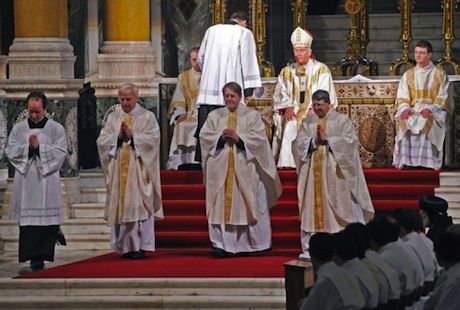
Peter Stanford needs to be congratulated on one of the most outstanding factually incorrect pieces of journalism regarding today’s ordination to the Catholic priesthood of the three former Anglican Bishops.

He starts as he means to go on:

“…fewer stranger sights…three Anglican bishops’ wives, in matching beige coats, one with an outsized brown hat…”

Saucer of milk, table for one Peter. Considering that he critiques the Catholic Church as being “not that keen on women”,  do I note a rather hypocritical attitude in bitchily analysing the attire of the wives? I don’t quite see what the colour of the coats or the size of the hats has to do with anything. Still lets put these upstart wives in their place.

“to the pain of the demonstrators from the Catholic Women’s Ordination movement protesting outside the cathedral’s doors”

What all two of them valiently clutching their banner? To be fair though there were also apparently two demonstrators from the Society of Saint Pius X, so lets make that a grand total of four. Jeffrey Steele was spot on earlier when he wryly observed that the tiny smattering of protesters would no doubt form the basis of at least one of the major media organisations’ coverage.

“It is the Vatican’s negative attitude to women’s ministry that formed the backdrop to the whole affair.”

Unsure where on earth to begin with this, other than, as Peter Stanford will be more than well aware, this is not about the ministry of women but fidelity to the catholic teaching which formed the ordinariate. The ordination of women, is one particular presenting issue, but to try and reduce the ordinariate and the Anglo-Catholic movement to be purely about the issue of women’s ministry is ignorant baloney. As a point of fact Andrew Burnham, one of the bishops ordained today, was very supportive of womens’ ministry in general, he did much to explore the issue of ordaining women to the diaconate within the Church of England. There was nothing about wanting a “female-free haven”, this was about accepting the truth of the Catholic faith, these men would not have converted if this was simply about the ordination of women, otherwise where are the 1333 Anglican clergy who signed the letter to the Archbishop of Canterbury in 2008 threatening to resign if women were elected to the episcopate with no safeguards? Surely if the Ordinariate was all about the issue of women clergy, these clergy would be signing up in droves? The fact that they haven’t indicates that this is not about the ordination of women. To claim otherwise is reductivist.

Stanford goes on to describe the Ordinariate as a place “where the normal rules of Catholicism don’t apply”. Sorry? Which rules are they Peter? The man has gone off his rocker. All members of the Ordinariate will have to abide by the catechism, like every other faithful Catholic. The fact that they have been admitted into the Catholic Church proves that they have accepted Catholic doctrine. There is no secret “oh well I don’t really have to agree with that part” clause, or implicit understanding that they can preach their own particular version of Catholicism. Yes, the Ordinariate will consist of a married priesthood, which is unusual, but there are rites within the Catholic Church in which it is possible to be married prior to ordination, as Peter Stanford will undoubtedly be aware. Allowing the use of Anglican patrimony for a separate rite, is not breaking any implicit rules. There are many rites within Catholicism, Roman being the most populous, and each rite will use its own patrimony whilst still coming under the jurisdiction of the Pope. What the Ordinariate has done, is to create a separate rite within the Roman Catholic Church.

The inaccuracies come thick and fast.

“In the space of 14 days, they have completed a journey that usually takes other converts seven years: 12 months to go through the Rite of Christian Initiation of Adults to become a Catholic, and six years in a seminary.”

Yet more drivel. Priest converts are not required to undertake RCIA. Some do, for others it is not deemed necessary for example,  the case of my husband, who has a Masters in Catholic Theology from Heythrop, although he did receive some personal instruction and it was ensured that he had read and understood the Catechism. In any event RCIA was not really meant for converts from other Christian denominations. It was designed for those who have not already been baptised or had any prior Christian formation. As for six years in seminary, again more imaginings. Each candidate is different, but obviously Anglican priests already have considerable knowledge, formation and experience and thus six years is not the norm, the average seems to be about 2-3 years. Anglican priest converts are not starting at the same position as say a young man of 21.

Stanford concludes that the Ordinariate was “a takeover not a merger”. Given that the Ordinariate was established as a direct result of supplication by various groups within the Anglican Church to the Vatican to create a structure that would make it possible for many of them to come home, I can hardly see how this could be likened to an aggressive takeover. Moreover no-one is compelled to join the Ordinariate, it is a benign invitation, not a legally binding order.

“When it was first announced, Nichols assured me in an interview that the biggest take-up was likely to be among unhappy Anglicans in the US and Australia, yet here we are in London.”

This may well prove to be the case, the Ordinariate may have begun in London, but we don’t yet know what the uptake is likely to be in Australia or the US, demographically speaking it is more than likely that these countries will have more members than in the UK. Does it matter whether they do or they don’t? It’s interesting that Stanford uses the word “assured”. Clearly he is frightened by the Ordinariate and sees it as something of a threat. Dare I suggest that he is terrified of an influx of  hordes of traditional-minded  properly -catechised Catholics undermining a liberal agenda?

The only puzzling thing about yesterday is why a Catholic would not wish to whole-heartedly welcome home his brethren in Christ and to lend his support to the extension of the Catholic Church in the UK.
A special welcome

Reading the moving eyewitness accounts of yesterday’s ordinations to the diaconate, of  the former Church of England Bishops, Andrew Burnham, Keith Newton and John Broadhurst, I was particularly touched by the following:

“One of the most striking elements of the mass was the way in which the wives of those being ordained were made to feel so welcome and made part of the mass. Not only did they bring the bread and wine at the offertory, but after the prayer after communion they assembled before the bishop as he thanked them for their example of love and family life and gave them a special blessing.”

This gesture of welcome should not be underestimated. I cannot begin to imagine how Mrs Burnham, Newton and Broadhurst must be feeling. Being a clergy wife in the Church of England is a delicate balancing act, requiring much tact, diplomacy and a willingness to take a back seat to your husband’s vocation; accepting that a considerable majority of the time your husband needs to put his ministry first, in the same way that a secular man needs to prioritise his job. The hours are unsociable and the demands unpredictable. The Anglican Church does however have a culture of married ministers and  a clergy wife is therefore not an unusual concept, unlike the Catholic Church whereby priests are required to practice celibacy, unless they have been granted a dispensation, as in the case of convert priests. To agree to become the wife of a Catholic priest, whereby your role may well be vastly different and your presence something of an anomaly or curiosity is not a task for the faint-hearted, particularly if you have been married to a high-profile spouse such as a Bishop.

The Ordinariate is treading unchartered waters, the former bishops have had to give up positions of great responsibility, their salaries, their homes and their pensions, a decision which will have an enormous impact on their families and would doubtless have been impossible without the support of their wives. It perhaps shouldn’t be surprising that their spouses were welcomed in this way, but given that no similar rite is included in the Anglican ordination service, the public acceptance and welcome of wives is all the more remarkable together with the thanks and blessing and must have been of enormous comfort to them as they accompany their husbands on this next stage in their journey.

Providentially enough I chanced upon this blogpost written by the wife of a Catholic priest in the Byzantine rite (h/t Christopher Smith & Shameless Popery, who also did a great precis) which describes the 7 most frequent comments that people blurt out when they discover that you are married to a Catholic priest. It’s definitely worth a read and I can certainly identify with many of her observations, particularly the parts about scheduling and her poignant response to her husband’s ministry.

“There is a huge part of my husband’s life that I can never understand or participate in. This is probably the strongest argument against a married priesthood in any rite. We priest’s wives cannot fathom the feelings of being at the altar or the confessional. These experiences are hidden from us. God’s grace abounds in these situations, but I suspect the evil one is lurking in the shadows, waiting for us to fail. Evil doesn’t like husbands, fathers or priests. So it is a lot to say yes to these vocations.  All we wives can do is be positive complements to our  priest husbands like any wife. Pray for the wives and children!”

So tomorrow, when we celebrate the momentous and joyful occasion of the start of the Ordinariate, let us also give thanks for the gift of their families and hope that they may be able to inspire other families to follow their courageous lead. A truly remarkable gesture for a truly remarkable movement.

Sposi Novelli

I have to admit to just a tinge of envy when I spotted that a new website has been set up which aims to help newlyweds receive a blessing from the Pope in Rome.

For the uninitiated this practice known as Sposi Novelli,  means that newlyweds may attend a general Papal audience in Rome within a year of their wedding, have allocated seats at the front and the Pope will come over, greet the couples and offer a handshake and a blessing. Most couples wear their wedding regalia for the occasion.

I can’t help thinking that it is something of a shame that Pope Benedict XVI has discontinued his predecessor’s  practice of individually blessing each couple. A former colleague of mine was fortunate enough to have received this grace from the then ailing Pope John Paul II and recounts an absolutely hilarious tale. Apparently as she and her husband knelt before the Holy Father as she stood up she got the heel of her shoe caught in the hem of her voluminous dress, felt herself toppling forward, automatically shot her hand out for support catching the knee of the elderly pontiff, almost dragging him onto the floor with her and sending the Swiss Guards running to disentangle the pair of them!

I console myself with the fact that though we were unable to get to Rome to receive this privilege in person, we were fortunate enough to receive an Apostolic marriage blessing, as a gift from our local parish which occupies pride of place. I would have relished the opportunity to put on my beautiful wedding dress one more time and can’t think of a more appropriate and resplendent setting for us in our nuptial finery, than Rome. Just thinking about it sends me into girlish raptures.

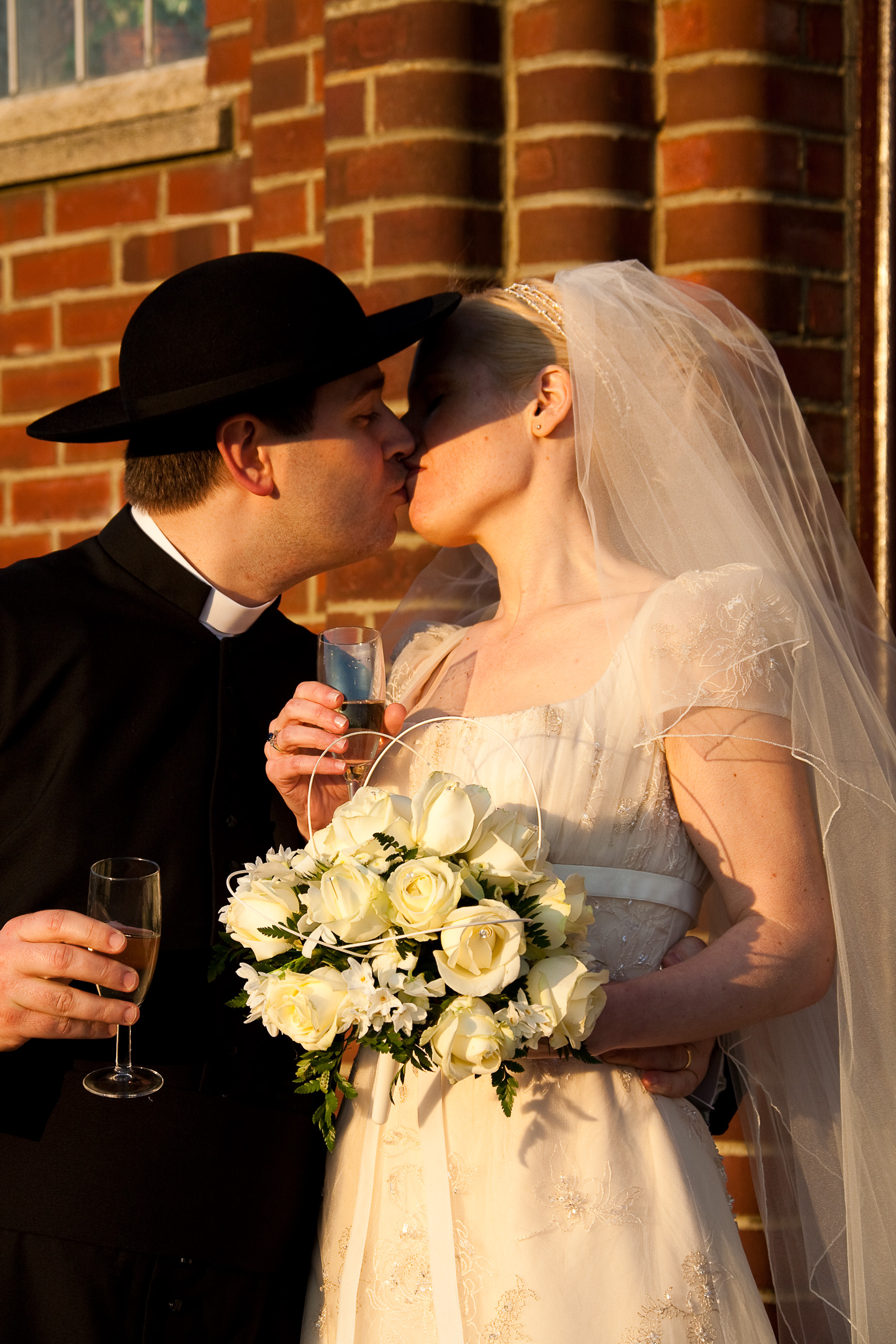
Mind you, given that I fell pregnant a few months after our wedding, I suspect the sight of a groom dressed in a long black cassock, dog collar and black saturno from Gamerellis* accompanying his visibly pregnant bride, whilst seeking a personal papal blessing, may well have caused a slight raising of the Apostolic eyebrow!


*Since posting, I have been informed that said hat came from Barbaconi, not Gamerelli. “Gamerilli, on my salary?! Ha ha ha ha”.

Dear Posh

I am delighted to hear of your pregnancy. A baby is always a cause for celebration. I know both you and the Daily Mail will be ecstatic. It must have been terribly irksome having to compete  for column inches with a proper Royal Wedding and the celebrity offspring of another prominent Queen, but rest assured, you are bound to keep upstarts like Cher Lloyd and the ubiquitous Kardashian sisters in their place for some time yet.

Just once teensy, weensy request from one beleaguered mother to another. Would you mind eating just a bit of dinner during this pregnancy? Just a few mouthfuls every now and then in order to make sure us lesser mortals who can’t control our weight don’t feel overwhelmed by despair and self-loathing at our lack of control when we survey photos of your non-existent 20 week bump. I know that Dave has abolished the Health in Pregnancy grant, but I’m sure you can stretch to the odd bit of roast lamb every now and again. Also, it might be nice, if whilst in the midst of  being superglued to the feeding chair for 24 hour breast-feeding marathons, we weren’t subjected to photographs of you losing the baby weight before the child has even been delivered. Nor the obligatory photograph of you back in your size zero skinny jeans, impeccably made up, coiffered and manicured, 20 seconds post-birth.

I know you have the money and resources to have a tummy tuck at the same time as having your section, I don’t blame you, I’m sure in your situation we’d all do the same, but you know what, it might actually earn you quite a lot of respect from amongst the ranks of us lesser mortals, who can’t afford personal trainers, chefs, make-up artists, nannies and the like, to be assured that behind that robotic facade there is a human being.

Appearing in public with just a hint of the baby weight would perhaps be the most positive gift you could give to your newborn, particularly if she is your much-longed-for baby girl.

Yours sincerely

A mother who was informed today that she looked as though she might be about to drop at any minute and who has another 15 weeks to go.

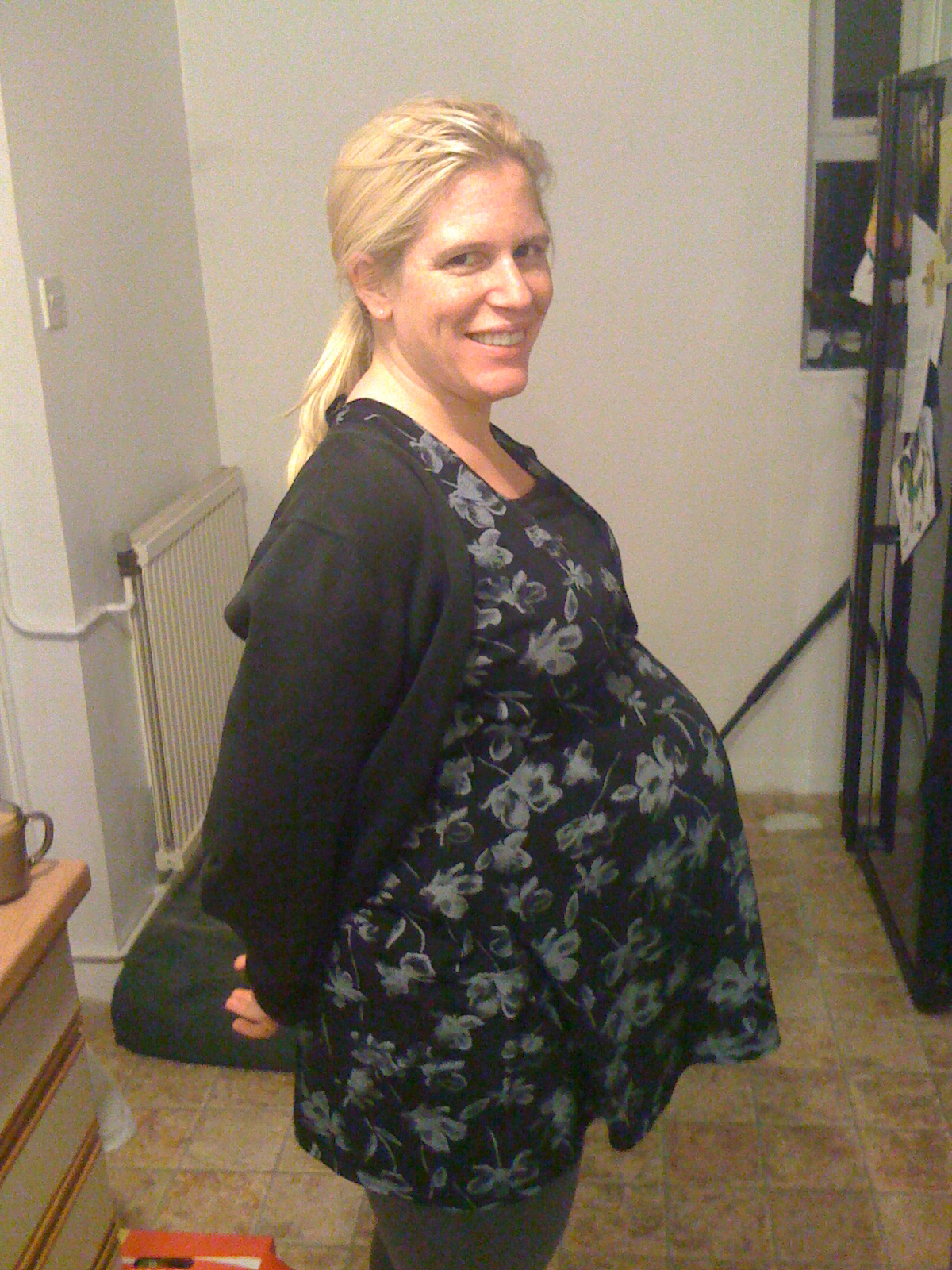
PS Just for good measure, I’ve put in a photo of myself taken at 40 weeks, on the date my daughter was due. Rest assured, you’re never going to look this bad.

Words fail me

This is what happens when we start thinking about children as being some sort of “right” or commodity, there to satisfy an innate “need” or craving.

If you disposed of a puppy or a kitten in a similar fashion you would end up with a fine or jail sentence and almost certainly be banned from ever owning a pet again.

But because it is children that we are talking about they are automatically treated as being some sort of property of the mother, her body and thus to do with as she sees fit, including killing them because they are the wrong sex.

And we as a civilised society sanction this, we validate their behaviour by succumbing to their destructive tantrums and concede that a child is a right not a human, but take this contortion of natural law one step further namely, not only is a child a right, but a parent has a right to a child of a sex of their choosing?

What better illustration can there be of the paradox of IVF, whereby the process of creating new life has destruction of life as its by-product?

But so long as nobody is offended or hurt, a child is produced who will be loved, that makes this all acceptable does it? The ends justify the means?

I’d like to hear from anyone who thinks that this is in any way acceptable.

My gaff, my rules

For those who have determined that they are still going to read, as a general rule, as owner of this blog, I have editorial control, in the same way as all blog owners.

I am happy to enter into discourse and general discussions, but personal and ad hominem attacks will not be tolerated. If I do not wish to pursue a certain topic further, then I will not publish further comments on a thread, particularly if I feel that there is no purpose to be served.

Somebody has taken my last post to be a personal attack on her, which it was not, although it was an attack on my assumed fear, hatred and distrust of gay people, which had absolutely no basis in fact.

She accused me of deliberately misquoting and paraphrasing her. I did no such thing and a quick glance at my Twitter feed will bear out the comments that were directed at me. My original post did contain an error, therefore I corrected it, however my sense of being under siege has not abated. This morning I have been subject to further barrages and haranguing. I have been told by disgruntled commentator, “I WILL NOT let you get away with this”. I have politely asked to be left in peace and told “just approve the comment and all this will be over”. Said person has also requested all her followers to pester me to approve her comment and therefore my phone has not stopped pinging with angry tweets, telling me that I must approve her comment.

As a matter of general principle I do not respond to harassment techniques, therefore I am extremely loathe to publish comment. If I wish to delete a comment, then that is entirely my call. I took note of comment and concerns of poster and edited my post so it neither paraphrased nor misquoted. This is my blog, predominantly for me to write about whatever subjects I feel fit and as such I reserve the right to dictate the terms of debate, in common with all blog owners.

As I suggested in my previous entry, if these rules do not suit, then perhaps this blog is not suitable for you.

Taking the bullet

Just before Christmas, my daughter was colouring in Christmas cards bought from SPUC. Though I am usually very circumspect in terms of keeping literature away from her, she caught a glimpse of the newsletter and asked “mummy what’s an abortion?”.

I’ve recently had to face a barrage of questions from her, such as “how did the baby get in your tummy” and handled them fairly deftly. I’m not a proponent of lying to children, preferring the age-appropriate response and therefore batted that one-off rather well with the “dad gave mummy a seed” response. Actually, that led to an interesting discussion about twins and multiples. Simple I thought. They should put me in charge of sex-ed for 6 year olds! No graphic explanations required, a few basic biological facts satisfied her curiosity. I came a bit unstuck a few days later however, when she started saying “if I have a husband and have babies…”. “Well you’ll need one if you are going to have babies darling, I said”. “No I won’t mummy, I’ll give myself as many seeds as I want to”. A generation ago this would have been dismissed as a 6-year-old’s whimsy, now it’s a scenario embraced as being an equally valid lifestyle option, why should she have to have a man to have a baby?

Without wishing to enter into a discourse on why single parenthood is not something I would wish for my children, I will undoubtedly raise the ire of the feminists, by my explanation that men had the seeds and women the eggs, so women needed men, ladies needed husbands, in order to make the babies. I also went on to explain that babies were very hard work as she has seen and could she imagine how difficult it would be for a lady to look after her babies if she didn’t have her husband to help her. She’s seen that first hand and stated that yes, it would be really difficult for mummy if dad wasn’t there to help with the baby. Who would give the baby the nighttime bottle? She went on to tell me “I don’t know how you’d cope with THREE children without dad to help you”. My daughter is fortunate to enjoy a loving and close relationship with both her father and step-father, so when she thought about “babies with no daddies mummy, that makes me very sad”. Of course where I did come even more unstuck is that she has picked up on the fact that this forthcoming baby is something of a surprise and not what we had planned. “How did dad give you the seed by accident mummy, tell me all about it?”. I think sooner or later “special married persons’ cuddles” are going to have to enter the conversation.

Getting back to the topic, does one tell a 6 year old what an abortion is? I briefly broadcast the question and the response was an overwhelming no, because she “wouldn’t be able to understand why”. That was an interesting and encouraging response, in that it admits that abortion is such an abhorrence, such a horrible thing, it’s not something that we should be telling children about, in the same way that I often switch the radio or TV off, if there’s a topic which might scare or alarm her. Added to which, children are natural little theologians. They automatically accept the existence of God and the concept of right from wrong. In both my pregnancies, my daughter has accepted that there is a tiny baby in mummy’s tummy, as soon as she has found out about it. We have looked at books together, detailing the growth of the baby, this week it can smile, this week it can hear, and at every stage she has embraced the baby as another person, never once asking about viability, or referring to clusters of cells. She loves looking at the pictures of the clusters of cells in rapt wonderment that those cells ARE really A BABY! No question.  Angel in the Waters is perhaps her most treasured book, she used it almost as a safety blanket throughout my last pregnancy.

So how do I tell her that some mummies choose to kill their babies? I don’t think I could, although a part of me feels that I should, not least as I don’t like withholding information or telling untruths to my child. I know her reaction would be abject horror, shock and revulsion, I know, given her temperament that she would worry about it, and she also might worry that I would do that to my baby. I think she would project her worry onto other pregnant women. I haven’t been that heavy-handed about the perils of smoking, and yet she still worries aloud when she sees adults smoking. It genuinely upsets and shocks her that people smoke. I have absolutely no idea how she would process the idea of an abortion and thus I glossed over the topic, by saying that it was something that women could do that hurt their babies and that SPUC was there to help women look after the babies in their tummies. Lame I know.

It goes to show though, that sometimes children are just spot on with their instincts. A 6-year-old instinctively and inherently knows that it is wrong for a mummy to kill a baby in her tummy, without me needing to spell it out. Perhaps I am projecting, but I wonder if the thought of infanticide might disturb her to the extent that she won’t be able to contextualise it. If women might kill the babies in their tummies, then they might also kill their children? Most of us want to protect our children from the horrors of life  until they are of an age to understand  factors such as mental illness and abortion is included in this definition.

Or should it not be a taboo horror? If abortion is healthcare, then maybe we do have to tell our children about it from an early age, although I suspect that were I to have explained exactly what an abortion was, I would have been met with horrified accusations of propaganda and emotional manipulation from the pro-choice lobby. There is a part of me that feels that if my daughter knows about abortion now then it might help confirm her adult views.

As far as both of us are concerned abortion is filicide. I have read countless mothers describe how they wouldn’t hesitate to take a bullet for their children, how they would fling themselves in front of a car to protect their children, how they would sacrifice their life for that of their children, the maternal (and paternal) instinct to protect is incredibly strong. Not once would they weigh up the options, is the child’s life worth saving, how would the rest of the family cope without them, no, in the heat of the moment, God-given instinct takes over and the vast majority of parents would willingly sacrifice themselves for their children without a second thought. This is why the concept of filicide is so abhorrent, because it goes against the natural order of things and against natural law. This is why we see Abraham asked to sacrifice Isaac, to demonstrate his love and fidelity to God and yet God is merciful. This is how we see God’s love for us so painfully demonstrated in the incarnation of His Son, and yet God does not kill his son, a concept which, incidentally, Dawkins has failed to grasp.

And this is why, I feel so passionately about abortion, whilst having immense sympathy with women in incredibly difficult and desperate situations, I cannot ever justify the killing of an innocent human being, the choosing to take the life of one’s child. Currently I am fretting about the possibility of flu, having read the sensationalised headlines outlining the dangers of flu for pregnant women. Over Christmas a women and her child died in childbirth after she was admitted into hospital with flu. Another woman, a mother of four, who has fortunately now recovered, faced an abortion whilst she was in a coma in order to save her life. Should the same happen to me, unlikely and melodramatic as it sounds, I have made my wishes known to my husband and I will outline them again for clarity here. My child’s life comes before mine. No question, end of story.

When I saw a haemotologist a few weeks ago, I was informed that the “normal advice for a woman in your situation would be to seriously consider terminating”. No doubt some would consider me to be stupid, foolhardy and selfish, putting my needs and wishes before that of my existing family. When I think about what could perhaps go wrong, I am admittedly scared, so most of the time, I’m attempting to put my fears out of my mind, although I think I’ll probably spend most of Lent in the confessional and I’m definitely dwelling too much on the due date of Good Friday. The reality is things should be fine, it’s just not what the doctors would have preferred and it’s part of the reason that I have taken a step back from an online group, in that I need to come to terms with this myself, without approbation or condemnation. Instinctively and intuitively, my baby, who is physically dependent upon me and who unlike me is wholly innocent, must come first. I could not choose to kill either of my children who are outside the womb in order to save my own life and the same criteria applies to my unborn child. There is no implicit criticism of any others, that is simply my choice. If I lived in Ireland, I would live in a society that would accept and respect that choice, one that will not sanction the killing of the unborn, and one that has the lowest rates of maternal deaths in the world.

Due to an oversight with the altar book, we accidentally celebrated the Feast of the Holy Innocents a day early at Mass. The slaughter of the innocents seems an appropriate moment to pause and reflect upon the 50 million lives lost to abortion in America and the 6 million plus in the UK, since we as societies embraced and accepted the notion of filicide. May they rest in peace.

The novels of Wordsworth

One of my favourite quotes from Four Weddings and a Funeral is the line uttered by Corin Redgrove when discussing the fact that he didn’t go to university. ‘University? Didn’t go myself, couldn’t see the point. What use are the novels of Wordsworth when you’re making a mint on the money markets?’

This struck a particular chord with me at the time, given that I had just taken the decision not to go to university to study English as I was working on the money markets for Lloyds bank, thoroughly enjoying both the job itself and the resulting salary. At that point in time, it made more sense to pursue a career in finance, as I was certainly earning the same amount as a graduate without any of the resulting debt. My boyfriend and I grinned at each other in recognition.

Richard Curtis clearly didn’t mean this line to be taken literally, quite the opposite, the character who uttered the line was a caricature of an ill-educated, misogynistic thick-skinned upper-class ignoramus. Had he been to university then he would have known that Wordsworth hadn’t actually written any novels. The implication being that those who haven’t been are somehow lacking refinement and knowledge. It was something of a sneer by the member of the liberal intelligensia.

This is a prejudice that I have suffered from almost all my adult working life. My husband used to belong to an on-line dating site. Being an intellectual, cerebral sort of chap, he had listed that a university education was a desirable quality in any potential spouse. He admitted that had he known that I didn’t have a degree when he first met me, then he might well have presumed me to perhaps not being intellectually suited to or compatible with him, as by his own admission, romantically speaking, he prefers intelligent woman. When he discovered that I didn’t have a degree, he decided that I was something of an anomaly.

At this point, it seems wise to give a brief précis of my career history to date. Despite having the grades to go to university, I decided not to go for various reasons. Career-wise, up until this point, it’s never held me back apart from some condescension from various city colleagues. From temping on the money markets of Lloyds I then was offered a job with the top accountancy firm in the UK. My good A Level grades meant that I was able to study for the ACCA qualification at the same time as being paid a decent city salary. ACCA is almost identical to the qualification of ICAEW, it means one is a certified accountant as opposed to a chartered accountant, however entry level to chartered accountancy requires a degree in any discipline and thus has more kudos. After a few years where I was stuck on an infamous insolvency case, which is never out of the media, I decided that accountancy wasn’t for me after all, had a severe case of itchy feet and restlessness, I felt that I had missed out on the university experience, on three years of fun and travel and thus got a job as cabin crew, flying all over the world, generally having a whale of a time. Again, no degree was necessary, a degree in tourism wouldn’t guarantee you a job whereby personality and a presentable appearance were the main selection criteria. Knowing about the intricacies of the industry may be interesting, but of no value when you have to deal with either a drunken passenger or safety issue at 35,000 feet. The job is all about thinking on one’s feet, handling difficult situations and keeping calm, focused and professional, no matter what. An ability to get on with anyone and everyone is also a huge advantage. No degree can equip you with those skills and the salary is not enough to merit taking on a significant debt. Those who fly do it for the lifestyle, because they genuinely enjoy the job and the travel perks, not for financial gain. I know I did and at times I still have a lingering regret that I no longer grace the skies with my presence!

‘Real life’ encroached however, a mortgage called, so I reluctantly decided it was time to re-enter the “real world”. Having decided that accountancy was not for me, I then decided to do a Pitman Executive PA Diploma, to give me some marketable skills, notably becoming a shorthand and Powerpoint whizz. Together with my former financial background, I had absolutely no problem at all in landing fantastic jobs in economic research. I worked for Warner Brothers, two investment banks and in Private Equity. It was my financial skills and my almost fluent French that were of interest, the PA skills were really the icing on the cake.

City life was really not compatible with the demands of a young baby, not least in terms of the time spent commuting and after a brief return to work in a company that was less than flexible, I became a stay at home mother for a few years. Circumstances dictated that I needed to return to work and my skills and previous experience meant that I landed roles as an office manager, not earning city money admittedly, but still a decent salary of over £30K. A degree was not an issue, nor was the fact that I had taken 2 years out of the workplace.

Marrying and moving to a new area coincided with the credit crunch, so the Office Manager, Executive Assistant roles to be found locally were non-existent. In addition I noticed that adverts for these roles specified that a degree was preferable. I found applications rejected on the grounds that I did not have a degree; some over-zealous HR admin assistant assigned the role of filtering through numerous applications had simply set-aside those CVs without a degree. All of a sudden, not having a degree was suddenly proving to be a hindrance. A degree is completely unnecessary for the role of Office Manager or Executive PA. It might indicate a level of knowledge, intelligence and critical thinking, it’s “nice” to have, but in all my years of working I have never once needed a degree to be able to carry out my job to a high standard. I read extensively, am interested in current affairs and politics and am able to engage in intelligent and informed discourse. Knowing the qualities of epic poetry and being able to discuss the merits of Aristotle and Plato is a worthy and admirable achievement, but in a day-to-day busy office environment, is utterly irrelevant. It doesn’t help you organise a staff of 200 nor does it assist with budgeting.

So I have some sympathy with today’s young school leavers who seem to need a degree if they are not to be written off or consigned to unskilled labour. In today’s climate, it is unlikely that I’d be able to have had the successful career that I have had to date without a degree. Partly due to the current emphasis upon a degree being a necessary qualification for entry level to any career, a legacy left by the previous administration with their 50% quota, I am now embarking upon a degree. Admittedly another motivation is that I wish to pursue a career in teaching, for which a degree is an essential pre-requisite. After all our children deserve nothing less than highly qualified professionals with an in-depth specialist subject knowledge. Finally, I have always had a passion for literature and I figure that if I am going to spend 3 years losing potential income as well as gaining a not insubstantial debt, then it may as well be in a subject for which I have enthusiasm. My only problem has been deciding between English, History, Philosophy, Theology and French, I’m probably better suited to the American Liberal Arts model. There is some degree of selfishness in my decision. I am doing this, not only because I feel a vocation towards young people, because I think that I have much to offer the profession but also because at the moment it fits in well with my current family circumstances. With young children it seems the ideal time to fit in study and of course if I am successful then teaching is great profession to be able to fit in around the needs of a young family.

When the current fee proposals came in I was outraged. In an ideal world, there should be no tuition fees, there should be access to Higher Education to all who are eligible and able to benefit from it. Therein lies the problem. It is not feasible for the government to be able to provide free university education for 50% of the population. The answer seems to lie in either fewer people going to university, or students, who will benefit from their education in terms of earning capacity, to bear the majority of costs. As someone who aspires to teach, if successful I will be earning significantly less than in my former career and the thought of a potential £30K debt on top of that was an absolute anathema, as was the idea that I would put myself into huge amounts of debt for a career in public service. Certainly I would not have chosen the university that I am currently attending, who are 3rd in the country for my subject, behind Oxbridge and who will be charging the full amount. In fact, Oxbridge was available to me but not accessible on the grounds of logistics, as opposed to money.

Having studied the proposals in depth, I have come to the conclusion that though not ideal, actually they are significantly fairer and more workable than the alternative of a graduate tax. As a mature student with limited means and on a low family income, I would be significantly better off. My first 2 years tuition fees would be paid, I would qualify for a higher maintenance grant and my repayment terms would be much more favourable than at present. If I qualify as a teacher, under the current system I will pay back £49.41 a month. Under the new fees this drops to £4.41 a month. There is absolutely no disincentive for the poorest to attend an Russell League or 1994 Group University. This is where the coalition has worked well, the Lib Dems need to be given credit for softening the original plans and for ensuring that there is no bar for the very poorest students, though the middle-income students will be hit the hardest. It takes courage, honesty and humility for anyone to concede that they were wrong. The Lib Dem ideology with regards to tuition fees was not wrong in itself, more foolhardy; as Baroness Williams suggested, they were perhaps foolish or precipitous in signing their pre-election pledge, without first being fully aware of the facts, namely the crippling amount of debt that the UK finds itself in.

It’s a fudge, it doesn’t go as far as the Browne report (commissioned by Labour) suggests, in that it doesn’t completely lift caps, but it is infinitely more progressive than the current system we have in place.  What I would like to see is fewer courses of negligible value, such as the degree in Homeopathy currently offered by Thames Valley University or the degree in Travel and Tourism offered by the University of Hertfordshire. Perhaps if we accepted that a degree is not an essential pre-requisite for a successful career, perhaps if university places were limited to those most suited to academic study, on the grounds of ability, not money, perhaps if not going to university was not seen as a second-class option, perhaps if people didn’t see university education as an automatic right, regardless of ability, then free university education would once more become available. With a 50% university attendance rate, a degree is rapidly becoming as devalued a coinage as the former ‘gold standard’ A Level. A necessary piece of paper and an expensive one at that. With a higher level of fees, minds will certainly be focussed upon whether or not this a worthwhile use of three years and of funds. For those aspiring to Oxbridge the answer will remain the same. For those wishing to study a degree in Popular Music at Northampton University, alternative options may now seem infinitely more attractive and sensible.

In the meantime I’ll stick to the novels of Wordsworth. Shouldn’t take too long.


Difficult decision

With a heavy heart, I took the decision today to defer my degree, until next year. Cue much sobbing, wailing and gnashing of teeth.

The reasons are straightforward enough; although I admittedly do procrastinate far too much on the internet, I was finding that the demands of a difficult pregnancy, a family and living out of cardboard boxes was just too much. The problem being that no sooner had I submitted one 5,000 word portfolio, I then had a week to get another 2 essays written and handed in. Although my timetable seems light, 11 hours per week, that entails an extra 29 hours of reading. Under normal circumstances no problem, but with so much to do to get the house in some sort of habitable order (clean clothes and plates being a rare and valuable commodity, nay on miraculous achievement), an iron-deficiency that doesn’t seem to be resolving, a baby with diarrhea and a six-year-old undergoing investigations for some sort of vertigo-related disorder, I needed one of those time-turner gadgets of Hermoine’s in order to be able to achieve anything. Term didn’t start well in that I missed the first week due to the entire family being stricken with gastroenteritis, add in the search for a new house and the logistics of a house move and it all went rather pear-shaped. I then subsequently realised that the new baby is due on April 23, four days before the start of a new term, and though I had romantic notions of taking baby into lectures and seminars in a sling and discreet breast-feeding, the reality would likely be vastly different, given that it seems likely that I’ll need another c-section. I remain optimistic as to a VBAC, but as the consultant succinctly put it – square peg, round hole…

Last time, despite the best of intentions, the recovery took much longer than I had anticipated, I remember volunteering to go to the supermarket 4 days post-birth, managing to stagger across the car-park and get to the entrance , before conceding that perhaps I’d been a little over-ambitious and needed to sit in the cafe, leaving him indoors to navigate the mysteries of the nappy aisle. So juggling a pushchair and new baby in sling on the bus (no driving allowed) into Uni, 4 days post section, walking around an extensive campus and then attempting to sit exams in the first week of June, is probably rather kamikaze.

So: a year to get the house in order, spend some time with the baby before the shock of a new addition hits her, time to get ahead on the reading lists and continue doing some part-time at home work for a text-answering service, beckons. It’s undoubtedly the right thing, I am finding the exhaustion debilitating, but it’s nonetheless disappointing. I can’t help but feel that I am letting everyone down, not least myself, although the current stress and exhaustion cannot be beneficial for the baby.

I won’t go off into a customary rant, actually perhaps I will, but I blame all these prolific superwomen who all manage to effortlessly combine pregnancy, a huge brood of children and a full-time career, whilst smiling cheerfully. It makes lesser mortals like me feel totally inadequate. During my first pregnancy I was working for a Private Equity firm, who made my life incredibly difficult, piling project after project on me, increasing my workload because after all I wasn’t ill, only pregnant, then commenting “you look absolutely dreadful, you definitely need to start maternity leave early” in order to fit in with their agenda. I can’t go into specific detail, given the confidentiality agreement I signed, but suffice to say, every single pregnant woman they employed had similar treatment. I almost ended up in court last year, testifying on behalf of a former colleague, who had an identical story to mine; pregnant women and women with young children were decidedly  unwelcome.

I had a similar problem last year, in that due to horrific morning sickness, my employer couldn’t renew my contract. I don’t know what the answer is, but I can’t help feeling that it’s something of a shame that pregnant women feel under so much pressure to perform and be superwomen career-wise, when the reality is, that simply by the act of carrying a child, they are physically heroes already.

The Gender of Religious Devotion

I am personally always very sceptical of debates that serve to highlight the differences between male and female within Christianity, particularly within Catholicism itself, which seem to centre on a presumed patriarchal hierarchy. Very often we see the rampant feminist, determined to expose the perceived misogyny within the Catholic Church and on the other hand, defenders of the patrimony of the Catholic faith, ignoring the very irony implicit in the use of that word, equally determined to hammer home the reasons as to why women may not be admitted to the priesthood.

I don’t intend to summarise the magisterium on this issue, having covered it in a previous post, but the one thing that strikes me in the various arguments surrounding gender equality in the Catholic Church, is that very often, the blindingly obvious is missed.

Right at the very beginning, we see that, contrary to the assertions of many throughout the ages, there is no hierarchy between our first parents:

Genesis 1:27: “And God created man to his own image: to the image of God he created him: male and female he created them.”

This fundamental equality is reiterated by St Paul:

Galatians 3:28: “There is neither Jew nor Greek: there is neither bond nor free: there is neither male nor female. For you are all one in Christ Jesus.”

Admitting and embracing equality should not entail eradicating of the heterogeneity of mankind.  What St Paul is emphasizing, is that within the body of Christ, we all have different roles to play, we will all be judged on our individual Christian merits, Christ is not interested in our gender, our race, our class, but on our souls themselves. Not one of us is more important than the other. He highlights our differences, not dismisses them, in order to distinguish those differences, but to say that ultimately, our differences are inconsequential, its is our life in Christ that unites us, it is Christ who renders all differences, unimportant. True equality embraces diversity; not by pretending it doesn’t exist, not by turning us into homogenous entities, but by accepting and respecting differences.

This week I have been focusing on the gender differences apparent in the religious poetry of two seventeenth century poets, namely Amelia Lanyer and John Donne. Although much of what I read disturbed me, in that I found the sexual resonances shocking, as was the poets’ intent, what fascinated me, was how both poets used their gender, as a tool to religious devotion, neither of them denying the traits or sociological positions of their sex, but in fact using them constructively as both a tool to devotion and also to challenge the conventions of what was a patriarchal society. Lanyer accents and eroticises the feminine attributes of Christ, whereas Donne focuses upon the erotic unconventionality of the gender-specific positions that conventional devotion demanded that men assume. Though metaphors for God had invariably been masculine throughout the Judeo-Christian tradition, Catholic devotional writers had recourse to Mary and a host of female saints as objects of veneration.  The God of the Protestant Reformation had however, become increasingly masculinized as a consequence to the theological emphasis on the absoluteness of divine power, as espoused by James I. This meant that a female worshipper made religious devotion a concentrated version of her everyday encounter with patriarchal authority, dangerously migrating the languages of erotic love and social submission from the social to the devotional realm, whereas a male worshipper was forced either to assume a feminine persona or engage in a discourse of same-sex desire. What both writers did was from differently gendered subject positions, to articulate desires, which crossed the perceptions and conventions of the society that they inhabited, both turning traditional gender roles upon their head. Lanyer wishing to liberate heterosexual desire from masculine oppression by turning them to God and Donne heightening the violence that invades heterosexual eroticism in a patriarchal culture, as a measure of the absolute submission God demands from him. Donne invites punishment and ravishment, whilst Lanyer’s God, welcomes redemptive suffering at the hands of his creatures.

Neither poets sought simply to fight against the limitations of their gender, but to use it, as an aid to devotion.

So, what relevance does this have, beyond the merely academic? What it signalled to me, upon reflecting this week, is that as St Paul points out, we should not deny the gender differences that exist between us, however use both our gifts and the limitations of our gender, race, class to maximum effect, acknowledging both our similarities, in the case of the Christian, of longing to enter into a deep and everlasting relationship with Christ, and of the different ways in which the service of Christ might be realised.

The extracts from Archbishop Vincent Nichols’ interview with the FT, published earlier today, were particularly salient given what I had been thinking about during the week.

In the Old Testament, the shedding of blood was for a man to perform. It was not for the woman, who gave life.

And then you have this iconography of Jesus Christ who stands in this spousal relationship bringing his people as [the] bride, to the Father.

This is not as eye-wateringly sexist as some commentators would have you believe. It highlights the differences and the similarities between the sexes in the giving of life. A man may shed blood, may lay down his life in order to save another, whereas a woman will do exactly the same thing in order to bring a new life into the world. One is not rendered more significant than the other. Women are not called to physically lay down their lives, although the act of childbirth may entail this, in the same way as men. This is not saying women are not worthy, but that their role is of a life-bringing nature, and this ability to give life, to nurture and protect their young, is too precious to waste or sully. It could even be argued that the male is the un -empowered impotent one, his role is to shed blood, either to dirty his hands with the blood of another, or to spill his own. Christ is the bridegroom, we are all the bride, male and female alike, but the way that we come to Christ will invariably differ as we ourselves differ.

One of my struggles has been with the physical pain of pregnancy and childbirth and entertaining the thought of enduring another pregnancy in the near future. Uniting my suffering to that of Christ, finding that suffering can indeed be a blessing, the Christian paradox of joy from pain has proved an enormous spiritual comfort over these past few weeks, although it has been the source of disbelief and shock to many. The thought of redemptive suffering has been described as a “sick and twisted” notion, a concept beyond the comprehension of most “rational” people.

Far from being repressed by a patriarchal Church, again a common misconception is that the Catholic Church is the institution of the Vatican, as opposed to being composed of all the peoples of Christ, laity and clergy alike, in my role of woman, I actually feel incredibly empowered by my own fecundity and the physical and emotional difficulties it comprises, giving me an opportunity to express and unite my suffering in a way not available to men. Though not my favourite communion hymn, I found this week, that the following words took on a new and poignant resonance.

This is my body broken for you

Bringing you wholeness, making you free

Take it and eat it and when you do

Do it in love for me.

Not only may this be applied in the explicit sense of the Eucharist, but also in my role as woman, literally giving her body in love for her unborn child. In my more dramatic moments I have indeed complained, “I feel broken”. Though not likening myself in any heretical fashion to Christ, I can use Him as an example, and like him bringing in a new body, a new world order by his bodily sacrifice, I too can experience the agony and ecstasy of bringing a new life into the world. Whether or not I would be able to display the same courage and acceptance should I be required to give up my life remains to be seen. Nonetheless, the notion of personal sacrifice, of literally giving of myself to another, is a source of enormous strength.

Finally, last week, Robin was invited to talk to the congregation of St Anne’s in Banstead about his journey. Our story seems rather unremarkable in the great scheme of things, but Fr Miceal pointed out a fact that we had previously been impervious to. All of the great protagonists in the journey, all of the influences were women; the narrative was dominated by the various women in his life, both physically and spiritually. Without us, it would not have happened. The alleged misogyny of the Catholic faith turned on its head, the so-called repressed gender, being the protagonist of eternal and everlasting change, calling a soul to spiritual fulfilment.