On the subject of imports from the abortion industry, I see the US has now picked up the rhetoric of the soft marketing messages used by the UK abortion clinics and sex education providers. The Guttmacher Institute, funded by Planned Parenthood , the US’s largest abortion provider, has launched a new 1 in 3 campaign, stating that 1 in 3 women will obtain an abortion before the age of 45. Sound familiar?
As the Right to Know campaign pointed out last year, this ‘statistic’ is trotted out time and time again, in order to validate abortion as an option. The best-selling academic and author, Dr Robert Cialdini, Professor of Psychology at Arizona State university, describes ‘social proof’ as being one of the six key principles of persuasion. People are more willing to take a certain or recommended course of action if they see evidence of others doing it, particularly if they perceive those others as being similar to themselves. So it’s highly likely that a woman considering abortion could well be persuaded by the ‘evidence’ of other women. Social proof is most influential if someone is undecided as to a particular behaviour, they look to what other people are doing and observe that as correct. A technique which is doubly effective if they identify with the other subjects in some way.
So it’s highly likely that a young person who is yet undecided as to the issue of abortion, will encounter this message on an Education for Choice website and be convinced – if one in three women are having an abortion, then it must be not only necessary, but also perfectly acceptable, surely? The same goes for a woman with an unplanned pregnancy in an ambiguous situation who is unsure of what to do. The fact that 1 in 3 women allegedly have an abortion is only there to influence her decision. Surely what other people do should be of no relevance, in terms of her own personal situation? If pro-choice is all about doing what is right for that individual woman in her particular circumstances, what does it matter what other people have done?
There is no reason to include that statistic other than to attempt to influence opinion. Still it’s very sneaky indeed. Simcha Fischer from the National Catholic Register gives some insight as to who these one in three women are.
Robyn Reed is one of the one in three. When she tried to escape from the abortion clinic where her family had dragged her, the abortionist tore off her clothes, hit her, tied her to a bed, aborted her child, and drugged her so heavily that she was unconscious for twelve hours. Reed was fifteen years old at the time. She is one of the one in three women in America who obtains an abortion.
This mother is one of the one in three. When doctors told her she would die if she didn’t abort, she refused and refused, but finally agreed to be induced early, on the condition that they would try to save her baby’s life. She delivered a son, and no one made any effort to help him. He died in her arms. Later, she discovered that he was healthy, and that she had never been at risk. She is one of the three women in America who obtains an abortion.
Here and here and here are hundreds of accounts written by women who had an abortion and regret it. Over and over again, they use the phrase, “I felt like I didn’t have a choice.” Each one of these women is one of the one in three women in America who obtains an abortion. They are part of the one in three.
These are the women the Guttmacher Institute is counting when they used numbers to make the claim that women want and need abortion.
This is what the “1 in 3” Campaign seeks to normalize: pain, regret, coercion, violence, despair. It is a campaign to make women understand that abortion is normal, abortion is their fate — that they have no choice.
Personally I’d like to see the stats behind one in three. Is it really one in every three women who have had an abortion before the age of 45? How has this figure been worked out? The ONS doesn’t routinely give out statistics regarding first time and repeat abortions unless one submits a Freedom of Information request, so how can we vouch for the veracity of the figure. Is this just the number of abortions averaged out between the number of childbearing women in the UK. According to this American campaign 22% of pregnancies end in abortion, but 1 in 3 women will have one. It seems that they have done a straight averaging job here, which means women who have had repeat abortions will skew the statistics, as will women who have never fallen pregnant. I’d love to see the raw data.
Even if the figure is true, what does that say about our society? One in three women are in such desperate and dire circumstances that they have no other choice than to abort their unborn baby? Or is it that contraception fails one in three women? Whatever the answer, it’s certainly not something that anyone should be treating with a healthy dose of pragmatism, unless of course we really do live in the culture of death.
Predictably enough, the pro-choice lobby has moved up a gear in response to 40daysforlife, despite the fact that no actual changes in the law are being mooted or lobbied for, with a glut of the usual rhetoric appearing on a daily basis on the internet, therefore this blog will take on even more of a pro-life bent until the end of the campaign, as much misinformation abounds.
A rather slick new website that appears to be supported by and it would seem, an initiative of the “charity” Education for Choice has sprung up. * (see note). It’s worth noting that Education for Choice masquerades as that Holy Grail of “evidenced based” information, whereas it is obvious from their website, that they are in fact all about promoting abortion. Given that they’ve managed to totally misrepresent the Roman Catholic position on abortion, falsely claiming that the Church used to accept abortion until quickening – it doesn’t inspire much confidence as to the impartial nature of the rest of their information. In any event, Education for Choice, is a wholly owned subsidiary of Brook Advisory, the “charity”, concerned with providing with sexual health advice and services. It can’t be any surprise that they are opposing anything that might present a challenge to the status quo on abortion, but it makes their false claims of 40DaysforLife being a professional political organisation, awash with cash, rather hypocritical.
The professional writer, journalist and pro-choice advocate, Sarah Ditum launches the site, with this post, riddled with inaccuracies. Ditum starts off by describing 40 Days for Life’s American roots, the standard trope de jour when talking about this issue. The point being that abortion is much more of a political hot potato in the US, than it is in the UK. This has nothing to do with clinic vigils and everything to do with the political and religious demographics of the US. Abortion should be an apolitical issue, one doesn’t need to have a tribal allegiance to either left or right wing parties to believe that the taking of an unborn human life is wrong. The pro-choicers who bemoan this, were the very ones who politicised the issue in 1967 and 1973 when campaigning for its legalisation. Those who point to America as being some sort of big bad bogeyman in terms of the abortion issue would presumably reject any of the tactics used by their pro-choice lobby, such as the setting up of a research institute funded by their biggest abortion provider?
The association with the US is repeated time and time again, to draw false analogies between the American bible-belt and the UK population. It’s a not-so subtle form of racism and superiority. Anyone who supports clinic vigils must be some kind of bible-thumping irrational redneck, is the implication. Not to mention the deliberate attempt to install fear, because in the last 40 years, eight abortion clinic workers have been killed in American since Roe v Wade, equating to two tenths of a person per year. That’s not to downplay the abortion related violence that has taken place, but the overwhelming majority of pro-life absolutely abhor all violence and killing, which is precisely the sentiment that motivates the vigils. Eight murders is 8 too many, but in a vastly populated country which has the right to bear arms enshrined in its constitution, it is likely that there will be unbalanced individuals who will take matters into their own hands, regardless of the cause. It does not automatically follow that this is likely to happen in the UK.
As anyone who attended the 40 days for Life kick-off rally on Tuesday night will attest, actually the fanatical aggression came from those on the pro-choice side, who spent a full hour ranting, chanting insults, blasphemy and screaming vile obscenities when faced with a group of people praying the rosary. The more they were ignored, the most venomous and offensive they became, the priest being a particular target of their hatred. A pro-life pagan gives her account of what happened here. As this report states, fanatical extremist violence seems to feature far more heavily from the pro-choice brigade; in America a loaded gun was pointed at the 40 days for life volunteers by an abortionist, at another location an abortion supporter tossed a homemade firebomb at them and recently we saw the attempted murder and mass shooting, averted by the bravery of a security guard at the Family Research centre in Washington DC. If American style tactics are taking place, then it would seem that it is actually the pro-lifers who are bravely putting themselves on the line in defence of the unborn.
A UK “pro-lifer” has added fuel to the fire by giving Ditum the “benefit” of their wisdom. Referring to a one-off incident where it is alleged that a volunteer filmed women entering the clinic, (he was supposedly filming for a documentary) something that 40 Days for Life does not condone and behaviour which will result in the volunteer being immediately asked to leave the vigil, said pro-lifer opined “what starts with a camera could end with a gun”. I cannot begin to dissect the motivation of someone who seeks to paint their alleged brethren in Christ who stand in silent prayerful solidarity with the unborn as crazed loonies with the potential to kill people, it’s not the kind of actions one might associate with Elizabeth Anscombe, Edith Stein or even Phyllis Bowman, but it goes without saying, that regrettable though that alleged incident was, it is not indicative of a desire to kill or even intimidate anyone and neither is it representative of the volunteers. Just as one cannot castigate the political LGBT lobby groups for the actions of an isolated gunman, anyone with a modicum of common sense can tell the difference between an over-enthusiastic cameraman and a gunman. Or are we saying that quiet prayer vigils should not occur in public places because no-one may be trusted to behave appropriately? Whilst we are on the subject of cameras however, what have BPAS got to say about the camera that they have constantly trained on the volunteers from the confines of their upstairs window? Could that end up as a gun also?
Ditum continues with her theme of intimidation and harassment despite the fact that no-one from 40 days for Life in the UK has been arrested, charged or even asked to move on by the police. Surely if women were being followed, encircled and generally harassed, there would be some evidence of this made public as well as criminal charges? A quick google maps search will throw up the location of the vigils – over the road on a public square, a good 50 yards from the clinic door. Women entering the clinic do not need to even walk ok the same side of the road as the vigil or past it. I don’t doubt for one moment that BPAS would not hesitate to call the police, press charges and display any incriminating video footage should this exist.
Other blaring inaccuracies include the statement that 40 Days for Life began in the UK in the Spring of this year – nope that’s incorrect, they commenced in the Autumn of 2010. She alludes to an email sent to her by Robert Colquhoun in which she claims that 40 days for Life house post-abortive women in the same building as women whom they are helping to keep their pregnancies – proof she says, that 40 days for Life have scant regard for women’s welfare. I’ve seen the email concerned and the most charitable interpretation is that there has been some misunderstanding on Sarah’s part. 40 Days for Life do not house post-abortive women in the same building as pregnant women – Robert was in this email attempting to set up an interview with Sarah and another journalist with 2 pregnant women who have been helped, along with the perspective of another, post-abortive woman, on the counselling and help from 40 days for life. Quite where she got the impression that they were all living together is not clear, but then again, despite the funds available to Education for Choice, she probably wasn’t paid for the piece and thus did not do the usual fact-checking.
It throws into doubt her central claim that 40 days for life don’t care for women’s wellbeing, given it’s based on this misinformation, the evidence of harassment or encirclement is absent and the US conclusions rather spurious at best. Presumably she wouldn’t have too much of a problem with the HSS bill or Obama-care – that’s one American import that’s definitely alright. Neither is there evidence that abortion clinics have shut down due to bullying. The industry is made of sterner stuff than that. Where clinics have shut down it has been due to withdrawn funding and/or losing licences to practice having been discovered being in breach of state laws governing safe practice, not due to the a group of people praying outside. Abortion clinic workers have quit the industry having had their eyes opened as to their unseemly grisly trade, not because 40 days for life have bullied or threatened them. Again evidence for this claim is missing. Of course, as Sarah rightly points out we will celebrate these conversions of hearts and minds and the closure of abortion facilities. That’s fairly obvious! And there’s the entire nub of their opposition. The US pro-life lobby has gained great momentum and had some incredible successes. No wonder 40 Days for Life is described as a noxious import – it actually works.
For an organisation that likes to tout it’s information as evidence-based, it seems clear that Education for Choice/40 Days of Choice etc opinion is firmly subjective, based on misinformation and bias. Still, all we can do is keep praying, whilst they keep desperately spinning. In the meantime, God Bless the USA – Land of the Free and Home of the Brave, where clinic vigils are lawful, successful and require courage.
Some scary American volunteers
*Brook Advisory is almost entirely funded by the UK government, proving that the word charity denotes tax status only. Still it’s good to know where tax revenue is being spent. Personally I can’t see why Brook Advisory can’t be incorporated back into the NHS and am rather concerned that it seems to be seeking to lobby to change government policy, in terms of its new campaign for more funding for sexual health in the light of government cuts. So let me get this straight, the government is funding an organisation that seeks to lobby itself for more cash. Rightyho…
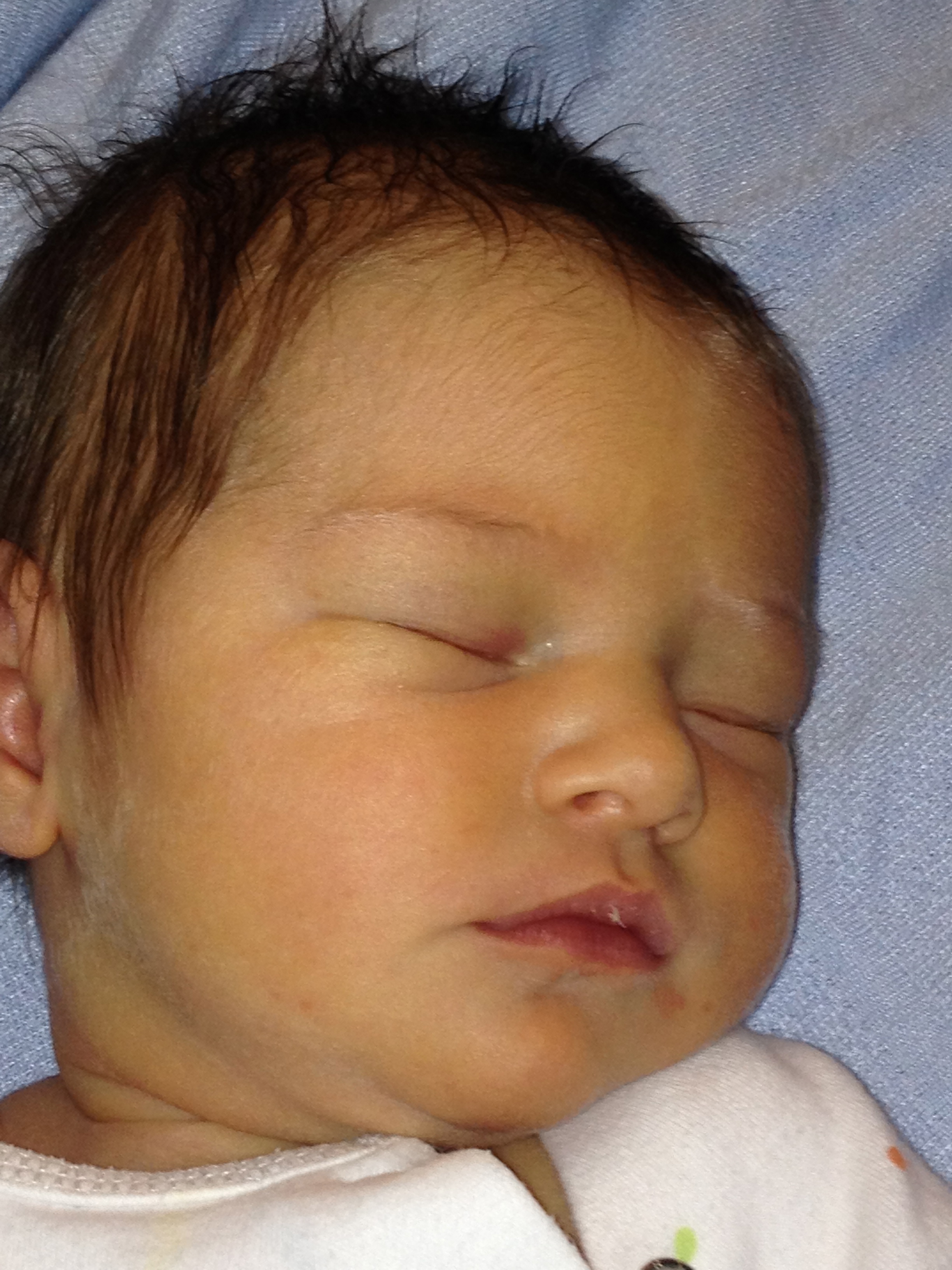
Apologies for the tardiness in posting an update, I’m just beginning to emerge from the post-natal fug. Theodora Mary Elizabeth was born on Tuesday 21st August 2012, at 3:57 pm, weighing 5lbs, 11oz, or 2580g in new-money.
Due to the high blood pressure problems that I suffered from in the latter part of pregnancy, Theodora is on the small side, especially when compared to all my other babies who weighed in at over 8lbs and sported gorgeously plump cheeks, arms and legs, so it is something of a shock having a baby who seems so absolutely tiny with not an ounce of spare flesh, with spindly lean limbs, but she is in good health, if a little jaundiced still and the pair of us are just hopefully coming out of the woods.
As for her name – it was one of those “lightbulb” moments. Right up until the moment of birth, we still had no definite idea of what to call her, other than a few ideas vaguely floating about. Theodora certainly did not feature on “the list”. It was during recovery, whilst Robin was having a cuddle, that he looked down tenderly at her, marvelling at her tiny, yet perfectly proportioned size and remarked that she really was a “teddy”. “Teddy – Theodora?!” I said, whereupon we just looked at each other and something just clicked. It just felt right, it was her.
When I suspected that I might be pregnant, the timing could not have been worse. I had just passed my first term’s assignments at university with flying colours, having had to defer my much-wanted place once already due to an unplanned pregnancy. I knew that another pregnancy would make continuing unfeasible; I struggle with pregnancy sickness and hormonally related depression and there was no way that I would be able to mange 3 children under 3 and the demands of a full-time course, let alone the costs of the university creche for 3 children. Added to which, the term dates had changed meaning that the baby was due a week before term recommenced, the creche won’t take children under 5 months and the lecturers and faculty staff were unprepared to let me attend with a feeding baby in tow. All of which doesn’t add up to a very pro-life environment for students with unplanned pregnancies – but there’s a rant for another time.
So anyway, with waves of nausea, shaking clammy hands and tears of despair, I did the test and the two faint lines appeared. Robin, who had been in a state of total denial, followed by incomprehension, took the toddler off to Adoration and Mass, looking rather pale. I’ll never forget the look on his face upon his return, which can only be described as serene and glowing. He had an air of acceptance and even excitement, whilst I broke down in tears. “It’s going to be okay” he said, “I sat there with the Lord, I looked at Imogen, I saw how beautiful she is, I thought of our other two children and realised that this is just a gift. I know it wasn’t what we expected, I know it’s the last thing we wanted right now, I know it’s going to be tough as hell for you, I know you suffer, but I can’t help but think this is what God wanted for us”. He was terrified, knew full well how difficult the prospect of yet another pregnancy and birth so close to the other two would prove, both physically and mentally for me, and the knock on effects of that to us and our family, and yet he was overwhelmed with a sense that it was just meant to be. We had in good conscience attempted to avoid pregnancy, we had been extremely scrupulous and yet despite our best efforts, here we were about to have another child. It really did feel like God’s will and if it hadn’t been for the support of my husband, I don’t think that I would have made it intact over the past few months.
Make no mistake, this pregnancy has come at enormous cost, physically, emotionally and financially. It has taken every ounce of strength that I have had. There have been times when I didn’t actually think I could continue any longer, but with the help of my husband and the grace of God and much prayer, I have somehow found the strength to get through not only the physically debilitating effects of pregnancy, but also to pull back from the depths of despair. Though I couldn’t see it at the time, the ordeal of the past 9 months actually did more than any other traumatic events in my life to draw me closer to God; I really did experience my own personal Calvary.
So nothing could be more apt than Theodora – God’s gift, given out of love and totally perfect in every way.
Just a quick update following today’s Sunday Morning Live.
Obviously there is quite a lot of Internet derision as I lauded the success rates of modern NFP systems, despite the fact that my last two pregnancies were unplanned – our perfectly legitimate attempts to avoid, were unsuccessful!
Here’s the thing about being open to life. One accepts that every act of intercourse is both unitive and procreative, i.e for bonding AND babies. Neither can be separated out. Every time one is intimate with one’s spouse, you accept the consequences that could result, even if those consequences are not what one was hoping for.
Having sat down with my NFP practitioner, I realised that the mistake was user error, not the system itself. What happened on the last occasion was that I had a sick bug around the time of ovulation, which threw the whole system out. Thinking I had already ovulated, with the entire family beset with illness, some observations went awry.
That’s more than enough information but the point is, like any method of ‘traditional contraception’ it didn’t work out. We accepted and welcomed the imminent arrival and are now looking forward to meeting her. Many of our non-Catholic friends and acquaintances have testified to multiple condom/pill failure. These are all intelligent people able to follow instructions on a packet. Anecdotes are not the plural of data. Contraception is not 100% effective. If you have sex, there is a chance you will have a baby, regardless of how careful you think you are being.
But here’s the crucial difference. I live in the developed western world. I know how jolly hard it is when one doesn’t space pregnancies. I’ve been either pregnant or breast-feeding continually since February 2009. This pregnancy has proved the most physically and emotionally demanding of all. I cannot begin to imagine how difficult this situation would be for a woman in the developing world. I have access to decent healthcare, ante-natal care, the ability to eat healthily, take vitamins, have clean running water and will give birth in sterile conditions. I am able to provide shelter for and feed and clothe my existing children .
A woman in the developing world has none of that. My contemporary in sub-Saharan Africa or any other impoverished country, would, in all probability die, if she were in my situation.
So what’s the answer? Accept this and give her a long lasting hormonal contraceptive jab to prevent her from having any more children? What happens if it fails? Or should that extra $4.6 billion that the Melinda Gates Foundation has acquired to prevent women from having larger families be spent on ensuring that women in the developing world have the same choices, opportunities, access to quality healthcare that women in the western world have? So that if a woman finds herself facing 3 pregnancies in 3 years, she actually has a practical and realistic choice? The choice of life, not only for her, but her family and children.
Shouldn’t aid be about helping and empowering women to raise healthy babies and choose their family size, large or small? No matter how difficult the circumstances?
I am going to write about what it really means to be pro-life at a later date, but this pregnancy is forcing me to put my money where my mouth is, in more ways that one.
When the word “crisis” pregnancy is bandied about, single women, often in straitened circumstances comes to mind. Actually a “crisis” pregnancy is one that is unplanned and is very difficult for the mother to accept, for a multitude of reasons.
One of the things that has been causing me a lot of anxiety is the thought of yet another cesarian section, my third in three years. My last two children were born by cesarian section and I have to admit that my personal experience is not a positive one. I shall spare the gory details, but in the interests of fairness and for any expectant women reading, it’s fair to note, that many many women testify to their cesarian as being a “blissful” experience, which, if it is planned, is certainly possible. Mine just haven’t worked out that way.
I thought that after 2 cesarian births I would not be allowed to attempt a natural birth, however this has been agreed in principle today. Though I can’t quite have the experience that I wanted, I can at least attempt to do what nature intends, on the proviso that I am strictly monitored at all times. This is a huge weight off my mind, the thought of yet another cesarian looming into view had been the source of repeated panic attacks.
Some prayers have been answered at least. This is what being pro-life means, having compassion for the stressed-out mother, understanding that for many childbirth presents a psychological barrier and that the heady cocktail of pregnancy hormones combined with pre-existing worries make her especially vulnerable and not dismissing her fears as histrionics or irrational.
This is why more midwives are needed in the UK – to help and support women to make the choices about childbirth that are right for them.
I was reminded of that earlier today, upon receipt of some news from the Good Counsel Network, regarding a mum and baby whom they are attempting to help and support. It would not at this point, be appropriate for me to go into the specifics of this case, but it’s a timely reminder that though the narrative of abortion seems to be about fully autonomous choice – the reality is far from that for many women, who are coerced into abortion against their will, often being frogmarched to abortion clinics by controlling relatives or boyfriends.
There are a handful of sceptics in the pro-life movement who believe that pro-life work should not consist of helping women in need, but should be all about the politics and campaigning for changes in society, in order to make abortion not only unthinkable but also unnecessary. Pro-life work should not consist purely of mopping up, of providing the layette and the basic baby equipment for impoverished or abandoned mothers, but needs to think beyond the needs of the newborn baby and address the needs of single mothers with toddlers and young children. It is not enough to think that once the baby is saved from the abortionist’s tools, that the job is done. We need a society that is prepared to protect the vulnerable, which includes amongst others, young children and their mothers.
In a recent conversation with Deborah Orr, I highlighted that abortion is a sign of female inequality, in that women are under various pressures not to have children if they want to be able to compete on equal terms with men in the workplace. There is something very wrong in a society that seeks to present abortion as solution to inequality, if anything abortion perpetuates the inequality as it forces the woman to suppress her feminine fertility and natural bodily functions, if she is to succeed, or in some cases survive. The social, financial and economic inequalities that lead to abortion being touted as a solution need to be addressed, which is why pro-life needs to look beyond pregnancy and the newborn baby.
But that does not mean that there is no place for practical action. In a society that uses abortion as a sticking plaster, we therefore need practical action to help these women who feel that they have little other choice. Whilst some may feel that the politicking and campaigning is their calling, there is also a need to step in and help those who are facing desperate and terrible circumstances.
Which is where organisations like the Good Counsel network come in. Contrary to the myths peddled by the Guardian, the Good Counsel Network are there helping the poorest and those marginalised in society. Their typical clients are not the middle-class professionals arriving for a lunchtime abortion, but those on the very fringes of society. Women from ethnic minorities who are facing terrible cultural pressures for example. Immigrants who do not qualify for any benefits and who financially feel that they have little other choice. Homeless women and victims of domestic violence. Why should these women be denied the choice or opportunity of motherhood, due to poverty or social isolation?
The Good Counsel network has been criticised for its overt Christian iconography and Christian mission, but let’s think about this for a minute. Christ was a man of compassion. He shared human burdens and alleviated suffering. Jesus could not look at those suffering without being moved to intervene in some way. He was moved when people experienced pain, sickness, sorrow, were hungry, lonely or confused. Christ was concerned with helping people, and if we are to bring about the Kingdom it is not simply by empathy, by feeling someone’s pain but by following in his footsteps and doing something to alleviate it. The Good Counsel network is all about compassion in action, by demonstrating Christ’s love, not simply by words and certainly not by evangelising or attempting to convert, but by the outreach, love and support they give to women in specific need.
I know what it is like to be pregnant and vulnerable, only too well. I am fortunate, my husband tells me everyday what a hero I am for doing the work of nurturing an unborn child and bringing her to life, whilst also looking after our other little ones. He is also good at doing what he can to alleviate the burdens when he can, be that cuddling the baby to sleep so that I can have a bath, doing as many household chores as he can, taking the children out for a few hours at the weekend so I can have a much needed nap, or simply going out to fetch a packet of Haribo or MacDonalds as the mood takes me. I think he’s the hero frankly for putting up with grumpy pregnant miserable hefalump wife for 9 months! I would not have coped without him. Many women do not have that. The Good Counsel network provides the much needed emotional, practical and often financial support that is so often missing.
To be pregnant, whilst not an illness, is to be vulnerable. Anyone who calls themselves pro-life, needs to accept this. Pregnant women get free prescriptions, free dental care because pregnancy puts an additional physical burden on the body, it lowers immunity and makes women more susceptible to illnesses and infections. Employment law also now recognises this, which is why employers have a duty of care to ensure that pregnant women are not working in an unsafe or physically compromising environment and are not over-burdened or compromised. In every single one of my pregnancies, I have at some point just wanted someone to understand all the various physical and emotional anxieties, and someone to reassure me that everything is going to be OK. This is where the support offered by pro-life organisations is invaluable. They are there to help, not just with platitudes but with actual help, be that being there at the end of the phone, or helping to provide the basics that a woman needs. The mother is not dismissed the moment that she has her baby either, the Good Counsel Network, continues to offer help, advice and support for as a long as a woman feels it necessary, hence they are still assisting mothers with toddlers and older children. It is up to the mother to decide when she no longer needs their help.
Here is why they should not be dismissed or scoffed at.
We spend £40,000 per year on feeding Mothers. And we give this help when a Mother has no wage, no right to benefits and no other means of support.
Some of our Mothers were sleeping on buses or on the street as late as 7 months into their pregnancies.
Many others considered abortion because of their devastating poverty when their baby’s father chose not to support them in having their baby.Those readers who have been pregnant and who know the awful hunger pangs you can endure in pregnancy even when you have plenty to eat will understand how terrible real hunger in pregnancy can be!
We always deliver the help that we promise an expectant Mother. We don’t provide luxuries, but we do provide the basics
I noticed pro-choicers scoffing at their website a few weeks ago. It comes to something when a charitable organisation is laughed at for its choice of font, and it also shows exactly where the priorities of the Good Counsel Network lie. This is not a glossy, pious sanctimonious spirituality, but a roll-your-sleeves up apostolic mission. People like Stuart and Clare are there on the frontline getting their hands dirty and incurring the wrath and enmity of those who would much rather the poor and marginalised were forced to abort their babies and the abuse that comes with that territory. Whilst society sanctions and condones abortion, then organisations such as Good Counsel network will be needed and never more so in these times of austerity.
Here are some of their costs:
It costs us £35 to feed an new Mother for 1 week.
It costs us £25 to feed an expectant Mother for 1 week.
It costs £15 to pay for baby milk each week when a Mother cannot breastfeed.
It costs us £7 a week to buy nappies for a baby.
It costs about £3.60 a day to feed an expectant Mother.
Here’s how to donate. £5 a month is the equivalent of 2 lattes in a typical chain, or perhaps a bottle of wine from the supermarket. In the meantime the Good Counsel Network would appreciate any prayers, fasting or acts of suffering for “M”.
Truly I tell you, just as you did it to one of the least of these who are members of my family, you did it to me.
I am admittedly suffering from ante-natal depression at the moment. It’s a condition that has affected every single pregnancy, but this bout is particularly bleak. I am struggling to find a light at the end of the tunnel.
Anyone who follows me on Twitter will know why this has been exacerbated. I’m not going into the tedious specifics, but since the beginning of February I have been the subject of a prolonged smear and hate campaign which has hit me, whack full-on at a time when I am feeling especially vulnerable, for a multitude of reasons. I simply can no longer cope with the abuse and latent threats.
I am primarily disengaging from Twitter for a while for my own mental health, I may still tweet the odd link, but it’s best, in the short term to concentrate on my own well-being and upon the odd blog post, which I find therapeutic, carthatic and healing. If it’s inspirational or informative , that’s simply a bonus.
Due to the issue of abortion being firmly back on the political agenda – and yes abortion is a political issue, it always has been, those campaigning in favour of the 1967 Act were more than happy to politicise the matter, once again the notion of acceptable time limits is under discussion. There has been a massive sea-change of opinion since the incredible advances in very detailed 4D diagnostic imaging pioneered by the likes of Professor Stuart Campbell. Babies of only 12 weeks gestation can be seen playing, smiling, sucking their thumbs, exercising, in minute detail. It is increasingly difficult to deny the humanity of the unborn child and the vast majority of the public favour a reduction in the abortion limit to 20 weeks. Over half of UK women believe that the current abortion laws are too lax, according to a recent YouGov poll conducted in January 2012. A more recent Angus Reid poll from March 2012, shows that over half of the respondents and 3 in 5 women believe that the current limit of 24 weeks should be reduced.
Discussing abortion limits is a minefield for pro-lifers and Catholics who believe that all abortion is the taking of innocent life, a viewpoint with which I am very much in accordance. To campaign for a lower limit seems to concede that it’s perfectly acceptable to kill an unborn baby at an earlier stage. Most abortions performed in the UK are now under the 12 week mark – to imply otherwise is misleading and disingenuous. Honesty and integrity matter when discussing such ethical topics. The problem with implementing a reduced limit, is not only does it imply that earlier stage abortions are acceptable, but it may also rush a woman into making a premature decision, aware that the clock is ticking. Another factor that comes into play is that the earlier the abortion is performed, the more straightforward and thus less risky the procedure. A surgical abortion at 12 weeks will be less physically traumatic for a woman than a procedure at 22 weeks. So if we’re looking at women’s welfare, its something of a double-edged sword. An earlier procedure may well be better for her (not the baby) but the existence of a time limit may not give a woman enough time to properly consider her different options.
Pro-choicers on the whole aren’t keen on any delay, they believe that a woman should be able to have swift access to abortion as soon as she “requires” it. Whilst this logic is understandable, most women faced with a crisis or unplanned pregnancy do need to be able to take some time to fully consider their options and not be rushed into an abortion by clinics, relatives or abortion limits. At the end of the day an abortion results in the end of a life, regardless of whether or not one wants to play around with the semantics of whether it is a real life or simply a potential for life. I know where I stand on that scale, but that’s an argument for a different time. An abortion cannot be undone ,therefore women must not be rushed. As the law stands, if a woman has made up her mind that she wants an abortion, she can go and book one for the next day, without counselling if that be her wont. If, however, abortion is this difficult decision that is only arrived at via a lot of soul-searching, then it seems right not to exert any undue pressure with time limits. Clinics already do enough of that in terms of rushing women into taking the abortion pill, because for them, this is a less costly and riskier procedure, regardless of whether or not the abortion pill is the right option for a woman. Let’s say, for example, I discovered at 6 or 7 weeks in pregnancy that the developing fetus had died. Would I opt to take a pill to induce a traumatic miscarriage or would I go for the surgical option under sedation or anaesthetic? The answer would most definitely be the latter – but surgery isn’t the option that is promoted for women in the early stages of pregnancy for obvious reasons.
An aborted baby/fetus, whatever terminology one wishes to use is just that, it can’t be magically revived, whatever stage of development it is at. Obviously, when we come to pregnancies post 2o weeks, there is the hotly disputed issue of fetal pain, awareness and viability. The general public are as a whole a lot more squeamish about later stage abortions because of the huge advances in neonatal care. Babies born at 24 weeks can and often do survive. This baby girl survived being born at 21 weeks and 5 days. At 22 weeks a baby has a 0-10% chance of surviving, increasing to 10-35% at 23 weeks and 40-70% at 24 weeks.
Ideologically speaking, limits should be something of a red herring, either abortion should be on demand right up until birth or it should be against the law, unless abortion is a necessary side effect of a procedure undertaken to save a woman’s life.
If only life were that simple. I admit to a personal heavy investment in the notion of reducing the limit, which I firmly believe would reduce the number of abortions. Not that there should be an acceptable number or quota, but one life saved is better than none. Someone close to me aborted healthy twins at the 23 week stage. She had already taken the decision to keep the babies following a 19 week scan, kept things quiet until she was 21 weeks, but was coerced due to an enormous amount of family pressure, led by an overbearing and dominant mother who was concerned about the shame that would be brought upon the family. The ironic thing being was that the pregnancy was already known about by most people and there was more shame, stigma and distress in the late stage abortion of twins than there would have been in actually giving birth to the babies. The situation was heartbreaking and no blame should be attached to the vulnerable 19 year old who was put in an insufferable position and convinced that an abortion was the only solution. Were the limit lower, then this would not have happened.
Time limits act as a cut-off point, beyond which it is deemed unacceptable to abort a baby, which is why for many they are an irrelevance. The very existence of a limit gives a protection to the unborn child beyond a certain age. It stops people from “unnecessarily” aborting their babies. I was won around to the idea about half an hour ago.
I’m having a very hard time, I am struggling mentally. That is not pure hyperbole, it is fair to say that I am on the edge. I find pregnancy difficult enough as it is. I am daunted at the prospect of coping with the demands of a breastfeeding baby, a hen 16 month old and 33 month old in a bungalow the size of an average flat. I am terrified by the prospect of another cesarian, my 3rd in 3 years. The last two were no walk in the park. I don’t know whether or not I will cope. My degree will need to be deferred – again. At any other time, I might be more mentally equipped to cope with the sheer undiluted spite that has been flung my way over the past few weeks, and that is no exaggeration, but coupled with everything else, it’s all proving far too much to cope with. I am having moments of panic, despair, darkness and anxiety. I am exhibiting signs of severe depression, losing appetite, finding menial tasks overburdensome and dreams filled with anxiety. I wake up drenched in sweat after being chased by an irate female client from my old job or troubled because I’ve had to sit an exam which I didn’t previously know about and for which I’ve done no revision.
Perhaps this is too much personal information, I’m not putting it out there to play victim as often accused, but to say look, I’m a normal bright intelligent woman with no previous history of mental illness (contrary to the 16 unsolicited emails sent to a lawyer advising me) but the strain of pregnancy coupled with a few months bombardment of internet harassment has proved too much. There should be no stigma or shame, I know I’m bent out of shape at the moment and I am fortunate to have a loving husband who is encouraging me to go and seek the help that I need. That is not an admission of any wrongdoing of which I’m accused either, I don’t want any amateur psychologists putting two and two together and making the invariable five. I am a very stressed and vulnerable pregnant woman. I am well aware of that, which is why I know that I have to take a break from Twitter which is proving enormously self-destructive. It’s like a sore tooth that I keep worrying away at, I keep hoping that it will get better, that I will get the much longed for apology or retraction, and am freshly hurt every time the invective recommences.
So, with all of that in mind, I’ve just come off the phone to someone well meaning. The conversation consisted mainly of me crying, which is what I have spent most of the past week doing. Either crying or getting into a blind rage, which is what those who are winding me up, want to happen. The next few months will be tough. There is a light at the end of the tunnel in that I’ve never suffered from post-natal depression, normally once the baby is delivered and the breast-feeding hormones kick in, I’m in my element.
The person to whom I was speaking recognised that I’m in a dark place and that life is difficult. They are really worried. I am 22 weeks and 3 days pregnant. I regularly feel my baby girl squirming around inside me. We’ve chosen her name. Doubtless several clinics would be prepared to carry out a termination on the grounds that this baby will probably be my last and is my fourth girl. At some stage it might have been nice to have a boy. It’s lucky I’m not married to a Tudor monarch or living in a culture that puts little worth on the life of girls. But anyway after repeatedly expressing the sentiment that it was a great pity that I did know when the baby was conceived because otherwise I could have taken the morning after pill, well meaning person came up with a solution. They were so worried about me that they had found a clinic, made preliminary enquiries and discovered that there was availability/feasibility for me to have an abortion next week, around the 23 week mark. I can see why it seemed an answer. I can also see why, to a person who is worried, anxious and suffering from depression it might seem the only way out.
Up until 24 hours ago, I thought I was managing fine. Today I’ve realised that isn’t the case. I am experiencing a crisis. Were I of a a less tenacious and stubborn persuasion or less affirmed in my beliefs about the sanctity of human life, then I can see how at 22 +3, a late stage abortion might seem appropriate. If I were to have an abortion next week (rest assured I won’t) it would be because the law says I could. My baby is healthy and moving, she is literally alive and kicking.
There is a myth that says late-stage abortions are necessary and only occur in the case of babies with life threatening abnormalities and it is for these reasons that the limit stays at 24 weeks. Given the law also shockingly states that it is fine to abort a disabled baby up until birth, something that should be an anathema to most people with any sense of a moral compass, there is a pressing case for a reduction in limits, provided no other grounds are ceded.
If I were to abort now it would be a short term solution that would generate longer term mental health difficulties. To abort would be a gruesome sticking plaster and panacea. If the mental health of pregnant women is of such pressing concern, surely more resources need to be put into making sure that they can cope, that they have the medical, emotional and practical support that they need? Surely that has to be a better solution than traumatically ending the life of a baby with a chance of survival outside the womb? Would an abortion be the answer for a woman in my situation? There is only one way to find out, and that’s a decision that cannot be undone. With a 20 week limit, a woman in a similar situation would not be faced with a choice. There would therefore be no other option for her other than to seek the support that she needs. With a lower limit fewer women are pressurised at a later stage, if circumstances suddenly and traumatically change, i.e. a partner walks out or the family faces redundancy. No woman should have to abort her baby because she feels she has no other choice. Would more women be pressurised prematurely, I think that’s unlikely. The later the limit, the longer the opt-out clause which some people will always leave til the last minute.
I effectively have no choice, I’ve not had a choice since the moment I’ve discovered I’m pregnant. That is not necessarily a bad thing and has been the case of millions of women since the dawn of time. Choice should not be mistaken for the Holy Grail or defining value of our age. A lack of choice forces me to find the help and support that I need. I’m no superhero. If I was a better, stronger and more heroic woman I wouldn’t be struggling quite so much, but stoically, quietly, patiently enduring and offering up my suffering and glorying in the miracle that is reproduction and the privilege of carrying my own baby. The fact that I am not coping is a testament to my own shortcomings and so if I can get through this, then anyone can.
I received the following comment from Clare McCollough at Good Counsel Network, showing that they are indeed aptly named. I thought it was worth publishing in a separate post.
Hi Caroline
I understand where you’re coming from (I can’t say I understand totally, because what every woman goes through is different of course).
I could take offence that you seem to suggest that no pro-lifer understands what you have described here. Or that you suggest that the only thing the pro-life movement can offer you is baby clothes. That’s not fair! We spend our lives working out ways for women to implement real solutions to exactly the type of problems you list here. However, I understand that you’re not in the easiest state of mind at present.
So just to be clear, I think there are ways you can be helped through this difficult time and would be glad to help. Good Counsel is on 02077231740 or email us at info@goodcounselnetwork.freeserve.co.uk
I agree with some of what you said about Counselling. It addresses part of the reasons why I didn’t support Nadine Dorries.
It’s possible too that a better method of NFP or one more suited to you is available – saying that doesn’t blame you for anything. Maybe there isn’t, but in any case, as a Catholic it seems a bizarre idea that anyone would walk around “blaming” a Catholic woman for getting pregnant. It’s what happens in Marriage. NFP is great in it’s place, but God didn’t say “Thou shalt use NFP and if it fails it shall be thine own fault thou art pregnant”…Many, many Catholic women who are open to life have faced the tremendous upheaval of a pregnancy at a time which seemed impossible. Catholic women are in this together, the really bizarre world view is the one that says “get married, enter into a life giving union with this man and use any gadget, gizmo, pill, gel, injection, patch or whatever to prevent the consequence…
It is not necessarily true to say Marie Stopes and BPAS wouldn’t make a judgement on you. One of the most frequent complaints I hear from women is “I think the lady I saw at that (Marie Stopes or BPAS) “clinic” is pro-life” When questioned further they think this because she was rude or agressive, shocked at their reason to abort, annoyed that they had aborted before, impatient when they were tearful or unsure. (A sad reflection of the media image of the average pro-lifer – but not a true image of the vast majority in my experience). We must steer clear of demonising anyone who works for MS or BPAS as not all understand the reality of what they are doing, but it is a mistake to believe that all who call themselves “pro-choice” are non judgemental and woman friendly. Many of them hate their jobs and blame the women who come to them for needing their services. This is well documented (see LIME 5 and many post abortion groups writings for evidence) and something
I have personally met with in “clinic staff” many times.
You face a difficult time at present, and you know life isn’t going to be easy even after the birth. My son didn’t sleep day or night for 2 decades after he was born (hang on he’s only 4 so that can’t be right, but it feels like it!) so I realise the way small children impact your life. But we would be glad to assist with the things you think would help and maybe even to put out a few other ideas that might help for you to consider.
Prayers are with you anyway.
God bless
Clare McCullough, Good Counsel
When I last wrote about what it was like to face an unplanned pregnancy, a commenter angrily wrote that they could not believe my cheek in asserting that I could now look a pregnant woman facing a crisis pregnancy in the face, that I was comparing myself to someone who had been raped when clearly there was no equivalence, I could never know how it could feel to be pregnant as a result of a rape.
Assuming that statement is correct, it must be remembered that trauma caused by an unplanned pregnancy is no less serious and distressing for a woman, regardless of how she came to be in that particular situation. Being avowedly pro-life does not somehow lessen the emotional or physical impact of an unwanted pregnancy. As a Catholic I feel under additional pressure to serenely grin and bear it, to plaster on a saintly smile and offer up every bout of retching for the Holy Souls in Purgatory, whilst declaring to the world how wonderful it is to be bringing another beautiful baby and human soul in the world.
Now whilst there is some truth in the latter part of that sentence, I know that once the baby is here, I will adore him/her, I will proudly post photographs of him/her on social media and proclaim “look, my baby is so beautiful, here is proof of the evils of abortion”, the reality of being pregnant and pro-life is somewhat different. The reason that I look at my babies and feel filled with horror at the idea of abortion is because I know quite how tempting that prospect is. I experience it on a daily basis. Looking at my babies once born, is an affirmation, not that one is needed, that I have undoubtedly done the right thing and if we’re going to psychoanalyse, is probably as much about assuaging my guilt for entertaining such abhorrent feelings whilst pregnant. One of my more unpleasant detractors said “if I see one more photo which says my baby is cute and abortion is wrong, I’ll throw up”, further consolidating that she had absolutely no idea what it is like to experience a pregnancy, let alone an unwanted or unplanned one.
Here’s the reality, warts and all. I will attempt to remain as dispassionate as possible and not whinge, but I think pro-lifers need to get a feel for what it is like when a woman is desperate, something that the pro-choice lobby, understand only too well.
I feel constantly nauseous. Not mildly nauseous, but full-on, I’m on the verge of throwing up big time here. Everywhere I go, a bucket or some sort of receptacle has to come too. I emerged from around the back of a shrubbery on campus yesterday, wiping tears from my eyes, mucous from my nose and surreptitiously dumping a plastic bag full of vomit in the nearest bin. Being British I cannot bring myself to face the mortification of using the campus toilets and bumping into someone I might know, or indeed that anyone might hear. If I’m not throwing up, I’m feeling that I’m on the verge of it at any second. Everything and everyone smells of cheese, even me. I disgust myself with my smell. Even my beloved children absolutely stink to high heaven. My beautiful baby is repellant, I can’t bear to have her anywhere near me, because she literally makes me sick, one whiff of her head and bleurgh I’m off. This is something of a problem, given that she refuses to drink anything other than breast milk and the odd bit of water. Every time she latches on to the breast, the surge of hormones as the milk is released causes another heave. Another issue is that she is, at not yet 9 months, going through separation anxiety. Put her down for more than 5 nano seconds and the million decibel screaming as if she is being tortured starts, thus setting off the toddler.
I’m exhausted. Not just a little bit tired, but as though my arms and legs are weighted down with lead. I feel constantly wiped out and struggling to keep my eyes open. When I’m at home with the children, I’m fighting sleep, but with a lively and boisterous 2 year old and the baby, it’s obviously not an option. What is exacerbating this is that due to a shortage of space in the house, there is nowhere to put a cot. Thus bunk-beds have been ordered, toddler will be evicted from her cot bed and the baby will then have a cot to sleep in. Until that time she is still in the bed with us and cannot get to sleep unless she is breast-feeding. She has now grown three teeth, so there is lots of biting, nights consist of being used as a giant human comfort blanket, my nipples made ultra sensitive via pregnancy hormones, spend the night being bitten or twisted, handfuls of flesh are grabbed, kneaded, scratched, pulled and pushed in order that the baby can slumber peacefully. As soon as the bunk-beds arrive, I anticipate a double dose of sleep trauma, toddler will be none too happy being evicted from her cosy cot, 7 year old will be getting frightfully stressed and coming to tell us every 5 minutes that toddler is talking, crying, whimpering etc (this happened on holiday when they shared a room) and baby will be apoplectic at having to sleep in a cot in a different room. There is a reason why sleep deprivation is used in torture techniques. It makes you desperate. What I have been doing, because I am a shocking, neglectful, lazy mother, is taking advantage of when my children are in University nursery to nip back home and catch a couple of hours of sleep.
The house is an absolute state and I am behind with my university work. I went to the much advertised Student Life building to get some advice about support, given I have a few late essays. I was told how to submit mitigating evidence but also told that there was no guarantee that my claim will be accepted. The highest I can achieve in my essays, if my claim is not accepted is 40%. This will do, it will get me a pass, but is more than a little frustrating.
So, to recap, I’m snowed under with university work, the house is its usual pigsty, I have three young children, I am utterly exhausted, my family live hundreds of miles away and I’ve no close friends nearby either. The parish we worship at is 10 miles away from our house, we started worshipping there before we moved, when Robin was still a vicar, have built a close relationship with the priest and have some friendships, but are still slight outsiders.
The thought of having another baby fills me with absolute dread. As soon as the nine month old reaches a vaguely manageable stage, yet another screaming newborn will be here. I have been pregnant and breastfeeding since February 2009. I have had 2 cesarians in two years, one in November 2009, one in April 2011. Neither of them have gone well. I have a phobia, a genuine dread and terror of childbirth. I feel sick, ill and rotten. I cannot believe that this is happening to me yet again, no sooner does my life begin to come together, then bang, I’m pregnant again. I also feel extraordinarily foolish for being pregnant, like I’ve done something wrong and incredibly stupid in my use of NFP; some would say its my fault for trusting in it, others would point out my deficiencies in not being able to use it properly. Either way it is my fault. In short I am not floating about in a state of pious tranquility that the Lord’s work is being fulfilled. I am miserable. I am letting just about everybody down, my husband, my family and my friends because I am finding it so difficult to function.
My husband is working really long hours, if I defer my degree again, then I’ll be liable for the higher £9,000 a year fees, if I give up, then I’ll never be able to get a job. This getting a job business is actually quite important. If for some reason my husband is not ordained, then instead of spending these few years training for a career, he’s been working in, what can be, a pretty back breaking job paying £5.90 a hour. He’ll need to do something else, as will I. Even if he is ordained, then it is not fair to expect the Catholic Church to pay for my upkeep. So the degree is important.
As an aside, perhaps people can understand why I may be just a tad short-tempered at the moment. Perhaps they can also understand why, given we gave up everything in order that my husband could cross the Tiber, and given that I have received unprecedented amounts of abuse for defending Catholic social teaching, it is more than a little galling to be called “liberal, pro-life lite, misleading the faithful and reinventing Church teaching” and had the fact that we are not cradle catholics thrown back at us by some of the traditionalist Catholics. It’s why I’m having a twitter break for a short while. Anyone looking through some of the early comments on this blog can see some of the abuse that I’ve had to put up with, being called a fundamentalist, extremist and other such names. It is just laughable to have my faith called into doubt this way. There has been absolutely no understanding that I might be feeling extremely vulnerable at present – name calling of the most un-Christian kind and aggression has been de rigour. It has been worse than anything previously faced, not simply because of the spiteful derision, but because this has come from brethren in Christ. Although I am to blame for perhaps overreacting, I think bloggers who devoted two consecutive blog posts to me and tweeters who embarked on consecutive twitter rants, need to ask themselves how they feel they might be coming across?Twitter does not allow for nuance, nor does it allow pause for thought. When faced with tweet after tweet after tweet, the blood starts pumping, the breathing quickens, hackles rise at the invective writ large in front of you and the emotional temperature is raised. This is not good for anyone and certainly not righteous. I would urge all Catholic tweeters, just to stop, pause and think. Things might not be meant aggressively, but that is certainly how they come across.
It’s fair to say that I am not Mrs Duggar, floating about in euphoric bliss about the Lord’s will being done, having conceived baby number 21. If only I were. This pregnancy is proving to be a huge spiritual test. I feel like asking “Lord, why me, again”, but am focusing upon Romans 8.
Why am I spilling like this – firstly, its to let people know in no uncertain terms that I am having a hard time. It’s to let pro-lifers know that pregnancy is often a terrible physical and emotional ordeal. I am effectively being forced to give birth, as the pro-choicers would put it, because for me there is no other choice. What I have to do, in the words of Mama Odie, from Disney’s Princess and the Frog (currently showing 24/7 in these parts) is to dig a little deeper. What we want and what we need are not always the same things, doing what is right, is not the same as doing what is easy. There are times when I feel that I would literally do anything to not be pregnant right now, I would make some kind of Faustian pact that didn’t actually involve taking the life of my chid or indeed selling my soul. If someone would offer me a solution to take away the pregnancy and the sickness, I would be mightily tempted.
This is what pregnant women face and this is what is on offer at Marie Stopes and BPAS. I know that were I to visit, they would not sit in judgement, but would validate my feelings of despair and negativity whilst offering a way out. This is the reality that anyone dealing with a pregnant woman has to face. I wrote a lot this summer about non directional counselling, my feeling was that women must not be bullied and hectored. I still stand by that, but my opinion has changed slightly. The only thing that is stopping me from not aborting this baby, is the fact that I know that it would be the killing of a child. I am 9 weeks pregnant. That’s definitely a baby, not a potential life, but a real live one. Abortion providers make moral judgements for women, they tell women that aborting children is acceptable and understandable. It might be the latter, but whichever way you look at it, when an abortion counsellor recommends a woman for an abortion procedure, they are making a moral judgement.
Pro-choice people understand only too well how difficult it is for a woman, which is why they hate us pro-lifers piling on what they believe is unnecessary guilt and pressure. But where I have changed my mind, is that actually, a woman needs to know that if she aborts her baby, she is killing her unborn child. There can be no getting around that fact. Women need to see ultrasounds and understand the choice that they are making. Someone needs to put the reality to them that abortion is the ending of a life. It’s an uncomfortable truth and it is what has people so up in arms, because they feel that women don’t need to know that, it’s easier to put the whole idea out of their minds, in a separate box to be dealt with later. This does not necessitate religious reference or hectoring, but simple facts. Here is your baby – here is what it looks like – the decision is still yours, but it is precisely because of the nature of abortion, that you may well feel some emotional trauma afterwards, particularly if you are already vulnerable.
I know that Marie Stopes and BPAS would offer me the solution that I wanted, but it would be a decision entirely centred around me, my feelings and my life as it stands now. The unborn baby would not feature at all, and thus spurious arguments would be used as qualification such as “its not really alive, it’s not viable”. That’s why this so emotive, desperate women take decisions to make their lives better, decisions that seem understandable, but decisions that are ultimately morally right or wrong. Either abortion is right, or it is wrong. What pro-lifers have to do is understand this desperation and fight to offer decent alternatives for women in these situations, as well as helping women to see the reality of their actions. What would help me? Someone to advocate at University, not only for the late penalty to be taken off my essays, but also to allow me to bring a newborn baby to lectures and seminars next year. Someone to help fight so that if I do defer, I don’t have to pay the higher fees. Ultimately we need people to fight for better conditions for pregnant women in terms of careers, so that they are not forced to put them on hold, or their prospects aren’t damaged by career breaks. That would get down abortions no end and would be a far more productive use of time than philosophically debating same sex marriage. Pro-life groups have to make it easier for women. I don’t need baby clothes, I need practical and career help.
No doubt aborting this baby would improve my short term health no end. It wouldn’t do much for the baby’s. No doubt I shall be filled with grace and blessings. But understand this – it is far from easy. I feel forced to set a shining example, when really all I want to do is to collapse into a hormonal mess. Faced with no alternative I just have to cope and dig a little deeper, I think it’s what most do when they are up against it. But I need people to be gentle. I needed a break from pregnancy. Desperately.
I was re-reading the piece I wrote for the Catholic Herald last Christmas and reflecting that it seems as relevant now as it did then!
For those who didn’t see it – here’s the subbed text. We did have a memorable and special Christmas, watching this year’s Rev Christmas special was a timely reminder that this short break from ministry has its advantages!
A peaceful & blessed Christmas to all – clergy families in particular. Only a few more days til it’s all over!
Every year I am reminded that all families, perhaps unwittingly, enter into the spirit of the Advent Season, regardless of whether or not they profess a Christian faith. For most households December is a time of preparation, often of uncertainty and stress in these difficult economic times, as well as a looking forward with hope, either to the festivities of the day itself, or perhaps to a more optimistic New Year. Regardless of whether or not most families are anticipating the Second Coming itself, the aspects of frantic preparation and anticipation certainly seem to be a feature of the twenty-first century Christmas; every year, the pressure for the ‘perfect Christmas experience’ ratchets up a notch in terms of the early appearance of festive goods in the shops and the non-stop bombardment of advertising and Christmas-themed programmes.
For my family, this Advent and Christmas will be unique in that it is the first time, that we will be truly united both in our spiritual and physical preparations and in celebrating the joy of the coming of Our Lord. Having been the Catholic wife of a Church of England priest, Christmas has previously had something of a bittersweet flavour. The compromise available to most couples of differing Christian denominations usually involves both parties attending two different Christmas services together, perhaps midnight Mass and then a service on Christmas morning itself. This option was never logistically available to us, for the last few years I have cut something of a conspicuous lonely figure, sat on my own, or with my young daughter during Mass on Christmas Morning. Clearly it was important to be able to support my husband, so usually we attended all his services on Christmas Eve, then I would go to the Mass at the Catholic Church just a few yards away from his church on Christmas morning, before joining him at the end of his service. It was at this time, that despite being linked by the sacrament of marriage, our disunity in faith was most acutely experienced. The incompleteness of our spiritual union was thrown into physical relief, the only time we had previously been able to receive communion together, was the occasion of our nuptial Mass, Bishop Kieran having graciously granted a special dispensation. We experienced the sense of deep pain and sadness at being divided at the most sacred moment of the Eucharist on a weekly basis, but at Christmas, a time traditionally associated with the family, this was felt more sharply than ever, when the family was both physically and spiritually fragmented. However, as the Bishops’ Conference of England and Wales reminded us in their 1988 teaching document, One Bread, One Body, this pain did much to highlight our brokenness, our division and acted as a spur to unity and healing, playing a not insubstantial role in my husband’s subsequent conversion to full unity with both the Church of the Apostles and his wife.
Like many others who are caught up in the whirlwind of pre-Christmas preparation, my focus was often predominantly on the practical, the making of the nativity costumes, the food shopping, the gift-buying, the Christmas card-writing, the decorating and so on and so forth. As many a clergy spouse will testify, Christmas is often unbearably hectic, one doesn’t see one’s husband for the vast majority of December and at times the rounds of lunches, Christmas fairs and carol services seem endless. In addition to being the Rector, my husband was also a School Governor and trustee of a local bereavement charity, all of which had additional Christmas services and meetings to factor in on top of the usual day-to-day business, as well as ensuring that the pastoral ministry to the sick, elderly, housebound and bereaved was not neglected. It is something of a family custom, that come Christmas Night, Robin will succumb to his annual bout of illness, following six weeks of relentless activity, including several sessions burning the midnight oil whilst sermon writing. The past two years have been particularly manic; last Christmas I was dealing with a newborn baby born in mid-November, the year preceding that, we were preparing for our forthcoming wedding on the 29th December and though both times I had attended various Advent groups conducted by my husband, it was incredibly difficult to remain spiritually focused. In previous years I had been on light girlfriend duties only! At the time of choosing our wedding date, Christmas had seemed a marvellous idea coinciding with his period of annual leave, with hindsight it was sheer folly. I came down with a chest infection on Boxing Day, Robin passed out with perhaps the worst case of genuine flu I have ever seen mid-honeymoon. “For better for worse, in sickness and in health” was enacted sooner than we had anticipated!
This year has also been equally manic and for most of the year we have been focussed upon Robin’s conversion and the upheaval that this would entail. At the moment, we as a family are thoroughly enjoying this season of Advent, finally having the luxury to take time and slow down, to pause and reflect, to fully spiritually prepare ourselves, instead of preparing others. We feel acute parallels between ourselves and the Holy Family who have always held particular resonance for us. St Joseph the foster-father of Christ is a constant source of inspiration to Robin in his role as step-father to our eldest daughter. St Joseph unfortunately sometimes seems to be sidelined in the Nativity story, although what is clear is that like Mary, St Joseph was uniquely singled out for his role. Robin felt very much that not only was he called to the vocation of marriage with me, but just as importantly he was also called to become a father to my little girl, with whom he had fallen deeply in love. He often reflects that it was perhaps her, as much as me, that helped him to affirm his calling. The fact that St Joseph is a foster father and that he probably died before Jesus began his ministry, affirms that the often difficult and complicated family circumstances in which people find themselves, do not doom us to failure. To fail to appreciate St Joseph’s role can undermine the importance of the Christian family and thus he continues to play an important role in our Advent reflections.
Another more obvious parallel for us with the Holy Family during this season, is that of Mary’s joyful acceptance of news that could have had fatal implications for her. Since discovering on the Feast of the Assumption, that we would be expecting another child, due on Good Friday, I have looked to Our Virgin Mother several times. Like her, this news has come unexpectedly, not at a time of our choosing and has thrown our lives into disarray. I noted with alarm the words “high risk” written in my pregnancy notes and certainly this pregnancy has had severe consequences in terms of its impact on my health. At a time when we were moving house and I was commencing a three year degree, along with the usual demands of a young baby and child and supporting my husband in his quest for work, the pregnancy meant that I had to put many of my cherished plans on hold. If I am candid the acceptance was more grudging than joyful, with much to learn from the example of Mary, ‘let it be done to me according to thy will’. However, in common with both Mary and the theme of Advent, I am now indeed looking forward with hope.
Of course, I am not the only one who has had to joyfully accept a calling that has entailed great personal upheaval and suffering. Like the Holy Family in exile, we are experiencing a period of great uncertainty. We have been uprooted from our home and though we continue to enjoy the prayers, support and friendship of former parishioners, we are in a period of transition, from one place to the next, unsure of what the future may hold. My husband still discerns a calling to priestly ministry, but this is entirely in the hands of the Lord.
No matter what happens we have answered the call of the Lord in as best a way we can and so we are looking forward with hope, in common with all Christians. Robin’s conversion means, that for the first time, we really can enjoy the perfect family Christmas, united in hope, love and joy in the Eucharist and in our celebrations of the coming of our Saviour.







 The Catechesis of Caroline