The misguided anger of pro-choice feminism

UK Social media and feminist blogs buzzed on Boxing Day following the publication of a leader article in The Times by Tim Montgomerie, who noted approvingly that the ground is shifting in the abortion debate and made the following extremely powerful point.

Many people are simply too frightened of having to raise a disabled child. Although the UK currently recognises that a 24-week-old foetus deserves the full protection of the law, this protection is not afforded to babies that might be disabled in some inadequately defined way.

Predictably the angry young feminist women emerged with a glut of articles about men interfering in women’s reproductive rights and the difficulties inherent in bringing up a disabled child.

Glosswitch focused upon what she saw as a misogynist and patronising attitude of pro-life male columnists towards pro-choice women and her point was hammered home by disabled campaigner Hannah Buchanan at the New Statesman, who bitterly resented what she coined as ‘being used as a totem’ or pawn by men who wish to restrict women’s bodily autonomy.

Both pieces are worth reading as they raise issues which pro-lifers should be aware of, namely the quality of life for those with disabilities and the difficulties encountered by their loved ones in terms of caring for them. Politicians who promote a pro-life or anti-abortion point of view deserve to be pilloried for their inconsistencies if they are a member of a political party that promotes measures  and policies which make life intolerable or even more difficult for our disabled or chronically unwell members of society. These are people who deserve the utmost protection from the very moment that they are conceived.

Furthermore I don’t believe that Tim Montgomerie’s assertion that many women are too frightened by having to raise a disabled child, is a value judgement upon women, rather a statement of fact and one that should fill the reader with compassion, regardless of where you stand on the pro-life/pro-choice spectrum.

If women are indeed frightened of raising a disabled child (and frankly who can blame them, I know I  would be equally daunted) the resulting outrage should not be directed at women, nor those who have identified their fear, but at those factors which have resulted in such terror. Both sides should surely be working to mitigate and eliminate the reasons why women feel that it will be impossible for them to be able to care for a disabled child, rather than accepting abortion as the de facto solution.

I share the rage of the feminists however my hackles are not raised by those men defending the rights of the unborn who are amongst the most vulnerable in society, their very existence being denied and obscured in a web of pseudo-medical sophistry, my anger is directed at the self-identifying feminist men who passionately argue for a woman’s ‘right to choose’ and claim that pro-lifers are unable to empathise what it is like to be faced with a crisis pregnancy.

One’s sex should not act as an automatic disqualification from discussing the subject of abortion and neither should it be assumed that being in possession of male genitalia renders empathy impossible. What makes me angry is that these men who advocate for abortion as being a perfectly acceptable and respectable option, are directly responsible for and contributing to a culture that abrogates their responsibility for a child resulting out of sexual intercourse and shifts the whole issue onto the shoulders of women. The ‘her body, her choice’ omits the logical conclusion and underlying premise of  ‘ her responsibility  and her consequences to face’.

This attitude of shifting all responsibility onto the woman has to be one of the biggest single contributory factors in terms of the stigma that single mums face – the opprobrium does not result from having sex, but being ‘stupid’ enough to be caught and presumably a state scrounger into the bargain without a father to support her. The proliferation of abortion means that women who choose to continue a pregnancy in less than ideal, chocolate-box, double-page magazine spread circumstances have to face a barrage of  pressure either directly from displeased employers, partners, friends and family or from softer indirect cultural pressure such as that in the mainstream press and media.

The notion of ‘reproductive rights’ is a canard sold to women which does nothing but harm them, advancing the false utopia of consequence-free sex.  There is no such thing as a right to abortion, in the same way that there is no guaranteed right to any medical procedure. Abortion is still technically an offence according to UK, legislation, a woman may only be granted permission to abort her unborn child if she fulfils certain criteria, none of which mention anything about it being her natural human right or even that her wishes should be paramount, although her feelings about the pregnancy would in practice be taken into consideration when weighing up mental health grounds. Dr Peter Saunders posits that 98% of UK abortions are in fact performed illegally.

The change observed by Tim Montgomerie, is one that I wrote about for the Catholic Herald back in March 2012; slowly but surely, public opinion is turning against the idea of abortion being of little consequence or import. This is an important first step because for the past twenty years, women have been fed the notion that abortion, particularly if it is in the early stages is nothing more than a vital piece of women’s clinical health care, a removal of  unwanted or malignant tissue similar to a procedure like a pap smear or colposcopy.

Magazines such as Cosmopolitan and Marie-Claire have sought to support this idea, providing soft marketing for organisations such as Marie Stopes, heavily promoting the idea of a walk-in lunchtime abortion and advocating pro-abortion groups such as Women on Waves, in uncritical terms. I should know, I was an adolescent in the nineties and grew up surrounded by these messages, reinforced by films such as Dirty Dancing, which subtly gave out the message that without abortion, women would die as they did back in the postwar era when a dirty backstreet knitting needle was one’s only option.

The stats however do not back that up, deaths from abortions prior to the 1967 Abortion Act numbered less than 50 per year. Not that 50 deaths a year  to illegal abortion should be regarded as anything but an extremely grave concern, as is the death of any woman for any preventable reason, but it’s far less than deaths from smoking or alcohol related diseases, two wholly legal pursuits, if we are going to play the numbers game. There are still a handful of legal abortion related deaths that occur on an annual basis in the UK and US in any event, the book LIME 5, an expose of the US abortion industry, explains that from 1992 to 1993, at least 23 maternal deaths were caused by abortion in America. These were reported to state agencies, but only 18 were reported to the Federal Center for Disease Control. When the official CDC report was released on mortality figures, there were only 2 deaths. Just as the CDC’s coding system  rejects abortion as a cause of death, similarly in the UK, deaths and injuries from abortion are not recorded once the woman has left the clinic premises.

Thank God, I thought, for the right to safe, clean, legal abortion and due to its existence, like many women, I therefore succumbed to pressure to put myself in unsafe situations and agreed with my boyfriend that should an unplanned pregnancy occur, we’d nip it in the bud as quickly as possible, without ever really understanding what that meant, either in terms of taking a life, or the physical and mental consequences that aborting an unborn child would bring.

Where my anger emanates from is the discussion of abortion from women and men alike, who have no notion of what it must be like to be pregnant and therefore project their feelings onto women. There is nothing worse than a feisty young feminist screaming about women’s right to choose and control their bodies who has no idea of what it is like to experience pregnancy, ditto a man. Because once you find yourself pregnant, everything fundamentally changes – this is no longer an intellectual or philosophical ideal, but a living growing being inside your body that one way or another that you need to deal with.

Intuitively and instinctively you know that you are carrying a child, no matter what stage at your pregnancy you are at and especially if you have been pregnant before, which is where there are common areas of agreement with the above writers, who understand all too well the dilemmas that pregnant women face. I have had many unplanned pregnancies, I have lived the terror and uncertainty combined with the conspiracy of silence of the abortion clinic. I don’t judge women who’ve walked the path that I did, but I reserve my anger for those who aided and abetted my self-delusion and participation in what was the most evil and wantonly destructive act of my life and which has haunted me through every single subsequent pregnancy. Feminist men who advocate for women’s right to abort, ought to experience an unplanned pregnancy and abortion, before flag-waving in the name of compassion.

Where Hannah Buchanan is wrong is to describe the decision to abort a disabled baby as a complex medical one. Even today’s sophisticated ante-natal sonography is unable to give a detailed prognosis as to the severity of a condition or quality of life experienced by a disabled person, instead everything is pathologised into a worst-case scenario. The mother or parents are given a likely prognosis and then weigh up whether or not they believe that they will be able to cope with a child in that situation. Concepts of love, joy, happiness are rarely mentioned whereas pain, despair, misery, panic and logistics are top of the agenda.

The decision to abort a disabled child is not a medical one in that a mother is not weighing up risks to her own life, which abortion statistics tell us are incredibly rare, but social factors. We should not allow ourselves to be befuddled by the clinical language and pathologisation of conditions, which all add to the fear factor – medics tend to speak in the abstract – of likelihoods, possibilities, forgetting that this is a human life at stake, a defenceless baby as opposed to a hypothetical scenario.

Ultimately the angry women are right to be angry, but not at the men who seek to defend all human life, but those who wish to place all the responsibility for the consequences of sex and the upbringing of children upon women whilst getting a sexual free ride. We should all be angry at incoherent and inconsistent politicians who are not prepared to politically follow through on their duties to the disabled unborn.

Glosswitch is right in her analysis that abortion is morally messy and difficult. This is a truth which the abortion industry are trying their hardest to counter, because once we admit that, then we admit that abortion is not morally neutral, good or a desirable thing, which is what every pregnant woman intuitively knows. It’s why we see organisations like Education for Choice desperately trying to dissuade young people otherwise and it’s why Tim Montgomerie has acknowledged that the ground is shifting and why we see rad-fems pushing back against the notion that every abortion is a tragedy. Pro-choicers who acknowledge this cede vital ideological ground in the abortion debate.

Glosswitch says:

It would be brilliant if pro-choicers were simply deluded. If “look, it’s actually a baby!” was the only answer we needed. That’s not how it is. “Look, we’re all human beings, we all make difficult choices, we all have to own our bodies and lives” is the less satisfactory answer. It is, nonetheless, the most honest and humane one we can give.

‘It’s actually a baby’ is the inconvenient truth. That we’re all human beings, we all make difficult choices is true and we all have to own our bodies and lives, is also true, however we do not own the bodies of other people, including those of our children. Killing unborn children is the less satisfactory answer, and we should reject any ideology which seeks to promote it as honest or worst still ‘humane’.

We can respect the right of other women to own their bodies, we can give our love and support to women free of insult and invective, but this can not be extended to supporting the right to terminate lives because the alternative comes at too much cost. This is where our anger is most usefully directed.

If we can create an environment where smoking is largely taboo, yet smokers do not on the whole face social ostracism or censure, then why can we not do the same with the life of an unborn child, regardless of whether or not they are able-bodied?

A bitter irony

Yesterday, after two years of a prolonged smear and abuse campaign I took the decision to finally delete my Twitter account.

Social media plays a big part in my online life, it is an extremely useful tool in many respects, I use to keep up with the latest news, views and developments, both in terms of the world at large and the more niche Catholic community. It helps me in terms of formulating column ideas, as well as providing a useful medium in which I can disseminate my views and contribute to a wider debate.

I have always commented under my own name in order not to be summarily dismissed as a faceless troll – such is the disbelief expressed by those encountering an orthodox Catholic mindset for the first time, the instinctive reaction is that the commentator must simply be trying to provoke a strong reaction.

My hope in using social media was to present an image of an ordinary faithful Catholic woman, a wife and mother, not some theological genius, but to demonstrate that loving God and leading a happy and fulfilled life were not mutually exclusive, but that the latter would automatically flow from the former. I also wanted to dispel the dour image of orthodox Catholicism; when I first started commenting from a Catholic position online, some people equated my lifestyle to that of a joyless puritan or membership of a bizarre cult. It was assumed that I didn’t drink, wouldn’t appreciate bawdy humour, wore shapeless floral dresses obliterating any hint of feminity and subjected my children to hours of forced bible study and corporal punishment.

As people got to know me, the dissonance grew, they couldn’t reconcile the picture of an outwardly normal woman with beautiful children, with the crazed extremist bigot of their imagination so instead picked on my weaknesses or any perceived flaw to pull me to pieces and indulge in character assassination, build up a different monster, in order to de-humanise and dismiss anything I had to say.  Had I been of an unprepossessing appearance, their job would have been made a lot easier. We shouldn’t fool ourselves that we are any different to the Victorians, most people prefer their monsters to manifest repellent physical characteristics and I guess that’s why a lot of the abuse that’s come my way from the odd alliance of self-professed Catholics and a particularly bitchy gay man, has focused on my appearance, with the Iggy Pop jibe, or the gay man happily preening that his hair is natural whereas my is “rank, dyed” and my face is “chubby and tangoed”. We see the similar phenomenon with the demonisation of ‘chavs’, with the uniform of Burberry and excessive weight or dull appearance being symptomatic of a perceived moral failure.

In a damning indictment of twenty-first century attitudes towards mental health, I’ve been horrified and amused in equal measure to note unqualified people whom I’ve never met diagnosing complex psychological disorders from which I allegedly suffer in order to qualify their disdain.

It seems that I can do nothing to avoid the false accusations and spite. Back in February 2012, a gay man invited  a huge Twitter storm my way after doing the passive aggressive trick of using a full stop before my handle, misrepresenting my stance on homosexuality and gay marriage to all of his four thousand followers. The level of abuse was like nothing I have ever seen.

Since then, he has not stopped. He monitors my feed on a daily basis, when I had a locked private account for personal use with friends only, he complained about it and trolled responses, despite having a similar account himself, he engaged in baiting and accusations about my alleged sock-puppetry, insinuating that I was this blogger and tweeter, used this as justification to out and taunt me about my former bar job (information which he would have only got from a third party), made tweets which I perceived as threatening, asking to see copies of personal messages that I had allegedly sent, saying that many people would like to see ‘those from Miss Holier than Thou’, mocked my pregnancy with his friends describing it as breeding like rabbits, a pun on the tweeters username and a nasty slur,(I lost the baby) my mental health and my appearance. He took issue at two tweets that I had made in January to someone else (he had been blocked) screenshotted them and sent them out to all his followers out of context stating that they were all about him, inciting yet more abuse my way. He mentions my handle and my name, then sneakily swiftly deletes tweets to deny his actions. I have a screenshot of him admitting to deleting his tweets because he “wouldn’t put it past her to allege harassment”.

Back in August he sent me a nonsensical self-aggrandising email about how I ought to apologise to him for talking about him, (I hadn’t, although I had expressed regret if he had felt hurt as a result of reading my feed) copied it to a professional associate whom he believed to be sensible and said that if I did not apologise he would write a blog expose about me. He tends to write many of these blogs about those whom he doesn’t like. This threat has been repeated again this week “I shall write a blog about this good Catholic wife and mother”, if accounts he doesn’t like mention him or upset his friends.

This guy has engaged in discussions about my abortion and whether or not I was culpable and the level of guilt I must be carrying around, he has discussed whether or not I am still excommunicated, whether or not my marriage is still valid and my children illegitimate as well as made several hurtful remarks about my appearance and accused me of child neglect. Using his locked account he has disrupted conversations, meaning people suddenly tail off accusing me of homophobia. On checking what prompted a discussion about abortion to descend into vituperative insults about homophobia and hopes that I have sex dreams about orange-haired lesbians, it seemed that his locked account interjected into a conversation I was having that had nothing to do with him. In addition in the past few weeks he’s used my handle (despite being blocked) to misrepresent my position on vaccination and complain vociferously about a re-tweet he didn’t like, got his followers to express hideous sentiments to me and then launched into a character assassination about what an evil person I am and how everyone knows about my online activities and how I am hated. In a discussion with another Catholic about a wholly unrelated topic, he couldn’t resist getting in my handle, blaming me for the conversation, before being reminded by a third party that they had initiated the thread.

It’s telling that any abuse that comes my way always seems to be as a result of this tweeter and yet in an act of sheer projection anyone such as Eccles who may pick him up on his behaviour or abuse is deemed to be my doing.

He’s been joined in this endeavour by another woman who has relentlessly spent since July engaged in an activity that can only be described as vampiric, feeding off my timeline on a daily basis, using my handle, my name and commenting in depth on every aspect of my life, right down from her opinion on my pregnancy to whether or not we ought to get a new puppy. By her own admission she regularly  screenshots my tweets in order to keep them for her records, so she can prove what a malevolent character she believes me to be.

I locked my account in order to deprive these people of their source of obsessive stimulation and to give myself some peace only to find that those who interact with me are also subject to attack.

Over the past two years I have been accused on no evidence of repeatedly being behind several anonymous accounts and told to prove my innocence and that my reaction “can you tell me why you believe this and provide some proof”, is abnormal. I have had one manic poster engage in a three week Twitter spree in which she posted manic stream of consciousness rants and blogposts and who still two years later, has convinced herself that I was part of a huge conspiracy with “The Left” (consisting of Helen Lewis, Owen Jones, Sunny Hundal, Ellie Mae O’Hagan, Medhi Hasan and errr, Toby Young) to smear her and deliberately endanger her daughter. She sent streams of emails to professional associates and wrote blogposts insinuating that I was seriously mentally unstable and a danger to my children. The police described her activity as alarming but felt that it was not in the public interest to prosecute. Other lawyers felt differently but one cannot force the CPS and being exhausted and heavily pregnant, suffering from pre-ecclampsia, I wanted to minimise the stress. Subsequent to being given a platform as a Telegraph blogger, she has deleted many of these fantasies, so at least there have been some small graces, but the idea that I would deliberately conspire to threaten or cause harm to a small child is extremely hurtful.

She has been joined by a ragtag coalition of people who dislike me for one reason or another, be it professional jealousy or dislike of my views and they have done their best to spread poison and undermine my personal and professional reputation, with  letters  written in green ink to as many people as possible, together with libellous, malicious and spiteful tweets, which has intensified as they’ve realised that they are not gaining any traction.

In recent months, I have been trolled and abused once again while pregnant, threatened (the threat was followed up) by complaint letters if I did not tweet disassociations from accounts that others did not like, been parodied in a blogpost by a deacon in Holy Orders, been too frightened to attend a Catholic bloggers’ Guild meeting that I desperately wanted to go to due to intimidatory tactics, all whilst pregnant and recovering from the loss of a baby. The threats came the weekend that we were preparing to bury our baby, my miscarriage described as an excuse. In addition I’ve had my maiden and former married name outed on the internet (information that would have need to have been obtained by paying the records office) and had my personal life outed and picked over in excruciating detail while being subject to libel on a daily basis. There have also been many false accounts, including one which took a personal photograph of me breastfeeding one of my children, which made reference to my abortion and previous marriage and used that as evidence of what a terrible Catholic woman I was. Whoever was responsible for it obviously had a good grasp of grammar and language and experience of setting up false accounts, but very poor knowledge of Catholic theology.

Even deleting my account has prompted speculation that I have been ordered off the internet by my bishop (to whom I am not answerable) or other agencies as the extent of my online activities has become known. This is incorrect, I took the decision yesterday afternoon, after yet another morning of accusations and responsibility for an Eccles blogpost being laid at my door.  It is being crowed about that no-one is sticking up for me or mentioning that I have been bullied off the internet. The reason being that none of my friends want to give these people the satisfaction and were hoping that I might come back.

Once again, I have never ever commented or engaged on the internet using any other name than my own. For the terminally hard of understanding, I am not Eccles or anyone else.

But it’s clear that the bullies will not leave me alone to use social media, either to interact with my friends, for work purposes or most importantly the New Evangelisation.

It’s impossible for me to be able to use social media without daily libels, abuse and harassment all stemming from the same group of people. The police tell me that my only option is to sue for defamation, they have expressed sympathy with the huge amount of undisputed trolling and harassment from the same few people, but said that as a semi-public figure I need to expect it.

It’s easy when it comes from random strangers, but when targeted personal abuse that tries to poison and undermine friendships, it makes social media an untenable and poisonous source, as well as risking my equilibrium. Two years of knowing that one is being stalked, that everything is being screenshotted and saved, just in case it can be used to undermine our family in some way, two years of being built up into some sort of two dimensional cartoon monster, of being accused of deeds of which I am wholly innocent, of being called a psychopath, of being called ugly, of attempts to interfere in my work, of any upset being laughed at, of being called “professional victim and martyr” disparagingly when I complain is enough. When I was pregnant, one of these people posted that I was too vain to take the correct medication for their diagnosis of  ‘schizophrenia’ and various alternative meds were suggested which wouldn’t make me put on weight. It was claimed that I was faking pregnancy and sites were linked to with fake bumps. When my husband was putting the baby’s tiny body in the casket, threatening letters were being sent because someone didn’t like an online video that I posted of my daughter singing the Salve Regina. I was described as a ‘dangerous pyschopath’ and the Catholic equivalent of Katie Hopkins. All for posting a video of my 9 year old singing a traditional Catholic chant using a sock puppet like a ventriloquist’s dummy, something that she did entirely spontaneously which caused a lot of merriment and mirth.

What makes me cross is that famous figures like Caroline Criado-Perez are treated seriously with random tweeters prosecuted for sending abusive messages and threats, whereas those who have done their best to destroy my reputation, both online and offline and have gleefully revelled in their public bullying and contempt, wallowing in any distress or ‘meltdown’ are free to find another target. I have been told that I endangered my own baby’s life by using Twitter, it’s been likened to a pregnant woman entering a smoky pub and blaming the smokers -if I don’t like the heat get out of the kitchen and yet following one parody post from Eccles, which doesn’t name any individuals and could be about a number of people, they have a fit of the vapours, snatch back their victim mantle and seek to invite further scorn upon my head for a post which I didn’t even write by a writer whom I don’t know!

One day I will tell this extraordinary story in full, together with screenshots, it would make a fascinating dossier for future archivists and sociologists, documenting the spread of internet communication, but I think it’s also a cautionary tale about how the internet is not a disembodied impersonal medium but an intensified microcosm of human weakness capable of fostering vituperative and vindictive vendettas of epic proportions.

There will be those who say that the abuse is a measure of my success and impact, no doubt this is true, but it is coming at too much of a cost to us as a family, I have to put my children first. I am at the stage where I am seriously worried about their safety, combined with various comments and insinuations that I am guilty of severe child neglect; at one stage someone remarked that there was no danger of their being overfed. So-called ‘liberals’ alleging that a  ‘dangerous Catholic homophobic mother’ is neglecting and/or endangering her children could have dreadful repercussions.

The bitter irony is that I will resurrect my Twitter account in the New Year,  however it will be under an assumed name.  It’s ironic, that for the first time ever, I’m forced into taking the very action that I have repeatedly been accused of.

Abby Johnson and the UK abortion industry

Abby johnson

Abby Johnson, the former director of a Planned Parenthood clinic is here in the UK to give a series of talks about her experiences and what motivated her to turn her back on the abortion industry.

She appeared on Woman’s Hour on BBC Radio 4 this morning (the interview commences at 1 minute 10 into the broadcast) against Lisa Hallgarten, former director of Education for Choice and pro-choice advocate.

What struck me about the interview was Lisa’s blanket denials that abortion constitutes anything other than an industry, claiming that abortion providers are not-for-profit charities. Being a registered charity denotes tax status only. Private schools constitute charities, because like abortion providers they are supposed to be providing a public service, they are not accountable to shareholders or take huge dividends, but their very existence depends upon demand and repeat custom. Independent abortion providers run their organisations along the same lines as any other business, they have marketing departments, formulate business plans, try to maximise revenue streams and any profits are ploughed back into consolidating and expanding their market share. In addition their managing directors are paid well above industry standards in terms of salary packages, Tim Black CEO of Marie Stopes, currently earns £125,000. Any measures that proposed to dramatically reduce the abortion rate in the UK would drastically threaten their existence, which is why we see figures such as Ann Furedi proclaiming ‘there is no right number of abortions’.

BPAS latest statement of accounts set out their financial objectives, which include generating a surplus of £2.1 million, increasing the number of NHS contracts won, notably by expanding into London, the South West and South East, as well as embedding a public education and engagement programme to build support for the BPAS mission, including lobbying for policy changes in terms of early abortion, increasing their local,  national and international profile through promotion of services and to establish a network of European referrers. This is the fifth year in a row that BPAS has reported an increase in trading surplus, and the plan for 2012/2013 is to build on the financial successes of future years.

But clearly not a business. As a point of note, Ann Furedi’s salary is not listed, however 1 employee is listed as being paid between £120,000 and £130,000 per annum. Given that her counterpart at Marie Stopes earns £125,000 it’s safe to assume that Ann’s salary would be of an equivalent level. In terms of charitable activities, BPAS note that they wrote off loans to clients, totalling £2,500 and they waived abortion fees to the sum of £24, 491. That equates to 41 early medical abortions, or 24  surgical abortions between 9 and 18 weeks, or 18 late stage abortions. Compared with the £26 million of annual income generated, and the aim to increase their operating surplus to £2.1 million, £27,000 spent on helping a handful of cash-strapped clients, doesn’t strike one as the epitome of munificence for a charity claiming to be of significant public benefit.

The other point that Lisa wanted to make to counter Abby was the excellence of the service and counselling provided by abortion clinics. Correctly identifying that most women who present at an abortion clinic have already made their mind up to have an abortion, Lisa takes this as proof that their choices must therefore be informed and correct and they will have sought advice elsewhere, especially from families.

Families don’t tend to be very good at the gold standard of ‘impartial  non directive counselling’ in my experience, nor are close friends. That’s not necessarily a bad thing, we are all entitled to impart our views and values if someone asks us informally for advice if they are facing a tough situation, but why is it better for a woman to be convinced that an abortion is the right course of action for her against an instinct to keep the baby, as opposed to a woman whose instinct is that she cannot have a baby to be persuaded otherwise?

Marie Stopes did not provide me with “gold standard, second to none care” in terms of counselling or the procedure itself. No-one explored other options with me and nor was there any acknowledgement or sense that I was facing a choice. Far from it, the ‘counsellor’ listened to the reasons why I felt that I should have an abortion and made no attempt to explore my fears or concerns, to test their validity, neither did she prepare me for the fact that I might face trauma, either directly afterwards, or that this may affect my mental health in future pregnancies.

I was told that an abortion was obviously the only course of action and that I was in no position to deal with a baby. Adoption was never even suggested or mentioned. The attitude was one of confirming my negativity and fears.

The physical care was pretty dreadful too. I wasn’t informed until after the misoprostol tablets were inserted that I could expect to experience a ‘mini labour’. The overriding image imprinted on my brain is one of ‘horseshoes’. I remember doubling over in pain in a cramped toilet cubicle, feeling as though I had been repeatedly kicked in the stomach by a horse. A nurse making a routine check of the toilets spotted me vomiting profusely into the sink. “That’s great” she said “it shows it’s really working well”. Resting my burning forehead against the cool tiles above the basin, in-between bouts of retching and convulsing into a ball on the floor due to excruciating stomach pains, I vowed never ever to go through childbirth. It’s no wonder that women who have experienced an early abortion have an innate fear of childbirth, it is forever associated with terrible pain, isolation, loneliness, desolation and despair. Pain, blood and mess with nothing to show at the end of it. I had an innate urge to walk up and down the ornate balustraded staircase (the procedure itself took place at Marie Stopes’ Barking facility) to alleviate the pain, but the staff were having none of it, trying to hustle me back into a bed. Lying still was the worst possible course of action, I was like a caged, rabid animal, pacing the premises, desperate to do something to soothe the excruciating pain wracking my body and for the whole experience to be over.

The sympathy, care and understanding from the staff was non-existent. They wanted me out of the way, safely in a ward or bed, not wandering around the joint with my contorted expressions of pain and clutching my stomach.

It’s one of the reasons why my recent miscarriage was quite so traumatic, as I had to go through an almost identical procedure, only this time my baby had already died of natural causes. The difference in care and treatment between the staff on a NHS gynae ward and an abortion clinic to whom the NHS has contracted out abortion provision, could not have been more marked. Every single member of staff I spoke to, introduced themselves with the opening phrase “I’m so sorry to have to be seeing you in these circumstances”, acknowledging that I was losing a baby, not getting rid of some unwanted unspecified lump of tissue, or treating me like a stupid adolescent who had been caught out for not taking better care of herself.  Though one hears of horror stories, the staff on level 11 of the Royal Sussex County hospital offered sympathetic and compassionate care right from the moment that we learnt that the baby’s heartbeat had stopped. Whether or not a baby is wanted makes all the difference in terms of whether or not it is treated as a human being or a woman as a grieving mother. The abortion clinics cannot treat women as mothers losing a baby for obvious reasons. To do so would render their  biological sophistry untenable.

In comparison to Marie Stopes who offered me nothing in terms of pain relief, the NHS offered to throw everything in their gamut, from liquid morphine to entenox if necessary. Using the same medication as on offer from the abortion clinics, I was kept in overnight and ending up losing almost two litres of blood and needing emergency treatment in the middle of the night to remove trapped placental tissue causing an enormous hemorrhage.

That the abortion providers wish to push this treatment for women to take at home, is utterly beyond me. Had I been home there could have been a medical catastrophe with the added trauma of young children as witnesses. Admittedly my miscarriage was later than the abortion, however the physical pain in both instances was identical. If abortion clinics purport to care so much about the welfare of women, why do they not provide adequate pain relief beyond paracetamol or ibuprofen?

Of course that would cost, not only in terms of the drugs themselves but also the supervision required of women who were administered opiates or entenox as well as someone competent and able to prescribe them, such as a qualified doctor. It wouldn’t help achieve the £2 million target of operating surplus. If pro-lifers were to campaign for adequate pain relief for women experiencing medical abortion, it would be written off as a wish to punish women, but god forbid we were to level a similar charge at the benevolent clinics.

Lisa Hallgarten was at pains to differentiate the UK from the US in terms of abortion provision. Personally I don’t see a lot of difference, simply that the UK’s abortion industry is more slick and has been more successful in terms of leveraging the typical British sentiment to contain messiness  behind closed doors, eschew all expressions of disgust and keep the aspidistra flying.

Frederica Mathewes-Green famously stated “no woman wants an abortion as she wants an ice cream cone or a Porsche. She wants an abortion as an animal in a trap wants to gnaw off its own leg”.

Abortion clinics act as the wire-cutters, coming along to cut and disentangle the wires in exchange for a fee and often inflicting damage as severe on the trapped woman, as bad as had she gnawed her own leg off in the first place. A humane society would campaign for no traps. But what the pro-life movement and organisations aim to do is show the woman that the trap is not is not as threatening or dangerous as she feared and enable to make her way out, free of damage and intact.

Increasing the number of wire-cutters in the form of abortion clinics does nothing to prevent the laying of traps. If as a rabbit you wanted to cross a pasture full of enticing clover, littered with traps, would you really trust the man you’d have to pay for wire cutters to help you navigate a path to avoid them?

Pray for Madiba

One of the insufferable aspects of social media, especially Twitter, is its tendency to shallowness or insincerity – the 140 character format lends itself to superficiality and at times empty soundbites, which is why blogging will always be a better medium in terms of allowing one to work out and explain complex concepts. I often wonder whether Tweets will be studied as a literary genre several generations down the line, the most amusing or profound statements being the modern equivalent of an epigram.

Nowhere is this tendency to make lots of noise better manifest than when we have the death of a major figure such as has happened today, Nelson Mandela. I’m not going to re-hash hagiographies here and now is not the time to lay into him for his failures in terms of governance as well as his liberalisation of abortion law (contrary to the wishes of most South Africans), Fr Alexander Lucie-Smith of the Catholic Herald and Tim Stanley of the Telegraph provide fine, thought-provoking obituaries of this ‘secular saint.’

What bothers me most about the abundance of  saccharin in evidence on social media tonight, is that it is the digital equivalent of the outpouring of grief following the death of Diana, Princess of Wales ,yet even more hollow and meaningless. We are encouraged to think of something terribly profound to say, to mark our loss and then move swiftly on to the next sujet du jour. It is mere noise, the ultimate sound and fury, signifying nothing.

Like mass hysteria, everyone feels compelled to say something, there’s an expectation that every right-thinking person will be wanting to pay their respects and anyone such as Rod Liddle, who expresses an unpopular or controversial opinion is pounced upon for their insensitivity. Admittedly no-one wants a sourpuss, the drunken old relative at the funeral reminding one of what a mean old skinflint Auntie Doris really was with her penchant for too much barley wine, but that’s part of the rich tapestry of life. Dying does not render someone saintly status, nor does it automatically cleanse them of their earthly sins, though we have to remember to exercise charity both towards the living and the dead in our speech. But to criticise someone for not reacting in the ‘right’ way, to hold someone up for public ridicule and attack because they have not behaved or mourned in the way that you think they should have done, reeks to high heaven of Pharisaism and is nothing better than an excuse to make one feel better about oneself.

This is a trait that is all too sadly apparent on the Catholic internet at times, there is far too much monitoring of other people’s comments going on, far too much “look at them over there, not being as orthodox as I am”, “look at those traddies/liberals” (delete as applicable) instead of the real and serious business of attempting to bring the peace of Christ in our encounters with everyone.

But back to Mandela, what is bothering me, is this digital equivalent of tying our bunch of garage flowers to the lamppost, a ghastly tradition which I would be sorely tempted to ban, in the unlikely event of becoming prime-minister. These outpourings of grief, mourning, loss, sentimentality are becoming part of the ritual of mourning, in lives where real-life lived experience and online interaction are increasingly enmeshed. So many of us are wasting so much time idling away on social media (and no need to point out the glaring log in my eye here) we spot someone has died, duly post some sort of mawkish sentiment and then move on to looking at cats or whatever else can distract us from higher pursuits.

An old man of 95 of ailing health has passed away after a prolonged and painful illness. His death has been expected for some time, indeed Fr Lucie-Smith was honest enough to confess that he wrote his piece some time ago, in common with many journalists I should imagine. Nelson Mandela had been out of the public eye for some time, is his death really such a tragic and terrible loss to the average Joe? Will we wake up every morning with a heavy-heart and sense of grief? Or for most of us, is it more a case of “great man, sorry he’s died”? In which case the tributes to a man we don’t really ‘know’ and never really ‘knew’ are a little insulting in their vacuousness. And why the hours of coverage on the BBC? A great elderly statesman has died of natural causes, surely after a few speeches or thoughts from world leaders and some other reactions, it’s time to move on, nothing more to see here. The broadcast media are also indulging and encouraging us in feats of grieving melodrama that would put the Victorians to shame. Perhaps hours of rolling news montages and acres of internet coverage are today’s equivalent of ornate gothic monuments?

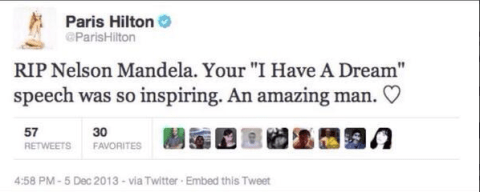
The fake tweet purporting to be from Paris Hilton sums up the spirit of Twitter tonight, as do the responses. Ha ha, isn’t she stupid, glad I’m not as stupid as what she is. One should point out that in the morning she will still be fabulously wealthy and incredibly pretty before we get too smug.

Screen Shot 2013-12-06 at 01.21.45

I digress. If the death of Nelson Mandela should teach us anything, instead of rushing to react, we should stop, pause and consider his life’s achievements and give thanks for them. He embodied the spirit of forgiveness and reconciliation and instead of worshiping his memory, or posting glib thoughts, a better tribute might be to see how we can emulate that in our own lives and instead of aiming for grand gestures of tolerance towards total strangers, start with the more testing folk close to home, who may have caused us personal harm.

Also can we stop nonsense like this headline from tomorrow’s Sun.

Screen Shot 2013-12-06 at 01.23.07

Nelson Mandela has not lost his final battle. Death, especially from geriatric causes, is not a ‘battle’ but an inevitability which comes to us all. We cannot win it, because it has already been won for us by Christ’s glorious death on the cross. Oh death where is thy sting, oh grave where is thy victory. We cannot cling on to life at all costs, we do not approach death as a battle, but with reconciliation and acceptance. As Christ says “For whosoever will save his life, shall lose it; for he that shall lose his life for my sake, shall save it.”

And finally, this may be lovely, poignant, tender, moving and funny  from tomorrow’s Times, but can we also cut it out?

Screen Shot 2013-12-06 at 01.25.32

Just as we cannot consign souls to hell, neither can we guarantee that they are going to heaven. Hopefully Nelson Mandela will end up a saint (with a small s, as it is highly unlikely that he will be canonised by the Catholic Church, though never say never) but we have no guarantee. To depict him as a saint does him no favours as he is still in need of prayers and  has whiffs of the diabolic in that it could prevent genuine prayer for him. This is what is so insidious about our current culture that fears and hides from death, in that once someone has died they are assumed to be enjoying the fruits of paradise, in order to comfort the living, which is in direct contravention of Catholic teaching. We cannot forget our responsibility to pray for all the dead.

And this is why the brief fake outpouring of grief and cloying sentiment is so damaging, because it distracts us from our very real obligation to pray for the dead as a work of mercy. Be sad for his family, be sad for South Africa, acknowledge the contribution he made to genuine equality, but keep things in perspective.

Like Nelson Mandela we too will die and on that terrible day of judgement, God isn’t going to be interested in tasteful and moving cartoons, rolling news coverage, front page headlines nor the amount of florid tributes written in haste by random strangers on the internet.

***************************************************************************************

(PS, perhaps I’m being unashamedly grouchy and fierce because 5th December marked the first anniversary of my Nana’s death. She died not having received the sacrament of reconciliation for at least 40 years and having forgone her previously regular Mass attendance being solely reliant on others to take her. I pray fervently every single day.)

Sexual objectification and gang culture

IMG_2144
‘Girls used, abused & discarded’. In the Evening Standard or in gangs? Will that be the story of former child star Miley Cyrus who is allegedly ‘keeping her kit on’ here?!

Last night as a favour to some final year broadcasting students I participated in a live TV show streamed on the internet discussing the subject of female sexual objectivisation both in the media and in nightclubs who admit scantily clad women for free. (I hope the students get a first, their production was as slick, professional and as well run as any big-name media group as well as being an innovative concept).

It was quite timely, following on from public ‘revelations’ about the fact I had once had a bar job requiring me to wear quite a provocative uniform, which was admittedly mild compared with the job of the presenter who was a former ‘Hill’s Angel’.

One of the points made was that women are actually choosing to wear next-to-nothing in order for commercial gain in order to build a brand or image around a single, although one has to question how ‘free’ that choice really is, if making themselves sexually provocative is allegedly the only way to sell their music.  The point I made was that though women wearing their underwear is nothing new these days, they are having to go to more and more outrageous lengths to sell themselves, hence the outrage wasn’t so much over Miley Cyrus’ outfit rather her twerking. Lily Allen’s recent pastiche  video featuring sexually explicit images of attractive women ironically reinforced the very sexual objectification that she  was overtly rejecting to in the lyrics, although I find the word “b*tch”  objectionable and offensive as a point of reference to women, regardless of who is ‘reclaiming’ it.

I also worked as cabin crew, another profession which at the time I was a member of it, was solely concerned with the image of their female crew as fantasy sex-objects as opposed to anything else. Look at the adverts for Virgin Atlantic, capitalising on the nostalgia of the uniform worn in the late eighties/early nineties, with its tight double breasted bright red jacket, matching short skirt and bright red shoes, colloquially known in the business as ‘f-me pumps’.

Whenever I got on the tube in uniform ready to go to work at 5am in the morning, I would always attract an obvious amount of attention, some of it flattering, others not so, but it always centrered around my appearance. Working in a profession that puts a high value on appearance which presents you as an object of sexual fantasy (note today’s uniforms are a massive improvement) means that unless you are exceptionally strong-minded, that is the attitude that you subconsciously adopt and absorb about yourself – i.e. that your value or stock as a human being is entirely dependent upon your appearance, even if you have done so willingly. One of the motivations for the bar work was that it was comparatively well paid, compared to say other jobs available to 18 year old cash-strapped students. In many ways it was a free choice no-one forced or compelled me to do it, but I wonder how many women in similar situations are doing it for the sheer enjoyment, or for the extra money, in which case how free are they?

In the case of cabin crew, the role was not simply about sashaying up and down the aisles or mixing a celebrity passenger their favourite cocktail, but predominantly about safety, however your appearance as an object of male desire, completely undermines the function of your job. Cabin crew are there to ensure passenger safety but it’s hard to be taken seriously when you are viewed as a vacuous dolly bird, there only to satisfy the whims of male passengers. At the time of the British Midland Kegworth disaster, it’s very telling that Cabin Crew/Flight attendants were not listed as coming under safety or within the remit of operations, but were under the control of ‘marketing’. In the event of an emergency, no-one is going to care if your lipstick matches your nails and hatband, if your hair has wispy bits, you need a spot more blusher or if you are half a pound overweight and yet these were assessed on a daily basis, pay rises being dependent upon consistently scoring well  in these areas in assessments. Additionally, the tights that are a non-negotiable part of the uniform (I am racking my brains to think of an airline that lets its female crew wear trousers) are a hazard and will exacerbate terrible injury in the case of disaster. Set a pair of tights (pantyhose) or stockings on fire and see what happens. Now imagine wearing them and high heels while trying to operate a slide or in extremes of temperature, or while stepping around fuel spills.

The final straw for me was when a former colleague decided to strip off for one of the red-top Sunday magazines. Handing out sweets during boarding, I noticed a sea of men engrossed in photographs of a woman stripping down to a skimpy pair of pants, whilst discarding the identical set of clothes that I was wearing and became acutely aware of the appraising glances of men, comparing my appearance to the girl in the magazine. One didn’t need to be a mind reader to be know exactly what was on their minds.

In the long run working in professions which set a great store on sexual attractiveness was not helpful for my spirituality or psyche. As C S Lewis’ Screwtape observes “all mortals turn into the thing that they are pretending to be”; making your living out of being a sexually desirable object, even if on your own terms, will distort your own self-perception.

I wouldn’t be arrogant enough to determine whether or not one could or should identify oneself as a feminist if one works in the sex industry or in a profession which uses the female sexuality to sell sex as several self-identifying feminists do just that, however I would question whether feminism, which is about ensuring female flourishing, equality freedom and independence is best served by reinforcing the idea of women as sexual objects.

What caught my eye on the journey home last night was the dreadful story in the Evening Standard about the sexual violence and abuse of women endemic in gang culture, where women are passed from man to man and severely beaten and abused. Juxtaposed next to the story on the next page were several images of sexually provocative women at the American Music Awards ceremony, together with comments about their appearance.

While all sorts of measures were being proposed to combat gang culture (not least more sex and relationship education) how on earth are we supposed to stop women from being seen as only good for one thing, when we are ourselves subconsciously buying into this and are saturated by such images in the media, although to be fair, there is an increasing trend of the sexual objectification of men. Joey Essex being one such contemporary example who comes to mind.

It’s absolutely pointless telling girls what a consensual relationship is supposed to look or feel like (I think most inherently have a sense of this) when a wholly different message is being sent out by the culture. I am not sure that explicit sex education is going to stop men from wanting to sexually abuse women, or even relationship education, which could even enable men to be able to emotionally coerce women into abusive relationships, persuading them that sex is what they ‘want’. Most abusive relationships do not start out that way from the outset, it is a gradual process and yet no woman should assume that because a man may treat her well, be attentive and charming, it signals that he is a secret sexual psychopath who is no doubt going to abuse her later down the line. Besides gang culture is not simply about a manifestation of misogyny, but is indicative of the crisis facing working class young men in urban societies.

One has to ask where are parents in this mess. In the terrible story of the middle-class girl who spent five years being abused, the parents seem to be wholly absent, proving that it is not class that is the determining factor, but the quality of parental relationships.  It is not meant as blame, but parents seem to be assumed to be taking passive roles, whereas children need good relationships, trust and respect modelled for them as opposed to being taught in a purely didactic fashion. How is a young teenager with crazy unstable hormones supposed to absorb what a healthy relationship should look and feel, simply by being told. They need to be able to intuit and most girls can intuit that something is not right, but not until it is too late.

Parents need to be empowered and enabled to keep tabs on their children and each others, either forming groups to ensure that children are kept occupied after school and reinforce each others’ house rules and curfews. Should thirteen year olds be allowed out late at night, especially on a school night? It’s not just about helping children to keep themselves safe, but teaching parents to help keep their own children safe and impose boundaries, instead of acting like they are powerless in the face of their children’s inevitable rebellion and physical responses to puberty.

Ultimately if we object to sexual objectification in the media and world around us, which contributes to the culture of abuse, self-loathing and brings nothing but long-term damage, both on an individual and societal level, then we need to take steps not only to pressurise our media, film and music industry to clean up their act, but not buy into it ourselves and for our children.

If we object to women being used as worthless sexual objects then we should not surround ourselves with music and videos or newspapers or media that refers to them as ‘b*tches’ or further entrenches the culture, whether that be in the Daily Mail or on the X-Factor.

Repercussions

Admittedly I’m feeling incredibly vulnerable following yesterday’s post, being ‘outed’ is an uncomfortable experience, but God willing, it could turn out to be something of a blessing.

Firstly I am beginning to feel a little more comfortable in terms of referencing my own very personal experience, which is not atypical of women who have been through an abortion.

 It could also turn out to be an opportunity for apologetics.

Those who made the accusation have continued to taunt and abuse, openly discussing my  blogpost (which is fine in many ways, if you blog about a personal situation you are putting that information into the public domain) and mooting whether or not I am excommunicated from the Church, whether or not our children are illegitimate (who cares) and indulged in the usual sixth-form pop psychology antics about the amount of guilt that I must be carrying around. How unfortunate, they say, that rules which she tries to impose upon others have got her into such a mess, whereas the irony is that had I been aware of the rules I wouldn’t have got into such a state in the first place! And of course living by those rules has brought me greater peace, contentment, joy and bliss and fulfilment than I ever gained previously, which is why I passionately promulgate them.

One of the reasons that I believe that those who promote an authentic pro-life vision come under so much attack is because time and time again, it’s thanks to that particular Catholic doctrine that attracts so many converts, whether it be through investigating what the Church teaches about marriage, about contraception, family-life or abortion.

 My experience of abortion was definitely an enormous part of my journey home as for the first time I truly understood what was meant about God’s most severe mercy. A generic faith in God had never deserted me and bitter experience taught me that Christ’s commandments were not designed by an arbitrary capricious vengeful god, but are there to keep us from harm. I wondered that if the Catholic church was in fact right about abortion, then what else were they right about and why?

It wasn’t the great Damascene conversion, but a gradual process of looking back at my life and seeing those moments, where in retrospect, God was definitely present and planting seeds of grace.

To answer some of the ridiculous assertions, firstly I am not excommunicated from the church. Abortion does carry an  latae sententia sentence of excommunication, meaning that one automatically excommunicates oneself from the church upon having an abortion, however one has to be over the age of 16 and aware that it is an excommunicable offence.  In addition if you are are forced into it, acted out of grave fear, lacked the use of reason (unless culpably via drink or drugs) then excommunication wouldn’t apply.

 It needs to be remembered that excommunication is a medicinal measure, the deprivation of the sacraments is designed to make people bring their lives back into conformity with the church, not cast them out eternally. Regardless of whether or not one was excommunicated for abortion, this is always lifted upon receiving the sacrament of reconciliation, although there are certain reserved sins that a priest needs to apply for permission from the Apostolic Penitentiary in Rome or his Ordinary, in order to absolve you from. Abortion is technically one of those sins which not every priest has faculties to forgive, however in the UK and other countries such as the US there is a blanket permission given to clergy to issue absolution for on the unfortunate basis that it is so common.

Are my children illegitimate? The answer is no, and I doubt anyone really cares. Illegitimacy is historically bound up with inheritance rights and though the church might recognise that a marriage never sacramentally existed, it does recognise that it had civil validity and thus any children are not deemed illegitimate. So neither my eldest child, nor my subsequent children are illegitimate as they were all born as a result of civilly legal marriages.

The Church does not care whether or not children were born within or outside wedlock, every single person is of equal dignity and worth, circumstances of birth are beyond all of our control and no decent person would wish to attack anyone’s children on this basis. Pope Francis has repeatedly called upon priests to ensure that they baptise the children of unmarried mothers and in a personal phone call offered to baptise the baby of a woman who wrote to him in great distress after discovering that she had fallen pregnant by her already married lover. It takes great bravery to decide to keep a baby in a society that looks upon abortion as a desirable solution for unplanned pregnancies.

But here’s the best thing of all, and that is that once you have confessed to having sinned, no matter how terrible or dreadful the crime, (provided that you make adequate reparation through penance and resolve not to re-offend) then you are forgiven. I don’t carry about a hulking great chunk of guilt, because I laid it at the foot of the cross and trusted that it was forgiven. Regret remains, but all of this is a manifestation of Romans 8, 28. The abortion can never be justified, God neither wanted or willed it to happen, He allowed me to make my own choice, however now He has caused good things to come out of a terrible evil and sadness.

 It is true that having confessed I felt liberated, I made my confession in Oxford and remember almost floating down St Aldates on a cloud of air, but actually confession is not about how it makes us feel. Sometimes you can go and for whatever reason, not feel wholly forgiven or that perhaps the priest didn’t really take your sins seriously but the whole thing is an exercise in faith and trust. A little like having been forced to make a public confession in fact.

There is a large part of me which feels that having admitted to such a terrible thing, I can never show my face in public again, a feeling which is exacerbated when I see Catholics quibbling over whether or not I incurred an latae sententia, together with their friends who outed the information in the first place, stating that I only confessed for ‘attention’ and I may now regret it as everyone will know that I am excommunicated and my children are illegitimate. It is hoped that I will now face great shame and disgrace.

But my faith tells me that I am a walking lesson in the power of redemption and how Catholics apply the principle of hating the sin but loving the sinner. What I did was undoubtedly wrong, but in common with most post-abortive women, there were several mitigating circumstances. Abortion is murder, however that does not make post-abortive women murderers and I have always been extremely judicious in my choice of language. A murderer, especially if one adheres to the legal definition, is someone who possesses intent. Most women who have an abortion do not have the intent to take the life of a human being, rather they do not see the baby as a life, and tie themselves into Gordian knots of illogicality, aided and abetted by contemporary attitudes and abortion providers. There is a silent unspoken conspiracy between the woman seeking the abortion and those who participate in the act, to obscure the nature of what is happening.

Of course I was misguided hoping that people might now leave me alone, my existence is naturally going to be jarring and dissonant to those who disparage the Catholic church, those who have been laughing about the bones of St Peter and transubstantiation as being sick and hocus pocus.

What self-identifying ‘liberals’ (who are in reality anything but) hate most is grace, repentance and transformation because it assaults them to the core of their being. It tells them that they can change, sin can be forgiven and that God is calling them to repent. Which means that they have to accept that they might be doing something wrong in the first place, a concept which the narcissist cannot cope with. Why does it matter if I consider certain actions to be sinful, i.e. separating from you from God?

I have to be attacked for having once been in a similar state of mortal sin, because to do anything else accepts that their position is not immutable. Admitting that something could be wrong is an anathema. They have to scream hypocrisy because the alternative to is run screaming for God’s mercy.

There’s a certain provenance that all this has occurred on the occasion of the end of the year of faith. Reflecting upon yesterday’s readings, Pope Francis said this in his homily;

Jesus speaks only a word of forgiveness, not of condemnation; whenever anyone finds the courage to ask for this forgiveness, the Lord does not let such a petition go unheard. Jesus’ promise to the good thief gives us great hope: it tells us that God’s grace is always greater than the prayer which sought it.

Lessons from St Augustine

St Augustine of Hippo, arguably one of the greatest doctors of the Church, is one of my favourite saints, not only for his blinding theology, but also because of his brutal honesty when describing his previously rackety and louche lifestyle before being converted to Christianity by the grace of God.

Confessions, his apologia which is a spiritual classic, does not hold back when it comes to describing some of his past sins. He writes about taking pleasure in stealing, how he revelled in a self-indulgent lifestyle, enjoying chariot-racing, gambling, the pleasures of the theatre, played rude and unkind tricks on people and his sex-life was legendary. Augustine recounts how he spent thirty years of his life lost from God and Confessions reflects upon this time and how he believed that God had used this period to save him, but far from being a navel-gazing autobiography, Confessions is a work that seeks to praise God.

Some scholars believe that one of the reasons that St Augustine wrote this defining work, was because he was attempting to give an answer for Catholics in response to the Donatists who had a legalistic approach and did not forgive sin very easily. Augustine had been building a solid reputation as a faithful convert, he’d been baptised ten years previously, but at time of writing his Confessions had only been a bishop a few years and therefore was encountering much jeering from the Donatists who did not afford him much credibility because his reputation as a past sinner preceded him.

I could never hope to attain the intellectual brilliance of Saint Augustine although I aspire to his holiness and have great sympathy with him, not least because like him I have a ‘past’.

Today, on Twitter, once again the same group of people comprised of a hotchpotch of gay activists and disaffected Catholics, launched one of their attacks and did so very publicly and very specifically, using my name and hurtful events in my past as a means to attack. The accusation being that due to having behaved in a less than holy way in the past, I am now a terrible example and appalling representative of my faith.

I don’t claim to be a plaster-cast saint and like Saint Augustine I have made some disastrous mistakes in my past. I told a few people about this in confidence, and on one occasion briefly went public on this for about 2 minutes, before deleting a post, as I was advised that I was opening myself up to a lot of personal attack and would need to ensure that I had the necessary emotional strength to cope with it.

Those who scan my feed with gimlet eyes 24/7 obviously saw it and/or they were informed by the former friend whom I once told and now toss this about with impunity, believing that it validates their contention about the state of my soul. When I did an interview for Vicky Beeching’s faith in feminism site, within 5 minutes, a commentator steamed in with a comment containing personal information, then complained bitterly when upon my request Vicky kindly deleted it, appreciating the inappropriate nature of the remark. She later related how she was repeatedly emailed and told about my past, the claim being that I was a secret pro-choice advocate!

So here are the three accusations. I have screenshots of the vile tweets, but I won’t use them here because I don’t want to make this about personalities.

Divorce

1) I have divorced and re-married. That’s not very ‘Catholic’ is it and in reality I’m still married to another man and committing adultery. Yes really, that’s what a fake account set up using the name @realfarrow and my photographs said. As did another fake account @stain_of_sin which tweeted bible verses from Revelation about the ‘hating the whore’ and ‘her flesh burning’. Really. The latter account still exists at time of writing. It made a list called ‘mummy’s friends’ and made threats that they should all be told the truth unless I got off Twitter.

I’ve written about this before. I was never validly married in the eyes of the Church and for reasons I’m not going to go into, there are doubts surrounding the civil legality of my former marriage.

I’m not going to get overly defensive about the affair because I turned it over to a Church marriage tribunal who ruled that no marriage ever previously existed. I have to bear some blame because I did not understand the nature of the sacrament of marriage, that it entailed being open to children, was life-long and unbreakable. Neither did my former partner who still believes that marriage should have nothing to do with children.

The lesson I have learned from that is to ensure that my children fully understand what marriage is all about and take real care in discerning whether or not it is for them as well as in discerning a potential spouse. Like many people of my generation I suspect, I walked into something, without thinking about what came beyond ‘the big day’, because I was cohabiting and it was believed to be the ‘next step’ and because I felt under pressure from family that it was the right thing to do. I also liked the idea of respectability that being married and having a nice flashy ring afforded. Yes, I was that shallow.

Relationship breakdown is always a painful experience, especially when children are involved and mine was no different. Had the pair of us been more honest with each other about desires for children, then a lot of heartbreak would have been avoided on all sides.

Dodgy Bar job

2) I once worked in a bar called Hooters in another country. At least three different people have made specific reference to this, it stems from something I told a former friend a few years ago, not being public information. The reference is used frequently in an attempt to shame and humiliate me, because those familiar with said establishment will know that their gimmick is to employ attractive women who wear a relatively sexy uniform.

Hooters is billed as family restaurant. Kids eat free there. So basically I served beer and food at the age of 18, whilst wearing short shorts and a vest top. Big woo!

Abortion

3) Most seriously, and there is a whole other post in this, when I feel emotionally ready and strong enough, as this group frequently  tells people privately and now publicly, I had an abortion in 1997. I am one of those ‘baby-killers’ who I allegedly judge and despise. Except I don’t because I’ve been there.

Some of the factors that influenced my decision was that the baby was the result of a non-consenual encounter and it was clear I would be bringing up a child alone. I was on a six-month temporary contract at work and would undoubtedly lose my job. I was scared of the stigma of being a single mum on benefits as well as the reaction of my family and my reputation. I knew one day I wanted to get married and had been told that “no decent man will look at you twice”. There is something of an irony in that I eventually went on to marry someone who was delighted that I had a beautiful daughter and couldn’t care less that I was a single mother.

Adoption was dismissed as “you don’t want someone knocking on your door in 18 years time” and thus I found myself at  the door of the Marie Stopes clinic Whitmore Street in July 1997.

I had been warned to expect protestors or demonstrators by the clinic and was almost disappointed that there was no-one there. There was a part of me that wanted to be confronted or challenged, I don’t know what the result of that encounter would have been, but my feeling is that I would now have a 17 year old child who was alive.

What bothered me was not the circumstances of conception, but the idea of coping alone with a baby along with the accompanying shame and stigma.

I used biological sophistry to defend my decision, despite knowing inherently that this was a human life who deserved the same protection as everyone else. The ‘counselling’ in Marie Stopes consisted of a woman telling me that ‘there is no other choice, it’s clear-cut, you’re obviously in no position to be able to look after a baby’.

There’s a lot more for another time about the horrors of the procedure itself, the way that Marie Stopes treated me like a contemptible stupid piece of meat, from the monosyllabic person who carried out the scan, to the aggressive woman on reception who shouted at me the morning of the procedure, for not having brought the right piece of paperwork, one which she subsequently found she had all along. As I burst into tears, she then looked at me with a hint of remorse and said “are you sure you’ve made the right decision”? It was too late, I’d already taken the tablets to poison the baby and cause the foetal sac to detach from the placenta the day previously. One memory that stays with me is of the slightly chubby West Indian girl, listing like a beached whale, stretched out flat on the bench to entrance, vomiting profusely into a kidney dish and crying, all alone, whilst everyone looked on rather nervously. I wanted to reach out and touch her hand, but I didn’t.

Despite the fact that I thought abortion was the ‘right’ decision for me, that I didn’t believe that the baby could feel any pain and walked out of the clinic, physically traumatised, but too exhausted really to think or absorb what had just happened, it hit me the next day.

I was at home, sitting watching Coronation Street with the family, when all of a sudden the after-pains kicked in and I experienced stomach-wrenching contractions, which caused me to writhe in pain. It hit me. What the hell was I doing watching Coronation Street, pretending everything was alright when really my baby was dead? I ran to my bedroom lay on my bed and howled pitifully, like a wolf at the moon. There was a palpable, visceral sense of emptiness and loss, which no-one had warned me about and which I didn’t expect.

My baby was dead and gone, would never come back and I had killed him or her. I would have given anything to turn the clock back 72 hours just to have my baby back, to hold them in my arms, to see them, but it was too late. I couldn’t actually believe what I had done. The best analogy is that of the character of John Coffey in the Green Mile, when he discovers the bodies of the dead children and desperately cradles them and attempts to use his supernatural power to save them.

“I tried to take it back, but I couldn’t”.

I vowed then, that I never ever wanted any woman to suffer either physically or emotionally in the same way that I had, and it’s one of the reasons that I am so passionately and vehemently pro-life.

I am ashamed that I did such a dreadful thing, but equally I brought this all to the Lord in the sacrament of confession many many years ago. The thought of confessing to having killed my unborn child was terrifying and deterred me from going to confession for years, but once I had done so, it was the most beautiful, liberating and healing experience of my life. I walked out feeling 10 stone lighter, knowing and trusting that I had been forgiven.

I am as healed as one can ever be from such an experience, although there is always a sense that one (now two) of my children are missing, I should also have a seventeen year old who isn’t here. I know one day I will have to look that child in the face and apologise for the fact that I deprived them of the chance of life, and I cannot justify my decision. There may have been mitigating circumstances but it was the wrong thing to do nonetheless and I accept that, which is why so many women struggle with the healing process. It’s a delicate balance of accepting that one has lost a baby, accepting your personal responsibility in that, but at the same time being gentle with yourself.  Looking at teenage mothers who had the courage to continue with their pregnancy fills me with a sense of awe, inspiration and shame.

Going through the recent experience of a managed miscarriage, which had many similarities to the abortion, has thrown it all into sharp and painful relief – the contrast of giving birth to a deceased child, instead of one that you had caused to die, along with according him or her the respect and dignity that they were due as a human being, rather than allowing them to be discarded as a piece of clinical waste in the incinerator.

Conclusion

I’m coming clean as this has been repeatedly used to attack me over the past few months in an attempt to shame and hound me off public forums.

I made some hideous and reckless decisions when I was young, which inflicted some lasting damage. Like all of us I am wounded, but it’s Christ who heals our wounds and like his they can be transformed and glorified. One of the reasons I deviated so far from the path of God, was not just my own sinful nature, but because I hadn’t been brought up with strong faith foundations and didn’t understand the teaching of the Church or have any vision to aspire to.

I look at certain members of Catholic youth with a certain enviousness; armed with similar grace, faith, trust and certainty at that age, I could have prevented a lot of heartbreak and unnecessary mess.

And funnily enough, the only people who wish to berate me for my past are those who are outside the Church in one way or another, who are living irregular lifestyles. From those so-called orthodox, traditional Catholics, I’ve had nothing but acceptance and love. It isn’t Catholics doing the ‘judging’.

Like St Augustine I learnt that our hearts are restless until they rest in the Lord. And if my painful experience deters just one person from entering through the abortion clinic doors, if my witness inspires others to learn why it is I am so passionate about our faith, or to make people approach the faith with an open-mind or concede that my ideas are based on reason and truth, then the psychological cyber-bullying is worth it and will no doubt continue.

But yes, I made a mess of my life, including an attempted marriage and an abortion. But I am secure in the knowledge that I’ve made amends, conformed my life to God and that His love for has not diminished. And if there’s hope for me, then there’s hope for everyone.

Pray for me.

The taboo of behaviour change

Most people accept and acknowledge that behaviour is an important factor when it comes to matters of health. Although we cannot change our genetics, certain people are predisposed towards conditions such as cancer, there are things that we can do to mitigate risk and attempt to maintain optimum health. We know that smokers substantially increase their chances of contracting disorders affecting their pulmonary and circulatory systems, we accept that eating saturated fats and salt in large quantities increases our risk of heart attacks, we accept that obesity is linked to diabetes and that ideally we should eat at least five portions of fruit and vegetables a day as well as take regular exercise.

Very few people kick up a fuss when the benefits of adopting certain behaviours are suggested and promoted by the government, we know that excessive drinking is bad for us, we know that pregnant women shouldn’t smoke and various health authorities and advisors are playing around with the idea of financially incentivising or discouraging certain behaviours in the interest of public health. One health authority is trialling the idea of financially rewarding mothers who breastfeed with a voucher system, in order to reboot and kick start a culture of breastfeeding which, if the mother is able to do so (the overwhelming majority of women can breastfeed with the right advice and support) is best for the child. We’ve seen minimum alcohol pricing introduced in Scotland and mooted in the UK, along with taxes on fast food, dubbed the ‘fat tax’. There’s also talk of making vaccinations compulsory for children in order to qualify for child benefit.

So why  is it, when it comes to issues of sexual health, proposing certain behaviours should be adopted, such as abstinence until marriage and remaining faithful and monogamous to one sexual partner only, becomes the subject of immense vitriol and scorn?

Those who follow me on Twitter, would do well to have a look at an illuminating discussion held over the course of the last few days. Leaving aside the usual awfulness comprised of “you have bizarre morals, you’d rather your children got cancer than had sex, you are twisted, everyone hates you, oh look now you’re playing victim again, you’re only doing this for attention, you ought to get off Twitter, no one listens to you and thank God you are not like most Catholics” (requisite skin of a rhinoceros is yet to form, it is hard to repeatedly attract such unfounded abuse) what seemed to be causing unprecedented amounts of opprobrium was the idea that sexual behaviour is key in terms of maintaining optimal sexual health and avoiding the transmission of STDs.

The first issue being that of the HPV vaccine which it is recommended that girls receive in early adolescence before they commence sexual activity. In a misleading advertising campaign, the NHS suggests that once the girls receive the vaccine they are therefore “armed for life”. As this interview with one of the lead researchers responsible for the development of the vaccine used in the UK, Gardasil, makes clear, HPV vaccination has its disadvantages as well its advantages. Instead of being armed for life, as the NHS advert suggests, the vaccine has a limited effect, lasting up to 15 years maximum.

Armed for life, or 5-15 years? Armed against every strain, or just a few?

The vaccine is not an immunisation against cervical cancer, but rather the HPV virus, which is present in almost all forms  of cervical cancer and believed to be responsible for the condition. While considering whether or not one ought to allow one’s child to be vaccinated, one needs to weigh up all information available, such as efficacy and benefits versus the risks.

As with all vaccines, there are risks with Gardasil, including auto-immune disorders and even death, although these are rare. As Marcia Yerman points out, this vaccine does not protect women for life, they can still get other HPV infections which are not covered by the jab and they must not neglect regular cervical smear tests, which are vital in terms of discovering and treating pre-cancerous cells.

An immunisation may protect you from certain forms of HPV which could lead to cancer, however cervical cancer is as my gynaecologist once put it, “one of the must stupid cancers to die from” in that is is easily treatable if caught early. Regular pap smears detect abnormal or precancerous cells which are then promptly removed before they have a chance to develop into full-blown cancer.

The best way to avoid infection with HPV, which is a purely sexually transmitted disease, is to limit the number of sexual partners you have, the ideal being to have just one sexual partner and remain faithful them to the rest of your life. If your sexual partner has equally never had any sexual contact with anyone else then your risk of developing an HPV infection which could lead to cancer is negligible. Worringly, there seems to be an emergence of head and neck cancers related to HPV infection, contracted through oral sexual contact.

While HPV vaccination could prevent infection, aside from the small risks of an adverse reaction, the danger is not that it will encourage promiscuity, (and regardless of vaccine, promiscuous behaviour is risky) but that it will encourage the phenomenon of risk compensation, as experienced by Professor Edward Green, former Professor of HIV Prevention at Harvard. Believing that they have been immunised against cervical cancer, girls may be encouraged not to use barrier forms of contraception and/or engage in sexual behaviour that they would otherwise have avoided, under the illusion that they were safe and protected. Most concerning is that they may be discouraged from participating in the cervical screening programme, (most women approach their smear with reluctance, no-one relishes the experience, it is a necessary uncomfortable part of health care) believing that they are protected from cervical cancer. An HPV jab isn’t going to prevent the development of precancerous cells let alone treat them.

Pap smears have never killed anyone. Pap smears are an effective screening tool to prevent cervical cancer. Pap smears alone prevent more cervical cancers than vaccines. The argument is best summed up by Marcia Yerman thus:

Gardasil is associated with serious adverse events, including death. If Gardasil is given to 11 year olds, and the vaccine does not last at least fifteen years, then there is no benefit – and only risk – for the young girl. Vaccinating will not reduce the population incidence of cervical cancer if the woman continues to get Pap screening throughout her life.

If a woman is never going to get Pap screening, then a HPV vaccine could offer her a better chance of not developing cervical cancer, and this protection may be valued by the woman as worth the small but real risks of serious adverse events. On the other hand, the woman may not value the protection from Gardasil as being worth the risk knowing that 1) she is at low risk for a persistent HPV infection and 2) most precancers can be detected and treated successfully. It is entirely a personal value judgment.

What is left out is that 95% of all HPV infections are cleared spontaneously by the body’s immune system. The remaining 5% progress to cancer precursors. Cancer precursors, specifically CIN 3, progresses to invasive cancer in the following proportions: 20% of women with CIN 3 progress to invasive cervical cancer in five years; 40% progress to cervical cancer in thirty years. There is ample time to detect and treat the early precancers and early stage cancers for 100% cure.

So really there is no need for the “Lord spare us from ignorant Catholic houseswives putting out dangerous information” “your daughters will get cancer”, “Farrow is spreading dangerous lies”, “you are pro-cancer and pro-HIV” invective spewing across my timeline.

Problem is, in a society when personal autonomy and choices are gods, suggesting anything other than all choices are of equal value (moral relativism) is akin to judgemental bigotry. It might be extremely convenient for me that Catholic doctrine on sexual morality is  scientifically sound, natural law is entirely logical, but it’s a nightmare for sexual libertines, most of whom seem to be unhealthily preoccupied or obsessed with others’ approval. Advocating a certain course of action is automatically deemed ‘judgemental’ or ‘blaming’ of those who don’t take that course of action and allegedly stigmatises those who do suffer from adverse health, regardless of whether or not they have engaged in risky behaviour.

The idea of a society when people can have as much sex as they like, with as many people as like, consequence free and that we can protect people from STDs might well be a beguiling one, but it is highly irresponsible. HPV vaccines, condoms, birth control and abortion all add to this masquerade, which is why people become so angry when their lifestyle is challenged. It’s easy to dismiss moral concerns as being based upon religious grounds but pointing out irrefutably scientifically established health risks raises things another notch. It must be disconcerting to learn that the prejudiced bigots are right, better to attack their motivation, values or character, instead of the issue itself.

The whole canard of HIV prevention in Africa was once again raised, with all evidence being dismissed as biased, simply because of the fact that it was presented by me and supported Catholic doctrine. As has been demonstrated, the Emeritus Pope was entirely correct when he pointed out that condom promotion exacerbated the problem of the spread of HIV. Condoms have a typical use failure rate of 18%, the spontaneous nature of sexual urgency makes laboratory conditions of perfect use, extremely difficult to replicate. Problems are exacerbated in countries such as Malawi, which as aid workers testify, are flooded with condoms nearing their expiry date and which have been stored and shipped in conditions making them more susceptible to damage. People are making risky decisions on the false premise that they are protected.

I guess I’m rather nonplussed, it’s bizarre to see coherent evidence denied simply because it supports your worldview. The ‘debate’ veered from accusations of making stuff up, of putting out irresponsible information on internet that would cause deaths, to an admission that I hadn’t actually said anything factually incorrect, but was cherry-picking the evidence to suit my own purposes. Isn’t that what most people do, come to a conclusion based on the evidence available?

Sexual health is not the only area in which emotions are inflamed when suggestions are made of an unhealthy lifestyle as being a contributory factor to certain conditions, and the age of moral relativism means that all are equal. Hence the perennial wars on baby websites about breast versus bottle. Health decisions, especially for children always involve  heavy personal investment. I’ve taken decisions (such as miscarriage management) that may not have been advocated as the best course of action as others, but the difference is, I’m not going to get offended if someone suggests I should have done something else, in the same way, I couldn’t give two hoots if someone thinks my cesarian-sections were because I was too posh to push. I know a natural childbirth is ideal but just because life doesn’t always work out the way you’d hope, doesn’t mean that we shouldn’t aspire to the best.

Trying to discourage promiscuity, instead of relying upon the illusions and false promises of the pharmaceutical society, has to be a much more sustainable, long-term and ultimately cheaper solution. Pointing out that condoms don’t always work should not be an issue to cause such bad feeling. Why aren’t we asking why until the HPV jab was developed, that condom manufacturers and family planning officials were not widely publicising that they didn’t fully protect from HPV?

Evidently I’m still a naif, in that I’m still taken aback and surprised by the animus coming in my direction, for stating a medical fact. Stick to one sexual partner only (or remain celibate) if you want to seriously lessen your chances of contracting a sexually transmitted condition. It may not be the easiest, it may take willpower, but it’s no more impossible than say quitting smoking or cutting out the booze. You just have to want to do it. Stating the ideal does not blame the unlucky.

I may well get a t-shirt printed – Catholic teaching on sex corresponds with medical fact, get over it. What is more dangerous, giving an illusion of protection, or presenting the pure unadulterated facts as they stand?

While I should no longer be surprised, I still find myself taken aback nonetheless. Why are otherwise intelligent people so willfully blind when it comes to the consequences of sexual behaviour? Uncharitably, the only conclusion I can arrive at that is that it’s concrete proof that sin really does darken the intellect and make you stupid. People are too attached to a certain behaviour to want to admit that it could cause harm.

Clerical celibacy and clergy wives

Taken from the Catholic Universe 17 November 2013


Snarky-Cardinal

The topic of clerical celibacy has been hotly debated on the letters page of the Universe of late and I’ve been intrigued to note the general theme has been overwhelmingly in favour of the notion that the Catholic Church ought to change her discipline regarding whether or not priests may marry.

It’s an issue in which I have a degree of personal investment; as my bio notes, my husband is currently in the process of formation awaiting ordination to the Catholic priesthood, following fourteen years of ministry as an Anglican vicar.

While one might automatically assume that I would be a natural advocate for a married priesthood, the reality is that I find discussion of the subject rather uncomfortable for a variety of reasons, not least because I am not wholly convinced that a married priesthood is in the best interests of the church, and because I find myself agreeing with St Paul not least in terms of the divided heart. Which arguably makes me something of a hypocrite!

From the point of view of a clergy spouse, one of the most irritating aspects is that the whole debate centres around the man himself and the benefits to him and thus his vocation of priesthood, of being married, many of which raise the canard of the benefits of a regular sex-life. The pedophile scandal has propagated a flawed narrative which holds that if a man is married he will therefore be enjoying frequent bouts of sexual activity and therefore less likely to go out and abuse children.

Leaving aside the fanciful notion that marriage is a guarantee of regular sex, statistics demonstrate that married men are just as likely to commit sexual offences as those who are single. There is no evidence to suggest that healthy heterosexual men develop erotic attractions to children or adolescents as a result of abstinence and even if there were, this would not excuse the heinous crime of sexual abuse. The other disturbing aspect of this line of thinking is that it validates the misguided idea that sex is a basic human need, on a par with food, water, shelter and rest. I’m yet to hear of the case of a man or woman who died as a direct result of lack of sex, and it’s more than a little insulting to the many millions of people who manage to live happy and fulfilled lives of celibacy, to suggest that there may actually be something wrong with them for not desiring sexual intimacy. The message that sexual intimacy is a necessary part of adult life runs is in direct opposition to Catholic teaching and one we should strongly reject.

 From my perspective, what I find enormously offensive about all of the arguments surrounding married priests is that no matter how well-meaning people are, they inadvertently take on a misogynist tone, in that the clergy wife herself is never considered as person, she is always reduced to the status of a chattel and often by those who would no doubt otherwise consider themselves bastions of a progressive attitude. It is beyond abhorrent to be referred to as some sort of faceless sexual object, there to fulfil one’s husband’s sexual needs in order to make him a more rounded person. Christ set the standard of celibacy, I don’t remember anything in the Gospels about needing to use women as either sexual or domestic objects in order to build up the Kingdom of Heaven.

 What is never mentioned and definitely needs to be borne in mind is that being a clergy wife is a tough call and a vocation in and of itself. Wives have to innately understand the demands of priesthood, this is not merely a job to put bread on the table, it is an indelible mark on the soul, your husband has responsibility for the care of souls and therefore it requires more self-sacrifice than in other marriages. On a practical level you have to accept that your husband probably won’t be there most evenings, a phone call or knock at the door means that children’s parents evenings will need to take second place to administering the sacrament to the sick or dying, weekends will be a wash-out, especially during the summer wedding season, you’ll need to run an open-house, keep a well-stocked larder, take full responsibility for childcare and accept the fact that your husband will not be able to retire until he is 75. In addition you will feel under constant scrutiny and pressure to be modelling the perfect example of family life and domesticity at the same time as trying to make oneself as inconspicuous as possible, in order not to be seen to be trailblazing a path or making some kind of political point about the merits of a married clergy.

Being married to a priest means that one needs to be able to support and not impede his ministry, so that on the terrible day of judgement, I will not be complicit in having prevented my husband in shepherding his flock. That’s not a responsibility, I, or any clergy wife I know, take lightly.

I never imagined I would wind up married to a Catholic priest, but life as an Anglican vicar’s wife has been a good preparation for the role. Convert clergy wives go into this with their eyes open and have to endure a great deal of personal upheaval and sacrifice before their husbands are even ordained.

 The laity may well believe that Father ought to take a wife. But whether or not he can find one that not only wants to marry him, but is prepared and equipped to deal with the unique and demanding life of being Mrs Father, one which has a potential to strain a marriage, is another matter entirely.

Nano Nagle – a beacon for 21st Century Catholic women

Taken from the Catholic Universe 10 November 2013

YoungNano

Having stated last week that it was possible to be both a Catholic and a feminist, my heart leapt at the announcement from the Vatican this week that Nano Nagle, the Irishwoman who founded the Sisters of the Presentation Order is to be declared a Venerable, the next step on the path to Sainthood.

Born to Irish Catholic gentry in Ballygriffin, North Cork in 1718, Nano (who was Christened Honora) was born against the backdrop of Ireland’s notorious penal laws, that were designed to subjugate and oppress Catholics, with the aim of wiping out the practice of Catholicism within Ireland. In the words of Edmund Burke, the Irish statesman, politician and philosopher, Nano’s distant relative, “Their declared object was to reduce the Catholics in Ireland to a miserable populace, without property, without estimation, without education”.

Eighteenth century Ireland banned the opening of Catholic schools and also forbade Catholics from travelling overseas to receive an education, therefore Nano’s family took some risks in smuggling her and her sister Ann to Paris where they were able to enjoy a full Catholic education.

It was witnessing the plight of the Parisian poor that inspired Nano to consider how she could best serve them and upon discerning a vocation, following advice from her spiritual director she decided to dedicate her life to providing an education for children in poverty.

The world is currently captivated by the story of the courageous Pakistani schoolgirl Malala Yousafzai who was shot by the Taliban for her activism encouraging girls to attend school, against considerable cultural pressure and yet 250 years ago, a Catholic woman was displaying the same bravery and pioneering spirit in terms of overcoming a cultural bigotry and prejudice that was enforced by law. When Nano’s brother accidentally discovered what she was up to, his initial reaction was anger as she was placing herself and the family under considerable risk.

Embodying the spirit of the Gospels, Nano’s first school in Cove Lane, Cork, admitted thirty children, from the poorest and most deprived backgrounds, by the time she died in 1784, a whole network of schools had been established, teaching over 400 pupils in seven different parishes, all funded by her own inherited wealth. The schools taught basic reading, writing and arithmetic alongside fundamental catechesis. She also introduced classes in practical skills such as needlework and lace-making in order to enable girls to be able to earn their own living and lift themselves out of poverty.

When her personal fortune ran out, she began begging on the streets on behalf of her schools and eventually founded her own order of religious sisters with the constitution of educating the poor. As the penal laws were still in force, instead of being able to be called Mother Superior or wear a habit, Nano was known as Miss Nagle. A hundred years before the work of Florence Nightingale she became known as the the Lady of the Lantern and her sisters known as ‘Nano’s walking nuns’, her love of the poor not confined to the education of children, but she extended her work to visiting the homes of the poor and doing rounds in the backstreets of Cork.

At a time when the media, the Irish media in particular and public life is preoccupied with sneering at Catholic Religious Orders, it is worth highlighting their contribution to Ireland and the world at large. Presentation Nuns alongside other orders were the first to provide Irish people with the opportunity for an education when no Government or other public body was willing or able to do so and at great personal cost to themselves. Through the foresight of those such as Nano Nagle, and the thousands of religious who dedicated their life to this work, generations of pupils were given a first-rate education, equipped with skills and thus able to elevate themselves out of poverty and contribute to the common good.

Today, many Catholic religious orders continue to provide education, often the only education available in some of the poorest and most unstable parts of the world, such as in Africa, Latin America and in Asia, a fact that is sadly all too often overlooked or ignored, even by Catholics. Nano’s Sisters of the Presentation Order has spread as far afield as Peru, Chile, Ecuador, India, Pakistan, Slovakia, Pakistan, the Philippines, the United States, Zambia and Zimbabwe.

Nano Nagle, set down the foundations of the education system in Ireland and inspired generations of educators to come, including a number of notable women who founded their own religious orders and network of schools. Those who so often rush to accuse the Church of misogyny ought to examine the history of Nano and her spiritual descendants, recognising and celebrating their contribution and the contribution of the Catholic Church to the education and empowerment of women.

Nano Nagle’s lantern became the symbol of the Presentation Sisters all over the world. Now her life has been officially recognised as being heroic in virtue, she continues to remain a beacon for twenty-first century Catholic women, showing that fighting for the causes of women and social justice do not need to be mutually exclusive.