They’re still at it…

The Daily Telegraph bloggers Ed West and Brendan O Neill have both written brilliant pieces about the dangers of statism in recent weeks. I would like to add this insidious example, that I found nestling amongst the pages of the Guardian in which it was claimed that the teenage pregnancy strategy was a ‘triumph’.

I have previously discussed and debunked some of the myths, but a short recap is in order. Teenage pregnancy rates have remained static since the 1970s. Over £280 million has been poured into the teenage pregnancy strategy with the sole aim of reducing teenage pregnancies. Rates have dipped slightly but fallen well short of the stated target of a 50% per cent reduction. When considering any drop in the teenage pregnancy rate, we need to remember that the rates detail a figure per thousand teenage girls. So if there are double the number of teenage girls and double the number of pregnancies, then the rate remains the same. In 1999 around 49,900 girls under the age of 18 fell pregnant.* In 2009, the number had dropped to 45,500. Whilst no-one can dispute the drop, to call the 18% reduction a ‘triumph’ requires a flexible interpretation of the word, particularly when one considers the target of a 50% reduction. They are not even halfway there.

Obviously there has been a limited success in terms of pure pregnancies and thus the Teenage Pregnancy Strategy may tenuously cling onto this reduction, however this does not take into account the STD rate which has shot through the roof. Since 2001 for example, rates of syphilis in the age category 15-19 have gone up by 125%! No teenager should be having to deal with syphilis. What the explosion in teen STDs coupled with the slight decline in teen pregnancy rates indicates is that more teens are having sex using long term hormonal contraception, which means slightly fewer of them are getting pregnant, but the known phenomenon of risk compensation is occurring. Teens are clearly not deterred from indulging in risky sex and thus the problem is far from solved, even if the symptoms are being mildly alleviated.

I am sorry to harp on about this, but the teen sex lobby are relentless in their constant drip-feeding of choice stories and subverted data to the press, keen to distort the figures to suit their narrative and prop up their case for existence. If the figures drop slightly they cry success and demand money to continue their marvellous work, if the figures rise, then more needs to be done and with the axing of the teen pregnancy quango, they feel the need to prick the public consciousness. Particularly when pesky people like me point out a few salient facts on a political website read by influential policy makers. For as long as they cry triumph, I will be looking at the real data behind the headlines.

Returning to the subject of statism, the aspect that really disturbed me about this emotive article (note the carefully chosen working class teenage girl pictured outside a block of council flats, glued to her phone instead of looking at her baby, because obviously poor teenage mums have minimal parenting skills, compared to the middle class Guardian reader) was this:

Young people are so attached to their mobile phones, notes Nursal Livatyali, that it’s as though they’re an extra body part. “We know that anything you send to them through their mobiles will be received.”

That is why in Enfield, north London, where Livatyali is the teenage pregnancy co-ordinator (TPC), young people wanting advice about sex, contraception and relationships can text questions to a free service for an answer within half an hour.

Providing advice on sexual health is key to cutting teenage pregnancy rates, as is giving girls the confidence to insist on contraception and not to feel pressured into sex

Here we have the prime example of the ‘virtuous state’ overriding the functions of the family, by texting answers to teen’s questions about sex direct to their mobile phone and bypassing the parents. Why can’t a teen ask their mum? Or an aunt, older sister, friend etc? The reason is simply because the state does not trust anyone but itself to impart the “right” information. Who needs strong interpersonal relationships when you can just go direct to a state counsellor, a total stranger with whom you can trust all your worries about sex and who will tell you all you need to know as well as counsel you in your relationship worries and empower you to say no?

Who is going to be more effective and influential, the state employee, clinically telling you all about the different methods of hormonal contraceptive methods or your mum, who might actually tell you that if Gavin tries it on you should knee him in the knackers and proceed to give you a lecture on the perils and pitfalls of teen sex and might make sure that you stay in and do your homework instead? The state makes the worrying assumption that the parents will give advice that is either incorrect or unhelpful, whereas all the research indicates that it is strong relationships with parents and influential adult figures that make all the difference in terms of averting teen pregnancies, not a stranger texting reassuring platitudes direct into a mobile phone. Whether the parent may want to give the teenager an earful about not having sex or getting pregnant or takes a more liberal approach of taking the child to the doctors and talking through the options available with them, the point is that this is parental prerogative. This service simply assumes that the parent is unwilling or unable to support their children and gives the children their first taste of state reliance. “Don’t worry if your mum won’t approve, you can always tell us”.

Appropriate contraceptive services should be discussed with a medical practioner, who will be best placed to decide whether an under 16 should be prescribed large doses of a synthetic hormone designed to simulate pregnancy. It is not the job of the state to act as replacement parent, friend and confidante. If the state has a role to play it is that of enabler and facilitator to encourage parents to build up relationships with their children and talk about sex in an open and frank manner, such as they do in the Netherlands. Not supplant this responsibility to a third party contractor, be that Teen Pregnancy Co-ordinators or representatives from ideological lobby groups with a vested financial interest in ensuring that teens are facilitated and encouraged into entering sexual relationships.

There is something more than a little sinister about the state acting as surrogate parent providing relationship advice directly into the mobile phone of a vulnerable teen and tacitly supporting a teen’s sexual relationship without the need for parental involvement or knowledge. It does not engender a sense of parental responsibility, which as the recent riots demonstrated, is sorely lacking in many areas of society. If this service does fall by the wayside it might be no bad thing. Horror of horrors teens might actually be forced to talk to their parents. Is that really such a terrible thing?

* I cannot bear the phrase fell pregnant, it implies a passivity, that pregnancy is something that happens entirely out of the blue, an unforeseen event: “oh look whoops, one minute I was doing the washing up and next, there I was – up the duff!”
Educating Pigeon

We are experiencing something of a technological meltdown chez Farrow. My laptop seems to have joined the husband’s phone in silicone heaven so there will be something of a hiatus until the children have swept enough chimneys to raise funds for a new one.

For some inexplicable reason, touch typing on a tablet just doesn’t seem to work too well for me, it’s so interminably slow that by the time one reaches the end of a sentence, the train of thought is lost.

So. No mobile phone and no laptop. Whatever does one do? I suspect this is rather providential as it means that I can get on with some serious reading minus distractions. Regular readers might remember that last year’s tumultuous events together with an unplanned pregnancy meant that I had to defer my degree only weeks after I had started the first year, the sickness was rendering concentration impossible and tiredness making it impossible to keep up to speed with the vast amounts of reading. Though it was a tough decision, it was undoubtedly the right one, Felicity was born via section, five weeks before the first year finals. It was never going to work.

This is a bit of a now or never moment in terms of the elusive degree. One of the biggest mistakes of my life was not going when I had the chance – it’s a long and unedifying story. My only sadness is that last year I had an Oxbridge offer, my dream was tantalisingly within my grasp, but at the time I had a then 5 month old, my husband was in ministry in Brighton, my daughter was settled in school here and it was just unfeasible. All of which makes me sound like a dreadful snob, I really am not, the quality of teaching at my university is top line and two of my tutors are very big names in their fields. It’s just in order to qualify for entry, I had worked jolly hard, undertaking a Foundation Course at Oxford University’s department for Continuing Education, which is the first year of a degree split part time over two years. I had combined it with a full time job as well as pregnancy, childbirth and weekly commuting to Oxford with a newborn baby, no mean feat and by some miracle scraped a first. Being something of an aesthete I felt like a successful Jude thrust into the playground of Sebastian Flyte. When people talk about the privileged at Oxford, that was certainly not my experience in terms of fellow students, especially the mature ones. There was an enormous diversity of backgrounds, one of the most successful people in my class was a young Muslim immigrant who combined the course with his cleaning job in the small hours of the morning, who was routinely scored marks of above seventy and who was awarded a full-time place at the end of the course.

The feeling of privilege came not from backgrounds but actually from one of appreciation and gratitude and perhaps this is what is sometimes mistaken for elitism. Oxford is an architectural delight to behold, combine that with exposure to some of the sharpest academic minds and latest ideas, resources that are second to none, walking down famous streets, dreamy spires, lush quadrangles and cloisters together with the assumption that you are worthy to be amongst these terribly clever people and it’s a heady mix. There is also a huge amount of pressure to achieve academically and an aura of undoubted competition, particularly in my class, where we were informed in no uncertain terms that any offers would be entirely dependent upon marks and applications could not be discussed until after the first year exams. I thrive under academic pressure, even if I did experience the odd mini meltdown and appreciated every single moment. Perhaps this pressure combined with the knowledge that you are considered to be an academic achiever is what gives Oxbridge graduates something of a veneer of confidence and invincibility which is often perceived as entitlement? Of course one cannot deny that Oxbridge does have a certain cachet and kudos, whilst a top job is not guaranteed by any means to graduates, there can be no doubt that one’s life chances are massively improved.

I guess I am rueful, knowing precisely what it is I’ve given up, but family life does entail sacrifices, being a spouse and parent (of whatever gender) requires selflessness. It’s not so much that where I am now is inferior, it’s just not quite the same, a campus university, although an extremely pleasant one, has a very different feel and of course there are no tutorials.

I had been giving serious consideration as to whether or not to return, given the demands of two young babies, but the forthcoming rise in tuition fees have given added urgency. My institution, unsurprisingly will be charging the full £9k in fees from next year and thus it’s now or never, although I am one of those who would be considerably better off under the new proposals; I already qualify for every single additional grant, the university has awarded me a bursary and I will receive heavily subsidised childcare, without which this just would not be feasible. Under the new system my final loan would be less and I would be re-paying in smaller chunks, but nonetheless I don’t want to delay any further. Given I have a confirmed place on a course at a University whose typical offer is AAA and this year’s unprecedented scramble for places, it would be unmitigated folly not to proceed.

Why am I doing this? For multiple reasons, in the current job market, the lack of degree is being used as a filter when there are huge volumes of applications, regardless of skill-set. I am also fed up with various condescending attitudes I have experienced by virtue of not having those two letters after my name, whereas the reality seems to be that my reasoning skills, critical thinking, lexicon and general knowledge exceed those with better prospects and paper qualifications. A Level grades have lost their impact. Even my dog seems to have 4 As and in my day an A* simply didn’t exist, I was once asked at interview why considering my A levels, my GCSE results weren’t better, numbering mere As and bereft of stars. I am still relatively young and in my 30s, but several career doors are closed. I am considered too ill-educated to enter teaching for example. Effectively I have little other choice career wise.

So minus the temptations of twitter and the net last night, I settled down to some serious reading and finished book 2 of Paradise Lost. I wouldn’t recommend it as a bedtime read; thoughts of a hybrid consisting of half woman and half fish giving birth on an hourly basis to rabid dogs who gnaw at her intestines and Sin and Death building a bridge in Satan’s wake to enable easy access from Hell to Earth through Chaos, certainly focussed the mind during night prayer. Reading reminded me of the predominant and most important reason for my degree: I have a passion for the subject and I enjoy learning. Rather too much I should imagine, in an ideal world a combination of literature, languages, history, theology, philosophy, politics and economics would be perfect. In an ideal world I’d never work again, I’d spend all the time when the children are at school ensconced in a comfy chair and surrounded by bookcases. But when I had a lightbulb moment, recognising all the cultural references that have become part of our everyday unconscious vernacular, when I read about earth being suspended from heaven via a golden chain and other worlds being formed out of “his dark materials”, I experienced the ripples of pleasure and recognition and felt just that little bit richer. When as an avowed proponent of a very small state the following lines gave pause to re-consider my opinion:

“Unacceptable, though in Heaven, our state
Of splendid vassalage; but rather seek
Our own good from ourselves, and from our own
Live to ourselves, though in this vast recess,
Free and to none accountable, preferring
Hard liberty before the easy yoke
Of servile pomp. Our greatness will appear
Then most conspicuous…”

And I found myself prompted to ponder on questions of politics, philosophy and theology, via the medium of literature, I realised that not to study would be doing myself and my children an enormous disservice.

Perhaps the loss of a computer will be a beneficial development. Too much surfing leads to to incomplete knowledge and lack of objectivity. In the meantime, I’ll continue to keep my nose to the academic grindstone, as at heart I am something of a Rita. I cannot look at my copy of Blake without lapsing into “oh you can’t dooooo Blake without Innocence and Expeeerience can you”. Nor can I resist the urge to answer every question with “put it on the radio”. And when I find myself considering whether or not Sidney was the ultimate proto-feminist and whether Stella was the new Orpheus, I cannot work out whether to be enormously self-satisfied or whether I am indulging in irrelevant academic pretentiousness. If nothing else, the next three years might well give a little more self-insight in that regard?

She should just come out with it

I honestly don’t have it in for Nadine Dorries, although I do keep a firm eye on her blog, but I was a little disappointed, if not surprised, to read her statement that “I am no pro-life Catholic”, when she was outlining her position to an interviewer from the Guardian, who thought that her alleged pro-life views stemmed from her Christian faith.

To some extent her faith does play a part, I don’t think Nadine would seek to deny that, but the point she was making was that her particular stance on abortion is based on science and science alone. When it comes to the highly contentious issue of fetal pain prior to 24 weeks, there is much conflicting evidence and thus Nadine came out with the rather unfortunate phrase “I have chosen the ‘fact’ I wish to believe.” I fear this is going to haunt her somewhat. Nadine says that she is motivated by the science alone, in the absence of definitive evidence that a fetus of 20 weeks does not feel pain, she is going to assume that it does until proven otherwise.

Whilst wishing to avoid unnecessary suffering is a commendable approach, it does leave the door open should the science ever be available to prove her wrong, although it is unlikely that the question will able to be satisfactorily resolved. An abortion is going to result in the death of the baby – fetal pain is a separate issue. Surely any pain could be circumvented by administering anaesthetic to the baby prior to the procedure to detach it from the womb and remove it? Whilst Nadine may claim that this is science based, actually her campaign is based on her ethics of wishing to spare undue suffering. A more factually correct turn of phrase would be to state that her stated values and aims of avoiding pain to the soon to be dead child, are rooted in what she believes to be the scientific evidence.

Nadine has criticised churches in the past, in an interview with the Catholic Herald in January, she told Ed West of how ‘she felt badly let down by Christians’ and how ‘the churches have been pathetic’ and how she needs ‘religious support’.

If that is the case, then stating “I am no pro-life Catholic” in somewhat disparaging terms, is not the way to get it.

Furthermore, to be pro-life is not, as I have written countless times, exclusive to a Catholic, Christian or any religious viewpoint, although it is a theme of commonality between all major religions. It is perfectly possible to believe that life starts at conception without any recourse to a deity whatsoever.

To be “neither pro-choice nor pro-life,” is not going to garner support from either Catholics or traditionally pro-life Evangelicals, it’s a wishy-washy sitting on the fence, trying to please everyone and yet pleasing no-one, pro-lifers recognising that this is not a politician who reflects their values and pro-choicers being suspicious of someone who looks to be chipping away at their perceived ‘rights’ by aiming to reduce the abortion time limits.

I do admire Nadine, I do believe that her campaign is based upon a genuine concern for women’s welfare as well as an abhorrence for the repugnant practice of late-term abortion, but I am disappointed that she feels the need to vehemently deny that her beliefs are based upon anything other than science. In her position I would be expressing my faith whilst simultaneously making a compelling moral, ethical, scientific and evidence-based case against abortion. Whilst my faith influences my views on abortion, it should not undermine the argument against abortion to any intelligent and critical thinker.

It says something about society and politics today, that Christianity is still seen as taboo, to admit to being a Christian automatically calls one’s judgement into question. Nadine was clearly on the defensive, when really there is no need to be. The question is not one of fetal pain or viability, but as straightforward as “it is acceptable to kill unborn children”? A negative answer is not indicative of a belief in sky-pixies or spaghetti monsters.

There is no shame in admitting that a value stems from a faith or lack thereof. To attempt to conceal religious belief in politics is to concede defeat to the irrational prejudices of atheist bigots and accept the agenda of those who would contend that faith has no place in politics. According to the likes of Dawkins all our values must be held outside of religious beliefs and based on evidence if they are not to be dismissed as mere ideology, a concept which is ironically itself an ideology.

This is why Nadine Dorries is coming unstuck. As a professed Christian, she is unsuccessfully attempting to separate out her faith and her ethics, which is leaving her open to criticism on both sides. Whilst attempting to peddle the “science” line, she neatly side-steps the issue of her morality or her faith in an attempt to avoid the inevitable personal criticism. The problem is one of credibility; it is difficult for a sceptic and hostile pro-choice lobby to believe that her faith plays no part in her politics, whilst it is equally difficult for pro-life Christians to back a politician who openly states that she is not against abortion, who seeks back-door fudges which avoid the issue at hand and who criticises them, their churches and their faith leaders.

All the science in the world, fetal pain and viability obfuscates the burning ethical question. “Is it right to kill an unborn child”? “You can’t have the death penalty in a civilised society” opined David Cameron yesterday. We have it already, 600 deaths per day.

A clergyman admitted to me the other day that it was with some reluctance that he supported Nadine’s efforts in terms of her Right to Know campaign, his main issue being that she came across as too self-serving, something of a self-promoter. Whilst Nadine obviously needs to be wary of protecting her public image, not least so that she does not undermine her campaigns, when I read statements such as “Are the Guardian out to get me” and her concerns that she might be perceived as “Britain’s answer to Sarah Palin” it does seem indicative of a preoccupation with self-image. The lives of the unborn deserve more than that. At least Sarah Palin, for all her weaknesses is able to be honest about her faith and her unequivocal views on abortion. Palin does not lack the courage of her convictions.

“Blessed are you when people insult you, persecute you and falsely say all kinds of evil against you because of me. Rejoice and be glad, because great is your reward in heaven”

Poetics, politics and polemics

I wonder what epithet will be applied to this year? 2011: The Summer of Lies? With public interest in phone-hacking having reached saturation point, the spotlight has turned back onto Johann Hari, who, it can reasonably be inferred, is about to be stripped of his 2008 Orwell Prize for Journalism.

In order to pre-empt and diffuse the inevitable renewal of interest in this story, David Allen Green reminded everyone that Johann Hari is reported as being in a fragile mental state and reminded Hari’s employers at the Independent that they had a duty of care towards him, as well as suggesting that a renewed feeding frenzy and Schadenfreude would not be the most compassionate response. Indeed Guy Walters, Damian Thompson,and David Allen Green (in a later post), all assert that questions need to be asked of the editors of the Independent.

I would agree. It seems to me that all newspaper editors need to be reminded of their duties of responsibility to both their readership and their young journalists. Factual inaccuracies should not be allowed to be passed off as truth.

As I said a few days previously, I was incensed by the lack of judgement on behalf of the New Statesman in relation to Laurie Penny’s article. What Laurie had done was to base her entire article around two lies, entirely unnecessarily. The points she wished to make could have been equally well articulated without needing to resort to untruths. These untruths were nothing more than assumptions or suppositions, ones that needed further explanation and examination and should not have been allowed to be printed unchallenged as truth.

This is important, not because of the issue that was under discussion, but because people still tend to believe and trust in the kind of journalism and opinion pieces of reputable and quality publications. Critique and criticism is vital but it must be based on truth, otherwise any debate and discussion will be meaningless, and any change or reforms brought about by such debate will be misconceived and ineffectual.

I confess to having experienced a touch of Schadenfreude having watched what happened to Johann Hari, because his writing indirectly contributed to a great deal of the abuse and haranguing I received on-line for my defence of Catholicism. In the run up to the Papal visit of last September, acres of column inches were devoted to attacking the Pope, the Vatican, the Holy See and Catholicism in general, not only for the child-abuse scandal, but also in relation to Catholic doctrine regarding sexual ethics. Ill-informed anti-catholic propaganda was being peddled across the media and the internet, anti-catholicism was seen as an acceptable prejudice and catholics everywhere were being pounced upon if they dared to speak up in support of their faith and their pontiff. There was concern that this prejudice had the capacity to turn violent.

I experienced this on-line, to some extent I still do. In the run up to the Papal visit, I commented that David Cameron seemed very enthusiastic to welcome the Pope and capture and explore the Catholic teaching on social justice, he was keen to draw parallels between his big society and Catholic social teaching. By pointing this out and generally defending the Pope’s visit, it was claimed that I was manic and on the edge of a mental breakdown.

In the midst of all this Johann Hari published an article chock full of inaccuracies in which he stated Catholics who supported the papal visit were “cheering a man who facilitated the rape of your children” and that to to support him was to endorse “his crimes and cruelties”. It was nothing other than libelous offensive rhetoric based upon his own irrational prejudices. Hari smeared and slandered the Pope offering absolutely no evidence for his assertions, other than alluding to a canon law document that he clearly did not understand, nor was going to take the trouble to interpret (several canon law specialists could have explained and contextualised it to him) and some cases of child abuse in the US, which had absolutely no links to the Pope whatsoever, but were great for upping the emotional ante and outrage. Thomas Bridge competently fisks the article here.

This article was syndicated everywhere, even the Daily Mail published it, and it was responsible for a surge of criticism. Catholics everywhere were dismayed by Hari’s distortions, his hysteria and his patronising language. Hari’s implications were clear. Catholics were obviously very stupid if kindly and generally benign individuals who didn’t understand their own religion. Hari would condescendingly deign to explain to them what the Gospels really meant, what Jesus would really think and he would have absolutely no problem with them being Catholics, so long as they didn’t agree with a large portion of their Church’s teaching and they attempted to get their leader arrested on his say-so. “Catholics, I implore you” he bleated. If Catholics didn’t agree with him, they were either ignorant, bigots or defenders of child abuse, probably a mixture of all three, but to be despised at any rate.

I had this article sent to me countless times. “Look Caroline, look, see what your pope has done, Johann Hari says it here and he’s always so right about everything. It’s the Independent, they are never biased, why are you so blind, why can’t you look and see”…Bleurgh. It did nothing for the morning sickness. Someone went so far as to say “you would stand by, watch a priest rape your daughter and do absolutely nothing about it. In fact you’d probably encourage it and then blame or disbelieve your daughter”. Somewhat unsurprisingly I snapped.

Since then I’ve never been particularly disposed to our Mr Hari. His polemics were too emotive and too sanctimonious by half and I could never be sure exactly how trustworthy they were, given his propensity to twist the facts. If anyone tried to engage with him, to point out the factual errors and ask him to consider alternative points of view then he simply blocked them. He wrote an article in a similar vein about Muslims, about how Muslim women needed to be shown what their faith really meant, how they needed to have it properly explained to them.

He seemed to suffer from a condition coined by the Curt Jester – homophobia-phobia. An irrational fear or aversion to homophobia, a contagion which seems to be spreading across the press. He wrote another article, beautifully disseminated by Quiet Riot Girl here, about homophobic bullying. Anyone who had any opposition to the notion of gay marriage or of two homosexual people buying into heterosexual norms of marriage and family and objecting to same-sex couples’ use of surrogacy had the blood of dead schoolchildren on their hands. Again, I was sent this article countless times, in some sort of effort to make me change my evil and abhorrent views. (Just to point out, I am categorically NOT homophobic, I have no fear, aversion or hatred of people with same-sex attraction; I defend the Catholic position and the vast majority of my time I have much better things to think about than the sexual peccadilloes, whatever they might be, of other people.).

I wrote about Hari’s ill-conceived campaign to attempt to persuade people to give up a benefit which they are yet to be granted, which grated for several reasons. The response was to cry “Homophobe!”, something of a non-sequitur and a link to said article on homophobic bullying together with a threat to run and snitch to Hari about my “twisted lifestyle”.

My beef with Johann Hari was how he twisted the truth to suit his own ends. Hari is a great writer. His rhetoric has a hypnotic and compelling quality. I can see how easy it is to be drawn into his narrative, but what is infuriating is that The Independent allowed him a platform from which to speak unchecked. The very fact that they were willing to publish him, cemented his reputation amongst his equally young, ideological and gullible readership, who understandably thought that his work had been edited and fact-checked. The Independent with their high standards of journalism wouldn’t publish falsehoods would they? Lately Hari seemed to be on a collision course, almost everything he wrote was critiqued somewhere, he would write lengthy polemics and have an opinion on almost anything, with very little factual grasp of the subject matter in hand, as Tim Worstall demonstrated when he laid into him for his misunderstanding of economics.

Any criticism of Hari was put down to either homophobia, jealousy of his status or age or simply due to opposing ideology, he was the great St Hari, the great campaigner, his views were sacrosanct. I think people were simply over-awed by both his Cambridge degree, his undoubted passion, however misguided, and his complex prose – full of obscure words and neologisms. Ironically I rather enjoyed his interviews, it seemed to me that this was the most honest aspect of his work, the notion of plagiarism did not occur. For those of us who do occasionally get our work published elsewhere, Hari’s actions are galling. I meticulously check everything before submitting work that is going to be published either on another website, or in print. I had nightmares about receiving a lawsuit from George Weigel prior to my piece in the Catholic Herald on John Paul 2 at Easter, given that I had relied on his biography for historical background.

As for Hari’s alleged sock-puppetry on Wikipedia, that is serious matter, as it could, if left unchecked or unedited have ruined lives and reputations. Johann is obviously extremely fragile and pathologically unable to handle any sort of criticism at all. He seems to have become dependent upon his reputation, to crave the glory, the pundits, the accolades and the fame. Who can blame him? It must be heady stuff and it seems that without it, his life is empty, devoid of meaning. There is an irony in the winner of the Orwell Prize covertly operating his own Ministry of Truth.

I said on Jack of Kent’s blog that Hari is a modern day tragic hero, a Henchard or Lear of our time. The Greek word hamartia or tragic flaw is especially apt given that it can encapsulate accident or mistake, as well as error or wrongdoing. I hope that like a tragic hero he can find his redemption and we our catharsis.

I think Johann Hari still has a career, he certainly has the makings of a novelist or even a poet about him. Sir Philip Sidney held that poetry should be mimetic, that it should imitate

” it is a representing, counterfeiting, or figuring forth–to speak metaphorically, a speaking picture–with this end, to teach and delight…the poets only ever deliver a golden”.

Hari was certainly an artist or word-smith and in the words of Wilde. “No great artist ever sees things as they really are. If he did he would cease to be an artist.”

I think similar could be levelled at Laurie Penny, who is of an ilk to Hari and for whom concern has been expressed, her highly controversial writing often results with her at the receiving end of personal attack, although she has not been particularly circumspect on her attacks on other people; recent examples include praising Amy Winehouse for spitting at Pippa Middleton and calling Damian Thompson a pathetic excuse for humanity.

Both Hari and Laurie must be seen more as artists than journalists, it can be the only explanation as to why they are allowed so much poetic licence and not pulled up on their loose and sloppy reporting of facts. They want to spin a narrative, create a golden, a talking picture, one that corresponds with their own world view.

Like Philip Sidney, the young courtier to Queen Elizabeth, both have “great expectations” placed upon them, due to their age and stratospheric rise. Like Sidney, Hari must be thinking:

For since mad March great promise made of me,
If now the May of my years much decline,
What can be hoped my harvest time will be?”
Like Sidney’s Astrophil, Johann Hari has written himself into a corner. If Laurie Penny wishes to avoid a similar fate and extend her influence beyond her coterie, she needs to accept like Sidney, her “young mind marred” and appreciate, unlike Hari, that words may be “right, healthful caustics“.

In words like weeds

“In words, like weeds, I’ll wrap me o’er,
Like coarsest clothes against the cold”

If he were writing today I wonder if Tennyson might have written “In Tweets like weeds”? The sentiment is as applicable to the group Internet mentality today as it was to a private individual mourning the death of his beloved friend in 1833.

Via the medium of twitter we can all express our sadness at the tragic and untimely death of Amy Winehouse. In 140 characters we pour out our horror at the events in Oslo. In one concise phrase we encapsulate the suffering of the victims of the famine in Sudan. A brief moment spent reading the profound thoughts of others, adding our sentiments before moving on.

Immersed in Twitter, armoured by words we don’t really have to think too deeply. We don’t need to engage on a meaningful level and yet we can live tragedies vicariously. These past few weeks have felt seminal, there’s been a palpable seismic shift in attitudes, Twitter has broken news and formed views.

Events seem blown out of all proportion. A very talented young woman has been found dead. The BBC has just devoted well over an hour’s coverage on News 24, interviewing amongst others, the owner of her local restaurant where she would sometimes pop in for a take-away or the bloke who struck up a friendship with her on holiday.

It is sad. We can all feel like we’re caught up in some major world event and whilst getting wrapped up in the superficial grief (and it is superficial, unless you knew her, how can it be anything else) we can experience the modern day version of a Greek tragedy via the news with Twitter cast into the role of the chorus.

Wrapped in the validation of others we feel less alone and by looking to what others say we feel more confident and secure in our own opinions. We don’t have to focus on our own mortality, we can procrastinate by dwelling on the death of another in a maudlin, narcissistic fashion. By expressing “grief” for a total stranger, we are admitting and projecting our grief and terror of our own mortality.

And if Tweets are today’s widow’s weeds, we must ask why we need them, why do we look for shelter in the virtual, not the real? What has happened today is not real, in the sense that it is not going to affect us beyond evoking sympathy and regret. What is going to affect us, what is of real value and worth is how we live our lives, for Christians how we live out the Gospel, where we see suffering and loss, what are going to do in practical and meaningful terms to alleviate, comfort and soothe the pain, tragedy and grief that we see all around us, not just on the TV or internet. That has to go beyond the self-indulgent “how do I feel about this”, “how may I express it”, on-line self affirming group hug.

Time to go beyond the verbiage.

“Words, like nature, half reveal and half conceal the soul within”.

Particularly when they are limited to 140 characters.

The new conchies?

Monday’s Guardian reports that an increasing number of doctors are refusing to perform abortions on pregnant women, which goes some way to explaining why the NHS feel the need to outsource the provision to private providers.

A study in the Journal of Medical Ethics reports that “almost a third of students would not perform an abortion for a congenitally malformed foetus after 24 weeks, a quarter would not perform an abortion for failed contraception before 24 weeks and a fifth would not perform an abortion on a minor who was the victim of rape,”

The Guardian goes on to report “The Royal College of Obstetricians and Gynaecologists has voiced concern about the “slow but growing problem of trainees opting out of training in the termination of pregnancy and is therefore concerned about the abortion service of the future”.

Ann Furedi takes the infuriatingly liberal and patronising line that these young doctors are clearly young, ill-educated ideologues in need of training in order to make them more right-thinking. She guesses that “students may not be required to engage much with the reasons why a woman may find herself with an unwanted pregnancy” and goes on to assert the “need to ensure that young doctors understand why women need abortions”.

She assumes that the reason why doctors may not wish to perform abortions is because they are somehow casting judgement on the woman’s character and doesn’t wish to entertain the idea that perhaps doctors are uncomfortable with performing unnecessary abortion procedures, because they recognise that it is the destruction of life, something which they are bound to protect.

Having already introduced the idea that refusing abortion might be all about the irrational prejudices of doctors, the article goes on to consolidate this, by conflating the issue of abortion, with that of whether or not patients with drink or drug related problems should be treated, quoting selectively from the Chair of the GMC . “It is not acceptable to opt out of treating a particular patient or group of patients because of personal beliefs or views about them, for example if they misuse drugs or alcohol,” said Dr Peter Rubin, the GMC’s chair.”

The issue of abortion is entirely unrelated to what a doctor might think about their patient, it is disingenuous to link the idea of being opposed to the destruction of human life and thus refuse to carry out a procedure to kill another, to that of moral judgement upon an individual and the circumstances in which they may find themselves. A refusal to participate in abortion does not amount to any sort of moral judgement as to how that woman became pregnant or the reasons behind her decision. It is more an absolutist principle as to the ethics of abortion.

The Department of Health said: “Patients’ clinical needs always come first, and practising doctors understand this. It is unlawful to discriminate on the grounds of religion or belief and the law does not entitle people to apply such beliefs in a way which impinges upon other people, even if they claim that their religion or belief requires them to act in this way.”

The concept of clinical need is clearly a highly subjective one, does a woman wishing to have an abortion for social reasons constitute a “clinical need”? What would happen to her medically if she could not have the procedure? In most cases, the answer physically is nothing, any adverse effect would arise out of her own intervention, although mental health is undeniably a factor when it comes to assessing issues of clinical need. Could the mental distress and anguish at not being able to procure abortion be enough to compel the patient to harm herself and would the harm outweigh the harm done to the unborn child?

The problem with the abortion law is that it casts the doctor into the role of moral arbiter, as with any other treatment. A person can’t simply demand a specific course of action because that is what they have already deemed appropriate. What constitutes clinical need will always be a highly subjective affair and thus talk of “why women need abortions” is nothing more than pro-abort propaganda. I fail to see why doctors would be any less aware than the rest of the population as to why an abortion might seem to be a solution. Aren’t they taught these things in school these days? Or is it that Ms Furedi feels that the message has clearly not permeated through the thick skulls of those who are studying for one of the most competitive, intellectually rigorous and academically selective professions? Doctors will be the ones taking these decisions so they need to be shown which are the right ones? Bit rich coming from someone who can hardly claim to be the most impartial on the matter.

What interests me is that whenever abortion is discussed, the inevitable polemic consisting of “you can’t force me to carry a baby to term against my will, ” comes into play. If this is the case, why is it then deemed acceptable to force a clinician to physically perform a procedure that is against their will?

Fortunately the GMC also reminds practitioners that the 1967 Abortion Act permits that ‘no person shall be under any duty, whether by contract or by any statutory or other legal requirement, to participate in the treatment authorised in this Act to which he has a conscientious objection’.

Furthermore the case of Janaway v Salford Health Authority All England Law Rep 1988 Dec 1;[1988] 3:1079-84 set a precedent and defined participation as ‘actually taking part in treatment designed to terminate a pregnancy’.

My suspicion is that students are opting out of the training in order that they don’t need to get involved in ever performing an abortion or being put in the position whereby they may need to exercise their conscience. Much easier to say “I can’t do that, I’m not qualified”.

It would be interesting to note, should a test case ever come up,which way the ECHR might fall on this, particularly in the light of last week’s announcement; the battle has already been won, although it seems as though there are some who would like to pursue this.

The UK has a brave and noble tradition of conscientious objectors. Long may it continue.

UPDATE:

<a href="This website also discusses the “problem” and suggests that students need to be “triaged” for unhelpful beliefs. How very sinister. It seems that the conchie, the person who refuses to be coerced by the state into killing another, is as relevant and as pressing a “problem” now, as it was over 70 years ago.

Charitable? Call me Bernard.

The Right to Know campaign released a report yesterday with evidence highlighting the theme of this blog for quite some time, namely that abortion providers are in this for the profit.

Here are some salient figures:

In 1991 the NHS funded 9,197 abortions carried out by the private sector.

By 2010 that figure had risen to 111,775 – an increase of over 1100%.

In 1991 the NHS funded 10% of abortions carried out by the private sector.

By 2010 that figure had risen to 93%.

In 1991 the NHS funded 84,369 abortions.

By 2010 that figure had more than doubled to 181,304.

The growth of NHS-funded but privately provided abortions entirely accounted for this increase.

As noted last week, BPAS’s statement of aims to the Charity Commission outlines its wishes to extend both the scope and the amount of its NHS contracts; in its Annual Report and Financial Statements for 2009-2010 it notes the following achievements:

• “The attainment of an additional 2,400 NHS procedures in calendar year 2009 compared to 2008.

• An increase of more than 3,000 procedures at less than 9 weeks gestation in calendar year 2009 compared to 2008.

• A key role in the development of DH policy regarding the commission and provision of abortion services.”

The Business Plan for 2010-2011 sets out the following:

Our key aim is to:

Develop further our use of the internet and multimedia to market services.

Identify opportunities and develop strategies for expansion…

Generate a surplus of £2m, before depreciation and refurbishment costs, to support further investment in our services, and move towards reinstating a cash reserve.

All seems very business-like to me. It’s all about growing a business, absolutely nothing different there from the stuff you’d read in the annual accounts of any PLC. The report also contains descriptions of free marketing materials handed out to doctors surgeries as well the copy of a job description for a Business Development Manager. Their primary responsibility would be to “promote the growth of business and income generation within the region” and to “actively source and develop new business (private and NHS). Other duties include “to undertake local marketing and public relations activities” and to “work in conjunction with the Business Development department to meet business needs”. The successful candidate should ideally posses “A diploma and experience in sales and marketing”.

The word charity is conspicuously absent, not appearing once in the job specification. For all of the whining that these are charities motivated by altruism, not the dirty word of “profit”, it would seem that BPAS doesn’t even think of itself as a charity, the language being purely corporate speak. It’s about brand, marketing and image as drivers for new business.

Now there’s nothing inherently wrong with charities organising themselves around business models, in fact it makes sense to ensure that you have your marketing and finances in order to maximise revenue streams. Private schools often take a lot of criticism for their charitable status, as like BPAS and MSI they are not-for-profit. It is recognised that private schools are run as businesses, for the benefit of the institution in order to be self-sustaining for many years into the future. The difference is that an argument may be made for the public benefit of private schools. The parents of pupils who attend private schools effectively pay double for their child’s education, both in school fees and in taxes and remove the burden of the cost from the state. Private schools also now have to demonstrate how they benefit the wider community and so facilities must be made available to state schools and more scholarships and bursaries available to those who would not otherwise be able to benefit.

Without getting into an ideological debate about the public/private school system, there is at least a case that might be made for private schools to retain their charitable status. I fail to see how any sort of case might be made in the case of BPAS or MSI. What public benefit do they provide? They don’t offer free abortions to those who are unable to access the NHS for whatever reason, the vast majority of their abortions are paid for by the NHS, they are simply an organisation to whom the NHS outsource. Why does the NHS outsource in this way? The answer is that fewer and fewer doctors wish to be involved in performing abortion and exercise their right of conscientious objection, something that the previous government tried its hardest to overturn.

Their aims are to increase the numbers of those having abortions on a year on year basis. How on earth may that be said to be in the public benefit, unless of course you are some sort of eugenicist. BPAS are profiting from human misery. “Oh but they provide other services too, like contraception”. And what happens when the contraception invariably fails, where will the user come back to?

Laurie Penny asks why profit is an unacceptable vested interest when it comes to the provision of healthcare services? Because this is women’s lives and the lives of their unborn children. Because, unlike in other situations, the client needs to make a choice whether to accept intervention or not. In almost every case the woman will not die from lack of intervention.A woman facing an unplanned pregnancy needs care and support, not coercion and sales messages. Whatever she does this is going to have an impact on the rest of her life and thus if she is confused about what course of action she should take, no organisation which stands to make money from one particular outcome should be in the position of advising her. Besides which the issue of abortion is a cross-party one, there are many who feel that private providers should play no part in the NHS.

As an aside, Lord Alton is currently lobbying the government in order to ascertain precisely how much money is spent outsourcing abortions to private providers every year. The government say they have no idea as to the figures, they have not kept any records. If these figures are published, they should make very interesting reading.

Not everyone is motivated by profit but no doubt Ann Furedi’s salary package is commensurate with her helping BPAS to achieve their stated aims in expanding the number of abortions carried out every year and generating a £2 million profit. It can hardly be surprising that they are vehemently opposing any measures that might reduce their revenue streams.

It’s amazing what passes as charity these days. What is clear is that for BPAS the word charity means nothing more than a favourable tax status, one that is highly dubious, given that BPAS exists simply to sustain itself and grow its business to abort ever increasing numbers of unborn children. A business that seeks to take taxpayers money to provide “healthcare” , a business who has rid itself of an unprofitable pension scheme, a business who seeks to make a £2 million profit, off the back of women’s misery, none of which will be spent on providing any sort of free services, is a charity? It’s as much a charity as I am an ordained Catholic priest called Bernard.

Hacked Off

Is it just me, or is anyone else, fed up with the relentless coverage over the phone-hacking scandal?

Twitter and the mainstream media have become a boring echo-chamber with events being reported and poured over with glee; speculation is rife about who will be the next major figure to fall.

Nobody comes out well and of course we need our media to clean up its act, but we need to remember that the story about MPs expenses came about through illegally obtained information. Journalists have always pushed the boundaries and clearly certain practices and cultures need to be stamped out. Of more pressing concern than phone-hacking is the degree to which the metropolitan police were involved in bribery and corruption. Even more than that is the issue of politicians from all sides courting of the media – acting in the media’s best interests and not ours, the people who voted for them.

The press coverage is simply a mirror image of what has been going on for years, it is in the journalists’ and political commentators best interests to keep pushing this story in order to up their own personal profiles, “look, I got the scoop first” and to be able to offer their expert or informed opinions.

Here’s mine. Murdoch was not the first. Anyone remember the relationship between Maxwell and the Labour party? The Trinity Mirror Group and Associated Newspapers have as much to answer for in terms of bad practice, and the BBC has a case to answer in terms of their relationship with politicians.

I am not going to speculate on David Cameron’s guilt or innocence in this affair, because I believe there is information that is yet to come into the public domain; the way events are moving and political chess figures shifting, it really wouldn’t surprise me to wake up tomorrow to find Tony Blair back in charge. Whatever it is that David Cameron may have done, or not done, whatever he may have known or didn’t know, was it really as bad as Blair and Campbell leading us into an illegal war via lies and media manipulation? A decision that has resulted in thousands of unnecessary deaths of soldiers and civilians and has done little to advance our reputation overseas. There was a much stronger case for Blair to be deposed, than it seems that there is for Cameron.

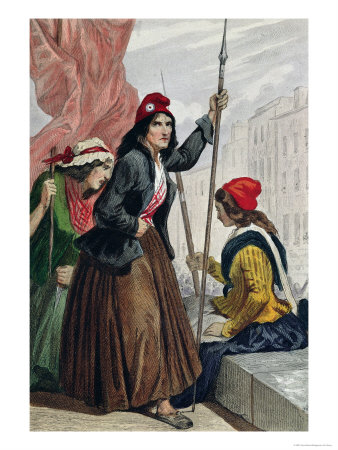
Right now it feels like we are in the throes of our own personal French Revolution with tweeters casting themselves into the role of tricoteuses. And look what happened after the French slaughtered all those associated with the nobility regardless of guilt in a bloody massacre. Just like with the Russian revolution of 1917, they replaced one form of tyranny with another and their press is now highly regulated and controlled by a rich and powerful elite. Is that really what we want?

In the meantime the European debt crises escalates, the price of gold is at an all time high, Greece is about to default, Italy and Spain are teetering on the brink and the US is two weeks away from running out of money to service its debts, both the dollar and the Euro are looking precariously weak. Is the collapse of the government really in everyone’s best interests in the middle of such financial tumult?

Is Ed Milliband, a man who cannot exercise any effective leadership over the squabbling members of his party the man for the job? If Labour had been able to demonstrate any sort of alternative and any indication that they are in touch with the concerns of the ordinary people in this country, then many would have been open to persuasion. But what is Ed Milliband’s finest hour to date? Being able to spin some half-way decent PR by attacking the PM for a media scandal, which he and his party were every bit as embroiled in as the Conservative Party. The only reason that the Lib Dems have remained untainted is because the media knew they had no chance of a whiff of power and didn’t waste their time.

Bread and circuses. Media folk – stop spinning this and show you are in touch by reporting on stories that are not simply in your own interests. The politicians, media and police work for us, not the other way around.

Still who cares, there’s a lynching to be seen later. I wonder what Rebekah Brooks will be wearing. Best get knitting.

Online curtain twitching

My passionate views merit passionate responses. That’s to be expected when talking about the subjects with which I deal.

What is hard to deal with is an on-line stalker. Imagine if you had a deranged neighbour who spent their time watching your every move and then writing about it, simply because you once had the temerity to disagree with them on an ideological basis. Imagine if your stalker wrote a blogpost naming you, calling you insane and divulging personal details about your children.

This is what happened to me when I was pregnant. A fellow twitter user published a blogpost in which she dismissed my support for the scrapping of EMA and my tentative support for tuition fees as being rooted in self-interest and lies because apparently my daughter goes to private school, paid for she kindly noted, by someone else and because I have private trust funds for my children so will be able to provide for their education.

The first is true, it was my ex’s express wish that our daughter attends a private school and therefore he picks up the school fees. My other children will not attend as we cannot afford it. Secondly my children do not have trust funds other than the accounts that all children were given upon birth. They may have been topped up by birthday and baptism gifts but that is all. My share of equity from my former house which was hardly significant was put into a savings account in my daughter’s name. I am not going to state the amount, it is nobody’s business as indeed my finances are nobody’s business, but my ex can clarify that it is not enough to be called substantial nor indeed does it qualify her as a trustafarian. This was my money, gained from the sale of a house to which I contributed 50% of the mortgage. It was implied that I had no moral integrity in that I allegedly profited from the breakdown of my relationship. I did not profit, far from it.

I shouldn’t have to publicly discuss this, however when someone blogs public untruths about your family’s finances and how they may impact on your views, and names you, as she did, then I have little choice.

My finances have no impact on my views. To blog about an individual and their private circumstances and their children from a snippet of information one has gleaned from a baby forum is as low as the recent News of the World scandals. I will resist with tit for tat reprisals, and in fact as a gesture of good will I offered to donate to charity the fee I had received for writing an article as my fellow twitterer claimed to be a Christian. She said that there was no need for this as she was going to  delete what she had said anyway. As a gesture of good faith, I donated the fee to charity anyway.

I then protected my twitter feed, particularly following the hate attacks from the so-called liberals who couldn’t cope with the idea that I might not actually be a homophobe and who also thought it acceptable to drag my daughter’s name through the mud.

I recently unprotected in order that I can engage with non followers. Since then every single tweet has been under scrutiny. I had a piece published on the Conservative Home website and she published a blog analyzing every single one of my tweets, savaging my choice of the word “nuance” and making facile comments about my data and research, “look how clever I am with my fancy charts”.

I ignored: I could not help but think that the poor woman must be mentally ill if she feels the need to obsess over my every word and devote whole blog posts to me. She tweets things to deliberately get into my timeline to provoke, hence she is blocked, She doesn’t seem to understand my distress at her thinking my family and my finances are fair game for her to publicly lie about. I do not as she states, have a private income. That is a libel. We receive help from a charity set up to aid former Anglican priests who find themselves homeless and jobless. To suggest that we would defraud them by having a private income is a vile slur which I must disabuse.

Today she has accused me on a CIF thread of obsessively stalking her and affecting her family. I have done no such thing, I have attempted to ignore her and not give her the attention she craves.

I won’t name the woman, but I would like her to exercise some honesty. She referred to my blog on a CIF thread, quoted from it, yet didn’t have the courage or integrity to name me.

I am a mother of three young children who has neither the time nor inclination to online stalk or pursue a vendetta. I blog and tweet for relaxation and evangelisation. I am passionate about the pro life cause and will defend against the anti natalists whilst I have breath in my body.

What I am not prepared to accept is lies or broadsides against my family. They are not fair game.