Catholic women rising

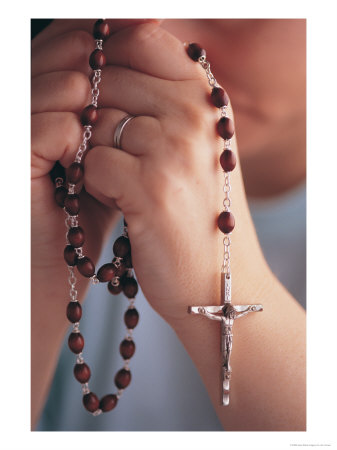
542401b~Woman-Praying-W-Rosary-Beads-Posters

Okay, so this is a bit of an experiment, but I’d really like it to catch on and would also like the support of the entire Catholic blogosphere, certainly in the UK and what an amazing thing if this could go global.

Inspired by Deacon Nick Donnelly, who has such an inspirational apostolate with his Protect the Pope blog, my blood pressure rose when I saw that a certain ‘Catholic’ theologian is once again hinting at doctrinal changes, seemingly misunderstanding that these are simply not possible. This isn’t meant to be a personal attack on Tina Beattie herself, I can understand that it must be unnerving to feel constantly besieged by a group of bloggers on the internet, but in a recent interview in the Guardian she states:

The new pope must show that he is willing to engage seriously with women’s theological voices and moral perspectives in a way which is broadly representative of the diverse experiences and aspirations of women, and not just with a few carefully selected theological handmaids.

The Church is not a democracy. Furthermore doctrines cannot change, Catholicism is based upon the truth that was revealed to us by Jesus Christ and handed down by the apostles to their successors. Revealed truth cannot change, the deposit of faith is comprised of this revealed truth expressed in Scripture and sacred tradition and thus cannot change. The church does not have the power to change or remove anything that has been given to us by Christ and His Apostles.

It is beyond annoying being told what the Church should do in relation to women, by people who are either not Catholic, or want the Church to change her doctrine in order to accommodate their own personal agendas, whether that be to allow self-destructive behaviour, to validate their own insecurity or to give them more ‘power’, which is never a healthy thing. None of us should crave positions of power or leadership.

Many faithful Catholic women are fed up of being told that they are not representative of the Catholic faith, that they are somehow brainwashed or marginalised, that their Church hates them and that most Catholic women are against the Church’s teachings, especially with regards to contraception, abortion and the male priesthood, most of which is based on dodgy poll data.

Here’s what I’d like to do. I’m not sure if this blog is the best forum for it, but then again it is run by a married mother of 4 young girls, who is passionate about female equality and empowerment, it’s just my definition of what that looks like, is very different to that of militant feminists or unrepresentative politicians and journalists, who think working women is all about a high-powered job in a nice city office somewhere on mega-bucks, or perhaps a well-paid newspaper column working from home, whereas the reality for most working mothers and children is entirely different.

I’d like to get as many Catholic women as possible, to sign up in the comments box below, to say that they agree with the following statement.

I am a faithful practicing Roman Catholic woman, who attends Mass at least once a week and who believes in and practices the Church’s teachings, specifically pertaining to matters on sexuality, contraception, abortion, marriage and the ordination of women. I believe that the Roman Catholic Church is sympathetic to and representative of the needs and concerns of women and their children, wherever they may be in the world. I would like to offer our new Pope Francis, my prayers and support and thank him for his continued protection and support of mothers and their unborn children. I fully endorse Church doctrine in relation to women’s issues. 

This could be an amazing gift for the Year of Faith. Imagine if every single faithful Catholic woman were to pledge their solidarity to our new Pope and Church doctrine in one place. What a gift, blessing and comfort, not only for Pope Francis, but also for ALL the Catholic clergy, Cardinals, Archbishops, Bishops, Monsignors, Priests, Deacons, as well as those members of the laity, who are engaged in catechesis. How heartening for them to see the fruits of their work and how loved, supported and appreciated they are by Catholic women everywhere.

Also, what an opportunity for catechesis this could be, in terms of promoting the New Feminism. If you do see this and you are a Catholic women who feels in good conscience that she cannot sign up, don’t leave a comment on this post, I’ll open up another sticky and we can get debate going there, or better still, discuss it with your priest, or someone you know who can sign in good faith.

What a message to the Pope, to the Church and to the world and media at large. We, the undersigned Catholic women, have a love for Christ and his Church burning in our hearts and we do not wish to alter or change doctrine one little bit. We are empowered by a beautiful teaching that recognises us as having an equal dignity and sets us free to live in love.

Francis Fever

I love Papa Francesco

It could be my misanthropic side or maybe I’ve just got a very short attention span or perhaps a combination of the two, means that I’m hoping that Francis fever will shortly subside, once the inauguration Mass has taken place.

That’s not to in any way question our new Holy Father, or throw any of his qualities into doubt, far from it, the Conclave played a blinder with that googlie (indulge me a little Bernard moment to mix my sporting metaphors here) but the constant focus upon Pope Francis, the style of his papacy and his personal gracious humility and simplicity, could I think, become counterproductive.

It’s marvellous that here we have a new Pope who has really got the media buzzing, proving that Catholicism is not as irrelevant as they would have us believe and that coverage has been incredibly positive, aside from one poorly researched attempted hatchet job from the usual suspect, the Guardian, but human nature loves nothing better than to build people up, if only to knock them down again, ably aided and abetted by the media.

My concern is that this important theme of poverty could swiftly start to become jaded and has the capacity to be caricatured and used as a weapon against the Holy Father, when and if, he does something wholly in keeping with his vocation, by a media who may not fully understand the implications of the office and responsibilities of the Vicar of Christ. Such as, for example, when he travels. Fr Ray Blake highlights an essential point, namely in order to be loyal sons and daughters of the Church we really need to get to grips with and actually understand what is meant by poverty. Anyone who thinks that the Vatican museums or Roman churches can or should be sold off to the highest bidder needs a reality check.

I cannot help but think that the very last thing Pope Francis wants is to be revered as some sort of living saint for the fact that he lives out the values of the Gospel and of his religious order. Whilst it’s entirely laudable that he does so, he is not the only priest or bishop to follow in the footsteps of Christ in this way. I know at least one UK diocesan bishop who drives about in an average non descript car, has very little in the way of personal staff and goes about with absolutely no pomp and ceremony whatsoever. A parish volunteer once related to me about how they once told a man that he couldn’t use a particular space in the church car park, because it was reserved for the bishop who was coming to do confirmations, whereupon the response was a fairly nonplussed, ‘I am actually the bishop’ much to the poor man’s mortification! He had been expecting a grand personage in a smart vehicle, not a low-key looking priest.

Pope Francis may well be on his way to sainthood, as are hopefully all of us, but he is not there yet and the very reason that he took us all by surprise is precisely because he had kept an extraordinarily low profile in the run-up to the conclave, he doesn’t do self-promotion and thus had fallen off everybody’s radar, including the most seasoned vaticanisti. This self-effacing man, whilst indicating that his papacy will be very different in style, does not want to be admired, far from it, but to lead us to Christ. The theme could wear thin very quickly not to mention backfire, if it is over-egged or swift conclusions drawn and I can’t help but wonder how soon we may see the satirists draw unkind Uriah Heep portraits. My mind drifted back to how Fluck and Law of Spitting Image portrayed Pope John Paull II, with a shudder.

Pope Benedict XVI was the one who laid the groundwork in terms of demystifying the papacy, not least by resigning it. His several books that were written in his own name, alongside his prolonged interview with Peter Seewald in Light of the World, in which he let people into his own personal reflections, showed, that in his words upon his election in 2005, that he was ‘a simple worker in the vinyard of the Lord’. Pope Francis seems to have the ability to breathe new life into the Church, he seems to be the right man at the right moment, he could do for the Papacy what Princess Diana did for the Royals, not forgetting that Diana’s charism with the poor and the sick was, however inadvertently, following in Christ’s footsteps, Francis is clearly able to speak from the heart, off the cuff, to rip up formal protocols and win hearts and minds for Christ, but he may not have been able to do so, if Benedict had not already shown the way. Pope Francis is very much what the church is aching for, but the likes of Cardinal Mahoney ought to remember that it was thanks to the Emeritus Pope, that this has been made possible. If we are to remember that the papacy is not a personality cult, then we also need to remember to keep some of our admiration and respect in proportion, before going overboard about a people’s pope. I think Pope Francis will do great things for us, but only if we give him the space, instead of projecting our own interpretation onto him.

As for the matters liturgical, I hate to rain on Rorate Caeli’s parade, but it seems to me, they are forgetting one vitally important point here, in that like everybody else, the Pope is a servant of the liturgy. I know liturgy matters, I’m not a traditionalist, but equally I appreciate the importance of the liturgy in orientating us towards Christ and subjugating our will to His. Liturgy is not about how we “feel” and what gives us the warm and fuzzies, but worshiping God as he has instructed us to do so , in a way that is noble, reverent, respectful, transcendent and mysterious. I guess I’m torn on this, because whilst appreciating the desire for a simpler style, there is a part of me that thinks, look, the Vatican has all these wonderful vestments in its various wardrobes, they aren’t going to sell them, go on, they might as well use the sparkly threads every once in a while. The whole thing is very hard to get right. One doesn’t want vestments that are just so ornate and dazzlingly beautiful that they detract from what’s going on in the Mass, equally we don’t want vomit inducing ’70s lairy florescent vulgar murals, neither does one want a priest that appears almost liturgically naked, his very simplicity being a statement and thus a distraction. The mystery and nobility needs to be retained, but I’m absolutely no expert, I’ve no idea how. It would clearly be a shame if Benedict’s reforms went by the wayside, his papacy was about making sure that the entire Church faced in the same direction, towards God (one of the reasons I’m all in favour of ad orientem) and Pope Francis will continue what Benedict did for the liturgy, in terms of prayer and action.

On the subject on nobility, though it’s as the result of a happy accident, I think we also do need to remember that the Pope is also the Head of State (albeit small), a role which enables the Holy See to achieve a vast amount in terms of international relations and behind-the-scenes negotiations and peace agreements so it is only right and proper that a certain respect is accorded to him in this office. Back to the unprepossessing bishops that I can think of, I think we need to remember that even though one may live simply and reflect this in dress or manner of transport, the dignity of office, the fact that a bishop, cardinal or Pope is one of Peter’s apostles, should never ever be forgotten. I know Anglicans who have often been flummoxed by this, forgetting that an appearance can often belie the office. One of the interesting contrasts I find between the Anglican and Catholic bishops I know, is that the Anglicans are all about the ecclesial purple and pectoral crosses and piping, the Catholic Bishops tend to be a lot more discreet in their dress, often leading to others perhaps treating them with inappropriate informality and yet Catholic bishops hold infinitely more power over their diocese than their Anglican counterparts. The commentators on Rorate Caeli need to remember exactly who they are talking about and the allegiance which is owed to him, Pope Francis has the keys of St Peter, the power to bind and lose.

None of this is to diss our new pontiff, but more to add a note of caution. Yes, we should be delighted that so far, the signs are looking promising, but Joseph Shaw has wise words on Papolatry and prudence. I can see attacks on the Church, on our new Holy Father really intensifying in the near future, from all quarters, including from within, as we have already seen. Whilst I take CS Lewis’ guidance to heart about the equal and opposite errors with regards to thinking about the devil, it seems to me that the reaction, the anger, whether that be from Rorate Caeli, the liberal press or hostile Anglicans, seems to flow from one cause. We have a great new Pope, who promises so much in terms of the New Evangelisation and the reinvigoration of the church. One who is going to re-sanctify the church and bring Christ to the world, especially the poor, sick, the needy, the elderly and the unborn in the twenty-first century. Not only that, technically we have TWO Popes, no matter how bizarre that seems. Not one pope, but two. One who will be actively leading us in prayer and holiness and another former pope, who will be storming the heavens on behalf of the church, with a life of prayer and penance. Think about that for a moment. I said in a previous post that we had two-for the-price of one in Pope Francis, with the merger of the Jesuit and Franciscan. Actually we have that in an actual physical sense, two popes together working for the church although in very different ways. One public and one private. They are even meeting privately next week, in order that Benedict may pass on some of his wisdom and experience to help Pope Francis in some of the difficult decisions. This is unprecedented stuff.

The power of two extraordinarily holy, deeply spiritual and wise men, leading the faithful in prayer. It can be no surprise that someone is angry, someone is furious, whenever great good happens, retaliation always occurs. Someone else has got Francis fever, which is why we need to all be on guard.

HeelandtheSerpentB[1]

*************************************************************************************************************************************************************

(Oh and as aside, to the critics who are claiming that the Church’s teaching on sexuality and priestly celibacy is misguided because it’s difficult but who are lauding the Pope’s zeal for the poor. The response to which is doing what is right, is not always the same as what is easy. I wonder what they would make of being informed that technically they should be giving at least 10% of their income away to charity. That’s not easy either, especially in these troubled times, but does that mean that it’s equally quite so misguided and wrong? If chastity and celibacy are wrong because they are allegedly difficult and challenging then why doesn’t giving a significant proportion of your income away, fall into the same category?)

The media and a cheeky little grumble

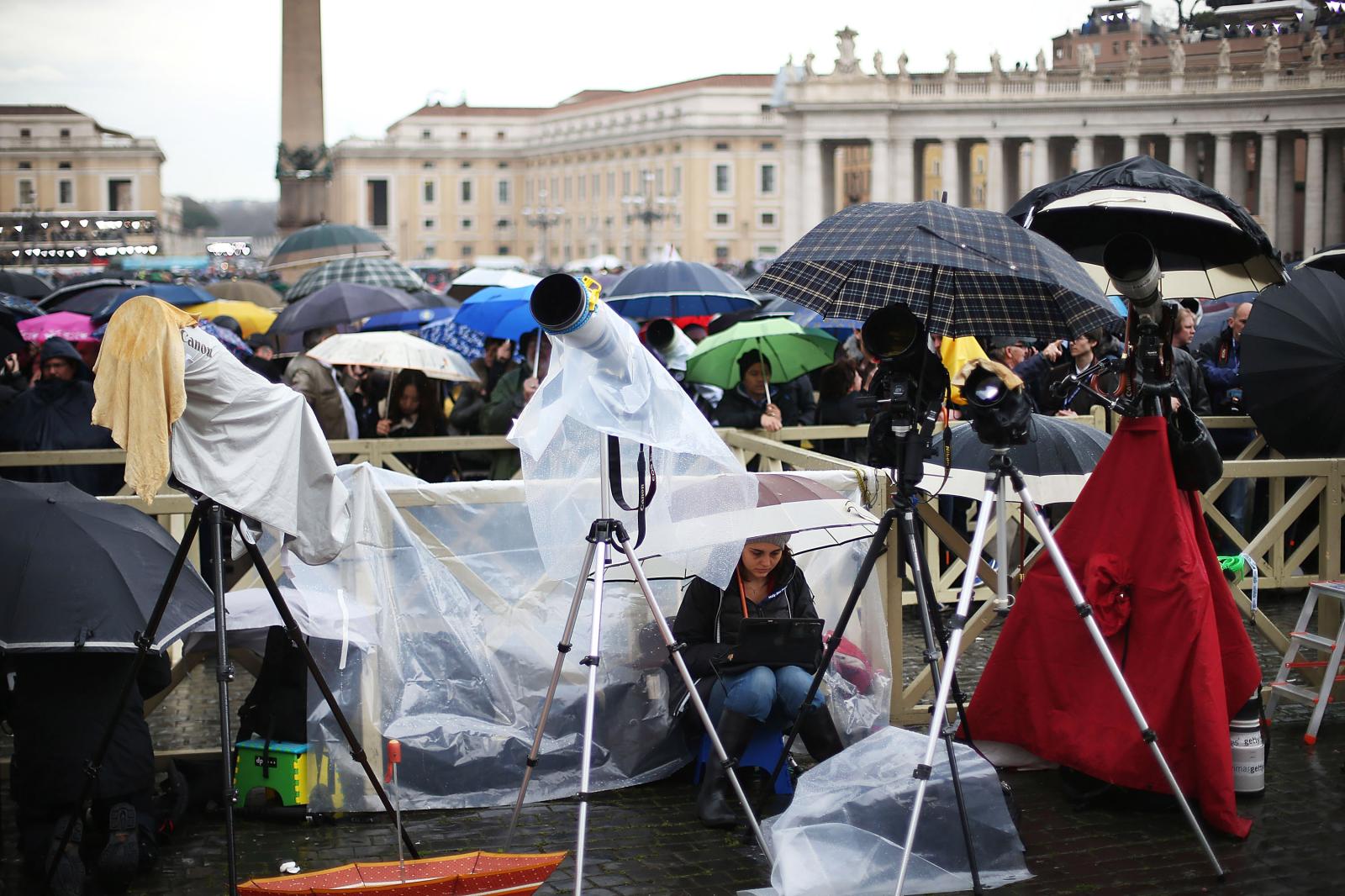
Who wanted to be in rainy Rome anyway?

Regular readers will have noticed that I haven’t been posting over the past few weeks, even though there has been no shortage of material. The main reason for this has been the time that I spend writing (usually evenings) has been taken up with vast amounts of reading around the conclave process, its history and the background of the various papabili in preparation for any media appearances which may crop up. Catholic Voices has really come into its own during these momentous weeks, many of the speakers have done a tremendous job in terms of informing the media and general public and one thing that I have noticed from my contributions, is that the attitude of the media certainly seems to have softened and become a lot less hostile and more open to a reasoned Catholic viewpoint, although there are occasions when one finds oneself addressing the same old canards again and again.

Whilst there will always be the same detractors, the one thing that should be borne in mind, is that despite the excellent and rigorous training and preparation for what it is like to be in the hot seat, there is no substitute for experience. The more media appearances you do, the more confident, relaxed and skilled you become at the whole process, so those who vociferously complain in the various coms boxes really need to bear this in mind before they let rip. I can certainly see an improvement and marked contrasts between my recent interviews and those of a year ago. It isn’t always easy being subject to scrupulous, superficial and often ignorant scrutiny when one has a microphone or camera trained on you. In most of these situations, nuance or an in-depth detailed theological discussion is impossible. Very often, such recently on the Big Questions, it’s superficial scattergun apologetics, bouncing from one neuralgic issue to the next, to the next, with no time for considered thoughtful answers. The opening shot of an interview I did yesterday was “well you obviously follow Catholic teaching on contraception then, you’ve got 4 children”. It then went down the usual rabbit holes and on reflection, I can see how at times I missed my chance to refocus the interview on the Pope, but it’s pretty difficult to concentrate when one is being poked in the eye with a sharp stick. But on another occasion, God Willing, I’ll be able to handle that better, having learnt.

I did an interview the other morning for Radio Merseyside, having woken up for the early morning interview chock full of cold and lurgy. It proved our saying, you are never as good or as bad as you think you are (I thought it was absolutely terrible), but judging by the stat counter on my blog, I’d obviously confused the listener by using the word pallium, without explaining what this was. Several people arrived here having asked google about “Caroline Farrow’s pallium”. I then received some friendly advice about not using specific liturgical terminology. ‘The problem is’, they explained, ‘that nobody knows what a pallium is. They probably spent the rest of the interview highly distracted wondering what a pallium was, how big is it, did he mean to leave it there and did he ever get it back. What happened to it? Is it like something out of Dr Who’. Which is fair comment and goes to show that for certain audiences, detailed complex theological or philosophical concepts are going to go way over people’s heads and prove counterproductive. But by the time I’d done 11 back-to-back interviews for local radio the other Sunday, I think I’d pretty much got the issues down pat and nailed, the only difficulty being attempting to make the same sentiments sound fresh after 2 and a half hours of non stop opining. As long as one can relax and enjoy the interview and realise that the presenter actually wants to find you winsome, a bit of jocularity goes down a lot better than jargon-heavy hectoring and might actually motivate people to find out more.

We’re in the realms of cloud cluckoo land if we think a short slot on local radio should aim to deliver the thunderbolt that sends the listeners rushing to their nearest confessional, certainly the common theme in both my journey of faith and those that Catholic converts have shared with me is not necessarily one incident but whole series of interlocking events that looked at as a whole, formed a path leading to the truth. A compelling media appearance can certainly play a part in that, but a 3 minute slot is not going to have the same effect as an hour’s talk or presentation by a great Christian or Catholic apologist.

The last few weeks have been something of a roller-coaster for us all. We’ve barely had time to come to terms with the resignation surrounding our beloved Pope Benedict, before getting into the swing of the conclave and the speculation surrounding his successor. On a personal note, like many of my colleagues, I’ve been rushed off my feet preparing for interviews, which not only takes it toll in terms of time but also emotional energy as well as, for someone like me, logistics. It’s not especially easy to arrange childcare at short notice when one’s husband is miles away at seminary and family needs to come first. I was really disappointed to have to turn down Sky News on the day of Benedict’s final general audience, but Robin had his official formal interview and feedback for the diaconate, which was infinitely more important. And let’s face it, doing the big media stuff is always fun and challenging, even if nerve-wracking, although one really needs to be on guard for spiritual vanity, which is one of the consequences of this kind of work and a trap which I really do have to work very hard not to fall into. If readers could continue to pray not only for me, but for all of us who try to speak for our faith in whatever medium, it would be hugely appreciated. We always make sure that we have a prayer chain of folk praying for us before we go on air and in the final moments before the camera switches on, I always clear my mind and pray.

But now onto the grumble and observation. Last week, I had word that the BBC were looking to fly me out to Rome to be a part of their coverage for the conclave. To say that I was beyond excited is something of an understatement. Robin and I agreed that if it were possible, given that this was a once in a lifetime opportunity, that we should do whatever we could to make it happen, hence I had a week of rushing about like a headless chicken, and a precise timetable of chores, involving making sure that two of the children could stay with their grandparents, clothes were meticulously laundered into handy piles, favourite cuddlies and books stockpiled and packed, along with bibs, beakers and all the various paraphanalia to ensure that life was as easy as possible both for them and my parents at the other end. A rota of other parents were enlisted to pick up the eldest from school and various favours called in, whilst in the middle of the week I made an eight hour journey to Peterborough and back to procure a passport to enable me to take the baby, as well as beginning to acclimatise her to taking a bottle of formula milk, in case the passport did not arrive in time and/or to make life easier whilst out there.

In between all the dashing about, I waited and there was nothing. No confirmation of what was happening or response to an email asking whether the trip was still on. As is their prerogative and their right, the BBC decided to change their line-up and were too preoccupied to respond. That’s fair enough really, it’s entirely up to them who they wished to cover the event and my childcare and personal arrangements are irrelevant and none of their concern. This kind of thing happens all the time – we need to be ego free, prepared to be dropped at a moment’s notice, but it was more than a little frustrating having to put in place a complicated contingency plan should I suddenly be asked to get on a flight at moment’s notice. Of course I could always have said no from the outset, but the BBC had asked specifically for a woman and the other candidates were already indisposed. Naturally I wanted to go, if at all possible. But it wasn’t to be.

Then to add salt into my wounds, the phone rang on Wednesday night, between the appearance of the white smoke and Pope Francis on the balcony, asking whether or not I would be able to appear on Newsnight. Robin said fine, he’d put the kids to bed and I ran to jump in the shower, with BBC News playing on full volume on the radio. Having made myself look vaguely presentable, I then sat there for a few hours, having spoken to the producer of the show, trying to stop the children from smearing sticky fingers and spilling milk all over my only clean suit, waiting for him to phone back and confirm that a car was on its way, having pressed on him that one needed to come quickly if it was going to get me from Brighton to London in time. All the while trying to compose myself as well as some cogent thoughts about our new pontiff. At 9pm, an hour before I was supposed to be at the studio, no car had come, so I rang the show, only to discover that they had decided to drop me in favour of two priests and had forgotten to ring me back and tell me.

So all dressed up, tons of adrenlin and nowhere to go. Which happens, it’s incredibly frustrating, part and parcel of life and every single Catholic Voice will have a similar story about being dropped at the last minute, it’s not the first time it has happened, it won’t be the last and is all part of being ego free, but nonetheless I was feeling a little antsy and fed up yesterday, having invested a great deal of time and emotional energy. It is disappointing when that happens, especially when one has built oneself up. So another thing to remember next time one sees anyone on television or on radio. We’re all members of the laity, we’re not full-time professional media commentators, we’ve all got lives and families of our own and we do this work gladly out of love for the church and though we undoubtedly enjoy what we do and strive to do well, it does entail sacrifice, and this week was something of a double-whammy in terms of building up expectation and adrenalin, only to come crashing back down again. I obviously need to take a leaf out of our new pontiff’s book in terms of humility.

So moaning aside, and yes this is admittedly a minor personal grumble although I am sufficiently recovered and able to take disappointment in my stride, what I find most interesting about this, is that the BBC, who are usually preoccupied with diversity and representation and who repeatedly question the Catholic Church in terms of whether or not it represents women, have on two occasions in its recent coverage, ignored the opportunity to represent the viewpoint of an ordinary faithful Catholic woman in the church, in favour of men. I’m loath to draw any conclusions about political agendas, sometimes these things just happen without reason, but I can’t help but wonder whether or not a dissenting or ‘liberal’ Catholic woman would have made a more compelling narrative? I think it’s why they were keen to interview me over the celibacy controversy and found that they didn’t quite get what they were bargaining for.

Perhaps unsurprisingly, the Catholic TV station EWTN had Colleen Campbell doing an excellent job covering events. Whereas the UK media’s coverage was predominantly male-dominated. In some ways that doesn’t bother me, I’m not one for shortlists, it should be whoever is best able to do the job, regardless of gender and certainly in the case of Newsnight, Fr Alexander Lucie-Smith was his usual erudite and charming self. But next time the BBC wishes to berate the Catholic Church over its representation and treatment of women, it perhaps ought to look at the predominant gender of who it chose to represent the faithful in their coverage of the past few weeks.

Still it’s all part of life’s rich tapestry and an additional Lenten penance. I’m now due for a bit of a rest, unless anyone fancies subbing me a quick flight out in time for the inaugural Mass…

A Tale of Two Francis

Viva Papa!
Viva Papa!

Here is the full unedited version of a piece I wrote for Mercatornet on our new Holy Father.

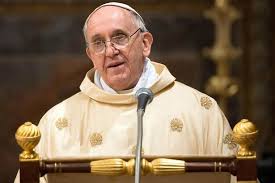
The world’s Catholics are reeling with the shock election of the Argentinian Cardinal Jorge Mario Bergoglio as the new successor to Peter, even the most seasoned Vaticanistas were not predicting that the runner-up to Ratzinger in the 2005 Conclave was a serious contender, his age and his Jesuit background both seemed to count against him.

Surprise swiftly melted into joy, excitement, anticipation and gratitude upon confirmation that age is clearly no barrier to innovation for the former Cardinal, as signified by his choice of name – the first Pope Francis in almost 2,000 years of Church history.

The name Francis is an indicator as to the future direction of a papacy which will have the themes of simplicity, humility, discipline, reform, rebirth and outreach at its heart. Not only do we have the first ever Pope from Latin America, but in Pope Francis we have something of a two-for-the-price of one, with a fusion of two major religious orders, whose founders both heralded a period of Church renewal and reform. Bergoglio could well prove to be a man for all seasons, combining the spiritual discipline of St Ignatius of Loyola with the humility and simplicity of St Francis of Assisi.

One of the defining qualities of the Jesuit order is that they don’t mess around and always mean business – something that could prove very useful for a Pope for whom reform of the Curia, the Vatican’s bureaucratic arm, is high on the agenda. The recent Vatileaks brouhaha was a symptom of the internecine factionalism that currently besets and hinders this small, but essential part of the Church from running in as efficient a manner as possible. A Pope who could be both governor and enforcer was one of the prerequisite criteria and a key theme emerging from the General Congregations, the meetings that preceded the Conclave. A religious order with a reputation for getting down to business , sorting wheat from the chaff seems to be exactly what the doctor ordered, and those who might doubt whether or not he possess the passion to bang heads together, ought to remember his scorching attack on clericalism, just six months ago in September 2012, when he denounced priests who refused to baptise the babies born outside marriage, as being guilty of “rigorous and hypocritical clericalism”. Pope Francis has no time for what he deems “the spiritual sickness of a self-referential church”.

All of which augurs well, as does his track record of swiftly appointing loyal bishops to troubled dioceses – the Catholic church is not a top-down organisation and depends upon good local governance. Rapid deployment of strong faithful intelligent bishops is key to rooting out decay and planting the seeds of the future.

John Allen, the veteran Vatican observer, has wondered whether or not Bergoglio’s lack of solid experience inside the Vatican itself would prove an obstacle, but an outsider with an Ignatian passion for rigorous discipline and an agenda for change, wholly untainted by insider corruption or personal interests, is ideally placed to implement the much needed root and branch reform. Pope Francis has previous form when it comes to taking action. He rose to prominence following his appointment as the provincial of the Jesuit order in Argentina in 1973, and unlike other Church leaders refused to back the country’s military dictatorship. He held firm against the rising tide of liberation theology sweeping Latin America, discouraging priests from political activism and insisted that Jesuits continued to staff the parishes and chaplaincies where they were needed instead of forming communities. Bergoglio’s insistence on obedience and stamping out of heterodoxy and dissent won him some local enemies, but indicates a desire to get things done, and is a trait that will stand him in good stead when it comes to continuing to root out what the Emeritus Pope Benedict described as the filth of the child abuse scandals, that have rocked the Church in recent years. There can be no doubt that Pope Francis will continue to act with an iron fist when it comes to sorting out sexual transgressions and there will be no room for cover-up. His struggle against the military government of Argentina together with the rise of liberal theology prefigures the battle against the pervasive rise of moral relativism in an increasingly secular West. “After a battle” he reportedly said, “you have to act firmly”.

The previous two pontiffs can be characterized as theological powerhouses, whose teaching was reinforced by a vast canon of personal writings and both of whom could be studied as philosophers and theologians in their own right. Following thirty-five years of academic reflection, many have felt that now is the time for some intellectual breathing space, to give the faithful time to digest and apply what we have been taught by John Paul II and Benedict XVI, who unpacked and applied the reforms of the Second Vatican Council. Whilst Pope Francis is no intellectual slouch – he trained as a chemist, before joining the priesthood, he has an undisguised passion for literature having taught the subject at University level alongside psychology, philosophy and theology and in true Jesuit tradition has encouraged priests to exercise their cerebral and artistic gifts, few people can pack the cerebral punch of Carol Wojtyla and Joseph Ratzinger.

Bergolio’s election is nonetheless a manifestation of the growing desire to see a different style of papacy, one that teaches and leads through its actions as well as words. It can be no surprise that a Cardinal noted for his humility and love of the poor has chosen St Francis of Assisi, the man who reformed the church through simplicity, as his namesake. Of humble origin, born of an Italian immigrant railway worker, Jorge Bergoglio has eschewed all trappings of office, avoiding media interviews and urging people not to spend money on plane tickets to Rome to celebrate his election to the Cardinalate in 2001, but instead to give the money to the poor. Instead of living in a lavish episcopal mansion in Buenos Aires, he chose instead to live in a small apartment where he cooked his own meals, did his own housework and took the bus around town visiting the poor, rather than a chauffeur driven limousine. True to form, following his election to the papacy, he chose to take the bus back to the hotel instead of using the Holy Father’s car, to spend one final night with the cardinals and emerged suitcases in hand in the hotel lobby, to pay his own bill.

In an era that is reaping the consequences of globalisation and the ravages of a rampant unchecked capitalism, the Christian message of concern for the poor and of social injustice is of paramount import. In Francis, we have a Pope who embodies the compassion of Christ, whether that be by kissing the feet of AIDS victims, or rolling up his sleeves and going out and ministering to the poor, accompanied by a rhetoric that denounces the failures of neo-liberalism.

One of the frustrating aspects of the papacy of the Pope Emeritus was that his constant critiques of an economy based on individualistic greed and mind-blowing masterclasses on natural law and reason were subsumed and ignored by a media only interested in sexual ethics and scandal. Pope Benedict’s problem was not that he was by any means ineffective, it is thanks to him that the Catholic Church now sets the gold standard in terms of child protection issue, but that self-promotion was not his forte and the Vatican failed to communicate the extensive measures that had been taken and neither did they initially understand the nature of a rolling global 24/7 media. At times it appeared that the Vatican press office consisted of an elderly telegraph machine and answerphone, allowing, in the words of Mark Twain, a lie to travel half way around the world, whilst the truth was still putting its shoes on.

The willingness to engage with the media could potentially pose one of the few problems for this naturally modest yet deeply spiritual man. Yet from the moment that the world caught of a glimpse of the new Pope it was clear, that whilst not possessing the natural charisma or showmanship of John Paul II, his prayerful nature demonstrated by breaking with tradition and asking the crowd to pray for him, before giving the customary blessing, this simplicity will be precisely how he will win hearts and minds in the New Evangelisation. Pope Francis is a man whose actions will demonstrate that he is all substance over what will be a very humble style.

Pope Francis has something for everyone, a seamless garment- a man who straddles all aspects of a diverse church, a man who holds the concepts of social justice as close to his heart as issues surrounding the unborn, the elderly and the protection of the nuclear family. His first papal blessing was given to a pregnant woman who happened to have got up early to pray at the basilica of Santa Maria Maggiore, where he too had gone to pray before the Roman image of the Mother of God. Pope Francis, will be a pope of the people, leading the way forward by example in prayer and in a lifestyle of simple humility.

Whilst there is some concern amongst traditionalists in terms of liturgical preferences, there is no reason to believe that he will be openly hostile to the reforms of Summorum Pontificorum – frankly he has bigger fish to fry and is too canny to alienate a significant proportion of the world’s faithful. Although yesterday’s Mass may have caused some facepalming amongst those delighted in Pope Benedict’s liturgical reform of the reform (‘Holy Father I love you already, but what’s with the polyester and freestanding altar’ said one friend), whilst Pope Francis may see a temporary return to practices that some may have hoped were on the decline, I think we have to remember that if he wishes to face the people, or changes the Benedictine altar set-up, it’s simply because he wants the people to see Christ – it is with good heart and intent, not because he has some secret liturgical agenda.

Though 76 and with only one lung, Pope Francis still has plenty of life to breathe into the Church, combining the evangelical zeal of St Francis Xavier, with the reforming simplicity good works and love of the poor of St Francis of Assisi. Whilst the Church may not be in ruins, this holy man from the South may be just the breath of fresh air that it needs. Jesuit decision-maker and political negotiator melded with poor mendicant friar will sow the seeds for a twenty-first century Catholic revival, in a world grown jaded and weary with the selfish excesses of consumerism. Catholics will need to start putting their money where their mouths are.

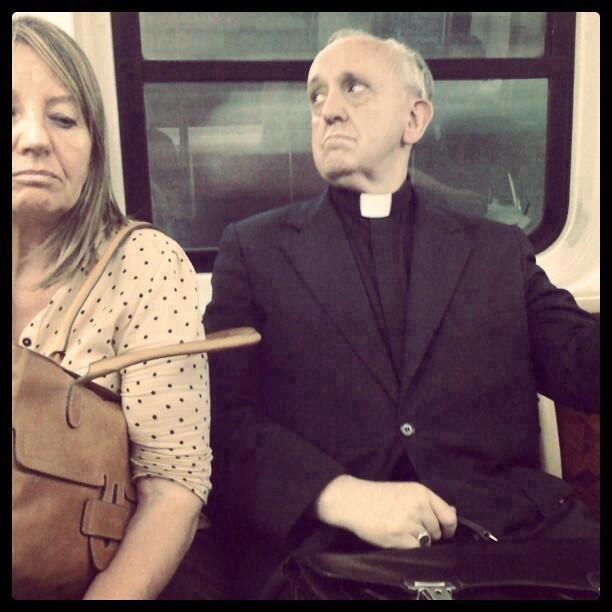
Pope Francis on an Argentinian tube
Snapped unaware on the Tube