The facts about LIFE

As His Grace pointed out on his blog earlier today, Sunny Hundal made a rather outrageous claim about the charity LIFE, describing them as “religious nutjobs”.

It’s amazing what passes for informed political comment these days however I think it is worth highlighting that LIFE are a non-denominational charity with no religious affiliation, therefore his assertion is substantially incorrect as well as being deliberately perjorative. Furthermore LIFE’s former Director of Education was an atheist, which although a strong position of faith, is patently not what is being inferred by the term.

A belief in the sanctity of life is not confined to a Christian position, Islam, Judaism, Sikhism, Hinduism and even Buddhism are all broadly against abortion as a principle, which is precisely why LIFE, though founded on Catholic principles, is non-denominational. I wonder whether or not Sunny Hundal would have the audacity to call a pro-life group consisting of a diverse number of faiths as being full of “religious nutjobs”? I wonder whether or not he would refer to a pro-life group consisting of Sikhs in the same derogatory fashion?

In any event the pro-life/pro-choice debate is independent to that of the theist/atheist debate. There is nothing in the pro-life position that requires one to be a theist, a fact that may be confirmed by looking at the work of Nat Hentoff, a prominent liberal atheist who is an outspoken critic of abortion and euthanasia. The pro-life position is a logical and philosophical concept which is a complementary extension of major religions but does not require a religion in order to be an adherent. To describe the belief that life begins at conception as being an extreme view born out of religious zealotry is an attempt to marginalise millions of people around the globe and deride their belief as being the product of an unsound mind. Not the most open-minded of approaches from a website that defines itself as liberal.

In relation to the point that was being made, LIFE’s counsellors, unlike those at BPAS, are all accredited by the British Association of Counselling and Psychotherapy and are therefore impartial, offering non-directive counselling. There is much misunderstanding and disbelief that a pro-life organisation might be able to provide non-directive counselling. With non-directive counselling you get exactly what is said on the tin. A counsellor will help someone to come to their own conclusion on a matter, to make their own mind up with regards to the best course of action, but will not offer any sort of opinion as to what that decision should be. What a counsellor will do however, is to explore the various perceieved barriers or obstacles associated with any particular course of action, to assist the person in reaching their decision. It is entirely possible that this may be done in a non-directive fashion. Dr Evan Harris recently tweeted that he believed that LIFE would be unable to offer non-directive counselling because “they would never tell a woman that she should have an abortion”, demonstrating that for such a proponent of science and evidence-based policy, he had absolutely no grasp of the concept.

In the context of a woman seeking to explore the best course of action when faced with an unplanned pregnancy, if she believes that there are financial or social barriers to her continuing the pregnancy, these need to be explored; it needs to be ensured that she is aware of any benefits, grants or other financial entitlements that she might be eligible for, i.e. that she makes a decision in possession of the full facts. Equally, she needs to be aware of what the abortion procedure itself will entail.

As the renowned pro-life lobbyist Phyllis Bowman says on her blog today, “BPAS should change its name. It does not ‘advise’ on pregnancy any more than the Mafia advises on “how to grow old gracefully. Moreover, they tell you that their advice is non-directional, at the same time leaving out half the story – all the uncomfortable bits that might put women off the abortion.”

The pro-abort advocates want to make out that this is scare-mongering, however if I were about to undergo a procedure I would want to know about the following possible complications: damage to the cervix leading to prematurity in a subsequent pregnancy, infection resulting in infertility, scarring of the lining of the womb which can cause subsequent prematurity, and the possible long-term increased risk of breast cancer.

It is the case that with any medical intervention that the risks and benefits of any treatment are outlined to the patient. Most surgeons will share x-rays and scans with the patients detailing what they intend to do. A pregnant woman considering an abortion is never shown the scan of the developing fetus, in an act of gross deception. Women should at least be offered the option in order that their consent may be fully informed, why is unacceptable for her to be aware of what stage of development the fetus has reached? Unless a woman is given the whole picture, which does not have to be emotive or directional then her choice cannot said to be fully consensual.

Of course some women will find the idea of mandatory counselling an irritation or an obstacle, having already come to their decision, in which cases the counselling session will be short, however at least it will give them the chance to confirm their decision. It is not a case of treating women like imbeciles, the reality is that at present, abortion clinics, who are set to benefit financially from a woman’s decision to abort, do not help a woman to explore all her options in any depth. As I have said frequently, I found myself  in the position of being coerced into an abortion, Marie Stopes having arranged an abortion for me on the say so of a third party. The doubt as to whether or not to continue with the pregnancy was all the validation required.

Ann Furedi of BPAS, along with the feminist Deborah Orr, are both on record stating that abortion needs to be a “back-up for when contraception fails”, which completely undermines those who claim that abortion is a method of last resort, a decision reached after much soul-searching and thus counselling adds an extra and unnecessary burden to women facing unplanned pregnancies. Abortion is not contraception (clue is in the name: contra – ception), this reasoning shows a flippant disregard for the value of human life and belies the attitude that abortion is always a considered conclusion. If you fall into the category of needing abortion as a back-up then there is an alternative and 100% failsafe method of avoiding conception, one that does not require medical intervention, does not entail the wanton destruction of human life and does not cost a penny.

The assertions that the Dorries/Field proposal constitutes an attempt to restrict abortion services are hysteria. Limiting or restricting abortion is not on the table, simply that women may feel empowered in the choice they are making in full possession of all the facts and that those facilitating those decisions do not stand to make any financial profit from them. It might be that counselling may well give pause for thought and prevent some abortions from going ahead which is not such a terrible thing.

The ardent hardline pro-abort faction are enraged because to introduce mandatory independent counselling goes a small way to getting back to the spirit of the 1967 Abortion Act, which was designed to help desperate women in terrible circumstances, hence the various built-in safeguards, which have now been reduced to a rubber-stamping exercise. Counselling recognises that abortion is indeed grave matter, one concerning life and death and seeks to ensure that a woman is in full possession of all the facts before she makes a decision that could have life-long repercussions.

Feminists who advocate abortion as being a woman’s right to choose, ignore the fact that abortion co-opts misogyny. The fact that every pregnancy is now viewed purely in terms of being a woman’s choice, has meant that many men feel absolutely no responsibility for their resulting offspring or on the other hand are denied any sort of involvement with regards to a child who is genetically theirs.

In the words of Camille Paglia, a noted feminist philosopher: “When it devalued motherhood, Western feminism undermined women’s most ancient claim to dignity.” 

Many people subscribe to Bill Clinton’s mantra that abortion should be “safe, legal and rare”. If this is desirable, then Dorries and Field’s proposal go some way to returning to the spirit of the Abortion Act; a last resort after every single possible option has been explored.
Worth £280 million of taxpayers’ money?

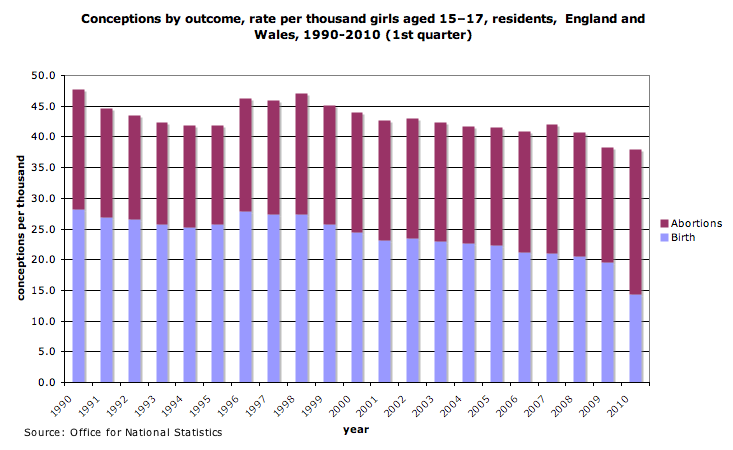
Just to recap, despite the introduction of compulsory sex education onto the National Curriculum by the Tories in 1993, followed by the establishment of the Teenage Pregnancy Unit by the Labour government in 1999 at a cost of £280 million, pregnancy rates have remained unchanged since the 1970s. The stated aims were to reduce rates by 15% in 2005 and by 50% in 2010.

Let’s examine precisely how close they got to achieving these targets shall we? In 1999 there were 49,900 conceptions by the under 18s. (numbers have been rounded to the nearest hundred and include both cohorts 13-15 and 15-17). In 2005, the figure was 50,200. Half way into the 10 year strategy, instead of the 15% decrease hoped for, there was in fact a slight rise of 0.6%. Ed Balls panicked and announced another £20.6 million to go into the program in February 2009.

In 2009, the latest full year figures available, teen conceptions numbered 45,500. Marvellous, a decrease at last, of 8.8% since 1999. Well short of the 15% target which was supposed to have been achieved 5 years previously with the desired 50% reduction seeming little more than a pipe-dream.

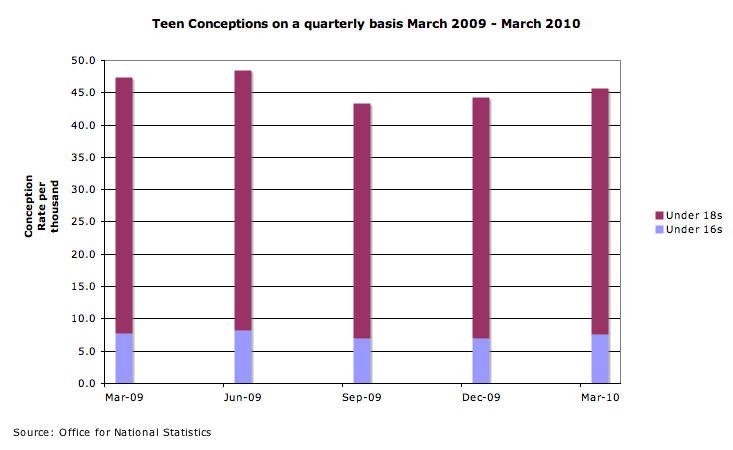
So, how are we doing now? Here’s a chart showing quarterly data from the last year, which includes the most up-to-date data which is available from March 2010.

It’s looking pretty static. No major changes, the extra £20.5 million given by Ed Balls is yet to have an impact. Both age cohorts experienced a slight rise in conceptions between March and June which over the course of the year gradually dropped to a lower rate, rose again and ended up close to where they started.

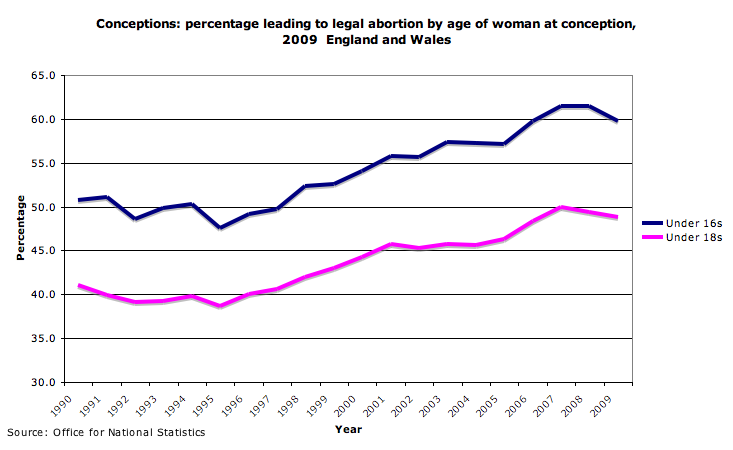
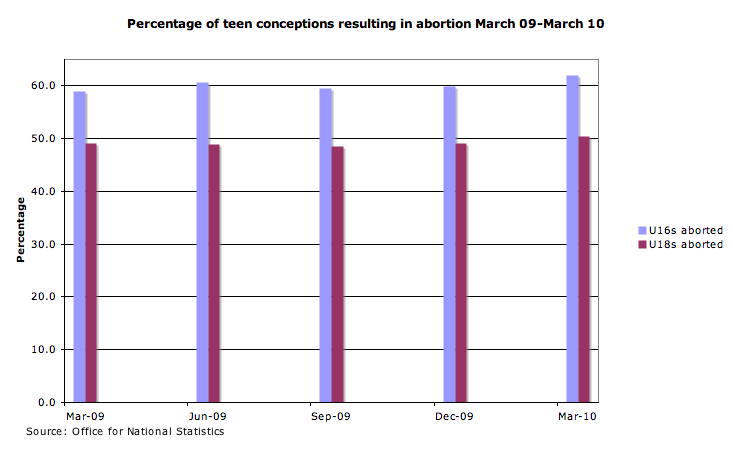
Interestingly the abortion rate in both age cohorts rose.

The abortion rate rose from 59% to 62% in under 16s and from 49% to 50.4% in under 18s, over the course of 2009.

Around 96% of abortions are carried out on the NHS. So, if we take 96% of 28,465, the total number of teen abortions carried out between March 2009 and March 2010, and multiply that figure by £500, the cost of the cheapest abortion procedure carried out by BPAS and Marie Stopes (the NHS refers/funds 91% of their abortions) that comes to a conservative total of £13.6 million.

So in 2009 we have an extra £20.5 million being spent to combat teenage pregnancy, on top of the £13.6 million being spent to carry out abortions on those for whom the strategy failed.

There are those who might argue that the £13.6 million is money well spent if it prevents welfare costs, which is a horribly cynical opinion all things considered, but nonetheless a perfectly valid position. However given that pregnancy is, in the overwhelming majority of cases, an entirely preventable condition, particularly amongst teenagers, then it could be argued that the £13.6 million is money that can ill afford to be spent, at a time of ever-shrinking resources, especially as the problem could be combated by a simple change in attitudes and behaviour.

Of course Marie Stopes and BPAS will be pushing for yet more access to contraception to teenagers at an increasingly younger age. Contraception has a notoriously high failure rate, it is estimated that around 50% of live births are unplanned, so it stands to reason that more teens being taught that sex can be ‘safe’ will result in more pregnancies and more abortions. Then that charitable organisation Marie Stopes, founded upon the principles of the wonderful lady who wrote letters of admiration to Hitler and who disinherited her son for the heinous crime of marrying a woman who wore glasses, will have more money to develop new business markets charitable ventures in developing countries. All funded by the UK taxpayer.

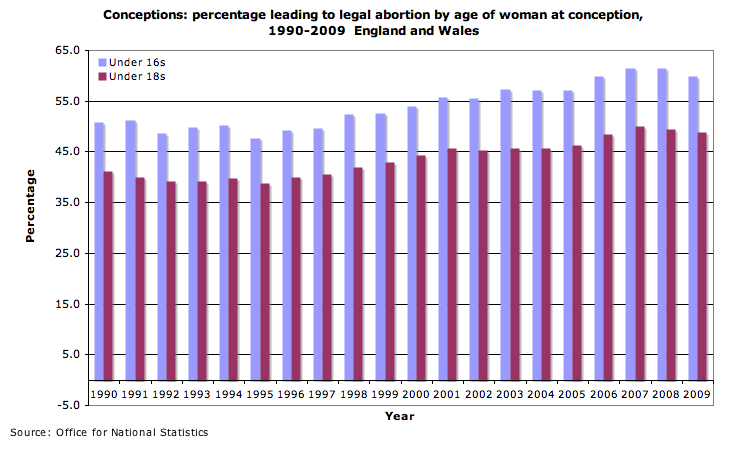
It’s a strategy that on the whole seems to be working. Have a little look at the teen conception rates resulting in abortion since 1990.

It’s fairly obvious which way the trend is going. It’s hardly surprising that the likes of BPAS are taking every single opportunity to fight to make abortion even easier to access, such as their campaign in the High Court earlier this year, to allow the abortion pill to be taken at home without medical supervision as well as attempts to change the law which currently requires the signature of two doctors, recognising that what was once safeguard against exploitation and a recognition of the seriousness of the procedure, has been reduced to nothing more than a rubber-stamping exercise.

Here are a few other charts which more than adequately illustrate the point.

No wonder those in the copulationary sex education business are laughing all the way to the bank. Money to promote their product and money to pay for their product. Every year over 60% of teens under 16 and over 50% of teens under 18 will seek an abortion. Kerching kerching kerching.

Meanwhile at the other end of the fertility scale, NICE is recommending that infertile couples should be allowed three cycles of IVF on the NHS, each cycle costing approximately £2,000. The biggest cause of infertility in the UK is women leaving it too late before starting a family. The average age of the first time mother in the UK has risen to 30. By the time a woman reaches the age of 35, her fertility will be 50% less than it was at the age of 25. At 40, it will be halved again. Most NHS trusts will not accept a patient for IVF until she is at least 35, when her chances of conceiving are between 17 and 25%.

So on the one hand we are spending millions of pounds assisting teenagers to interrupt their fertility at the moment it shows signs of commencement, whilst on the other, spending millions to deal with the aftermath. Absolute madness.

I am anticipating the inevitable howls of ideology and wishing to impose my morality on other people, by suggesting that different strategies could be employed to reduce these unacceptably high numbers of teen pregnancy and abortion. Of course the idea that teenagers should abstain from sex is no more ideological than the idea that they should feel free to have sex with whomsoever they choose, at whatever age they choose and as frequently as they choose, just so long as they behave in a “responsible and safe” fashion. Indeed the idea that sex can be risk-free and harmless so long as contraception is used is nothing more than wishful thinking with downright dangerous consequences. It is obvious which ideology has the greatest impact physically, emotionally and financially.

Don’t be fooled

I am in the process of writing a comprehensive post on strategies to combat teenage pregnancy, as a result of which I’ve been thoroughly engrossed in data from the Office of National Statistics. Of particular interest was the teenage pregnancy rates over the last quarter of a century. Both previous administrations promised to halve the unacceptably high levels of teenage pregnancy; the Labour government put an extra £280 million over 10 years into the Teenage Pregnancy Strategy, which involved making the morning after pill, condoms and sex education more easily available. The aim was to cut numbers by 15% by 2005 and by 50% by 2010. The Tories don’t get off scott free here either, they promised to halve the numbers when they were in power in the 90s and it was with this aim that compulsory sex education was put onto the National Curriculum in 1993.

Professor David Paton of Nottingham University is widely regarded as the expert in the economics of teen pregnancies. Whilst looking at some of his research, I noted that he stated that the levels of teenage pregnancy had remained static since the 70s. I was slightly sceptical of this claim, given that every year the various sexual health charities seem to laud the ever decreasing rates of teenage pregnancy and claim that it is proof of their “evidence-based” approach. Give children plenty of access to sex education, contraception and abortion and the rates will fall. That said, organisations such as Brook, who incidentally have a contract with the NHS and are paid to supply free contraceptives and contraceptive advice, will of course have a vested interest in pushing this line.

The latest statistics from the ONS website look encouraging. The provisional 2009 under-18 conception rate for England was 38.2 per 1000 girls aged 15-17, a decrease of 5.7% from the 2008 rate and the lowest rate for nearly 30 years. Since 1998, the under-18 conception rate has fallen by 18.1%. Wow, fantastic, our strategy is working say Brook, BPAS, Marie Stopes et al. The teenage pregnancy figures are falling, and yet you’ve got rid of the Teenage Pregnancy Independent Advisory group in the bonfire of the quangos. Oh no, we’ve done so well and now you are getting rid of us, when in fact we need MORE funding to continue our good work further.

Actually this rate of conceptions for the under 18s is misleading; it only includes the age group 15-17, the age bracket of 13-15 having been split out and dealt with separately, thus giving a skewed picture. The provisional 2009 under-16 conception rate for England was 7.5 per 1000 – a decrease of 4% from the 2008 rate, and representing an overall reduction of 15% from the 1998 rate of 8.8. per 1000. It doesn’t need me to point out that a year on year decrease of 4% is risible, the rate decreasing from 7.8 to 7.5 pregnancies per 1,000 girls, although any decrease is good news.

But all in all, according to the ONS figures the teen pregnancy rates have been going down since 1998 which goes to show that “evidence-based” policy works and we need to have more sex education, more contraception and more abortion. Right? (Incidentally the numbers of abortions being carried on the under 16s and under 18s has increased by over 10% in each category over the past ten years, which does not correlate to the decrease in conception rates. Slightly fewer girls may be conceiving however considerably more of them are choosing to abort the pregnancy. Abortions have risen by a third since 1997).

Before we all throw our spare pennies into the nearest Marie Stopes collecting tin and write letters of support to Dr Petra, it’s worth looking at the 1998 figures in further detail, given that they are always used as a benchmark, both by the previous government and by the sexual health charities. The 1998 figures are unusually high for two reasons, firstly following a scare about third generation contraceptive pills, which suggested that users might have an increased risk of deep vein thrombosis. BPAS estimated that this scare accounted for an extra 29,291 abortions. The other reason that the figures show a slight spike is due to a change in methodology. The ONS implemented a new algorithm in 1999 which caused a slight decrease in the previous figures. In any event the rates of under 16s conceptions were higher in 2007, than they were in 1999.

If the answer is as simple as more education and more access to contraception and abortion, then surely we should see a marked decrease in the levels of teenage pregnancies at least since 1993 when this was put on the National Curriculum and even more since 1998 when Labour pumped £280 million into their Teenage Pregnancy Strategy.

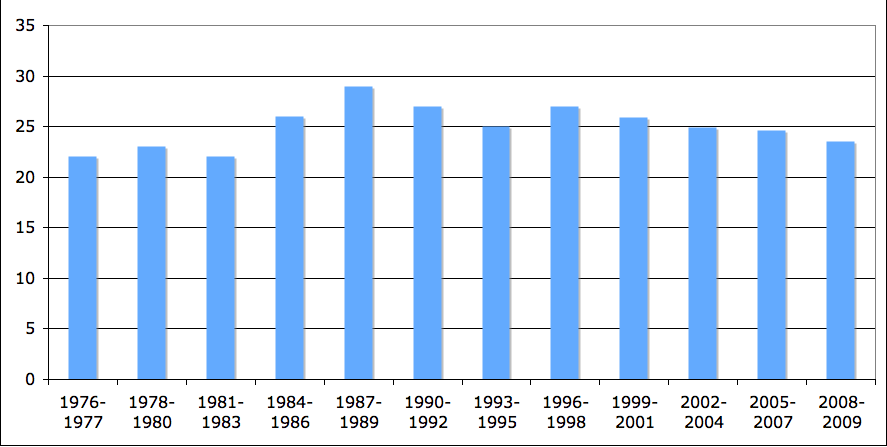
Here’s a chart showing the rate of conceptions for all under 18s, since 1976. There has not been much change, levels are currently slightly above those in the seventies when contraception was not taught about in schools, access to clinics was more difficult, under 16s could not get advice without their parents’ consent and there were less methods available than there are today, the morning-after pill only coming into use in the mid-nineties.

£280 million well spent? Or throwing good money after bad? The decision to invite LIFE to sit on the new sexual health advisory panel is not such a bad idea after all, particularly when LIFE’s expressed aim is to reduce the amount of teenage pregnancy and abortion. If we are talking about that holy cow “evidence-based” policy, it seems like the totem of more contraceptive education and services is nothing more than self-serving ideology. And if more evidence were required, it was reported this week that a scheme providing free morning after pills for under 16s in Wales has had little impact.

Time to go back to the drawing board.

The Swing of the Sea

I was probably rather intemperate in my rant regarding Mrs Dorries yesterday. Rudeness always undermines reason and let’s face it Nadine is something of an easy target. Upon reflection I realised that I had failed to highlight the glaring irony in her diatribe about the Archbishop of Canterbury. Her identification of the spiritual needs of Christians encapsulates the values of the Catholic Church:

 church goers across the country scream out for guidance. A church to lead and one they can follow. They want and need continuity and conformity, basic tenants upon which the church is based.

What could be more explicit than a written set of rules such as we have in the Catechism? Continuity and Conformity are indeed the very precepts of the Roman Catholic Church which follows the traditions handed down from Christ and the apostles. When Nadine stated that church-goers wanted to know Dr Williams’ views on abortion and euthanasia, that they were screaming out for guidance, she was advocating for a strict line on these issues; the Catholic Church is well-known and often criticised for its dogma regarding the sanctity of human life.

The irony is that Nadine Dorries was calling for leadership, for the Archbishop of Canterbury to be explicit in his views, but as I pointed out, his views are simply that, Anglicans must come to their own conclusions on these matters, not being bound by any formal teachings. Dr Williams has spoken out  with regards to how far society has deviated from the spirit of the 1967 Abortion Act, he has not however come down on any side of the debate, not even supporting Dorries’ bid for the reduction in the time limit for abortion, but  instead stated that “clear principles are not going to get you off the hook”.

So the answers and leadership that Nadine seeks from the Established Church in terms of life issues will not be found. I share her frustration, it is incomprehensible that the Archbishop of Canterbury is willing to be politically contentious, willing to upset his flock and give a clear indication and lead on matters of political ideology, but will not state his position when it comes to the lives of the most vulnerable. That is nothing short of tragic.

It puts me in mind of an early poem of Gerard Manley Hopkins, Heaven-Haven, written in 1864, prior to his conversion to Catholicism in 1866 and one of the few poems which survives the holocaust of his early work which he burnt upon entering the Jesuit order as it was “not belonging to my profession”.

I have desired to go
Where springs not fail,
To fields where flies no sharp and sided hail,
And a few lilies blow.

And I have asked to be
Where no storms come,
Where the green swell is in the havens dumb,
And out of the swing of the sea. 

Though the poem is ostensibly about a nun taking the veil, it is also read as an Anglo-Catholic poem. The images of nature lyrically and sensuously evoke that which must be renounced, namely the beauty of Anglican patrimony; Catholicism the place of tranquility by contrast to the ‘swing of the sea’ that is Anglicanism which shifts and changes with the tides.

I was right in my original assessment. Behind the emotive rhetoric, Nadine Dorries hit upon an element of truth, although I don’t see her becoming a nun at any time in the near future. To quote another poem of Hopkins on a similar theme, The Habit of Perfection; whilst she is in politics her lips cannot remain ‘lovely-dumb’.

Mad as a box of frogs

Nadine Dorries added her voice to the chorus condemning the remarks of the Archbishop of Canterbury on her blog. Very often I have some sympathy with Mrs Dorries, she is the UK’s answer to Sarah Palin, the politician that everyone loves to deride, her personal reputation meaning that her detractors often don’t take the time to see beyond the muddled, emotive rhetoric, designed for maximum impact, but often with minimum thought or nuance. Today’s blog is a perfect example, with Dorries taking issue on both the content of the Archbishop’s remarks and also that he dared to speak on the ‘wrong’ topic.

She starts by trying to call the Primate of the Church of England’s Christian faith into doubt:

only weeks ago he proclaimed how uncomfortable he had been with the shooting of the mass murderer and most wanted man in the world, Osama Bin Laden. In 2008 we had Sharia Gate. A speech given by the Archbishop which must have deeply offended every practicing Christian in the UK.

Many people were uncomfortable with the execution of Bin Laden. The fifth commandment states “thou shalt not kill” which is why, as Dorries should undoubtedly be aware, many Christians don’t condone either abortion or the death penalty. Dorries certainly seems to support the latter. In any event being uncomfortable with the death of an unarmed man, is not indicative of a lack of Christian faith. Dorries seems to be rather un-subtly implying that Dr Williams is more concerned with Islam than he is his own religion by rather unfairly linking Sharia Gate (when Dr Williams made some equally ill-judged comments stating that Sharia would become unavoidable in this country) with his concern regarding the execution of Bin Laden. The Roman Catholic Church also stated that the death of a man was no cause for celebration.

(His article) was a derogation of his responsibility to lead and unite his flock

Calm down dear. He guest edited a magazine and made some political comments, that is all. It is the role of the Church to offer moral comment on government policy, no matter how unpalatable that may be to those who are of a different political persuasion.

and the most transparent expose yet of the fact that at the top, the Church of England is almost wholly infiltrated and run by people who would regard The New Statesman as their own particular gospel.

Watch out, there’s a communist in every cassock! This is ridiculous paranoia and untrue to boot. The Labour party have somehow managed to infiltrate the Church of England by sending party activists off to theological college and then ordination and then managed to get them elected onto the Synod. That takes some doing. Clergymen are more concerned with the New Statesmen than the Gospel of Jesus Christ? They are all hypocrites and liars, who don’t put the Gospel at the centre of their lives? Rightyho. Whatever you say dear…

There are areas of policy where politics and the church overlap, where debate should be robust and where the church and its Archbishops could speak with authority and have real influence and effect.

Such as those which might involve the poor and disenfranchised. But here’s the nub of the issue. Dr Williams did not speak about those issues which Nadine Dorries would have endorsed and supported her agenda. That’s hardly surprising, Dorries already mentioned the readership of the New Statesmen, so all the Archbishop of Canterbury was trying to do was reach and engage with the readership who would not be inclined to purchase an issue with a heavy pro-life agenda.

MPs and congregations want to know, what does Rowan Williams think of our over sexualised society, or the teaching of abstinence in schools?

Do they? Is that the most pressing issue on the minds of congregations when it comes to what Rowan Williams thinks? Are congregations actually that concerned about what Rowan Williams thinks? With the greatest of respect, church-goers will obviously pay attention to his remarks, but as they aren’t doctrine, they are simply his opinion, there to be noted and thought about, but not infallible pronouncements. I would argue that most people don’t really care about what Rowan Williams thinks about our over-sexualised society, having already come to their own conclusions. Same with abstinence, and in fact never mind most congregations, most members of the population seem to have focussed on the most negative interpretation as to how abstinence may be taught and thus don’t really care what the Archbishop thinks. Are most MPs most concerned about abstinence and the over sexualisation of society? If only.

What words does he have for his congregations on abortion or assisted suicide? What does he have to say about the screening of the documentary to be shown which next week which will shows us a man’s dying moments at a Dignistas clinic in Switzerland? What does he think of embryology research? Silence. Nothing, nada, not a word.

OK I get this and understand the point she’s making. The Church of England’s teaching on abortion and euthanasia is clear, they are pretty much against these practices, although with some room for interpretative hand-wringing. The Church leaders do need to speak more loudly and more frequently against these practices. It is nothing short of a tragedy that the leaders of Christ’s Church remain silent on the issues that affect the most vulnerable in our society. In some ways this is something of a veiled advert for the Catholic Church, although we would like our priests, bishops and archbishops to be more vocal in their defence of the elderly and unborn, often shying away from these uncomfortable topics, at least we have the authority of the magisterium, which is crystal clear on these issues.

Abstinence, abortion and euthanasia are issues that dovetail perfectly with Christian teaching, which is what Dorries is getting at. These issues are however, entirely logical stances to support, which do not require a belief in God. The support of the Church is vital, but the problem is that by linking them with the Church, Dorries makes clear her agenda is predominantly a Christian one, which gives fuel to the idea that abstinence teaching in schools is motivated purely by Christian morality, as opposed to being a good idea in itself. Abstinence makes sense and does not need to be taught within a Christian framework, as might be inferred. If Dorries is serious about getting a decent SRE programme in place, she needs to appeal to more than just the Christian vote or agenda. All these issues are rational ones, reinforced by religious faith, but not necessitating it.

I wonder if Nadine Dorries is interested in the views of the Archbishop of Canterbury on adultery? I know of some who are screaming out for guidance on this issue also.

the retreat of the church from our communities into its own ivory alters, is what has left a void within communities.

Rambling hyperbole. How precisely has the church withdrawn from communities?

A void the Big Society initiative is trying desperately to fill. The coalition, Archbishop, is trying to do the job in which your church has failed and is that maybe what has irked? That the Big Society policy has shone a light over the lazy failings of a rather wealthy established church?

Offensive piffle. How has the Church failed? Is it the Church’s job to prop up the government’s economic policies, to provide social care if the government won’t? Actually the Church provides an enormous amount of community support, from volunteers who visit the elderly and sick, to fund-raising for local causes such as hospices. David Cameron wants to emulate and build upon the model of community support that churches provide, recognising that this is all organised at a local level. The Church of England does not work from the top down; though it is governed by a mixture of episcopal, synodical and also parliamentary authority, it is also highly congregational, in short a unique structure that is very different to that of the Catholic Church. To state that the Church of England has somehow failed, without defining how, is erroneous and to call it lazy, is deeply offensive to all the members of the congregations and clergy that comprise the Church of England. What have these lazy priests, many of whom work longer hours and for considerably less pay, despite being easily as qualified as a city executive, failed to do? What else should the members of the Church of England be doing, other than what they are doing already? The only laziness here is Dorries’ statement of wealth of the Church of England. The Church of England is not some centralised organisation sitting on piles of cash, far from it. Churches cost thousands a week in upkeep, clergy salaries, pensions and houses need to be provided and maintained, not to mention the church schools. Many parishes are desperately struggling financially. To accuse the Church of England of lazily sitting back and doing nothing to tackle the problems of social exclusion whilst wallowing in money is the statement that surely must offend very single member. I’m not one, but I am offended nonetheless, having seen firsthand the selfless dedication and generosity of members of church communities.

church goers across the country scream out for guidance.

Why? How very patronising. They don’t know what to think and need the Archbishop of Canterbury to direct his scattered flock? Is the Bible and the guidance of their local priests and clergy not enough for them?

A church to lead and one they can follow. They want and need continuity and conformity, basic tenants upon which the church is based. That’s why they attend church because otherwise, they may as well stay at home and pray in isolation.

People attend Church because they want an encounter with Christ in the Eucharist, which is not available at home. They want to share in the fellowship of Christ as he commanded.

They want their church leader to reflect the teaching of Jesus and to spread his word into the wider community. To influence policy in the way Jesus would do if he were here today. What people don’t want is an Archbishop hijacking their church as a platform for his own Sharia friendly, socialist, personal political views.

Ah nice, another smear on Dr Williams’ agenda. I’m always wary of the “what would Jesus do” debates. What we do know is that Jesus Christ was the most revolutionary radical person ever to walk this planet. In terms of policy he would amongst other things demand that individuals, corporations and governments do everything possible to ensure that the poor have access to nutritious food, clean water and sanitation, decent housing, good schools, adequate employment and health care. So Dr Williams was well within his remit.

Their Church? The one that is lazy and wealthy? How can the Archbishop of Canterbury “hijack” something that he is already in charge of? Isn’t this something of a contradiction in terms? Which is it, thanks to the Archbishop of Canterbury the church is failing, lazy and wealthy and now he’s taking it over? Surely if the former is true, perhaps his sudden hijack might improve matters? Is every member of the Church of England right-wing? Bit of a sweeping statement. I thought the Church of England had been infiltrated and was being run by socialists already according to her opening statements. Presumably they are very happy to see Dr Williams use it as a platform for his socialist views. In any event anything that any Archbishop of Canterbury says will always be his personal views. He is not a direct sovereign of the Church, he word is not binding law.

The buzz word around Westminster is ‘Who will rid us of this troublesome priest’. The answer is ultimately his flock, as they stay at home week after week. The Archbishop is feeling the effect of true democracy as they let him know what they think of his ridiculous uttering’s, with their feet.

If congregations are down, it is for reasons far more prosaic than folk disagree with Rowan Williams. Most genuine Christians, would not let a leader with whom they may have divergences of opinion, affect their encounter with the divine. Just because one might have some personal disagreement with the political views of a bishop or archbishop, will not affect our desire to deepen in spirituality. Another nonsense banality.

The last time “who will rid us of this turbulent priest was uttered” it resulted in sainthood. Dorries should think on.

I have been loathe to write this because Dorries is one of the few pro-life MPs who we have in Parliament. There is a glimmer of sense and rationality behind some of the rhetoric, once you manage to unpick it. When she comes out with tripe like this, you just want to put your head in your hands and groan. Surely we can do better – we have to. The thought that she is the sole voice of the unborn, terminally ill and elderly in Parliament is profoundly depressing.

Goodnight kisses

On last night’s BBC Question Time the acclaimed feminist Germaine Greer came under a lot of fire for suggesting that little girls flirt with their fathers. Her statement was met with outrage and derision by the audience and Twitter alike.

Greer knows her stuff when it comes to ideas regarding sexuality. I didn’t agree with her comments that the only clothes commercially available for girls are pink, sparkly and vampish (she’s never heard of Boden obviously 😉 ); plenty of high street retailers do sell other items of clothing, it’s not a difficulty I have ever encountered. The reaction was particularly vociferous from men, no-one likes to think of their daughter play-acting in a sexy fashion with them or trying to get sexual attention from them, particularly in a society that has lost it’s innocence, with awareness about the dreadful crime of pedophelia reaching paranoid proportions in certain sections of the media.

Fact is children DO rehearse adult behaviour in a safe environment with parents and siblings. They may not be consciously aware of it, but it is something that happens.

We nodded with recognition because coincidentally, literally 2 hours earlier, daughter whilst saying goodnight had put on a silly voice, said “I’m mummy, I’m Caroline, give me a kiss darling” put her hands on her hips and wiggled in an attempt to portray herself as me. Given that I don’t walk around the house like Jessica Rabbit, on a subconscious level she sees the sexual and romantic side of my relationship with my husband and was copying it! Whilst it was a little uncomfortable for my husband, because he is her step-father and is hyper aware of boundaries, he screamed with laughter and called me to witness. “Go on, do your mummy impression again it was hilarious”. He was right it was hilarious and spot on! It demonstrated Greer’s point admirably.

Children are very perceptive which is why we need to give them examples of positive loving adult relationships. They pick up and copy the behaviours and relationships exhibited by their parents. A child who witnesses a violent domestic relationship is infinitely more likely to end up in a relationship of a similar type, regardless of gender. Greer focused purely on girls as have most commenters on the notion of sexualisation, I did for the simple reason I have girls, but it goes without saying boys also learn ways of behaviour from their parents and are just as likely to be affected by ‘sexualisation’.

Greer’s point illustrated precisely why a safe stable relationship between two different gendered parents is believed to be the ideal, not only by the Catholic Church but by millions of others with other faiths and none.

Single-parent families are not “bad”, people must not be stigmatised, often they are the only safe option and parents who have been deserted or bereaved have no choice. Single parents tend to have it tougher without the support of a live-in partner.

Supporting and acknowledging Greer’s comments, no matter how uncomfortable they are, means recognising two difficult truths. Children use their family environments to develop, explore and practice their relationship behaviour and psychological development. If we want them to develop balance then ideally they need a parent of each gender, as different genders have different qualities. Gender is not a purely social construct. Two parents of the same gender will not provide the same balance. Children will not witness a male/female romantic relationship from which they will draw subconscious lessons. It does not mean that they are more likely to develop same sex or bisexual attraction, but if we accept the ONS’ latest statistics that 1% of people identified as LGBT in their last survey, it does mean that children will most likely be growing up with a one sided version of sexuality and relationships and less awareness of how to form, conduct and behave in relationships with those of a different gender; not witnessing or be able to copy it at close quarters in a safe environment. Unless of course you believe that people exhibit the same types of behaviour with their partner regardless of gender. Men and women’s sexual behaviours are interchangeable? Two women or two men in a relationship behave in exactly the same way as a man and a woman?

On picking up the example of the little girl kissing her father goodnight, Greer hit a nerve hence the outrage. Most children practice their sexuality at home and ideally need a parent of each gender. That is a fact, regardless of religious belief and it is not homophobic to say so.

The Bailey Review

I took a look at the recommendations of the Bailey Review this morning. As a Christian mother who is concerned that her children don’t pick up unhealthy messages regarding sex and society, the report is of obvious interest. The recommendations are outlined below, together with my comments.

putting age restrictions on music videos to prevent children buying sexually explicit videos, and to guide broadcasters over when to show them

That seems reasonable enough, given some of the hard-core porn type content of certain R&B music videos and some of the lyrics. It’s probably unnecessary however, given that mainstream broadcasters already exercise sensible judgement in terms of what they screen and when. Anyone remember the Girls on Film video by Duran Duran? A highly abridged clip was only ever broadcast. Same with Michael Jackson’s Thriller. I remember the first time that appeared in full on British Television with much emphasis placed on the broadcast time of after 9pm. No trip down the memory lane of ’80s music is complete without a reference to Frankie Goes to Hollywood  and  Relax…Dedicated music channels don’t show explicit videos during the day. I can see the sense in putting age categorisations on music videos, but I suspect it won’t change an awful lot, and often age categorisations only increase the lure and kudos of this type of material. Pop music has always been subversive. My mother was banned from listening to Bill Hailey and the Comets when she was a teen in the fifties. The nuns thought it was “decadent”. I  don’t want my children to be singing “I’m horny, horny, horny, horny” or similar, so for that reason we don’t listen to commercial radio stations.

covering up sexualised images on the front pages of magazines and newspapers so they are not in easy sight of children

What is a sexualised image? Surely what is sexy is in the eye of the beholder? You only need to pay a visit to one of Cologne’s finest pornographers to see what passes as sexy to some is comedically ludicrous. (I should state here, that in my wild days as cabin crew, a very camp young man who decided I needed educating, took me into his favourite shop in Cologne for a giggle.Upon viewing the magazine cover which featured nothing more daring than a young lady in a bikini and an elephant, I erupted into peals of hysterical laughter and was forcibly ejected from the shop by the proprietor for inappropriate mirth. “Eeet iizzz NOT funny, eeez serious artistic erotica”.)

I’ll stop there before I get myself into too much trouble. I do agree that retailers need to ensure that lads’ mags are placed out of eye level of children, it isn’t ideal needing to explain to a 5 year old that the lady on the front of the magazine isn’t about to feed her baby, or why she is wearing long socks and knickers that go right up her bum (that must be painful mummy). Retailers need to implement a voluntary code and ensure that these types of magazines are placed firmly on the top shelf. At present men’s “lifestyle” magazines don’t fall into quite the same category as blatant erotica, hence they are placed in places designed to catch the eye and be accessible. Normally in the checkout queue, to aid impulse purchases.

Some retailers are responsible, others not so, but the notion of a “sexualised” image is highly subjective, and we need to ensure that we don’t go too far in this respect. We don’t want to be photoshopping in extra sleeves, in order that a glimpse of bare flesh may corrupt, as happens in Emirate states.

making every customer make a decision at the point of purchase over whether they want adult content on their home internet, laptops or smart phones, rather than receiving it automatically

At last, an entirely sensible proposition. One that won’t please the pornographers, but the only caveat is that adult content filters can prover incredibly frustrating. We have been banned from accessing well known Christian bloggers, I haven’t been able to view websites containing advice on pregnancy and giving birth and often email will fall into spam filters. Most adults would opt to receive adult content and put their own filters or controls in place. I have no problem with this option being offered, but we need to ensure that no record is kept of who has opted in or out of such controls. I believe it happens in practice anyway, I am with Vodaphone and because I haven’t automatically enabled some widget or other I automatically have an age-restriction on my phone, meaning I can’t access adult material. Fundamentally however, I can’t see a problem with offering people the option. If you  really want your children to be safe on the internet, don’t buy them a smartphone and don’t let them have their own laptop.

retailers to offer more age-appropriate clothes for children and sign up to a code of practice which checks and challenges the design, buying, display and marketing of clothes, products and services for children

Covered this yesterday. If you don’t like it, don’t buy it for your child. We don’t need nanny questioning whether or not this is really appropriate. My sister had a sixth form job working in Laura Ashley and was in receipt of free clothes as part of the job. On wearing a long flowery halter neck dress to school one day, she was sent home to change by Sister Margaret Mary for coming to school attired in “beachwear”. The idea of code of practice that “challenges design” seems rather sinister. How far will they take this. My 7 year old has one of these. Will that be inappropriate as it will be deemed to be foisting a religion upon her?  Why can’t we let the free market rule?

restricting outdoor adverts containing sexualised imagery where large numbers of children are likely to see them, for example near schools, nurseries and playgrounds

OK, we’re getting into the realms of paranoia now. Either a billboard advert is suitable to be seen by children or it isn’t. Isn’t that the role of the ASA? Again what is suitable for children, will vary from person to person. Surely there is already a consensus on the types of advert that are suitable for public display.

giving greater weight to the views of parents above the general public in regulating pre-watershed TV

I really don’t like this one at all. Why on earth should the views of parents be more valid than the views of everyone else? So if you don’t like a certain scene or programme being shown at a certain time on TV, maybe because you were watching it with your delicate Aunt Mabel, your views are not as valid as those with young children. Since when did having children render you more wisdom in terms of  gleaning what may be appropriate viewing material? The moment my baby popped out meant that I can have greater say as to what’s on television? Great. More programmes like the History of Christianity, Scared Music and less football please. That’s what “my” children should be watching. I don’t want my children to be watching scenes with sexual references. That’s why we don’t watch much live TV. That’s what DVD players and now more recently the Iplayer are there for. The advent of technology means that we’re no longer tied to broadcaster’s schedules and there is an argument to be made that the watershed could be obsolete, although I am in favour of keeping it as a general principle. Are our broadcasters not already regulated?

providing parents with one single website to make it easier to complain about any programme, advert, product or service

We have this already. It’s called Mumsnet.

banning the employment of children under 16 as brand ambassadors and in peer-to-peer marketing, and improving parents’ awareness of advertising and marketing techniques aimed at children.

So no more Miss Pears then? I’m struggling to think of any under 16s who are brand ambassadors, but maybe someone down with da kids could tell me. I think most parents are already aware of the effect of advertising on their children, which is why  guidelines have been developed already. My children don’t watch adverts, I like the quiet life. My daughter has seen the “adopt a jaguar” advert in between husband’s surreptious bouts of Stargate, I’ve not heard the end of it. The types of adverts that she does see are not those that are likely to be the cause of  ‘sexualisation’. This last rule seems to be more about curbing advertising aimed at children, which is already the subject of regulation. I can’t see the harm of letting Justin Beiber advertise a can of Coke or whatever.

My daughter has a pair of the dreaded Lelly Kellies. Why? Because they were sparkly, she liked them and had seen her friends wearing them. Absolutely nothing to do with any adverts, or being persuaded that they were the cool brand, she had no idea. She liked them for the product in all their ghastly garishness. They are so obviously a shoe that only a child could like, I have no problem (besides Grandma bought them for her birthday). Shock horror they came with *make up*, i.e. a palate of pastel eye shadow, blusher and lipgloss. She has no idea what to do with make-up, but just possessing it makes her pleased as Punch. The attempts at applying it were a sight to behold, having no idea that blue is not a colour that one would volunatarily use to put one’s forehead. Harmless childhood pleasure, not stemming from sexualisation but a desire to be grown-up, which even the tiniest toddlers posses.

Where the problem with what seem to be over-precocious children lies is entirely with the parents, who perhaps desire a best friend, as opposed to a child. It wouldn’t have been the make-up that was the problem, but had child known exactly how to expertly apply it like an adult; the make-up itself being hardly visible, an extra marketing hook, but as I said yesterday, parents hold all the power in this area.

I am by all accounts a “fundamentalist” Christian, who would wish to bring up her children to wait until marriage for sex and who aims to teach my children conservative messages about sex and society.  I am very keen to keep them safe and prevent them from growing up too soon. But it is not my role to prevent them from growing up, quite the opposite, I wish to help them grow up to be healthy and fulfilled adults able to function as a useful part of society. The way we do that is not by changing society to suit them, but by gradually helping them to adapt to society as it is. If I can keep my children safe from becoming over-commercialised, I would argue that anyone can.

We don’t need illiberal and misconceived legislation which seeks to limit grown-up choices and puts the rights of parents over the rights of everyone else. Children need to learn that the world is often not a nice place and most importantly it does not resolve around them. I often wish that society was more conservative in nature, but the way to do that is not to force it with misconceived legislation.

Advertising and the media is a reflection of society. If this is over-sexualised, then there is a reason why, which goes far beyond a raunchy music video.

Won’t somebody please think of the kids

When I was little the Benny Hill show was all the rage. Much to my sister’s amusement and my parents’ embarrassment, whenever I was asked what I wanted to be when I grew up the answer was always a Hill’s Angel. I also fancied being a member of Legs 11, Bucks Fizz (didn’t we all want one of those rippy off swishy skirts) or one of the dancers on the Kenny Everett show

I don’t look back on that with any sense of shame, I actually think it’s rather amusing and quite ironic all things considered. I haven’t grown up with a skewed sense of women as objects or being man-pleasers, nor did it adversely affect my body image. To quote the cliche, it’s not done me any harm, nor I suspect countless others of my generation.

The women I saw prancing about on TV seemed exotic, glamourous and beautiful, a world away from a mundane existence in an Essex village. They exuded excitement, much more fun to be a Hill’s Angel than a school-teacher, you get to wear sparkly costumes and make-up, be on TV and more to the point everyone would think you were really cool. I spent hours in a make-believe world of being a fabulous dancer for an admiring audience.

I’m sure had Nadine Dorries or Mary Whitehouse seen me practicing my various dance routines they would have exploded in apoplexy, little knowing that this over-sexualised youngster would one day marry a vicar, advocate abstinence and get the odd feature writing about the poetry of John Paul 2 in the Catholic Herald!

The Benny Hill show was seen as clean family viewing as were the Carry On Films. Every time I watch a Carry On film I spot a new double-entendre and from an adult perspective they are almost eye wateringly rude, but with the eyes of a child, it was the characterisation, plots and slapstick humour that were amusing. The sexual nature of the humour went over our heads. The iconic scene whereby Babs Windsor lost her bra provided the source of much entertainment for my sister and I for years, as we acted it out; pretending to be grown up ladies with breasts was hilarious: “And Fling, And In, And Fling, And In, And FLING – ooooh Matron, hee hee hee hee”.

The TV shows that were on exposed children of the 70s and 80s to every bit of sexualisation as they do today, only in today’s post feminist world the portrayal of sex is very different, but it is still nonetheless there. We needn’t panic about this unduly. All children will want to copy adult behaviour that they see on television. It’s how they explore and learn. Over the years the games that I’ve seen my daughter play have made me wonder whether or not I need to bring in a psychologist, but concepts such as illness, death, being kind to others, nurturing, playing at being mummy or daddy are all explored through play.

Sexuality is no different. Children don’t just arrive at the magical age of 16 and suddenly they are fully sexual beings with mature adult feelings. They experiment and play at being adult, at being sexy and one of the ways that they do this is by copying adults who embody cool or those qualities that they would like to have as adults. Sexuality is always encompassed, but almost always on a subconscious level. So next time you see a teenybopper bumping and grinding, before cringing and blaming an overly-sexualised society, think of me, pretending to be a Hill’s Angel at the tender age of 7 or 8, with absolutely no idea that I was being “sexy” simply copying the attractive ladies on TV. When and if my children do it, I’ll simply laugh and realise that it’s exploration. Though the sight of a mini-Britney may send shivers through the spine, the discomfort is the perception of the sexually-aware adult, confronted with the uncomfortable juxtaposition of childhood and sexuality. The notion that children may be “sexualised”, that they are somehow sexual creatures or are attempting to buy into the adult world of sexuality is the defence of the pedophile.

I write this in response to today’s news that the government are now wishing to pass measures to counter the over-commercialisation of children to protect them from over-sexualisation. There is some merit in a few of their proposals; anyone who saw last Tuesday’s Holby City with its depiction of homo-erotic violent sex, with two men stripped to the waist fighting then kissing, followed by a similarly graphic heterosexual scene, to emphasise the character’s alleged sexual confusion, will agree that this was too adult a scene pre-watershed. I would not have wished to be sat there watching it with a 10/11-year-old and having to explain the very adult nature of the themes involved, to be honest I’m not sure that I would understand them myself. The BBC and other broadcasters have a duty to ensure that their content is suitable for younger viewers, although Holby City is rated as a 12 show and given the adult nature of many of their themes, I would not be allowing a child any younger to watch it.

Whilst we need to make sure that TV and internet content can be appropriately filtered in order that parents may discern what is suitable for their children to watch, I am extremely wary about the government acting as the nanny state in this respect. I am flabbergasted that a Conservative prime minister is mooting the idea that the state needs to control what may be supplied in the shops, in terms of appropriate children’s clothing. I am well aware of the ubiquitous padded bra and other inappropriate material for children, but it seems to me that if you don’t like a certain item of clothing, then don’t buy it for your child. You have the money, you are the adult paying either a mortgage or rent, you are the one in control here, therefore rather than complain about the availability of such items, let your wallet do the talking. It’s the same principle whilst in the supermarket, we all get subject to pester-power, but ultimately the key is not to give in to the demands for chocolate breakfast cereal or whatever.

But what about those people who do buy chocolate cereal for their children, don’t we need to legislate for them? No, in a free country, our children are OUR responsibility, not that of the state and thus though wanting to save them from the perils of a sugary breakfast is a laudable objective, in the same way that it is wanting to save them from the horrors of a tracksuit with “juicy” written across the rear, we have to let parents make these choices for themselves. We cannot be legislating or letting the state determine every aspect of our children’s lives. Besides, the chocolate cereal might be a one-off holiday treat, or do we ban it for those parents who can’t be responsible? Do we ban turkey twizzlers and fast-food? It’s the same with abstinence actually. Legally children must be given sex education, the state determining what is appropriate. I don’t want the state to decide what my children must be taught in terms of sexual behaviour, I think that is entirely down to the parents, which is why schools shouldn’t just present one option that is politically acceptable or motivated, which is currently the case.

My seven year old has an entirely innocent Little Miss Naughty nightshirt. She likes Little Miss Naughty, unsurprisingly enough there’s some empathy going on there. If she saw the Little Miss Naughty Bra and asked for it, I would say no, explaining that she doesn’t need a bra yet, but when she does, mummy will help her choose one. But playing devils advocate here, say I did buy her the bra, where is the real harm, particularly if I didn’t let her go out in it? Why would she want a bra? Because she sees mummy wear them and wants to pretend to be a grown-up like mummy. Would she want it to look sexy? She’s got no idea what sexy means, she’d probably want it to look pretty and grown up. She’d want Little Miss Naughty on it, because it would appeal to her. A child would have no idea of the way a beloved character has been exploited for its potential sexual double-entendre by the crossover into the adult market.  It is clearly cynical marketing, but adults have the power. We are not helpless or powerless in the face of childhood pleading. By the time child has got home she has probably forgotten all about said bra. But, if I wanted to buy it for her, if I thought it was harmless, then again that would be my choice as the adult consumer. Since when did the state start deciding what should be supplied in the shops? Why can’t I buy my child a bra if she wants one?

I don’t like to see children dressed like sexually aware adults admittedly. Not because I think that they will attract pedophiles, who are unlikely to be swayed by what the child is wearing and very rarely will a pedophile attack a random child simply because s/he happens to be wearing a bikini or whatever, but because there is something that jars and is discordant about a child wearing an item of clothing that has been designed to draw attention and flatter sexual features they are yet to possess. But this idea of children not looking like mini-adults is a relatively new one, which only really began to take off in the twentieth century, up until then, children were always dressed like adults, it was followers of Rousseau who began to copy the idea that children perhaps should be dressed in order to give them more freedom of movement. Most people don’t have a problem with children wearing minature versions of modest adult clothing, it’s the immodesty that causes the issue.

Whilst there might be a case for putting in place certain restrictions to ensure that children are not inadvertently subjected to inappropriate material, whether that be on the TV, in advertising or on the web, there seems to be a fine line between that and the censorship of the Victorian era or an Islamic state. Some adverts have recently crossed the mark, but if an advert is sexually graphic enough not to pass the ASA guidelines, then it shouldn’t be put on a billboard anywhere. Children are likely to see billboards wherever they are posted, so rather than ensuring a poster is not put somewhere that a child might see it, surely the most logical stance would be to ensure all adverts are appropriate for viewing by children. Moving lads mags to the top shelf again seems sensible, but it seems to me to be akin to rearranging the deck chairs on the Titanic.

There is something discordant about a society which on the one hand is fretting about the idea that our children might be taught to say no to sex, as many of the members of the Labour party seem to be, and yet on the other are doing everything possible in their power to ensure that children never see a single naked body or any sexual images whatsoever until they wake up one day and discover they are sexually aware. The main issue is not the images, clothes or dance routines in themselves but the morality and messages about sex that underpin them, banishing them from out of sight of the children does nothing to help children contextualise or deal with these images as adults. If anything it contributes to an unhealthy attitude about sex. As we do live in a sex saturated culture, anyone concerned about the impact on their children should use their initiative to filter out inappropriate material and also explain and discuss these images and concepts with their children, but ultimately what is appropriate is dependent on the judgement of the adult.

We seem to be adopting a similar attitude to sex and children as we are to death. It’s clinical, let’s sanitise it, keep it behind closed doors, not mention it in front of the children, its scary, they won’t understand, until suddenly one day they have to deal with it for themselves.

If we are going to keep our children safe, then it is up to us as parents to take responsibility for our children’s upbringing. My 7-year-old has no idea what “sexy” is or how to be sexy. Hannah Montana, High School Musical and Glee are not watched in our house and by the time the X Factor starts she is in bed. Similarly we don’t listen to pop music stations. No television is watched which has not been pre-filtered by us and the computer is not used. Her clothes are entirely age-appropriate and no arguments ensue at this stage. She is not sexualised in any way shape or form, although she knows the different between boys and girls, what naked adults look like and understands that husbands give wives their seed to make babies. I know that sex is everywhere and unavoidable but rather than get squeamish about it, I take ownership and responsibility making sure that she is not watching programmes aimed at teens. When the time comes we will watch programmes together rather than let her passively absorb any messages of dubious value.

She still came home from a party the other day saying that she liked Lady Gaga and might quite like to be a pop singer one day. I laughed. I am confident enough in my parenting and my values not to be reaching for the smelling salts at any perceived sign of sexual precociousness. But then again I see the issue of managing my children’s developing sexual awareness and their path to adulthood as being no-one’s responsibility but mine. If we are serious about keeping children safe and ensuring they reach adulthood minus an unwanted pregnancy then maintaining open communication about sex and relationships is key. Persistent exposure to adult nudity keeps vigilant  parents on their toes, not perhaps being the most helpful of images, but unless one isolates children from society, some exposure to images is inevitable. We simply need to ensure that these images are not unduly explicit. The underwear sections of women’s catalogues will continue to provide adolescent titillation for generations in the same way that most children furnished with their first dictionary will immediately proceed to look up the rude words. If you don’t want children to see anything stronger than the Next catalogue, then don’t have that material in your house, no matter how “well hidden”.

Whilst the use of Internet porn has disturbing implications, for adults and children alike, the responsibility needs to be on the parents to prevent their child’s exposure. Society needs to resolve issues of sexuality, far-reaching questions need to be asked about our culture and how sexually healthy we really are, but banning children from playing at being exotic grown ups by putting restrictions on what they may wear or what other people may wear or how they may dance is a superficial answer.

Oh, and I’m pretty sure that I still have my fingerless lace gloves surreptitiously bought from Etam circa 1984 and hidden in a drawer safe from the disapproval of my mother’s eyes aged 9, together with the rows of bangles to go with them so I looked just like Madonna on the front cover of my sister’s Like a Virgin album.

Enemy of reason?

I had a wee bit of a twitter spat with Steven Baxter of the New Statesman last night. He had attracted quite a bit of opprobrium after suggesting that “Seven-year-old children should be taught to put a condom over Nadine Dorries’ face”.

That was plainly an attempt at humour, clearly in poor taste and several tweeters pulled up Mr Baxter on the violent and sexist undertones of his “joke”. Whilst checking out the resulting brouhaha (@stebax on Twitter), I noted that he had called Dorries’ views on sex education “dangerous”.

I therefore enquired what he meant by dangerous. It seems to me that if, as the writer for a national publication (although the New Statesman is hemorrhaging readers) you are going to call a certain viewpoint dangerous, then a certain amount of elaboration and explanation is necessary. Otherwise we can all go around smearing those who hold viewpoints as contrary to ours as “dangerous” in an attempt to discredit what are legitimately held views and close down any meaningful debate. If something is dangerous, then there’s a possibility that it could cause real, definite and lasting harm. I fail to see how not having sex until adulthood falls into this category.

I can’t quite work out how to reproduce screenshots from Twitter onto a Mac as other bloggers do (any technical help would be much appreciated) however here’s the conversation in full, I’m in blue:

 I’m trying to understand @Stebax ‘s notion that teaching teens not to have underage sex is somehow dangerous…

 It’s not ‘teens’ though, is it? It’s just girls.

so teaching girls that they can resist pressure (from many different sources) is “dangerous”? I agree boys should be included too. 

It is to focus on them in the way Dorries is.

but given girls bear the brunt of pregnancy, abortion, STDs, cervical cancer, then it’s hardly dangerous to focus upon them.

Everyone can resist pressure. That is not what is being advocated, and you know it.

what do you think is being advocated? Serious question.

OK, the reason why I said what I said was because I was implying that was your tactic.

No, I’ll start by asking you, then I can pick holes in your tweet. Off you go.

what we are talking about is SRE. Not just plain mechanics, or here’s how to do it “safely”. Abstinence *plus* approach. Google it.

Why abstinence though? Google ‘patronising’.

because there is no such thing as 100% safe sex. Because condoms do fail. 15% typical use failure rate. Hormonal contraception also.

so the only way to truly prevent pregnancy is not to have sex. Society with high rate of teen sex has high rate of teen pregnancies

There’s no such thing as safe life. All we can do is make it as safe as possible. People stuffed with hormones will fuck.

so we stuff teen girls still going through puberty full of synthetic hormones designed to simulate pregnancy? I know what is safer. 

The only way to stop people dying is to make sure they don’t cross the road. Which kills more kids than sex.

But as in my analogy, it’s safer for no-one to leave the house. But we will leave the house. We have needs.

sex is not a “need”, particularly for teens. If sex is a “need” does that act as a defence for rape, if a man isn’t getting any?

Oh, don’t do the ‘you just justified rape’ thing. That cheapens you completely. Disappointed in you.

I didn’t say that, don’t twist my words, I am asking how you quantify sex as a “need”. Let’s not do ad homs, it’s a logical stance.

You asked if I thought it justified rape. No, it doesn’t. Not at all. Is that clear? But sex is a need. And a lovely thing.

I agree on the latter. But what happens if a teen doesn’t have sex? What harm comes to them by waiting a bit? What are the risks?

 Nothing apart from seeing something natural as something wrong & forbidden.

so you agree now that abstinence as part of SRE not dangerous? Besides it doesn’t teach sex is wrong or forbidden, but appropriate.

think I love appropriate sex more than any other kind. And no, I don’t agree with you.

 but why is abstinence, i.e. not having sex, or teaching that kids shouldn’t be having sex, “dangerous”? Where is the “danger”?

so teaching kids sex best left til they can handle consequences is dangerous as it makes them think sex is wrong & forbidden?

No.

all I’m trying to do here is unpack your notion that abstinence as part of SRE is dangerous. You need to define what you meant.

All I am trying to do is say that we should agree to disagree. I think it is, you don’t. OK, fine.

Fine. I’ve explained why abstinence is not dangerous, you don’t want to substantiate your assertion to the contrary. Understood 🙂

That’s a spectacularly passive-aggressive tweet. So well done for that. I think our discussion might be over.

Subsequent to this conversation, Steven Baxter was the recipient of several tweets stating that I was clearly a “loon” and “moron” and poor man, he had a difficult night and been misunderstood and I should really leave him alone. Perhaps I am a moron because I still don’t understand why he insists on calling abstinence inclusive SRE “dangerous”? Other tweeters picked up his cause and laid into Nadine Dorries. They may well have had a point, however, just because an individual may lack personal credibility it doesn’t automatically follow that her views are lacking. We should certainly engage and evaluate before writing them off and if they are going to be called “harmful” the harm should be quantified.

I am more than a little amused to have been rebuked for being mean and unkind to him, when it is clear that the aggression was not coming from my side. I asked him a reasonable question and was met with personal aggression for not conforming to his viewpoint.

Steven Baxter runs a website called the enemies of reason. How very ironic.

So sue me

Talking of Stacey in the Daily Mail, here’s a lovely photo of Stacey Cooke at Manchester United’s Player of the Year awards. Minded to think of that famous quote of Paul Newman: why go out for a hamburger when you have steak at home?  Incidentally I have a daughter named Imogen, it means “maiden” and  ironically was Shakespeare’s first misprint.

Thought of an excellent piece of cockney rhyming slang.

Flyin’ Pigs

Apt on so many levels.

I am Spartacus.