Too close for comfort

depressed_woman_c-200x200

I have a confession to make. In tweeting up a storm about the media blackout surrounding the trial of Kermit Gosnell, the Philadelphia abortionist who reportedly snipped the spines and cut the throats of babies born alive following late term abortions, I was actually being very hypocritical. I knew about this story some time ago, having seen it mentioned by US pro-lifers as well as reading about it last month in the Daily Mail and yet refrained from writing about it and raising awareness.

I’ll forgo the false modesty, I know that this blog is, on the whole, highly regarded in pro-life terms, I also know it is referred to by pro-choice advocates and activists and read by BPAS, Marie Stopes and, according to my stats, IP addresses that emanate from inside the Houses of Parliament. Over the last year, it’s become increasingly apparent that I do have a platform, which I need to remember to use wisely.

So why did I neglect to do my bit here?

1) I was scared. Last year when all the bullying nonsense was occurring, a certain tweeter was repeatedly (and falsely) claiming that I was a member of Abort 67, “an extremist, a bad egg, a fake pro-lifer who doesn’t care, who must be flushed out of the pro life movement”.

I’m not a member of Abort 67, but I’m not ashamed to state that I have enormous respect and admiration for their courage and what they are trying to achieve. Andy Stephenson doesn’t just sit about writing polemic on the Internet or chew the philosophical fat in smokey pubs, but he dedicates his entire life to trying to show people the horrors of abortion, at times risking his own personal safety and even his liberty, when he was subject to an illiberal and misguided prosecution.

Whilst I might have some reservations about the tactics of showing images outside an abortion clinic, actually I have no problem with the way Abort 67 try to reach University students on campus or lobby politically, such as outside the Houses of Parliament or at Speaker’s Corner. But I was worried that by talking about the grisly horrors of Gosnell, and the pickled human feet found in storage jars or dead babies in the freezer, I might be perceived as a sensationalist or extremist. The only coverage I’d seen was in the Daily Mail, a publication that garners much deserved disdain at times, I hadn’t read the Grand Jury report and was concerned that I would be accused of scare-mongering or spreading inaccuracies. A major tactic of pro-choicers (as I will demonstrate in a subsequent post) is to attempt to bamboozle with science and stats, nit-picking to the umpteenth degree and attempting to use semantics, in order that they can scream “liar”. I didn’t want to put my reputation on the line, or be seen to be posting graphic photos or perceived to be revelling in gore.

2) The other reason and perhaps most importantly, was that I didn’t want to think about what had gone on in Gosnell’s abattoir or engage with it. I’d read the reports and recoiled with horror. It was literally unbearable and had the capacity to drive me mad. No doubt the pop psychologists and misogynists will liberally apply the ‘hysterical’ label, but stories regarding the twisted and bloodied corpses of murdered babies, are too close to home for a woman who has had three babies in the space of as many years.

I saw the photograph of one of Gosnell’s victims which appeared without a prior warning, in yesterday’s Atlantic and had a meltdown. The photo depicted a beautiful baby girl, with a full head of black hair, all her features perfectly formed, bizarrely, her umbilical cord had been cut and clamped, and she bore a startling and uncanny resemblance to my youngest baby daughter, and in fact all of my children who were born with lustrous heads of hair and tiny delicate little features. Except she was lying there, lifeless, motionless, dead and cold, having been mercilessly killed by Grosnell, shortly after her cord was cut and clamped and she was breathing. She would never again twitch, her hands wouldn’t uncurl, her limbs wouldn’t fling out in the startle reflex, her mouth would never root around for the comfort of a nipple or teat, she would never have known the comfort of her mother’s, or any human arms, her life consisted of being prematurely forced out of her mother’s womb, then disorientated and distressed from birth, longing for warmth and food, she was brutally murdered and left like a piece of rubbish on the cold hard slab of the abortionist’s table.

It was like looking a photograph of my own babies, particularly my youngest who was born early, weighing 5lbs, less than one of the little boys who was killed, and whom Gosnell jokingly referred to as being big enough to walk to the bus stop. Like this baby, my own baby was tiny, with fragile spindly limbs and swamped by the smallest size nappy. Even the colour of the clip on the umbilicus was the same.

I broke down. There were no words. I usually grab snatches of Twitter or the net on my phone or tablet, often whilst cooking, and the initial response was like being hit in the stomach. I curled up in the foetal position on the floor by the fridge in floods of tears, completely unable to process either the image or my response to what had happened. There was a mixture of overwhelming grief, sadness, anger and despair. I wanted to kick the living daylights out of this man and anyone who may have aided or abetted him in any way. That feeling still hasn’t dissipated, nor have the questions – namely, how on earth could the people working in the clinic have brought themselves to do this, what made them so damaged as individuals that they were able to justify and disassociate themselves from their actions? How could they have become so desensitised to what was going on? What kind of society are we living in when we can allow this to happen and where most people are happy that the media do not report it?

Yesterday was a concrete manifestation of why I had deliberately avoided engaging with this and so writing about it. Because I didn’t have the courage, it was too close to home and I didn’t think I had the emotional resources to cope. I had a very disturbed night’s sleep last night and I still am struggling to rid my mind of those dreadful images as well as deal with the emotions they invoke, which make me want to do terrible things, tear my hair and clutch my head in horror. Whenever I read about dreadful cases of child abuse or murder which crop up depressingly frequently in our national press, it churns me up inside. I cannot envisage what might motivate a person to do such odious things to a little child, and it terrifies me that people can often lose control in such a way that they inflict and violate little children with acts of sickening violence and depravity. Any parent who denies having the odd flash of anger, is either a genuine saint, or lying to themselves, all of us occasionally, at the end of our tether, might speak a little more harshly to our children than we should, but what is that forces a person to cross that line and inflict acts of utter sadism? And the worst most harrowing thing, is imagining the terror and pain experienced by these little ones. Imagining their trusting little faces and lack of comprehension and fear as they are repeatedly battered or worse.

I can’t stop myself imagining the brief painful lives of these little babies, treated as human waste, what they must have gone through, and also the agonies endured by the women, many of whom suffered life changing injuries, permanent infertility, infections and two of whom died. No matter how opposed one is to abortion, we shouldn’t forget the ordeals suffered by the women, most of whom were vulnerable, either by virtue of age, or socio-economic circumstance. No woman would chose to give birth to a live baby to have him or her murdered in front of her eyes. Most women have no idea of what is entailed in a late-stage abortion until it is too late, and I would wager most women going for an abortion have no idea of what to expect, everything is couched in such vague clinical terminology involving ‘products of conception’.

I eschewed writing about Gosnell, because I didn’t want to have to process this emotionally, or deal with the horror, the images or the reaction that they would invoke. Much easier to stick one’s fingers in one’s ears and pretend that it doesn’t happen, or that this is simply an one-off aberration and not think about tiny bodies beheaded and contorted in pain, or women giving birth amongst animal faeces, with filthy tubing used for both inter uterine suction and breathing purposes and freezers and storage jars full of neonates or neonatal body parts.

I suspect that’s one of the reasons for the media blackout. Some things are just too repugnant to bear. We often read about sadistic crimes, such as those of cannibal killers, for example, or serial murders, with a sense of detachment, we can look at these monsters clinically and though be disturbed by their crimes, have a sense that these sorts of crimes are relatively rare and won’t happen to us. With Kermit Gosnell it’s different, in that he and his staff genuinely didn’t seem to have any awareness that what they were doing was in any way immoral and neither did anyone seem to wish to report it. These atrocities occurred at a state licensed abortion facility, which went un-inspected for 17 years due to the pro-choice policy of the Republican Governor of Philedelphia, Tom Ridge. This wasn’t something that just happened to people who had an unfortunate encounter or mixed with the wrong sort. This was something that happened to women who exercised their free and legal choice in one of the most developed and civilised countries in the world. This is what abortion entails. The wilful destruction of innocent human life, depriving babies of their basic right to life in an act of brutal violence, whether inside or outside of the womb. Every single member of humanity, every single person reading this post, has something in common with Gosnell’s victims, we all began the same way, we were all blastocysts, developing embryos and unborn babies too. We all went through those same stages of life, only we escaped the abortionist’s instruments because we were the lucky ones.

And like the media, and like those who knew but didn’t think to report, I sat on this story too, for my own selfish reasons, born out of fear. It once again proves Burke’s adage – all that requires for evil to triumph is that good men do nothing.

Savita, Sepsis and Statistics

Much crucial detail from the inquest into the tragic death of Savita Halappanavar is emerging in the media, which is being seized upon and manipulated by opponents of Ireland’s pro-life laws as well as those with an anti-Catholic or militant secular agenda.

The inference is clear – Catholic dogma is responsible for the death of a pregnant woman from sepsis, as evidenced, according to one tweeter, by the presence of a religious statue outside of Galway University College Hospital and the fact that many of the wards are named after saints. Something of a non-sequitur. Clearly the presence of religious symbolism, a reflection of Ireland’s cultural heritage, is indicative that patients can expect a substandard level of care, where medically unsafe and morally dubious dogma overrides the best clinical interests of the patients. Anyone attending St Thomas’s or Bart’s hospitals in London had better be on their guard!

Let’s start with the stats.

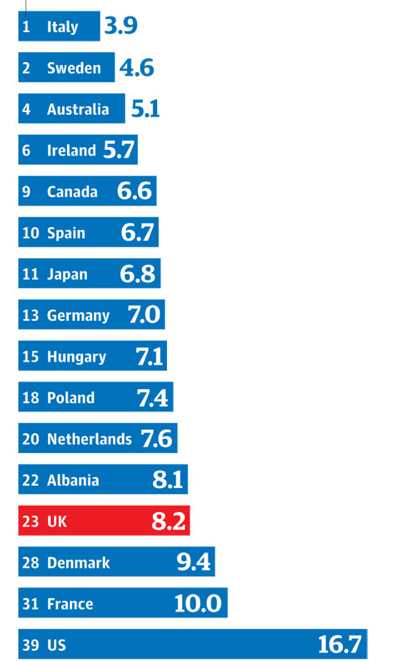
Here’s a table showing the maternal mortality ratio, the number of maternal deaths per 100,000 live births from the Guardian’s datablog, where ‘facts are sacred’.

Screen Shot 2013-04-10 at 22.52.28

So, the one of the highest rates of maternal mortality occurs in the US which rather disproves the claim that liberal abortion legislation is safer for women. Ireland, that country where women are deprived of abortion, has one of the lowest maternal death rates in the world, official stats show that on average 4,000 women in the Republic travel to the UK for an abortion every year, a figure that has been steadily decreasing from a high of 6,600 in 2001, so the blame for the UK’s relatively poor performance in the area of maternal health care, can hardly be explained away as being an Irish export. Pro-life Chile has the lowest maternal death rate in Latin America and Poland, another pro-life country also fares well.

Furthermore, more than 100 mothers have died in childbirth in London in the last five years, twice the rate of that of the rest of the country. Whilst we are all screaming about the first maternal death in 17 years at a hospital in Galway, where is the outrage about the lamentable situation in the UK, due to a desperate shortage of midwives? Surely anyone who identifies themselves as ‘pro-woman’ should be demanding to know how the government intends to remedy this increasing problem, aside from disincentivising those who may want more than two children?

Whilst on the subject of outrage, where were the candlelit vigils and expressions of anger over the death of Jessie-Maye Barlow, God rest her soul, the 19 year old mother of one, who died from septic shock following an abortion in September 2012, the inquest acknowledging that BPAS had not followed up on their aftercare and thus the fact that Jessie-Maye had failed to pass all the ‘products of conception’ was missed, leading to her death? Where were the protestations of anger that a beautiful young mother of one, with her entire life in front of her died as a direct result of medical negligence on behalf of an abortion clinic that was too busy to follow basic protocols regarding patient care?

Sepsis

Savita Halappanavar died from sepsis. According to the Royal College of Obstetricians and Gynaecologists, between 2003 and 2005 there were five maternal deaths in the UK of pregnant women from sepsis, with a baby under 24 weeks gestation. “Sadly, substandard care was identified in many of the cases, in particular lack of recognition of the signs of sepsis and a lack of guidelines on the investigation and management of genital tract sepsis. Between 2006 and 2008 sepsis rose to be the leading cause of direct maternal deaths in the UK, with deaths due to group A streptococcal infection (GAS) rising to 13 women. Severe sepsis with acute organ dysfunction has a mortality rate of 20 to 40%, which increases to 60% if septic shock develops. Studies in the non-pregnant population have found that the survival rates following sepsis are related to early recognition and initiation of treatment.”

In 2012 the RCOG published green top guidelines for treatment of sepsis in pregnancy. The guidelines state

The signs and symptoms of sepsis in pregnant women may be less distinctive than in the non- pregnant population and are not necessarily present in all cases; therefore, a high index of suspicion is necessary.

The diagnosis of sepsis must be confirmed by blood cultures and early swift administration of broad spectrum antibiotics are the key to the survival of the patient, alongside regular monitoring.

Crucially and unfortunately, this did not happen in the case of Savita, who was admitted into the hospital on the evening of Sunday 21st October. Blood tests that were taken that night, which were never followed up on, showed an elevated white blood cell count which would have been one of the key indicators that infection and indeed sepsis was present.

Whilst oral antibiotics appear to have been started on the Monday night, following the spontaneous rupture of membranes, an infection of the severity of Savita’s would have required intravenous administration. The consultant obstetrician has described the situation as a systems failure on multiple counts, not only were the blood results not followed up on, but also, the vital regular observations which may have alerted the staff to the presence of an infection sooner, were not carried out at regular intervals throughout the night, which is why the infection was only picked up in the early hours of the Wednesday morning, after Savita had taken a dramatic turn for the worse, a doctor who had come to check on her on the Tuesday evening, saw she was asleep and so left her. Once Savita’s membranes had ruptured (in the early hours of Monday morning) then she should have been checked every 4 hours for signs of infection.

The RCOG guidelines state that all staff should be aware of the signs and symptoms of potential sepsis and the rapid and potentially lethal course of the disease, which is often less distinctive in pregnant women. Therefore whilst one can reasonably assume that care was lacking, notably in the failure to follow up on the results of the blood tests, the narrative that University College Hospital Galway were knowingly refusing to treat a woman with a severe and life-threatening infection in order to prioritise the life of her baby, due to Catholic dogma reflected in the law, is an erroneous one. As the consultant testified, had they known about the sepsis or infection, they would have intervened much sooner, however Savita’s symptoms did not physically manifest until the early hours of Wednesday morning, over 48 hours since she was first admitted, whilst the signs may have been present, i.e. a slightly elevated temperature and raised pulse rate, this could also have been due to other factors, such as anxiety and it is only with hindsight and in the light of the missing bloodwork, that this can be identified as being the start of the infection.

Speaking to the inquest, Savita’s husband has reported that doctors seemed nonchalant on Tuesday, certainly there was no cause for concern, or reason to think that her life might be at stake.


Abortion to treat Sepsis – a red herring

Savita’s sepsis stemmed from an antibiotic resistant strain of E-coli, an issue that is in itself concerning. Pathology has indicated that the infection most likely originated in her urinary tract and tallies with the backache that she complained of, prior to admission to hospital. Aborting the baby would not have cured Savita of her infection and indeed in these situations, surgery is to be avoided if at all possible, as it runs the very real risk of spreading the infection further and causing death.

Whilst the hospital had failed to spot the infection, they had noted that an inevitable miscarriage was taking place. Savita, understandably, was very distressed, and wished for her ordeal to be over, as opposed to the interminable wait for nature to take its course and allegedly requested an abortion on the Tuesday morning, following the ultrasound to determine the baby’s progress.

Upon admission to hospital on the Sunday night, it was noted that no cervix could be felt, hence Savita was fully dilated and hence the premature delivery of the baby was imminent, which would mean that the baby would not survive. Later on, her membranes ruptured, meaning that the protective sac of fluid surrounding the baby completely drained, a situation which would likely result in the death of the baby and spontaneous natural delivery.

This is where the confusion sets in, which is being exploited to the max by the abortion lobby. Firstly, that Savita was fully dilated, was as a direct result of the infection which was in her urinary tract. The unborn baby was in a sterile sac of waters and therefore not the cause of the infection. The dilated cervix did not cause her infection either. An open or dilated cervix will not cause an infection, as any woman who has ever had more than one baby, or indeed a smear test will testify. Once you have had a baby, the cervix never fully closes. When I was pregnant with my eldest child, I was dilated by 2cm for a good week before I delivered. An open cervix does not make one more ripe for infection.

The infection risk is posed when the membranes or waters have ruptured, normally hospitals will be wanting a woman to deliver within 48 hours of this occurring in order to minimise risk of infection to the newborn baby. Clearly in Savita’s case this would not have applied, but if her waters broke on the Sunday night, it was not unreasonable for no action to have been taken on the Tuesday, the medics obviously thought that delivery or natural miscarriage would take place swiftly and that conservative management was the safest option in the circumstances.

Whilst Savita may have requested a termination, this may well not have been in her best medical interests.

The unborn baby was not the cause of the sepsis and so there was no good reason to terminate it as Savita’s life did not seem to be at risk. Dr. Hema Divakar, President-elect of the Federation of Obstetric and Gynaecological Societies of India speaking to the Hindu Times said:

“Delay or refusal to terminate the pregnancy does not in itself seem to be the cause of death. Even if the law permitted it, it is not as if her life would have been saved because of termination. Severe septicaemia with disseminated intravascular coagulation (DIC), a life-threatening bleeding disorder which is a complication of sepsis, major organ damage and loss of the mother’s blood due to severe infection, is the cause of death in Savita’s case. This is what seems to have happened and this is a sequence which cannot be reversed just by terminating the pregnancy.”

Catholicism and the law

It seems to me that there is something of a cop-out or buck passing exercise going on here. Dr Katherine Astbury, the doctor in charge of Savita’s care, told the inquest that in Ireland it is not legal to terminate a foetus on the grounds of poor prognosis for the foetus, but also admitted that she did not once clarify the legal situation with her colleagues or think to do so.

The law in Ireland does not prevent a termination from being carried out, if the life of the mother is at risk and as Dr Astbury testified, had she known the severity of the situation she would have intervened earlier, although from what we know now, an abortion could well have made the situation a lot worse. It seems obvious, that Dr Astbury perhaps sought to take shelter in the law as opposed to exercise her own moral and clinical judgement. No law can be formulated that will cover all the possible permutations and complications that might arise from real-life pregnancy management and so doctors can’t ever be entirely freed from having to make theraputic and ethical decisions. Whilst doctors might have to work within the law, they also need to exercise clinical judgement which will invariably and inevitably involve ethics.

The law in Ireland is clear, section 21:4 of the Medical Council Guide for Registered Practitioners says this:

“In current obstetrical practice, rare complications can arise where therapeutic intervention (including termination of a pregnancy) is required at a stage when, due to extreme immaturity of the baby, there may be little or no hope of the baby surviving. In these exceptional circumstances, it may be necessary to intervene to terminate the pregnancy to protect the life of the mother, while making every effort to preserve the life of the baby.”

So there was no legal reason why the pregnancy could not have been terminated were Savita’s life deemed to be at risk. One has to wonder why Dr Astbury couched her response to Savita’s request in purely legal terms? This was not simply about what the law proscribed, but medically speaking, conservative management of delivery is the safest approach, in the absence of any other pressing clinical factors. Theatre was obviously felt to be unnecessary at this stage, the cervix had dilated, the membranes had ruptured, delivery could not be far off, there was still a foetal heartbeat, the prognosis for the baby was poor, but there was no pressing need to abort medically, as well as legally. Why were the medical reasons not explained to her – that it was presented purely in legal terms seems to be a total failure of communication and gave the Halappanavar’s the impression that best clinical practice was being hampered by the law. The only people qualified to judge on whether or not an abortion should be performed were the doctors, not the lawyers and if any conflict had been perceived, why was this not instantaneously taken up with the hospital’s legal team, who would have been well versed in the ethics.

The Irish Catholic Bishops, responding to the case, said this:

The Catholic Church has never taught that the life of a child in the womb should be preferred to that of a mother. By virtue of their common humanity, a mother and her unborn baby are both sacred with an equal right to life.

– Where a seriously ill pregnant woman needs medical treatment which may put the life of her baby at risk, such treatments are ethically permissible provided every effort has been made to save the life of both the mother and her baby.

Which is why the conjecture over potential situations coming from all sides is unhelpful. Catholic teaching is very clear. Mother and baby have an equal right to life, whilst a baby must never be directly killed in order to save the life of a mother (and I cannot envisage a single situation where that would be necessary), a mother may receive treatment such as in the case of an ectopic pregnancy or a cancer diagnosis, which may put the life of her unborn baby at risk, or may end a baby’s life as an indirect consequence.

‘This is a Catholic country’

This was the comment made by Ann Maria Burke, a midwife manager, in response to a conversation with Savita, who stated that in India, a Hindu country, an abortion would be possible. Now is not the place to discuss India’s abortion record, especially when it comes to baby girls or how that reflects Hinduism, which treats all life as sacred, but as Ms Burke now admits, the remark was regrettable and had nothing to do with medical care. The remark perhaps smacks of racism, or was made in the context of a general conversation pertaining to religious and cultural attitudes, but tellingly the midwife was not directing the care of Mrs Halpannavar, nor was she dictating hospital policy. She was trying to explain the reason behind Ireland’s pro-life laws, which whilst they might stem from and be in accordance with Ireland’s Catholic history, do not indicate that Ireland is currently a country that is governed by those in accordance with the Catholic Church, quite the opposite Enda Kenny the current Taoiseach is doing all that he can to put distance between himself and the Vatican. Moreover Catholic moral theology would not sanction the delivery of a non viable baby as a direct cure for a pregnant woman, and is therefore slightly at odds with the letter of Irish law.

Conclusion

Had the initial blood tests been followed up on, and 4 hourly observations undertaken, then perhaps the tragedy may not have unfolded in the way that it did. What seems clear is that the infection was present upon admittance to hospital and that it is unlikely that an abortion would have cured the infection and potentially could have hastened Savita’s death. The unborn baby could not have been the source of the infection and by the time that the infection was noted, things had already progressed too far. The infection was obviously incredibly aggressive and Savita’s condition deteriorated so rapidly on Wednesday 24 October, that the decision as to whether or not to abort became moot. According to the inquest, septic shock was diagnosed at 1.20pm, two hours later, Savita’s already dead baby was delivered in theatre, so the conservative approach would have been the correct one, nature had taken its course swiftly, within the normal 48 hour window.

There is no indication that the hospital was ignoring the plight or symptoms of a critically ill woman with sepsis in order to rigorously follow the letter of the law regarding her unborn baby, when the law already allowed for an abortion to take place in these circumstances. Until the early hours of Wednesday morning, there was no obvious manifestation of infection, to those caring for her. It was only then that seriousness of the situation became glaringly apparent.

The issues here are about an awareness of sepsis. That is what Parveen Halappanavar, Savita’s husband should be angry about. This is the issue that he should fight for in his wife’s memory, as well as suing the hospital for their negligence in following up on her blood tests. Understandably he wanted his wife’s distress to be alleviated by an abortion, a procedure that may well not have been in her best interests either physically or emotionally. That the hospital could only explain this in legal terms is as great a dereliction of care and duty as it was not to have chased her blood results or carried out her observations.

Ireland’s abortion laws may change as a result, unborn babies will die and no action will be taken to address the urgent problem of sepsis diagnoses, nor indeed the worrying spread of ESBL bacteria that killed Savita. Abortion won’t cure sepsis or aid its diagnosis. It may however mean that more women and babies are exposed to the deadly bacteria. Savita’s memory deserves better.

Women as Witnesses

For those who haven’t seen it over there, here’s my thoughts on the remarks made at Pope Francis’ General Audience today. This theme of women and motherhood and what that means, is going to need much more analysis and apologetics.

Quite early on in this blog, I had several non-denominational Christians as well as general enquiries, wanting to drill down a bit further into the notion of women as mothers. The inherent dignity, importance and value of motherhood needs to be emphasised, whilst taking care not to alienate women who are not physical mothers, as being some sort of lesser beings, or somehow lacking in innate femininity. It’s a tricky tightrope, whilst the goods of motherhood must be reclaimed, care must be taken not to fetishise mothers in an unhelpful way either.

Here’s the post anyway.

Speaking in his General Audience today, Pope Francis emphasised the importance and role that women have to play within the Catholic Church, as unselfish communicators of the Gospel.

The women are driven by love and know how to accept this proclamation with faith: they believe, and immediately transmit it, they do not keep it for themselves. They cannot contain the joy of knowing that Jesus is alive, the hope that fills their heart.

Contrasting the implicit faith of the women who are the first human witnesses to the Resurrection with that of the male Apostles, Pope Francis says:

The Apostles and disciples find it harder to believe in the Risen Christ, not the women however! Peter runs to the tomb, but stops before the empty tomb; Thomas has to touch the wounds of the body of Jesus with his hands.

The very act of returning to the tomb, to anoint the body of Christ is a manifestation of this faith and also trust. Why did they return to the tomb? They would have been aware that the tomb entrance was sealed by an enormous boulder that would have been impossible for them to roll away without some assistance, as well as the fact that guards were posted at the tomb’s entrance, who were unlikely to have been amenable. And yet still they trusted.

Reinforcing the historicity of the Gospel accounts, Pope Francis reminds us of Christ’s radicalism. Women were not considered credible or reliable legal witnesses in first century Palestine, this was a role reserved to Elders or men over thirty, and yet it was to women that Christ first manifested his Resurrection, as a reward for their faith and in recognition of their love.

This is beautiful, and this is the mission of women, of mothers and women, to give witness to their children and grandchildren that Christ is Risen! Mothers go forward with this witness! What matters to God is our heart, if we are open to Him, if we are like trusting children. But this also leads us to reflect on how in the Church and in the journey of faith, women have had and still have a special role in opening doors to the Lord, in following him and communicating his face, because the eyes of faith always need the simple and profound look of love

Beautiful and inspirational. What can be more important than being witnesses to the Resurrection and the love of God? Those very first witnesses, who were so convinced by what they had seen and so determined to spread the Good News, to the extent that they would lay down their lives and suffer the most excruciating and painful deaths, played a crucial and key role in the development of the faith. Women are called to witness, whether that be as physical or spiritual mothers, to pass down and impart the joy of the faith to their children and in their families, in a way that only they know how. That the Pope has chosen to affirm and link women with motherhood should not be overlooked.

Christ called Mary Magdalene by name in the garden in acknowledgement of her simple and uncomplicated love, faith and trust. Furthermore Mary Magdalene is no plaster saint or unrealistic model of womanhood. Her lack of inhibition and emotive displays are often embarrassing or discomforting and yet Christ loves because of her innate feminine authenticity and total lack of guile and self-awareness. Whilst Our Lady set the pattern of motherhood, in the encounter in the garden, we see Christ conferring a vital vocation upon St Mary Magdalen as the first female missionary.

Traditionally depicted as beautiful, sensuous and possessing an unrestrained yet totally pure love of the Lord, she accepts her vocation through a direct encounter with Christ, with no thoughts as to what may be in it for her in terms of status, earthly or material reward, and neither does she stop to compare herself with the Apostles. She has no need. Christ has already reaffirmed her equality, as St Mark awkwardly relates. Not only does Christ make his first appearance to a woman, but one who was once demonically possessed.

St Mary Magdalene allowed herself to be won over by Christ and gave herself over to him whole-heartedly and he rewarded, affirmed and entrusted himself to her in all of her femininity.  This is the message for contemporary women today.

Bank holiday fun – Liebster Award

I was delighted to see that Lazarus had nominated me for a Liebster Award, not only because I really enjoy his blog and find him a voice of common sense and sanity on the blogosphere, but because it gives me an opportunity to unashamedly prattle on about myself. Which probably tells you all you need to know. I also saw I’d been nominated by Rhoslyn Thomas and was tempted to naughtily pick and choose on questions, but Lazarus got there first. I’ll give Rhos a plug anyway because she deserves one. Young, pro-life, Welsh traddie. What’s not to like?

Liebster-Award

The point of the award is to encourage blogs to link to each other and so boost their profiles and traffic.

Here’s what you do:

1) Post the Liebster award graphic on your site. (Google to find it if needed)
2) Thank the blogger who nominated the blog for a Liebster Award and link back to their blog.
3) The blogger then writes 11 facts about themselves so people who discover their blog through the Liebster post will learn more about them.
4) In addition to posting 11 fun facts about themselves, nominated bloggers should also answer the 11 questions from the post of the person who nominated them.
5) The nominated blogger will in turn, nominate 9 other blogs with 200 or less followers (We’re guessing for our nominees) for a Liebster award by posting a comment on their blog and linking back to the Liebster post.
6) The nominated blogger will create 11 questions for their nominated blogs to answer in their Liebster post.

So, done the first two tasks. Here’s the eleven facts about me. (I go on a bit, I didn’t include that brevity or conciseness is not my forte).

  1. One of the most surreal things I’ve ever done is approach Paul O’Grady of Lily Savage fame, in the Telephone Bar in Bangkok and throw water at him. He didn’t mind, it was Thai New Year which is celebrated by sprinkling water over other people as a sign of good luck. In recent times it has degenerated into a giant 3 day city-wide water fight, where gangs of adolescents prowl the city on the backs of jeeps and motorbikes, with industrial water tanks strapped to their backs connected to elaborate water pistols, in order to drench passers-by. Probably something of a mating ritual, but if you ever go to Bangkok around the time of Thai New Year, be sure to wear either a swimming cossie or plastic overalls.
  2. My skills of prophecy are summarised by the occasion I looked at a battered old orange 737 sitting on the tarmac at Gatwick airport in 1997 and opined “No Frills airlines. That’ll never work”
  3. Fr John Glynn of I watch the Sunrise, fame, was the priest in charge of my school. He used to stalk the Alyosius Corridor, singing and smiling and leant his guitar against the altar. I used to confuse him with Ralph McTell.
  4.  My favourite book of the Aeneid is Book VI. It evokes memories of GCSE Latin and moments of Billy Bunter-esque stupidity in class. Virgil describes an eclectic mix of characters including “The hundred armed Gyles Brandreth” and, much to the amusement of privileged Essex boarding school pupils, with terribly middle-class names, a ferryman called “Sharon”.
  5. I’ve always wanted to give Cathy and Heathcliffe a hearty slap.
  6. I can’t touch vodka following an unfortunate incident involving Highlander II, popcorn on an empty stomach, a litre of Blue label Smirnoff, a chincilla and a poodle who resembled Roly in Eastenders.
  7. If I had to chose a final meal it would be infinite oysters, with a dipping sauce made out of shallots and red-wine vinegar, a dash of lemon and tabasco, washed down with Veuve Cliquot served the temperature of liquid nitrogen.
  8.  I have to work a lot harder on the asceticism and Evangelical Poverty thing.
  9.  I will forever harbour an unashamed crush on the young Stiff Pilchard Cliff Richard in his heyday. Cor. 

  10.  I’d like to have the sublime Faure’s Requiem at my funeral and wangle a way of getting in the Cantique de Jean Racine also.
  11.  Compline is my favourite part of the Divine Office. It hands everything over to God at the end of the day.

So here are the questions I had to answer:

What inspired the title of your blog?

My name. Original huh?! Actually, it was originally called asnailinmypocket, which was a favourite phrase of mine back in the day, being an equivalent to Monty Python’s hovercraft full of eels. Very often in my days as a flight attendent, we’d operate domestic European flights for a non-English airline, between cities such as Cologne and Dresden. I once told an unsuspecting German with no command of English, that I had ‘a snail in my pocket and I think I’m about to use my vest’, instead of telling him to stow his hand luggage under the seat in front of him, much to the hilarity of my colleague. He seemed to get the gist. Perhaps it was the hand gestures? Anyway the phrase stuck and it was the first thing that came to mind when setting up the blog and summed me up. Random, surreal and probably quite juvenile.

What is your personal favourite post on your blog?

No idea, although I’d like to think that I’ve done some very solid investigative pro-life writing. BPAS are regular readers. *waves* 🙂

What has been the most popular (most viewed) post on your blog?

Oh lawks, not sure we should go there. It was the Babyworld post of DOOM. To cut a long story short, I used to be a member of a Mumsnet type website called Babyworld, which had a ‘Discus, Debate and Deliberate’ forum. In the run up to the Papal Visit, things got extremely heated and being the only practicing Catholic in a forum predominated by liberal mummies was something of a recipe for disaster. They simply didn’t get it and I should have realised that it was always going to be a waste of time.

There were threads upon threads of the usual old cliches and every single time, I tried to bust the myths or engage in any sort of apologetics – KAPOW, they’d all go nutty. I remember one member who indignantly C&Ped huge chucks of the Catechism, in order to heap her scorn and vitriol upon this disgusting religion and its doctrine.

Others just couldn’t work me out. On the one hand I seemed this perfectly nice, reasonable, quite fun woman, who didn’t walk about dressed like a member of the Amish, but there I was espousing hateful bigotry and homophobia. At one point it was suggested that I was brainwashed or had cognitive dissonance “I don’t think Caroline hates gay people, she obviously doesn’t, she seems a nice person, but her attitude is homophobic and that causes her problems, which is why she tries to explain it away”.

Finally, my patience blew during yet another homophobic Catholic church debate (I think people decided to deliberately start inflammatory threads) during which posters posted the most inane and theologically illiterate statements I’d ever seen, which were as hilarious as they were offensive. “Face it, you can’t tell me whether or not Jesus was a breast or a bum man with any certainty”, said one, and in my frustration and amusement, I C&Ped some of the choicest comments onto here for the delectation of my gentle readers, along with the Bad Vicar sketch from Mitchell and Webb. Well, it was funny, a bunch of women screeching about how terrible Catholicism was, how they had spent some time in Rome and decided that I had read too many books and therefore wasn’t ‘spiritual’, reminded me of the classic line about “hastily assembled internet philosophies”.

Anyway, they didn’t like it much, linked the blog to Babyworld and the stats went stratospheric. Much silliness ensued about petitioning WordPress to get the site taken down for breaching copyright (despite the fact I’d done nothing illegal and hadn’t mentioned identities) and a huge amount of cross comments, for taking their comments about Christ’s alleged sexual preferences out of context!

I left shortly afterwards, it all got a bit much and I lost patience with the “oh no, my child’s Christian school is teaching them that God exists and about the crucifixion and Resurrection, how very dare they”, but they still link to here from time to time, bless them.Christian mummies, stay away from mainstream mummy forums, no good can come of it, unless you are married to Giles Fraser.

Which post on your blog has attracted most comments?

This one. About finding out I was pregnant, the week that Robin left the Anglican Church.

What other hobbies or interests (beyond blogging) are you prepared to admit to?

Not that much time, with the children, so it’s mainly reading and playing the piano. Beethoven Sonatas with their crashing chords can be most Cathartic, but tend to wake the children. I also love Bach prelude and fuges as well as Mozart sonatas. I adore ragtime, probably not very PC, but I’d like to be able to play Debussy’s Golliwog’s Cakewalk without making any mistakes before I shuffle off this mortal coil. It’s fiendishly difficult.

What’s your favourite song?

Cemetry Gates by The Smiths. Timeless and with puns worthy of Philip Sidney.  Perhaps the wittiest and cleverest pop song there is. It is a deliberate paradox, being the embodiment of the traits that it knocks- pretentious and pseudo-intellectual and reminding us that all writers and fans of literature and the arts are self-conscious, angst-ridden inadvertent plagiarists at heart.

What’s your favourite novel?

I’m going to cheat, because I can’t possibly chose. Three of Maupassant’s short-stories, Boule de Suif, La Parure and En Famille. All tragi-comic, demonstrating his immense ability as an original story-teller, who describes his subjects and their physical and mental flaws with affectionate, painstaking and earthy detail. Maupassant holds up an uncomfortable and discomforting mirror to human nature. Though none of these stories have an aspect of redemption, they demonstrate the nature of sin. When I recently re-read them, the compelling subtext for me, was how they highlighted the necessity of Christ’s sacrifice on the cross.

Actually upon re-reading that, I should say, Brideshead Revisited because it sparked my return back to the Catholic Church. When my eldest was born, I spent hours sat nursing her with a book in hand. One of them was Brideshead which I had never previously got around to. As I turned the back cover, tears were streaming down my face and I thought to myself, “well it’s too late for me, but I am going to make darned sure that my daughter is saved” and resolved to have her baptised. I then attended the local baptism course and things progressed from there.

Complete this sentence: ‘I think religion is….’

I’ll go with St Augustine’s definition. I think religion is the thing that binds us to God in voluntary subjugation.

How good a dancer are you?

Dreadful. I don’t do dancing, unless it’s of the Gay Gordons, or the basic ballroom variety that we had to learn at school. I am hopelessly uncoordinated, more embarrassing that your grandad and don’t enjoy it at all. I never know what to ‘do’.

Which do you prefer: tea or coffee?

Tea. Coffee is the devil’s own brew.

Have you ever been a smoker? (Of tobacco…!)

Yes. I used to smoke an unhealthy amount of Marlboro Reds. I still crave a cigarette whenever I have a gin and tonic in my hand, but on those occasions where I’ve grabbed a crafty puff of someone else’s, have wanted to throw up. I gave up in 1998, following the smoking ban on long-haul flights. My smoking habit was never curbed by the cost of cigarettes, seeing as I used to be able to buy them very cheaply in various destinations. At one stage I had a stash of about 2,000 in my room, for personal use, and never had to husband or ration cigarettes due to spiralling costs, unlike British smokers. It was easy-come, easy-go. I figured that if I could manage on a flight to Sidney without a puff, then, it was just a matter of gradually extending the period of time.

So now I have to nominate 9 other blogs with under 200 readers. That’s the hard part. I don’t tend to do compare and contrast on stats, so really I’ve no idea whether that’s readers or subscribers or what? I’d love to ask some of the priests such as Fr Ray Blake, whether or not he used to practice playing and pretending he was celebrating Mass as a little boy, or whether Joseph Shaw is secretly scared of spiders, but I guess that would be disrespectful and they have well over two hundred readers, so my list is a little random. I’m struggling, because most of those whom I would nominate, have already participated

  1. MyBattlementofRubies – my absolute heroine of all time. Clare, Catholic Homeschooling mother of six who has the most fabulous turn of phrase along with buckets of wit and common sense.
  2. Abudance of Rainbows – Lovely, lovely Lucy
  3. Laurence England – who doesn’t need the plug, but has written some outstanding stuff of late, and hasn’t yet participated
  4. James Preece – Oi James, put down your Latin books, forget the gerundives and answer some inane questions. Your public demands it
  5. Five feet above sea level – this is swiftly becoming a must-read, the wonderful and inspirational Katherine Rickards.
  6. A Miscellany of Musings – ‘The Idle Rambler’

And erm, I give up. Feel free to join in by all accounts, if questions inspire.

  1. Do you have a favourite Evangelist?
  2. What are the best and worst aspects of blogging?
  3. If you were able to choose your final meal, or God forbid you were on Death Row, what would it be?
  4. Favourite Saint?
  5. What book do you have on your bedside cabinet?
  6. What has been the most popular post on your blog?
  7. Which blogpost has attracted the most comments?
  8. What did you want to be when you were a small child?
  9. If you had a Harry Potter invisibility cloak for one day, what would you do?
  10. What inspired the title of your blog
  11. Favourite prayer or novena?

And that’s me done.


Easter Hymn

I first heard this piece, from Pietro Mascagni’s opera, Cavalleria Rusticana at the funeral of Robin’s elderly uncle. The evocative and rousing melody along with the proclamation of the Resurrection seemed absolutely perfect for the occasion as well as for Easter morning. Perhaps most poignantly, the recording that was played as the coffin departed, featured the voice of the deceased who had sung this in a recent amateur production. How many of us get the opportunity to sing at our own funeral?!

This is a piece of music that never fails to reduce me to tears, it is so incredibly moving. Utterly breathtaking, beautiful, audacious and as triumphal as the event it portrays.

Happy Easter.

O rejoice for the Lord has arisen,
He has conquer’d the power of the grave,
He has broken the gates of the prison,
He has risen in His glory to save;

Does the Church need to renew its relationship with women?

Hot on the heels of the initiative which allows Catholic women to pledge their support for Catholic doctrine (the aim of which is to present Pope Francis with a significant number of signatures as well as present a forum for Catholic women and apologetics), Catherine Lafferty has written a piece for the New Statesman’s version of Comment is Free, which suggests ten ways in which Pope Francis can renew the Catholic Church’s relationship with women.

It is no secret that I have personal issues with Lafferty. Many people witnessed her behaviour towards me last year when I was pregnant, with alarm and dismay. The episode caused considerable distress and much prayer is needed because I still struggle with forgiveness and coming to terms with it all.

This should be borne in mind when reading my critique of Lafferty’s piece – this isn’t about ad hom or personal attack, I wish to lay my animosity to one side and engage with and critique what was written, but it should be noted that perhaps understandably, I find it extremely hard to be objective towards someone, who I believe caused actual harm to my health and that of my unborn baby with a campaign of unfounded and malicious allegations and whose repeated presence in my timeline has been an occasion of sin at the start of the Triduum.

The article’s premise is that the Church needs to renew its approach to its female followers with regards to sex and reproduction. This would seem to be a little misleading, not least because it implies that the Catholic Church somehow needs to change its doctrine, something which is impossible. Secondly, it buys into the myth that most Catholic women are unhappy with the Church, especially in relation to the doctrine on sex and reproduction. This is a myth that I’m looking to disprove.

If women are unhappy with Church doctrine on these issues, the blame can largely be laid at the door of poor or inadequate catechesis. This would certainly be an area that one could argue is in need of renewal, but the Emeritus Pope Benedict did much in terms of sowing the seeds in this regard. The growing Juventum movement is packed with young women as well as men. A newer, younger generation of orthodox faithful Catholic women is emerging. Before claiming that the Church needs to take action to renew its relationship with women, some evidence as to this fractured relationship needs to be provided. A more accurate assessment would be to say that the Church needs to engage with lapsed Catholic women and evangelise better. It needs to send positive and joyful messages of female sexuality as well as remind everyone of the beautiful teachings of John Paul II, in Theology of the Body and Mulieris Dignitatem.

Here’s my take on the some of the suggestions:

  • Use the reform of the Curia to promote female excellence in the corridors of power. Hard to argue with this one, it’s a point that I have argued and would do much for the Vatican in terms of its perception. With that it mind, it should be remembered that the pursuit of power is not a goal that should be encouraged, for any Catholic in good conscience. Secondly, whilst female excellence should be encouraged, the Vatican needs to be extremely careful to ensure that it does not engage with secular identity politics that are contrary to Catholic teaching which teaches that our identity lies in our dignity as created beings in the image of God. If women are promoted it needs to be because they possess requisite competence and fulfil the criteria of any given position, not solely because of their sex. Woman quotas should be avoided because they are a form of unfair discrimination and buy into the idea that the Catholic Church is somehow oppressive or patriarchal as demonstrated by the priesthood. Whilst it would be good to see more women in the Curia, this should not be for the sake of political correctness. The Catholic Church is not a political party or democratically elected institution.
  • This bureaucratic reform should be extended downwards to Bishop’s Conferences and diocesan offices, which should also become more efficient and productive with professional staff and dragged out of ‘sleepy backwaters’ with a similar drive for female excellence. This seems primarily a comment on the Catholic Church in the UK. I’m not sure that the same could be said of other countries, such as America for example, and who knows what the situation is in the far-flung corners of the globe. We need to be wary of accusing hardworking diocesan staff of ‘complacency’ or not doing their jobs properly. Many dioceses, such as Portsmouth have in fact, recently undergone restructuring, the Catholic Church works on a model of subsidiarity to which diocesan bishops are key. Where failures are identified, it should be up to the individual bishop to take appropriate action, rather than for centralised guidelines – every diocese will have different requirements. Furthermore some of the staff working in and supervising diocesan offices are stipendiary priests who are unpaid. Many parish secretaries, admin and finance staff are also unpaid volunteers. Instead of replacing them with a professional bureaucracy, which will prove costly, additional training would seem to be the answer in areas where there are gaps in knowledge or experience. There are admittedly diocesan roles that require paid professionals, standards matter and dioceses do conform to employment laws and norms, so I think we need to be careful before making sweeping statements or wholesale accusations of inefficiency. The same sentiment as above would apply when it comes to promoting female excellence. Replacing priests and unpaid volunteers with a professional bureaucracy would cost a considerable amount of money at a time when we know that many dioceses are running a deficit. In any event most diocesan offices are filled with the laity.
  • Turn all Catholic workplaces into centres of excellence for family-friendly employment. How do we know that this is not already the case? I can think of several positions in my diocese which are staffed by women and are part-time or job-share. As employers, Bishops are subject to UK laws with regards to unjust discrimination when it comes to employment and would legally need to demonstrate that they have the relevant policies in place, which means amongst other things, that women returning from maternity leave will already have the right to request family-friendly hours and parental leave. When it comes to building creches, that is entirely dependent on the size of the plant that a diocesan office may occupy as well as number of staff. There doesn’t tend to be a high staff turnover in diocesan offices, so a creche could quickly become obsolete.
  • Take a lead in providing affordable childcare. The Catholic Church teaches that couples should be open to the gift of life, a principle which is made harder to live up to by women’s economic needs. Lovely idea in theory. Pie in the sky in real life. The Catholic Church does teach that couples should be open to the gift of life, but she also teaches that parents should be the primary educators of their children. A mother’s economic needs revolve around providing food and housing for her children. Ideally speaking a woman should have the choice as to whether or not she wishes to work, countless surveys demonstrate that most mothers yearn to be at home with their children. Jonas Himmelstrand, a Swedish sociologist, is reporting that psychological disorders in children have trebled in Sweden, widely held up as being a childcare utopia, where over 90% of children under 3 attend full time nurseries. Having children in full-time childcare should not be encouraged. It is not in the common good to encourage or promote a system whereby mothers have little choice other than to become wage slaves. That mothers have always worked is undeniable, but traditionally women needing extra income did this inside the home, whether it be by a bit of extra farming, being a nursemaid, taking in ironing, sewing, craftwork etc. Whilst that is admittedly out of step for today’s era, the rise of the mumpreneur, or woman who works from home, whether that’s freelance writing, running a business on ebay, or whatever, shows that this is still seen as an ideal. Women should be their own bosses, as they always have been, working on their own terms, providing for themselves and their families in a way that fits around family commitments, and not wage slaves to outside employers, trying to split themselves between two masters. Ultimately, it tends to be the children who suffer, when mum has to put them in wraparound care 5 days a week, in order to keep working for an implacable inflexible boss who pays the wages.
  • Aside from the fact that the Catholic Church lacks the resources to provide free or cheap Catholic nurseries and ignoring the fact that such a practice would inevitably fall foul of laws regarding discrimination, there would bound to be some vexatious litigation surrounding the nature of such provision, encouraging mothers to put their children in nurseries would not renew the relationship with women, but could cause alienation and resentment. The Church would be sending a very definite message as to the desirability of work, and no nursery, no matter how wonderful or gleaming the equipment or activities on offer, can replace a mother’s unique love and care. Children aren’t objects, they should not be viewed as barriers or commodities to financial or economic success and to put one’s own self-fulfilment on the same level as their welfare, is directly contrary to church teaching. Whilst the Church recognises and argues that women should have equal access to public functions and roles, speaking in Familiaris Consortio, John Paul said this

While it must be recognized that women have the same right as men to perform various public functions, society must be structured in such a way that wives and mothers are not in practice compelled to work outside the home, and that their families can live and prosper in a dignified way even when they themselves devote their full time to their own family.

Furthermore, the mentality which honours women more for their work outside the home than for their work within the family must be overcome. This requires that men should truly esteem and love women with total respect for their personal dignity, and that society should create and develop conditions favoriung work in the home.

  • The Catholic Church can plough funding for research into fertility management which complements rather than compromises its core principles. No need for this. The technology, already exists, NFP methods such as Creighton are 99% effective. Pope John Paul II singled out the Pope Paul VI Institute, who are world leaders in terms of reproductive technology for special praise and worthy of support. Catholics have to accept however, that no method of contraception is 99% effective, and whilst couples may have serious reasons not to add to their families, they must also tread a fine line in terms of not falling into a contraceptive mentality. Where the Church needs to do better is at communicating its message on human sexuality to young men and women, which really needs to start at grassroots level. The technology exists, it’s just not promoted heavily enough and neither do many priests do a great job in terms of preaching about contraception or promoting the alternatives. Likewise NaPro technology, has success rates far and above those of IVF, treating the underlying cause of which infertility is just a symptom. A fertile married couple has to regularly think and pray when it comes to the issue of whether or not to add to their family, and not simply use NFP as an alternative form of contraception. It involves a wholly different mindset.
  • Put women and their needs at the heart of its Pro Life activism. This is what happens now. Organisations such as the Good Counsel Network and LIFE Charity do just that in terms of their activism, campaigning and actual pro-life work. A creaking Pro Life lobby is ill-equipped to consider why women opt to have abortions and what they need to continue their pregnancies willingly. The pro-life lobby in the UK may be creaking, but there are certainly signs of healthy rejuvenation, such as in the recent foundation of the Alliance of Pro-life students and the success of the 40 days for Life movement. Speaking at the launch of APS, Eve Farron their founder, explained how they made common cause with feminists on campus and forced campaigning and provision for pregnant students at certain universities to be drastically overhauled, so that students with a crisis pregnancy were presented with actual realistic options enabling them to keep their baby and continue studying. Again the Good Counsel Network help women on a day to day basis, they are well versed in the multitude of reasons why a woman may find herself at the door of an abortion clinic and provide help accordingly. A pro-life movement that lacks cohesiveness will find it hard to gain political traction, but that doesn’t mean that it is unable to discern why women may abort. Pro-life work does need to consist of a political element, not simply in terms of legislation surrounding abortion laws, but legislation to enact a society that is open to life and the needs of pregnant women, but this is not its only role. For Catholics, pro-life work consists of prayer, politics, practical action and PR. The pro-life movement is at its strongest when we recognise and hammer home the message that a life is a stake here and the injustice of abortion, to mother and child. Politicians will respond to the will of the people and even SPUC, an organisation of which I am highly critical, is extremely effective at marshalling and consolidating grass-roots support. This is vital.
  • as tough on the causes of abortion as abortion itself. Good soundbite, albeit a modified version of William Hague. But we need to very careful here. Whilst society must clamp down on those factors that contribute to a woman’s feeling that she has little other ‘choice’, the causes of abortion are very often complex, there is not one single factor. Women who abort their babies are not two dimensional creatures simply exercising a choice because they can, or because they see it as a form of contraception and not the taking of a life. Whilst some women undoubtedly do view abortion as a trivial matter, many don’t and abortion is arrived at via a contribution of factors, not least a society that advocates and promotes abortion as being ‘no biggie’ and certainly not something that one should feel guilty about. Whilst we have to work to bring about an elimination of those factors that conspire to make a woman have an abortion, human history shows us that there will always be women who feel they have reasons to abort. We cannot concede that a reason to abort is a justification and neither should we be giving any fuel to the notion that until reasons to abort are demolished, then abortion itself can be tackled. When we consider the causes of abortion, we have to be extremely careful not to play into the hands of pro-choicers, who will argue that abortion has always existed, there will always be a good reason to abort and so abortion must be safe and legal. People will always want to engage in destructive behaviour, sadly there will always be those who are compelled to hurt their fellow human beings and themselves, but that does not mean that society should legislate, normalise and accept harm, on the premise that it is a lesser evil. Whilst we must be tough on the cause of abortion, we must not lose sight of the fact that abortion is, to use the hated words, a moral evil. That does not mean that women who have abortions are morally evil, or of dubious character, but in our compassion, we must not forget what abortion is. We must continue to be tough on it and not fall into the hands of well-meaning pro-choicers who attempt to justify abortion. Being tough on various causes of abortion includes getting tough on lifestyles of sexual impropriety as well as on repeated abortions, and accepting that a woman’s judgement is not always sound or prudent, by virtue of her gender or reproductive organs. This is a always a flashpoint or bone of contention, no-one likes to be seen as finger-pointing or interfering in others’ sex lives, it plays into the Christian fundie fiddling with ovaries stereotype, but ultimately as Christians we are compelled to make moral judgements with regards to certain courses of action, including abortion.

The other points with regards to population control, education and women’s rights are fairly sound. But as I said at the beginning, the Catholic Church needs to be very wary about succumbing to identity politics. Women are signing up thick and fast at CatholicwomenRising to pledge their support for Church doctrine. To state that the Church needs to renew its relationship with women, implies that there is a schism, one that is only evident in the minds of the media. What the Church does need to do is continue to win souls of all ages, be they the elderly, middle-aged, or young. Part of this must involve evangelisation. But Church renewal is a question that each subsequent generation has to face – we have to enthuse our children and young people to lives of Christian witness and holiness. This is why identity politics is so irrelevant, because Catholic doctrine reflects that men and women were created equal but with different vital roles to play. Our strengths and weaknesses are disparate, we are not all one homogenous mass. The way we go about renewal is in two ways – firstly by how we live our lives and the examples we set to others, Pope Francis is leading the way here, and secondly by implementing decent catechesis and instruction at a local level.

That the Catholic Church in the Western world needs to find ways of countering the rising tide of secularism, atheism and the prevailing zeitgeist of individualism and renew itself is indisputable. But it has to start at catechesis and finding effective ways of educating its laity, be they male or female. Women friendly policies may make for fluffy soundbites in left-wing publications and make a convenient flag for Catholics to wave to show off their progressive credentials. But the New Evangelisation requires action that goes infinitely deeper.

Hijacking the Royal Society of Medicine

Royal Society of Medicine

BPAS are advertising a conference in June which they appear to be sponsoring, called ‘abortion, motherhood and the medical profession’. It seems a strange title for an organisation who is predominantly concerned with removing motherhood, but this conference needs to be called out for what it is. An attempt at co-opting the Royal Society of Medicine (RSM), in order to endorse abortion as being a matter of medical treatment when as a recent symposium on Excellent Maternal Healthcare noted in their press release, abortion is never medically necessary to save the life of a mother. 

Abortion is a medical procedure, hence the involvement of the RSM, but this conference will obviously be incorporated by BPAS into their promotional material, with the RSM being used as leverage, in order to endorse any findings or conclusions as being those of a  professional body or allegedly evidence-based. The RSM describe this event as a joint meeting with BPAS, which raises questions about impartiality, as well as funding. Have BPAS subsidised this meeting in any way? It probably falls under costs of marketing and PR, in their Profit and Loss account.

In case of any doubt, I’ll run through the programme of events and outline the credentials of the speakers:

Introduction and Opening remarks:

  • Mrs Joanne Fletcher, Consultant Nurse, Gynaecology, Sheffield Teaching Hospitals NHS Trust 

An impartial consultant nurse? Actually Joanne Fletcher was the publication co-ordinator of this document about abortion care for the Royal College of Nurses in 2008. Interestingly the document was sponsored by Exelgyn, manufacturers of the abortion pill, RU486, Bayer Healthcare, who manufacture contraceptives and abortifacients. So, absolutely no vested interests there whatsoever then? Back to Mrs Fletcher, not only did she co-ordinate publication of this document but she is also a member of the RCN group – ‘Nurses working within termination of pregnancy Network’.  So it’s obvious where she stands on abortion.

  • Ms Jennie Bristow, Publications and Conference Manager, British Pregnancy Advisory Service

Fairly straightforward who this lady is, she’s in charge of commissioning and publishing research and organising conferences that promote abortion such as this one.

Foetal imaging and imagining the foetus:

This session, is chaired by Clare Murphy, Director of External Affairs at BPAS. She used to tweet as @clare_bpas before deleting her account in favour of a more professional generic BPAS account. I remember her tweeting about the appearance of some of those on 40 days for life – if one can be bothered to search through the blog, I’m sure there’s a tweet somewhere about her deriding the colour of tights of a volunteer, but again, I think we all know where Ms Murphy stands when it comes to abortion.

What intrigues me is why she is chairing a session on foetal imaging and “imagining the foetus”? Is she some sort of leading expert in the field of foetal imaging and diagnostics? Is she a qualified sonographer? My understanding is that she’s been promoted up from her original role within PR at BPAS.

What is imagining the foetus? One has a scan and sees a foetus on the screen (well actually you don’t at BPAS, they won’t show you and will dissuade you if you ask, can’t begin to imagine why). What has imagination got to do with it? Either you see a foetus or you don’t, if one is present on screen, it’s certainly not a figment of imagination.

Which is really the entire point of this session. It’s nothing to do with medical science and more to do with helping the client conceptualise her unborn child as being as un-human as possible. It’s about understanding the psychology of a pregnant woman and manipulation, by using medical terminology such as ‘gestation sac’ and ‘the pregnancy’ instead of what’s actually there, a foetus. (Fetus: Latin “offspring”, “hatching of young” “bringing forth”)

So, who have we got discussing foetal imaging and imagining, conceptualising (or lack of) of the foetus?

  • Dr Stuart Derbyshire, Reader in Psychology, University of Birmingham

A psychologist, able to discuss ‘helpful’ ways of thinking about and describing the foetus to the mother. Not only is he a reader in psychology, but he is one of the medical experts who argues against the notion that foetuses may be able to feel any pain. So no doubt, his talk will have something to do with the fact that even though the baby might look human and fully developed, it probably won’t feel any pain (how can any of us know with any certainty and besides medical opinion is divided) and so it’s perfectly okay to kill it.

  • Professor Carol Sanger, Columbia Law School

Professor Sanger is also a fellow of St Anne’s college Oxford. She writes articles on family law and women’s ‘reproductive rights’. She’s an abortion advocate who last year delivered BPAS 2012 public lecture on abortion in the US. Sanger has fought against laws in the US requiring mandatory ultrasounds for pregnant mothers.

And our final ‘expert on this session regarding foetal imaging and imagining is:

  • Zoe Williams, columnist for the Guardian

Zoe Williams frequently churns out pro-choice feminist propaganda for the Guardian. She describes her views as left-wing and feminist and has written some amusing guides to pregnancy and motherhood. Not quite sure what she’s doing on a session which is ostensibly about foetal imaging. I’ve got 4 children to her 2, have had numerous scans and know quite a fair bit about embryology and foetal development, I’d wager that I’m every bit as qualified when it comes to discussing foetal imaging…

So anyway, then we come on to the next session

Information, counselling and the law

Chaired by:

  • Dr Ellie Lee, Reader in Social Policy, University of Kent

I’m actually rather an admirer of Dr Lee, despite being co-ordinator of the Pro-choice forum and a strong advocate of abortion. She’s often on Women’s Hour and other media, advocating for abortion. Always eloquent, she has written this paper which is essential reading for any pro-lifer, discussing how the issue of abortion must be ‘de-moralised’, i.e. stripped of any notion of morality. She argues that pro-choicers have not yet won the battle on abortion and discusses ways that the issue should be approached in Parliament. Notably for pro-lifers, Dr Lee has observed that failing to sustain arguments about the sanctity of life has derailed pro life groups in the past, but nonetheless, the idea that abortion should be outside of politics is one of concern. That abortion is  political, favours pro-choicers as they well know, despite their protestations about ‘politicising the issue’. It seems pro-life hasn’t done very well, when it has deviated too far from the idea that a baby has a right to life. Her research is invaluable for pro-lifers who wish to inform themselves and develop effective strategies.

  • Dr Patricia Lohr, Medical Director, British Pregnancy Advisory Service

Needs no further comment

  • Ms Jane Fisher, Director, Antenatal Results and Choices

Despite their title, Antenatal Results and Choices, whilst not overtly partisan, certainly favour abortion, Jane Fisher has spoken about the improvements in first trimester ante-natal testing which means that women can access ‘abortions they need’ earlier – a good thing in her view.

  • Professor Sally Sheldon, Kent Law School

Another abortion advocate, who argued in favour of a woman’s right to have a sex-selective abortion and states that it should be women, not doctors who decide whether or not they need one. (Unlike every other medical treatment).

After lunch (if they can stomach it) we have the following session

Testing positive, negative and in between: How the semi-quantitative pregnancy test could transform the management of abortion, miscarriage, fertility treatment and ectopic pregnancy

A semi-quantitative pregnancy test is a self-administered urine test that one takes at home, following a medical abortion, that is once you’ve taken the abortion pill. At present, women require a clinic follow up if they have taken the abortion pill, in order for either a blood test or ultrasound to check whether or not uterine evacuation is complete. This obviously increases the clinics’ overheads and the cost of abortions. You’ve given the woman the pill, had her money, sent her home, it’s obviously a bit of a faff for all concerned that she needs to come back for any sort of check in person to see whether or not the pill has done its job or whether there might still be some bits floating about inside. Of course a pill could transform management of abortion and see a significant cost reduction (wonder if this will be passed on) enabling women to do the test at home before trekking back to the clinic where a person can actually check they are alright.

With the vast majority of abortions being performed under 12 weeks and clinics pushing the abortion pill which can be taken under 9 weeks, it’s no wonder they are excited about this option. More free time to see more new clients!

So which experts have we got on this panel then?

Chair:

  • Ann Furedi Chief Executive BPAS

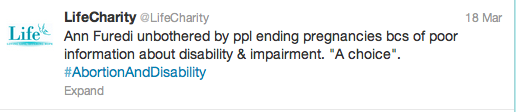
Say no more, Ann (kill all the unborn up until birth) Furedi

  • Professor Paul Blumenthal, Stanford University

The man who argued against the banning of partial-birth abortion in America. That’s when they deliver the baby and crush its head as its coming out. A particularly nasty and gruesome procedure which is fortunately now illegal both over there and over here.

  • Mrs Joanne Fletcher, Consultant Nurse, Gynaecology, Sheffield Teaching Hospitals NHS Trust

As discussed above. A pro-choice activist consultant nurse

  • Dr Roy Farquharson, Consultant Gynaecologist, Liverpool Women’s Hospital

Author of a book on abortion in the first trimester

The day finishes off with the following session

Discussion: A new generation of abortion doctors – challenges and opportunities

Or, how do we entice more doctors into performing abortions, given there is an acute shortage of suitably qualified doctors, with more and more opting out of abortion procedures and training on conscience grounds, something that is naturally very concerning for abortion providers, hence they are resorting to all sorts of measures, including campaigning for the removal of conscience grounds and offering paid interships in order to train medical students.

So who do we have in this session?

  • Katharine Elliot 

A medical student from the University of Newcastle. I’m guessing she’s pro-choice. Perhaps she’s been on one of their placements and can testify to the joys of learning how to be an efficient abortionist?

  • Dr Richard Lyus, British Pregnancy Advisory Service

Again self-explanatory

  • Mr John Parsons, Consultant Gynaecologist

A doctor who believes that there are not enough abortions. 

In conclusion then, BPAS are hosting a wholly partisan conference, with a variety of pro-choice campaigners, activists and doctors and seeking to leverage the Royal Society of Medicine’s credentials in order to give the conference and any conclusions or press releases that may emanate from it, authority.

Whether you’ve read this in any depth, or simply scrolled through it to get the general gist, there can be no room for apathy. This is BPAS, this is what they do, it is extremely clever and slick manipulation, designed to fool the general public with medical terminology and assurances that their conclusions are following the deliberations and discussions of experts in the field, all highly scientific, evidence-based and neutral.

Nothing could be further from the case and no-one should be fooled. This is where some of the vast income from providing abortions for the NHS is diverted. Into promoting abortion as an option and finding ways of marketing and making it palatable to the general public, under the guise of science and using women’s rights campaigners as unofficial PR.

If SPUC or LIFE or Right-to-Life hold a conference on maternal care, this is immediately dismissed as being the work of loony nutjob fundies and therefore not worthwhile because their views on abortion are apparent in the name of the organisation. What BPAS are doing with conferences such as these, is a clever piece of PR, marketing and strategy, one that is not overtly political, but masquerades as some sort of scientific inquiry.

Pro-lifers need not only to disseminate this information, but also dispel the inevitable narratives that will pop up arising from this conference, as well as raise our game. We need to remember that there are equally well-informed experts who, on looking on the evidence available , take an opposing view, one that is peer-reviewed and evidence-based.

It is not surprising what is going on here, but anyone who feels apathy as opposed to anger, needs a wake-up call. This is life and death stuff, BPAS  are attempting the hijacking of the medical opinion to justify and disguise what is going on – the wholesale killing of the unborn, paid for by taxpayers’ money and wrapped up in important sounding conferences, which are nothing more than an echo chamber for abortionists and their supporters.

Given enough rope

Back to pro-life matters and it’s been heartening to watch LIFE charity who have really raised their game on social media over the past year, in terms of putting out some really useful information, along with biting commentary out into the public domain. Their Twitter handle is @LifeCharity

LIFE were live-tweeting testimony from the Parliamentary Inquiry (led by the all-party Pro-life group)  into abortion and disability which examined the unjust discrimination that allows for disabled babies to be aborted right up until the moment of birth, whereas ‘healthy’ children are subject to a 24 week limit. A discrepancy with which the general public are becoming increasingly uncomfortable following the resounding success of London’s 2012 Paralympics, which did much to raise awareness that having a disability does not preclude one from living an active and fulfilling life, nor from achieving success in a chosen field.

All of our medal winning athletes would have been allowed to have been aborted up until the moment of birth according to current UK law.

Ann Furedi, Chief Executive of BPAS made no attempt to hide her extremism, with the following statement, which is an absolute gift to the pro-life cause. Whatever else, one cannot fault Mrs Furedi’s honesty, these are the thoughts of one the UK’s most prolific and influential advocates for abortion:

Screen Shot 2013-03-21 at 10.46.30

That’s right. If it’s unfair to kill disabled children up until birth, let’s kill ALL the children, instead of attempting to save the lives of those who can be killed right up until the moment that they are born. And they scoff at the moniker culture of death? Highly appropriate I’d say. Instead of choosing life for all, let’s choose equal rights to be unjustly killed, if at any stage your life becomes an inconvenience.

Here’s another good one.

Screen Shot 2013-03-21 at 10.52.05

So when the expectant mother feels her baby kicking and hiccuping from around 5 months, it isn’t really alive, and neither is a baby alive when you can see him or her kicking, somersaulting, stretching, yawning, swallowing on your 12 week pregnancy scans. That’s not life, no it’s just human sentimentality telling us otherwise. When a woman suffers a tragic miscarriage, she has no need to mourn, or hold a funeral because her baby was never really alive? I wonder what this organisation, which exists to support and counsel parents who have lost a baby at any stage in life would make of that?

On the contentious issue of time limits:

Screen Shot 2013-03-21 at 10.57.35

I can think of some pro-lifers who may sympathise with that. It’s logically coherent, either abortion is acceptable or it isn’t. If you can kill a baby, does it really matter at what stage?

I think the answer is yes, for two reasons. Firstly, we know that late-stage abortions are physically much more dangerous to the mother, which is why there is always such a rush to get women to abort at the earliest possible opportunity. Late-stage abortions are also a lot more emotionally harrowing for a woman, which any organisation that claims to care about their welfare should acknowledge.  Read some of the testimony on this womens’ forum, I linked to in a previous post. Also note, that since linking to it back in November, a pro-choicer has demanded that the moderators remove said thread, due to its age and it allegedly being ‘unhelpful’ towards women thinking of late-stage abortions. Unhelpful being a euphemism for deterrent.

It’s an astounding coming from someone whose organisation purports to care about women, that time-limits which are related to the health and well-being of the mother as well as the baby, are deemed unimportant. Autonomy or choice must come before personal safety and wellbeing.

The other reason why late stage abortions are important from a pro-life point of view is that the 24 week limit means that no attempt is made to help babies who made be born prematurely before this time, such as the case of baby Jayden, who was left to die for hours, as it was against the rules to help him. Ideology must not cause us to stick our heads in the sand over this issue.

But so what if time limits are a political preoccupation? Abortion has become political ever since pro-choicers decided to politicise it back in the sixties. In a democracy politics exist to reflect the will of the people, the majority of whom are extremely uncomfortable with the notion of late-stage abortion. Does Ann Furedi deem public opinion irrelevant in the face of her own personal ideology. It doesn’t matter whether or not stomachs are churned by the idea of fully developed healthy babies being killed subject to the whims of others? People are obviously very ignorant, what matters is that babies must be able to be killed right up until the moment of their birth, if that is what an individual wants, regardless of whether or not it is in step with the views of the general public, who don’t really matter anyway. The kind of atrocities such as those committed by Kermit Gosnell, are irrelevant?

If anyone was in any doubt about the ethic of autonomy being paramount regardless of consequences, here’s a chilling example:

Screen Shot 2013-03-21 at 11.23.59

So it doesn’t matter if parents abort a much-wanted unborn baby because they have been poorly informed about their potential quality of life, or future prospects? It doesn’t matter if parents later find out something that had they known prior to the abortion, would have changed their mind and then have to live with the fact that they aborted an unborn baby on a false premise. The anger and sadness of grieving parents doesn’t matter, their right to be properly informed is of secondary import, what really matters is that they made a choice, even if it then turned out to be the wrong one and one that they would not repeat given similar circumstances. All that matters is that a decision is made?

Blowing all claims of impartiality and informing women of all their options out of the water, the Chief Executive of the British Pregnancy Advisory Services, says this

Screen Shot 2013-03-21 at 11.31.10

People were screaming blue murder at Nadine Dorries’ proposed amendment which suggested that abortion clinics did not offer wholly impartial advice and offered to give pregnant women the choice of independent counselling in which all options and alternatives could be discussed. Whilst wary of adoption being offered as a panacea or first solution to a woman with a crisis pregnancy, it should at least be discussed and given equal weight as an option as abortion. It makes a complete mockery of BPAS’ name of the British Pregnancy Advisory Service – the type of advice on offer is one way.

People say pro-lifers are the extremists? Try telling that to those from 40 Days for Life in Brighton yesterday, who had a car drive past them sizing them up, and which then returned to pelt them with eggs. Or to those working at the Youth Defence office in Dublin who found the memory of Savita Halappanavar defiled when her photo was stuck to their office doors with human faeces.

Sometimes there is no need for pro-lifers to make an opposing argument. Give some people enough rope…

Save all the children

A dissenting voice

st mary's university college twickenham

An interesting comment appeared in response to my post about the Catholic Women Rising project, stating that I am never going to manage to attempt to get every Catholic woman to sign up. Maybe not, but just because something may be difficult, doesn’t mean that it’s not worth doing.

As a point of note, the Catholic Women Rising site is not meant to be a personal vanity project – the intention is to hand over blog administration to any other Catholic women (or men) who may wish to be involved, especially in the apologetics side. The aim is to promote the New Feminism, winning over lapsed Catholics and hopefully even persuading women of other denominations,  as well as a manifestation of the huge amount of grass roots support that exists for Catholic teaching.  I don’t care from whence the apologetics comes so long as it is not only sound, but gentle – there will be no time for hectoring those who struggle with teaching or at times fall short. Whilst sin or error can not be validated,  one catches more flies with honey than vinegar as the saying goes and it is intended to be a place of joyful witness to the truth, not petty sniping or personal carping. I wonder whether women are better placed in terms of evangelising to other women nonetheless.

In the meantime, it will mainly be pro-life and personal witterings reflections as per usual on this site, but so far the response has been overwhelming, my email and social media inboxes have been inundated with support, with Francis Philips of the Catholic Herald, Joanna Bogle and Marianne Cutherbertson, being among those who have supported the site and signed. It’s early days yet, but I do intend to keep plugging away at it and getting as many names as possible and publicising the initiative outside of the internet.

Whilst not wishing to pick on the person who left the comment, another one of her points was that unrest exists within the Catholic church with regards to women. If this is the case then this needs to be identified and engaged with, not least so that women who feel uncomfortable with doctrine, are at the very least, afforded the privilege of being listened to and it needs to be established whether any pastoral solution can be sought, or whether they are labouring under a misapprehension. No-one is claiming that unrest doesn’t exist, but it’s a question of how representative some of the media narratives are. The majority of Catholic female voices in the mainstream media (Catholic Herald staff aside), from Joanna Moorhead to even Cristina Odone, seem to publicly dissent from at least one aspect of teaching. The project aims to offer a response and counter, to which a new post has gone up, which names some of the women of influence within the Holy See itself.

Tina Beattie suggests that the handful of women to whom the Vatican are listening are “selected handmaidens”, a deliberately inflammatory phrase, designed to reinforce the notions of patriarchy and sexual subservience and oppression. If one were of a less charitable disposition, one might wonder whether or not there is a hint of bitterness or frustration that as a theologian in a Catholic university, she is not among their number.

Occam’s razor comes in handy here – if there are not as many women as perhaps would be desirable amongst those positions open to the laity in the Curia, it has as much to do with the fact that many Catholic women have a vocation of wife and mother which is incompatible with a full-time job located in Vatican City. The complaint that ‘diverse prominent women theologians’ are not being listened to is due to the nature of the dissenting views of such theologians as opposed to their gender. Hans Kung wasn’t stripped of his teaching faculties on account of his sex.

If the church fails to take account of the problems of the women in the world, and I’m far from convinced that this is true, then this needs further definition.

But the most interesting aspect of this comment, is that it appeared to jump on the fact that I had apparently misunderstood and taken Tina Beattie’s Guardian quote from Protect the Pope, out of context and it appeared to be leaping to her defence. I have no intention of attempting to out the person who made the comment, who I suspect was a student and neither do I have the time or inclination to pursue or track down those who leave comments expressing disagreement.

WordPress does however automatically log the IP address of those who leave comments and as such I can often identify persistent trolls. This commenter is not a troll, she was simply disagreeing with me as she is perfectly entitled to do so, however what jumped out at me was that WordPress assigned a name to the originating comment, which was St Mary’s University College, Twickenham, a Catholic University, which has been experiencing a fair amount ofshenanigans of late.

That we have a student who seems to be in agreement with Professor Beattie is nothing to get rattled about. But it does once again pose the wider question about what might be going on in terms of teaching or catechesis at that university, which seems rather sad.

Protectors of life, the family, friendships and each other

Image

No-one could fail to be inspired by Pope Francis’ homily at this morning’s inaugural Mass. He calls for tenderness, and describes how authentic power comes with service, reminding us of our duty to protect one another.

We must never be afraid of goodness, of tenderness which is a great sign of strength. A tender heart is indicative of a capacity for concern, compassion, and a genuine openness to others for love.

Just as these are the qualities shown by St Joseph in his role of loving protector towards Mary, Jesus and over the whole church, these are also the qualities inherent in motherhood, whether that be of a spiritual or physical nature. Like St Joseph all of us must watch over and protect Christ’s mystical body, but his homily was a potent reminder of why we must be protectors of life, at whatever stage, from its conception to it’s final moments.

It reinforced the message of Christ to me as a woman, wife and mother, reminding me of my duty to nurture and protect my husband and children, as well as reaching out to fellow women in their moments of danger and crisis.

Last night, following a germ of idea in which I thought it would be a great to have an online space where faithful Catholic women can witness to their faith, I set up a new website, catholicwomenrising.wordpress.com in which women can stand up and be counted for their faith and offer their love, gratitude and prayers for Pope Francis as well as register their unqualified support for Church teaching.

Please could those who commented in the comms box here, go and register their support over there, spread the word and pray. My hope is that this could be a real gift and blessing, not only to Pope Francis, but to the Catholic Church as a whole, countering the repeated negative media cliche that the Catholic Church is not representative of well over 50% of its members.

I’d like women to stand up and be counted for their faith, to show the world that they embrace the freedom and love that comes with adhering to God’s plan for the world. Far from being oppressive, the New Feminism is all about empowerment and recognising the inherent dignity of all women as created beings of God, free of cultural and society’s expectations to become sexual objects and to limit and crush our innate fertility and restrict our ability to love. The culture of death pressurises us to murder our unborn children, put limits on our resources to love and to reject our elderly, in favour of our own selfish needs.

The culture of life and love recognises our abilities and strengths as women, it does not expect us to be subjugated to male desire, it allows for us to fulfil our potential, whether we are married, single, mothers, childless, whether we are working or seeking work, whether we are homemakers, businesswomen, volunteers or a combination of all of the above. It does not seek to put a lid on the female achievement in whatever a woman’s chosen area.

Catholic teaching allows for us to love Christ, to love ourselves and thus reach out to and love and protect for one another. It is freedom, dignity and empowerment.

Please could you pass on the website and urge every Catholic woman you know who agrees to sign. It would be a simple act of faith, in this Year of Faith, but send an incredibly powerful message to the world, that here is a group of happy, fulfilled, empowered and spiritual nurtured women; a message of encouragement, not only to each other and to the rest of the Church, but also to those women who have become estranged from the faith.

The plan is to set up some separate posts and sensible forum debate, whereby women who do not agree with Church teaching (yet) can debate and discuss the issues in an atmosphere of openness and non-confrontation. Where those who might be struggling with some of the challenging issues such as IVF or contraception, can talk this through in a  non-judgemental way and receive gentle explanation, encouragement, support and resources in terms of alternatives.

But first and foremost, it would be amazing if we could muster as many women as possible to say “Yes, I love the Catholic Church, I follow her teachings, not because I am brainwashed or fearful, but with a heart and mind that is open to God”.