Allison Pearson has written a thought-provoking piece about the burka debate in her Daily Telegraph column. I disagree with her, on grounds of both libertarianism and religious freedom, however she raises an interesting issue, quoting Sarah Wollaston’s tweet that the burka won’t be banned because too many politicians will hide behind the guise of freedom.
I’ve already written about this issue for this week’s Universe column, so I don’t intend to re-hash the arguments, but this point about creeping oppression dressed up as freedom of choice seems far more salient when it comes to the subject of abortion.
Arguably abortion is infinitely more oppressive than whether or not a woman is being coerced into wearing a piece of clothing or even prevented from certain activities (by the way Muslim women are not forbidden from swimming, specialised swimwear is available) because the way it is promoted and encouraged by society, automatically presents women with a choice, which is not a good in itself. Choice is not a value that we should put above all others. There is nothing to be ashamed about being labelled ‘anti-choice’ when one considers what the nature of that actual choice is, namely the decision to end the life of another human being.
But like it or not, despite the fact that the UK’s legal framework is designed for the protection of unborn life, every single pregnant woman is now forced into the position where she has to consider and indeed medically affirm whether or not she wishes to carry her unborn child to term and give birth to them. This then presents a whole new set of dilemmas and pressures, such as does a woman have the ‘perfect’ or ‘ideal’ set up to have her baby and if not, is she being responsible or even fair to unborn child to allow it to live?
When we consider that abortion on the grounds of sex seems to be allowed to go unpunished, in the name of reproductive choice, is this really freedom or oppression dressed up in the name of choice? Given that girls and disabled children are the main victims of freedom of choice, how can we claim this as liberating? What is free about a society in which children are not given the basic right to life, on the grounds that their sex or physical disability is seen as an inconvenience?
Equality is not achieved by banning a piece of clothing, but changing prevailing attitudes which leads to thinking that certain sections of society are second or third-class citizens. If we want to tackle perceived unfairness we should start with the fundamental principle that every unborn child deserves protection, regardless of the circumstances of their birth, their sex or their physical ability. Anything else is oppression, for mother and child alike, even if it is marketed and sold in the name of choice.
Having written both a blogpost and a feature for the Catholic press on the subject of Fr Ray and his misrepresentation in the mainstream media, I don’t want to over-egg the pudding on this issue, nonetheless the whole affair has thrown up cause for further concern.
When posting the text of my Universe article earlier, I was searching for a flattering image of Father Ray online and found what I thought was a nice photo taken of him in the pews of St Mary Magdalen church. After clicking on the image, I saw that it was copyrighted by the Brighton Argus and lo and behold, linked to yet another misleading article based on the contents of his blog, in which it was claimed that Fr Ray was denouncing the traditional foot-washing on Maundy Thursday as ‘sinful.’
The piece was not penned by Bill Gardner, but in common with his recent feature, it did not link to the original post and gave a false impression that Fr Ray was condemning the practice of foot-washing, whereas Fr Ray once again with typical humility and frankness, described how it was an occasion of sin for him. Read in context, the post was moving and challenging in equal measure, Father’s concern for the homeless is almost palpable, far from de-humanising them as undesirable objects, he wondered whether previously he had unconsciously not treated people with the dignity and respect that they deserve, but rather as a quantity to be exploited.
With all the brouhaha surrounding the election of Pope Francis during Easter week, this didn’t get picked up by the nationals, but it did of course attract the usual anti-Catholic sentiment in the comment section and once again chipped away at the reputation of Fr Ray.
When the most recent story broke, I took at look at the Twitter stream of Bill Gardner, who despite being a local journalist hadn’t previously registered on my radar, even though I do use Twitter to keep up with other local journalists and politicians.
What I found was a little disturbing. On the one hand Bill Gardner is a lively, engaging and clearly very ambitious local journalist who is obviously trying to build his career in the profession, probably in tabloids. He is able to sniff out a good story and put quite a sensationalist spin on events, which is a pre-requisite for any budding journalist. Headlines and features need to instantly attract attention and it’s something that the Brighton Argus seems to have perfected down to a fine art, I am often struck by seemingly fantastic or scandalous local headlines on the sandwich boards outside the newsagents as I walk to school.
Newspapers and journalists are frequently and I think unfairly, described by the commentariat as “trolls” themselves, in that they publish deliberately controversial articles and headlines to attract interest. The internet may have made print and on-line media more cut-throat, but publishing sensational stories and photos to attract readers is not a new feature of the press. Back in the ’80s and ’90s an exclusive photograph of Princess Diana on the front page did wonders for that day’s circulation. The overriding memory I have of my A Level results day is of my mother waking up at crack of dawn to sneak to the post-office lest anyone local might catch her buying a copy of the Daily Mirror, but she was dying to view the photos of Sarah Ferguson having her toes sucked by the Texan millionaire, before they sold out!
So I am not going to criticise either Bill Gardner or the Brighton Argus for wanting to boost readership or interest, nor do I think we should take heed of the many comments I found on Bill Gardner’s feed criticising him for being a ‘troll’ himself following his appearance on ITV’s Monday night show about internet bullying. The Argus have run a good campaign highlighting the effects of online bullying and how ineffectual the police response is to this, therefore it is highly ironic that one of their journalists seems to be engaging in that very activity. Bill Gardner is not a troll, he’s a journalist attempting to further his career, but his methods are unethical. By all means report a story, but do so fairly, accurately and without bias or attempting to mislead the reader or incite hate upon a particular target.
I don’t want to make this a personal attack on Bill Gardner, his feed reflects an obvious left-wing and socially liberal bias, which he is more than entitled to hold, he does seem to care passionately about issues of social justice. I note he spent an afternoon with the police anti-begging squad, whose aims he seemed to sympathetically report, which makes me wonder why he attacked Fr Ray over his perceived attitude, but he does evidently possess some morals, not to mention charisma and has unashamedly and unapologetically borne the storm of criticism from Catholics. Perhaps living in Brighton has given him more front than Blackpool?
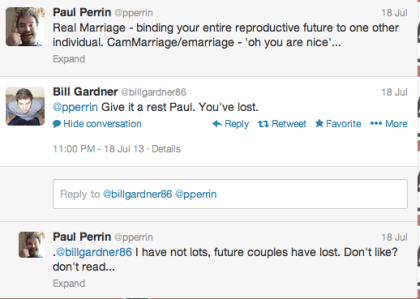
But here’s what I think is the crux of the attitude. One thing that is apparent from his Twitter feed is that in common with many of Brighton’s residents, Bill Gardner is a supporter of ‘equal marriage’.
Frank exchange of views there, nothing for anyone to get upset about. Except it might then explain Mr Gardner’s reaction to Fr Ray’s wholly reasonable comments in response to being rung up and asked about a recent Brighton Bridal Bondage Fair.
Here’s the piece, despite the hyperbole, I’m not sensing the ‘outrage’, Fr Ray’s comments seem measured enough and indeed the organiser of the event explicitly says that she agrees with much of what he has to say. I can’t quite see what there is to get excited about in the following quote.
“Sexual fantasies belong in the bedroom, not at the wedding altar.
“Marriage is ultimately about building a stable environment for the procreation of children.
“It’s supposed to be about partnership, but this event seems to be designed for the fulfilment of individuals.
“From a Catholic point of view, marriage is sacred and I think dressing up in fantasy outfits risks damaging that.”
I suspect however the key sentence that provoked a reaction is the one with regards to the purpose of marriage being about creating a stable environment for children, given Bill Gardner had previously publicly baulked at similar sentiments.
It might explain why Bill Gardner seems to then go on a bit of a crusade, dredging his blog to find what other ‘damaging’ or ‘scandalous’ quotes or stories could be attributed to Fr Ray. Or maybe I’m being unfair and it was a slow news day, but the timing of the next piece, reporting Fr Ray’s purported disdainful attitude to the poor and homeless is interesting, coming as it did, the following day. I think one can definitely conclude that Fr Ray’s blog was being trawled on an offence-finding mission and may explain why a blogpost that was over a month old was seized upon.
No need to re-hash the piece or the response to it, but it has been the source of great pain to Fr Ray. For those who may claim that no publicity is bad publicity and that overall it’s done him good, I would point to the response of my mother, who rang me up to ask me all about the affair, presuming we would know the priest, she and her Catholic neighbour (in extremely good standing) having been scandalised and appalled by what they had seen, although they had noted that the Telegraph was more balanced in their coverage.
The Catholic blogosphere is a specialised niche, there will have been many people who were therefore given a one-sided view of the story which is why it was important that the Catholic press could provide a balance.
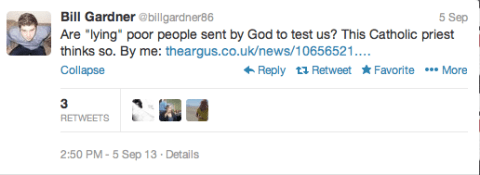
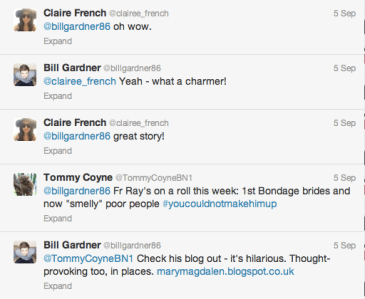
In the meantime, the following set of tweets from Bill Gardner, definitely seems to be inviting ill-will, contempt and scorn upon Fr Ray and the Catholic Church by association and could be perceived as bullying.
Fr Ray has been caused a lot of distress, but fortunately he also knows that he enjoys the support of his parishioners, his blog readers and his Bishop has described the piece as “mischief”.
The problem is that the “mischief” on behalf the Brighton Argus, does not seem to be an isolated case, that’s three stories that have misrepresented him in the last six months. I’m loath to accuse the Argus of outright anti-Catholicism, more likely his views on same-sex marriage, have made him a target for criticism in a city that likes to pride itself on its ‘progressive’ and ‘liberal’ credentials. Being a local priest, Fr Ray’s blog provides a rich and steady stream of local outrage to boost circulation and hit rates, especially when there might be a slow news day. Nothing that Fr Ray actually says is any more controversial than anything that any other priest blogger has come out with, it’s just that he is Brighton’s very own ‘outrageous celebrity priest blogger’. What is concerning is the one-sided and inaccurate way in which the Argus has presented him of late, which has sought to turn him into a local comedic hate figure, who hates the smelly poor and holds the obligatory ‘bigoted’ view of the LGBT community. Brighton’s very own Fred Phelps if you will.
A complaint to the PCC certainly seems to be in order as does boycotting the Argus as well as their advertisers and informing them why, until Fr Ray receives a formal apology at the very least.
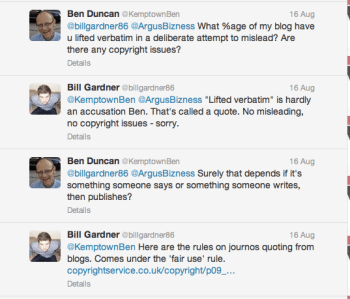
As a final point, it might be worth noting that in his haste to get the story, Bill Gardner and the Argus, have made previous mistakes and errors. It could be claimed that lifting and distorting quotes from blogs, is something in which they have previous form.
Happy to clarify for an important MPThis tweeter faced a minor twitter storm as a result of misattributed tweets in the paperSounds a bit familiar
Trawling local blogs for titbits that can be distorted into a scandalous feature is quite the opposite innovative or go-getting journalism, it’s indicative of laziness and lack of inspiration. If you are going to do it, then at least have the decency to quote in context or do some background on your target.
Trouble is all this enhances Bill Gardner’s reputation as an edgy journalist, he’ll love the controversy, whereas the constant attacks on Fr Ray, could do his important ministry irreparable damage.
It’s all tomorrow’s fish and chip paper, or at least it would be were it not for the permanent nature of the Internet, but following three concurrent occasions of blatant misrepresentation, enough is enough.
Taken from the Catholic Universe – 15 September 2013
Lying – of no great import to the man who cheated on his wife
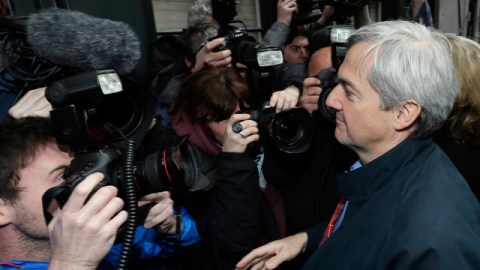
Chris Huhne, the disgraced former government minister who resigned following his conviction and subsequent jail sentence for perverting the course of justice over persuading his ex-wife to accept penalty points that he had incurred, came out with an astonishingly frank statement this week. Under pressure from the perennially brutal Jeremy Paxman with regards to his blatant and repeated public lies, he defended himself as follows:
“Anyone who tells you that they have never told a lie is lying, the reality that white lies, small lies help in certain circumstances and avoid you hurting other people’s feelings.”
I was torn between amusement at the delicious irony of a former politician’s impassioned and honest defence of untruths and an instinctive horror, recoiling at the notion that lies, no matter how small, can ever be anything other than pernicious.
Lying, in the context alluded to by Chris Huhne, can never be justified because its purpose is always to mislead and to put it in theological and philosophical terms, lying goes against the God-given purpose of speech, namely to assert a truth about reality in order to communicate or convey the concepts in one’s mind. St Thomas Aquinas therefore describes lying as ‘a statement at variance with the mind’ and the Catechism reminds us that it is a sin because ‘to lie is to speak or act against the truth in order to lead someone into error’.
Though Chris Huhne may be correct in observing that most of us will at some point have told an untruth, as human beings we are called to rise above the lowest common denominator. The actions or thoughts of the majority determine neither truth or even morality, which is the main flaw in any democratic system. That many people might have told a lie, does not render the action acceptable. The only person whom lies can ever benefit is the person uttering them, even if they believe that they are doing so with good reason, such as to spare the feeling of another, or for the greater good, but the ends never justify the means.
It can be argued that in a few limited contexts we do not expect to hear the truth from another and not every literal falsehood is a lie. For example when someone asks ‘how are you?’ the response ‘fine thanks’ is a general pleasantry and not an attempt to deceive, but we’ve reached a pretty poor and dangerous state of affairs, if our cynicism to politicians is such that we always expect to hear untruths and thus they are therefore justified in misleading us.
Perhaps most disturbing is that Mr Huhne’s public apologia for lying seems to have been largely unremarked upon in the mainstream press, indicating that most of our political and media commentators are in agreement with him. A society that condones, accepts and even expects lies is one that is in grave danger and on a personal level, even the tiniest of lies can often spiral into tangled knots of deceit, angst and despair.
On the other side of the coin, this week has also seen Fr Ray Blake, a priest local to me in Brighton, slammed and vilified by the press both nationally and internationally for a searingly honest blogpost in which using the very same language as Pope Francis, he described the poor and homeless of his parish, which is right in the heart of the city and attracts many addicts, as ‘messy’.
In a shameless misrepresentation of his original post, which was a theological reflection upon how we are called to treat the outcasts in society, a local journalist, who was seemingly already irritated by Fr Ray’s thoughts on marriage and looking for controversy, picked up on a recent article in which the priest had expressed the very specific challenges posed by the homeless with stark candour, describing how he has to clean up blood, excrement and used needles on a daily basis.
Far from attacking the poor as widely reported, Fr Blake was in fact reflecting upon his own shortcomings; the homeless challenge him he said, they shake him out of his complacency, he doesn’t always find the mess and chaos easy to deal with, but this is no bad thing, and reflects the message of the Gospels. We are not called to live comfortable lives of compromise, but to roll our sleeves up and get our hands dirty, which Fr Ray and his parish team do, with a soup distribution apostolate that runs 365 days a year.
Rather than patronising the homeless, with a dewy-eyed romantic view, Fr Ray Blake expounded the issues surrounding their care with his typical mixture of forthrightness and compassion. To pretend that issues related to homelessness such as addiction and crime do not exist, does the very people in need of help a huge disservice. One can only assume that his words pricked too many consciences.
While Fr Ray Blake is now contemplating closing his blog as a result of the unfair press coverage surrounding his brave honesty, Chris Huhne is now reviving his career as a journalist and commentator, off the back of being a convicted liar.
I wonder what the avowed atheist George Orwell would make of the fact that in 2013, a Catholic priest would prove his maxim, “in a time of universal deceit – telling the truth is a revolutionary act”.
Taken from the Catholic Universe – 8 September 2013
The row over faith schools has been reignited this week following the British Humanist Association’s successful challenge to the Office of the Schools Adjudicator with regards to the entry criteria for the London Oratory in Fulham, one of the UK’s leading Catholic Schools.
Under its current admissions policies, one of the criteria under which children are prioritised is that of ‘service’ by a child or their parent within a Catholic church or community over at least three years, which could include singing in the choir, being on the flower-arranging rota or some kind of church based voluntary work. The Oratory had argued that this is a religious activity in accordance with canon law, however the adjudicator disagreed, stating that the criterion meant parents who wanted a place for their children would need to start planning three or four years in advance of their child’s admission. This apparently would favour those who were sufficiently well-organised and that it therefore excluded more chaotic and presumably more disadvantaged families. It is apparently unfair that parents should be need to be thinking about school admissions four years ahead of actually requiring a place.
Firstly, one has to question what right the British Humanist Association has to challenge and interfere with the admissions criteria of Catholic schools, to whom they are vehemently opposed. This was little more than a thinly veiled and intolerant attack upon the rights of parents to be able to give their children an education of their choosing.
What the British Humanist Association and other secular lobby groups fail to grasp, is that though all faith schools enjoy state funding, they are also funded by the Church itself, which currently contributes around £20 million a year towards the capital costs of her schools in England and Wales. It is therefore only right and proper that schools should be able to maintain a Catholic ethos, part of which must include reserving the majority of its places for children from the Catholic community, for whom they were established to serve.
In most Catholic schools, the proportion of non-Catholic students is actually much higher than the government’s stipulated 15%, the proportion of Catholic students is around 75% in England, 65% in Wales, meaning that the non-Catholic students number around a third of the total intake, more than double the official requirements, but obviously there are also some schools, such as the Oratory, who are hugely over-subscribed, which is where difficulty arises.
The Catholic Education Service is opposed to admissions criteria such as those of the Oratory, because as the schools’ adjudicator says, it can disadvantage those of a lower social status or those families where both parents work, making it difficult for them to be involved in parish work, meaning that the Catholic Church falls short in her duty to provide education for the entire Catholic population.
I confess to having very mixed feelings on the topic, speaking in the position of someone who will shortly be applying to our over-subscribed local Catholic primary for a place for our daughter next year. The demands of 4 young children, 2 of whom are little more than babies, does admittedly make it extremely difficult to get involved in various parish activities, reading at Mass for example, would be impossible. Were my husband working long hours as a layman, as he did in the period between being an Anglican clergyman and attending seminary, it would be a Herculean task. But that said, despite working long and irregular shift patterns, he still did what he could. Not because we had an eye on school admissions, (our local school doesn’t require any service element) but because as Catholics we felt obligated to contribute to our community in some way.
The thinking on school admissions seems to emanate from cynicism. Most people do not get involved in parish work due to some ulterior motive, but because they generously want to give of their time and energy and be involved in the work of the Kingdom.
We have to remember that Catholic schools are not solely about imparting a first-class academic education, but also raising our children in the habits of the faith, teaching them first and foremost about their vocation as Christians. Therefore it should be hoped that most Catholic parents are already somehow involved in their local community, even if their commitment can only extend to baking cakes for the parish fair, or occasionally helping out on an ad-hoc basis as required.
Catholic schools are rightly disbarred from probing into the Catholicity of parents, but we all know of cases where parents have turned up solely for the required period of time to enable the priest to sign the school form in good conscience, never to be seen again once the child has started school. It therefore feels innately unfair that parents who have been local parish stalwarts for a period of time, could well miss out as a result of such opportunism. The requirement for service certainly overcomes this particular issue.
Ultimately however, whilst we continue to have over-subscribed Catholic schools, there can be no perfect system, frequent Mass attendance or parish service being imperfect ways of selecting pupils, as they both rule out recent converts or those who may have only just moved to a particular area.
The great injustice of the British education system is that effectively it is only those with the cash to pay for private schools or to move into the right catchment area, or those with faith who are able to access a good education. Catholic schools are regularly applauded as being excellent models of education by the education watchdogs. What we need is more of them, so that places are available, not only for every baptised Catholic to receive the education that is their right, but also for anyone else of whatever religion who feels that a Catholic formation could be of benefit to their child.
I’m still suffering from severe morning sickness, which is making life particularly difficult in terms of writing and blogging, because for some reason I am yet to fathom, more than about 10 minutes in front of a screen, be it computer, tablet or phone, sends me hurtling towards the bathroom, which makes life a little tricky when you are trying to cobble together some additional income from freelance writing.
All of which means I’m a little late to the party when it comes to the topic of sex-selective abortion, which this week as been at the top of the UK pro-life agenda, with the Crown Prosecution Service deciding that it is not in the public interest to prosecute doctors who were discovered by the Daily Telegraph breaking the law, in that they were happy to approve second trimester abortions on the grounds of the sex of the unborn baby.
There isn’t therefore much to add to the excellent post by Catholic Voices which points out that this decision not to prosecute shortens the path to a eugenic society, but it’s certainly worth visiting this Facebook page which gives some guidance as to how to write to the Secretary of State for Health, Jeremy Hunt, who has also expressed his concern.
One question that is troubling me as the mother of four beautiful girls, who is in all likelihood experiencing her last pregnancy on health grounds, is whether or not there are those who would justify a decision to abort this baby if we were to discover that it was another girl? In my particular situation, which is probably more typical of the Western mindset, an abortion would be justified not because a girl is deemed to be of lesser value as in other cultures, but simply because we have this skewed notion of a perfect or balanced family. Someone has, in all innocence, asked me the question ‘are you just going to keep going until you get a boy’, a notion that is incredibly hurtful as it implies that there is something wrong with my beautiful girls, or that I am in some way dissatisfied and will remain unfulfilled until I have a child of the opposite gender.
Were I to have four boys, the issue would be exactly the same, it would be assumed that I am somehow desperate for a girl, the issue is not about feminism or misandry, although I have to say that my observation is that most women would like a daughter at some stage, most men a son, the desire for a specific gender seems to be more entangled with individual gender identity issues than with a cultural norm. There are various myths about raising genders, many of which are nothing more than projection or whimsy, i.e. that girls are easy as children and nightmarish as teenagers, and many parents seem to want to have a same-sex offspring in order to cultivate a rather unhealthy friendship type of relationship. Some women crave daughters to go shopping or get their nails done with, some men want sons in order to take to the pub and play football with, wanting their children to be an extension or better version of themselves.
So before we are too disparaging about cultures that are unapologetic about a strong gender preference in children, we also ought to examine our own cultural attitudes towards gender selection and perhaps think more carefully before embarking on thoughtless banter, such as “another girl oh no, how disappointing, you really need to give him his boy” which is what a former parishioner said to me as I limped into Mass, 4 days post c-section proudly holding my baby girl, delighted to have made the Easter vigil.
There will be feminists out there who would experience dissonance were I to announce that I would abort this baby on the grounds that it was a girl, torn between disgust at the patriarchal attitude implicit in the decision, but also supporting my right to choose and have control over my own body. On the other hand there will be feminists who would condone such a decision on the spurious grounds of mental health, claiming that if a girl would cause me such mental distress and given that this could well be my last opportunity for a baby, then I should be free to choose, having already done my bit for the sisterhood. Others would take an unashamed attitude, reasoning that the reasons behind abortion are irrelevant, it is my decision that should take precedence. Wanting to abort a baby is a good enough reason in and of itself.
Admittedly it is enormously distasteful and more than a little traumatic to be hypothetically discussing whether or not I would be justified in killing my unborn child. But it goes to show that far from being concerned with equality, the nature of modern feminism is to do with supremacy. Recently I was interviewed by the broadcaster and theologian Vicky Beeching, on whether or not it was possible to be a pro-life feminist, to which one feminist replied ‘no, because the rights of a woman come before those of a foetus’. Whereas any pro-lifer worth their salt, will tell you that the two lives are of equal value. One should not be sacrificed for the other and even in those extremely difficult and rare cases, where a mother’s life could be put at risk, every effort should be made to preserve both lives. No pro-lifer would advocate for a law which would entail a pregnant mother being denied life-saving medical treatment, even if it were to mean that her unborn child may die as a result.
This type of militant feminism doesn’t strike me as being concerned with the rights of equality or the most vulnerable, what a woman wants, she must have, regardless of the impact upon other people and regardless of whether or not the killing of a baby girl contributes to and reaffirms a culture of misogyny. I’ve also yet to hear this argument framed in terms of whether or not it’s acceptable to abort unborn baby boys on the basis of gender. Whether or not it is a widespread practice is irrelevant, if it’s not okay to kill a girl on the basis of gender, it’s not okay to kill a boy and as Fr Lucie-Smith highlights, it’s a small step from denouncing sex-selective abortion to being pro-life. Perhaps that’s why the silence from the feminists has been overwhelming.
The question should not be is it possible to be a feminist and pro-life but rather is it possible to be a feminist and support the killing of your unborn sisters, simply because they happen to have been created female? What kind of ideology is it that will throw one more baby girl down the sluice in the name of female emancipation?
Taken from the Catholic Universe – 1 September 2013
With apologies for the delay in posting
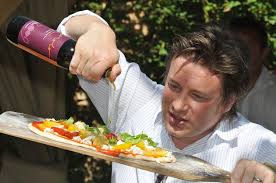
It seems hard to disagree on face value with Celebrity Chef Jamie Oliver’s controversial remarks designed to promote his upcoming series Jamie’s Money Saving Meals.
Speaking in an interview to the Radio Times, Oliver says, “but I’ve spent a lot of time in poor communities, and I find it quite hard to talk about modern-day poverty. You might remember that scene in Ministry of Food, with the mum and the kid eating chips and cheese out of Styrofoam containers, and behind them is a massive TV. It just didn’t weigh up.”
To many it seems that Oliver has a good point, it’s difficult to keep a straight face when discussing poverty levels in the UK, when many of those who are portrayed as facing dire financial circumstances would appear to be in possession of luxury or frivolous items, such as the ubiquitous flatscreen TV or expensive smartphone. Can people whose diets consist mainly of expensive and unhealthy take-away food really be justified as being poor?
One of the things that Pope Francis seems to be continually attempting to do is to shake the faithful out of our attitude to complacency to the poor. We therefore should not buy into this easy stereotype of a feckless and undeserving class who are unable to effectively budget or prioritize, spending their money on the wrong things.
Food spend in the UK has rapidly shrunk over the past few decades to eight per cent of total household income, across all social classes, which when considers it, is staggeringly low, for something that is absolutely vital to our health and wellbeing. Food prices have risen 12% in real terms over the past five years, combined with median income which has fallen by 12% for households in the lowest decile. Fruit and vegetables are now 22% more expensive in the UK, than the EU average and have risen by 25% in the past five years.
Low income households are buying fewer fresh meat products, fewer fruit and vegetables, fewer fish and instead more flour products, but are not able to trade down to cheaper brands as they were already buying the cheapest available. Furthermore the lowest 10% of earners have increased the proportion of their expenditure spent on food. As we face the beginning of a new academic year, reports are coming of squeezed parents having to spend hundreds of pounds on new school uniforms. Incomes are already on a knife-edge, often convenience or low quality foods are packaged under value brands to appear cheaper.
Looked at in this light, it’s hard to maintain the idea that low income households are being more irresponsible than anyone else, it’s simply that the middle-classes have far more flexibility in terms of making choices. Those on lower incomes should not be lambasted for wanting the things such as TVs or take-away meals that others can more easily afford, but instead all of us should be looking to live more simply and less wastefully and consider do we really need the latest smartphone or gadget, despite its alluring glitter.
Where Jamie Oliver is correct, is in his identification of healthier eating habits of other cultures, referencing a Sicilian street cleaner who “has 25 mussels, 10 cherry tomatoes, and packet of spaghetti and knocks up the most amazing pasta for 60 pence”. This is precisely the mentality that we need to cultivate across the whole of society, encouraging people to cook high quality cheap meals from scratch as an everyday habit, for the good of our health and the economy, instead of relying on cheap over-processed nutritionally empty junk.
One of the factors has to be a reintroduction of good old-fashioned home economics lessons in schools. As the person in charge of the culinary department in our household, I know all too well how difficult it is to feed a growing family of six, a wholesome and enjoyable diet on a low budget. It’s a skill I’ve had to learn from necessity; coming from an affluent family of two, my dessert making skills are second to none, but a mean lemon meringue pie or pavlova won’t really cut it.
Cooking should not be thought of as a middle-class hobby but a basic life skill with which everyone should be equipped. But teaching people to source healthy ingredients and cook is only part of the picture. We need to change shopping habits and end the reliance on supermarkets, who bear a massive responsibility in terms of how their profit margins make items such as fresh fruit unaffordable to so many. I recently switched to my local greengrocer whose produce is not only vastly superior but also significantly cheaper. But the government is actually encouraging supermarket dependence as it is only the big chains who will accept the government-issued vouchers specifically for fruit, vegetables and milk for those with children on low incomes. There needs to be more support and funding if necessary for other means of getting good-quality, affordable food to more people, via markets or local food co-operatives, an initiative that was often promoted by Pope Benedict XVI as an alternative to rampant capitalism and a solution to world hunger.
Instead of blaming people for making bad choices, the government needs to support and enable people to make better ones.
In an astonishing and frankly scandalous piece of ‘journalism’, the Daily Mail and Daily Telegraph have both launched in to Fr Ray Blake for his ‘scathing and un-Christian attack’ on the poor and homeless in a recent blog piece. Neither paper had the courtesy to link to the original post, which makes one wonder whether they bothered to even read it, as it was abundantly clear that far from attacking. blasting, condemning or whatever other hyperbole was used, Fr was actually reflecting upon his own attitude one which is probably shared by many of, us which he believes, falls short at times. What any reasonable or thoughtful reader would have taken away from that, is that the poor are challenging, and if we are to live out Gospel values, then we must be shaken out of our complacency and be prepared to get our hands dirty and help.
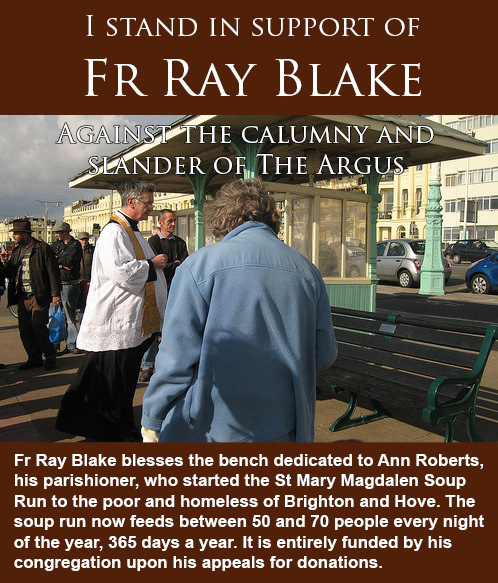
I’m not going to launch into a premature hagiography of Fr Ray, not least because he’d undoubtedly be mortified, but there are a few points I want to make. As most people are aware, Fr Ray’s parish is in the heart of Brighton which is beset by homelessness and drug addiction. Fr Ray is therefore in a good position, as indeed are most Brighton and Hove clergy of all denominations to comment on this, because it is the local churches who are doing much to mop up and alleviate the social problems, together with various local charities. Far from attacking the poor, the parish of St Mary Magdalen (I note the Daily Mail can’t even get the name of the parish right), under Fr Ray’s leadership, has a soup run, providing soup and sandwiches to the homeless on a daily basis. Fr Ray frequently joins them and for anyone cynical as to his motives, as he says here, the food comes with no ’emotional conditions’ or devotional element, they feed the hungry because that is what Christ commands us to do.
A brief glance at the comments underneath Fr’s post, shows him passionately advocating for a compassionate attitude to the poor and homeless, specifically even giving money if required, which isn’t a popular attitude in today’s society. Another fact that has not been alluded to is that Fr Ray has given over a substantial portion of the presbytery to house asylum seekers. So this is not a priest who dislikes or attacks the poor by any imagination, quite the contrary, he sets a stunning example by word and deed, from which clergy half his age could learn.
Anyone who regularly reads Fr Ray’s blog will see how his words are always infused with compassion, which is why those of us who know him, either in real life, or simply by virtue of his blog, will be quite so incensed by this misrepresentation. What I will say about Fr Ray, aside from the fact that my 9 year old thinks he’s quite the nicest confessor in the whole wide world (which when you’ve got a daughter happy to go to confession thanks to a kindly priest is some feat), is that he is one of the few people whom I would feel comfortable phoning up in an emergency and knowing that he would do his best to help, regardless of whether or not you are his parishioner. There is a sense of genuine ‘care’, even if it means sometimes saying the things that one doesn’t always want to hear.
Moreover, Fr Ray is right, when he talks about how the poor are messy and complicated and turn our lives upside down. There is an unhealthy tendency to believe that Christians are somehow immune to squalor, filth, disease and deprivation, by virtue of our faith. It’s almost as if we are expected to walk around with a ‘Ready-Brek’ glow, meaning that we don’t notice the stink of stale urine, or the open weeping sores and that somehow our belief allows us to transcend the more sordid elements of humanity. Whilst ideally we should all wipe the backsides of the poor, elderly and disabled with a beatific and happy smile on our faces, giving thanks that we can be of service, it’s much easier said than done.
This is what was at the heart of Fr Ray’s post, pointing out how physically difficult and challenging the poor and homeless can be, but this is why we are commanded to love, because it doesn’t come easily or naturally to most of us, particularly when faced with the earthy reality. There was no element of blame attached, but equally we need to be careful about a glib and patronising characterisation of any group in society, just because people are poor, it does not mean that somehow they are without fault, unable to put a foot wrong, as this clerical blogger points out.
As a fellow Brighton and Hove resident, I also want to point out how the homeless challenge me on a regular basis. This isn’t to attach blame or fault, but to point out the reality, which does force us to respond.
When I moved into the Rectory I was alarmed to discover a bevvy of double locks and panic button by the front door. The reason being that by virtue of being a Rectory, the homeless would come knocking on a regular basis. Robin had previously given money and thus earned a reputation as being a ‘soft touch’, so much so that on one occasion when he genuinely didn’t have any cash in the house, an addict was so desperate for money that he kicked the front door down in anger.
As a result of living next door to a Church and homeless shelter, we frequently get people knocking on the door, and as Fr Ray relates, the story almost always involves needing a train fare to go somewhere, usually a Catholic funeral. The same person will come and tell you a myriad of different tales, but all variations on a theme. We live on a busy street and often discover people have urinated or defecated in our front garden or against our wall. It’s sometimes troubling when you are trying to leave the house with a multitude of babies and toddlers in tow, wanting to pick up the gravel or cigarette stubs and who can’t play very safely in our front garden. A challenging inconvenience in fact.
Most often the knock at the door comes in the early evening. Usually when the children have just finished dinner, are tired, running about naked before bath-time and a dirty dishevelled, wild-eyed man smelling of urine, stale tobacco and with bleeding sores comes to your door. If I were a good Christian, I’d invite him in and feed him, perhaps even offer him the spare bed in the insulated shed in our back garden. Instead, I panic about the children running out of the front door, worry about him coming in and casing the joint or touching the children, ask him to sit on the bench outside our front door and hastily make him some kind of packed lunch, sandwiches, crisps, fruit, a chocolate bar and a can of fizzy pop to take on his way, rather than actually having to engage. I do what I need to do, but is it out of love, or simply duty? Am I being too comfortable and middle-class, a better woman than I would no doubt invite him in and in so doing act as a model of caritas for the children.
Another example might be having to remind my daughter to step away from the piles of vomit, urine and used needles often found around St Andrew’s Church on Church Road, while walking to school. Or not taking the short-cut, around the back of Tescos, in order to avoid the homeless and drug addicts who congregate there.
I’m not going to defend my actions, I know full well that I ought to take more time than a brief 5 minute chat with the local Big Issue vendor or making a hasty packed lunch or dinner, or giving out the odd cup of tea to the homeless. I need to overcome my natural aversion to dirt and mess and smell. But it isn’t easy, it is challenging, I haven’t yet discovered that regular Mass attendance, prayer life and access to the sacraments gives me a magical imperviousness to either physical or spiritual murkiness. But what it does do is remind me of the example that we are called to follow.
Christ wasn’t afraid to touch the unclean, we have to pray for similar fortitude and rise to the challenge, no matter how much it takes us out of our comfort zone.
Still, Catholic priest reminds us of our obligation to the poor doesn’t make such a great headline.
NB, Just before hitting publish, I spied Fr Ray has officially responded here.
(Since this piece was written, I’ve lost well over half a stone in weight and my nutritional intake consists solely of sips of flat coke, water and bites of white bread, further reinforcing the original view. At times I’ve been almost bedridden and barely able to leave the house, thank goodness for a supportive husband who is carrying the majority of the load during his holiday, whilst I languish like some gothic Victorian heroine. How women are supposed to function normally let alone make rational decisions in this condition is beyond me. Once again I am reminded why abortion must seem like an attractive option to those who may already be overburdened and find the crippling nausea and fatigue almost too much to deal with).
My Catherine Earnshaw moments are rather less glamourous!
Much to our delight, we discovered a few weeks ago that we are expecting our fifth child who is expected to put in an appearance some time in March.
The response, even from Catholic quarters has been interesting and is one from which lessons can be drawn. Many people have questioned whether or not I am correct to announce things at this relatively early stage in the first trimester. “Do people tend to go public before 12 weeks, I thought it had to be top secret” asked one colleague in good faith , which made me realise that a taboo pervades when it comes to the subject of early pregnancy.
I’ve therefore decided, perhaps rather foolishly, to lead by example and announce the happy news to the world at large. This pressure to keep mum about being mum, seems to me to be doing women a major disservice under a misguided notion of compassion.
There are really only three main reasons why a woman may wish to keep her pregnancy news to herself. Firstly, she is concerned about the risk of miscarriage, secondly she wants to be sure that the baby is healthy following her twelve week scan and thirdly, she might be undecided and not want to have to face the public stigma of abortion. Which goes to debunk the notion of choice, because surely if the unborn child is not really a person but a bundle of cells, if the decision is hers alone, to do whatever she likes with her body, then why the urge to keep silent? If pro-choicers are wishing to remove the stigma of abortion, to discuss it in terms of need, then why are they wishing to buy into the silence that surrounds early pregnancy?
Regardless of choice, there can be absolutely no doubt, that for most women, the first trimester is a physically and mentally exhausting time. Added to the worry about potential miscarriage, the majority of which take place in the first trimester, women, if they are anything like me, have to face the trauma of perpetual nausea and sickness, loss of appetite, food and scent aversions, (my children currently smell appalling much to my horror), crippling fatigue, periods of feeling faint, accompanying breathlessness along with headaches, with the skin and temperament of a moody adolescent as huge amounts of progesterone go crashing through your body.
In short, one is a wreck. It’s not surprising, as the first trimester is when all of the baby’s major development takes place. By 4 weeks, all of the baby’s major organs and body systems are in place and beginning to form. By 12 weeks all bodily organs and systems are fully-formed and ready to grow. It’s no wonder you’re shattered! There’s an incredible amount of building work taking place inside you, it’s only after 12 weeks that the placenta takes over in terms of supplying the baby with vital nutrients. Before then, it’s one’s body doing all the work in constructing this tiny human, which will naturally deplete your existing resources.
It therefore seems crazy to keep this quiet when the first trimester is the time that a woman requires most support from her partner, family, friends and employer. You need people to exercise due care and understanding and even if one’s symptoms are not all that severe, it is likely that at some point, a woman will need some leeway and understanding. To keep things quiet forces a woman to conform to the expectations and demands of others, whilst suppressing her own needs, which is not an ideal model of womanhood.
While it is understandable that a woman may not wish to publicly announce the loss of a child if she were to miscarry, it is far more likely that she will get the time off work and compassion she needs from others, if she has previously made them aware of her pregnancy. By suppressing the news, a woman inherently buys into the prevailing zeitgeist which holds that a child is only a child if it is wanted and once it has reached a certain stage in development, whereas biology tells us that a life is formed from the moment of conception.
Why should women be forced to suffer the grief, pain and loss of a child in early pregnancy alone and unsupported? Friends of mine who have experienced the tragedy of multiple early miscarriages have testified to experiencing enormous stigma for wishing to mourn the loss of their little ones, because an abortive mentality tells us that this is not really a child or person.
To keep news of a pregnancy silent until one finds out whether or not the baby may have any abnormalities, heaps further pressure on the disabled who live in our society and upon the parents who may be faced with some very difficult news. The silence serving as a shroud with many parents not feeling able to discuss their news with anyone who might be able to give them a more positive vision than a gloomy clinical prognosis, which talks only in terms of pathologies.
A woman who is undecided needs even more compassion in a society which endorses abortion as an acceptable and even responsible option. If she is struggling with a terrible dilemma whilst in the throes of feeling absolutely dire, how does a conspiracy of silence help her to be able to talk through her options with someone other than the worker at the abortion clinic, who will in all probability consolidate her doubts and offer a swift concrete solution.
In 2012, 91% of abortions were carried out in first trimester, compared to 57% in 2002. It’s no wonder the abortion industry want to keep early pregnancy hidden and behind closed doors. Pregnant women should not feel silenced.
This week’s Catholic Universe column – 18 August 2013
A man ahead of his time.
This summer has marked the 45th anniversary of one of the most important Church documents of the twentieth century, namely the papal encyclical Humanae Vitae, that re-affirmed traditional Church doctrine regarding sexuality and marriage and controversially rejected all forms of contraception as being a moral evil.
It was a teaching that proved very hard to swallow by certain members of the Catholic faithful, published when the sexual revolution was in full swing, going against the the tide of both public opinion and views held by many theologians in academe – 600 of whom dissented, signing their names in a public statement, but many of whom later recanted.
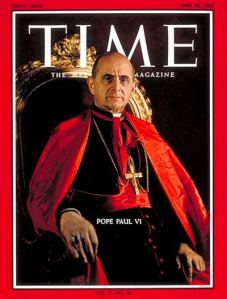
Pope Paul VI’s words have nonetheless proved eerily prophetic, as he made four major predictions about what would happen to individuals, families and nations if the widespread use of artificial contraception was allowed.
The first being, “Let them first consider how easily this course of action could open wide the way for marital infidelity and a general lowering of moral standards.”
If anyone were in any doubt about this, according to the latest statistics from the ONS, it is estimated that 42% of all marriages in England and Wales, are expected to end in divorce. 22% of marriages that took place in 1970 had ended by their fifteenth anniversary whereas 33% of marriages in 1995 had ended after the same period, i.e. by 2010. Marriage figures are an at all-time low, with many couples instead opting for cohabitation. The proportion of children born to unmarried mothers hit a record 47.5% in 2012, up from 11% in 1979 and it is predicted that by 2016, the majority of children will be born to unmarried parents. A study by the Marriage Foundation calculates that cohabiting couples who have children are twice as likely to split up as their married counterparts and that more than half of the children born today will have been through at least one family break-up by the time they are 16. The idea of being ‘unhappily married’ would appear to be a myth – 93% of couples whose relationship is still intact by the time their children are teenagers, are married. The increase in family breakdown being disastrous for children’s prospects and society as a whole.
Pope Paul VI’s second prediction was as follows; “a man who grows accustomed to the use of contraceptive methods may forget the reverence due to a woman, and, disregarding her physical and emotional equilibrium, reduce her to being a mere instrument for the satisfaction of his own desires, no longer considering her as his partner whom he should surround with care and affection.”
According to the charity Women’s Aid, 1 in 4 women will be a victim of domestic violence in their lifetime, many of these on a number of occasions. One incident of domestic violence is reported to the police every minute. On average 2 women a week are killed by a current or former male partner.
The widespread acceptance of the use of pornography is further evidence as to how both men and women have been reduced to mere objects of sexual gratification, with young women forced to sexually objectify themselves to compete for male attention and increasing numbers of young men caught in the throes of a pornography addiction with devastating effects for their future wellbeing.
The third prediction was perhaps the most chilling, warning of what might happen should the power of preventing births, fall into the power of the state: “Careful consideration should be given to the danger of this power passing into the hands of those public authorities who care little for the precepts of the moral law. . . . Should they regard this as necessary, they may even impose their use on everyone.”
One only needs to think of the catastrophic effects of the draconian one-child policy in China which has led to forced abortions, sterilisations, increased rates of infanticide and accompanying child-trafficking. China is now facing a demographic timebomb. Lest we think that this is confined to areas outside of the Western World, it’s worth considering, the recent UK government proposals to cap child benefit for two children, a policy which if implemented ,will hit the poorest families.
The final prediction is obvious: ‘Unless we are willing that the responsibility of procreating life should be left to the arbitrary decision of men, we must accept that there are certain limits, beyond which it is wrong to go, to the power of man over his own body and its natural functions – limits, let it be said which no one, whether as a private individual or as a public authority, can lawfully exceed . . . .”
Our hubris has replace natural human reproduction with IVF, cloning, embryo experimentation, creation of hybrid organisms and most recently 3-parent embryos.
Humanae Vitae simply proclaims the messages of nature and the Gospel, that by going against the laws of nature and of God, we inflict almost irreparable damage upon ourselves and society at large. Speaking in 1988, one of the original dissenters, Dr William E. May, said this “I began to realise that the moral theology invented to justify contraception could be used to justify any kind of deed.”
The Church urges responsible parenthood, which means allowing families to prayerfully discern how many children they may be able to accommodate according to individual circumstances. Family Planning is not in itself a sin but Humanae Vitae urges us to find a way of achieving that which still respects our inherent human dignity as created children of God.








 The Catechesis of Caroline