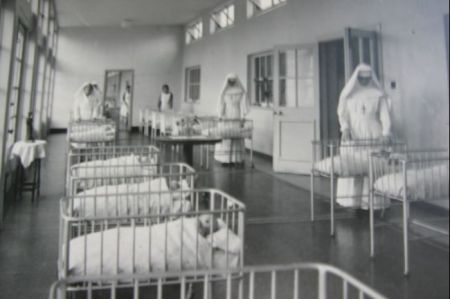
Annulments in the Catholic Church – it’s not who you know!

Nope, never had to do this guy a favour.

A few years ago this piece from Cristina Odone in the Telegraph would have had me reaching straight for the laptop to bash out a corrective response, but fortunately Joseph Shaw has beaten me to it.

Efficiently deconstructing her doublethink, Dr Shaw critiques her dismissal of the Church’s annulment process as being ‘dependent on money and contacts to unpick the marital knot’ as follows:

“This is extremely insulting to those many people who have been through the process of annulment in good faith, after marrying a person whose marriage vows were an empty sham.”

I am one of those people whom Cristina presumably believes used their money and contacts to unpick the marital knot. Except the whole process took six weeks and required an admin processing fee of under £20. Technically speaking for any canon lawyers who may be reading and wanting to nitpick, I did not receive an annulment, but was declared free to marry. No thorough examination needed to be conducted, the bare facts spoke for themselves.*

Nonetheless, an annulment is categorically NOT a Catholic divorce, It is a statement of fact that a marriage never existed in the first place. The judges involved in a tribunal case do not seek to apportion blame or guilt to a single party, they are there simply to examine the facts before them.

A tribunal panel does not in any way resemble a civil court process. Meetings are held in complete confidentiality and on a one-to-one basis. Where possible both spouses are asked to testify along with relevant witnesses. One does not need to spend money on hiring specialist Church, or canon lawyers. In terms of fees, all that is asked that a contribution is to made towards covering the admin fees and costs, but those who are unable to afford to do this, are not required to pay anything at all and neither will cases be prioritised according to wealth. Typically they are dealt with in date order and the reason that the process may sometimes take a few years is because it can often take that amount of time to get all of the relevant documentation and witnesses assembled. Pope Francis has already announced a commission to review whether or not the process may be simplified or streamlined, in advance of the forthcoming Synod on the Family.

Another thing Cristina omitted to mention is that this process is not only open to Catholics but to anyone who wishes the Church to investigate the circumstances of their marriage, say for example an Anglican divorcee who now wishes to marry a Catholic. The Church will examine the circumstances surrounding their marriage and determine whether or not it was valid.

Any decision does not have any bearing on the civil law, nor does it decree that a civil marriage never existed. Hence any children born from that union, are not deemed to be illegitimate, in case any bigots still care about that these days.

Cristina’s attitude is symptomatic of that I have experienced from non-Catholics. One woman even came onto this blog to decry my selfishness. I was so desperate to get married in a Catholic Church that I deliberately made my daughter illegitimate.  A gay man, who is so invested in the issue of gay marriage, deliberately briefs people that I have a child from another man, as proof of my alleged inconsistency and hypocrisy. A Twitter account was set up in the name of @realfarrow which stole my photo and accused me of adultery. And they say that Catholics are judgmental? Fact is I once made some errors of judgement and committed some sins, (several actually) long since confessed, along with every other Catholic on this planet. It doesn’t invalidate the truth of the matter at hand, nor does the fact that I failed to live up to Catholic teaching, mean that it is therefore wrong. I didn’t know what it was!

It’s also worth noting that prior to getting sacaramentally married, even though the wedding took place in a Catholic Church, the permission of the former Bishop of Chichester needed to be sought. He agreed that my former marriage was not valid, purely on the grounds of my ex not being open to children, and gave his consent for my marriage to Robin to go ahead, but noted that he did not value my Catholic annulment. Like Cristina he believed it to be a process for the rich and well-connected which was both infuriating and distressing. By contrast the Anglican church does not have any formal process for investigating validity of former marriages, instead operating a postcode lottery depending on the personal opinion of the minister involved. There’s something very reassuring about having one’s case independently and formally assessed.

How does one obtain an annulment? Simple. Approach your parish priest and ask for his help and advice. Every single diocese in England and Wales has their own marriage tribunal department who will investigate these matters for you. The priest will help you to fill out the paperwork and will then send it to the local office. Only in the extremely rare cases of Pauline and Petrine privilege, does anything need to be approved by Vatican bureaucracy. No palm-greasing, rolling up of trouser legs or funny handshakes involved.

Anyone who has gone through a divorce will testify that not only is it an extremely painful experience but that it requires a great deal of soul-searching and brutal honesty. The Church walked with me throughout this process, never once judging or telling me what I ought to do, but instead offering compassion, practical help and prayer.

I had to face up to the fact that I had made mistakes through a combination of my own emotional immaturity and ignorance. Had I not fallen away from the faith or been woefully unprepared for marriage, not least in terms of my understanding, then a lot of heartache could have been avoided.

With that in mind, it was the experience of an unplanned child combined with a difficult relationship which facilitated my return back to the Church. Once I fully understood Church teaching and the vision of marriage on offer, it was obvious that I had been living in a pale imitation without any of the graces conferred by the sacrament.

There isn’t a day that goes by when I am not grateful for being given the opportunity to live out the true vocation and vision of marriage in contrast to my previous experience. My life is now lived in the fullness of truth, instead of self-deceit, in glorious high-resolution technicolor, not fuzzy black and white.

I threw myself on the mercy of the Church, hoping and praying that she would indeed recognise that I was free to marry, but that involved having to accept that she may rule otherwise.

For internet trolls to throw ignorant uniformed insults about is one thing. When seasoned Catholic journalists and leading Anglican clerics intimate that you have done some dodgy deal to buy yourself out of a spot of bother and valid union it is quite another. But hurt feelings aren’t the main issue here. By propagating incorrect myths, not only about divorcees not being able to receive communion, but by misrepresenting the annulment process, Cristina Odone puts people’s spiritual welfare at risk, both by deterring people from presenting themselves for communion and also by preventing them from accessing the natural justice to which they are entitled.

*(As a baptised Catholic I married outside of the Church without a dispensation, or to use the lay term, permission, meaning that it was illegal according to Church law. With that in mind, had matters gone to tribunal, given that I was married to a divorcee who had explicitly and repeatedly stated to myself, friends and family that he did not ever want children, and who still confirms that to be the case, then it’s fairly obvious which way things would have gone.

Couples who are in an illegal marriage are able to get the Church to formalise them later on, however in my case this would have been impossible. )

Message of support for Vicky Beeching

Last year, the prominent religious broadcaster Vicky Beeching (presenter of Thought for the Day on BBC Radio 4 and frequent reviewer of the papers on Sky News) asked me for an interview on Catholic perspectives for her faith and feminism website.

As is standard practice these days, she used the medium of Twitter to publicise her various interviews. At that point, my personal painful story of abortion was not common knowledge, however a former friend whom I had confided in, sent Vicky a series of messages in which she informed her of my secret and claimed it as proof that I had probably had multiple abortions (not true) and was secretly pushing a pro-choice agenda.

Again and again she messaged Vicky, her messages becoming increasingly urgent and demanding in tone, “what about her abortion, how can you interview her as being pro-life” the recurring theme.

Thankfully Vicky paid no heed and published the interview here, one which, I hope does give a good account of Catholicism in relation to women. Almost within 5 minutes of the interview being posted, another woman who has displayed obsessive tendencies in terms of her strong and frequently posted contempt for me, wrote a comment in which she too, mentioned my abortion, accusing me of hypocrisy, of sanctioning abortion for myself and no-one else, failing to understand that my experience of abortion made me realise what a terrible thing it is, for mother and baby alike.

Though healed, at that time I was still in the early stages of the pregnancy with Raphael (who died in utero) and not ready for this information to be outed, especially not on in the comments box of such a public website.

I therefore asked Vicky to remove the comment and she immediately edited it, much to the chagrin of the original poster, who repeatedly hectored her on Twitter “why did you delete my comment about Caroline Farrow’s abortion”.

Perhaps it was a coincidence, but shortly after the interview was published Vicky repeatedly found herself tagged into a series of vitriolic and very personal comments, about her appearance, her intelligence and her motivations by the person who had messaged her, using the pretext of something else Vicky had said publicly, with which she disagreed.

Vicky could, if she was unprincipled and unscrupulous have published all this information, in an attempt to show me up as a hypocrite and undesirable person whose position on abortion was untenable, especially as she herself has a pro-choice view. The fact that she didn’t speaks volumes about her honesty, integrity and decency as a person. As does the fact that she also passed a series of radio interviews my way about the forthcoming papal conclave back in 2013, feeling that I would make a better pundit on the subject.

I’ve only met Vicky in the flesh once, (when she told me about the trolling she had received in relation to me) but found her to be an immensely charming, genuine and sincere person, who has treated me with utmost Christian kindness, despite the fact that she must have found my views on same-sex marriage difficult to accept, and going by her interview in today’s Independent, in which she comes out as same-sex attracted, potentially quite hurtful.

A lot will be written by many Christian commentators about this, but I’d like to publicly offer my love, prayers, support and thanks to Vicky who has modelled Christian behaviour, tolerance, compassion and understanding to someone with whom she is ideologically opposed. I owe her at least as much.

To support Vicky in her coming out, is not to necessarily endorse any of the choices which she might make, but to accept that what she has done is extraordinarily brave, not least because many of her target audience will strongly disagree with her. There has been talk of boycotting her music and this admission could well affect her commercially, although I suspect it will consolidate and further her position in terms of mainstream broadcasting. It must also have been difficult coming out with parents who take the traditional and orthodox Christian view of homosexuality. I should imagine she will also be subject to a fair few salacious and sexually derogatory comments, especially from certain newspapers and media outlets.

Vicky’s experience of public exorcisms are not the way in the Catholic Church, most would agree that this is no way to help and support anyone struggling with feelings of same-sex attraction, however it does highlight the plight of many young Christians who believe themselves to be gay.

Reverend Peter Ould in his response on Facebook, offers some typically sensible thoughts:

1. It’s almost always better this side of the closet. Locking away such a huge part of your emotional life leads to the kind of stress Vicky describes. Being truthful about your feelings is normatively liberating and tends to be much more about living with yourself than living with others (and their perceptions of you).

2. Coming out as LGB does not necessarily mean endorsing a particular sexual ethic. It is perfectly possible to be open and honest about your sexual attractions and still hold to a traditional position on sex and marriage. The sign of an emotionally and intellectually stunted and repressed person is not that they don’t act on their attractions, but rather that they think a person has to act on their attractions and emotions in a particular way to be spiritually healthy.

3. Coming Out narratives, with their accompanying emotions, need to be reviewed with the passage of time. As C S Lewis so clearly indicates with the story of the Queen of Glome in “Till we have Faces”, the victim narrative many of us tell is in fact often a denial of responsibility for our own sinful decisions and responses that have shaped who we are today. It’s too easy just to ignore inconvenient facts from yesterday that distort (even contradict sometimes) the picture you’re trying to paint today.

4. When Vicky says “The Church’s teaching was the reason that I lived in so much shame and isolation and pain for all those years” and then describes that teaching as ” I am attracted to people of the same sex and I’ve been told God hates that”, it’s worth pointing out that such a teaching is not Biblical. The Bible has plenty to say about the sinfulness of some sexual practices but it does not say that God hates people for being gay. And if we shape our future theologies and lives on a reaction to incorrect previous ones, we need to pick up “Till we have Faces” again.

(The Catechism of the Catholic Church says similar and goes on to say that people should never be treated unjustly on account of their sexual orientation)

Peter goes on to note the choice of Patrick Strudwick as interviewer, who is certainly no friend to either the Evangelical or Catholic churches as a result of their teachings about homosexuality. A few commentators describe the choice of interviewer as a ‘punch in the gut’ and highly political.

Peter Ould wonders whether or not the Independent would be prepared to run full and front page spreads of the equally brave testimonies of those who publicly identify as having same-sex attraction but have chosen to live celibate lives?

I might disagree with Vicky about the direction in which she wants to take the Anglican church, but from her testimony it is clear that more needs to be done to help young gay Christians identify their true vocation and not to alienate them from God, who, as she says, still loves loves them regardless. If nothing else, certain denominations ought to seriously re-think the practice of public exorcisms or the idea that a sexual orientation is indicative of demonic possession!

I strongly believe that when it comes to Christians who are attempting to reconcile their sexuality with a strong love of the Lord, as in Vicky’s case, Pope Francis’ words are the most salient “If a person is gay and seeks God and has good will, who am I to judge”.

It is not for us to judge the heart and mind of another Christian, all we can do is explain our own stance and why we believe God has asked us to live a certain way and leave the rest to Him. I certainly can’t claim that my heart is any purer than any other Christian seeking to deepen their relationship with the Creator and who at the same time wishes for a lifelong partner.

I disagree with many of Strudwick’s narratives and assumptions, which are coloured by his personal judgement, but I am sorry that Vicky has experienced such a tortuous and painful time, including a debilitating illness and like many of my good Catholic friends, I have no interest in eschewing her on account of her sexual preferences.

Talking of her parents’ attitude to the theology around homosexuality, who disagree with her, but love her all the same she says “it’s a picture of what is possible, even when you don’t agree, that love can supersede everything”

A sentiment that we all ought to bear in mind.

My children and Lourdes -time to get ‘tradismatic’?

If you read the Universe or follow me on social media, you may be aware that I have just returned from a pilgrimage to Lourdes.

One of the things that struck me about this particular trip is the response of my children, especially that of my ten year-old and four year-old. I guess this is how ‘indoctrination’ or enculturation really works – not by verbal barracking or proselytising but what Pope Francis would probably term a ‘culture of encounter’. My experience demonstrates why accusations of indoctrination against Catholic schools are so far off the mark. If a family does not practice the faith at home or introduce their children to Catholic traditions, then any seeds planted in school are likely to fall upon fallow ground.

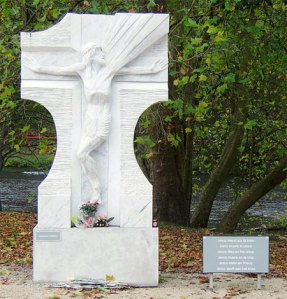
If we begin with the ten year old, when asked what her favourite part of the trip (which included hotel party nights and lots of opportunities to socialise in a small group consisting of children her own age) her response was ‘doing the high stations of the cross’. For those who have never been, there are two sets of stations of the cross in Lourdes; one high up on a hilltop which give an imposing aerial view of Lourdes which I’ve never done, the steep slope rendering them impossible for wheelchairs and buggies, the other on the flat plain, adjoining the river. The lower stations are huge modern interactive sculptures, designed to be touched, whereas the high ones consist of larger than life tableaus, which really bring the Passion to life. Both are beautiful.

Jesus-falls-the-first-time-9553
Jesus falls the first time, High Stations of the Cross

lourdes_12_135
The Crucifixion, low stations of the Cross

I have to confess that upon hearing that her favourite part had been the Stations, I did shed a few tears of both pride and joy and no doubt any non-Christians reading this would cite this as proof of emotional abuse, ‘fancy,’ they would say, ‘making a ten year old walk in Jesus’ bloody footsteps and gruesome death on her holiday, how deranged and bizarre, robbing her childhood and imposing your ideas upon her’, but the point is that she was given the choice whether or not to do the more grown up version and chose to do it on her own. Furthermore, the Stations of the Cross, while constituting the penance that Our Lady requested that pilgrims to Lourdes must make, are invariably joyful – they have a happy ending and demonstrate Christ’s love for us. The Passion, the crucifixion is a central tenet of our faith. It does pre-teens no favours to infantilise them and in any event, the figures, while incredibly lifelike, go nowhere near as far as the realism of the Mel Gibson, Passion of the Christ movie.

So anyway, the other things that our eldest child enjoyed were the torchlight procession, perhaps unsurprisingly, what child would not enjoy walking with lit candles through the twilight and darkness, and full immersion in the baths, again, something that I have never done, both on health grounds (last time I went I was 37 weeks pregnant) and the logistics of 3 under 5s. In terms of the baths, again (and I know this reads like a smug mother post, really I don’t care) I was delighted that one of the adult helpers commented upon how quiet and thoughtful she was during the two hour wait, joining in with all the prayers and actually setting the tone for the other children. She didn’t think it was a weird thing to do at all, Our Lady asked for pilgrims to bathe in the spring and so that is precisely what she did. At the service of reconciliation, her age group was taken off to have some age-appropriate preparation prior to confession; she was one of the last to queue up and make her confession because according to the leader she wanted to have a little bit more time to think about things, rather than rushing straight up to get it over with.

Now I certainly can’t take the credit for producing such a thoughtful and reflective child, but I do believe that having a family that practices our faith at home, not in an ostentatious way, but just in little everyday habits, along with being away with a group all with a similar attitude towards Christianity, has definitely helped, in a way that being lectured at would not, which most children find deathly boring and is counterproductive.

The big surprise of the trip however, was not my eldest child, but the response of the four-year old, who tends to stubborn, wilful boisterousness and what this has to demonstrate towards the Church, particularly those who make certain assumptions about the young and ‘traditionalism’.

While away I read Joseph Shaw’s excellent blogpost on children and Latin whose experience mirrors my own. One of the things that the eldest loved while on the torchlight procession was being able to join in with all of the Latin chants. She may not know what every single word means, but in a procession consisting of several languages, whenever the Salve Regina, Paternoster, or Gloria Patri cropped up, she was able to join in and belt it out with gusto, a smile of recognition and excitment lighting up her face. This is what we sing at home, and wow, we are singing it here. She loves this whenever we go to a certain N.O. Mass here in Brighton. What we sing should never be about how it makes us feel, but given that this is cited so much as justification for ditching the Latin and plainsong, I suspect like most children, mine loves it because being able to join in makes her feel included and actually the Latin, quite grown-up. Children savour big words, they adore feeling as though they are adults, words like consubstantial make them feel all clever and sophisticated, like they too have been let in on a secret.

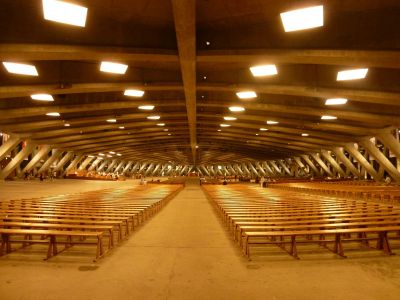
So on to the 4 year old, and also the 3 year old. Most of the basilicas in Lourdes, frankly aren’t very inspirational, especially the basilica of Pope Pius X, which resembles a giant underground car park, draped with flags of the saints in an attempt to give the place a spiritual air, but which from a distance could pass off as advertisement posters. The children absolutely loved the place. Why? Because it gave them licence not to concentrate and to run about in several different directions. Church meets play area, the low benches providing plenty of opportunity for imaginative young minds to double as hurdles, balance beams, places to hide underneath, swing off and climb over. Their attention wasn’t focused, all they could see was the play potential of the place.

bas
Interior of Pope Piux X basilica – lots of potential for adventurous toddlers and not much to capture their attention

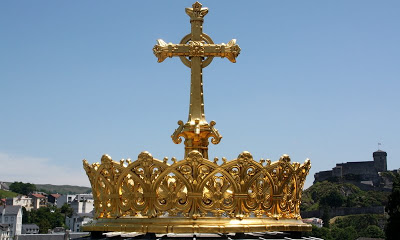
On being informed however, that our final mass would take place in the Our Lady of the Rosary basilica, I have never seen the children so excited. For the uninitiated, this is the Church that Our Lady requested was built, on top of the grotto where she had manifested to Bernadette Soubirous over a period of 15 days. The building itself is incredibly imposing and ornate, decorated with irridescent gold mosaics, surrounded by statues and topped by a golden crown, signifying that of Our Lady, Queen of Heaven.

Catholic bling for children - a golden crown, what's not to like?
Catholic bling for children – a golden crown, what’s not to like?

The children could not wait. It was for them, like going to Cinderella’s castle, all week long they had been pestering us to climb up and down the stairs of the side of the basilica going to the ramparts, the Church was a source of amazement and fascination, like something out of a fairytale. They were drawn to it and dying to go inside, knowing that it was a special place, ‘guarded by statues.’

Move over Disneyland, exciting looking Church - who's inside...
Exciting looking Church – who’s inside…

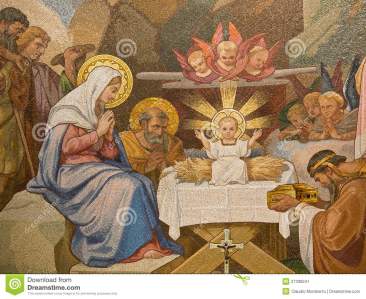
When inside, they were not disappointed. Every single wall is covered with a gold mosaic, depicting one of the mysteries of the rosary. We were seated by the Nativity mosaic, to which the children went running up to “look mummy I can see Baby Jesus…and the wise men…and the angels”. They were transfixed, not knowing where to look next, but engaging with what they could see, instantly recognising the scene, despite the fact that some would claim that Byzantine iconography upon which the tableaus are based isn’t child-friendly, and wanting to walk around the church and stare. And stare. Inevitably towards the end of the Mass, they did begin to get fidgety, due to the prolonged announcements, but there was a considerable period of time where they were happy just to sit and gaze in wonder, and a curiosity was aroused to ask more – what’s that picture over there, who’s that, why are the windows round, and so on.

hdr-3858

????????????????????????????????????????????????????????????????????????????
Part of the Nativity scene that my children instantly recognised

During the Eucharist, presumably the ciboria belonging to the Basilica were used, and again, they were an object of wonderment to the children, having an obvious golden lustre. ‘What’s in there mummy’, asked the 3 year old, ‘is it treasure?’, ‘well actually yes it is’, being my response, ‘it’s the body of Jesus’. ‘Can I have it too’ she asked for the very first time.

Upon leaving the church, the children asked if they could go there every time they went to Mass and have repeatedly asked the same thing since returning home.

This is what the iconoclasm of the Reformation and to some extent the post-conciliar era, have deprived our children of – their cultural heritage which they are hungry for and able to engage with, which needs no dumbing down. I’ve never ever seen the children so excited about a church before, nor indeed so willing to engage. Not only with the basilica, but the whole spirit of the place; despite some of the tacky tourist overtones, the holy sites themselves in Lourdes retain an aura of great reverence, this really is the place where the veil between this life and the next is extremely thin. The 4 year old asked us whether or not Bernadette was sad when she never saw the beautiful lady again and insisted upon the lengthy story being read to her every night at bedtime, proving that when she wants to concentrate and engage, she is able to. To put things into cultural perspective, I was sent to a Catholic secondary school but had no idea who Bernadette was, what had occurred at Lourdes, other than it was something to do with Catholic superstition and the name of Madonna’s daughter!

For those who would say that the Church ought to concentrate all of its resources on the poor and embrace simplicity in all things, including buildings, vestments, ciboria and so on, I can only point to John 12:5. Yes, we must help the poor, but not to the exclusion of everything else, it helps no-one to lift them out of poverty if we then exclude them from the richness of the Gospel. We should not lose sight of the fact that we are here to serve God, spread the Gospel and not just get caught up in single issues, whether that be the pro-life cause, or fighting to get rid of poverty, something which in any event, will never be accomplished.

The money is well spent, if, as with my children, the surroundings of a building really helps draw them closer to God and want to engage with and understand what is going on inside. The fact that a 3 year old thought that a ciborium contained treasure, demonstrates the importance of the symbolism. No complex theology was needed to draw her eye to and cause her desire for the Eucharist. She could see how important and valuable it was for herself.

Reflecting on this later with an older religious sister, she disagreed and said what a shame it would be if the Church were to go back to a more formal liturgy, roman chasubles and so on and doubted whether or not altar servers ought to wear robes. She thought that a modern style was so much more universal and engaging, especially for the children. When I told her my experience, she was rather lost for words, believing that my children had a unique privilege due to their parents, but actually our family faith and habits are no more sophisticated or complex than the average Catholic, 50 or 60 years ago. There is nothing difficult, elite or complicated about being able to repeat a chant that you hear regularly in Church. Nothing deeply erudite about saying grace before meals, bedtime prayer or having a holy water stoop by your front door, or some statues or icons somewhere in your house, which can be picked up extremely cheaply.

The main objection seemed to be that traditionalists (as good a description as any can be found here) are concerned with ritual, rubrics and nothing else, whereas charismatics have their heart of fire for Christ. To me this seemed grossly unfair, why is a traditionalist deemed incapable of burning with love for Jesus and the Gospel, simply because they prefer the Extraordinary Form? The two traits are not mutually exclusive.

My children aren’t traddies, we don’t go to the Extraordinary Form often enough, none of us wear mantillas (so as not to draw attention to ourselves as much as anything else, although I bet the girls would love them) but they certainly responded far far better to a traditional version of Catholicism and the simple piety on offer in Lourdes, than anything they have in this country, although when we do go to a NO Mass at local church in Brighton which does celebrate the EF, their behaviour is markedly improved – the solemnity with which Mass is celebrated and the disposition of the other Mass-attenders has an impact.

A young seminarian whom I discussed all this with on the train journey home, posited that we need a new word to describe a new culture, noting that the pendulum is still swinging back into position since the extremes immediately following V2 and that nothing yet is settled, we are still on shifting sands. He coined the phrase “tradismatic”, a combination of traditionalism and the overt burning passion and fire for God manifested by the charismatic movement.

I’ve been rather taken with the phrase and the idea. The future’s bright, the future’s tradismatic! I hope it takes off.

Abortion and Assisted Dying: Birth and Death on the NHS

Back in 1967, the Abortion Act was passed following a passionate and heated debate in the Commons. Baroness Knight’s speech against the motion was greeted with uproar and derision, when she stated that this bill, if passed, which was framed around compassion and cited difficult cases, would lead to wholesale abortion on demand. Her statement,

“once we accept that it is lawful to kill a human being because it causes inconvenience, where do we end?”

was mocked as being over-emotive and full of exaggeration. The Abortion Act had built-in safeguards, required the signature of two doctors to stop coercion or forced abortion and was only to be applied in limited cases to help desperate women who really had no other choice.

The parallels with the rhetoric surrounding Lord Falconer’s assisted suicide bill are striking. Forty-five years later, the architect of the bill has said that he never envisaged it would lead to abortion on demand, almost 200,000 abortions take place every year and repeat abortions are on the rise with some women having as many as 9 in their lifetime.

The two doctor safeguards have been thrown out of the window, undercover investigations have discovered doctors are not even examining their patients and have pre-signed stacks of abortion forms up to four years in advance and the Department of Health have outsourced the business of aborting babies to private companies, who claim to be charities and yet who receive millions of pounds from taxpayers for the medically awkward and messy task of terminating the lives of babies whose existence would cause an inconvenience to their parents.

The past forty-five years have seen doctors abuse procedures and break the law with impunity and enjoying immunity from prosecution or professional sanctions. In all likelihood thousands of babies have been aborted because they were female, others were aborted because their disability meant that their life was deemed to be of less value or worth, and some have been terminated, way beyond the point of viability. As one report last week pointed out, babies can be and are killed up to the point of birth for easily treatable conditions.

Medical prognoses have often been proven to be incorrect too. Babies predicted to have disabilities have been born perfectly healthy, in some cases a condition has proved easily manageable and no barrier to a good quality of life and some babies with absolutely nothing wrong have been aborted due to a mistaken diagnoses. The problem with any prognosis is that it is always phrased in fairly stark medical terminology with probabilities and scary official-sounding words like co-morbidity, the language often requiring a medical dictionary or interpreter. The language is devoid of joy, happiness or personal fulfilment but replete with potential difficulty and obstacles. There is only ever probability, never certainty and never any existential or metaphysical dimension to any sort of medical or clinical discussion.

Like the abortion laws, the assisted dying bill is backed by a host of rich, powerful and wealthy celebrities. With abortion a host of well-paid self-identifying ‘feminists’ both male and female come out in favour, with the same tropes – rights, compassion, autonomy.

But it isn’t the rich well-paid people who by and large are having abortions. Statistics worldwide demonstrate that is the poorest and most disadvantaged sections of society, especially certain ethnic minorities or immigrants who are resorting to abortion, because they find that they have no other choice.

Thinking about the UK for a moment, Tamara Beckwith, the millionaire trustafarian IT-girl of the 90’s, one of the Tara Palmer-Tomkinson stable, had a baby aged 19. For her, money was no object and she choose life, because she did not have a financial barrier. Equally we have former Spice Girl Geri Halliwell, soap star Clare Sweeney and various other Daily Mail celebrities having babies and enthusiastically embracing and promoting single-motherhood because they can. They have the resources and the lifestyle to accommodate children and the perennial approval of an all-adoring public.

People such as these can argue for a position of choice, because they had the rare luxury of being able to enjoy it. Having a baby would not have been a game-changer for them in terms of money, resources or career.

But this situation is rare for us lesser mortals. We have to limit our family size or resort to abortion because it feels like there really is no other choice and we do not have a celebrity career or have to face the disapproval of friends and family for choosing to wreak havoc upon ourselves for having a baby.

Let me demonstrate how abortion, sold to Parliament as a compassionate choice to be used in limited circumstances with the signature of two doctors has been incorporated into the health care system. I’ve been pregnant once or twice now. The first thing you have to do (in my area anyway) is make an appointment with the GP to ‘confirm your pregnancy’. This entails telling the doctor that you have taken a positive pregnancy test and in my case asking to be referred to the midwife (and thinking that the whole business of saying hey doc I’m up the duff is a waste of everyone’s time and NHS resources).

See that. You cannot just book in directly with the midwife at my practice. No, you have to ‘discuss’ it first with a GP. Why? So that abortion can be discussed with you and offered if necessary or if you are undecided. In some cases, including mine, it has been suggested as a solution, to severe morning sickness and anxiety. This has happened to me with my third and fourth children. I’ve requested to be booked in with the midwife to get the whole ante-natal plan working and been asked whether or not I’m sure and reminded that there is plenty of time.

You offer someone abortion, or assisted death and there it is, straight away, on the table, like the big fat elephant in the room. When a doctor suggests it or even hints at it, it has added gravitas and instantaneously the pressure mounts, no matter how firm you might be feeling in your own mind. The impression is given that somehow you are being demanding, burdensome, irresponsible and reckless.

Since the legalisation of abortion every single pregnant woman now feels keenly aware of her ‘choice’. It’s a decision that hangs heavily in the air, every single day of an unplanned pregnancy, and even sometimes when one is planned, if there is a sudden change in circumstances. When employers become terse and uncooperative, if family or friends are unsupportive, the unspoken question, circles your head “am I doing the right thing”. When someone indicates to you that you are not, the pressure of social affirmation or expectation can prove almost irresistible.

Those diagnosed with a life-limiting condition or who suffer from a number of illness, if this bill is passed will every day have to confront this choice. “Should I just end things here and now? Am I selfish for wanting to stay alive? Am I a burden on family and resources?”. Could a bad day now lead to their premature demise thanks to a bout of depression or despair. I know, I’ve been there in pregnancy, wanting to do anything just to make the sickness end. Composer and peer Andrew Lloyd Weber has said that last year he was on the verge of joining Dignitas thanks to excruciating pain following 14 leg and back operations, but having come through the experience appreciates that to have killed himself would have been reckless and irresponsible.

Just as we see certain sections of the media and press demonise those with larger families on benefits or single mothers, because they didn’t take the option of abortion and now receive state benefits, will we now see the same said about those with multiple disabilities?

It certainly seems likely, when you have writers such as Polly Toynbee cheering on those who might feel that they would be a burden, ‘yes you will’ she says , it’s no bad thing if the terminally ill or medically dependent feel pressurised and Baroness Warnock barking that people with dementia have ‘a duty to die’.

Like abortion, the advocates for assisted dying are rich, famous and well-paid celebrities like Cilla Black, Richard and Judy and even now Lulu, seeping into the nation’s consciousness, introducing and reinforcing misplaced fears about death, dying and burdens.

They won’t have to face a cash-strapped NHS which will offer them euthanasia as a cost-saving and compassionate measure as an alternative to treatment which would prolong life. Like celebrity single mothers they really can choose between life and death without having to face censure or opprobrium for choosing the former. Meanwhile the rest of us are made to feel guilty for wishing to continue our existence.

It’s staggering when you look at the statistics surrounding birth, people are having babies later and later, partly due to financial pressures and partly because they perceive that they need to be a in a perfect chocolate box situation. Hand-in-hand with that, the idea of bodily autonomy (which is specious, no-one truly has this, you can’t force a doctor to chop off your leg) means that now we are all tuned in to the unrealistic idea of the perfect or ideal birth.

The same concept will inevitably creep in to the dying. Death will have to be further clinicalised, managed, perfect and ‘dignified’, and sold as being something which we deserve. Perceived quality of life will determine respect and value given to other people and where do you draw that line?

We are fundamentally treating our existence as passive consumers of an experience in which we are control freaks determining that everything has to be perfect according to our personal dictats and tastes, from relationships, careers, sex, pregnancy, birth, family circumstances and death. It’s hardly surprising that as society has become more prosperous and wealthy, people have become proportionally more selfish and fearful of becoming dependent on others or having others dependent on them.

Life is not perfect, it is fundamentally messy and we have to accept that everything has its season. We are on an unavoidable journey of dependence, independence and dependence once more. The fear and refusal to accept inter-dependence between parent and child now manifests right at the start of life, with parents desperate to put children in child-care and to rush their independence in order that they can be free of the burden of 24/7 child-rearing and resume their previous lives, with the child treated little more than a pet which needs training and in whom the state needs to have a stake. Is it any surprise then, when children similarly treat their parents as the state’s responsibility when they get older or that parents have a fear of intimate dependence?

There is never a perfect time to fall in love, never a perfect time to have a baby and never a perfect time to die. We must not licence doctors to build killing into our heath care system as part of a palliative care approach, but rather enable patients, just as we should pregnant women, to accept and reconcile themselves with what is going to happen, all the while offering comfort and support, rather than a violent way out.

I often muse that a woman is pregnant for 9 months as that period is a time of acceptance, anticipation and growth. The same should be applied to the dying, who deserve more than a validation of their fear, inner turmoil and despair.

Abortion was never intended to be an integral part of a woman’s healthcare needs, promoted in schools and offered as a routine and morally neutral choice. Neither was it believed by parliamentarians that society would promote abortions as desirable amongst certain classes of people, like single mothers , ‘chavs’ or those with chaotic personal lives and/or addictions. What makes Lord Falconer and his chums fool themselves into believing that assisted dying will not be applied to the poor and vulnerable in the same way?

Bindel: Born this way?

10306749_10204155500145824_5709196772182821552_n
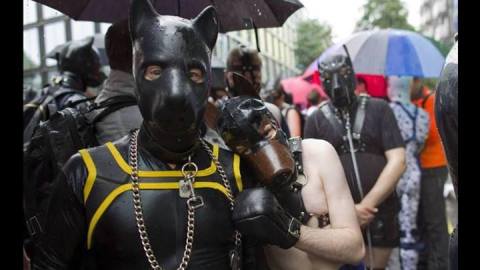
Taken from this weekend’s Gay Pride event in London. Genetic pre-disposition or social conditioning/choice?

Julie Bindel, bete noir of the LGBT activists scene is back, having written an interesting book Straight Expectations, one chapter of which examines the question of the ‘gay gene’ and whether or not homosexuality is a choice.

I never got an opportunity to debate Bindel  in any of the same-sex marriage media debates much to my regret. I’d like to meet Julie, though no doubt she would vehemently disagree with me. She’s highly intelligent, feisty and ferocious and in my opinion one of the most challenging writers on the entire subject. Her writing is all the more compelling for the conservative Christian when one considers that she does not share or endorse our creed, particularly in the area of sexual ethics.

Out of every single opponent I was put up against, including Peter Tatchell, whose main response was to screech ‘bigot’ by way of retort, none of them seemed to match the intellect of Bindel, nor did their  arguments go beyond the whole ‘equality equals sameness’ schtick. Intermingled amongst the disappointment of not debating Julie, was a sense of relief in that her arguments offered a genuine critique of the institution of marriage as a whole – which is a deft re-frame.

No doubt she would consider Catholic ideology as batshit extreme and outrageous as I consider some of her radical feminism, however what both positions have in common is that they are, if nothing else, entirely reasoned and logical. One of my colleagues appeared on a few programmes with her, and said that though her overall position was outre, he also conceded that she was very good and did actually make some sound points.

My husband, who has no idea who’s who in the media and chattering classes sent me a text the other day, saying that he had listened to Start the Week on Radio 4 on his way into work and heard this woman, whose name he couldn’t recall, whose overall position he didn’t espouse, having some disastrous ideas, but who was, in his opinion, nonetheless interesting. He urged me to download the programme or listen on Iplayer as he thought it was absolutely fascinating. Having checked out the synopsis, it was indeed Bindel discussing her new book and he was right, she did make some excellent and compelling points. If nothing else, Bindel is always interesting.

The Independent has published an interview between the respected establishment gay male voice Patrick Strudwick and Bindel, in which Bindel steadfastly and robustly defends her point of view that being gay is a choice. The dislike, frustration and contempt emanating from Strudwick is palpable. He deliberately chooses loaded comparisons, referring to her as an “Old Testament Maven from Tennesse” thereby planting and reinforcing the Levitical laws cliche, neatly aligning Bindel’s views with the Deep South redneck caricature.

Strudwick attempts to dismiss the issue of why some people have a different sexual orientation as being irrelevant and a preoccupation of bigots, forgetting that human diversity will always hold fascination for scientists and athropologists alike. It’s not bigoted wondering if there is a biological or evolutionary reason for various difference and by and large it is those very same bigots who would fight vociferously for the rights of gay people to be born should a test ever be developed which could identify the gay gene or sexual orientation in utero.

Bindel’s definition of choice is complex – it certainly isn’t of the “I think I’ll be gay to be fashionable”, or picking a sexual identity off the shelf, if one were to apply the word in a consumer context.

“Because I think the opposite of having an innate, biological explanation [for homosexuality] – there’s no evidence for that – has to be some kind of choice, as well as some deep-rooted, embedded responses that developed through different experiences in our childhood.”

That would appear to make sense, twin studies, appear to demonstrate that there is some kind of biological root, while there may be some kind of genetic disposition, gay men share some genetic signatures on the X chromosome, this is not the whole story. Biological factors could perhaps be mediated by childhood experiences, according to one clinical psychologist. Another theory is that environmental factors outside our control could affect gene receptors, meaning that they are either triggered or switched off in certain people, which always goes some way to explain why some people can smoke and drink inordinate amounts and yet still live to a ripe old age, free of related cancers.

The interesting thing is that these biological factors only seem to have been prevalent in men; Bindel may well have a point when she talks about lesbianism being chosen, and she’s also correct not to want to lump those who do not subscribe to hetrosexual norms, (including asexual people) into one homogenous mass. which if nothing else, is a form of de-humanisation. Actress Cynthia Nixon made a similar point about her lesbianism being freely chosen a few years ago, but was forced and  shamed by the liberal media into making a later retraction.

The quest for knowledge is not in itself bigoted and neither is there evidence to suggest that the scientists who Bindel believes to be ‘obsessed’ with the question are necessarily pursuing an agenda, whether that’s to definitively confirm the presence of a gay gene, or to use the idea of choice as a stick with which to beat gay people.

Strudwick puts his finger on the nub of why Bindel arouses such horror amongst some of the gay community because he believes that he stance will give ‘bigots comfort and fuel their agenda’.

They will say that even a prominent gay-rights campaigner agrees that it’s a choice, I counter.

“But I don’t agree with them! They wouldn’t use an argument from me in a million years!”

Strudwick is right, up to a point, there are those, including myself who believes that the personal testimony of a lesbian woman bears weight and there does seem to be an innate biological difference between lesbian women and gay men. Anecdote is not the plural of data, but I can think of several lesbian women of my acquaintance who have embarked on relationships with women after long-term relationships with men and sadly in some cases, of women who have decided that they were lesbian or preferred women following traumatic childhood cases of sexual abuse by men.

I’d also be inclined to agree with Strudwick in his identification of biological differences, gender is not merely a social fluid construct as Bindel would contend. Gender theory relies solely on ideology not an any established scientific fact. Julie’s position is a political one.

Given the numerous accusations of ‘bigotry’ leveled at those who did not wish to see the law changed and have a new definition of marriage imposed upon us, my support of Bindel will reinforce Strudwick’s conviction and unease about Bindel’s opinions.

Strudwick would do well remember that the endorsement of those with ‘undesirable views’ of a certain position, doesn’t alter the facts at hand and shouldn’t be allowed to poison or close down the discussion. Society and the media must allow for the free exchange of ideas and ignore the fact that haters on both sides of the sexual conservatism/libertinism debate or culture wars will grasp whatever is available to fuel their prejudice. The issue of whether or not being gay is freely chosen or an involuntary one, down to biological factors alone will continue to intrigue people until its satisfactory resolution, which would appear to be some way off.

The mainstream debate about same-sex marriage did not in any way centre around the causes of homosexuality, it was rightly irrelevant. What was under discussion was the institution of marriage, not the behaviour of non-heterosexuals.

Even in Catholicism that most ‘bigoted’ of religions the issue  does not ever figure, the Catechism observes that it is is not known why people have a different sexual orientation, and in event everyone ought to be treated with the dignity and respect that they are due. Straight or gay everyone is urged to act with appropriate sexual restraint. Being straight does not mean that one has no other choice other than to have sex with those to whom you find yourself attracted. Having consensual sexual intercourse or indulging in sexual acts will, always be a choice.

What is missing however, is that personal choices of this nature are rarely straightforward and almost never made in a vaccum. It doesn’t really matter whether or not homosexuality is chosen, what should be recognised is that even if this is the case for some people, even if a tiny minority do make a conscious choice to be of a certain orientation, this is completely irrelevant. We don’t stigmatise and demonise post-abortive women on account of their choices, the same principles must be applied to the gay community.

For those wondering why a Catholic is writing about or endorsing a LGBT writer, the answer is pretty simple. You can’t reject a point of view with any credence unless you can engage with it critically. Julie Bindel offers a radical critique of LGBT culture from a unique perspective.

No cake please, we’re British

Imagine for a moment, that I were to start writing and campaigning about obesity and its effects upon children.

The usual trolls would descend, claiming this to be somehow religiously motivated, would take some obscure Levitical verse as being my motivation and bang on that I believe in the ludicrously outdated notion of sin, in this particular case, gluttony. No doubt I’d also be accused of lacking compassion for the overweight and made to take responsibility for any fat person who felt ashamed, was driven to diet or who suffered from any bullying or mental health difficulties.

There may be no religious conviction underpinning the current crusade against obesity and sugar in particular, which is rapidly replacing tobacco as the next thing which must be banned or regulated, but certain health professionals are pursuing the cause of weight and obesity with a zeal which would put Torquemada to shame.

So, hot off the back of the mooted ‘sugar tax’, the normally sensible Dr Sarah Wollaston MP, Chairman of the select Health committe, appeared on Good Morning Britain to state that all primary school children ought to be weighed in school, a call which was promptly reinforced by Britain’s loudest self-proclaimed voice of reason, Katie Hopkins.

No-one is denying that obesity or sugar is bad for us, or that being overweight can have a negative impact upon health. According to the World Health Organisation, even being slightly overweight can increase the risk of health problems. And by and large we know that being overweight is a preventable condition, we all need to take more care over what we eat and increase the amount of exercise we take. Fewer saturated fats, less sugar and thirty minutes of regular moderate activity every day. Simples!

Except it isn’t. We know that people have a complex often psychologically unhealthy relationship with food, and that something which sounds so straightforward often isn’t. We also know that metabolisms differ and that in some of cases people really are unable to shed weight easily, for a variety of medical reasons and conditions. To attribute a weight problem to ignorance,  laziness or some kind of psychiatric disorder is a glib attitude of the smug.

The idea of weighing children in school is a horrifying one, which will set them up for a lifetime of negative body image issues, overt paranoia about weight and creates fertile ground for a culture of bullying, which as most parents will know, teenagers do not need any encouragement with. I have bitter experience of this, though never technically overweight, I came in at the top end of the scale, and the regular weigh-ins were a form of torture, along with the inevitable playground comparisons and competition. The process was equally traumatic for those at the lower end of the spectrum. It’s no surprise that almost all of my school friends  struggled with eating disorders and food issues at some point in their lives.

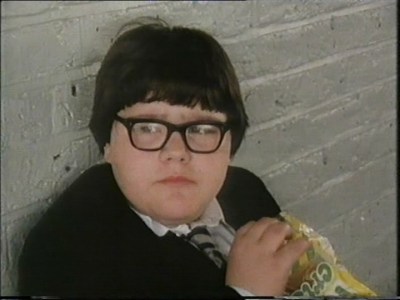
This is no longer the feminist issue perhaps it would have been a generation ago, although people of a certain age will remember Roland from Grange Hill, demonstrating that overweight children is not a new phenomenon. A quarter of people affected by an eating disorder at a school age are boys.

seriesfive058

Clamping down on homophobic bullying in schools, telling children it’s okay for them to be exactly how they are, lacks sincerity and is undermined by measures which tell children precisely the opposite. You may not be able to help being gay, but to be fat or overweight is completely unacceptable and must be stamped out.

In many ways this current crusade about weight is linked to the culture of death. We are sending the message that your life is of more value and of a better quality if you are thin, whereas actually the stereotype of the fat happy person might actually have some truth to it, according to research, the obesity gene is linked to happiness.

If the state were to charge for contraception and abortions, there would be an outcry about how they were attempting to interfere with people’s personal lives, getting in the bedroom along with the usual ridiculous, hysterical and factually inaccurate rhetoric of poking about in women’s wombs. Acres of column inches would be devoted to how the state has no place as a moral guardian, attempting to dictate and impose moral values about how we should conduct our sex lives, the fact that they already do this in terms of nudging young women towards Long Acting Reversible Contraceptives, and men towards condoms, having escaped the attention of most.

Why is no-one questioning the ethics as to whether or not the state ought to be complicit in  moulding and encouraging its citizens into a homogenous size and shape? Is there really so much difference between this and the proscribed haircuts and clothes of the North Koreans, or is state intervention in our eating habits and sex lives a necessary and desirable trade-off  and inevitable consequence of the existence of the NHS? If we were all responsible for bearing the costs of our own health-care would the nation’s size still be seen as an urgent and pressing public health concern, which the government must instantly tackle?

One can’t help but wonder whether or not by advocating and supporting state intervention into eating habits, including the involvement of schools we are conceding yet more control of our lives and feeding a cycle of co-dependence. This is where Catholic Social Teaching, with its emphasis upon the family as first and primary educators, with ultimate responsibilities to their children and non-delegable duties, comes in.

An interesting comparison can be made when we look at the drive to get more children into Early Years and nursery education. A few weeks ago I attended an induction session prior to my daughter’s entry into primary school in September. The school had helpfully provided a list of expectations, things which children ought to be capable of achieving independently before they start. Incredibly, the list included whether or not they could recognise their own name. Not in written format, but did they actually know what their own name was. Would they know that the teacher was actually calling to, speaking to or referring to them if their name was used in a classroom situation. Another was were they able to use the toilet independently – were they potty trained?

It beggared belief that children may be starting school without these basic skills, but seemingly there is an increasing tranche of parents who believe that this is the state’s responsibility. No wonder the government is wanting to get as many children as possible into nursery care, in order to be confident that children have reached a minimum standard before starting school. As the state takes more and more responsibility for our diet, our children, our sex lives, the more dependent we become and instead of taking responsibility for ourselves, or encouraging other people to, the more we expect someone else with spurious qualifications (like a City & Guilds in bottom-wiping) to take control and sort it out.

Arguably state intervention in terms of prescribing our diet and lifestyle is far more intimate and invasive than moves to discourage abortion and promiscuous sex, yet the latter remains taboo, the former desirable in the minds and consciousness of the public.

What the current moral panic about sugar and obesity demonstrates is that religion does not possess the monopoly upon attempting to proscribe certain norms of behaviour and employing morality and shaming tactics to those who do not conform. The new pariahs are no longer single mothers, divorced women, prostitutes or sex workers, but those who are overweight. It isn’t hard to draw a parallel between children who were removed from their mothers on account of their marital status and those who are forcibly removed from their parents on account of their size or parents’ couch-potato lifestyle. Their crime,  in essence, being that of loving their children too much, or not being able to exercise tough love. Removing the child from their parents may conversely cause more long-term problems that it solves.

Stuffing down an entire tub of ice-cream or packet of tortillas in one sitting has become more shameful and sinful than a raunchy sex orgy with a group of random strangers picked up on the internet. When it comes to sex, ‘who are we to judge’: when it comes to food, you must be identified as being at risk, ridiculed, shamed and punished by higher food prices for wanting to do that which is wrong, bad for you and which fecklessness could cost other people money.

There’s an irony in that moderation is constantly touted as the key in terms of diet, but dare to apply that to the sexual appetite and you’ll be shouted down as a judgemental bigot.

Forget sex, that’s sorted. The new Puritans no longer care about who you choose to sleep with or how many abortions you have, how many families you break up by your freely chosen behaviour, how many embryos you freeze or how much strain you put on your body and your or the state’s finances by your choice to use IVF, it doesn’t matter how many children are affected by negative consequences of IVF, how many women you pay to bear children for you or how many kids you deprive of loving mum and dad or of a stable family.

You can do all of these things and should not expect to receive any negative judgement on any aspect of self-destructive behaviour. Unless of course, you are fat.

Lessons from Tuam: an essay

So it seems that the narrative about the bodies of 800 babies ‘dumped in a a septic tank’ in the grounds of the former children’s home in Tuam has finally unravelled as I predicted last week.

The post met with an overwhelming response – it was never my intention to garner or generate controversy, let alone defend the indefensible, but to cast a critical eye over what seemed to be some very implausible headlines.

It seemed beyond belief that nuns who were purported to be in the grip of religious fervour, would ignore its basic tenets, rites and rituals and simply tip the corpses into the sewage pit. Nothing is impossible, but an examination of the logisitics and historical evidence to the contrary (such as the tender for coffins) showed that the story was the result of febrile imaginations and a confirmation bias. A gruesome motif symbolising the brutal, vicious Catholic monsters of popular imagination.

The story was not so much of a hoax, there was no deliberate intent to mislead, but innate prejudices combined with a journalist’s desire to create a splash and prove his mettle as a top investigative reporter, meant that the only thing being consigned to a septic tank were basic principles of fact-checking.

I was lambasted for suggesting “it was the builder’s wot done it” but in most situations, Occam’s Razor ought to be the default position. The nuns would have had to have gone to an awful lot of trouble and inconvenience to be opening up a septic tank on a regular basis; it would have required a degree of determined and willful cruelty from all involved. It’s inconceivable to think that such an abomination would have been able to have been kept secret for over 53 years. Other people such as the lay staff at the home would surely have known.

In any event two further possibilities emerged this week.

Firstly, the Irish Times published an important letter from Dr Finbar McCormick from the school of Geography, Archeology and Palaeoecology at Queen’s University, Belfast.

Sir, – The media should be very wary of using the term “septic tank” to describe the structure containing the child burials at St Mary’s mother-and-child home at Tuam. It is offensive and hurtful to all those involved. The structure as described is much more likely to be a shaft burial vault, a common method of burial used in the recent past and still used today in many part of Europe.

In the 19th century, deep brick-lined shafts were constructed and covered with a large slab which often doubled as a flatly laid headstone. These were common in 19th-century urban cemeteries. The stone could be temporarily removed to allow the addition of additional coffined burials to the vault. Such tombs are still used extensively in Mediterranean countries. I recently saw such structures being constructed in a churchyard in Croatia. The shaft was made of concrete blocks, plastered internally and roofed with large concrete slabs.

Many maternity hospitals in Ireland had a communal burial place for stillborn children or those who died soon after birth. These were sometimes in a nearby graveyard but more often in a special area within the grounds of the hospital. It was not a tradition until very recently to return such deceased infants to parents for taking back to family burial places.

Until proved otherwise, the burial structure at Tuam should be described as a communal burial vault. – Yours, etc,

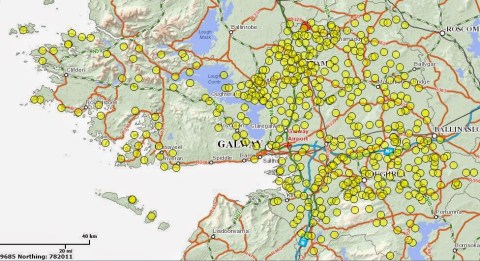
The RTE journalist Philip Boucher-Hayes bears a lot of responsibility for the misrepresentations of the story. He strenuously denies ever stating that there were bodies in the tank, but he certainly strongly implied it, with reports posing the question “what lies beneath”, along with posts and maps demonstrating that the spot where the boys discovered bodies was in the area of a former septic tank, and linking to photographs and highlighting awareness of a protest for ‘the babies in the bog’.

The misrepresented headlines did not appear mainly in foreign publications, as Philip claimed, they were published in UK media such as on ITV, the Belfast Telegraph, the Times and were reported as fact on BBC radio and TV and Sky news bulletins throughout the day.

Philip may not have claimed that there were bodies in a septic tank, but he did go some way to stoke the hysteria.

That said, his blogpost of yesterday appears to have shed more light on exactly what happened to the bodies of the children who died and seems to be the most likely explanation, although of course we still do not know precisely whom the bodies in the tank or shaft, discovered by the boys 40 years ago, belong to.

A woman has come forward who has related to me a credible first hand account of falling into a burial plot at the rear of the home in in the mid 70’s where she discovered a large amount of infant remains wrapped in swaddling.

Her interview suggests that one of the two spots where baby and child remains were placed could not have been a septic tank.

The Mail on Sunday has identified two sites side by side each other in its radar survey. Frannie Hopkins and Barry Sweeney discovered one as boys in 1975. The Mail called it Plot B.

Plot A is the square shaped one Mary Moriarty says she fell into in the 1970’s when the ground subsided. A child was found playing with a baby’s skull and when Mary and neighbours investigated she discovered a large underground space with shelves from floor to ceiling stacked with infant bodies. She says she saw in excess of 100 tiny figures swaddled and guessed from the size they were newborn or stillborn.

Subsequently she talked to a woman called Julia Devaney who had been a resident of the home and later an employee. By then in her late seventies she told Mary how she had assisted the nuns carrying dead babies along a tunnel running from the back of the home to this vault.

Now obviously it will take excavation to confirm any of this but her description of the space and the possible existence of a tunnel used to access this burial plot would suggest that plot A (whatever of Plot B) at least was not a septic tank.

Boucher-Hayes goes on to say that unanswered questions remain such as why were the babies buried there instead of the municipal graveyard over the road where there was an ‘angels’ plot’ for unbaptised babies. I suspect the answer is cost, we know that the rate-payers were already unhappy at having to fork out for ‘illegitimate’ children along with convenience. We do not know whether or this vault was consecrated at any point or whether or not it only contained babies.

It’s been exasperating and amusing in equal measure to watch how media organisations including the BBC refer to how the babies and children were ‘routinely denied baptism’. Firstly, why should the BBC even care about whether water was splashed over a child’s head and received a religious sacrament which will probably be nothing more than superstition to an impartial secular state broadcaster.

Secondly, there is no evidence to suggest that such a thing did routinely happen, if anything the childrens’ circumstances of birth would have made their baptism seem doubly important to those religious running the homes and there are plenty of accounts of children attending Mass and receiving First Holy Communion, a sacrament it is impossible for the unbaptised to receive. As yet there is nothing to suggest that baptised children were not buried in consecrated ground, but as ever it’s a subtle way of reinforcing contempt for these sisters and placing the finger of blame upon their religion, by portraying adherents as uncaring hypocrites who tried to exclude children from the faith. The evidence to support this just isn’t there.

This is why campaigners have been so keen to attempt to repeatedly hammer home other unpalatable facts, in particular the high mortality rate experienced at Tuam’s children home which was in common with the mortality rates for infants and children born out of wedlock and in institutions across Ireland. This, they believe, is evidence of deliberate cruelty and maltreatment, in which the home at Tuam, being run by a Catholic order, would have undoubtedly participated.

Mortality rates and Vaccine trials

Lurid claims that the children in some homes were subject to horrifying trials of vaccinations without consent, along with other claims of abhorrent practices are precisely why an inquiry needs to be held, in order that, as the Archbishop of Dublin has said, the truth may come out. The vaccine trials element seems to be especially concerning, in that this would have involved the complicity and silence of the manufacturers and medical profession, who to some extent must have been driving this initiative. Did no-one in the medical profession, including those who received the results of such research think to ask questions about the appropriateness of testing them upon children or the ethics of using or recommending a vaccine that had been developed in such a fashion? What is the involvement and complicity of big Pharma along with the state’s medical officers who supervised and administered the trials. Why are they not being pressed about this issue in the same way? Do pharma companies still use institutionalised children and prisoners as has been suggested? It seems that there is still an issue in terms of obtaining informed consent from patients for drugs trials in poorer countries, but without the addition of monstrous demon nuns, the interest is limited.

It is not good enough to blame atrocities upon the age or the time, those who ran Christian institutions ought to have known better – Christianity is uncompromising about sexual ethics, but it is equally demanding on the principles of forgiveness, reconciliation and treating one another with love. Strictures about due care of widows and orphans appear to have been wholly disregarded.

However, justice is not best served by trashing the reputation of a particular order of deceased nuns on the basis of scant evidence, supposition and confirmation bias. All parties deserve better than for Tuam’s children to be treated as a convenient totem. As yet there is nothing to suggest the deliberate or willful cruelty at this one institution.

So if the story about the septic tank is wrong then what else is wrong? If you’re going to fashion a stick with which to beat the Catholic church, it would be better not to use papier-mache as your raw material.

This leaflet produced by the Committee for the Children’s Home memorial in Tuam, describes not only how children were receiving Firstly Holy Communion but also how one of the problems facing the children were that they were boarded out to unsuitable homes, where foster parents were happy to take the money from the government to look after the children, but treated them like slaves, in many cases not giving them enough to eat or even clothing them properly.

How responsible were the sisters for vetting the homes into which the children were sent? The Mother Superior complained that the home was not suitable or designed for large numbers of children and that there were not sufficient numbers of staff to look after and raise them all. Whose responsibility was it for ensuring the wellbeing of the children once they left the home?

I am not saying that the nuns were not in any way at fault, but what has emerged is a picture of a home which never left the hands of the state who were struggling with rising costs, a delapidated building, a council reluctant to put its hands in its pockets and an elderly doctor on the point of retirement. According to this report, the medical officer in the Tuam Home was probably “Ireland’s oldest doctor”.

Some of the many causes of death were listed as follows: whooping cough, anaemia, influenza, kidney inflammation, laryngitis, congenital heart disease, enteritis, epilepsy, spinal bifida, chicken pox, general odeama (dropsy), coeliac disease, birth injury, sudden circulatory failure and fits. As anyone living in any sort of close proximity to another knows, it only takes one member of a family to come down with a lurgy and within 24 hours the whole household is struck down, with whatever nasty is doing the rounds. Conditions like gastroenteritis could quickly prove fatal in the absence of decent medical care, hygiene and medication. I’ve had to take two of babies to hospital for dehydration.

There are many issues arising from child mortality rates, Irish blogger Cathyby has compiled some useful charts which put these into sombre perspective and ought to be considered as part of the inquiry.

Speaking on RTE’s morning show, historian Ann Matthews who has written a book on the mother and baby homes made some interesting points. She reminded listeners that under discussion were isolated high mortality rates in the ‘20s. In 1933-34 the mortality rates of children in one home spiked to 40% due to a measles epidemic,  but by 1934-1935, due to help from the local government and the sweepstake, 4 homes had dedicated maternity hospitals built and they started to slowly get on top of keeping the spread of infection down, stopping the spread of measles and trying to feed young women.

What is overlooked is that there were clusters of young girls aged 14-18 coming into the homes completely malnourished, barely capable of carrying a successful pregnancy to term and unable to breastfeed the baby so that it would have little chance of thriving. Some reports blame nuns for forcing women to breastfeed, which is commonly accepted as best for the baby, others berate them for encouraging bottle feeding which would have put the babies at increased risk of deadly gastroenteritis.

The effect of maternal health upon the unborn child is a something that there is increased awareness of today – we know that conditions such as hypertension and diabetes need to be carefully monitored as they may affect mother and child. Teen pregnancies are more problematic from a health point of view, they at are increased risk of complications and premature birth. When you factor in the age and social strata of many of the girls presenting at the homes, it may go some way to explain the high mortality rates, along with other factors such as lack of  nutritious diet, antibiotics and adequate infection control.

According to Ann Matthews, meticulous records were kept at all the homes she studied, which are now in the hands of Ireland’s HSE.  All the information is there to enable the story to be studied and told in a non-judgemental and informative way. She claims that the religious orders were more than happy to assist her in obtaining the information and answering enquiries in the course of research for her book.

I do have some sympathy for the nuns especially the current sisters who have come under severe criticism for their decision to employ a PR firm. The fact that they have allowed this to be known, shows how ill-equipped they are to handle the media. The sisters have neither confirmed or denied reports of a mass grave because they are unable to. The home shut down 53 years ago and the records were handed over the authorities at the time. Their particular vocation is about caring for the sick and suffering particularly in hospitals, care homes and private homes, not running a slick PR operation. They have neither the time, manpower, nor expertise and this must detract from their vital and necessary daily work  of tending to the sick.

Any inquiry must examine, not only the religious institutions and how they were interconnected, but also the state organisations such as the state-run County Homes where up to 70% of unmarried mothers and their children ended up which is what historian Sean Lucey claimed in this week’s Irish Times. The scandal of the unmarked graves in the Protestant-run Bethany institution which was revealed in the same week as Tuam, received no global media.

It isn’t just the deaths of the children which are problematic, it’s the maltreatment, the vaccination programme, forced adoptions and boarding out. The inquiry should be far-reaching and ask why these homes were set up and include both the privately and publicly funded ones. It should also examine the young women and how they came to be there, including how they became pregnant, was it rape, family members or employers? It should also examine all of the individuals’ records.

One unfortunate consequence of the story is that it has proved enormously distressing to the survivors of these homes who have been left wondering whether or not their relatives were dumped in a septic tank or similar. It has also concerned those who do not wish for their personal histories and stories to become public knowledge as a result of the press coverage or any resulting criminal investigation. Much of the resulting coverage has been very insensitive and caused enormous hurt to the already vulnerable victims and survivors.

“You pro-lifers you don’t care about dead babies, only unborn ones – you have no compassion”

Some of the personal criticism I have received as a result of writing about this has included accusations of a lack of compassion and trying to defend wrongdoing. Let me be clear about this, as a mother of 4 children, the issue of how unmarried mothers and children were treated has appalled me and not just in Ireland.

Thinking about the physical conditions and shame that these women had to endure, along with how most of them were forced to give their babies up, produces a hard knot of nausea and panic in my stomach. It constitutes a form of torture for mother and child alike. My visceral response is one of violence, the type of violence that anyone would receive if they tried to remove one of my babies or children from me.

When it comes to the children themselves, it’s the small details that choke me, for the last week every time I brush my children’s teeth I can’t stop thinking about the children in the home, who was there to help them with basic tasks of self-care, who helped them to cut up their food, or hold a drink without spilling it, wiped their bottoms and so on. It isn’t just the harsh conditions, but the lack of a loving family and individual emotional nurture that is so heartbreaking, especially when you then consider how they were further stigmatised by the wider communities as untouchables.

Keep your nose out of Ireland’s business
lucky charms

The other criticism or implication coming from folk like Colm O’Gorman who was happy to welcome Nadine Dorries’ negative comments about the Irish Catholic church (on the grounds of her Liverpudlian family connections) is that as an ignorant Sasanach I really ought to refrain from commenting on this affair which is purely Ireland’s business and resulting from a particular brand of Irish Catholicism.

Whatever the particular causes, be it a Jansenist version of Catholicism which was practiced in Ireland, or that people were genuinely terrified as to the consequences of illegitimacy and poverty having experienced several famines, or that the newly established Free State was trying build a Utopia and using Catholicism as a moral arbiter, (though no Christian could condone what happened here), leaving aside the ubiquitous Irish family card (my husband’s family), or the fact that I write for a publication with a significant Irish readership, this story is of interest to anyone concerned with the rights and welfare of women and mothers.

As a pro-lifer I have a direct interest in attempting to understand attitudes which led women to be abandoned in institutes and caused suffering to them and their babies – these are the same attitudes which lead to abortion today. In the absence of serious indications to the contrary, mothers and babies always fare better when a mother is allowed to raise her own child. Adoption is a wonderful gift but it should only ever be a last resort.

As a Catholic there is also an interest in getting to the bottom of what happened. What people fail to understand is that the Church is the body of Christ, comprised of every single believer on the planet. When one part hurts, we all feel the pain as a collective. Therefore where abuses have been committed in her name, it is the responsibility of all of us. This is not just Irish history, but part of Catholic history. Communities are formed in part by memories and histories and so we have a duty not only to the victims, but also to future generations to ensure an accurate version of history is preserved.

But to write this off as purely an Irish tragedy or an Irish Catholic tragedy is short-sighted. The UK had more than its fair share of institutions which were little more than dumping grounds for unwanted mothers and babies. The website motherandbabyhomes provides a harrowing insight into life and conditions in such UK institutions. Jennifer Worth, author of the Call the Midwife series of books, relates how unmarried mothers were pressurised into giving up their babies for adoptions, in many cases being threatened with incarceration in a mental hospital if they refused and of false diagnoses of mental illnesses justifying the child’s removal.

David Quinn writing in the Irish Independent has highlighted how that liberal paradise Sweden forced unmarried mothers to have abortions and sterilised them along with other women thought to be at risk of producing illegitimate children. Even the good old USA, land of the free and home of the brave has something of a chequered history when it comes to forced programmes of eugenics and sterilisation of poor women.

We are deluding ourselves if we think these attitudes do not exist today – a recent UK example being the numbers of Downs Syndrome children aborted, whose existence was  forgotten, deemed unimportant enough for the abortion clinics to even record properly.

Equally the drive by successive UK governments to get unmarried and single mothers back into work as swiftly as possible instead of the all important job of raising and nurturing their children, echoes a similar desire for ‘penance’ and a Protestant work ethic.

The enquiry is both a blessing and a curse for Enda Kenny, on the one hand he can indulge his habit of berating the Irish Catholic society of 50 years ago thereby distracting from the pressing issues of Ireland’s healthcare system and the economy; on the other hand Ireland is currently skint, and one could legitimately ask whether or not an inquiry is the best use of resources.

In a scandal which has shades of Tuam, one child dies every fortnight in Ireland’s HSE care system, according to this report in November 2013. Old people are stigmatised and institutionalised in homes on account of their fragility and similarly complained about in terms of their cost.

To isolate Mother and Baby homes as being a symptom of twentieth-century Ireland combined with Catholicism is self-satisfying, sanctimonious, short-sighted and glib. The answer lies not in demonising Ireland or Catholicism, but returning to Christian teachings which identify flawed human nature and propose a definitive strategy in terms of how we should all be treating each other.

Tuam Breaking: 800 babies were NOT dumped & mortality rates were LOWER

In a revealing article in the Irish Times published online 45 minutes ago, Catherine Corless, the amateur historian who uncovered the records of the 796 children who died at the Tuam children’s home, run by the Bon Secours sisters has expressed her dissatisfaction by the way the story has been covered by the media, in particular the claims that 800 bodies were ‘dumped’. ‘I never said that word’ – she states.

What has upset, confused and dismayed her in recent days is the speculative nature of much of the reporting around the story, particularly about what happened to the children after they died. “I never used that word ‘dumped’,” she says again, with distress. “I just wanted those children to be remembered and for their names to go up on a plaque. That was why I did this project, and now it has taken [on] a life of its own.”

Her motivation was entirely about commemorating those who died there and her original article describes how she believes that the children were buried in an unofficial graveyard at the rear of the home. Perhaps this is why the locals have been so shocked on the discovery of the news, because many of them had tended to what was believed to be ‘the angels plot’ putting up a makeshift garden and Marian shrine.

In the light of Corless’ research which was first reported last year, a graveyard committee was established, a copy of her article was distributed and donations asked for a plaque following a Mass at Tuam Cathedral last year. Barry Sweeney, one of the boys who had originally discovered the graves, got in touch with Catherine to confirm that he had found bones, but as the Irish Times reports:

. “But there was no way there were 800 skeletons down that hole. Nothing like that number. I don’t know where the papers got that.” How many skeletons does he believe there were? “About 20.”

He goes on to state that the size of the slab broken into was 120cm by 60cm, roughly the size of his coffee table. This makes sense and what I was suggesting in my previous post which received such condemnation from certain quarters. There is no way that you would squeeze 800 bodies into a septic tank.

The article notes the archive material about the sewage scheme which was brought to the home in 1937. The tank had been in use between 1926 and 1937 during which period 204 children died. Catherine Corless admits that it is impossible that the tank would fit 204 bodies and that they would have been thrown into a working sewage tank.

My theory has always been that during these works, which would have required digging, bodies of famine victims were unearthed and it was these who were put unceremoniously into the hollowed out tank, perhaps to save space.

Catherine Corless has said that no-one from the government has asked to review her work, neither has anyone corroborated it, but that she would be happy to share it.

It is likely that the babies are buried on the site somewhere, there are many children’s burial grounds in County Galway and throughout Ireland, but the story that 800 babies were ‘dumped in a septic tank’ is undoubtedly false.

Michael Cook from Mercatornet produced this map of all the childrens’ burial grounds in Country Galway.

Childrens Burial Grounds Galway

Here is an archeological explanation of the work that has so far been carried out on the site of the former home. These specialists posit  that the children may have been buried at a site less than a mile away.

We would hypothesise that not only did the Bons Secours nuns in Tuam have to face the difficulties in burying dead infants but so too did many/most Irish families at a time when infant mortality rates were very high. It is no coincidence that Children’s Burial Grounds abound throughout Ireland and also that one is found in Ballymoat townland less than a mile northeast of the Workhouse. If the nuns did bury the infant dead within the Home grounds then where did the neighbouring families bury their infant dead? Some in the children’s burial ground and some in consecrated ground?

None of this detracts from the unacceptably high death rates in Mother and Baby homes and it is important that more research into these institutions is carried out, which is why the Archbishop of Dublin asked his diocesan archivist to collate all the records pertaining to the Mother and Baby homes and make them available to the government, just a few months ago.

This letter in the Irish Times, along with many of the comments on my previous post, throws some light onto conditions faced in the home.

Cohorting infants in institutions puts small infants at risk from cross-infection, particularly gastroenteritis. Early infection to the gastrointestinal tract can cause severe bowel damage. Without the availability of recent technology, many such infants would die from malabsorption resulting in marasmus [severe malnutrition]. The risks would have been much increased if the infants were not breast fed.

In foundling homes in the US in the early 20th century, mortality was sometimes reported as greater than 90 per cent among infants cared for in such institutions. Lack of understanding of nutrition, cross-infection associated with overcrowding by today’s standards, and the dangers of unpasteurised human milk substitutes were the main factors.

Of course many of the babies are reported to have been breast-fed as their mothers were there, but gastroenteritis is certainly an important consideration. Even if the babies were breast-fed, they would have been at increased risk once weaning began. There is always the possibility that they were mixed fed but in any event milk substitute only one factor in gastroenteritis which is very dangerous. My daughter was very ill with campylobacter as a baby, despite good hygiene and being breast-fed.

Irish Blogger Shane, (Lux Occulta) has carried out research indicating that the mortality rate in the home at Tuam was actually LOWER than much of the rest of the country, except in Dublin, where it was the same.

Between 1925 and 1937, 204 children died at the Home — an average of 17 per year. 17 deaths out of 200 children equals a mortality rate of 8.5%. It is interesting to compare that with the rest of the country at the time. In 1933, the infant mortality rate in Dublin was 83 per thousand (ie. a mortality rate of 8.3%), in Cork it was 89 per thousand (8.9%), in Waterford it was 102 per thousand (10.2%) and in Limerick it was 132 per thousand (13.2%). (Source: Irish Press, 12th April, 1935; below).

Also the historian Liam Hogan (@limerick1914) who has done so much work in digging up the archives and sharing them, has discovered that the home never once left the hands of the County Council. In 1951, 10 years before it shut, the sisters were begging the board for a grant, saying that they were too ashamed to show councils part of the building which desperately needed renovations, the children were sleeping in attics in terrible conditions and the building were considered a fire risk. In a meeting in 1949, Senator Martin Quinn were told that the children were suffering as result of the condition of the building, to which he replied “I do not like these statements which receive such publicity”.

It seems that the home shut after money wrangles, the County Council were simply not prepared to spend the money to upgrade the building which they owned, especially if it was later to be handed into the hands of the nuns. It was pointed out however, that the nuns could not be expected to take over and maintain a property which was in such bad condition.

Other interesting facts to have emerged are that the Mother Superior was a member of the NSPCC and that the ratepayers repeatedly talked about the unacceptable cost of the ‘misfortunates’. ‘I want the public to know what the illegitimate children are costing the ratepayers of Galway’ said one report in 1938.

This is not meant in any way to deflect or divert blame from any individuals within the Catholic Church, we know that various religious fell well short of the standards expected of them.

“800 bodies dumped and she wants to talk about the logistics” scoffed one tweep. But to most critical thinkers, the story never made sense.

No matter what may have gone on, there is no way that nuns would have been refusing to baptise children as suggested or simply tossing their bodies into a septic tank. That people were so willing to believe this and jump on the outrage bandwagon should be a cause for concern and shows that much work still needs to be done to atone by the Church and others for a terrible time in Ireland’s history.

Tuam children’s home – salting the earth

article-2645870-1E1E699200000578-319_634x321The story of the home run by the Catholic sisters of the Bon Secours has hit the UK press after a resulting Irish media storm.

It has predictably whipped up anti-Catholic outrage and sentiment amongst the small clique of Irish secularists who seem to inhabit Twitter, lurking to pounce on anyone who dares to say anything less than condemnatory about the Catholic Church in Ireland. It’s difficult to tell how representative they are of wider public opinion, but nonetheless the story and the victims deserve a response.

The UK Daily Mail handles the story in an uncharacteristically balanced fashion, noting that these types of homes were prevalent throughout Ireland and run by both the Catholic and Protestant Church.

The existence of a mass grave is tragic – it is saddening that children were buried in this fashion, without any sort of memorial and no burial records, however the claims that they were unceremoniously dumped into a septic tank full of sewage will almost certainly be false. The bodies which were found by two boys playing in the 1970s were interred in a concrete tank. The septic tank referred to had been attached to the building when it was a former workhouse, and was decommissioned by the time the sisters took over the building to run as a home in 1926.

Little is known about the size of the tank, nor has it been confirmed how many bodies are contained therein. The first task must surely be to secure the site and carry out forensic analysis. The boys who discovered the grave describe it ‘full to the brim with bones’ after breaking through concrete slabs, but that does not confirm numbers of bodies. It’s interesting that back in 1975, no further investigation was thought necessary, the site was apparently blessed by a priest before being resealed.

Local historian Catherine Corless has discovered the records of 796 babies and children who died at the home, but it isn’t clear whether or not they are all contained within the grave. The first thing must be to establish numbers and ages of those who were interred and a respectful re-internmnet and memorial must be erected. This is already in progress. The sisters of the Bon Secours have already requested an urgent meeting with the Archbishop of Tuam to discuss how best to honour all those in the home. This is an important first step.

One inconsistency is that according to an advert placed in a local paper, the Connacht Tribune in 1932, the Home was tendering for coffins. This would seem to be inconsistent with a policy that sought to expediently dispose of bodies in an undignified fashion.

The logistics of tossing corpses into a septic tank should also be thought about. How likely is it that they would have had a permanently open space or pit in which to to place bodies. Surely the existence of this would have been noted somewhere along with resulting hygiene concerns?

Archives from 1937 call for “the removal of the cesspool at the back of the home” as the smell was intolerable. In 1938 the MO and Matron of the home pleaded for a new disinfecting chamber and laundry and six months later sent a letter to the Committee asking if anything could be done to speed up the process. The idea of a permanently open grave doesn’t seem to tally with the other stated concerns. One also has to wonder about how the bodies were placed into a sealed septic tank via narrow pipes. Did the nuns return regularly to a pit full of decayed macerated corpses without commenting on it anywhere?

The Connacht Tribune records that Tuam Sewerage Scheme was to be extended to the Children’s Home in 1928. Is it possible that during this period existing graves were exhumed and the bodies reinterred. The boys’ description of a pit with a brimful of bones suggest that the bones could at least have been adult, it is unlikely that babies’ bones buried in shrouds would have been visible 20, 30, or 40 years later. The grave was  explained as belonging to famine victims  – presumably this belief would have had some basis? Prior to being a home for married mothers, the building was a workhouse for famine victims.

What we do know is that often bodies were exhumed during the road building process in Ireland and not reinterred in a respectful fashion, even being dumped in drains in some instances. It is feasible that the children were buried correctly, even on consecrated ground and then later moved during a redevelopment of the site. This is why decent forensics is vital.

Another piece of the outrage stems from the widespread practice of burying babies in unconsecrated ground. These days this no longer happens, but the belief in limbo was still prevalent in mid twentieth-century Ireland. I remember being shocked as a child when my mother pointed to an area on the edges of the churchyard in Ashburton which is where she said, her baby brother born in 1946 was buried, away from the graves of his grandparents right in the centre of the church. She related how the monks from neighbouring Buckfast Abbey came out to conduct the service, (they did not have a graveyard at this time), but that he died before they had a chance to baptise him. This may seem cruel, but it was the norm. That’s not to say that no rites were carried out. In any event limbo is not an abhorrent concept which has been revamped in a PR exercise. The truth is that we do not know what happens to the souls of the babies, but we trust in God’s mercy, knowing that He is good. Limbo taught that as innocents, the souls of the babies would enjoy happiness, only not the perfect happiness of the beatific vision.

The practice of burying babies in unconsecrated ground has long since been revised, however it’s telling that no such outrage is expressed by these pro-choice secularists with regards to the appalling treatment of foetal remains by hospitals and abortion clinics who  were happy to incinerate them for energy with surgical waste.

The death rates from neglect, malnutrition and preventable diseases easily treated with antibiotics are undoubtedly shocking. No-one seeks to excuse them. With that in mind, the death rates in Tuam seem to be consistent with the death rates of illegitimate children throughout Ireland as a whole, which were 3 or 4 times that of legitimate children and double the death rates of illegitimate children in England and Wales.

Ireland was in the grip of poverty, as  Anglo-Irish Catholic tweep @dillydillys has pointed out, rural Irish society was ruthless compared with our comfortable armchair perspective. Life was tough during the lean years of the economic wars between Britain and the Free State.

Clare Mulvany, an Irish colleague in Catholic Voices tells of how her uncle died aged 18 months from a simple skin infection easily treatable with antibiotics who was hastily buried the next morning. It’s how life operated. Antibiotics were not easily available or accessed and bodies would be buried swiftly.

There are many allegations of children being deliberately starved and maltreated – where this happened this is abhorrent and should be condemned. The calls for an inquiry and a Garda investigation are correct, if belated. This should have happened back in the ‘70s or even in February 2013 when the story began to emerge in the press. Also there are reports of Catherine Corless meeting with the film-makers behind Philomena last year, Why did this story take so long to air?

In direct contravention of allegations of ‘dying rooms’ and deliberate starvation, a Tuam Herald report in 1949 on the Inspection of the home, says that “they found everything in very good order and congratulated the sisters on the excellent conditions in their Institution”. An earlier Board of Health report in 1935, says that “Tuam is one of the best managed institutions in the country”.  In 1944, the Matron requested that all occupants were immunised against Diphtheria.It was also recommended that vaccines for whooping cough were supplied.  Is this indicative of an uncaring attitude? In 1950 a programme of improvements to the building was proposed to the Committee however these were never carried out due to costs. The home finally closed due to dilapidation in 1961 after the £90,000 proposed extension was instead used to carry out improvements on the nursing home run by the sisters.

children-at-the-home-in-tuam-co-galway

In a revealing exchange in 1961, it was claimed that those in charge of the home had not been paid for extra work done and that some of the most capable nuns had been moved. It was admitted that the conduct of the home had been unsatisfactory for quite some time. The conditions were attributed to a shortage of ‘trained staff, unsuitable buildings and other factors’.

The Archbishop of Dublin is quite correct to call for a social history project to be run in parallel to any inquiry in order that an accurate picture of life in the homes can be established.

This is not to deny abuses or shocking treatment, but to point the blame solely at the church alone is too simple.

Reports from 1929 show that a special maternity ward for the unmarried mothers was added to the Home in Tuam. The reason for this is that married women and paying customers at the local district hospital in Connacht were unwilling to share their hospital facilities with the ‘misfortunates’. They wanted segregation. This proposal was opposed by a priest, Canon Ryder who wanted to find accommodation for these mothers in other hospitals.

This moving of the mothers to a separate institution lacking trained staff and facilities would have undoubtedly contributed to infant and maternal mortality rates.

Society and state wanted these women to disappear and colluded with the Church who were willing to provide institutions. A sanctioned burning of library books portraying unmarried mothers in a positive light took place in Galway in 1928. A ratepayers meeting in  Portumna said that no additional burden should be placed upon married parents who already had enough to do with the raising on their own children and that the state must step in to act. In a direct contravention of the Catholic principles said to be influencing attitudes towards unmarried mothers, it was deemed unreasonable to expect married families to pitch in and help. In 1926, the annual cost of £26 for each year to raise each infant was deemed unacceptably high. The Board of Health was told to provide for them at the least possible expense and therefore the charity of the Sisters was extremely convenient.

Fr Owen Sweeney, Chaplain to London’s Irish centre noted in a meeting in Galway in 1964, that “facilities were so much better in Ireland (than England) for the unmarried mother and her child”.

But before condemning the Church alone, we should also ask questions of a society that was happy to wave goodbye to unmarried mothers and who wanted them hidden. The concerns and stigma were driven as much by cost as anything that the Church taught on this matter. Every single Western culture stigmatised single mothers prior to the advent of the contraceptive pill.

I am glad that such attitudes have changed. I mentioned in previous posts that my grandmother was illegitimate. She was born in 1913 and one of the lucky ones, but the stigma blighted her childhood and affected her right up until her death at the age of 99. My family has experienced what this does to a person. My mother was never able to learn the identity of her own grandparents until her mother died last year.

For every mother sent to an institution there was a society unwilling to accept them into their community and to stand up for their basic dignity. There was a documented unwillingness to rely on their testimony regarding the paternity of their children or to hold the men to account.

To blame the refusal to share precious resources with those who were deemed to be morally deficient on account of their straightened circumstances, on Christian doctrine, demonstrates a fundamental misunderstanding of the Gospel message. The Catholic church may be complicit in that the institutions may well have mistreated those in their care, but that surely needs to be attributed to the individuals who worked there, some of whom had discovered a vocation was a convenient solution to their own poverty. Nowhere does the Catechism ever condone unjust treatment of the poor and Christ reserves some of his strongest words for those who mistreat children. One wonders how much of this pointing the finger of the blame at the Church is a projection of personal guilt – the children from the home were forced to sit apart from and bullied by their legitimate peers as Catherine Corless relates.

But we are fooling ourselves if we believe that we are living in a more enlightened age or seek to blame such stigma on religious doctrine. The demonisation of those on welfare and benefits due to the media coverage of families such as those belonging to White Dee has nothing to do with Christianity and everything to do with human nature.

We display exactly the same attitude in terms of marginalising vulnerable children and wishing for an expensive embarrassing problem to be quietly dealt with every time we stay silent or sanction an abortion, whether that’s of a child from a socially disadvantaged or financially struggling parent or one who has disabilities.

Last week Archbishop “Charlie” Brown described the green shots of the Irish Catholic Spring following 20 years of winter.  Ireland’s wounds are beginning to heal, helped by the enthusiasm of the young and the appointment of Marie Collins to the newly established Pontifical Commission to the Protection of children.

With the green shoots and buds of Spring emerging no wonder then, that there are those waiting and willing to use opportunistically whatever they can, in this case the tragic deaths and apparent insensitive disposal of childrens’ remains, to scorch then salt the earth. Justice can only be served by truth. The victims deserve nothing less.

childrens_home_nursery

With thanks to Twitter user @limerick1914 who has provided a fascinating compilation of the archives.

Update:

This post is not intended as either a defence of anything untoward which may have happened in the Toam home. It is simply applying a reasonable standard of criticism to hyperbolic narratives flying about the internet, based on publicly available sources.

The facts as we have them so far are these: there are records of 797 children dying over a 40 year period at The Home in Toam. Some bodies are known to exist in the site of a former water tank. We know the site was formerly a workhouse for famine victims. It is reasonable to request more evidence, be that forensic or some sort of archeological records in terms of work completed on the site which now contains part of a building site.

For those concerned with the fate of the deceased, a far more constructive step than venting online would be to donate to the St Jarlath’s Credit Union account set up for the purpose of receiving donations to the memorial fund which is one of the reasons why Catherine Corless broke her story. Incidentally she does not seek to lay the blame at the door of the Catholic Church – her reflections being far more nuanced. 

Making parents – the reality of the gay dads

A few years ago, I critiqued Tony and Barrie Drewitt-Barlow, the ‘gay dads’ who have set up a surrogacy business, after being spammed  by them on Twitter for suggesting that surrogacy exploited women. The post received some interesting comments after the Drewitt-Barlows put it out there on Twitter, said I was a mad Catholic woman in need of their help and requested that people leave their views.

Their new TV show aired last night and so they appear to be trolling Twitter, appearing to generate controversy and publicity to raise their viewing figures. One of the criticisms of surrogacy is that it reduces children to commodities, but of course parents would never treat their children like consumer goods , let alone ridicule and humiliate them for their genetic inheritance and the way in which they were brought into the world.

When Barrie shouted this at his son, it was clearly a joke:

“I paid for a gorgeous designer child with straight hair, not some reject from an 80s pop band with curly frizz.’’

The clip of the series in which Barrie can be seen shouting this at his son, can be seen here. (Not suitable for children, contains strong language). It gives an insight into his character as well as some of the heartbreak faced by infertile couples and pretty much encapsulates every single objection to this clinical and commercial procuring of children.

I don’t want to give them publicity for their new show and I am aware that by writing about this, I am giving them exactly what they want, but these men, together with a friend who seems to be wishing to kick start a career as a celebrity, have tonight called for me to be crucified, suggested that I am urinated upon, said that I am a pervert, a racist and a homophobe, in an unsolicited and unprovoked attack.

Writing for the Conservative Woman website, Laura Keynes proposes similar arguments and critiques of surrogacy highlighting the familiar silence and dissonance of mainstream feminism on what, like gendercide, should be a pressing issue for all who profess female solidarity.

For those who can bear it, I’ve created a storify of the Drewitt-Barlow’s libellous accusations here. I hate writing these kinds of blogs, but a few people have said that I need to find a way of documenting exactly what is going on here.

I stand by the tweet made back in November 2013, which the Drewitt-Barlows dug up tonight to justify their attack. This ‘dating site’ for egg donors really is a tawdry look into the women-for-hire nature of these men’s surrogacy business. Their company website is equally chilling. It strongly suggests surrogacy in America, California in particular, where the Drewitt-Barlows made legal history in that they were able to get a court order naming them both as parents on their child’s birth certificate. They advise on how to file an Pre-Birth order, which removes any rights or hold over the gestational mother may have over the child, so that the minute the child is born “specialist arrangements can be put in place to ensure the transition goes as smoothly as possible”. In the case of the birth certificate for same-sex parents, the court issues a pre-birth judgement specifying that on the birth certificate, one name is put in the box for father, the other in the box for mother,  in a piece of mind-bending legal fiction. The ‘intended parents’ therefore have rights over the woman’s body in that her child is yet to be born. ‘Intended parents’ are advised to  file for and obtain this judgement once the woman has reached 20 weeks in her pregnancy, in order to ensure that she is not able to exercise any rights over her child or her name be automatically placed on the birth certificate, should he or she be born prematurely.

It’s all about getting the baby away from their gestational mother before she has any chance to change her mind. One also has to ask whether or not as legal ‘intended parents’ a couple may impose their wish of birth plan onto a woman? Who gets the final say when there are tough decisions to be made which could perhaps compromise the baby. Is she restricted in her choice of pain relief and disbarred from commonly used opiates such as pethidine, which cross the placenta and can make the newborn drowsy?

Barrie Drewitt-Barlow, is I gather, responsible for the @gaydads Twitter account, which has been issuing misogynistic, abusive and libellous tweets. The force of his unsolicited and unprovoked aggression, has knocked me for six, it’s bizarre that two men who are millionaires,  have a flourishing business,  five children, their own TV show and over 137,000 followers on Twitter want to squash a minor Catholic commentator in this way even writing to the Universe to suggest that I am dropped for being ‘evil’ and ‘homophobic’. Just to jog a few memories, this was the couple who threatened to sue the Church of England if they were not allowed to conduct a ‘gay wedding’.

According to the British Surrogacy Centre, Barrie is their lead ‘social worker’, having worked in clinical social work for over 10 years. A regular on day time TV shows such as This Morning and Lorraine, he is asked to take part in many TV debates regarding surrogacy and areas on same sex parenting.  Barrie has been a regular contributer to many top magazine and newspapers for many years now and has recently written his first book as a guide to Surrogacy.  As a social worker, Barrie’s aim at all times is the welfare of any children born through surrogacy and has at any one time up to 5 student social workers under him from Universities across the UK.”

And this ‘social worker’ is abusing a mum of four for her defective genes, supposed evilness, being a ‘troll’, a ‘bully’, a racist, a homophobe and getting his followers to hate on her and tweeting her editor to get her dropped from her weekly column all because she dares to publicly disagree with the nature of their business? He’s appearing on daytime television as an equality champion, social worker and expert in children’s welfare, but is quite happy to call for the crucifixion of a pervert evil mother, with his mate asking for her to be urinated on, a sentiment which he happily endorsed by re-tweeting to all his thousands of followers?

I’d love to know what a social worker would have to say to me if I were to even allude to a negative aspect of my daughter’s physical appearance on television.(She is totally perfect as she is and I wouldn’t dream of humiliating her in this way, she’s enough of a sensitive sausage as it is). I think we’d all know what would happen, they’d be whisked away from me quicker than you could say bigot. I’m more than a little bit scared, having been warned off saying anything about this couple, for my own personal welfare – a few have reminded me that we are dealing with very wealthy and very influential people here.

Orwell and Huxley are in my blood, I remember my dad discussing, Brave New World, Animal Farm and 1984 with me from an absurdly young age. I was brought up to believe that free speech and free expression are sacrosanct, that the press must be liberated from state-control and that everyone should have the right to speak their mind, no matter how unpopular their views. One of the difficulties that my father has with my Catholicism (him being a staunch Anglican) is that thanks to his influence I have always been a fierce individualist, always resisting the pressure of group-think. The same is still true, I became convinced of the truth of Catholicism, on the strength of the evidence and after some critical thinking and against some pretty fierce opposition. Again and again my dad emphasised that it does not matter what other people think of you, all that counts is being true to yourself and able to account for your own views. Mind you, my dad is probably every bit as foolhardy as I, on a family weekend to Canterbury back in 1983, as my sister and I were making a bee-line for Morelli’s the famous ice-cream parlour, a group of activists were standing outside forming an impromptu conga-line with some hastily scrawled placards and shouting “Maggie, Maggie, Maggie, Out, Out, Out!” What did my dad do? Returned each chant with “Maggie, Maggie, Maggie, In, In, In!”, while my mum looked on in fear in and dread, hissing “Stop it Ken, you’re going to get your teeth knocked down your throat”! I’m still rather proud of him for that, truth be told – though translated into the digital world, it would definitely constitute a definition of ‘trolling’.

I was brought up to believe that we lived in a truly free liberal and democratic society, as a child at the height of the Cold War, I really valued the freedoms that I believed that we had. Disillusionment is proving to be an increasingly difficult pill to swallow. What kind of a world are we living in when I’m scared for what might happen to my family and children as a result of being forthright about my views on the internet?

I guess I still haven’t fully internalised Matthew 10: 16-42. Tough times ahead.