Report from Msgr Reilly to all pro-lifers

Here is the official statement from Monsignor Philip Reilly, Director of Helpers of God’s Precious Infants. Let’s pray for similar in the UK.

OB/GYN Pavilion at the Ambulatory Surgery Center of Brooklyn has been a Center for abortions since June of 1971. It was the oldest and largest abortion clinic in New York City and for many years, in the United States, where I believe more than a quarter of a million unborn children lost their lives.
I use the verb was rather than is, since the abortion clinic was closed on Sept. 1st 2012. Obviously the pro-lifers are happy and the unborn babies are happy but so also are the owners of the abortion Center. Why are the owners happy?

The Helpers are present in prayer outside of abortion clinics not simply to save babies but to save souls. Indeed the Helpers are present not simply to witness the truth but to convert people to the truth and to change hearts. After so many years of good lay people, religious, priests and Bishops praying and fasting outside of Ambulatory Abortion clinic; after so many years of dedicated laypeople offering help by sidewalk counseling to the pregnant women entering the clinic, the Lord has granted a complete victory.

On Monday September 17th the same building will reopen under the same ownership but as the New York Center for Specialty Surgery where only true healing will take place. In this building there will be absolutely no more abortions, abortifacient contraceptives, morning after pills, RU486 etc. performed or distributed. The old owners change of heart is real and complete and all the new doctors are real doctors who will not do an abortion procedure. Praise God.

PSALM 115

Non nobis, Domine, non nobis
Sed nomini tuo da gloriam

Not to us, O Lord, not to us
but to thy Name give glory

Feminist dissonance

A new and positive discourse seems to be emerging in Catholic circles, not just in the UK, but also amongst young Catholics in all continents, including the developing world, as to how Catholicism can counter the poisonous and popular narratives of misogyny propagated by the media and white chattering classes, and demonstrate that Catholicism offers an authentic and compelling vision of womanhood, one that offers total freedom, empowerment and is the only way that a woman may fulfil her true potential as a human being, created equal with men in the image of God.

Of concern is the way that a very narrow-minded definition of feminism, one synonymous with the misnomer of bodily autonomy, is now being globally evangelised with all the zeal of a nineteenth century missionary with the same patronising and even misogynistic attitudes, that accompanied the colonisers. If only these women in the developing world knew what was good for them, they would stop having so many children! Leaving the population agenda aside, these attitudes have been disturbingly crystallised by the Melinda Gates foundation, despite the fact that contraception is neither wanted nor needed by women in the developing world, as this open letter by a Nigerian women pleadingly testifies. Those wanting to help the plight of women in developing countries would do much better to actually listen to the voices of women in impoverished countries, rather than condescendingly deciding what is in their best interests – reinforcing and entrenching the disempowerment brought about by poverty.

The illogical, harmful and dissonant values of western feminism and sexual liberation were perfectly encapsulated in this characteristically vulgar pro-choice defence written by the 40 days for choice apologists. I’m going to disseminate it, not only to highlight the incoherence but also to ask, are these really the values that we want to be promoting to our children and exporting across the globe?

I’ve had sex with many different guys – in relationships, as one-night stands, in threesomes and foursomes and twosomes, in beds, on beaches, on trains. I’ve never had an unwanted pregnancy. – sounds like you’ve been very fortunate by all accounts, because the sexual behaviour and lifestyle would fall into the at high risk of pregnancy and/or STDs category. That’s not, to use society’s favourite verboten concept ‘judgemental’ or attacking your morals, it’s a statement of fact.
Thanks to the sterling work of teachers and parents, I’ve been taught about sexual health – great news! So you are well informed that you are participating in risky behaviour, you’ll know the risks of non-exclusive, non romantic and early sexual activity. You’ll know for example that you are at increased risk of cervical cancer, STD-related infertility, antibiotic resistant gonorrhoea and so on, before you’ve even thought about an unplanned child.

Thanks to the men I’ve slept with, I’ve never had to fight to get them to use condoms. – do most men in the Western world refuse to use condoms? Is it a struggle to get men to don prophylactics? Anecdote is not the plural of data, do we have any stats on that? Are we implying that most men are ignorant selfish misogynistic apes who don’t care whether or not they transmit disease or impregnate a woman? If we reverse the genders in that statement and say thanks to the women I’ve slept with I’ve never had to fight to get them to allow me to use condoms, does that not imply that a woman has to take sole responsibility for the consequences of sexual encounters? As does the original statement. It accepts that whatever may or may not result from sexual intercourse, it is always a woman’s responsibility. Doesn’t sound very empowered on in a woman’s favour to me. The men get off scott free!

Or, if it is a struggle to get men to use condoms, whether in the Western world (which I doubt) or more plausibly in the developing world, where there are cultural barriers to condom use, that implies that they are rather ineffective as a method of contraception. There seems little point in flooding developing countries with condoms. If one has to fight to get men to use them, sexual education is clearly not working, especially for men. So Nadine Dorries may actually have a point with her extra SRE targeted at girls then?

Thanks to sheer good luck, I’ve never been raped. – Let’s be charitable and attribute this to clumsy phrasing, but it is nonetheless offensive. Rape victims are undoubtedly victims of circumstance, be that the woman who is raped on the street, the woman who had something slipped in her drink, the wife whose husband has had one too many and refuses to take no for an answer and so on, but this just perpetuating the rape culture myth. Gender violence does undoubtedly exist and is a problem, but it is not the binary concept implied by this term. To state that it is lucky that one has never been raped, following on from a description of high risk sexual behaviour, like it or not implicitly victim blames. Is it due to her behaviour that she’s lucky never to have been raped? Or is it that all men are somehow pre-disposed to rape and she’s just fortunate never to have been a victim? In this context it is at best glib, ill-considered, and typical of the feminist genre.

It’s important to recognise the myriad things that could result in an unplanned pregnancy – the different bases that we have to cover, the balls we have to juggle, (ha unfortunate pun or turn of phrase considering the subject matter)to make sure that sex remains just sex. But most important is the base we just can’t cover – luck.

Best bit of unwitting Catholic sexual apologetics I’ve seen in ages. A tacit admission that sex is not designed to be a mere leisure activity. It is designed to be unitive, to reinforce pair bonding and procreative. Having sex could well result in pregnancy whatever you do. Stripping the emotional intimacy and potential for pregnancy from sex requires mental gymnastics and sophistry, it requires one to attempt to re-programme one’s innate inbuilt emotional responses, to condition oneself not to care about the other or get emotionally involve and it requires at least two methods of contraception or sterilisation to ensure that one doesn’t get pregnant or a disease, and even then it’s not guaranteed.

Wouldn’t a much better solution be a society in which monogamy, chastity and fidelity were valued and desirable concepts to reduce the risks of disease and in which women could be aware of their natural peak times of fertility and together make an informed choice with their partners as to whether or not to take the risk of pregnancy? If its all such a juggling act to keep sex as just sex, shouldn’t that tell us something? Sexual empowerment seems to be much harder work for women than it does men. All those threesomes, foursomes and one night stands are worth pumping one’s body full of huge doses of synthetic hormones, risking one’s long-term health and the killing of an unborn child?

Pregnancies are not solely caused by your own decisions. – yes they are. A woman who doesn’t have sex is not going to get pregnant.

As women who are desperately trying to get pregnant can tell you, one of the key deciding factors is luck. – yes, there is undoubtedly an element of circumstance when one is trying to achieve pregnancy, there are a myriad of measures one can take to attempt to maximise one’s chances of pregnancy, but there is nothing that one can do to guarantee that one becomes pregnant. There is however, something that one can do to mitigate the chances of not becoming pregnant. If you have sex and you are fertile then engaging in sex is something of a gamble, admittedly with measured risks. As the writer goes on to say: Can we beat the odds?

And so, what can we do when something as essential as sex is risky enough to make or break people’s lives? – so sex is essential now is it? We live in a culture whereby sex is essential? What happens if people don’t have sex? Do they turn into this?

No-one has ever died from not having sex. Sex is essential on a macro level for the promulgation of humankind, but not a micro level. Sex is pleasurable, feels good and is certainly important in terms of increasing intimacy in a committed relationship, but it’s not essential in terms of life or death or even overall well being, unless the writer is claiming that the significant proportion of the population who are not having sex are somehow deficient either emotionally or physically.

As for make or break, if sex really does have the ability to ruin one’s life, then abstinence sounds like the most advisable option. The idea that sex can totally transform one’s life for the better is delusional. The best sex is not merely physical but requires a level of mutual intimacy, love and trust. A relationship where sex does not constitute a stressful plate spinning act but a mutual and consensual outpouring of love.

For as long as we walk the planet we’ll be having sex. And as long as we’re having sex there will be unwanted pregnancies. As long as humankind exists, it will continue to have sex and there will always be unplanned or even unwanted pregnancies, no-one is disputing that, least of all me.

The lucky ones will avoid them, the unlucky ones won’t, but right now we’re lucky enough to have a safety net. Let’s keep it that way. – a new euphemism. Abortion is a ‘safety net’ – destroying an unborn child is a safety net when all other attempts to avoid pregnancy have failed. If the safety net is required, one needs to ask oneself why. Ultimately we need to have a safety net so that we can indulge our own selfish pleasures. A safety net implies that it is a method of last resort, there is no other option available. That means that women who are in poverty, who have been raped, who are in all kinds of reduced, straightened or desperate circumstances need a safety net as they have no other choice other than to abort their children. That’s not a status quo worth keeping and we should fight for change, otherwise we accept and promote injustice. And in all of this, where is the humanity of the unborn child? Its cloaked in euphemisms of safety nets and choices. Being killed before you have a chance to live does not sound like much of a safety net or choice to me.

According to this typical feminist perspective, being a woman is all about being a fatalist, a victim, the weaker sex. That isn’t something that chimes with my experience nor is a central principle of the pioneers of feminism, who recognised that women were equally strong, resourceful and powerful as men, but in different ways.

The early feminists fought for equality of opportunity – for women to have access to the same level of education, the same rights in the workplace, the rights to access the same choices as men. It was only through education could women begin to be on an equal playing field and enjoy equal status in society to men. That is why every woman is at heart a feminist, we don’t see ourselves as lesser beings or worthy of less opportunities.

But not every woman wants to identify as a feminist, in that some of us, I would argue most of us, do not see man as the enemy, the potential rapist of the typical feminist tropes. Our fathers, brothers, husbands and sons deserve better than being pathologised as potential rapists and aggressors. They also deserve better, as do we as women, than the sexual objectification of both genders that takes place in today’s society as a result of the libertine attitudes that prevail and dominate the sexual discourse. Sex can never be free of responsibility, this is an unobtainable Utopian ideal.

If sex cannot come without consequences, then the responsibility should always be mutual. To frame the issue as women’s bodily autonomy, (aside from the fact that bodily autonomy does not exist, a doctor won’t just cut one’s arm off because one asks him to) absolves the men from any responsibility for sex and leaves women co-opting with their own oppression. Lack of fidelity and monogamy exposes primarily women and children to poverty and exploitation and turns both genders into sex objects – simply means to require objective ends.

Francis Philips recently wondered whether or not the term feminism carried too much baggage amidst efforts to reclaim it. I think she’s right. I am leaning towards womanism, coined by the author Alice Walker, which has none of the negative connotations of white middle class feminism. Ultimately we have to recognise that women will always have different bodily functions and responsibilities to men. Men cannot bear children, nor can they breastfeed newborn babies. If we want a woman and child-friendly society, one that does not treat women as inferior, one that does not abandon them or their children to a live of poverty and deprivation, a society that acknowledges the dignity and contribution of all women to society, not just in our role of mothers, then we need the active support, co-operation and collaboration of men.

As a Catholic woman I want the same for my four daughters as for myself; access to equal education and the confidence that they can achieve whatever goals they set their minds to. I want them to take responsibility for their own fertility and bodies and I expect them to enjoy equal civil rights under the law. I want them to face every single challenge and setback that life may throw at them with confidence and grace; that they keep going in faith, hope and trust, no matter how difficult the odds.

What I don’t want is to raise weak women, who blame men for everything and who place themselves at the mercy of some fatalistic victim culture, or to expect special treatment or favours as a result of their gender thereby perpetuating a different form of inequality.

Whilst feminism continues in this vein of self-pitying victimhood and encouraging hatred of men, our companions in humanity, then strong women, who want to fight for a better future for all those struggling from oppression, should have nothing to do with it.

Smart Loving – reigniting the spark

My attention was drawn to the Smart Loving website in a letter by Edmund Adamus, director of Marriage and Family Life for Westminster Diocese, in this week’s Catholic Herald.

I’ve just spent some time scouting round the website which looks to be an excellent resource for single, engaged and married Catholics and Christians, whether in a relationship, looking for romance or simply wanting to reignite the spark.

Discover your unique love profile or take the quiz to discover whether your relationship needs some work to love smarter. There is also some useful information regarding spirituality and a
guide to getting started if you do not already pray as a couple and eight steps to deeper couple prayer. I cannot recommend strongly enough the benefits of praying as a couple as a way of increasing and deepening intimacy. I think many couples, especially when embarking on a relationship feel very self conscious at the idea of praying with one’s boyfriend or girlfriend, especially if the relationship doesn’t work out, or they are worried that the idea might put the other person off, but what can be more natural than wanting to help each other and walk together in one’s journey of faith and quest for holiness? To help each other deepen one’s eternal and everlasting relationship that extends beyond the mere earthly plain.

There is also a smart loving marriage seminar taking place in London, the weekend of 24 November, to enrich and empower married couples, commencing with Mass, opportunities for confession and including input from Theology of the Body.

Definitely worth attending, providing one can get babysitters!

Mary’s Dowry

During his inaugural address, Bishop Philip Egan the new Bishop of Portsmouth has urged Catholics to fight “the strangling counter-culture of death”. Specifically he spoke about how we as Christians must offer the salvific message of the Good News and the “civilisation of love it occasions. We must communicate imaginatively, with confidence and clarity, together with our fellow Christians, and all people of faith and good will, to the people of England, this wonderful land, Mary’s Dowry.”

It echoed the reflection issued today, on the first day of the Forty Days for Life campaign and answers the critics who ask why Christians feel the need to pray outside abortion clinics. As Christians, we are messengers, ambassadors for Christ, not coming with messages of condemnation or hate, but simply with love. Why do we stand outside clinics? It’s not to condemn or harass but to let people know that we are there, offering prayers not only for the unborn children and their mothers but also for the abortion clinic workers. Shawn Cawney, the director of Forty Days for Life in the US, testifies that it’s the prayer and peacefulness of the campaign that has affected many workers, particularly the presence of the same volunteers, day after day in all winds and weathers, that really begins to shift previously deeply entrenched attitudes. In relation to her own conversion of heart, former abortion clinic worker Jewels Green notes:

“The 40 Days for Life movement has changed the hearts and minds of not just those outside the clinic, but inside as well. For those who work inside, they feel what’s going on outside the door. That makes it easier to leave — if you know that you’ll be accepted into open, forgiving and loving arms outside.”

Clinic vigils take place for a variety of reasons and none of them are about hassling or intimidating women. The clinics are places of death and destruction of human life and so it is only natural to go and pray at the scenes where human lives are eviscerated, in the same way that vigils are held outside prisons when a sentence of death is being carried out. There is the indisputable fact that many women are influenced by the presence of the volunteers, particularly those who are feeling uncertain and especially those who are being pressurised or coerced. The very existence of the volunteers provides a last ditch opportunity for women to turn back and experience shows it is those who want to turn back, who don’t really want to abort, who are the ones to initiate contact. It is a hand outstretched in love, never a finger pointed in hate or condemnation. It is the act that is abhorrent, not the person, who is made in the same likeness and image of Christ as ourselves. The volunteers know full well that societal and personal pressures often convince women that they really do have no other choice; these are very often women living on the margins of society who literally have nothing, no access to benefits and are scratching a living, or women who simply have not been offered a true choice in terms of the opportunity to explore the options around keeping the child.

The other aspects of 40 days for life are naturally downplayed by the media, but just as important as the clinic vigils themselves, is the community outreach, prayer and fasting. The community outreach consists of attempts to engage with passers by and those in the area, again, never forcing themselves on anyone, but the offering of scientifically correct information – refusals are graciously accepted.

In terms of prayer, for those who cannot attend the vigils, it is asked that people say a rosary, or an extra rosary if it is said daily, for the intentions of Forty Days for Life. On days of prayer and fasting – the next one coming up is this Friday, 28 September, people can also offer an extra effort such as going to Mass, or an extra Mass, or attending Adoration. Another good discipline is to sign up to the mailing list to receive daily reflections, passages from Scripture and prayer intentions. Fasting can be either a total fast aside from bread and water, or an eschewing of a particular food or luxury, but it must consist of something sacrificial and not be merely a token gesture.

Bishop Kieran Conry summed up the spirit of Forty Days for Life when he called for a return to public prayer on the first Friday of every month to mark the Year of Faith, not only as a way of deepening one’s personal relationship with Christ, but also as a way of quietly and confidently witnessing your faith to those around you. As Catholics, as Christians, we are called to live our faith, which entails an element of public witness, no matter how uncomfortable it may feel to the typically reserved English psyche. We should not be ashamed to fight for a voice in the public square and we should not succumb to the secular agenda who would wish us not to manifest any symbols or practices of faith outside of our homes and churches.

What some Catholic pro-lifers forget, is that 40 Days for Life and groups such as the Good Counsel Network or Helpers of God’s Precious Infants are absolutely not about the politics but are apostolates, ones that must be supported and encouraged being wholly in accordance with church doctrine. They are truth and charity in action, a complement to what must happen in the ante-rooms and chambers of Westminster, a totally separate mission from the political manoeuvrings. As Catholics we must support and encourage good deeds and spiritual and corporal works of mercy. Politics and prayer are not mutually exclusive. We should not be afraid to display that we are motivated by faith, despite not requiring it to make a cogent watertight pro-life case to the wider world.

If we want to participate in the New Evangelisation, to articulate the message of Christ, to bring about conversion of heart, this civilisation of love and reclaim Mary’s Dowry from the chokehold of the culture of death, then the prayers, fasting and vigils that consist of the Forty Days for Life campaign is a very good place to start.

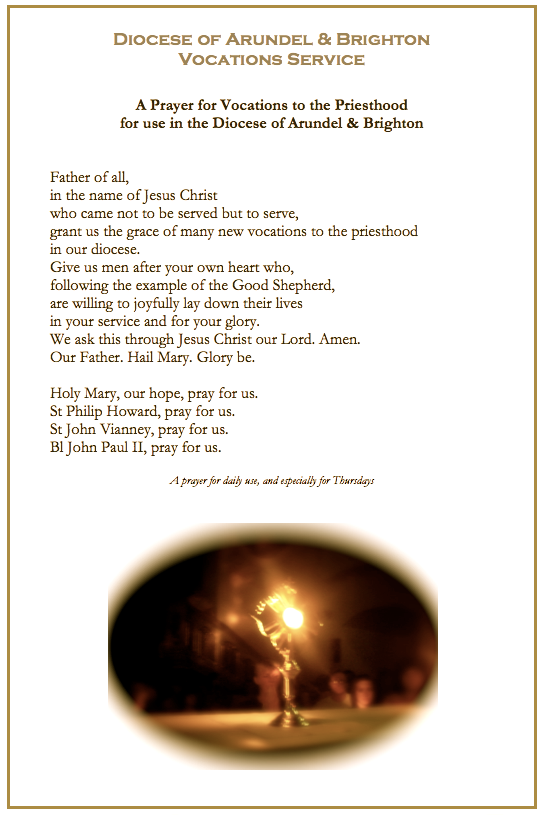
Vocations Voice

As it’s vocations Sunday today, it seems appropriate to post Robin’s talk on vocations given at 3 Masses at a parish in the diocese. 

This is my second time discerning a call to ministry. My experience of vocation began as a child within the Church of England.  I remember discussing this sense of being called with people in my church when I was about eight. It wasn’t clear cut, but a sense that there was something about my experience of being in church and watching our parish priest at the altar that drew me; that said – maybe this was something that I was supposed to do with my life. As I grew older I wanted a really clear message from God, perhaps an angelic visitation. I prayed about it for some years and when I was about fourteen and attending the ordination of a deacon coming to our parish had a spiritual experience. It seemed that the sermon at that ordination mass, which was all about accepting God’s call to service, was speaking directly to me as if I was the only person in Church. It was actually quite scary, and I thought and prayed it over wondering if perhaps God really wanted to give me some other vocation than priestly ministry. But I came to the conclusion that this was what God wanted and that if I didn’t pursue it I would always be nagged by the feeling that there was something missing in my life. So I took all this to my parish priest and began the formal process of discernment within the Church of England. I was selected for ordination while at university and spent 13 years as an Anglican priest before becoming a Catholic.

That’s a story for another time. Suffice it to say that having been a Catholic for a year and a half that sense of vocation has not gone away. So here I am, asking the Church if God is calling me to fulfil that original sense of vocation. Asking if God is calling me to a more complete ministry of priesthood within the Catholic Church.

My story isn’t very unusual and contains a number of elements that would be recognised by others exploring a vocation to priesthood.

  • I was already in the Church, worshipping, praying, seeking to develop my Christian life when I heard this call from God. If we are to hear God speaking to us we need to be first and foremost living a fully Christian life and listening to him in prayer.
  • Although it took a while to become clear my sense of vocation was specific. For me, seeing the priest at the altar, at the Eucharistic heart of his ministry, made it clear that this was where I should be. If God is calling you to a specific ministry he will make it clear.
  • The call was persistent – that sense of vocation lasted over the years while I was discerning, even when I wasn’t sure what God wanted from me – or that I wanted to say yes!
  • I took my personal sense of calling to the Church so that others could help me discern if this was really God’s will.

That’s some of my story but how does this affect you?

Firstly, I ask you to pray for all those who are exploring a vocation to priesthood at the moment and that all those God calls will be enabled to say yes. We often hear about a crisis of vocations. I firmly believe that God is calling men to the priesthood, we need to help and encourage people to respond.

Secondly, I ask you to practically encourage young men you think could have a vocation to priesthood. I might never have offered myself for priesthood either within the Church of England or the Catholic Church without the encouragement of others.

Thirdly, I would encourage any young single men here to ask themselves what God wants from them. So many of us drift through life without asking ourselves that all important question. Maybe God is calling you to marriage, which is a holy and wonderful vocation. But maybe instead he is calling you to the priesthood, to a different sort of Fatherhood. Whatever his call God is knocking at the heart of each one of us. We need to listen and discover how he wants us to respond to his loving call.

Further thoughts

Something I was thinking about last night when pondering whether or not to pursue police action was that it’s a very telling indictment of society when a concerted online bullying campaign can tip a person over the edge into depression, so much so that she can contemplate aborting her baby and this would be perfectly legal.

Tom Chivers from the Daily Telegraph wrote a thoughtful piece on bullying yesterday and how words can really hurt – they trigger an intuitive evolutionary response and can do real damage.

Using social media to bully & harangue others is an increasing menace. I can well see how others could be driven to extremes and suicide. It’s a tightrope to be walked, but where someone has clearly transgressed the limits of acceptable discourse and actually tried to interfere in another’s real life (such as in my case) then we need to think again.

When a pregnant woman is driven into depression such that abortion is mooted as a solution, something needs to change. When social media is able to whip itself up into such a misguided frenzy of moral superiority, that a pregnant woman pleading with others to stop, for them to at least provide detailed charges and evidence of whatever it is she is supposed to have done as a matter of natural justice, is met with more bullying, derision and accused of using her unborn child as a human shield – something is seriously wrong.

When a well-known pro-abort blogger with a self-proclaimed mission of exposing liars in the media, sends a string of emails accusing you of making a malicious blog comment, evidenced by “it must be you it mentions your nana, don’t even try to deny it, does your good Catholic lawyer know what kind of a person you are”, it gets to you. When he says that he will publish something defamatory about you, but is just giving you the chance to respond, it gets to you. Why should I have to defend myself against something I haven’t done?

When fellow Catholics menacingly and repeatedly comment “tick, tick, tick your time is up” and admit they are working with this person to “expose” you, refer to you as a boil who needs to be lanced, as a person in need of public exorcism, that they are looking forward to seeing you suffer, they’ve bought popcorn, and then piously proclaim that it’s necessary, everyone must pray but I must be brought to my knees in order to repent and apologise, it’s sickening. Particularly when I haven’t done whatever it is I am vaguely accused of and there is nothing to suggest otherwise.

When people are willing to destroy my family through a misguided sense of “justice” something needs to change.

We talk about living in a progressive enlightened tolerant age. Quite how civilised is it to accuse, judge, condemn and punish a pregnant woman, to revel in taunting and abusing her, for the simple fact she has, in their opinion, got above herself and is trying to build a career?

I am a mother, a wife and a university student. My husband is a funeral director on minimum wage. Two years ago we had a lovely big rectory and garden, guaranteed income and lifetime stability and a wide circle of friends and a support network.

Today we are struggling, with reduced living space and no nearby friends or family. I have no idea what the future holds, where we will be living or what schools to think about for my children. Mothers and families crave security. I sometimes find it hard to get out of the house with 2 very small children. I don’t know many people nearby and am loath to invest in friendships locally in that I’ve no idea whether or not we will be living in the area for very much longer. It’s why I had become a bit dependent on the Internet as a support network as many of my real-life friends are there.

I actively encouraged and supported my husband in his decision to convert knowing precisely what this entailed. I knew the future would be rocky and uncertain. As a result of this unfounded hate campaign we could find ourselves homeless and without a job. A zealous Catholic has already described how my university’s Catholic Society has been contacted, to find out if they knew me. The fact that I was unknown (I attend a local parish instead) was held to be damning. There has been talk of contacting our diocese to exact an apology and prevent “scandal” which isn’t commensurate with the gloating over the alleged forthcoming “media sh*tstorm”. The charges are that I pretend to be bullied whilst using this as a cover to bully others.

It’s precisely to protect myself and my family that I am seriously considering what to do next. I didn’t start blogging to build a career, I did it because I enjoyed it and it tied in with some of the previous voluntary pro-life work. It’s a shame if it has to end, but I have to put my family first.

The bully has stated his intent that this “Mallory Towers Messalina”, this “Iggy Pop in drag” should be made to withdraw from the net. To do so is to let him win. Other people have kindly said that I write some of the best pro-life stuff around. I wish that were true.

Maybe the answer is just to solely concentrate on that. The last thing I want to do is cause scandal to the Church I love and the cause I am so passionate about. I’ve been accused of being a terrible wife and mother. I am told I am neglecting them as a result of blogging or tweeting in spare moments either at home or in the university library. It’s provided a great foil to Marxist gender theory. The Internet has been a source of comfort, spiritual inspiration and support.

There is nothing like Christian fellowship, with people who cry, rejoice and share in your sufferings and triumphs. At times of trouble they bear your burdens and lift you up in prayer. (Though it is fair to note that two people who have reached out and provided comfort have been skeptics and atheists.)

The wonders of Christian fellowship renders its failure even more painful. It is always hurtful when someone says horrible things about one, but when they are a brethren in Christ, the pain is magnified. Vulnerability is a key part of Christianity. We open our hearts to each other and to Christ in order to share in his suffering, this can be wonderful.

The word “vulnerable” derives from the Latin vulneris meaning “wounded.” If you’re vulnerable you’ve let down your guard, you are capable of being wounded, which means uncharitable words and deeds are not like water off a duck’s back but penetrate through and pierce your heart and soul.

Feminists are sissies?

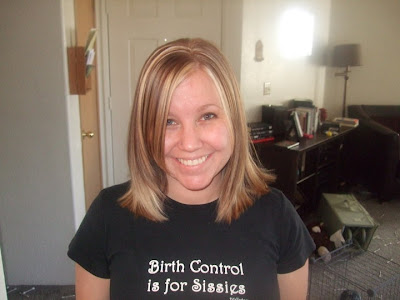
Calah Alexander, a young American Catholic convert who writes the provocatively titled Barefoot and Pregnant blog seems to have caused something of a minor brouhaha with her most recent post. She is currently 4 months pregnant, found herself in need of a maternity bra, so went out shopping wearing a t-shirt bearing the ‘offensive’ slogan stating that Birth Control is for Sissies and then had the audacity to write about the reactions she rerceived.

Though not partial to slogan t-shirts on anyone over the age of 5, I have to admire her chutzpah and bravery, having some sympathy with the sentiment expressed. As Calah is well aware from her post, wearing any kind of ideological slogan on clothing does invite a response, particularly when it is as obviously counter-cultural as denouncing birth control; combined with the physical manifestation of her belief, i.e. her emerging bump, the image and statement was especially potent.

The post was quite lighthearted in tone,(though Calah pulls no punches in terms of choice of phrase, I wouldn’t like to get on the wrong side of her), she describes the relief and transformation in discovering the effects of a well-fitting bra, the trials and tribulations of shoe-shopping and buying ice-cream with the kids, but she also describes the reaction she received from others whilst out shopping wearing said shirt, which tended from the incredulous to the downright hostile,  and ending on a humorous note, when she bumped into another mother, who recognised her from Church.

All in all, a quirky and touching blogpost from a typical American Catholic mom, sharing some of her life with us. Nothing to get offended about surely?

WRONG. As @kathleengreenwood pointed out, it spawned an entire 7 page hate-fest on a forum full of self-professed snarky mothers. The blogpost spawned comments such as “what a f*cking b*tch”, “I want to slap her across the face”, “I hate people like her, I’ll take my pill…you f*cking b*tch”. Yeah, kudos to the sisterhood! They then congratulated themselves on how morally superior they were to this ignorant fundie, encouraged and incited others to leave comments pointing out the error of her ways, and then became downright obsessive, trawling through her blog to see what other thought crimes may have been committed to the blogosphere, venting their vitriolic spleen and bile.

It seems Calah has previous form. On one occasion her little boy got rushed to hospital with severe anaphylactic shock requiring them to pay $280 for an epi-pen. They didn’t have the money, so took it out of the children’s’ Christmas present fund, thinking that a life was more important than presents and that their kids would be well catered for by the extended family. She made the heinous statement that it seemed mightily unfair that under the vagaries of the US healthcare system she had to pay a substantial amount for something that was absolutely necessary in terms of saving her son’s life, the state would not assist, however they will provide contraception and birth control free of charge, something that she feels is unnecessary, as if you don’t wish to get pregnant there’s a simple answer. She has a point, one might not agree, but it does not necessitate the level of hatred. Every detail of her life was poured over in an attempt to prove what an awful person she really is and discredit her point of view. She is obviously a liar who puts herself before her children, as evidenced by the fact that she went to a relatively upmarket department store. Her finances and entire lifestyle were subject to scrutiny.

“Her house seems nice are they really running so short they can’t buy gifts and meds? Shouldn’t they have been budgeted out or don’t they have emergency funds for sh*t happens”.

“That confused me too. I feel like it was her way of getting pity. ‘Our poor children didn’t get Christmas gifts BUT at least they have their brother’ !!! I also find it odd that they couldn’t scrounge up a little extra cash to get one or two gifts for each child  yet she now is buying decent bras and dress shoes for the kids at the mall”.

The thread reads like it’s been taken over by the below-the-line comments on the Daily Mail. How very tolerant. How very inclusive. How very pro-choice! The ernest feminists seem to have utterly missed the point. It. was. a joke. I thought that the t-shirt was rather good. It didn’t even need to be a Catholic or ideological statement, it could just have been highly ironic or self-deprecating. Ah, I forgot, I’m dealing with Americans here. One commenter noted that she would have refused to serve a woman who was wearing such a t-shirt and, she pouted, she would have been backed up by her boss. Gotta love those all-American land of the free and home of the brave values on display there. The most ludicrous comment was that the t-shirt was deliberately ‘homophobic’ with its mention of the word sissy.

Needless to say it all rather resonated. This forum made clear that they were not prepared to tolerate this woman, they hated her and all they believed that she stood for. I couldn’t help but wonder whether or not she would have elicited that reaction had she not been a Catholic?

But the statement on the t-shirt and its reaction does bear a little analysis. Why is it so hateful? Taken on face value it is a statement that proclaims that pregnancy and motherhood is difficult, not for sissies, not for the feint-hearted, but the truly heroic. Which is precisely why it upset the feminists with their “we are the strong tough fearless Amazonian pioneering women” self-vision quite so much. It implies that anyone who deliberately avoids motherhood is somehow a weaker specimen. And therein lies the paradox and antagonism at the heart of modern feminism. On the one hand it strives to be the Xena warrior princess, fearless, brave and bold goddess, stronger, bigger, bolder and better than men, yet on the other, in order to survive it also has to tap into the vying narrative of victimhood. Hence lots of outraged comments along the lines of how people would have to take hormonal birth control, otherwise their uterus would fall out, and obviously Calah, with her outrageous ideas that women can actually refuse to have sex if they don’t want to get pregnant, is slut-shaming and blaming, wishing to impose Victorian morality and blame on women. Either as women we are strong and in control, or we are not? Or is it that we want to be, but are still oppressed by the patriarchy and so have no choice other than to have sex, so must protect ourselves any way we can?

I can’t help but hearken back to that statement by Mary Wollstonecraft who saw abortion as being a consequence of women becoming weaker than they would otherwise be, if they had not been subject to sexual objectification.

“Women becoming, consequently, weaker, in mind and body, than they ought to be, were one of the grand ends of their being taken into account, that of bearing and nursing children, have not sufficient strength to discharge the first duty of a mother; and sacrificing to lasciviousness the parental affection, that ennobles instinct, either destroy the embryo in the womb, or cast it off when born. Nature in everything demands respect, and those who violate her laws seldom do so with impunity”.

Pregnancy and childbirth are at the very core of femininity which is why feminists fight so hard for what they believe is control over their own bodies. The paradox being that this physical control admits, encourages and coerces female subordination. Female fertility is a problem, something that must be repressed and overcome, the body must be stopped from carrying out its natural functions of monthly ovulation and potential to bear children. A society that continues to view women’s fertility as a problem to be solved, is a society that does not value women and places unfair expectations upon them. Whilst society continues to view female fertility and childbirth as a problem, then women will never achieve true equality. Empowerment is an illusion in that a woman is only ever empowered if she can be 100% sure that her contraception will work and is entirely happy with the notion of aborting an unwanted unborn child in case it doesn’t. Are any feminists truly happy that most women chose to abort because they feel that they have no other economic or social choice? After all we are always being told that women don’t stroll into the abortion clinic as if it were Starbucks?

Bibi Lynch tragically and bitterly captured the essence of  how it can feel to be a childless woman in the Guardian last week.

“You won’t heal – because this is deep in you. What you’re supposed to do. What’s inside us to do. What we’re born to do. And you didn’t do it.”

Motherhood is without a doubt the most joyful and rewarding experiences there is. That does not mean that it is easy. Pregnancy is often a struggle, multiple young children at times demanding and stressful, even if one does stay at home. It may not be the same type of stress as the demands of a career, but it is nonetheless challenging at times. Responding to the catty comments of Hilary Rosen that she was somehow a lesser or inferior species due to not having worked, but instead been a stay-at-home mum or to use the now un-PC term, housewife, Romney said that just because they had not financially struggled, her life as mother of five children, has not been without its fair share of struggle, including fights against cancer.

Being prepared to endure pregnancy and childbirth, being prepared to die to self for the needs of others, is a sign of great strength, not weakness or oppression. Child-rearing entails a great deal of sacrifice, physically and emotionally.

Not using birth control is a sign of strength, it is a sign of responsibility and being prepared to accept and endure the consequences of having sex. It is not a fatalistic mentality, but a working with the feminine rhythms of your body, not attempting to counteract them. It is an exercise in self-control and potentially standing up to a partner keen to get amorous.

Why did Calah Alexander attract so much hate? Because she dared to go against and question a feminist mantra and by doing so demonstrated that she is stronger than others who (for perfectly legitimate reasons) have decided not to have more children. Anyone who cannot cope with a humorous slogan on a t-shirt that has a grain of truth and challenges a deeply cherished orthodoxy and is so moved to incite and spew tirades of loathing and spite, is not as tolerant and pro freedom of choice as they would claim. Anyone who feels so defensive as to chuck indiscriminate hatred and wish violence upon a total stranger because they disagree with a point of view is a bigot. Why have they reacted so strongly? Because they feel ‘judged’.

All of which proves that Calah was right all along. They really are sissies.

Blessings of children

It was with a sense of dismay that I read the posts over at Father Z and The Deacon’s Bench, regarding the issue of whether or not children should be given blessings during the distribution of the Eucharist. My initial knee-jerk reaction was “oh no, not another thing I’m doing wrong, gosh these traddies ARE strict and it does seem rather mean-spirited”.

The arguments against not giving children blessings are however logically coherent. Firstly and perhaps most importantly, it is not in the rubrics. Whilst it may not be the most serious of liturgical abuses, it needs to be remembered that the liturgy is at the centre of our faith and as Cardinal Burke noted last year we must ensure that the Eucharist is entered into properly , according to Church norms, if we are not to weaken or lose our faith.

Secondly, the blessing of children seems to have its roots in a very Anglican practice, namely that all are welcome around the Lord’s table. Wonderful as this sounds, the Eucharist is no mere symbol, it is the body, blood, soul and divinity of Our Lord Jesus Christ. He offers himself to all however we have to ensure that we are in a state to receive Him and not guilty of mortal sin. Whereas in Anglican churches sidespeople enthusiastically shepherd all members of the congregation to the altar, row by row, either to receive communion or a blessing, there is reason why this practice does not occur in Catholic churches. The responsibility remains on the communicant to decide whether or not they should present for communion, as to partake of communion in a state of mortal sin or not believing in the real presence is an offence against God himself as it profanes the Eucharist.

This is why it is important that not everybody is herded up en masse to receive as to do so places undue pressure upon those who may not be able to receive for a multitude of reasons, such as not having observed the Eucharistic fast or perhaps already having received the Eucharist twice that day already. If everyone is always encouraged to traipse up to the altar then those who must not receive the Eucharist may well receive out of either habit or fear of what others may think.

To take children up to the altar during communion can foster a misleading attitude in terms of how we think of the Eucharist. It is not simply about us, but about God meeting with us, not something to which we are entitled, but something which is freely given, of which we must ensure that we are worthy of receiving.

I can identify with Fr Cory Sticha when he says:

“One of the arguments frequently given in defense of blessing children is, “They feel like they get something.” Yes, because we wouldn’t want our children to learn how to do something without getting something in return.”

On the occasions where we have attended the Extraordinary Form of the Mass, my eldest has got quite indignant that she has been instructed to stay behind in the pews, “it’s not fair” being the refrain, she feels excluded and of course all children of a certain age want to join in with what their parents are doing. Whilst it is undoubtedly character building, given the practice goes on in the Novus Ordo, it’s another (minor) barrier for us in terms of exploring the Extraordinary Form. The eldest hates it, has no idea what is going on, finds it unintelligible and she’s not even allowed to join in for a blessing.

I’m not sure whether or not I agree with the sentiment that often parents want the children to go up because it gives them the warm and fuzzies. Whilst this may be the case in some families, the eldest went through a prolonged shy period until she was about six and I had no desire to trundle up a truculent child, ensuring that she kept her arms in the requisite crossed position or didn’t shy away from being touched like a scalded cat before eagerly dashing back to her seat, but we did so, not knowing any better, thinking it was the done thing. I’m not particularly comfortable with the blessings distributed by the extraordinary ministers of communion either. But then again I’m not entirely comfortable with extraordinary ministers of communion distributing the body …

On the other hand, when one listens to the blessings that are given out to the children, they are certainly not priestly or sacramental, being somewhere along the lines of “God bless you dear” or “May the Lord Jesus bless you and keep you safe”. They are carefully worded to ensure that there can be no confusion that this is a sacramental or “official” blessing. In which case what on earth are blessings doing during the distribution, particularly given that they are wholly unnecessary, a blessing is given to the entire congregation at the end of the Mass?

There’s also the issue of very little children such as ours. If the baby is left in her car seat during communion, she wails inconsolably fearing permanent abandonment and disturbs the peace of the others; if the toddler is not firmly manacled or forcibly velcroed to an adult during communion, she will run off to begin disassembling of the Easter garden or the shrine to our patron saint. We have very little practical choice other than to take them up with us. So of course when faced with my beaming brood of Botticelli cherubs any priest with half a heart will naturally want to give them a little blessing…And why not?

The formidable Elizabeth Scalia has reminded me of why I don’t eat peanuts in bars, when she questions the hygiene aspect of the practice – the priest will touch little Xavier on the head or face prior to to dipping his hand back into the ciborium to dispense the Body to the next person. Not something that is worth dwelling upon in any great detail. The Church should not be stingy with blessings she argues and sits on the fence, blessings of children, is not something that we should get het up about either way, it should be an individual matter for each parish.

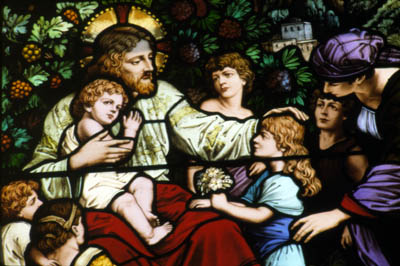
I’m not sure that I agree. Whilst not to bless children seems very much against the spirit of Mark 10:14, it is not as if the children are being forbidden from getting to know Christ and building a relationship with Him. It is precisely because of the reverence in which the Church holds the Eucharist that it prescribes the certain conditions under which one is eligible to receive. We are not telling children that they are exempt from the Eucharist or the altar for ever, in fact we are teaching them a valuable lesson in terms of its importance.

What is important pastorally is that there is consistency, i.e that practices and customs do not vary from parish to parish and priest to priest, causing confusion, upset and hurt. It would therefore be helpful to see some official clarification from the Vatican one way or another. Technically this should be a piece of cake next to Summorum Pontificum. But then again, as my husband and countless clergy will testify, some of the biggest causes of fallings out amongst congregations are where precious offspring are involved. Perhaps this is one of those battles that just isn’t worth fighting?

Update:

Joseph Shaw has written a detailed post that outlines precisely how this practice contravenes the rubrics. A few important points come to light, firstly that the blessing of children was never outlined in the list of liturgical abuses described by the Blessed John Paul II, which means that secondly, the majority of the faithful are unaware as I was, that this should not be customary.

One of his commenters raises a point that I was thinking of when writing the post. Many non-Catholics and/or those not permitted to receive communion often come to receive a blessing in good faith, as a sign that they are making a spiritual communion. Indeed the celebrant often invites them to do so. In the light of this it seems that official clarification and pastoral advice is overdue.

40 days: what did you do?

Here is a round-up of coverage from the 40daysforlife vigil in Bedford Square on Friday night. There seems to be some disparity about numbers. I blogged the numbers who attended, using the figures tweeted by Madeleine Teahan from the Catholic Herald, who live-tweeted from the event with the dispassionate eye one would expect from a professional journalist. Joseph Shaw has an entirely different perspective. Joanna Bogle wrote the most poignant and moving account of the vigil that I have read, professing her overwhelming sadness with regards to what she witnessed. She encapsulated what most of us feel.

What struck me from all the coverage that I have read, is the contrast between the two sides, not only in terms of overall attitude, for the most part it seems that those attending the vigil were attempting to peacefully pray in silence as opposed to those determined to make as much noise as possible with the aim of disrupting the vigil, but also the  contrasting diversity in terms of participants on both sides. From what I can gather, there was a wide spread of people attending the 40daysforlife vigil, from the very young, even the unborn in the mother’s womb, to the old, people of difference race, gender and class. The pro-abort demonstration seemed to consist of predominantly middle class angry white young women and men.

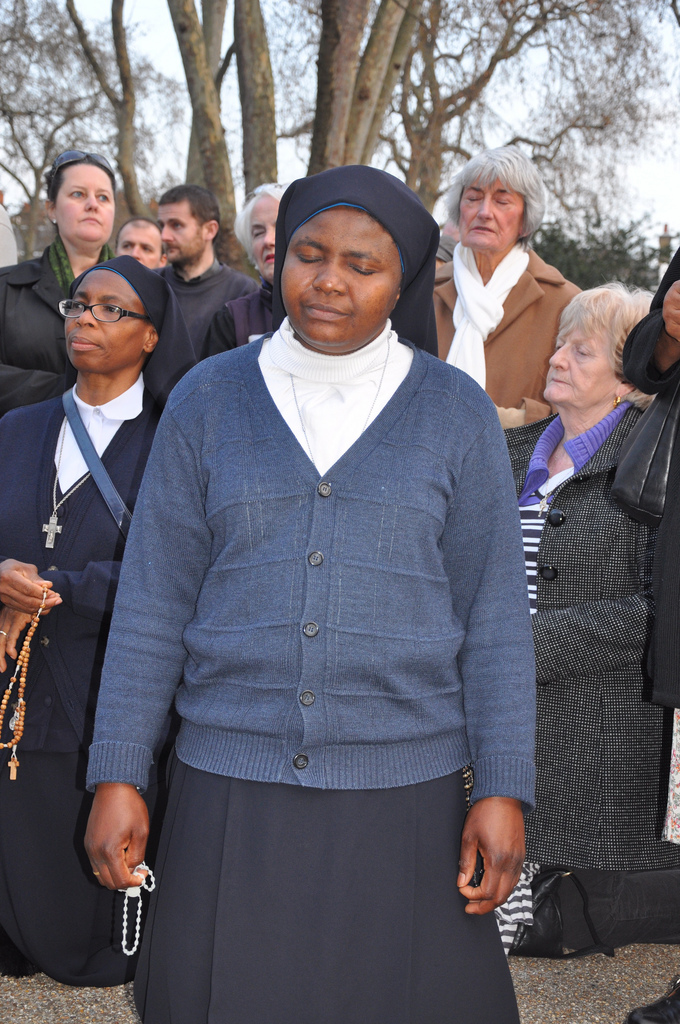
The twitter feed of those on the pro-abortion protest seemed to indicate that the majority of protestors were men, but that reality certainly doesn’t seem born out by the photographs. This beautiful woman doesn’t look much like a “creepy old man” to me. I note, despite being very prominent at the front of the vigil and indeed prostrating herself in prayer, by all accounts for much of it, the pro-choice demonstrators didn’t see fit to make fun of her, unlike with the “horrid old men praying”. I wonder why that would be:

Creepy old man?
Provocative?

We should all be glad that the vigil went off peacefully, it would be disingenuous to state that all of the participants on the 40daysforlife vigil were faultless, there were two reported incidents where people were not threatening but were perhaps reckless, perhaps understandably in the face of such raucous, confrontation and provocative behaviour, one planting a placard containing a photo of the unborn child in the crowd of pro-abortionists, the other apparently using his rosary in a provocative fashion. Frankly the mind boggles, it sounds like something out of Monty Python, only not as dangerous as the Holy Hand Grenade of Antioch and rather telling that people might be frightened of a rosary, but whatever happened it wasn’t the most sensible, given the explicit instructions that were given by the organisers of the vigil not to engage with the protestors in any way at all.

It’s obviously very difficult for the organisers of the vigil to physically remove somebody who isn’t abiding by the rules, the most that can be done is to ask them to desist and/or leave, keeping the peace is largely a matter for the police, who are not going to arrest someone for over-enthusiastic jangling of a rosary. That’s not to say that there is room for complacency, though 40daysforlife deserve our congratulations and thanks for their brave witness, as do the participants, it seems fair to comment that once Holy Week is over, there needs to be some sort of official debrief of the campaign if one has not been planned already. It would be helpful to review events, strategy, organisation in order to see what worked, what could be improved upon and to ensure that participants do stick to the rules in order that they are not left open to allegations of harassment. Having witnessed the vigil in Brighton on a couple of occasions now, without actually participating (it’s very difficult for me to arrange childcare for 3 children during the Easter holidays and my younger 2 are simply not up to sitting still in a buggy for an hour on a busy road) having sat in a car with the DVD player on and watched and prayed a rosary from a discreet distance, or played with the children in the park opposite, I have to say that it is my observation that no women are hassled or harangued whatsoever. At most 4 people stand under a banner with a sign saying, we are here to help. I have a copy of the newspaper that they offer out – it is devoid of graphic imagery and there is no incorrect or misleading scientific information. Passers-by are asked if they would like a copy of a newspaper – that is all. It seems to be members of the general public that approach those on the vigil rather than vice-versa. There’s been no cameras or videos that I have witnessed. The other day there was simply a solitary man stood there in the pouring rain, getting very wet as he prayed. I know several of the regular attendees of the Bedford Square vigil who are not in the business of hassling women. One man, who we all know very well, featured in several articles in the Daily Telegraph and Guardian. This man is so very frightening that on the occasion I attended the Michael Voris talk in London, he was thoughtful enough to realise that I would be bringing my young baby who I was breast-feeding, rang me on the train and asked if he could meet me to help with the buggy etc as he was worried I might be struggling. A young single man in his twenties, who spent much of the time cuddling my baby or little Miss Pidge as he called her. Not the vicious, intimidating thug insinuated by the glut of photographs, which made me giggle and indignant at the same time. Other friends of mine who attend are again, not the bullying type and would refuse to be associated with an event that included the haranguing of women. All of them categorically deny ever having witnessed any members of the vigils filming. Frankly I know who I am minded to believe.

There have been criticisms of the man who was apparently filming, but 40daysforlife have disassociated themselves from this and the person was asked to refrain from repeating his actions. 40daysforlife have come in for repeated criticism with regards to this incident and how they handled it. Whilst it is almost impossible to physically stop people from filming and leave a public area, if they are not breaking the law, perhaps the PR could have been handled more professionally.

What has utterly dismayed me however, is that some pro-lifers seem to be revelling in criticism of 40daysforlife and keen to denounce their every move. What has shocked and dismayed many, is the criticism levelled at 40daysforlife by people who simply were not there, either during the campaign itself or at Friday night’s vigil. Any of us can be a keyboard warrior and opine on the internet, but it takes guts, courage, determination and commitment to set up and run a campaign like 40daysforlife. What Robert Colquhoun has done deserves the utmost respect, admiration and praise. As I said previously, he is not a professional, he is not paid to run 40daysforlife, he has a day job and other commitments, but he does it because he committed to the concept of prayer and fasting to end abortion.

I don’t actually want to criticise Robert because I think he’s done an absolutely marvellous job. He is a saint who puts most of us to shame. We can all opine about 40daysforlife, who should run it, how it should be run, if it should exist at all but to me the man is a hero, because he got off his backside and actually did something. He has mobilised many many Catholics in this country to actually come together and pray for an end to abortion as well as unite various groups in order to offer support for women who may change their mind at the presence of those praying on the vigils. Catholics have been crying out for years in frustration and impotence in terms of actually being able to “do” anything to help save the unborn – 40daysforlife have harnessed and mobilised that desire.

There may be questions about whether this should be a diocesan controlled event, who should be in charge, how it should be run, strategy, whether or not it is a manifestation of deep fissures in the pro-life effort that need to be resolved, but at least it’s a start. There may be many problems and issues, but why not use 40daysforlife as a starting point – keep what’s good, tighten up on procedures, have the campaign more tightly organised and stewarded, but it’s been an excellent foundation, it’s raised awareness and certainly got the pro-aborts concerned. Babies have been saved and women have been helped, maybe not in the vast numbers that critics would like to see in order to keep them statistically satisfied, but there is no doubt that women and babies have been helped. Better some than none. There is one not very far from me, who had it not been for the presence of 40daysforlife would have aborted, feeling that she had no other choice and by her own admission, probably would have ended up committing suicide as a result. She desperately wants to keep her baby and people are doing their best to ensure that she is supported in that.

40daysforlife has always been a lay initiative. If it needs to be improved, consolidated and have slick professional full-time PR or employees such as groups like Abortion Rights, then that needs both time and money that are in short supply. Perhaps ways can be found to help them? But rather than publicly carp about perceived faults, why not celebrate and applaud in a spirit of charity all that 40daysforlife have managed to achieve? Why not try to work with Robert and his team, instead of public critique and handing out ammunition which has been eagerly seized upon by the pro-abort campaign? It was heartening to see so many foot-soldiers turn up on Friday, rather than wannabe generals.

Instead of criticising, carping, using this as an excuse to air deeply held grievances against “enemies” (and really no Catholic should be in the business of making enemies of anyone, let alone other Catholics) why not offer this expertise and knowledge to help improve the campaign and make it better? 40days sprang up to fill a definite void in pro-life action, it gives people an opportunity to be pro-active and “do” something. We can all disseminate and bemoan the reasons why the void existed in the first place, but how does that really help us going forward? What does that achieve other than negativity? Perhaps the CBCEW should get involved, or donate resources, but actually what we should all be doing is congratulating 40daysforlife for what they achieved to date, not with complacency, but with a genuine, honest eyes of charity and love and getting involved in whatever way we can, if we feel as passionate about pro-life as we claim.

When I look at Robert Colquhoun and what he has done and when I look at what I have done, I feel nothing but awe and a sense of shame that I’ve only really, thus far, been able to opine on the sidelines, although I have contributed in other ways. I have providentially been inspired, to find ways of helping out locally with those who were on the 40daysforlife vigil in Brighton. It is an exciting time for us locally. We have big plans afoot that don’t involve the perceived harassment of women but constructive, positive, practical support and help. The abundant graces that flow once one has made a decision to chose life are innumerable.

It is Holy Week, a time of reflection and preparation, how did Lent go for you, if you were pro-life what did you do? Join the vigils, or if you could not, did you pray at home, fast, give alms for an end to abortion? Did you get off your backside and actually do something positive and make an effort? Or did you just sit on the fence or alternatively carp, criticise and opine at one end of a keyboard?

Lost liturgical heritage

I was minded to look at the newsletter from my old school earlier and have taken the inevitable trip down memory lane. One of these days I really should knuckle down to writing a pseudonymous autobiography, however what jumped out at me was the invitation to attend an Easter celebration at the school, for an “afternoon of creative liturgy and sharing of the Paschal journey”.

This sums up my liturgical background quite neatly and why, unlike some Catholic bloggers, I rarely write about the liturgy, because put very simply, I am liturgically illiterate, for a variety of reasons.

Although technically a cradle catholic, my grandfather was a benefactor of and greatly involved in the rebuilding of Buckfast Abbey, where he is buried and where I was baptised. My mother is a lapsed catholic; she is of the generation who was misled by the press and her priests and felt a great deal of hurt and disappointment when Humanae Vitae was issued. My father was, although he claims he is now lapsed, a staunch Anglican and a fierce admirer of Martin Luther, “one of the greatest men who ever lived”.

Thus my upbringing or Christian formation was far from conventional, religion was barely mentioned, let alone practiced at home, apart from the regular arguments between my parents as to who was the most wicked of the Tudor monarchs and whether Mary or Elizabeth numbered a higher heretic body count, when both would become amusingly tribal. I have a vague memory of asking why lying was wrong and being told that “Jesus doesn’t like it”, which meant nothing and later on in my teens, repeating in an RE essay, my mother’s mantra that the Pope was really very wicked owing to his stance on condoms, in the attempt to be the cool kid and stir up a bit of controversy. But other than the Pope being wrong on contraception, Smithfield bonfires and the merits of Martin Luther, religion didn’t feature at all in our house, unless it came up in the context of school.

My father is rather a fine organist and played for 30 years in our local C of E parish church as well as leading the choir, hence my sister and I were both recruited to join when I was seven and we regularly attended the morning service and Evensong (complete with a copy of the Enid Blyton to read during the boring bits). Evensong seemed to consist of lots of old tone deaf people warbling, hurried putting down of a book, standing up, turning 90 degrees, singing “Glory to the Father and to the Son, And to the Holy Ghost. As it was in the beginning, is now and shall be forevermore Amen”, before settling back down to the book again, before another bout of singing. Not to mention burning fingers on the hot water pipes underneath the choir stalls where the books were quickly stowed.

I had absolutely no idea whatsoever that I was a Roman Catholic, or what that meant, until my sister started secondary school, at the local private Catholic boarding school. I remember the night before she started, her hurriedly being taught how to make the sign of the cross, in true nuns on the run style. My mother literally told her, “my father used to have a funny rhyme, spectacles, testicles, wallet and watch”, before dissolving into peals of laughter. She was instructed to take communion, simply by joining the queue and copying what everyone else does. When we went to the obligatory Masses on Parents’ weekends etc, I was horrified. Though my parents were totally charmed by the Headmistress in full Joyce Grenfell swing during the pre-Mass warmup of hymn singing “C’mon gels, give it some welly”, it all seemed very evangelical or Pentecostal to me. I equated Catholics with Gospel choirs and the Kenny Everett character with the big pointy hands.

My father was torn between abhorrence, embarrassment and hilarity. He chose the latter. One of the things that I’ve always admired about my father is that from an early age, he always taught me to think for myself and not to give two hoots about what anyone else ever thought. He never does. So during Mass he would literally hold his nose and belt out “Our God Reigns – Down the Drains” or “Jubilate Have a Chapati” as loud as he possibly could, before cackling evilly adding “utter tripe” in a not-so-sotto voce.

When I started at the school, my sister and I were summoned to a meeting at the Rector’s house one Saturday morning. He made the point that given we were both baptised Catholics, yet we regularly attended his church, a decision really needed to be made as to what denomination we were going to be. I was happy to stay as a C of E, the music and weirdness of the nuns at my school frankly terrified me, I had absolutely no interest in being a Catholic whatsoever, but obviously a decision needed to be taken about confirmation. We came home rather confused, told our parents that we had been told to choose, whereupon my mother, who has an inbuilt terror of nuns and consequences of not doing what we were told, rushed off to Sister Mary Francis, who decreed that we absolutely must be Catholics and therefore attend Mass with the boarders every Sunday morning.

So that’s what happened and subsequently I became a boarder. I never had any catechesis or took First Holy Communion, I simply lined up and copied what everyone else did. Genuflecting was never explained, it was just something that we all did in rows upon leaving the school chapel, and it took me years to work out what ON EARTH was that funny thing people did at the start of the Gospel. Why did everyone scratch their nose, chin and neck. I copied doing a funny thing with my thumb without having any idea what it was I was supposed to be doing and hoping that no-one would ever notice. I don’t think that they did.

Despite being an ostensibly Catholic school, there was absolutely no catechesis whatsoever. We all had to take Religion as a compulsory GCSE, but no talk of sacramentals whatsoever. The nuns seemed to do their own thing, so long as everyone went to Mass every Sunday and on Feast days that was it really. I don’t really remember much teaching on Catholic ethics either. It did feature as part of the GCSE, we covered abortion and euthanasia, but that was about it. Contraception was certainly talked about and covered in great detail. We had several informative talks from the local FPA clinics, we all knew about the methods that were available then, about condoms, the pill and the signs and symptoms of STDS, but no-one ever told us not to go and have sex, or that sex was evil, dirty and wicked, contrary to common perceptions about Catholic schools.

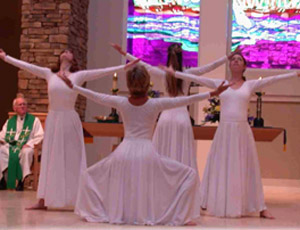
The liturgies were chock full of Taise, Farrell and Christopher Walker. We weren’t averse to the odd bit of liturgical dance. Once, as a punishment, from what I recall, a group of us were recruited to join Mr Reece’s Morris dancing club, in which we had to learn to Morris dance in time for the Christmas Carol service. I can never again hear “O Little Town of Bethlehem” without chanting rhythmically “step – caper” at the end of each line. Yes, Clare P and I danced, complete with strap-on bells, jangley sticks and waving of handkerchiefs in the Sanctuary in front of the altar. As did the modern dance group during the Good Friday liturgy. Nobody knew any different.

I could relate various anecdotes for hours, one of these days there is an autobiography dying to be written, but needless to say it was guitars galore. At Easter, everyone, day-girls included, had to stay for the entire weekend, engaging in various Easter activities, from baking Easter chicks with the hard-pressed kitchen staff, to desert island discs in Poles’ common room. (Sarah Askew very daringly brought along Madonna’s Like a Prayer, radical rebel that she was, and I thought it was cool and hard to bring It’s a Sin, by the Pet Shop Boys). There was some bizarre bonfire type activity as part of the vigil, involving people dancing around it in a manic fashion, pretending to be drunk on mulled wine and singing “We are an Easter People and Alleluia is Our Song”. I cringed, wore a black spotty shirt from Kensington Market on top of a Cure t-shirt and pretended I was cooler than the rest of them to hide my embarrassment.

So, given all of that, the fact that I am now a practicing Catholic, is something of a surprise. This is not a post for conversion story, but amusing reflection and reminiscences aside, I actually feel really rather cheated. I appreciate all of the intellectual arguments around the Extraordinary Form of the Mass, but I find it really hard to “get into”, probably because a trendy Novus Ordo is all that I am used to. The demands of young children don’t make this any easier, it is hard enough to concentrate, focus and pray at ANY form of the Mass, when you have 3 children to be keeping an eye on, and because my eldest isn’t used to the extraordinary form either, she finds it terribly boring. I am normally too self conscious about noisy babies and toddlers ruining the silence for other people, to get into the habit of attending. It’s one of the things, I have promised myself I will seriously explore when the children are a little older.

Though I have largely outgrown the happy-clappiness and charismatic music of my schooldays, I prefer the commons all sung and preferably in Latin, this has been an acquired taste, as has plainsong, which has as much to do with my father’s own musical tastes, than any Catholic upbringing. There are many Catholics of my age and older who have experienced, if not as zany, a similar liturgical upbringing. The Novus Ordo is what we are used to, and the Extraordinary Form, just seems alien. Pope Benedict has done much in terms of liturgical reforms, however it isn’t all filtering down to Parishes. The sung vigil Mass on a Saturday night in my parish is an altogether different and more preferable experience to the Sunday morning service which is tailored to families and seems to feature the same four hymns.

It’s a very hard balance, “One more step along the way I go” may be a crowd pleaser, but the problem is, for people who are brought up solely on this stuff, they are missing an important part of our cultural heritage as Catholics. It is not for nothing that we are part of the Latin rite. I am fortunate, in that unlike many I did Latin GCSE at school and hail from a musical family, so the chants are not unfamiliar, my father is also an aficionado of plainsong and high church liturgical music which was passed down to us as children, but for many, “If I were a butterfly” seems a perfectly reasonable thing to be singing in Church.

At the moment there seems to be a rather unnecessary divide between those who would prefer the EF Mass and those who are terrified that it’s going to become compulsory and must be stopped at all costs. I’m not sure that I understand it. In my world it would be horses for courses, those who want the EF should be able to access it as they wish, equally the Novus Ordo should not be spurned for those of us who have grown up with it and can’t quite get to grips with priests facing away from us, a silent canon and lots of incomprehensible gestures. But what we do need to ensure, is that non of our culture, none of our rich liturgical heritage is done away with. Having the Mass in the vernacular is one thing. Holding hands around the altar whilst singing the Caribbean Our Father quite another.

Rather than polarise the two camps, it seems sensible to keep the EF, but also gradually reform the Novus Ordo in order to more properly reflect the changes of Vatican II and get rid of the liturgical abuses that sets everyone’s teeth on edge. In that way, the EF may become more accessible to many and seen as complement, not a threat. The Lord is equally present through the sacrament at both kinds, even though the Heavenly Host may not be singing Colours of Day.