A propos of nothing, I was re-reading my way through arguably one of the Church’s finest pieces of social teaching, Pope Leo XIII’s great encyclical Rerum Novarum when the following passage, perhaps providentially jumped out. It answers much of the argument amongst Christians, not only as to whether or not ‘gay marriage’ is permissible, but also addresses the concerns of those who believe that by stressing family as being the purpose of marriage, apologists and defenders are perhaps being utilitarian and not Christian in approach.
In choosing a state of life, it is indisputable that all are at full liberty to follow the counsel of Jesus Christ as to observing virginity, or to bind themselves by the marriage tie. No human law can abolish the natural and original right of marriage, nor in any way limit the chief and principal purpose of marriage ordained by God’s authority from the beginning: “Increase and multiply.”(Genesis 1:28) Hence we have the family, the “society” of a man’s house – a society very small, one must admit, but none the less a true society, and one older than any State. Consequently, it has rights and duties peculiar to itself which are quite independent of the State.
Also whilst we’re on the subject, a blogger known as ‘gentlemind’ has posted a wonderful Q&A demonstrating how marriage exists to bind procreation to parenting. Crucially:
The cost of inventing the legal fiction of same-sex marriage is that we will have to legally pretend that parents and children are not physically related. That is what happens when we seek to legally redefine nature: nature legally disappears.
*Reader discretion advised – this post contains discussion of an adult nature*
Fr Tim Finigan has blogged along similar lines to my post of the other day, detailing the type of material that could be used in schools, if the ‘Equal Marriage Bill’ is enacted into law. Teachers and parents who object to having detailed descriptions of anal sex or homosexual practices on the curriculum may be compelled to accept it in the classroom or face legal consequences.
For those who haven’t the constitution to read about the ins and outs of ‘bum fun’, couched in gay street parlance (and to be fair this specific booklet is not aimed at schoolchildren, they would most likely get a watered down version minus some of the expletives), I’ve read it for you which required much clenching of cheeks alongside a dose of mind bleach. This is the trouble with viewing sexually explicit material. Visual images are extremely powerful, they burn and imprint themselves into the brain, you can’t actually ‘unsee’ them and this really isn’t something we want young impressionable children or teens to be seeing and automatically associating with sex. ‘Anal Play’ does not come without considerable risks, listed at the end of this post.
Though diseases and injuries resulting from anal sex occur far more frequently in homosexual men, this practice is not restricted to men – it is becoming increasingly mainstream and is prominently featured on the most popular adult heterosexual porn sites. This is a problem in that young men are now beginning to expect it as par for the course from their girlfriends; that teenagers are drawn to exciting, exotic and dangerous practices which make them feel more grown-up , is not a new phenomenon and teenage girls report that they are under increasing pressure to conform to sexual pressure not only in terms of engaging in activity, but also in terms of performance. Furthermore, some young men who are experiencing same sex attraction, whether fleeting or permanent, report feeling under pressure to experience anal sex in order to be ‘real’ or ‘authentic’ gays.
Speaking in an article for Jezebel(caution a soft porn image and graphic discussion) a popular online feminist journal, Hugo Schwyzer a Professor in gender studies, tries to explain the seeming rise in popularity of the practice, which seems to me to be a symptom of feminism, in terms of the record levels of anxiety that young women are experiencing and how cultural sexual expectations of females have increased considerably over a relatively short time. Women are routinely expected to undergo increasing amounts of physical pain (such as intimate waxing) and extreme dieting, in order to fulfil male ideas of beauty – that this extends to sexual practices is hardly surprising. But at least there is an admission that this a painful business along with the acknowledgement that it is this causation of pain that is most stimulating and satisfying to the male.
And more than any other sex act, anal simultaneously symbolizes both the capacity to push through suffering and the willingness to please. For a generation uniquely acclimated to pressure, anxiety, and pain, it’s little wonder that this once taboo act has become so celebrated, so popular, so expected.
Almost invariably, the camera focuses on the young woman’s grimaces. More so than with any other sex act in mainstream heterosexual porn, in depictions of anal sex there’s an explicit connection between women’s discomfort and male arousal.
Is this really the authentic and joyful vision of sex that we want to be instilling into our children? An idea that has more to do with twisted, subverted desires and concepts of pain, domination, control and submission than the idea of mutual self gift?
Discussion of sex and sex education is a total minefield for Catholics, not least because as I am painfully aware in writing this post, we don’t want to titillate, be gratuitous, cause scandal or lead others astray. We know what we don’t want to see – like all parents, whether they admit it or not, we are disturbed by the idea of our children being given chapter and verse on sexual practices and techniques, which is wholly unnecessary. As John Paul II wrote in Love and Responsibility:
This is where the ‘culture of marital relations’ comes in and what it means. Not the ‘technique’ but the ‘culture’. Sexologists often put the main emphasis on technique, whereas this should rather be thought of as something secondary, and often perhaps even inimical to the purpose which it is supposed to serve. The urge is so strong that it creates in the normal man and the normal woman a sort of instinctive knowledge ‘how to make love’ whereas artificial analysis (and the concept of ‘technique’ implies this) is more likely to spoil the whole thing, for what is wanted here is a certain spontaneity and naturalness (subordinated of course to morality).
But we are scared to discuss this for fear of appearing homophobic or even sexually repressed, whereas the reality is that it’s not as simple as worrying that this type of intimate sexual education may, to use the unfortunate term ‘gayify’ children, for which there really is no evidence, simply that we do not want to normalise or give tacit encouragement to a sexual practice that is as harmful to women as it is to men.Given there is a spectrum of sexuality, we do not want organisations such as the Terence Higgens Trust or any sex educators misleading children into thinking that a fairly common fleeting but intense same-sex crush is indicative of a fixed sexuality or that children should seek to define themselves in that way, or sexually explore those feelings.
Laurence England has written an extremely courageous post outlining an experience of sexual abuse as a youngster, which he believes contributes to his same-sex attraction – his abusers being little more than boys themselves. Teaching children about sexual experimentation is not only unnecessary, it also contributes to the hyper-sexualised culture and pressures that are placed upon teens, as well as encouraging them to experiment sexually amongst themselves. If children are taught that they should explore their emerging sexual desires, it logically follows that they may well enculturate other younger youngsters such as in Laurence’s case. It also makes life very difficult in terms of protecting children from exploitation by adults. The recent appalling cases of child sex rings in Rochdale and Oxford, whereby social workers ignored the fact that children were working as prostitutes, deeming them to have made their own sexual choices, stems from such a policy of mistakenly assuming that children and adolescents should have sexual agency. That Peter Tatchell deems it appropriate to lower the age of consent to 14 and has lobbied No 10 to this effect, is cause for concern. Why is a 13 year old able to consent to sex with a 16 year old but not a 19 or 20 year old? And of course that will be the next logical progression, if any such decriminalisation were to occur.
Rather than simply saying that we don’t want this type of material taught in schools, Catholics need to be able to explain why and that this is not born out of the dreaded homophobia or obsession with what other people are up to in the bedroom. Let’s take another fairly niche practice – BDSM, which can take many light or heavier forms. If there was a push to have this as part of the sex education curriculum, there would be an outcry. If educators took the view that people are inevitably going to try it, everyone has read 50 shades of Gray, and so children may as well learn how to do it safely and consensually, we would rightly be horrified. It’s not that anyone is phobic of, or has hatred for those who wish to engage in fringe sexual behaviour, what folk get up to in the bedroom is their concern and theirs only, but the state should not be giving tacit encouragement to or promoting this in schools. After all the Terence Higgins Trust leaflet is aimed at those on the scene, why not continue to target those already engaged in sexual activity and give advice as to safety as required, instead of steering young people in that direction.
And why do schools need to make such a big deal about teaching sex anyway – by the time they’ve clinicalised it and endlessly discussed it and talked children into using hormonal contraception and condoms etc, no wonder it’s lost half its allure and fun and children then feel the need to go and try something bit stronger, more grown-up and edgier, whether that be anal intercourse, unprotected sex, multiple partners or group sexual activity.
Enough to give anyone a headache.
Some discussion of sex in schools these days in unavoidable and probably rather sensible. The question needs to be, what vision should we be presenting to children? The idea that sex-education can be morally neutral is a fallacious one. Sex education is always taught from an ideological viewpoint – an allegedly neutral stance which allegedly imparts only facts, is an ideological viewpoint in itself, leaving the decision as to when or whether to start sexual activity up to the individual. It is the moral relativistic stance of ‘whatever is right for the individual’. Children and adolescents possess neither the emotional intelligence, the wisdom or experience to make wise choices in a moral vacuum. Even the so-called ‘relationship advice’ does not advise children other than to tell them that they should wait until they feel ready, which is meaningless. When are you ready to have sex? When you are ready to face the consequences that a baby might occur from such an encounter and both partners are ready to take on the responsibility of raising a child together.
But all in all carrot needs to accompany stick and carrot is generally a much better tactic in terms of motivating and encouraging people to reach their aims and goals, rather than a tactic that consists of scare-mongering, i.e. you’ll get pregnant, an STD and here are the harms caused both to your body and the environment by hormonal contraception…
Catholics and Christians are rather poor at presenting a positive vision of sexuality, instead appearing like a bunch of miserable party-pooping puritans out to spoil everyone’s fun. It all seems to be about ‘thou shalt not’, rather than the beautiful, authentic, joyful, wonderful vision of sex, love and sexuality by our faith. We should be shouting this from the rooftops. Catholic doctrine on sex is fabulous stuff, it’s not about power, domination, submission, control or cultural expectations of beauty and behaviour but about mutual self-gift, taking delight in the other and real love, a love that is not solely based on selfish personal sexual satisfaction, but a love based in body and soul. It’s heady and empowering stuff that really does set you free.
Here are some more extracts from Love and Responsibility:
From the point of view of another person, from the altruistic standpoint, it is necessary to insist that intercourse must not serve merely as a means of allowing sexual excitement to reach its climax in one of the partners, i.e. the man alone, but that climax must be reached in harmony, not at the expense of one partner, but with both partners fully involved.
There exists a rhythm dictated by nature itself which both spouses must discover so that climax may be reached both by the man and by the woman, and as far as possible occur in both simultaneously.
There is a need for harmonization, which is impossible without good will, especially on the part of the man, who must carefully observe the reactions of the woman. If a woman does not obtain natural gratification from the sexual act there is a danger that her experience of it will be quali- tatively inferior, will not involve her fully as a person.
A woman finds it very difficult to forgive a man if she derives no satisfaction from intercourse.
The natural kindness of a woman who (so the sexologists tell us) sometimes ‘shams orgasm’ to satisfy a man’s pride, may also be unhelpful in the long run.
There is here a real need for sexual education, and it must be a continuous process. The main objective of this education is to create the conviction that ‘the other person is more important than I’.
Not the kind of stuff that one would expect from a celibate old man in a dress! The reason that I, and I suspect most Catholics who have read anything of Theology of the Body, feel so strongly about sex education in schools is not only because it is the parents’ primary duty (and why aren’t schools empowering parents to be able to talk to their children openly, instead of assuming that they won’t and usurping our roles) but also because children deserve so much better. I really wish I had been taught this in school, it would have saved me a lot of pain and heartache. I recently read Dawn Eden’s The thrill of the Chastewhich should be required mandatory reading in every school – confirming and endorsing my experience (as someone who has previously co-habited and then was entirely chaste up until my marriage to Robin) that actually waiting until such time you are married, is awesome and improves your marriage, your intimacy and the quality of your relationship no end. The rewards of chastity are immense and more than outweigh any temporary frustration, temptation or impatience. Instant gratification is a false god, leaving you impatient, restless and hungry for the next thrill or hit.
By all means teach children about reproductive biology, teach them about contraception, how it works both physically, emotionally and spiritually, but also teach them the really good stuff – what it is they should be aiming for and why. And for non-Catholics or non religious schools who may grumble about indoctrination or religious belief, ask why it is that they should want to expose their children to early sexual activity, multiple partners and whether or not this is in anyone’s long term best interests, be that emotional or physical, because sooner or later, your past will catch up on you.
Which vision looks more attractive, a series of passing transitory encounters for which you need to take precautions in order to mitigate risk, in the hope that one day you might find the right person and do the same thing with them for the rest of your life as you have with umpteen other people, or one intimate life-long relationship which from the outset engenders mutual love, respect and responsibility?
For those in any doubt here’s the ewwww part from the Terence Higgins leaflet. Diseases and injuries Are we still sure we want this stuff taught to our kids?
Rectal gonorrhoea
anal herpes (no cure for this one and it makes HIV transmission more likely)
anal syphilis (making a comeback according to THT due to multiple partners, often symptomless until its spread)
anal warts (treatment for this is ouchie. Frozen off with liquid nitrogen or acid, treatment takes months and they may reoccur)
LGV (lymphogranuloma venereum) – rare type of chlamydia, first made its appearance in the UK in 2004
Hepatitis A
Hepatitis B&C
Moving onto gut infections now which are more common (you really don’t want to know why)
Giardiasis (invisible parasite, chronic infection can last months or years and be hard to treat, known as Beaver Fever in the US due to polluted rivers)
Amoebiasis (very nasty if it spreads to the liver)
Shigellosis and Salmonellosis
Threadworm
Then of course HIV. Not a death sentence these days, but certainly a very serious disease requiring an enormous cocktail of retrovirals to be taken for the rest of your life and constant tests and check-ups
Next we have prostatitis which comes in three different forms
Brandon Vogt beat me to it with this, as I was planning to comment later today, but he is quite right to urge people to read the message from the Holy Father about using online social networks, in his message for the 47th World Communications day, on Sunday 12 May, this year.
Intuitive as ever, Pope Benedict just ‘gets it’. It’s all about being the voice of calm reason, not overblown melodramatic rhetoric, no nasty personal insults, calumny or detraction and above all being a great witness to the faith. People glean a sense of who you are through your words and someone who is always carping and criticising, even if their points are valid, does little to demonstrate the beauty and richness of our faith, let alone impart the joy of a close relationship with our Creator, the one who will continue to love every single one of us throughout eternity.
None of us are perfect (I’m recalling my grumble earlier today about a certain Catholic columnist rather guiltily) but we have to remember at all times that we are ambassadors for Christ. And, as the Pope says, people are interested in us as people, not simply in ideas, although all of us have to admit that blogging is a form of narcissism and not get carried away by that, it is also fine and often helpful to share personal anecdotes, ones that testify to our own fallen humanity, rather than simply preach lofty and unrealistic ideals.
It’s why I write at length about unplanned pregnancies – I’ve walked the walk on that issue and can understand how it feels. It’s also why I talk about NFP sometimes being tricky and requiring sacrifice. Not because I wish to deter people, but because it’s important to understand why people may feel uncomfortable and I can empathise with the struggle. Chastity, that is appropriate sexual behaviour is not easy for everyone, regardless of sexuality or even marital status. It is the teaching that most people have an issue with simply because they cannot see the harm that results from a gesture ordered towards individualistic pleasure. It’s important for those involved in ministry or catechesis to understand those issues and sharing personal experience of struggle can not only help in understanding and walking with someone else in their hour of need, but will also bring others to reconciliation and an acceptance of truth.
Former abortion clinic workers and great apologists and converts such as Blessed John Henry Newman, demonstrate that gentle living witness and personal experience are infinitely more powerful tools of evangelisation than lengthy arid philosophical and theological jargon, which can in itself be an exercise in narcissism and intellectual show-boating.
What the Pope is saying is that it’s not ‘just the internet‘. He is understanding the importance that digital media is having on everyone’s lives and the power of social media as an effective tool for envangelisation. In terms of how he talks about the internet bringing people and communities together, again he is correct. I have met some of my closest real-life Catholic friends as a result of the internet – we now use the internet to swiftly communicate, but as a result have much closer real-life contact, as the three hour conversation I had the other night, encompassing amongst other things, Eucharistic miracles, will testify. The internet has enabled me to meet wonderful Catholics with shared common interests in real-life, whom I am proud to call friends. It has transformed my prayer life, not least in terms of some of the digital applications available – whether that be in terms of helping me make a really good confession or introducing me to an easy way of Praying the Divine Office. It has proven a far richer depth of spiritual resources, in terms of pointing me to relevant meetings and lectures, decent reading material, podcasts and online prayer requests, than simply word of mouth or any individual catechesis sessions. Whilst it cannot replace authentic real-life human contact, the internet acts as a supplement.
And because it isn’t just the internet, because what’s said on social media or blogs, can have a real and lasting impact on people’s lives, then it is beholden on all of us to ensure that we use these tools in an entirely appropriate and effective way. The internet can undoubtedly be a deadly weapon, intended to inflict real and lasting damage on others’ lives in the wrong hands. When we look at its power to evangelise and transform, to bring about conversions of heart and healing graces, it can be no surprise that the glamour of the internet is beset with pitfalls, so though the Pope urges us to be creative and imaginative with our language, we must be like Michelangelo, reflecting the glory of creation and the word made flesh, through our own words.
People are so keen to write the Pope off, in terms of his age, his commitment to orthodoxy and his liturgical preferences, but with this message he captures the heart of the internet and demonstrates an detailed understanding of a very modern tool, which people half his age either write off or have very little knowledge of. He’s certainly not anywhere near ready for retirement or mentally slowing down yet and I would wager that whilst he would approve of the way the internet is gradually bringing about and supporting much needed liturgical reform, he probably wouldn’t appreciate much of the ecclesiastical bashing that goes on either.
But all in all, like his perceptive insight in so many other areas, the Pope just gets it. And that’s why an overwhelming majority of Catholics are so delighted that the Holy Spirit moved to give us Joseph Ratzinger as our Vicar of Christ.
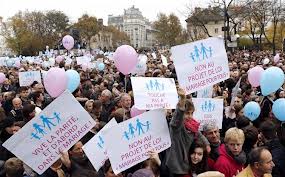
More than 100,00 people on the streets at the demonstration in Paris on 17th November
There is an excellent blogpost on the new Catholic Voices media blog, which states we have much to learn from the example of the French in our defence of marriage. The French bishops have successfully managed to keep the frame away from homosexuality (how many people realise that the Church favours the decriminalisation of homosexual acts) and have instead kept the focus upon the conjugal meaning of marriage and the welfare of children.
The French Church has managed to build a broad civil alliance against same-sex marriage, including various gay and atheist activists. The movement is called Manif pour Tous, which according to Le Figaro, includes “La Socialo, La Catho et l’homo.”
There is a rally taking place in Paris on Sunday, which has a predicted turn-out of at least half a million people – a rally ‘for marriage’ and ‘against homophobia’.
Against this backdrop, in a decision which could have implications for religious freedom across Europe, France’s education minister, Vincent Peillon, has written a controversial letter warning Catholic schools not to engage in any discussion about this issue with their students, after Eric de Labarre, secretary general of France’s Catholic schools had sent a letter to France’s 8,300 schools, urging just the opposite! The socialist President, Francois Hollande has weighed in on the side of his education minister and thus French Catholic schools (which are private) are barred from discussing the issue at all, unlike state institutions.
In the meantime, rumour has it that the ‘Equal Marriage’ Bill is coming before Parliament for its first vote (second reading) on 28 January.
La Manif pour Tous, has invited supporters of traditional marriage to join with them in solidarity and make their feelings known in London, this Sunday at the same time as the Paris rally. Meet in front of the French embassy, 58 Knightsbridge, from midday.
Catholics could make a day of it and go on from there to Southwark Cathedral where the relics of St Don Bosco can be venerated between 3.30pm and 5.30pm with the Mass at 6pm.
The Church of England has joined forces with Prince Charles in expressing their concern over plans to remove barriers that currently prevent members of the royal family from marrying a Catholic.
I would venture that most Catholics really don’t care, no matter how worthy the proposal may appear. In theory either we or our offspring will not be prevented from marrying a member of the Royal family due to our faith. Is this really important in the grand scheme of things? It’s designed as a sop and cosmetic gesture to appease David Cameron’s uneasy conscience with regards to how he is continuing the relentless process of undermining freedoms of religion, began by the Labour government under the guise of equality.
As opposed to being concerned as to whether or not their offspring may now be able to snaffle Harry, the Princesses Beatrice and Eugenie, Catholics are made far more anxious by the threats to the family posed by this government, not least with the forthcoming imposition of the new definition of marriage – a process which has to be amongst the most undemocratic in history, with the state seizing control of something that is not theirs to define. I’d also wager that Catholics are far more concerned that a judge possessing all the religious literacy of Thomas the Tank Engine has arbitrarily decided that the fourth commandment is not considered part of the Christian faith, thereby compelling Christians to work on a Sunday. A measure that is as detrimental to family life, as it is illiberal.
Let’s face it, the average Catholic is hardly in a position to be able to be afford to send their offspring to the same schools as any royal personnages and how likely is it really that if, as in the case of Prince William and the former Kate Middleton, our offspring will mix in the same social circle as those who form part of the royal entourage even if they do attend the same university. Though the Duchess of Cambridge was technically a commoner, even in our supposedly classless society, are we really going to see members of the royal family admit those who attended a large Catholic state comprehensive (no matter how excellent) and emanate from a socially deprived area, into their social set? Catholic congregations are typically far more eclectic than the ‘Tory party at prayer’ – are the young Polish, Nigerian or Mexican couple really bothered by whether or not their child can marry into Royalty, or are they more concerned as to whether or not they will be forced to work weekend shifts or if in healthcare, whether or not they will be forced to go against their conscience. Far more pressing is how work, particularly in the public sector is becoming more and more impossible and fraught with difficulty if you have any sort of religious faith.
In any event, discussions upon the potential constitutional repercussions would appear to be fairly academic and I’ll explain why. As a Catholic who married a vicar, i.e. a serious Anglican, it’s fair to say that the faith of any of our children could be something of a potential flash point. At NO point did my husband ever have to promise that his children would be brought up in the Catholic faith, despite the fact that the Bishop was gracious enough to grant us a dispensation in order that we could have a full Nuptial Mass and to allow Robin to receive communion. The priest who married us was explicitly clear about this. As the Catholic party in the marriage, I had to sign to say that I would make all reasonable undertakings to ensure that any children were brought up in the Catholic faith. That is a subtle, but important difference from compelling one’s children to be brought up Catholic.
Furthermore it was made clear to me that potentially it could be the source of scandal and/or difficulty in our marriage, if our children were raised Catholic against my husband’s will and that the sacrament and covenant of marriage was every bit as important as the faith of our children. Therefore if my husband was unwilling (which he wasn’t in principle) to raise the children Catholic, it would not be an issue that one should compromise the marriage for. Understanding that Catholics recognise one sacrament of Baptism, provided a child is baptised in a Trinitarian church the sacrament is valid, Robin had the privilege of being able to baptise his own child, in his own church with the support of my Catholic priest. My plan was that she would be fully received into the Catholic Church and supplied with the additional rites at the time she was presented for First Holy Communion, (although Robin was still mulling over her religious upbringing) but obviously things moved more swiftly and she was received at the same time as our third daughter was baptised.
My point is really that there are ways around these things and it is likely that in the case of a serious Catholic (one who wanted to raise their child in the faith) marrying a case of a serious Anglican (i.e. the heir to the throne) then these matters would be discussed and smoothed out in advance. It would not be the Catholic faith itself that would prevent a union, more the intransigence of either party with regards to their children. Would a practicing Catholic with the expectation of wanting to raise children in the faith, really want to marry into a family where this would cause serious rupture and vice versa?
It’s not impossible of course, love conquers all but it seems that no-one has really advised the Bishops as to the practical realities as to what happens in the case of children in inter-demoniational marriages – the idea of the element of compulsion is a myth.
Perhaps more interesting is the underlying convergence of strands which are all coming together to push the idea of disestablishment to the top of the agenda. A constitutional crisis potentially looms in terms of gay marriage, women bishops in the C of E and now the plans to allow Catholics to become heirs to the throne, all of which requires Parliament to interfere with laws of the English Church.
Maybe that’s why as Catholics, we ought to give these plans a lukewarm reception – particularly when the Queen in her capacity as head of church and state, is compelled to give her assent to laws which undermine the Christian fabric of her nation.
One of the valuable lessons I learnt last year is that sometimes it’s better not to air one’s grievances publicly. The internet is still a new tool and all of us are learning as we go in terms of how to most effectively utilise it. This time last year I made some criticisms about SPUC which resulted in a very unpleasant fall-out. Whilst I don’t regret what I said, and stand by many of my concerns, I also accept that I was blogging in a state of anger (never a good idea) fuelled by what I felt was unfair criticism and aided by a huge dose of pregnancy hormones. Hopefully SPUC of all people, should be able to understand that a woman experiencing her third pregnancy in as many years, coming 8 months after the birth of her previously unplanned child, was perhaps not in the best place emotionally and took the criticism rather too personally.
Therefore I ought to apologise for the intemperate nature of those posts, feelings were running high and admittedly I was being cleverly manipulated by a behind-the-scenes agitator, suggesting that I should blog. Mea culpa.
I still have reservations about the wisdom of whether or not it was a wise idea for SPUC to use its resources in defence of marriage, but in the interests of balance, I ought to admit to an interesting conversation regarding with my father-in-law, who is still technically an Anglo-Catholic and long term member of SPUC. He informed me that he was having a meeting with his MP in the middle of January in order to discuss same-sex marriage. He doesn’t expect to get anywhere, given the MP is a Liberal Democrat, but felt the issue was important enough to make his views known.
I asked him what prompted this, to which the response was “I had an URGENT letter from SPUC, which said that something had to be done, so I straight away phoned up the young girl in their office, had quite a long in depth conversation and then made the appointment to see the MP”. So fair dos really. SPUC do seem to be rallying some grass-roots activism, which is no bad thing.
To be honest, I still believe their campaigning and strategy needs some updating and revisions. The fact that they were successful with my father-in-law is because he is pretty typical of the average SPUC member, i.e. over 65, a staunch Christian, not net literate (he doesn’t use the internet at all) and he tends to get very worked up by the angrily typed letters and edited handwritten slips of paper which look like they have been produced on an old-fashioned duplicating machine, that drop through the letterbox, containing their latest foreshadowings of imminent danger or deadly peril and urging strongly-worded letters and street petitions. I think SPUC’s appeal lies mainly with the retired reactionary Tory voters as well as the young traddie Catholic movement and at some point they will need to broaden their focus, but you know what, fair-play.
How many Catholics reading this have lobbied their MP yet? And if not, why not? I’ve just moved to Hove, so I’m wondering whether or not to have a bash at Mike Weatherly, the Tory Hove MP who narrowly won the key marginal from Celia Barlow, the former Labour incumbent and within a year of his election, lobbied David Cameron to shut down churches in his constituency who won’t conduct same-sex marriages. Modernise or close down was his rallying cry. Is two bites at the cherry (given I met with Caroline Lucas back in October) a little greedy, or is there no point? Incidentally I’m more than a little peeved – a Tory vote was recommended in the key marginals, if I recall correctly and it turns out that Celia Barlow had a much better pro-life record than I should imagine Mike Weatherly will have.
But I do endeavour to be fair-minded, so err yeah, credit where credit’s due. Although quite what L’Osservatore Romano’s reviews of Skyfall, have to do with a secular pro-life lobby group is beyond me. I’m not sure I agree with the sentiments therein, a group of seminarians and priests I know went to see the film and thoroughly enjoyed it. Didn’t someone say something about being in the world and yet not of it? If we want to warn youngsters of the dangers and pitfalls of life as a secret agent, or the false glamour espoused by James Bond, then doesn’t it help if we’ve actually seen the material in order to be able to engage effectively with it and view it critically?
Pope Benedict has just issued an excellent new Motu Propio entitled Intima Ecclesiae Natura in which he speaks about the works of charity in and by the church and has also issued regulations to improve the organisation of the Church’s charitable activity.
“With the present Motu proprio, I intend to provide an organic legislative framework for the better overall ordering of the various organised ecclesial forms of the service of charity, which are closely related to the diaconal [ministerial] nature of the Church and the Episcopal ministry.
Key phrases to note:
“It is important, however, to keep in mind that “practical activity will always be insufficient, unless it visibly expresses a love for man, a love nourished by an encounter with Christ”
i.e. any charitable endeavour must not be a mere fund-raising activity but should be caritas in action, demonstrating Christ’s love in word and action.
“The Church’s charitable activity at all levels must avoid the risk of becoming just another form of organized social assistance”.
Perhaps most importantly for Catholic charities not only must they confirm with relevant civil laws but
“there is a need to ensure that they are managed in conformity with the demands of the Church’s teaching and the intentions of the faithful”.
Furthermore charities “may use the name “Catholic” only with the written consent of the competent authority, as laid down by canon 300 CIC.”
Every Bishop has been instructed to encourage a local Caritas service but
” It is the duty of the diocesan Bishop and the respective parish priests to see that in this area the faithful are not led into error or misunderstanding; hence they are to prevent publicity being given through parish or diocesan structures to initiatives which, while presenting themselves as charitable, propose choices or methods at odds with the Church’s teaching.”
From my cursory reading it seems that the Holy Father has quite rightly, in accordance with the Catholic principles of subsidiarity, devolved the responsibility for ensuring the promotion of charities and adherence with Catholic principles, into the hands of the episcopacy. Not only does he seem to be wanting to step up Catholic charitable activity and working in the service of Christ, it is a reminder to all of our obligation to work for the poor, the sick, the hungry, the outcast and the needy in deed and word, but also and perhaps crucially, Pope Benedict emphasises that any charity must be wholly in accordance with Catholic doctrine. The Pontifical Council Cor Unum will have overall responsibility for Catholic charities and ensuring guidelines are adhered to.
This can only be good news. Interesting times ahead for various “Catholic-in name-only” charities. The Holy Father is sending out a clear message here, various unholy alliances with pro-abortion groups will need to cease.
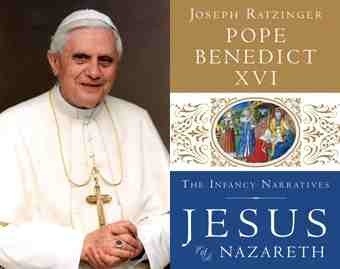
I was trying to work out why the media seem to have focussed on the Pope’s thoughts about the appropriateness of the ox and the ass in the nativity scene. It really is something of a non-story, although when I was interviewed about this earlier today, the presenter seemed to believe that the Holy Father had broken controversial new ground, by ‘re-dating’ the birth of Christ and claiming that by highlighting the lack of cattle in the manger, the Holy Father is trying to remind us that the nativity story is simply a myth, not to be taken literally.
I’m not sure how well I managed to get my points across (unfortunately one of the children had a meltdown towards the end of the phone interview) but one of the things that I did point out was that though Joseph Ratzinger is an acclaimed theologian and biblical scholar, whilst his book does not undermine anything in the Magisterium, neither is it infallible doctrine, it’s a book written under his own name and Catholics are free to disagree. There’s no need to consign the donkey figurines to the knackers yard just yet. The Pope may think that they have no place but as he said, he can’t see that changing any time soon. There were no accounts of cats or peacocks in the Gospels, but they often feature in nativity scenes, the peacock symbolising immortality and there is a legend about a cat giving birth to a litter of kittens in the stable. In some parts of the world you might also find a St Francis figure anachronistically kneeling at the crib, Mary’s midwife or representations of local townspeople and tradesmen, although I think the lobster in the film Love Actually, might be stretching things too far.
We know that there are no mentions of cattle in either Luke or Matthew’s account of the Nativity stories. This won’t come as news to anyone who is au fait with their Bible and neither will the Pope’s clarification that the dating of Christ’s birth is out by a few years, I remember being taught the controversy over twenty years ago in school.
It is thought that the tradition of Nativity scenes were introduced by St Francis of Assisi. The basic elements comprise Mary (on Christ’s right), St Joseph (on Christ’s left), at least one shepherd, at least one angel, the three magi (who make their way to the crib in time for Epiphany), a lamb to symbolise not only the shepherd’s gift but also the sacrifice of Christ on the cross and the ubiquitous ox and ass. The reason for the presence of the cattle is in fulfilment of the Old Testament prophecy,Isaias 1:3
The ox knoweth his owner, and the ass his master’s crib: but Israel hath not known me, and my people hath not understood.
The donkey also prefigures the arrival of Jesus into Jerusalem on Palm Sunday. There is a rather endearing tradition that a cross was marked on the donkey’s back as a reward for using its breath to warm the infant Christ in order to mark out its offspring precisely so Jesus would recognise it for his entry into Jerusalem. I remember searching for this mark every time I encountered a donkey as a child, just in case!
What stands out for me, from the limited extracts that I have read, is what Pope Benedict is emphasising with his interpretation of the infancy narratives. Rather than suggesting that the nativity is a fable, he is grounding Christianity firmly in historical fact by going back to the primary written sources. That there may have been no donkey in the inn is something of a minor detail, our Pope is an incredibly thoughtful and precise man, his reflections are typically very careful. I would suggest he was focusing on the way in which the Gospels were written and what they can tell us. Benedict argues that the Evangelists set out to write real history, that had actually happened and he seeks to contextualise this.
The media have focused in upon the donkey detail for a number of reasons; firstly it makes a sensational story and is an easy way to get in a dig at the Pope and casts him in the role of Ebeneezer Scrooge. Secondly, in a post-Christian era that subverts the message of Christmas in a grotesque orgy of consumerism and self-indulgence, casting doubt upon the nativity justifies the distortion. The Nativity isn’t real anyway, look even the Pope says so. Thirdly and probably the most overriding reason is that journalists are not theologically literate enough to pick out the compelling points from the Vatican’s press release, so go for the easy story.
More compelling than the lack of cattle, or that the angels may have spoken rather than singing, is what the Holy Father confirms for us, such as the Star of Bethleham was an actual celestial event. One of the things that struck me was the comparison of Pax Christi to Pax Augusti and the discussion of the political realm. These words seem especially prescient in the light of the vociferous opposition and vilification of those who defend life and marriage.
The political realm has “its own sphere of competence and responsibility;” it oversteps those bounds when it “claims divine status and divine attributes” and makes promises it cannot deliver.
The other extreme comes with forms of religious persecution when rulers “tolerate no other kingdom but their own,”
Any sign God announces “is given not for a specific political situation, but concerns the whole history of humanity.
It would be marvellous if the negative publicity whetted appetites and aroused public curiosity to make the book hit the best seller lists, so that people could experience precisely what the Pope has to say for themselves. Perhaps the headlines should have emphasised that it’s an uncharacteristically short tome, only numbering 132 pages.
There should be controversy around the book, it reaffirms the cornerstones of Christianity, namely the Virgin Birth and the Resurrection. As Pope Benedict says, Jesus’ life was full of contradiction, paradox and mystery and remains a contradiction today.
Benedict describes Christ’s life as a scandal against the spirit of the modern age; God does not restrict himself to the ethereal or spiritual but demonstrates his power in the material world. The true scandal is not the omission of the Ox and the Ass, but that God humbled himself in order to redeem mankind. That’s what the headlines should have been screaming.
Damian Thompson writes today that the era of Anglo-Catholicism in the Anglican Church is drawing to a close due to the forthcoming vote on women bishops in the Synod this week. According to Damian, Anglo-Catholics who are serious about their faith,will have already decamped leaving only what he describes as the ‘gold chasuble brigade’ i.e. those who like the liturgy of the Roman rite but not the meat of the Catechism. He also describes how the Ordinariate has not attracted most of the Anglo-Catholic laity and attributes this in part to the failure of the Catholic Church to provide the Ordinariate with a London church.
I’m not so sure he’s right on either score. I don’t think it’s fair to use the amusing biretta and lace trope (which does have an element of truth) when discussing matters of spiritual integrity. There are undoubtedly those who like the liturgy and outward trappings of pre Vatican II Catholicism but are very liberal in terms of Catholic teaching on sexuality and other matters; on the other hand there are those who genuinely yearn for reunification, who are well-formed, highly educated, theologically and morally literate who just cannot in good conscience sign the Catechism. I would hazard a decent guess that the former Bishop of Chichester, John Hind, is just such a man. Those who do not ‘Pope’ are not hypocritical or ignorant, all style over substance, simply that leaving home is not easy and takes much soul-searching.
There have been a few times online when I have seen decent men barracked and hectored that if they have any integrity they should convert. Such attitudes make me sad and angry in equal measure. Bullying and berating people is not the way to ensure conversions of heart.
I can only speak of my second-hand experience as the wife of someone who converted, though I was party and privy to Robin’s journey, being already a Catholic, I could not experience the turmoil in the same way. For me, it was blatantly clear that he should convert, but that was something he had to discern for himself in much prayer and thoughtful reflection, it was a decision between him and God, one in which I could have very little input. If I’m being entirely candid, on one level it would have suited me absolutely fine had Robin remained an Anglican clergyman. We had a lovely Rectory, a great parish, he was Freehold, a wonderful circle of friends and support, a pension scheme and lifetime security. We went to vigil Mass on a Saturday together so I could fulfil my obligation and then I would support him in the parish on a Sunday. I was being spiritually nourished, we had a good life, Robin was on Synod, conducted lay reader training, was part of diocesan vocations, school governor, trustee of a local charity, all in all was doing well, surely to throw all that away for an uncertain future was folly? I know both sets of parents were very uneasy about it all.
But all the while there was a nagging and niggling sense for me, that this was somehow dishonest. It became clearer and clearer that he needed to convert, that he wasn’t being honest with himself, with his parishioners and most importantly with God, but the impetus, the examination of heart and conscience can only come from deep within, no-one else can or should make those spiritual choices for you, plus we have to trust in God’s grace and the Holy Spirit. I wanted nothing more than the person who I love most in all the world to be in communion with me in faith, there is nothing more painful than being spiritually divided; of course I wanted him to receive all the richness and beauty of the faith, the graces and blessings of being a member of the one true Apostolic Church. Love is not selfish, it wants to share its joys with others, it will put the other person first regardless of the cost. But ultimately I could not substitute my will for his.
And yes, there was a cost, an enormous cost for us as a family and no doubt if I were a better, holier and more pious woman, I would have borne it a lot more unflinchingly, but when the eventual decision came, it was full of joy, our parish made Robin so welcome, but it was very bittersweet. We laid down our previous lives to take up a new one, which entailed much pain and sorrow. I know Robin felt like he was letting people down, deserting a group of people who he had cared for and ministered to over the past ten years and I felt like I was betraying those who had made me so welcome and loved when we got married.
We then, as detailed on this blog, had an incredibly testing two years whilst he discerned vocation and worked in the funeral industry, during which we doubled our number of children from two to four, I found a writing voice and struggled to come to terms with the swash and buckle of internet discourse and was subject to a series of vicious personal attacks, which was at times my only social contact with the outside world.
That’s not to deter potential converts, our story is not unique, every single Anglican convert’s wife has a similar tale to tell in terms of the impact upon their family life. One of the things that almost all mothers crave is stability and the opportunity to build a future for their children. One of the downsides of being any clergy wife, is that you have to accept that your husband’s vocation does not entail a guarantee of permanence. Moving house multiple times can be incredibly destabilising and losing one’s circle of real-life local friends and acquaintances, to move to an area in which you know no-one and can’t easily get out and about, isolating.
I was as supportive as I could be, I knew it was the right thing, but it was by no means easy and I was by no means a paragon of saintly virtue in serenely accepting the family turmoil or years of flux and uncertainty.
I’ve digressed, but the point is, that I was always 100% supportive of Robin. What about Anglo-Catholic clergy whose wives are reluctant to convert and/or support them? It’s an enormous ask and therefore denigrating the decision to put family stability first cannot be the correct way to go. Furthermore leaving one’s spiritual home can be an enormous wrench. I’ve never done it, but when C of E clergy are ordained, like their Roman counterparts they believe this to be a lifelong commitment and calling, in the same way as marriage vows. One cannot deny the affection for the spiritual tradition in which one was formed and it takes a lot of courage to admit there is no realistic prospect of reunification, to abandon your home and watch helplessly as it tears itself to pieces and moves further and further away from universal truths.
Crossing the Tiber is not the straightforward intellectual exercise that it might seem on paper, these are real people with real lives and a multitude of responsibilities to juggle. For the clergy there is the additional question of vocation. One has to accept that one’s former ministry was probably not wholly valid. What if one still feels called to priesthood? There is no guarantee that the Catholic Church will accept one as a candidate. What do you do if your life hereto has consisted of ministry, you have a hatful of theology degrees, huge amount of transferable skills yet are competing with people not only younger but with more relevant experience? All of a sudden you have to rebuild your life, whilst attempting to provide for yourself and any family. Was your former life a waste of time and meaningless?
All of which means than the decision to convert has to be made out of love in a spirit of joyful acceptance and not because one feels that the Church of England has left one with little other choice. There is a difference between choosing to ‘Pope’ and being pushed. Neither of us regret for one moment the decision to convert, there is no question that it was where The Lord was leading, our lives are spiritually richer, our marriage has been transformed and strengthened and if ordination does not take place, though crushing, we would still not look back. This is where converts need to be, it has to be a total laying down of a life in order to resume it and an acceptance that The Lord may not lead one back to the altar in the same way. It’s a total death to self and an acceptance than one may no longer be in ministry. The older one is, the more difficult that becomes, and if one is a young unmarried vicar, then one has to abandon any previous notions of marriage and family.
And this, I suspect is one of the reasons why perhaps not as many laity as some expected have joined the Ordinariate, because again, for many, leaving a former parish church and affiliated social groups is just too physically painful, not because of any shortcomings on behalf of the Ordinariate. I’m willing to bet as well that there are plenty of families where one party is far more enthusiastic than the others, Anglicanism famously encompasses a broad spectrum of views. An unsatisfactory status quo is psychologically more comforting than a leap of faith into the great unknown.
Is Anglo-Catholicism dead? I am no longer au fait with the latest developments, but it seems to be thriving as ever in its little pockets around the country, such as here in Chichester diocese. I guess it depends on one’s definition, perhaps life is untenable for Anglo-Papalists, but groups such as Affirming Catholics would claim otherwise.
I cannot stress strongly enough that the joy and happiness of conversion far outweighs any difficulties and every convert clergy family I know says the same. There is no looking back, no regrets and this is, I believe, because it was an independent decision to embrace Catholicism and not a convenient bolthole. There is a distinct difference. This is why Damian Thompson is wrong to want the legislation on women bishops to pass in its current format, with no provision worked out for conscientious objectors. We should not laugh or pass judgement on the consciences of those who remain behind to be alienated and vilified by their peers and brethren in Christ. It must be a horrific time for all. It could well have been my husband, I take no credit for his journey but undoubtedly one of the factors that led to his conversion was the actual experience of worshipping in a Catholic Church with his wife every week for two years. The unknown did not seem so scary, Christ called from the Eucharist, he pushed at doors and found them opening. Not everyone is so fortunate. I know many who are still grappling with their consciences.
For those Anglo-Catholics who do read this (I had the honour of being listed as a blog of note by New Directions) please know that you are all in our thoughts and prayers. If clergy or families want to contact us to sound out ideas or go through any practical realities, put your details in the combox (I won’t publish) and I’ll get in touch. There is help and support available, not least the St Barnabas society without whom this would not have been possible.
If Anglo-Catholicism is dead, it is a tragic time. The only reason for rejoicing is if this alleged death provides an impetus that leads people home. This is far more likely if we extend a lifeline out of caritas, condescending pre-judging and barracking is counter-productive. The body of Christ is wounded but never beyond repair. If history teaches us anything it is that any movement that feels suppressed eventually re-emerges stronger. We have to trust the Holy Spirit and pray for resolution and comfort for those whose futures currently lie in the balance.
Those calling for the liberalisation of Ireland’s abortion laws are making much capital of the fact that Savita was allegedly denied an abortion. According to the rhetoric, Ireland’s law should have allowed her to have an abortion, the moment she asked for one. Savita was miscarrying a wanted child. She was in agony and experiencing considerable distress, therefore she asked for the treatment for her miscarriage that she believed was most likely to swiftly deliver her from torment, which is more than understandable. Faced with an identical situation, most of us would do the same, I had a suspected ectopic in one of my pregnancies, the pain was excruciating and I would have done almost anything to make it stop.
Though Savita had unquestionable medical knowledge, like most of us, she was not a qualified obstetrician. She was not requesting an abortion, but what she believed was the most appropriate course of treatment for her miscarriage; one that would get the ordeal over for her quickly. Though medics must consider the feelings of their patients when it comes to treatment, they are not obliged to follow patients’ demands, no-one can force a surgeon to operate against their will, particularly not if the surgeon does not believe it to be in the patient’s best interests. Though a patient is able to withhold medical consent, they are not able to determine the precise and exact nature of their treatment. A pregnant woman cannot force a doctor to induce her baby at 36 or 37 weeks or carry out a planned cesarian simply because it is her will. She may think she has a valid medical reason, but ultimately the decision is in the hands of the doctors, as is the case with any medical treatment. Being a pregnant woman does not privilege one when it comes to determining medical treatment.This case is not about the refusal of abortion, but the mismanagement of a miscarriage and medical malpractice. James Reilly, Ireland’s health minister, himself a doctor, noted that allowing a miscarriage to occur naturally can often be the safest option.
For those blaming Ireland’s Catholic culture, this is not the view of Archbishop Diarmuid Martin who believes that Ireland “is now a highly secularised society, and many look to the Church through a secularised lens to the point that, in a sense, one could speak of what I call ‘a climate of undeclared heresy’ that pervades many dimensions of understanding of Faith among Catholics.” We do not know whether the medic who reportedly uttered the phrase ‘this is a Catholic country” said this in support of the law or against it; either way they were theologically, medically and legally uninformed.
All of us who identify as pro-life would like to express our sincere condolences to Savita’s family on the loss of this beautiful young woman and her baby. No-one believes that a woman should be compelled by law to sacrifice her life for that of her unborn child and as everyone has pointed out, treating Savita would neither have contravened Catholic bio-ethics nor Irish law.
None of that is any consolation however, an enquiry needs to take place and if necessary dismissals and re-training need to occur to ensure Ireland manages to maintain its place as one of the safest places in the world to give birth, a country safer for pregnant women than the UK.



 The Catechesis of Caroline