Bank holiday fun – Liebster Award

I was delighted to see that Lazarus had nominated me for a Liebster Award, not only because I really enjoy his blog and find him a voice of common sense and sanity on the blogosphere, but because it gives me an opportunity to unashamedly prattle on about myself. Which probably tells you all you need to know. I also saw I’d been nominated by Rhoslyn Thomas and was tempted to naughtily pick and choose on questions, but Lazarus got there first. I’ll give Rhos a plug anyway because she deserves one. Young, pro-life, Welsh traddie. What’s not to like?

Liebster-Award

The point of the award is to encourage blogs to link to each other and so boost their profiles and traffic.

Here’s what you do:

1) Post the Liebster award graphic on your site. (Google to find it if needed)
2) Thank the blogger who nominated the blog for a Liebster Award and link back to their blog.
3) The blogger then writes 11 facts about themselves so people who discover their blog through the Liebster post will learn more about them.
4) In addition to posting 11 fun facts about themselves, nominated bloggers should also answer the 11 questions from the post of the person who nominated them.
5) The nominated blogger will in turn, nominate 9 other blogs with 200 or less followers (We’re guessing for our nominees) for a Liebster award by posting a comment on their blog and linking back to the Liebster post.
6) The nominated blogger will create 11 questions for their nominated blogs to answer in their Liebster post.

So, done the first two tasks. Here’s the eleven facts about me. (I go on a bit, I didn’t include that brevity or conciseness is not my forte).

  1. One of the most surreal things I’ve ever done is approach Paul O’Grady of Lily Savage fame, in the Telephone Bar in Bangkok and throw water at him. He didn’t mind, it was Thai New Year which is celebrated by sprinkling water over other people as a sign of good luck. In recent times it has degenerated into a giant 3 day city-wide water fight, where gangs of adolescents prowl the city on the backs of jeeps and motorbikes, with industrial water tanks strapped to their backs connected to elaborate water pistols, in order to drench passers-by. Probably something of a mating ritual, but if you ever go to Bangkok around the time of Thai New Year, be sure to wear either a swimming cossie or plastic overalls.
  2. My skills of prophecy are summarised by the occasion I looked at a battered old orange 737 sitting on the tarmac at Gatwick airport in 1997 and opined “No Frills airlines. That’ll never work”
  3. Fr John Glynn of I watch the Sunrise, fame, was the priest in charge of my school. He used to stalk the Alyosius Corridor, singing and smiling and leant his guitar against the altar. I used to confuse him with Ralph McTell.
  4.  My favourite book of the Aeneid is Book VI. It evokes memories of GCSE Latin and moments of Billy Bunter-esque stupidity in class. Virgil describes an eclectic mix of characters including “The hundred armed Gyles Brandreth” and, much to the amusement of privileged Essex boarding school pupils, with terribly middle-class names, a ferryman called “Sharon”.
  5. I’ve always wanted to give Cathy and Heathcliffe a hearty slap.
  6. I can’t touch vodka following an unfortunate incident involving Highlander II, popcorn on an empty stomach, a litre of Blue label Smirnoff, a chincilla and a poodle who resembled Roly in Eastenders.
  7. If I had to chose a final meal it would be infinite oysters, with a dipping sauce made out of shallots and red-wine vinegar, a dash of lemon and tabasco, washed down with Veuve Cliquot served the temperature of liquid nitrogen.
  8.  I have to work a lot harder on the asceticism and Evangelical Poverty thing.
  9.  I will forever harbour an unashamed crush on the young Stiff Pilchard Cliff Richard in his heyday. Cor. 

  10.  I’d like to have the sublime Faure’s Requiem at my funeral and wangle a way of getting in the Cantique de Jean Racine also.
  11.  Compline is my favourite part of the Divine Office. It hands everything over to God at the end of the day.

So here are the questions I had to answer:

What inspired the title of your blog?

My name. Original huh?! Actually, it was originally called asnailinmypocket, which was a favourite phrase of mine back in the day, being an equivalent to Monty Python’s hovercraft full of eels. Very often in my days as a flight attendent, we’d operate domestic European flights for a non-English airline, between cities such as Cologne and Dresden. I once told an unsuspecting German with no command of English, that I had ‘a snail in my pocket and I think I’m about to use my vest’, instead of telling him to stow his hand luggage under the seat in front of him, much to the hilarity of my colleague. He seemed to get the gist. Perhaps it was the hand gestures? Anyway the phrase stuck and it was the first thing that came to mind when setting up the blog and summed me up. Random, surreal and probably quite juvenile.

What is your personal favourite post on your blog?

No idea, although I’d like to think that I’ve done some very solid investigative pro-life writing. BPAS are regular readers. *waves* 🙂

What has been the most popular (most viewed) post on your blog?

Oh lawks, not sure we should go there. It was the Babyworld post of DOOM. To cut a long story short, I used to be a member of a Mumsnet type website called Babyworld, which had a ‘Discus, Debate and Deliberate’ forum. In the run up to the Papal Visit, things got extremely heated and being the only practicing Catholic in a forum predominated by liberal mummies was something of a recipe for disaster. They simply didn’t get it and I should have realised that it was always going to be a waste of time.

There were threads upon threads of the usual old cliches and every single time, I tried to bust the myths or engage in any sort of apologetics – KAPOW, they’d all go nutty. I remember one member who indignantly C&Ped huge chucks of the Catechism, in order to heap her scorn and vitriol upon this disgusting religion and its doctrine.

Others just couldn’t work me out. On the one hand I seemed this perfectly nice, reasonable, quite fun woman, who didn’t walk about dressed like a member of the Amish, but there I was espousing hateful bigotry and homophobia. At one point it was suggested that I was brainwashed or had cognitive dissonance “I don’t think Caroline hates gay people, she obviously doesn’t, she seems a nice person, but her attitude is homophobic and that causes her problems, which is why she tries to explain it away”.

Finally, my patience blew during yet another homophobic Catholic church debate (I think people decided to deliberately start inflammatory threads) during which posters posted the most inane and theologically illiterate statements I’d ever seen, which were as hilarious as they were offensive. “Face it, you can’t tell me whether or not Jesus was a breast or a bum man with any certainty”, said one, and in my frustration and amusement, I C&Ped some of the choicest comments onto here for the delectation of my gentle readers, along with the Bad Vicar sketch from Mitchell and Webb. Well, it was funny, a bunch of women screeching about how terrible Catholicism was, how they had spent some time in Rome and decided that I had read too many books and therefore wasn’t ‘spiritual’, reminded me of the classic line about “hastily assembled internet philosophies”.

Anyway, they didn’t like it much, linked the blog to Babyworld and the stats went stratospheric. Much silliness ensued about petitioning WordPress to get the site taken down for breaching copyright (despite the fact I’d done nothing illegal and hadn’t mentioned identities) and a huge amount of cross comments, for taking their comments about Christ’s alleged sexual preferences out of context!

I left shortly afterwards, it all got a bit much and I lost patience with the “oh no, my child’s Christian school is teaching them that God exists and about the crucifixion and Resurrection, how very dare they”, but they still link to here from time to time, bless them.Christian mummies, stay away from mainstream mummy forums, no good can come of it, unless you are married to Giles Fraser.

Which post on your blog has attracted most comments?

This one. About finding out I was pregnant, the week that Robin left the Anglican Church.

What other hobbies or interests (beyond blogging) are you prepared to admit to?

Not that much time, with the children, so it’s mainly reading and playing the piano. Beethoven Sonatas with their crashing chords can be most Cathartic, but tend to wake the children. I also love Bach prelude and fuges as well as Mozart sonatas. I adore ragtime, probably not very PC, but I’d like to be able to play Debussy’s Golliwog’s Cakewalk without making any mistakes before I shuffle off this mortal coil. It’s fiendishly difficult.

What’s your favourite song?

Cemetry Gates by The Smiths. Timeless and with puns worthy of Philip Sidney.  Perhaps the wittiest and cleverest pop song there is. It is a deliberate paradox, being the embodiment of the traits that it knocks- pretentious and pseudo-intellectual and reminding us that all writers and fans of literature and the arts are self-conscious, angst-ridden inadvertent plagiarists at heart.

What’s your favourite novel?

I’m going to cheat, because I can’t possibly chose. Three of Maupassant’s short-stories, Boule de Suif, La Parure and En Famille. All tragi-comic, demonstrating his immense ability as an original story-teller, who describes his subjects and their physical and mental flaws with affectionate, painstaking and earthy detail. Maupassant holds up an uncomfortable and discomforting mirror to human nature. Though none of these stories have an aspect of redemption, they demonstrate the nature of sin. When I recently re-read them, the compelling subtext for me, was how they highlighted the necessity of Christ’s sacrifice on the cross.

Actually upon re-reading that, I should say, Brideshead Revisited because it sparked my return back to the Catholic Church. When my eldest was born, I spent hours sat nursing her with a book in hand. One of them was Brideshead which I had never previously got around to. As I turned the back cover, tears were streaming down my face and I thought to myself, “well it’s too late for me, but I am going to make darned sure that my daughter is saved” and resolved to have her baptised. I then attended the local baptism course and things progressed from there.

Complete this sentence: ‘I think religion is….’

I’ll go with St Augustine’s definition. I think religion is the thing that binds us to God in voluntary subjugation.

How good a dancer are you?

Dreadful. I don’t do dancing, unless it’s of the Gay Gordons, or the basic ballroom variety that we had to learn at school. I am hopelessly uncoordinated, more embarrassing that your grandad and don’t enjoy it at all. I never know what to ‘do’.

Which do you prefer: tea or coffee?

Tea. Coffee is the devil’s own brew.

Have you ever been a smoker? (Of tobacco…!)

Yes. I used to smoke an unhealthy amount of Marlboro Reds. I still crave a cigarette whenever I have a gin and tonic in my hand, but on those occasions where I’ve grabbed a crafty puff of someone else’s, have wanted to throw up. I gave up in 1998, following the smoking ban on long-haul flights. My smoking habit was never curbed by the cost of cigarettes, seeing as I used to be able to buy them very cheaply in various destinations. At one stage I had a stash of about 2,000 in my room, for personal use, and never had to husband or ration cigarettes due to spiralling costs, unlike British smokers. It was easy-come, easy-go. I figured that if I could manage on a flight to Sidney without a puff, then, it was just a matter of gradually extending the period of time.

So now I have to nominate 9 other blogs with under 200 readers. That’s the hard part. I don’t tend to do compare and contrast on stats, so really I’ve no idea whether that’s readers or subscribers or what? I’d love to ask some of the priests such as Fr Ray Blake, whether or not he used to practice playing and pretending he was celebrating Mass as a little boy, or whether Joseph Shaw is secretly scared of spiders, but I guess that would be disrespectful and they have well over two hundred readers, so my list is a little random. I’m struggling, because most of those whom I would nominate, have already participated

  1. MyBattlementofRubies – my absolute heroine of all time. Clare, Catholic Homeschooling mother of six who has the most fabulous turn of phrase along with buckets of wit and common sense.
  2. Abudance of Rainbows – Lovely, lovely Lucy
  3. Laurence England – who doesn’t need the plug, but has written some outstanding stuff of late, and hasn’t yet participated
  4. James Preece – Oi James, put down your Latin books, forget the gerundives and answer some inane questions. Your public demands it
  5. Five feet above sea level – this is swiftly becoming a must-read, the wonderful and inspirational Katherine Rickards.
  6. A Miscellany of Musings – ‘The Idle Rambler’

And erm, I give up. Feel free to join in by all accounts, if questions inspire.

  1. Do you have a favourite Evangelist?
  2. What are the best and worst aspects of blogging?
  3. If you were able to choose your final meal, or God forbid you were on Death Row, what would it be?
  4. Favourite Saint?
  5. What book do you have on your bedside cabinet?
  6. What has been the most popular post on your blog?
  7. Which blogpost has attracted the most comments?
  8. What did you want to be when you were a small child?
  9. If you had a Harry Potter invisibility cloak for one day, what would you do?
  10. What inspired the title of your blog
  11. Favourite prayer or novena?

And that’s me done.
 

Easter Hymn

I first heard this piece, from Pietro Mascagni’s opera, Cavalleria Rusticana at the funeral of Robin’s elderly uncle. The evocative and rousing melody along with the proclamation of the Resurrection seemed absolutely perfect for the occasion as well as for Easter morning. Perhaps most poignantly, the recording that was played as the coffin departed, featured the voice of the deceased who had sung this in a recent amateur production. How many of us get the opportunity to sing at our own funeral?!

This is a piece of music that never fails to reduce me to tears, it is so incredibly moving. Utterly breathtaking, beautiful, audacious and as triumphal as the event it portrays.

Happy Easter.

O rejoice for the Lord has arisen,
He has conquer’d the power of the grave,
He has broken the gates of the prison,
He has risen in His glory to save;

Does the Church need to renew its relationship with women?

Hot on the heels of the initiative which allows Catholic women to pledge their support for Catholic doctrine (the aim of which is to present Pope Francis with a significant number of signatures as well as present a forum for Catholic women and apologetics), Catherine Lafferty has written a piece for the New Statesman’s version of Comment is Free, which suggests ten ways in which Pope Francis can renew the Catholic Church’s relationship with women.

It is no secret that I have personal issues with Lafferty. Many people witnessed her behaviour towards me last year when I was pregnant, with alarm and dismay. The episode caused considerable distress and much prayer is needed because I still struggle with forgiveness and coming to terms with it all.

This should be borne in mind when reading my critique of Lafferty’s piece – this isn’t about ad hom or personal attack, I wish to lay my animosity to one side and engage with and critique what was written, but it should be noted that perhaps understandably, I find it extremely hard to be objective towards someone, who I believe caused actual harm to my health and that of my unborn baby with a campaign of unfounded and malicious allegations and whose repeated presence in my timeline has been an occasion of sin at the start of the Triduum.

The article’s premise is that the Church needs to renew its approach to its female followers with regards to sex and reproduction. This would seem to be a little misleading, not least because it implies that the Catholic Church somehow needs to change its doctrine, something which is impossible. Secondly, it buys into the myth that most Catholic women are unhappy with the Church, especially in relation to the doctrine on sex and reproduction. This is a myth that I’m looking to disprove.

If women are unhappy with Church doctrine on these issues, the blame can largely be laid at the door of poor or inadequate catechesis. This would certainly be an area that one could argue is in need of renewal, but the Emeritus Pope Benedict did much in terms of sowing the seeds in this regard. The growing Juventum movement is packed with young women as well as men. A newer, younger generation of orthodox faithful Catholic women is emerging. Before claiming that the Church needs to take action to renew its relationship with women, some evidence as to this fractured relationship needs to be provided. A more accurate assessment would be to say that the Church needs to engage with lapsed Catholic women and evangelise better. It needs to send positive and joyful messages of female sexuality as well as remind everyone of the beautiful teachings of John Paul II, in Theology of the Body and Mulieris Dignitatem.

Here’s my take on the some of the suggestions:

  • Use the reform of the Curia to promote female excellence in the corridors of power. Hard to argue with this one, it’s a point that I have argued and would do much for the Vatican in terms of its perception. With that it mind, it should be remembered that the pursuit of power is not a goal that should be encouraged, for any Catholic in good conscience. Secondly, whilst female excellence should be encouraged, the Vatican needs to be extremely careful to ensure that it does not engage with secular identity politics that are contrary to Catholic teaching which teaches that our identity lies in our dignity as created beings in the image of God. If women are promoted it needs to be because they possess requisite competence and fulfil the criteria of any given position, not solely because of their sex. Woman quotas should be avoided because they are a form of unfair discrimination and buy into the idea that the Catholic Church is somehow oppressive or patriarchal as demonstrated by the priesthood. Whilst it would be good to see more women in the Curia, this should not be for the sake of political correctness. The Catholic Church is not a political party or democratically elected institution.
  • This bureaucratic reform should be extended downwards to Bishop’s Conferences and diocesan offices, which should also become more efficient and productive with professional staff and dragged out of ‘sleepy backwaters’ with a similar drive for female excellence. This seems primarily a comment on the Catholic Church in the UK. I’m not sure that the same could be said of other countries, such as America for example, and who knows what the situation is in the far-flung corners of the globe. We need to be wary of accusing hardworking diocesan staff of ‘complacency’ or not doing their jobs properly. Many dioceses, such as Portsmouth have in fact, recently undergone restructuring, the Catholic Church works on a model of subsidiarity to which diocesan bishops are key. Where failures are identified, it should be up to the individual bishop to take appropriate action, rather than for centralised guidelines – every diocese will have different requirements. Furthermore some of the staff working in and supervising diocesan offices are stipendiary priests who are unpaid. Many parish secretaries, admin and finance staff are also unpaid volunteers. Instead of replacing them with a professional bureaucracy, which will prove costly, additional training would seem to be the answer in areas where there are gaps in knowledge or experience. There are admittedly diocesan roles that require paid professionals, standards matter and dioceses do conform to employment laws and norms, so I think we need to be careful before making sweeping statements or wholesale accusations of inefficiency. The same sentiment as above would apply when it comes to promoting female excellence. Replacing priests and unpaid volunteers with a professional bureaucracy would cost a considerable amount of money at a time when we know that many dioceses are running a deficit. In any event most diocesan offices are filled with the laity.
  • Turn all Catholic workplaces into centres of excellence for family-friendly employment. How do we know that this is not already the case? I can think of several positions in my diocese which are staffed by women and are part-time or job-share. As employers, Bishops are subject to UK laws with regards to unjust discrimination when it comes to employment and would legally need to demonstrate that they have the relevant policies in place, which means amongst other things, that women returning from maternity leave will already have the right to request family-friendly hours and parental leave. When it comes to building creches, that is entirely dependent on the size of the plant that a diocesan office may occupy as well as number of staff. There doesn’t tend to be a high staff turnover in diocesan offices, so a creche could quickly become obsolete.
  • Take a lead in providing affordable childcare. The Catholic Church teaches that couples should be open to the gift of life, a principle which is made harder to live up to by women’s economic needs. Lovely idea in theory. Pie in the sky in real life. The Catholic Church does teach that couples should be open to the gift of life, but she also teaches that parents should be the primary educators of their children. A mother’s economic needs revolve around providing food and housing for her children. Ideally speaking a woman should have the choice as to whether or not she wishes to work, countless surveys demonstrate that most mothers yearn to be at home with their children. Jonas Himmelstrand, a Swedish sociologist, is reporting that psychological disorders in children have trebled in Sweden, widely held up as being a childcare utopia, where over 90% of children under 3 attend full time nurseries. Having children in full-time childcare should not be encouraged. It is not in the common good to encourage or promote a system whereby mothers have little choice other than to become wage slaves. That mothers have always worked is undeniable, but traditionally women needing extra income did this inside the home, whether it be by a bit of extra farming, being a nursemaid, taking in ironing, sewing, craftwork etc. Whilst that is admittedly out of step for today’s era, the rise of the mumpreneur, or woman who works from home, whether that’s freelance writing, running a business on ebay, or whatever, shows that this is still seen as an ideal. Women should be their own bosses, as they always have been, working on their own terms, providing for themselves and their families in a way that fits around family commitments, and not wage slaves to outside employers, trying to split themselves between two masters. Ultimately, it tends to be the children who suffer, when mum has to put them in wraparound care 5 days a week, in order to keep working for an implacable inflexible boss who pays the wages.
  • Aside from the fact that the Catholic Church lacks the resources to provide free or cheap Catholic nurseries and ignoring the fact that such a practice would inevitably fall foul of laws regarding discrimination, there would bound to be some vexatious litigation surrounding the nature of such provision, encouraging mothers to put their children in nurseries would not renew the relationship with women, but could cause alienation and resentment. The Church would be sending a very definite message as to the desirability of work, and no nursery, no matter how wonderful or gleaming the equipment or activities on offer, can replace a mother’s unique love and care. Children aren’t objects, they should not be viewed as barriers or commodities to financial or economic success and to put one’s own self-fulfilment on the same level as their welfare, is directly contrary to church teaching. Whilst the Church recognises and argues that women should have equal access to public functions and roles, speaking in Familiaris Consortio, John Paul said this

While it must be recognized that women have the same right as men to perform various public functions, society must be structured in such a way that wives and mothers are not in practice compelled to work outside the home, and that their families can live and prosper in a dignified way even when they themselves devote their full time to their own family.

Furthermore, the mentality which honours women more for their work outside the home than for their work within the family must be overcome. This requires that men should truly esteem and love women with total respect for their personal dignity, and that society should create and develop conditions favoriung work in the home.

  • The Catholic Church can plough funding for research into fertility management which complements rather than compromises its core principles. No need for this. The technology, already exists, NFP methods such as Creighton are 99% effective. Pope John Paul II singled out the Pope Paul VI Institute, who are world leaders in terms of reproductive technology for special praise and worthy of support. Catholics have to accept however, that no method of contraception is 99% effective, and whilst couples may have serious reasons not to add to their families, they must also tread a fine line in terms of not falling into a contraceptive mentality. Where the Church needs to do better is at communicating its message on human sexuality to young men and women, which really needs to start at grassroots level. The technology exists, it’s just not promoted heavily enough and neither do many priests do a great job in terms of preaching about contraception or promoting the alternatives. Likewise NaPro technology, has success rates far and above those of IVF, treating the underlying cause of which infertility is just a symptom. A fertile married couple has to regularly think and pray when it comes to the issue of whether or not to add to their family, and not simply use NFP as an alternative form of contraception. It involves a wholly different mindset.
  • Put women and their needs at the heart of its Pro Life activism. This is what happens now. Organisations such as the Good Counsel Network and LIFE Charity do just that in terms of their activism, campaigning and actual pro-life work. A creaking Pro Life lobby is ill-equipped to consider why women opt to have abortions and what they need to continue their pregnancies willingly. The pro-life lobby in the UK may be creaking, but there are certainly signs of healthy rejuvenation, such as in the recent foundation of the Alliance of Pro-life students and the success of the 40 days for Life movement. Speaking at the launch of APS, Eve Farron their founder, explained how they made common cause with feminists on campus and forced campaigning and provision for pregnant students at certain universities to be drastically overhauled, so that students with a crisis pregnancy were presented with actual realistic options enabling them to keep their baby and continue studying. Again the Good Counsel Network help women on a day to day basis, they are well versed in the multitude of reasons why a woman may find herself at the door of an abortion clinic and provide help accordingly. A pro-life movement that lacks cohesiveness will find it hard to gain political traction, but that doesn’t mean that it is unable to discern why women may abort. Pro-life work does need to consist of a political element, not simply in terms of legislation surrounding abortion laws, but legislation to enact a society that is open to life and the needs of pregnant women, but this is not its only role. For Catholics, pro-life work consists of prayer, politics, practical action and PR. The pro-life movement is at its strongest when we recognise and hammer home the message that a life is a stake here and the injustice of abortion, to mother and child. Politicians will respond to the will of the people and even SPUC, an organisation of which I am highly critical, is extremely effective at marshalling and consolidating grass-roots support. This is vital.
  • as tough on the causes of abortion as abortion itself. Good soundbite, albeit a modified version of William Hague. But we need to very careful here. Whilst society must clamp down on those factors that contribute to a woman’s feeling that she has little other ‘choice’, the causes of abortion are very often complex, there is not one single factor. Women who abort their babies are not two dimensional creatures simply exercising a choice because they can, or because they see it as a form of contraception and not the taking of a life. Whilst some women undoubtedly do view abortion as a trivial matter, many don’t and abortion is arrived at via a contribution of factors, not least a society that advocates and promotes abortion as being ‘no biggie’ and certainly not something that one should feel guilty about. Whilst we have to work to bring about an elimination of those factors that conspire to make a woman have an abortion, human history shows us that there will always be women who feel they have reasons to abort. We cannot concede that a reason to abort is a justification and neither should we be giving any fuel to the notion that until reasons to abort are demolished, then abortion itself can be tackled. When we consider the causes of abortion, we have to be extremely careful not to play into the hands of pro-choicers, who will argue that abortion has always existed, there will always be a good reason to abort and so abortion must be safe and legal. People will always want to engage in destructive behaviour, sadly there will always be those who are compelled to hurt their fellow human beings and themselves, but that does not mean that society should legislate, normalise and accept harm, on the premise that it is a lesser evil. Whilst we must be tough on the cause of abortion, we must not lose sight of the fact that abortion is, to use the hated words, a moral evil. That does not mean that women who have abortions are morally evil, or of dubious character, but in our compassion, we must not forget what abortion is. We must continue to be tough on it and not fall into the hands of well-meaning pro-choicers who attempt to justify abortion. Being tough on various causes of abortion includes getting tough on lifestyles of sexual impropriety as well as on repeated abortions, and accepting that a woman’s judgement is not always sound or prudent, by virtue of her gender or reproductive organs. This is a always a flashpoint or bone of contention, no-one likes to be seen as finger-pointing or interfering in others’ sex lives, it plays into the Christian fundie fiddling with ovaries stereotype, but ultimately as Christians we are compelled to make moral judgements with regards to certain courses of action, including abortion.

The other points with regards to population control, education and women’s rights are fairly sound. But as I said at the beginning, the Catholic Church needs to be very wary about succumbing to identity politics. Women are signing up thick and fast at CatholicwomenRising to pledge their support for Church doctrine. To state that the Church needs to renew its relationship with women, implies that there is a schism, one that is only evident in the minds of the media. What the Church does need to do is continue to win souls of all ages, be they the elderly, middle-aged, or young. Part of this must involve evangelisation. But Church renewal is a question that each subsequent generation has to face – we have to enthuse our children and young people to lives of Christian witness and holiness. This is why identity politics is so irrelevant, because Catholic doctrine reflects that men and women were created equal but with different vital roles to play. Our strengths and weaknesses are disparate, we are not all one homogenous mass. The way we go about renewal is in two ways – firstly by how we live our lives and the examples we set to others, Pope Francis is leading the way here, and secondly by implementing decent catechesis and instruction at a local level.

That the Catholic Church in the Western world needs to find ways of countering the rising tide of secularism, atheism and the prevailing zeitgeist of individualism and renew itself is indisputable. But it has to start at catechesis and finding effective ways of educating its laity, be they male or female. Women friendly policies may make for fluffy soundbites in left-wing publications and make a convenient flag for Catholics to wave to show off their progressive credentials. But the New Evangelisation requires action that goes infinitely deeper.

A dissenting voice

st mary's university college twickenham

An interesting comment appeared in response to my post about the Catholic Women Rising project, stating that I am never going to manage to attempt to get every Catholic woman to sign up. Maybe not, but just because something may be difficult, doesn’t mean that it’s not worth doing.

As a point of note, the Catholic Women Rising site is not meant to be a personal vanity project – the intention is to hand over blog administration to any other Catholic women (or men) who may wish to be involved, especially in the apologetics side. The aim is to promote the New Feminism, winning over lapsed Catholics and hopefully even persuading women of other denominations,  as well as a manifestation of the huge amount of grass roots support that exists for Catholic teaching.  I don’t care from whence the apologetics comes so long as it is not only sound, but gentle – there will be no time for hectoring those who struggle with teaching or at times fall short. Whilst sin or error can not be validated,  one catches more flies with honey than vinegar as the saying goes and it is intended to be a place of joyful witness to the truth, not petty sniping or personal carping. I wonder whether women are better placed in terms of evangelising to other women nonetheless.

In the meantime, it will mainly be pro-life and personal witterings reflections as per usual on this site, but so far the response has been overwhelming, my email and social media inboxes have been inundated with support, with Francis Philips of the Catholic Herald, Joanna Bogle and Marianne Cutherbertson, being among those who have supported the site and signed. It’s early days yet, but I do intend to keep plugging away at it and getting as many names as possible and publicising the initiative outside of the internet.

Whilst not wishing to pick on the person who left the comment, another one of her points was that unrest exists within the Catholic church with regards to women. If this is the case then this needs to be identified and engaged with, not least so that women who feel uncomfortable with doctrine, are at the very least, afforded the privilege of being listened to and it needs to be established whether any pastoral solution can be sought, or whether they are labouring under a misapprehension. No-one is claiming that unrest doesn’t exist, but it’s a question of how representative some of the media narratives are. The majority of Catholic female voices in the mainstream media (Catholic Herald staff aside), from Joanna Moorhead to even Cristina Odone, seem to publicly dissent from at least one aspect of teaching. The project aims to offer a response and counter, to which a new post has gone up, which names some of the women of influence within the Holy See itself.

Tina Beattie suggests that the handful of women to whom the Vatican are listening are “selected handmaidens”, a deliberately inflammatory phrase, designed to reinforce the notions of patriarchy and sexual subservience and oppression. If one were of a less charitable disposition, one might wonder whether or not there is a hint of bitterness or frustration that as a theologian in a Catholic university, she is not among their number.

Occam’s razor comes in handy here – if there are not as many women as perhaps would be desirable amongst those positions open to the laity in the Curia, it has as much to do with the fact that many Catholic women have a vocation of wife and mother which is incompatible with a full-time job located in Vatican City. The complaint that ‘diverse prominent women theologians’ are not being listened to is due to the nature of the dissenting views of such theologians as opposed to their gender. Hans Kung wasn’t stripped of his teaching faculties on account of his sex.

If the church fails to take account of the problems of the women in the world, and I’m far from convinced that this is true, then this needs further definition.

But the most interesting aspect of this comment, is that it appeared to jump on the fact that I had apparently misunderstood and taken Tina Beattie’s Guardian quote from Protect the Pope, out of context and it appeared to be leaping to her defence. I have no intention of attempting to out the person who made the comment, who I suspect was a student and neither do I have the time or inclination to pursue or track down those who leave comments expressing disagreement.

WordPress does however automatically log the IP address of those who leave comments and as such I can often identify persistent trolls. This commenter is not a troll, she was simply disagreeing with me as she is perfectly entitled to do so, however what jumped out at me was that WordPress assigned a name to the originating comment, which was St Mary’s University College, Twickenham, a Catholic University, which has been experiencing a fair amount ofshenanigans of late.

That we have a student who seems to be in agreement with Professor Beattie is nothing to get rattled about. But it does once again pose the wider question about what might be going on in terms of teaching or catechesis at that university, which seems rather sad.

Catholic women rising

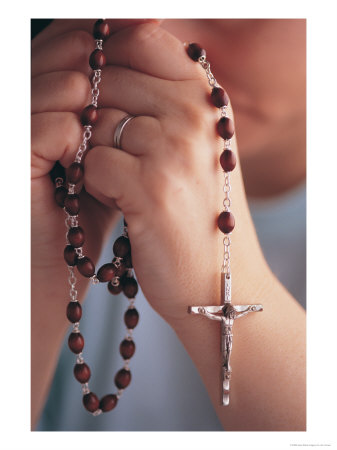
542401b~Woman-Praying-W-Rosary-Beads-Posters

Okay, so this is a bit of an experiment, but I’d really like it to catch on and would also like the support of the entire Catholic blogosphere, certainly in the UK and what an amazing thing if this could go global.

Inspired by Deacon Nick Donnelly, who has such an inspirational apostolate with his Protect the Pope blog, my blood pressure rose when I saw that a certain ‘Catholic’ theologian is once again hinting at doctrinal changes, seemingly misunderstanding that these are simply not possible. This isn’t meant to be a personal attack on Tina Beattie herself, I can understand that it must be unnerving to feel constantly besieged by a group of bloggers on the internet, but in a recent interview in the Guardian she states:

The new pope must show that he is willing to engage seriously with women’s theological voices and moral perspectives in a way which is broadly representative of the diverse experiences and aspirations of women, and not just with a few carefully selected theological handmaids.

The Church is not a democracy. Furthermore doctrines cannot change, Catholicism is based upon the truth that was revealed to us by Jesus Christ and handed down by the apostles to their successors. Revealed truth cannot change, the deposit of faith is comprised of this revealed truth expressed in Scripture and sacred tradition and thus cannot change. The church does not have the power to change or remove anything that has been given to us by Christ and His Apostles.

It is beyond annoying being told what the Church should do in relation to women, by people who are either not Catholic, or want the Church to change her doctrine in order to accommodate their own personal agendas, whether that be to allow self-destructive behaviour, to validate their own insecurity or to give them more ‘power’, which is never a healthy thing. None of us should crave positions of power or leadership.

Many faithful Catholic women are fed up of being told that they are not representative of the Catholic faith, that they are somehow brainwashed or marginalised, that their Church hates them and that most Catholic women are against the Church’s teachings, especially with regards to contraception, abortion and the male priesthood, most of which is based on dodgy poll data.

Here’s what I’d like to do. I’m not sure if this blog is the best forum for it, but then again it is run by a married mother of 4 young girls, who is passionate about female equality and empowerment, it’s just my definition of what that looks like, is very different to that of militant feminists or unrepresentative politicians and journalists, who think working women is all about a high-powered job in a nice city office somewhere on mega-bucks, or perhaps a well-paid newspaper column working from home, whereas the reality for most working mothers and children is entirely different.

I’d like to get as many Catholic women as possible, to sign up in the comments box below, to say that they agree with the following statement.

I am a faithful practicing Roman Catholic woman, who attends Mass at least once a week and who believes in and practices the Church’s teachings, specifically pertaining to matters on sexuality, contraception, abortion, marriage and the ordination of women. I believe that the Roman Catholic Church is sympathetic to and representative of the needs and concerns of women and their children, wherever they may be in the world. I would like to offer our new Pope Francis, my prayers and support and thank him for his continued protection and support of mothers and their unborn children. I fully endorse Church doctrine in relation to women’s issues. 

This could be an amazing gift for the Year of Faith. Imagine if every single faithful Catholic woman were to pledge their solidarity to our new Pope and Church doctrine in one place. What a gift, blessing and comfort, not only for Pope Francis, but also for ALL the Catholic clergy, Cardinals, Archbishops, Bishops, Monsignors, Priests, Deacons, as well as those members of the laity, who are engaged in catechesis. How heartening for them to see the fruits of their work and how loved, supported and appreciated they are by Catholic women everywhere.

Also, what an opportunity for catechesis this could be, in terms of promoting the New Feminism. If you do see this and you are a Catholic women who feels in good conscience that she cannot sign up, don’t leave a comment on this post, I’ll open up another sticky and we can get debate going there, or better still, discuss it with your priest, or someone you know who can sign in good faith.

What a message to the Pope, to the Church and to the world and media at large. We, the undersigned Catholic women, have a love for Christ and his Church burning in our hearts and we do not wish to alter or change doctrine one little bit. We are empowered by a beautiful teaching that recognises us as having an equal dignity and sets us free to live in love.

Francis Fever

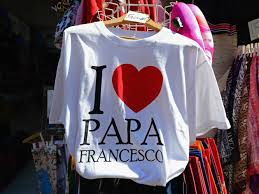
I love Papa Francesco

It could be my misanthropic side or maybe I’ve just got a very short attention span or perhaps a combination of the two, means that I’m hoping that Francis fever will shortly subside, once the inauguration Mass has taken place.

That’s not to in any way question our new Holy Father, or throw any of his qualities into doubt, far from it, the Conclave played a blinder with that googlie (indulge me a little Bernard moment to mix my sporting metaphors here) but the constant focus upon Pope Francis, the style of his papacy and his personal gracious humility and simplicity, could I think, become counterproductive.

It’s marvellous that here we have a new Pope who has really got the media buzzing, proving that Catholicism is not as irrelevant as they would have us believe and that coverage has been incredibly positive, aside from one poorly researched attempted hatchet job from the usual suspect, the Guardian, but human nature loves nothing better than to build people up, if only to knock them down again, ably aided and abetted by the media.

My concern is that this important theme of poverty could swiftly start to become jaded and has the capacity to be caricatured and used as a weapon against the Holy Father, when and if, he does something wholly in keeping with his vocation, by a media who may not fully understand the implications of the office and responsibilities of the Vicar of Christ. Such as, for example, when he travels. Fr Ray Blake highlights an essential point, namely in order to be loyal sons and daughters of the Church we really need to get to grips with and actually understand what is meant by poverty. Anyone who thinks that the Vatican museums or Roman churches can or should be sold off to the highest bidder needs a reality check.

I cannot help but think that the very last thing Pope Francis wants is to be revered as some sort of living saint for the fact that he lives out the values of the Gospel and of his religious order. Whilst it’s entirely laudable that he does so, he is not the only priest or bishop to follow in the footsteps of Christ in this way. I know at least one UK diocesan bishop who drives about in an average non descript car, has very little in the way of personal staff and goes about with absolutely no pomp and ceremony whatsoever. A parish volunteer once related to me about how they once told a man that he couldn’t use a particular space in the church car park, because it was reserved for the bishop who was coming to do confirmations, whereupon the response was a fairly nonplussed, ‘I am actually the bishop’ much to the poor man’s mortification! He had been expecting a grand personage in a smart vehicle, not a low-key looking priest.

Pope Francis may well be on his way to sainthood, as are hopefully all of us, but he is not there yet and the very reason that he took us all by surprise is precisely because he had kept an extraordinarily low profile in the run-up to the conclave, he doesn’t do self-promotion and thus had fallen off everybody’s radar, including the most seasoned vaticanisti. This self-effacing man, whilst indicating that his papacy will be very different in style, does not want to be admired, far from it, but to lead us to Christ. The theme could wear thin very quickly not to mention backfire, if it is over-egged or swift conclusions drawn and I can’t help but wonder how soon we may see the satirists draw unkind Uriah Heep portraits. My mind drifted back to how Fluck and Law of Spitting Image portrayed Pope John Paull II, with a shudder.

Pope Benedict XVI was the one who laid the groundwork in terms of demystifying the papacy, not least by resigning it. His several books that were written in his own name, alongside his prolonged interview with Peter Seewald in Light of the World, in which he let people into his own personal reflections, showed, that in his words upon his election in 2005, that he was ‘a simple worker in the vinyard of the Lord’. Pope Francis seems to have the ability to breathe new life into the Church, he seems to be the right man at the right moment, he could do for the Papacy what Princess Diana did for the Royals, not forgetting that Diana’s charism with the poor and the sick was, however inadvertently, following in Christ’s footsteps, Francis is clearly able to speak from the heart, off the cuff, to rip up formal protocols and win hearts and minds for Christ, but he may not have been able to do so, if Benedict had not already shown the way. Pope Francis is very much what the church is aching for, but the likes of Cardinal Mahoney ought to remember that it was thanks to the Emeritus Pope, that this has been made possible. If we are to remember that the papacy is not a personality cult, then we also need to remember to keep some of our admiration and respect in proportion, before going overboard about a people’s pope. I think Pope Francis will do great things for us, but only if we give him the space, instead of projecting our own interpretation onto him.

As for the matters liturgical, I hate to rain on Rorate Caeli’s parade, but it seems to me, they are forgetting one vitally important point here, in that like everybody else, the Pope is a servant of the liturgy. I know liturgy matters, I’m not a traditionalist, but equally I appreciate the importance of the liturgy in orientating us towards Christ and subjugating our will to His. Liturgy is not about how we “feel” and what gives us the warm and fuzzies, but worshiping God as he has instructed us to do so , in a way that is noble, reverent, respectful, transcendent and mysterious. I guess I’m torn on this, because whilst appreciating the desire for a simpler style, there is a part of me that thinks, look, the Vatican has all these wonderful vestments in its various wardrobes, they aren’t going to sell them, go on, they might as well use the sparkly threads every once in a while. The whole thing is very hard to get right. One doesn’t want vestments that are just so ornate and dazzlingly beautiful that they detract from what’s going on in the Mass, equally we don’t want vomit inducing ’70s lairy florescent vulgar murals, neither does one want a priest that appears almost liturgically naked, his very simplicity being a statement and thus a distraction. The mystery and nobility needs to be retained, but I’m absolutely no expert, I’ve no idea how. It would clearly be a shame if Benedict’s reforms went by the wayside, his papacy was about making sure that the entire Church faced in the same direction, towards God (one of the reasons I’m all in favour of ad orientem) and Pope Francis will continue what Benedict did for the liturgy, in terms of prayer and action.

On the subject on nobility, though it’s as the result of a happy accident, I think we also do need to remember that the Pope is also the Head of State (albeit small), a role which enables the Holy See to achieve a vast amount in terms of international relations and behind-the-scenes negotiations and peace agreements so it is only right and proper that a certain respect is accorded to him in this office. Back to the unprepossessing bishops that I can think of, I think we need to remember that even though one may live simply and reflect this in dress or manner of transport, the dignity of office, the fact that a bishop, cardinal or Pope is one of Peter’s apostles, should never ever be forgotten. I know Anglicans who have often been flummoxed by this, forgetting that an appearance can often belie the office. One of the interesting contrasts I find between the Anglican and Catholic bishops I know, is that the Anglicans are all about the ecclesial purple and pectoral crosses and piping, the Catholic Bishops tend to be a lot more discreet in their dress, often leading to others perhaps treating them with inappropriate informality and yet Catholic bishops hold infinitely more power over their diocese than their Anglican counterparts. The commentators on Rorate Caeli need to remember exactly who they are talking about and the allegiance which is owed to him, Pope Francis has the keys of St Peter, the power to bind and lose.

None of this is to diss our new pontiff, but more to add a note of caution. Yes, we should be delighted that so far, the signs are looking promising, but Joseph Shaw has wise words on Papolatry and prudence. I can see attacks on the Church, on our new Holy Father really intensifying in the near future, from all quarters, including from within, as we have already seen. Whilst I take CS Lewis’ guidance to heart about the equal and opposite errors with regards to thinking about the devil, it seems to me that the reaction, the anger, whether that be from Rorate Caeli, the liberal press or hostile Anglicans, seems to flow from one cause. We have a great new Pope, who promises so much in terms of the New Evangelisation and the reinvigoration of the church. One who is going to re-sanctify the church and bring Christ to the world, especially the poor, sick, the needy, the elderly and the unborn in the twenty-first century. Not only that, technically we have TWO Popes, no matter how bizarre that seems. Not one pope, but two. One who will be actively leading us in prayer and holiness and another former pope, who will be storming the heavens on behalf of the church, with a life of prayer and penance. Think about that for a moment. I said in a previous post that we had two-for the-price of one in Pope Francis, with the merger of the Jesuit and Franciscan. Actually we have that in an actual physical sense, two popes together working for the church although in very different ways. One public and one private. They are even meeting privately next week, in order that Benedict may pass on some of his wisdom and experience to help Pope Francis in some of the difficult decisions. This is unprecedented stuff.

The power of two extraordinarily holy, deeply spiritual and wise men, leading the faithful in prayer. It can be no surprise that someone is angry, someone is furious, whenever great good happens, retaliation always occurs. Someone else has got Francis fever, which is why we need to all be on guard.

HeelandtheSerpentB[1]

*************************************************************************************************************************************************************

(Oh and as aside, to the critics who are claiming that the Church’s teaching on sexuality and priestly celibacy is misguided because it’s difficult but who are lauding the Pope’s zeal for the poor. The response to which is doing what is right, is not always the same as what is easy. I wonder what they would make of being informed that technically they should be giving at least 10% of their income away to charity. That’s not easy either, especially in these troubled times, but does that mean that it’s equally quite so misguided and wrong? If chastity and celibacy are wrong because they are allegedly difficult and challenging then why doesn’t giving a significant proportion of your income away, fall into the same category?)

The media and a cheeky little grumble

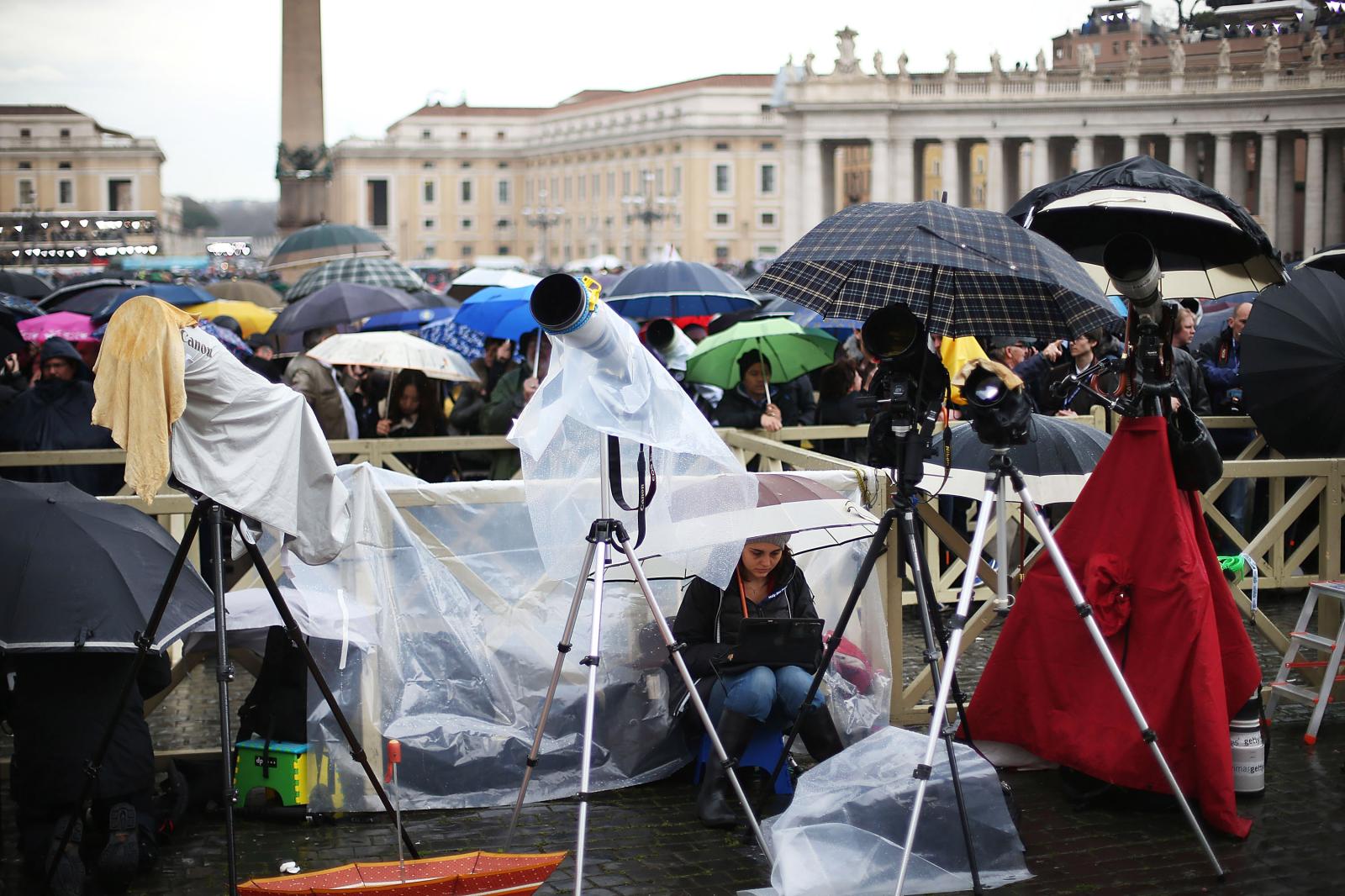
Who wanted to be in rainy Rome anyway?

Regular readers will have noticed that I haven’t been posting over the past few weeks, even though there has been no shortage of material. The main reason for this has been the time that I spend writing (usually evenings) has been taken up with vast amounts of reading around the conclave process, its history and the background of the various papabili in preparation for any media appearances which may crop up. Catholic Voices has really come into its own during these momentous weeks, many of the speakers have done a tremendous job in terms of informing the media and general public and one thing that I have noticed from my contributions, is that the attitude of the media certainly seems to have softened and become a lot less hostile and more open to a reasoned Catholic viewpoint, although there are occasions when one finds oneself addressing the same old canards again and again.

Whilst there will always be the same detractors, the one thing that should be borne in mind, is that despite the excellent and rigorous training and preparation for what it is like to be in the hot seat, there is no substitute for experience. The more media appearances you do, the more confident, relaxed and skilled you become at the whole process, so those who vociferously complain in the various coms boxes really need to bear this in mind before they let rip. I can certainly see an improvement and marked contrasts between my recent interviews and those of a year ago. It isn’t always easy being subject to scrupulous, superficial and often ignorant scrutiny when one has a microphone or camera trained on you. In most of these situations, nuance or an in-depth detailed theological discussion is impossible. Very often, such recently on the Big Questions, it’s superficial scattergun apologetics, bouncing from one neuralgic issue to the next, to the next, with no time for considered thoughtful answers. The opening shot of an interview I did yesterday was “well you obviously follow Catholic teaching on contraception then, you’ve got 4 children”. It then went down the usual rabbit holes and on reflection, I can see how at times I missed my chance to refocus the interview on the Pope, but it’s pretty difficult to concentrate when one is being poked in the eye with a sharp stick. But on another occasion, God Willing, I’ll be able to handle that better, having learnt.

I did an interview the other morning for Radio Merseyside, having woken up for the early morning interview chock full of cold and lurgy. It proved our saying, you are never as good or as bad as you think you are (I thought it was absolutely terrible), but judging by the stat counter on my blog, I’d obviously confused the listener by using the word pallium, without explaining what this was. Several people arrived here having asked google about “Caroline Farrow’s pallium”. I then received some friendly advice about not using specific liturgical terminology. ‘The problem is’, they explained, ‘that nobody knows what a pallium is. They probably spent the rest of the interview highly distracted wondering what a pallium was, how big is it, did he mean to leave it there and did he ever get it back. What happened to it? Is it like something out of Dr Who’. Which is fair comment and goes to show that for certain audiences, detailed complex theological or philosophical concepts are going to go way over people’s heads and prove counterproductive. But by the time I’d done 11 back-to-back interviews for local radio the other Sunday, I think I’d pretty much got the issues down pat and nailed, the only difficulty being attempting to make the same sentiments sound fresh after 2 and a half hours of non stop opining. As long as one can relax and enjoy the interview and realise that the presenter actually wants to find you winsome, a bit of jocularity goes down a lot better than jargon-heavy hectoring and might actually motivate people to find out more.

We’re in the realms of cloud cluckoo land if we think a short slot on local radio should aim to deliver the thunderbolt that sends the listeners rushing to their nearest confessional, certainly the common theme in both my journey of faith and those that Catholic converts have shared with me is not necessarily one incident but whole series of interlocking events that looked at as a whole, formed a path leading to the truth. A compelling media appearance can certainly play a part in that, but a 3 minute slot is not going to have the same effect as an hour’s talk or presentation by a great Christian or Catholic apologist.

The last few weeks have been something of a roller-coaster for us all. We’ve barely had time to come to terms with the resignation surrounding our beloved Pope Benedict, before getting into the swing of the conclave and the speculation surrounding his successor. On a personal note, like many of my colleagues, I’ve been rushed off my feet preparing for interviews, which not only takes it toll in terms of time but also emotional energy as well as, for someone like me, logistics. It’s not especially easy to arrange childcare at short notice when one’s husband is miles away at seminary and family needs to come first. I was really disappointed to have to turn down Sky News on the day of Benedict’s final general audience, but Robin had his official formal interview and feedback for the diaconate, which was infinitely more important. And let’s face it, doing the big media stuff is always fun and challenging, even if nerve-wracking, although one really needs to be on guard for spiritual vanity, which is one of the consequences of this kind of work and a trap which I really do have to work very hard not to fall into. If readers could continue to pray not only for me, but for all of us who try to speak for our faith in whatever medium, it would be hugely appreciated. We always make sure that we have a prayer chain of folk praying for us before we go on air and in the final moments before the camera switches on, I always clear my mind and pray.

But now onto the grumble and observation. Last week, I had word that the BBC were looking to fly me out to Rome to be a part of their coverage for the conclave. To say that I was beyond excited is something of an understatement. Robin and I agreed that if it were possible, given that this was a once in a lifetime opportunity, that we should do whatever we could to make it happen, hence I had a week of rushing about like a headless chicken, and a precise timetable of chores, involving making sure that two of the children could stay with their grandparents, clothes were meticulously laundered into handy piles, favourite cuddlies and books stockpiled and packed, along with bibs, beakers and all the various paraphanalia to ensure that life was as easy as possible both for them and my parents at the other end. A rota of other parents were enlisted to pick up the eldest from school and various favours called in, whilst in the middle of the week I made an eight hour journey to Peterborough and back to procure a passport to enable me to take the baby, as well as beginning to acclimatise her to taking a bottle of formula milk, in case the passport did not arrive in time and/or to make life easier whilst out there.

In between all the dashing about, I waited and there was nothing. No confirmation of what was happening or response to an email asking whether the trip was still on. As is their prerogative and their right, the BBC decided to change their line-up and were too preoccupied to respond. That’s fair enough really, it’s entirely up to them who they wished to cover the event and my childcare and personal arrangements are irrelevant and none of their concern. This kind of thing happens all the time – we need to be ego free, prepared to be dropped at a moment’s notice, but it was more than a little frustrating having to put in place a complicated contingency plan should I suddenly be asked to get on a flight at moment’s notice. Of course I could always have said no from the outset, but the BBC had asked specifically for a woman and the other candidates were already indisposed. Naturally I wanted to go, if at all possible. But it wasn’t to be.

Then to add salt into my wounds, the phone rang on Wednesday night, between the appearance of the white smoke and Pope Francis on the balcony, asking whether or not I would be able to appear on Newsnight. Robin said fine, he’d put the kids to bed and I ran to jump in the shower, with BBC News playing on full volume on the radio. Having made myself look vaguely presentable, I then sat there for a few hours, having spoken to the producer of the show, trying to stop the children from smearing sticky fingers and spilling milk all over my only clean suit, waiting for him to phone back and confirm that a car was on its way, having pressed on him that one needed to come quickly if it was going to get me from Brighton to London in time. All the while trying to compose myself as well as some cogent thoughts about our new pontiff. At 9pm, an hour before I was supposed to be at the studio, no car had come, so I rang the show, only to discover that they had decided to drop me in favour of two priests and had forgotten to ring me back and tell me.

So all dressed up, tons of adrenlin and nowhere to go. Which happens, it’s incredibly frustrating, part and parcel of life and every single Catholic Voice will have a similar story about being dropped at the last minute, it’s not the first time it has happened, it won’t be the last and is all part of being ego free, but nonetheless I was feeling a little antsy and fed up yesterday, having invested a great deal of time and emotional energy. It is disappointing when that happens, especially when one has built oneself up. So another thing to remember next time one sees anyone on television or on radio. We’re all members of the laity, we’re not full-time professional media commentators, we’ve all got lives and families of our own and we do this work gladly out of love for the church and though we undoubtedly enjoy what we do and strive to do well, it does entail sacrifice, and this week was something of a double-whammy in terms of building up expectation and adrenalin, only to come crashing back down again. I obviously need to take a leaf out of our new pontiff’s book in terms of humility.

So moaning aside, and yes this is admittedly a minor personal grumble although I am sufficiently recovered and able to take disappointment in my stride, what I find most interesting about this, is that the BBC, who are usually preoccupied with diversity and representation and who repeatedly question the Catholic Church in terms of whether or not it represents women, have on two occasions in its recent coverage, ignored the opportunity to represent the viewpoint of an ordinary faithful Catholic woman in the church, in favour of men. I’m loath to draw any conclusions about political agendas, sometimes these things just happen without reason, but I can’t help but wonder whether or not a dissenting or ‘liberal’ Catholic woman would have made a more compelling narrative? I think it’s why they were keen to interview me over the celibacy controversy and found that they didn’t quite get what they were bargaining for.

Perhaps unsurprisingly, the Catholic TV station EWTN had Colleen Campbell doing an excellent job covering events. Whereas the UK media’s coverage was predominantly male-dominated. In some ways that doesn’t bother me, I’m not one for shortlists, it should be whoever is best able to do the job, regardless of gender and certainly in the case of Newsnight, Fr Alexander Lucie-Smith was his usual erudite and charming self. But next time the BBC wishes to berate the Catholic Church over its representation and treatment of women, it perhaps ought to look at the predominant gender of who it chose to represent the faithful in their coverage of the past few weeks.

Still it’s all part of life’s rich tapestry and an additional Lenten penance. I’m now due for a bit of a rest, unless anyone fancies subbing me a quick flight out in time for the inaugural Mass…

A Tale of Two Francis

Viva Papa!
Viva Papa!

Here is the full unedited version of a piece I wrote for Mercatornet on our new Holy Father.

The world’s Catholics are reeling with the shock election of the Argentinian Cardinal Jorge Mario Bergoglio as the new successor to Peter, even the most seasoned Vaticanistas were not predicting that the runner-up to Ratzinger in the 2005 Conclave was a serious contender, his age and his Jesuit background both seemed to count against him.

Surprise swiftly melted into joy, excitement, anticipation and gratitude upon confirmation that age is clearly no barrier to innovation for the former Cardinal, as signified by his choice of name – the first Pope Francis in almost 2,000 years of Church history.

The name Francis is an indicator as to the future direction of a papacy which will have the themes of simplicity, humility, discipline, reform, rebirth and outreach at its heart. Not only do we have the first ever Pope from Latin America, but in Pope Francis we have something of a two-for-the-price of one, with a fusion of two major religious orders, whose founders both heralded a period of Church renewal and reform. Bergoglio could well prove to be a man for all seasons, combining the spiritual discipline of St Ignatius of Loyola with the humility and simplicity of St Francis of Assisi.

One of the defining qualities of the Jesuit order is that they don’t mess around and always mean business – something that could prove very useful for a Pope for whom reform of the Curia, the Vatican’s bureaucratic arm, is high on the agenda. The recent Vatileaks brouhaha was a symptom of the internecine factionalism that currently besets and hinders this small, but essential part of the Church from running in as efficient a manner as possible. A Pope who could be both governor and enforcer was one of the prerequisite criteria and a key theme emerging from the General Congregations, the meetings that preceded the Conclave. A religious order with a reputation for getting down to business , sorting wheat from the chaff seems to be exactly what the doctor ordered, and those who might doubt whether or not he possess the passion to bang heads together, ought to remember his scorching attack on clericalism, just six months ago in September 2012, when he denounced priests who refused to baptise the babies born outside marriage, as being guilty of “rigorous and hypocritical clericalism”. Pope Francis has no time for what he deems “the spiritual sickness of a self-referential church”.

All of which augurs well, as does his track record of swiftly appointing loyal bishops to troubled dioceses – the Catholic church is not a top-down organisation and depends upon good local governance. Rapid deployment of strong faithful intelligent bishops is key to rooting out decay and planting the seeds of the future.

John Allen, the veteran Vatican observer, has wondered whether or not Bergoglio’s lack of solid experience inside the Vatican itself would prove an obstacle, but an outsider with an Ignatian passion for rigorous discipline and an agenda for change, wholly untainted by insider corruption or personal interests, is ideally placed to implement the much needed root and branch reform. Pope Francis has previous form when it comes to taking action. He rose to prominence following his appointment as the provincial of the Jesuit order in Argentina in 1973, and unlike other Church leaders refused to back the country’s military dictatorship. He held firm against the rising tide of liberation theology sweeping Latin America, discouraging priests from political activism and insisted that Jesuits continued to staff the parishes and chaplaincies where they were needed instead of forming communities. Bergoglio’s insistence on obedience and stamping out of heterodoxy and dissent won him some local enemies, but indicates a desire to get things done, and is a trait that will stand him in good stead when it comes to continuing to root out what the Emeritus Pope Benedict described as the filth of the child abuse scandals, that have rocked the Church in recent years. There can be no doubt that Pope Francis will continue to act with an iron fist when it comes to sorting out sexual transgressions and there will be no room for cover-up. His struggle against the military government of Argentina together with the rise of liberal theology prefigures the battle against the pervasive rise of moral relativism in an increasingly secular West. “After a battle” he reportedly said, “you have to act firmly”.

The previous two pontiffs can be characterized as theological powerhouses, whose teaching was reinforced by a vast canon of personal writings and both of whom could be studied as philosophers and theologians in their own right. Following thirty-five years of academic reflection, many have felt that now is the time for some intellectual breathing space, to give the faithful time to digest and apply what we have been taught by John Paul II and Benedict XVI, who unpacked and applied the reforms of the Second Vatican Council. Whilst Pope Francis is no intellectual slouch – he trained as a chemist, before joining the priesthood, he has an undisguised passion for literature having taught the subject at University level alongside psychology, philosophy and theology and in true Jesuit tradition has encouraged priests to exercise their cerebral and artistic gifts, few people can pack the cerebral punch of Carol Wojtyla and Joseph Ratzinger.

Bergolio’s election is nonetheless a manifestation of the growing desire to see a different style of papacy, one that teaches and leads through its actions as well as words. It can be no surprise that a Cardinal noted for his humility and love of the poor has chosen St Francis of Assisi, the man who reformed the church through simplicity, as his namesake. Of humble origin, born of an Italian immigrant railway worker, Jorge Bergoglio has eschewed all trappings of office, avoiding media interviews and urging people not to spend money on plane tickets to Rome to celebrate his election to the Cardinalate in 2001, but instead to give the money to the poor. Instead of living in a lavish episcopal mansion in Buenos Aires, he chose instead to live in a small apartment where he cooked his own meals, did his own housework and took the bus around town visiting the poor, rather than a chauffeur driven limousine. True to form, following his election to the papacy, he chose to take the bus back to the hotel instead of using the Holy Father’s car, to spend one final night with the cardinals and emerged suitcases in hand in the hotel lobby, to pay his own bill.

In an era that is reaping the consequences of globalisation and the ravages of a rampant unchecked capitalism, the Christian message of concern for the poor and of social injustice is of paramount import. In Francis, we have a Pope who embodies the compassion of Christ, whether that be by kissing the feet of AIDS victims, or rolling up his sleeves and going out and ministering to the poor, accompanied by a rhetoric that denounces the failures of neo-liberalism.

One of the frustrating aspects of the papacy of the Pope Emeritus was that his constant critiques of an economy based on individualistic greed and mind-blowing masterclasses on natural law and reason were subsumed and ignored by a media only interested in sexual ethics and scandal. Pope Benedict’s problem was not that he was by any means ineffective, it is thanks to him that the Catholic Church now sets the gold standard in terms of child protection issue, but that self-promotion was not his forte and the Vatican failed to communicate the extensive measures that had been taken and neither did they initially understand the nature of a rolling global 24/7 media. At times it appeared that the Vatican press office consisted of an elderly telegraph machine and answerphone, allowing, in the words of Mark Twain, a lie to travel half way around the world, whilst the truth was still putting its shoes on.

The willingness to engage with the media could potentially pose one of the few problems for this naturally modest yet deeply spiritual man. Yet from the moment that the world caught of a glimpse of the new Pope it was clear, that whilst not possessing the natural charisma or showmanship of John Paul II, his prayerful nature demonstrated by breaking with tradition and asking the crowd to pray for him, before giving the customary blessing, this simplicity will be precisely how he will win hearts and minds in the New Evangelisation. Pope Francis is a man whose actions will demonstrate that he is all substance over what will be a very humble style.

Pope Francis has something for everyone, a seamless garment- a man who straddles all aspects of a diverse church, a man who holds the concepts of social justice as close to his heart as issues surrounding the unborn, the elderly and the protection of the nuclear family. His first papal blessing was given to a pregnant woman who happened to have got up early to pray at the basilica of Santa Maria Maggiore, where he too had gone to pray before the Roman image of the Mother of God. Pope Francis, will be a pope of the people, leading the way forward by example in prayer and in a lifestyle of simple humility.

Whilst there is some concern amongst traditionalists in terms of liturgical preferences, there is no reason to believe that he will be openly hostile to the reforms of Summorum Pontificorum – frankly he has bigger fish to fry and is too canny to alienate a significant proportion of the world’s faithful. Although yesterday’s Mass may have caused some facepalming amongst those delighted in Pope Benedict’s liturgical reform of the reform (‘Holy Father I love you already, but what’s with the polyester and freestanding altar’ said one friend), whilst Pope Francis may see a temporary return to practices that some may have hoped were on the decline, I think we have to remember that if he wishes to face the people, or changes the Benedictine altar set-up, it’s simply because he wants the people to see Christ – it is with good heart and intent, not because he has some secret liturgical agenda.

Though 76 and with only one lung, Pope Francis still has plenty of life to breathe into the Church, combining the evangelical zeal of St Francis Xavier, with the reforming simplicity good works and love of the poor of St Francis of Assisi. Whilst the Church may not be in ruins, this holy man from the South may be just the breath of fresh air that it needs. Jesuit decision-maker and political negotiator melded with poor mendicant friar will sow the seeds for a twenty-first century Catholic revival, in a world grown jaded and weary with the selfish excesses of consumerism. Catholics will need to start putting their money where their mouths are.

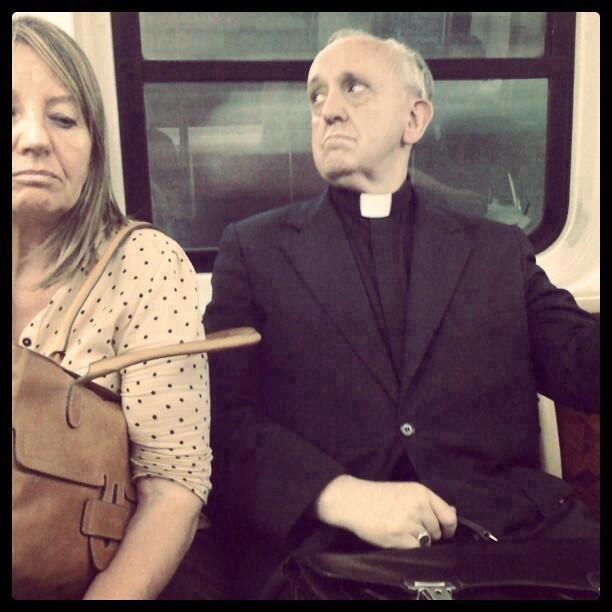
Pope Francis on an Argentinian tube
Snapped unaware on the Tube

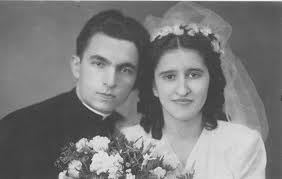
Dog collars and wedding rings

happy couple

According to Damian Thompson, the next Pope must think seriously about married priests. It may be that Damian has a point, as we all know celibacy is a discipline and not a doctrine of the Catholic church, the Church will ordain married men who have previously been in ministry, the discussion is a perfectly valid one, however I imagine that before such a far-reaching move were considered, the opinions of existing clergy spouses would be sought and taken into consideration.

Here’s my fourpennorth, speaking from the point of view of someone who was a clergy spouse and will shortly be one again – it’s interesting, we don’t often hear from the point of view of the clergy wives, who tend to quietly keep their heads down and get on with life, which should give something of an indication of the nature of the role.

Damian distinguishes between the vocation of priesthood and that of celibacy and says that the two are not necessarily mutually exclusive. He may well be right in that, but priesthood entails that one fashions and patterns one’s life around that of Jesus Christ, who was himself a celibate male. The apostles were admittedly married, but this was prior to their call to follow Jesus, there is absolutely nothing in the Gospels that suggest that they married subsequent to this. Celibacy should therefore be the norm, it’s a gift that my husband has begun to really appreciate as he has be drawn closer into the Catholic church and though he does not wish either myself or his children away, he is acutely aware that celibacy is a gift that he cannot give, although if I were to predecease him then he would not be allowed to re-marry, which is something that he has had to consider carefully. Celibacy affords a freedom that is simply not available to married men, on both a practical and spiritual level. Fr Terry Martin, the Vocations Director for the diocese of Arundel and Brighton, puts it beautifully:

a celibate discovers again and again the truth that he finds everything he needs in God .

It isn’t simply about the practical consequences or the being free to serve and pour oneself out fully in the service of your people, which is a functional consequence of celibacy, but it’s about having a heart to dedicate fully in the service of the Lord.

Does this mean that my husband is going to be less of a priest, or not a priest in the fullest sense? No, because like all priests, once ordained he will have an indelible mark on his soul, there is only one sacrament of ordination, it does not have first or second-class orders, but the church recognises the duality of vocation in those cases of convert priests who were not brought up in the tradition that they would need to choose between marriage and priesthood, as well as recognising and honouring the previous ministry.

Married priests have a lot to bring to their ministry, they will have personal and direct experience of married life and often physical fatherhood. Having had a few years out of ministry prior to ordination was an enormous gift to my husband, not only strengthening his call back to the altar, but also the experience of a full-time lay profession and juggling the demands of a young family, perennially pregnant wife along with keeping up with his spiritual formation, prayer life and volunteer work, will stand him in good stead, in terms of understanding the pressures and challenges for Catholic families, who are desperately trying to keep the faith. He also understands the great challenges and enormous gift of the Church’s teaching on sexuality and will be able to communicate that in a very open and honest way that might perhaps prove more difficult for a celibate priest.

But there is, as both Fr Tim and Fr Sean Finigan note, a duality of heart at play here. Exlaodicea also has some poignant insights.  Though one should not focus solely on the practical nature of a married priesthood, it would have consequences, not least who on earth is going to support all these married clergy, most of whom, would presumably have a fair few children, for obvious reasons. Not all presbyteries are sprawling Victorian piles, some are very functional 2 bed houses, built in the 50s and 60s when the time of the housekeeper was beginning to decline. Suitable accommodation, ideally near to decent Catholic schooling needs to be found. A married priest with children simply cannot be moved in and out of various parishes at will, as to do so would disrupt the childrens’ education, so a bishop will find that he has far less flexibility. He’ll have to find a parish or ministry able to support the married priest and his family, together with a suitable house, and leave him in situ there for quite some time, or at least until the children have flown the nest.

Those are really minor issues in the grand scheme of things. A clergy spouse has to understand that her husband does not have a job but a vocation, regardless of denomination. This entails a couple of points. Firstly, a priestly wife is going to have to share a deep love of the faith. A cafeteria Catholic or generic go to Church once a year Christian is simply not going to be well suited. An Anglo-Catholic vicar friend describes his frustrating experience of dating an Evangelical. She was, by all accounts a lovely girl, but didn’t understand or agree with concepts such as infant Baptism or Eucharistic adoration (why are you worshipping a piece of bread) which made for some fraught moments, when he felt that perhaps he was being inadvertently attacked, or just didn’t want to engage in apologetics in his own home. I guess we all search for someone who innately understands us and shares our goals. Antoine de Saint Exupery has a wonderfully apt quote about love – it does not consist in gazing at each other, but in looking outward together in the same direction.

So if a spouse has the same devout faith as her priestly husband, she is going to understand that vocation will often need to come first and before her needs and wants and sometimes above the family. An example might be an RCIA class on Valentines Day, or an evening interview doing marriage prep with a couple on her birthday. Agape will often need to trump eros. It’s also quite a scary thing being a clergy spouse. You don’t have care of souls, but you share your life with someone who acts in personae Christi. On that terrible day of judgement you will be asked to account as to whether or not you helped or hindered in the care of souls and there is really no excuse for spiritual laxity.

A clergy spouse has to understand that whether she likes it or not, to some extent she has to keep an open house and be happy to accept visitors at all hours and be ready to feed multitudes at the drop of a hat. I remember one occasion when Robin (bless his cotton socks) had no idea what it might be like following the birth of a new baby and announced when child 2 was about 6 weeks old, that we had 14 deanery clergy coming for lunch the next day and would I be able to rustle up a spot of lunch! (Gosh did I feel smug when I managed it, baby lay in her Moses basket in the middle of the living room likes a sacrificial lamb, surrounded by several clergy, whilst one elderly Father sat in my special breastfeeding rocking chair, noting that it was the most comfortable chair he’d ever sat in and asking where I bought it, to which I despatched him off to Mothercare!)

I digress, but what that means is often, in effect, it can be difficult for a clergy spouse to work – she can’t rely on her husband to help out with childcare and thus to a certain extent her ministry has to revolve around his. She has to be flexible, discreet, patient, diplomatic and tactful. So when Ethel says to you “oooh you had a late night, I saw you had your light on reading til 1am” or it takes 3 hours to get around Sainsburys after being buttonholed by half the parish who seem to take an unnerving interest in what you might have in your trolley (oooh Fr Robin, he does like his lemon meringue pie) or have folk sweep in and out of your home, which is often used to hold meetings in, you just have to smile sweetly and accept it and make the tea and sandwiches for whoever has come a knocking at whatever time of the day or night. On one memorable occasion a former parishioner attempted to quiz me on our intimate life – being a clergy wife seems to hold particular fascination in that respect for the prurient. Oh and don’t expect weekends to be your own either, for obvious reasons.

That’s not meant as a litany of horror, but rather a jolt of realism, being married to any clergyman is a vocation itself and puts a unique pressure on a marriage. In the Catholic church it is recognised that married priests do indeed have a dual vocation so technically they are never in charge of a parish, but still there will be times when a priest is pulled in two directions and may need to prioritise his family. Plus no-one has mentioned the kids – having a Catholic priest as a dad does put quite a bit of pressure and expectation upon them. We’ve heard of David Burrows MP having had his children bullied at school as a result of his homophobia. Being an RC priest is about as counter-cultural as it gets, and things can be even more complicated if you are a governor of or affiliated with a school, in which your children are getting a hard time. And there might be times when the children often have to miss out on their dad’s presence at things – simply due to the erratic hours that a priest might work. One can’t refuse the dying the sacrament of the sick due to a parents’ evening or school play.

So the idea that a married priesthood is going to be a wonderful thing and make priests so much happier, is highly dependent upon him finding a spouse who is going to be wholly supportive of his vocation. What happens if she isn’t? Is it fair for a parish to be dealing with the fallout of their priest’s marital breakdown?

And we all know that the idea of a married clergy being less likely to abuse, is a canard. The argument doesn’t make sense – in the UK less than 1% of people were shamefully abused by Catholic priests. The NSPCC states that as much as 24% of the population are victims of abuse that took place in childhood or adolescent , of which 65.9% was perpetrated by those under the age of 18. Clearly then, the majority of the blame for the abuse cannot be laid at the door of the Catholic Church, let alone celibacy, given that the vast majority of abuse is reported as taking place in family situations. Even in the US where the number of clerical abuse victims rises to 4%, this is a lesser figure of abusers than, say teachers. Most of those responsible for abuse are those who are permitted sexual relationships with others and celibacy does not account for the abuse that has taken place within the Church of England. That’s not to undermine the seriousness of the offences that did take place, but there is nothing to suggest that celibacy is responsible for abuse, the evidence points firmly away from drawing this conclusion. Which leads me nicely into the next point.

The idea that sex is a need that must be fulfilled otherwise it will lead to abuses is one that must be fought as it seeks to shift blame away from the abuser themselves. All of us have self-control and there can be no excuse for sexual assault. Furthermore those who look towards marriage as a being some sort of cure for these tendencies not only ignore the statistics on married men and abuse, but are deluded if they think that marriage is any sort of guarantee against sexual frustration. Even the happiest marriages go through periods of abstinence, for a variety of reasons and most married couples, especially those with busy lives and/or young children will testify that they aren’t swinging from the chandeliers seven nights a week. This post-modern idea of sex as a basic human need, such as food or water is one that must be fought back against. There are many non religious celibates who live happy and fulfilled lives and to treat a wife as a vehicle with whom to overcome sexual frustration is wholly contrary to Catholic teaching on marriage. Clergy spouses will have read the canonist Ed Peters on marital continence with alarm.

The other point of contention in Damian’s piece is that it wholly relies on his anecdotal evidence – most suburban priests in various Western areas are gay (which ones) and most clergy in Africa have at least one secret wife. It’s impossible to verify or discount these statistics one way or another. It’s definitely true that no vocations crises exist in Africa, seminaries are turning away candidates due to lack of space.

The happiness of a married priesthood hinges on a very narrow definition of marriage being all about sex and is mooted as a false panacea to the abuse crisis. Personally I am extremely grateful that the Holy Father has been generous enough to grant exceptions on a one-off basis, but as part of this process, I needed to pledge my whole-hearted support, knowing full well what this would entail. The happiness of a married priesthood is wholly dependent upon a good quality relationship and a wife who can get 100% behind her husband’s vocation, and places an additional burden on the priest himself who will always have divided loyalties.

That’s not to say that a married priesthood can’t work, the Eastern Rite and Orthodox churches have good approaches, but we should be in no rush to lift this and it is difficult to see how celibacy could be promoted as the ideal standard, were priests suddenly allowed to marry. One also has to note that all this speculation seems terribly unfair and unkind to those seminarians currently being formed in the expectation of celibacy as well as existing clergy. One of the problems around the time of Vatican II was that there was very little formation of this nature – everything seemed to be up for grabs and the process of formation was not as thorough as it could have been, seminarians were ill-equipped to quote with the pressures of the then emerging sexual revolution. These days seminarians are well aware as to the temptations of the modern world and have at least six years to consider their vocation.

I hear on the grapevine that Mrs Newton was a little taken aback by Damian Thompson’s piece. I’m not surprised, I expect she greeted it with mixture of delight (how flattering to have a piece in a broadsheet newspaper calling into question the discipline of celibacy based on a brief dinner encounter) and horror. Opinions on the merits of celibacy should not be hung off the back of individuals. Though many congregations are open and welcoming of married Catholic clergy as Damian notes, there are still some people that see marriage as an impairment to Father’s ability to be at their beck and call and make their feelings known, quite vociferously and at deliberately unsocial hours. At the other end of the scale, one acts as an unwilling or unintentional ambassador or advert for a married priesthood, such as in the case of Mrs Newton.

A change to the rules is one that needs to be approached with due caution. Being a clergy wife is a difficult path to navigate, particularly in a world where celibacy is the norm. Behaviour that would be acceptable in the Anglican church, is not possible in a Catholic setting, where wives are unusual and tolerated. It is not your ministry and one has to be extra careful not to tread on toes or offend a myriad of people or be seen in any way as interfering or taking over. I guess a suitable parallel could be drawn to my sixth form, which at the time was integrating girls into a formerly all-boys school. In my year there were 15 girls to 115 boys and many of the masters did not see our presence as a positive thing. It’s unfair to say that existing clergy have been anything other than welcoming, all of them have been, but all Catholic clergy wives I am friends with know that we are an exception, not the rule and have no desire to trailblaze or queer the pitch for any future former convert wives, or extol the virtues of a married priesthood. Our situations are as unique and individual as we are, and we are able to testify to both the positives and negatives.

Just as a vocation to priesthood is a calling, one could argue the same of a clergy spouse. A priest requires years of formation, one could argue that a clergy wife needs similar, she certainly learns things as she goes along on the job, often getting things wrong and making gaffes along the way. Unlike her husband she is not in receipt of any sacrament, and yet she is subject to similar scrutiny and certain standards and expectations of holiness and behaviour. She knows that her marriage and conduct will, whether she likes it or not, be held up as an example, for good or ill as will her appearance and the behaviour of her children. She knows that her husband’s vocation is ontological in a way that her marriage is not – she will no longer be married in heaven, her husband will still be a priest.

There’s quite a lot of pressure on her shoulders, it is neither a panacea nor a situation for the feint-hearted. Most of us love our spouses on account of who they are, not their job. A clergy wife loves her husband for who he is and that includes accepting, welcoming and embracing his vocation, no matter how difficult or counter-cultural. She will often need to accept that a career may not be possible for her and neither will a permanent home. Like those original fishers of men, she will need to follow the Lord wherever he is leading or calling her husband.

I never thought I’d wind up married to a Catholic priest, I think the nuns at my school would have a blue fit were they ever to find out where my life has led. But at least I knew what I was getting into when I married a man with a vocation, which I accepted as being part of who he was and impossible to separate out, being integrated into his identity given he’d felt the calling from a very young age.

It’s worth looking up the work of American sociologist Andrew Greeley who discovered that celibate priests scored much more highly on the happiness index than their married Anglican counterparts. The challenges that face the priesthood are not celibacy-related. Everyone should know exactly what they are getting themselves into, before getting carried away by notions of dog collars and wedding rings.

The Cardinals and reverse psychology

Papal Conclave-005

The words of the Secretariat of State seem particularly prescient in the light of the damaging allegations that have surfaced regarding Cardinal Keith O’Brien in this morning’s Guardian.

Once again the media seem to be disregarding the rules surrounding natural justice and due process that would be followed in any criminal court, namely a presumption of innocence until proof to the contrary, and are commenting upon these allegations as those they were established fact, with the usual suspects rubbing their hands in glee, not least those who thought Cardinal O’Brien’s Bigot of the Year award, fitting.

With regards to the allegations, the following questions present themselves:

  • Why are they only being made now? If the concern has to do with whether or not Cardinal O’Brien should be allowed to vote in the Conclave, why given the age of the alleged incidents, did the accusers not make known their concerns prior to the conclave of 2005, or even earlier in 2001, when it was announced that O’Brien would be elected to the college of cardinals?
  • Do the comments surrounding priestly celibacy have anything to do with this not least in terms of the media exposure of Cardinal O’Brien of late? Does Cardinal O’Brien’s stance on gay marriage have any part to play on behalf of those who would seek to expose or out him? It ties into the first point – the timing seems peculiar.
  • Who leaked the nuncio’s emails to the Guardian and why?
  • If these allegations do turn out to be sadly true, it would not appear that any criminal offence has been committed. These would appear to be consenting adults – there are no accusations of assault. Surely this would be an internal church matter and not within the remit of secular authority? Cardinal O’Brien is due to retire in a month’s time, what action are the priests expecting the church to take? An individual’s sexuality should have no bearing when it comes to prayerfully discerning whom the Holy Spirit might be guiding into the Chair of St Peter. It sets a very dangerous precedent to assume that clerics are guilty of any allegations without due process being followed and neither is it for the secular world to interfere in the internal processes of the church. So far, we have had one side of the story and it would seem very much as though Cardinal O’Brien is subject to trial by media.

All of which brings me neatly onto Cardinal Mahony, who due to his mishandling of priests guilty of sexual abuse in his diocese, is also subject to similar calls to stay away from the conclave. Let’s be clear. Cardinal Mahony, though guilty of severe negligence is not a pedophile or abuser himself. It’s hard to get one’s head around why he didn’t report these abhorrent crimes to the police, or at the very least lock the perpetrators up in a remote monastery somewhere, but as has been documented, times were different then. The psychology of abusers was not understood in the same way, it was genuinely believed that therapy could cure a disordered sexuality, and the abusers’ professions of repentance were taken at face value.

There’s a whole essay into the factors contributing to the abuse that took place and its subsequent cover-up by local diocesan bishops and parallels to be drawn with what happened in other non-Church institutions such as for example the BBC, but it isn’t fair to imply, nor is there evidence to suggest, that those who did cover-up the scandal, did so because they didn’t care about the victims or because they thought that abusers were likely to re-offend and simply didn’t care, what enquiry after enquiry has demonstrated is that they were misdirected out of love for the church and actually ignored the regulations that were already in place which directed bishops to report these crimes to the police. There is no basis for the claim that various bishops simply didn’t care – the credible answer is, that as prelates such as Mahoney have testified, they simply didn’t get it.

Does that mean he should be disbarred from voting in the conclave to satisfy the demands of a baying press? I would posit that a Cardinal who has personally faced the scandal of clerical sex abuse and who has faced widespread criticism and rebuke not only from the outside world, but also from his peers, would be ideally placed to prayerfully reflect upon who should succeed Pope Benedict and which candidate may possess the necessary qualities. Cardinal Mahony indisputably knows the enormity of the scandal and the huge repercussions for those who may get it wrong. There can be no doubt that he does now understand the seriousness of it all. Perhaps a good comparison would be that of the airline industry? Whenever a pilot has been implicated as being at fault in a serious incident, such as the Kegworth disaster in 1989, British Airways always rush to offer that pilot a job, the First Officer in that tragic crash is now a serving Captain with them – the rationale being that they will never make that mistake again.

Cardinal Mahony may well have made a grievous mistake, one for which he has been disciplined by his successor, but that is no reason to doubt his judgement or ability to vote in the conclave. He may well be better placed than many of the others and have a valuable insight into the motivations and catastrophic failures.

Ultimately whether either of the cardinals attend is a matter for them, their consciences and their fellow peers. It is not for the media or general public to judge and were the Vatican to announce that they were succumbing to public pressure and the cardinals disbarred from voting, this would set a very dangerous precedent, besides which no-one has the authority to prevent their attendance. Only they can recuse themselves. No-one can make judgements about others’ hearts. O’Brien may well be innocent, only time will tell.

In the meantime, anyone wishing the cardinals not to exercise their rights, ought to learn the basics of reverse psychology. The louder the calls for non-participation, the greater the guarantee and likelihood that both Cardinal O’Brien and Cardinal Mahony, will attend, and no-one could blame them for doing so.