He’s alright is our Dave

You know, just as I was beginning to lose patience with that Mr Cameron, he goes ahead and restores all my faith in him. I know I was narked over the whole gay marriage thing and his redefinition not only of marriage, but also conservatism, but I’ve had a bit of a change of heart, as obviously all our Prime Minister wants to do is to make things fairer. Equality is clearly a cause very close to his heart. As a Roman Catholic who cares whether or not he undermines society’s notions of marriage and family? He’s making it all alright again with some very exciting and marvellous news. He’s making the monarchy fair is our Dave! Seriously!

Listen, if Wills and Kate’s first child is a boy and say he mixes in the same social circles as either of my three daughters and fancies an older woman with no family name, trust-fund or indeed any money at all, then the fact of my daughters’ Catholicism will no longer prove an obstacle.

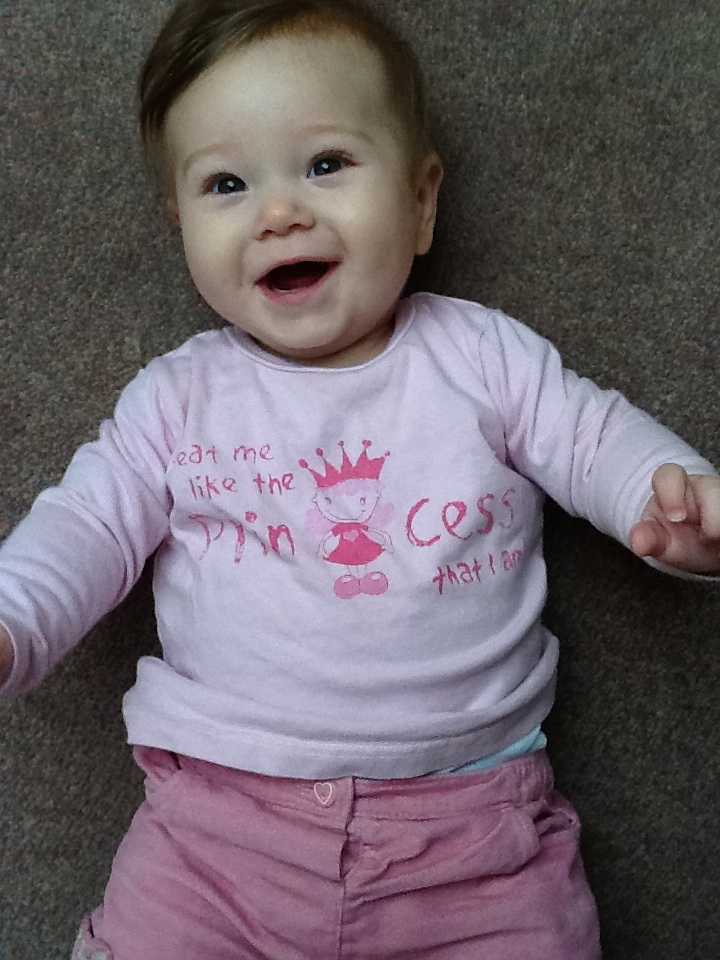
I could be the Queen Mother!!! Just call me Carole, after all, we do have a former occupation in common! Doors to manual is positively de rigour these days and there can be absolutely no denying that any of my children are more than beautiful enough to qualify as a princess. Look, I’m already grooming Felicity at the tender age of 6 months.

Treat me like the Princess that I am

I had been harbouring secret plans to make Felicity a fifth columnist and subvert the British monarchy into a local branch of the Vatican until Will Heaven happened to point out an inconvenient truth, one that I had overlooked in my passion. Catholicism does not force a parent to bring up their children Catholic, it only requires that they do all that is in their power, which is exactly what I promised when I married an Anglican vicar, one who had the privilege of baptising his own daughter, before he converted. Ah well, it’s the thought that counts and, Caroline Farrow, Queen Mother, still has that certain ring to it.

No longer may I feel marginalised or excluded from our British monarchy by virtue of my faith, or my gender. Dave’s gone and made it all alright again.He’s made the monarchy fair and accessible to all. He’s alright is our Dave.

As for the fact that Catholics who refuse to endorse a homosexual lifestyle are not considered suitable as foster carers or adoptive parents, due to their unacceptable views, well that’s just a mere irrelevance, a trivial matter. We can marry the monarch, what more can we ask for?

And the knock on effect to the Church of England, that brings the UK a step closer to disestablishment, which loosens still further our foundations as a Christian country? We’ll try not to worry our little heads about that either. Tis but a minor detail, Dave’s a Christian, I’m sure he’s thought of that and has it covered somehow. He’s alright is our Dave.

I’m off to start planning my outfit. I hear there’s some good designer bargains to be had in Greece. Dave says that the success of the EU is crucial, so in order to ensure that it all stays together, Greek citizens are struggling to survive and all their stuff is dirt cheap. So it makes sense to start stocking up on the Ouzo now so we can all drink a toast to the groom’s great-grandfather on the big day!

He’s alright is our Dave.

Catholic baby rustling

Following last night’s documentary on BBC2: This World, Spain’s Stolen Babies, the obligatory anti-Catholic meme is spreading like wildfire across the net, perpetuated with glee by Richard Dawkins on his website.

Here’s the gist – under Franco, the Catholic Church formulated a plan in which the aim was to make as much money as possible by stealing newborn babies from unmarried couples, pretending to mothers that their newborn babies had died whilst secretly selling them on to suitable couples. The Catholic Church can now add this to its charge-sheet of heinous crimes. Further proof that we are wicked evil and corrupt organisation, far removed from the teachings of Christ and an organisation that must be stripped of any remaining credence and power. Don’t believe those evil Catholics, look, they are BABY TRAFFICKERS and this was obviously all sanctioned and secretly hidden by Pope Benedict himself.

If Johann Hari was not currently enjoying his rehabilitation, he would be spasming in paroxysms of outrage and sympathy. “Walking through the backstreets of Madrid, the repression of Catholicism still hangs heavily in the air, the spires of cathedral dominating the skyline. I meet Maria, the cares of the past fifty years and the pain of loss etched into every deep furrow on her face. One minute she was in the confessional, the next her baby had disappeared through an invisible trapdoor, never to be seen again. She grips my hand tightly, draws heavily on her cigarette and directs the power of her soulful dark gaze upon me.” One can only imagine the write-by-numbers Hari verbiage.

Of course, I do not mean to detract from, or make fun of the genuine loss and pain of the women who had their babies taken from them. There are no words adequate to convey my sympathy or express consolation and if this was done in the name of the Catholic Church or in the name of Christ, I am truly sorry. I would like to note a few thoughts, I am hoping that a historian or apologist of gravitas investigates this further, but here’s what occurs to me.

Katya Adler, the BBC reporter, has form when it comes to religious bias, equating Jeruslaem’s rabbis with Islamic Jihadi fanatics and orthodox Judaism as extreme, right-wing and aggressive. Secondly, this is not a new story. Both Time magazine and the New York Times ran the story back in March and July, which gave some interesting history/background that seemed to indicate that the numbers, whilst shocking, did not amount to 300,000 which is sensationalised speculation. A Business Insider report from a few weeks ago states that the current number is in its thousands, not hundreds of thousands, as estimated by the programme. If you do the maths, 300,000 babies stolen over 50 years, amounts to over 100 a week, which requires a stretch of the imagination. If the practice was as common as this, surely it would have come to light sooner?

“Attorney General Candido Conde-Pumpido announced on June 18 that 849 cases were being examined, adding that 162 could already be classified as criminal proceedings because of evidence pointing to abudctions”.

Whether one baby or thousands of babies, it is nonetheless shocking and painful and not a practice anyone would seek to defend, however it is important to consider the period in history in which this occurred. We tend to judge the culture of previous times, by today’s social mores; what needs to be remembered is that the Spanish Civil War and its aftermath was a time of social upheaval and repression. Single mothers were socially unacceptable in the same way that they were throughout the rest of European society in the post-war era, and no social welfare would have been available. Inconceivable though it is, by today’s standards, those responsible for removing the babies and placing them with “suitable couples” may well have believed that they were doing a work of great charity or mercy. The mothers were told that their baby had died, presumably those involved thought it was kinder to let the mother think that her child had died, rather than live with the pain of separation and genuinely thought that it was in the baby’s best interests to be be placed with those in a better position to be able to bring up a baby. The children were not, as under some regimes, forcibly aborted.

Whilst not defending those actions, it was commensurate with the spirit of the age and a feature of society following a period of military upheaval. Argentina is facing a similar glut of claims. Where Catholicism comes into the mix is that Franco’s brand of ultra right wing nationalism relied heavily upon “traditional” Spanish or family values, which dovetailed with the Catholic teachings on family. In Franco’s mind Catholicism was an essential part of his vision, therefore the local Catholic church in Spain often became an unofficial arm of Franco’s state. That’s not to say that all of the Catholic Church in Spain supported Franco, on the contrary, some members of the priesthood did make a stand against fascism, but they didn’t stand much of a chance against the state and were in a minority. If nothing else, salutary lessons may be learned from what happens in a society where Church and State are too close, in Franco’s Spain, the relationship was distinctly too close for comfort and unhealthy in nature.

The truth is, as ever, somewhat more nuanced than the sensationalist headlines suggest. The Vatican was not complicit in a great conspiracy to profit from baby trading, or baby snatching. Any money that was raised from this practice, in all likelihood would have gone back into various social causes, or supporting a fund directed towards the welfare of the mothers and the adoptees, as opposed to being siphoned off into some secret slush fund. It’s likely that this practice was localised as opposed to a nationwide conspiracy, and had as much to do with Franco’s regime as some secret Vatican plan.

As the New York Times notes: a few nuns have confessed to selling children, but without suggesting that they were part of a criminal network.

Though I am a Catholic, I am something of a natural sceptic, in common with Dawkins. As a sceptic, I thought the point was to focus on proven details, not sensationalised beliefs in the possible. The notion that the Catholic Church deliberately stole and profited from the sale of 300,000 babies is certainly the later.

Beads and bigots

When I’m Queen of the Universe, I will issue a decree making incorrect use of language a criminal offence. It goes without saying that erroneous use of the terms

homophobia and bigot will carry the largest penalties.

We’ve done the homophobia one countless times, but just to recap for those hard of understanding, homophobia is defined by the OED as “an extreme and irrational aversion to homosexuality and homosexual people”.

Whilst I am undoubtedly guilty of what Mark Simpson would term the fetishisation of marriage, that doesn’t stem from any aversion, let alone of an extreme or irrational nature. It’s fascinating that in order to qualify as a bona fide homophobe, one’s aversion must be “extreme or irrational”. Common or garden “homosexual sex is a bit ick” wouldn’t seem to cut it according to the OED. I don’t think that there is anything inherently “homophobic” about being averse to sexual acts between same gendered partners. Several friends with same sex attraction have confessed to me that the idea of sex with a differently gendered person revolts or turns them off, the concept being utterly unthinkable. It’s not an irrational feeling in their eyes, it’s simply “the way they are” therefore it is entirely logical that people may well be repelled by the idea of same gendered sex in a similar vein, without necessarily being “homophobic”.

As I’ve said right since the inception of this blog, homophobia or homophobic is simply a perjorative smear, designed to discredit and close down any sensible debate. Much easier to infer that someone is an unpleasant or unsavoury character who should not be given any credence rather than engage directly with the issue. The word has been used so often that it’s now meaningless.

I’ve deliberately avoided discussing the gay marriage issue in theological terms for a few reasons. Firstly, most Christian readers don’t need them explained and secondly, given that for some inexplicable reason I seem to have picked up quite a large following of non-Christians, I don’t think that the Church (Roman Catholic or Anglican) has the monopoly on marriage. I’ve wanted to steer away from the whole “well Christians can have their version and we can have ours” line.

The point is this. Marriage is a public institution that transcends and pre-dates Church and State, neither of whom have the monopoly on it or the power to change it. As marriage is a public institution, proposals that could negatively affect or harm it should be given the same kind of objective analysis as any other issue of public policy. It’s not simply a matter of “fairness” or “forcing religious dogma down people’s throats”. This is why I’ve discussed the issue in broad terms, redefining marriage will have a huge impact upon society.

I was therefore disappointed to note the following comment directed at me on Facebook. “For G-d’s sake, people aren’t still losing sleep about gay marriage are they? Stop rattling your beads in my face. Your backward views should be kept to yourself”. It goes without saying that it garnered several “likes”, no doubt validating the author’s sense of worth and popularity amongst her peers.

I am often accused of homophobia, and “hiding behind the dictionary definition” of the word if I can be bothered to refute it. Apparently it’s quite “lame”. To me the dictionary is important as it defines the common consensus and meaning of a word. Otherwise we all become like Humpty Dumpty and language loses its potency as has indeed happened with homophobia. What is lame is giving someone a perjorative label based on an incorrect and lazy character assumption, or a generalisation. You don’t want gay marriage, it must be because you either hate gays, you are stupid and most definitely because you are religious.

As invective goes it wasn’t particularly powerful, but there are slightly sinister undertones of “anyone who disagrees with me is irrational and stupid and has no right to speak, they must be silent”. I enjoyed the wild imaginings, at no stage were beads rattled in anyone’s faces – bead rattling seems to be becoming quite a common conceit. I can’t say it bothers me really, although I don’t so much rattle the beads, it’s more of a thoughtful fingering, a rolling between one’s thumb and forefinger, but I suspect the subtleties of the rosary are of little interest and not as evocative of the image of a fervent believer in the throes of religious ecstasy feverishly thrusting a rosary into someone’s face.

The delicious irony is that as Cranmer’s Law testifies, people who believe themselves to be of a liberal or permissive bent, love to bandy the word bigot about, when clearly they have absolutely no idea what it means.

I’ll clarify.

“an obstinate belief in the superiority of one’s own opinions and a prejudiced intolerance of the opinions of others”.

Well most of us tend to have some sort of belief that our moral code is the right one, even if that moral code leans towards relativism.

A prejudiced intolerance of the opinions of others? How would that be manifested? Presumably by telling others that they should keep their opinions to themselves? Or calling other’s opinions nasty and stupid? Of course those sentiments may be thought to be justified, but the irony is that by telling someone that they should either shut up, or are a “nasty stupid bigot”, betrays a bigotry all of its very own.

All human beings are bigots but some bigotry is better than others.

Hypothetically speaking…

Imagine, hypothetically speaking, that you were studying Shakespeare’s problem play, Measure for Measure, and attempting to historically contextualise it. You attend a lecture that sets out a brief history of the 16th Century politico-religious situation, starting with Henry VIII’s break with Rome which explains the various political, physical and religious tensions and undercurrents that were simmering in London of 1604. Fears of an imminent Spanish invasion and return to Catholicism were rife, James VI, the great Protestant hope had acceded the throne, immediately signed the Treaty of London, ending the hostility between Spain and England and was making moves to marry his son to a Catholic Spanish princess.

Shakespeare writes an enigmatic play, in which it is widely agreed that  two of the major characters, Angelo and the Duke, represent Puritanism and Catholicism respectively. The lecturer repeatedly refers to these as two extremes, which is correct in a historical context. James VI was keen to be seen as a moderate, to steer the via media between Puritanism and Catholicism. The lecturer also explains the Elizabethan dramatic traditions of staging plays involving members of religious orders (associated with physical and moral corruption and portrayed with the manifestations of venereal disease) in order to contextualise the role of the Duke, who spends the vast majority of the play in disguise as a Friar, listening to confessions. Measure for Measure is littered with allusions and puns concerning syphilis.

What the lecturer fails to communicate, in the opinion of the hypothetical listener, is that Catholicism is not considered to be an extreme religion in today’s contemporary society, perhaps assuming that when repeatedly mentioning “the extremes of Papism” and the “extremes of Catholicism” as opposed to Puritanism, that the listener would understand that “extreme” was meant in a historical context and that the play is concerned with portraying polar opposites. It could, in fact, be viewed as a play that portrays Catholicism in a very positive light, however therein lies a whole other narrative.

Whilst feeling a little bit uncomfortable with the constant references to “extremes of Popery”, the listener senses that they are perhaps being a little over-sensitive. The listener remembers the lecture  as being identical to the previous year, which fell immediately after the Papal visit and in the light of the negative press from the likes of Master Hari, so decides that it is just their own bias and sensitivities.

The lecture moves on, with the listener thinking that they really must read more about the practices of Renaissance Catholicism to see whether or not it might be justified as being viewed in an “extremist” light, before realising that they read need to tackle the core reading in front of them, instead of day-dreaming of Eamon Duffy and the like. The lecturer then begins to examine the hypocrisy prevalent in the character of Angelo, the Puritan. They then go on to say that of course religious hypocrisy, the tensions between the outer manifestations of piety and the innate desires of the individual are still apparent and causes problems in Catholicism today, something that is illustrated by the child abuse scandals.

Perhaps a more accurate and balanced turn of phrase would be to note that many religions struggle in terms of religious leaders being perceived as hypocrites, or that many politicians experience similar problems. The listener was left with the impression that a room full of first year undergraduates were given the impression that Catholicism is an extreme religion with hypocrite priests as shown by the scandal of clerical abuse. The listener felt that the lecturer lacked nuance and though students are blessed with the ability to think for themselves, a lecturer describing Catholicism as extreme and stating that it still has difficulties with hypocrisy today (when in fact it was the hypocrisy of the Puritan that is manifest in the play) constituted a subtle form of indoctrination.

Of course all religions have their hypocrites, but I wonder how many students were able to identify the undercurrents and how many have now come away with the impression that Catholicism is extreme. Many people would not have a problem with the situation as described, however were a student to be in a lecture which subtly endorsed a Christian or Catholic perspective, one suspects that there would be an outcry.

It illustrates that education can never be wholly impartial, education will always consist of more than a simple delivery of facts, a teacher or lecturer can never be wholly objective or impartial.

Had the listener had time, then hypothetically they would have liked to have discussed this further with the lecturer. They are also inclined to see if they can have a word or send an email to the lecturer, advising them that though they greatly enjoyed the content of the lecture having now listened to it twice, they found the allusion to the contemporary child abuse scandal rather unnecessary and offering comment which could well have been interpreted as being definitive knowledge.

The listener doesn’t wish to gain a reputation for being a trouble-maker early on and sometimes wishes that they were possessed with the ability to keep their head down, their mouth closed and their opinion to themselves, but is nonetheless troubled and disturbed by what they perceive as an example of institutional and cultural bias. Would silence constitute an acquiescence or passive acceptance? Would speaking out change anything or would silence be an implicit collaboration in calumny?

Passion is sometimes a very mixed blessing, particularly when one has not been blessed with an equal measure of sagacity.

All you need is love?

“Church steps up gay rights attack” reads the headline on the BBC website.

The Archbishop of Glasgow, Mario Conti has written an outstanding letter to every parish in Scotland, urging Catholics to voice their opposition to gay “marriage” in the forthcoming consultation.

I’d be interested to learn what rights the BBC feel are under attack? Are there any legal privileges currently granted to married couples that are denied to those in civil partnerships? How are those in same-sex relationships under attack?

What is it precisely that the Church is aiming to take away or attack?

I guess “Church seeks to uphold the sanctity of marriage” doesn’t have quite the same ring to it?

This is Archbishop Conti’s message. The Catholic Church simply wishes to uphold the special and unique meaning of marriage as being the union of one man and one woman for the procreation of children.

Marriage is neither simply about love, nor is it a private contractual arrangement, otherwise why would the government seek to afford it particular rights and privileges? Both church and state recognise that marriage forms part of the common good, however neither church nor state can take ownership, no matter how much the government might like to.

Once marriage is separated from children, its value is instantly diluted, it becomes purely about love and it is precisely this notion that marriage is only about romantic Iove, coupled with no-fault divorce that has already done so much damage to society over the past fifty years, the fruits of which became apparent on the streets of London this summer.

David Cameron clearly believes that it is no longer important or desirable for a child to be brought up by a mother and a father and wishes to enshrine this in law. He also wishes to re-write article 12 of the European Convention on Human Rights.

I’d suggest “Cameron announces that a mother and a father are no longer the most desirable environment for a baby” as being the more accurate headline instead of the non-existent attack on rights.

Now that really is of note and it can be of no surprise that the Catholic Church wishes to challenge it. Even if the “conservative” party won’t.

Catholic Voices

I’m really honoured to have been selected to join the Catholic Voices team.

Austen, Jack and Kathleen have gone out of their way to make this possible, both in terms of interview arrangements and assisting me with the logistics of coming to Leeds with a young baby, who can’t really be left for long periods of time, not least because she is refusing to take a bottle of any description. Kathleen has gone above and beyond the call of duty in terms of sorting out arrangements so I can attend, Austen was incredibly helpful and forbearing in terms of my IT issues and of organising an interview at short notice, so I’m really very grateful.

For what it’s worth, I’m really looking forward to being a part of the team, I hope that not only will I learn valuable skills from their experience and hone my apologetics, but I also hope to be able to make a valuable contribution. The Catholic blogosphere can often feel like something of a specialist and perhaps irrelevant niche, so I’m delighted to be going more mainstream.

In the words of Blessed John Henry Newman:

I want a laity, not arrogant, not rash in speech, not disputatious, but men [and women] who know their religion, who enter into it, who know just where they stand, who know what they hold and what they do not, who know their creed so well that they can give an account of it, who know so much of history that they can defend it. I want an intelligent, well-instructed laity – I wish…to enlarge [their] knowledge, to cultivate [their] reason, to get an insight into the relation of truth to truth, to learn to view things as they are, to understand how faith and reason stand to each other, what are the bases and principles of Catholicism…

Theology and evolution

Cristina Odone had an interesting conversation with Richard Dawkins in last week’s Guardian.

There’s quite a lot to pick out, Cristina seems to be on a mission to please Richard Dawkins, no mean feat and whilst I would agree that an aggressive approach is counter-productive when engaging in dialogue with non-Christians, I think we all need to learn that affability should not supersede doctrine. In Cristina’s attempt to appear reasonable and open-minded she overlooked a few key points.

Whilst alluding to the creation myths, Odone states that our children are now being taught about religion in a metaphorical way. Actually this way of thinking is not particularly new, in the forth century, St Augustine of Hippo, one of the great doctors of the Church, held that Genesis must be read allegorically or figuratively and was not a literal account. He even wrote a book, The Literal Interpretation of Genesis, in which he expounded the theory that the six days laid out in Genesis was a logical framework, not a specific passage of time. According Augustine we should remain open-minded about the creation story and prepared to change our interpretation as new information became available. One can surmise that Augustine probably would not have had much time for the literal creationists who seem to be prominent in American politics.

“It not infrequently happens that something about the earth, about the sky, about other elements of this world, about the motion and rotation or even the magnitude and distances of the stars, about definite eclipses of the sun and moon, about the passage of years and seasons, about the nature of animals, of fruits, of stones, and of other such things, may be known with the greatest certainty by reasoning or by experience, even by one who is not a Christian. It is too disgraceful and ruinous, though, and greatly to be avoided, that he [the non-Christian] should hear a Christian speaking so idiotically on these matters, and as if in accord with Christian writings, that he might say that he could scarcely keep from laughing when he saw how totally in error they are. In view of this and in keeping it in mind constantly while dealing with the book of Genesis, I have, insofar as I was able, explained in detail and set forth for consideration the meanings of obscure passages, taking care not to affirm rashly some one meaning to the prejudice of another and perhaps better explanation.”

Writing to the Pontifical Academy in 1981, the Blessed Pope John Paul II wrote the following:

“Cosmogony and cosmology have always aroused great interest among peoples and religions. The Bible itself speaks to us of the origin of the universe and its make-up, not in order to provide us with a scientific treatise, but in order to state the correct relationships of man with God and with the universe. Sacred Scripture wishes simply to declare that the world was created by God, and in order to teach this truth it expresses itself in the terms of the cosmology in use at the time of the writer. The Sacred Book likewise wishes to tell men that the world was not created as the seat of the gods, as was taught by other cosmogonies and cosmologies, but was rather created for the service of man and the glory of God. Any other teaching about the origin and make-up of the universe is alien to the intentions of the Bible, which does not wish to teach how heaven was made but how one goes to heaven.

So whilst Odone is correct in terms of creation being taught metaphorically, this certainly isn’t a new or modern development, and one might hope that in a Catholic or Church of England school, religion is not taught metaphorically per se. Jesus is a verified historical figure and not a literary metaphor.

Dawkins remains unconvinced, stating that one has to decide which bits of the bible are metaphorical and that he would like to consult further with a catholic theologian. He has been invited to debate with Dr William Lane Craig on several occasions, most recently at the “Is God a Delusion” lecture at the Sheldonian Theatre in Oxford on 25 October, but has so far refused the invitation. I am sure that there are plenty of Catholic theologians with both a small and a capital C who would be only too pleased to answer his questions nonetheless, so do feel free to invite them to contact Professor Dawkins.

The aspect of the conversation that concerned me the most was Odone’s pronouncement on birth control.

Look at birth control. The pope has said there are no ifs or buts, this is doctrine – we must never use birth control. But how many Catholics do you think go to confession and say, “I’m sorry, I’ve used birth control”? Well here we are, and this is part of the evolution of theology.

Though I sometimes find myself agreeing with Cristina, I found this remark incredibly disappointing. On a technical note, whilst attempting to engage with Dawkins and use his terminology, she applies the concept of evolution to theology. Actually evolution is an erroneous term when discussing theology, as evolution implies that a doctrine becomes obsolete or defunct and is replaced by something superior. A more accurate way of conceptualising how theology may change, would be to think about organic growth, not replacement. One of the things that attracted me back to the Catholic Church is the fact that doctrine is always intellectually coherent and logical – never contradictory. Doctrine is not policy and subject to changes on the whim of public opinion. Doctrine is never replaced with something completely contrary, rather it grows organically as our scientific understanding increases. Changes are always consistent with what has gone before.

Odone implies that Catholics are using birth control and not confessing it, therefore the theology has changed or evolved. I’m not quite sure that I understand her thinking. Disobedience is not the same as organic growth is it? Either fewer instances of that sin are occurring, or as Odone suggests, more people are considering that it is no longer a sin to use birth control. Sorry Cristina, but it is. Doctrine doesn’t change along with public opinion. One cannot assume Cristina is correct, and I would doubt that she is, after all how does she know, has she conducted a study of penitents or is she judging by social chatter? She has absolutely no way of gauging what people are saying in the confessional unless she has somehow managed to persuade confessors to break the seal for her back of an envelope calculations, so this is pure speculation. Supposing her assumptions are correct then this does not mean that the doctrine is misguided, simply that people need a reminder. Fewer people may be confessing all sorts of different things, I might not think that coveting my friend’s gorgeous new Mulberry handbag constitutes a sin, after all it is beautifully soft leather, highly on trend and just well, gorgeous, it’s perfectly natural that I would want one too, but it’s still every bit as unhelpful spiritually, no matter how normal or understandable.

Comments like this are incredibly unhelpful to normal Catholic women like myself. Although the physical practicalities of Catholic family planning take a little getting to grips with, the teaching itself is wonderful. We need to hear more women advocating NFP, shouting out the benefits, of which there are many, talking about how chastity (behaving in a sexually appropriate manner towards another, not to be confused with celibacy) within a marriage is a great thing. We need women to be honest about NFP, to extol its virtues, not buy into the whole contraceptive mentality which is fundamentally misogynist in nature. When Cristina Odone and her ilk makes comments such as this, it sells out ordinary catholic women trying to live lives of faith and witness. When I was having difficulty with getting to grips with it last year, so many people attempted to claim that catholics don’t really use it, are not expected to use it and its only extreme fundamentalists who attempt to observe church teaching. The reality is different; all the catholic women I know could not be described as fundamentalists or even traditional catholics and they find far from detracting, NFP enhances and improves communication and intimacy within a marriage.

As a high profile and influential Catholic, Cristina Odone risks reinforcing existing error as well as leading people into sin. Sometimes I wish we could have more authentic female catholic voices in the media and not just the privileged catholic aristocracy. As a mother juggling three young children with a full-time degree and recovering from 2 cesarians in as many years, we are not able to consider adding to our family at this time and yet I am able to manage perfectly well with NFP. Furthermore I am not ruling out adding to my family in a few years time, despite the fact that our household income is under half what Cristina spends on school fees. It’s called being open to life.

This could have been a great opportunity for apologetics, but in an attempt to placate the implacable, she ended up reinforcing the same old negative perceptions. I’m sorry she finds the teaching on birth control unacceptable. Perhaps, like Dawkins she needs to consult with a catholic theologian, as well as a passionate advocate of NFP. Can someone give her my number?

Cranmer’s Law

Archbishop Cranmer has to be quite my favourite blogger, even if His Grace is something of a heretic *. Today he has defined and articulated the phenomenon to be known hereafter as Cranmer’s Law:

“No matter how decent, intelligent or thoughtful the reasoning of a conservative may be, as an argument with a liberal is advanced, the probability of being accused of ‘bigotry’, ‘hatred’ or ‘intolerance’ approaches 1 (100%).”

This blog was founded upon the precepts of Cranmer’s Law. Fed up with being unable to discuss any sort of moral issue on internet forums without being called a homophobe, hateful, intolerant and subject to personal abuse, I then set up this blog, so that I could discuss things in a reasonable and rational fashion, on my own terms, without constantly being subject to abuse and incorrect labelling in an attempt to personally discredit and shut down debate.

As Cranmer says:

Thus is the level of political discourse in modern Britain: every contentious issue, no matter how worthy of scrutiny or debate, is swiftly closed down with threats of a fatwa or observable character assassination

Indeed. What people have failed to grasp with me, is that on the one level here is someone who appears to be warm, amusing, intelligent, witty and (I hope) kind. When Robin and I became engaged, I was staggered at some of the comments from my former work colleagues. “I can’t believe you’re going out with a vicar, you’re far too much fun”, or “but you don’t LOOK like a vicar’s wife, you don’t wear Laura Ashley, puffa jackets, flowery skirts and you’ve got nice teeth”, or even the staggering “but you’re really pretty and sexy, you CAN’T marry a vicar”. That’s right, because obviously being a clergyman means that one is so utterly dour, devoid of any sort of a sense of humour and generally boring, it is absolutely inconceivable that he may be able to attract a vivacious spouse with a mind of her own. Actually both of us found it rather amusing, particularly given that Robin had some  very beautiful, highly intelligent girlfriends in the past, at least one of them enjoying a high-flying career. Why does a love and desire to serve God in whatever way He may be calling entail a un-prepossessing spouse?

This blog is mine and mine alone, my husband has very little to do with it, other than to occasionally read it although I am careful not to say anything that could reflect badly or undermine any future ministry. What people have failed to understand is that I don’t just toe the party line, so to speak, my views are honestly, avowedly and straightforwardly held, I haven’t been coerced or brainwashed in any way. As a matter of fact, I was a practising and faithful Roman Catholic before my husband. My views just don’t tally with the side of me that appears reasonable, rational, intelligent and fun, therefore if I have not been brainwashed (which some people seem to refuse to believe, it must be the only explanation) then I must be absolutely stark raving mad. There’s something wrong, no “normal, nice or sane” person could be a Catholic, so it’s much easier to write me off as mentally ill, that’s obviously the answer. I must be psycho analysed and stuck into a box in order that I can’t actually challenge anyone or my views be allowed to gain any traction.

This is why we see non-Christians attempting to define Christianity and what they believe it means, in order to deflect the notion that they might in fact be the intolerant ones. Christianity is this vague touchy-feely religion all about being nice to each other and never daring to criticise anyone else or cast any sort of judgement upon behaviour, because that’s “not nice”. Anyone who claims to be genuinely concerned about the spiritual welfare of others is simply using that as subterfuge for their own inherent bigotry or unpleasantness. No Christian who is opposed to same-sex marriage or parenting, women’s ordination or abortion is a nice or likeable person, unless, in my case, they are either mentally ill, brainwashed or both. These views cannot be accepted as being the product of rational thinking and must instead be attributed to deficiency of character.

Cranmer should win the Orwell Prize for his entry this morning. He won’t however. He’s far too much of a “bigot”.

*Note, no-one was more excited than I when Cranmer announced his intention to join the Ordinariate on 1st April. I gave thanks to God, excitedly texted everyone I knew and danced around the kitchen. I still haven’t quite got over it.

The facts about LIFE

As His Grace pointed out on his blog earlier today, Sunny Hundal made a rather outrageous claim about the charity LIFE, describing them as “religious nutjobs”.

It’s amazing what passes for informed political comment these days however I think it is worth highlighting that LIFE are a non-denominational charity with no religious affiliation, therefore his assertion is substantially incorrect as well as being deliberately perjorative. Furthermore LIFE’s former Director of Education was an atheist, which although a strong position of faith, is patently not what is being inferred by the term.

A belief in the sanctity of life is not confined to a Christian position, Islam, Judaism, Sikhism, Hinduism and even Buddhism are all broadly against abortion as a principle, which is precisely why LIFE, though founded on Catholic principles, is non-denominational. I wonder whether or not Sunny Hundal would have the audacity to call a pro-life group consisting of a diverse number of faiths as being full of “religious nutjobs”? I wonder whether or not he would refer to a pro-life group consisting of Sikhs in the same derogatory fashion?

In any event the pro-life/pro-choice debate is independent to that of the theist/atheist debate. There is nothing in the pro-life position that requires one to be a theist, a fact that may be confirmed by looking at the work of Nat Hentoff, a prominent liberal atheist who is an outspoken critic of abortion and euthanasia. The pro-life position is a logical and philosophical concept which is a complementary extension of major religions but does not require a religion in order to be an adherent. To describe the belief that life begins at conception as being an extreme view born out of religious zealotry is an attempt to marginalise millions of people around the globe and deride their belief as being the product of an unsound mind. Not the most open-minded of approaches from a website that defines itself as liberal.

In relation to the point that was being made, LIFE’s counsellors, unlike those at BPAS, are all accredited by the British Association of Counselling and Psychotherapy and are therefore impartial, offering non-directive counselling. There is much misunderstanding and disbelief that a pro-life organisation might be able to provide non-directive counselling. With non-directive counselling you get exactly what is said on the tin. A counsellor will help someone to come to their own conclusion on a matter, to make their own mind up with regards to the best course of action, but will not offer any sort of opinion as to what that decision should be. What a counsellor will do however, is to explore the various perceieved barriers or obstacles associated with any particular course of action, to assist the person in reaching their decision. It is entirely possible that this may be done in a non-directive fashion. Dr Evan Harris recently tweeted that he believed that LIFE would be unable to offer non-directive counselling because “they would never tell a woman that she should have an abortion”, demonstrating that for such a proponent of science and evidence-based policy, he had absolutely no grasp of the concept.

In the context of a woman seeking to explore the best course of action when faced with an unplanned pregnancy, if she believes that there are financial or social barriers to her continuing the pregnancy, these need to be explored; it needs to be ensured that she is aware of any benefits, grants or other financial entitlements that she might be eligible for, i.e. that she makes a decision in possession of the full facts. Equally, she needs to be aware of what the abortion procedure itself will entail.

As the renowned pro-life lobbyist Phyllis Bowman says on her blog today, “BPAS should change its name. It does not ‘advise’ on pregnancy any more than the Mafia advises on “how to grow old gracefully. Moreover, they tell you that their advice is non-directional, at the same time leaving out half the story – all the uncomfortable bits that might put women off the abortion.”

The pro-abort advocates want to make out that this is scare-mongering, however if I were about to undergo a procedure I would want to know about the following possible complications: damage to the cervix leading to prematurity in a subsequent pregnancy, infection resulting in infertility, scarring of the lining of the womb which can cause subsequent prematurity, and the possible long-term increased risk of breast cancer.

It is the case that with any medical intervention that the risks and benefits of any treatment are outlined to the patient. Most surgeons will share x-rays and scans with the patients detailing what they intend to do. A pregnant woman considering an abortion is never shown the scan of the developing fetus, in an act of gross deception. Women should at least be offered the option in order that their consent may be fully informed, why is unacceptable for her to be aware of what stage of development the fetus has reached? Unless a woman is given the whole picture, which does not have to be emotive or directional then her choice cannot said to be fully consensual.

Of course some women will find the idea of mandatory counselling an irritation or an obstacle, having already come to their decision, in which cases the counselling session will be short, however at least it will give them the chance to confirm their decision. It is not a case of treating women like imbeciles, the reality is that at present, abortion clinics, who are set to benefit financially from a woman’s decision to abort, do not help a woman to explore all her options in any depth. As I have said frequently, I found myself  in the position of being coerced into an abortion, Marie Stopes having arranged an abortion for me on the say so of a third party. The doubt as to whether or not to continue with the pregnancy was all the validation required.

Ann Furedi of BPAS, along with the feminist Deborah Orr, are both on record stating that abortion needs to be a “back-up for when contraception fails”, which completely undermines those who claim that abortion is a method of last resort, a decision reached after much soul-searching and thus counselling adds an extra and unnecessary burden to women facing unplanned pregnancies. Abortion is not contraception (clue is in the name: contra – ception), this reasoning shows a flippant disregard for the value of human life and belies the attitude that abortion is always a considered conclusion. If you fall into the category of needing abortion as a back-up then there is an alternative and 100% failsafe method of avoiding conception, one that does not require medical intervention, does not entail the wanton destruction of human life and does not cost a penny.

The assertions that the Dorries/Field proposal constitutes an attempt to restrict abortion services are hysteria. Limiting or restricting abortion is not on the table, simply that women may feel empowered in the choice they are making in full possession of all the facts and that those facilitating those decisions do not stand to make any financial profit from them. It might be that counselling may well give pause for thought and prevent some abortions from going ahead which is not such a terrible thing.

The ardent hardline pro-abort faction are enraged because to introduce mandatory independent counselling goes a small way to getting back to the spirit of the 1967 Abortion Act, which was designed to help desperate women in terrible circumstances, hence the various built-in safeguards, which have now been reduced to a rubber-stamping exercise. Counselling recognises that abortion is indeed grave matter, one concerning life and death and seeks to ensure that a woman is in full possession of all the facts before she makes a decision that could have life-long repercussions.

Feminists who advocate abortion as being a woman’s right to choose, ignore the fact that abortion co-opts misogyny. The fact that every pregnancy is now viewed purely in terms of being a woman’s choice, has meant that many men feel absolutely no responsibility for their resulting offspring or on the other hand are denied any sort of involvement with regards to a child who is genetically theirs.

In the words of Camille Paglia, a noted feminist philosopher: “When it devalued motherhood, Western feminism undermined women’s most ancient claim to dignity.” 

Many people subscribe to Bill Clinton’s mantra that abortion should be “safe, legal and rare”. If this is desirable, then Dorries and Field’s proposal go some way to returning to the spirit of the Abortion Act; a last resort after every single possible option has been explored.

The Swing of the Sea

I was probably rather intemperate in my rant regarding Mrs Dorries yesterday. Rudeness always undermines reason and let’s face it Nadine is something of an easy target. Upon reflection I realised that I had failed to highlight the glaring irony in her diatribe about the Archbishop of Canterbury. Her identification of the spiritual needs of Christians encapsulates the values of the Catholic Church:

 church goers across the country scream out for guidance. A church to lead and one they can follow. They want and need continuity and conformity, basic tenants upon which the church is based.

What could be more explicit than a written set of rules such as we have in the Catechism? Continuity and Conformity are indeed the very precepts of the Roman Catholic Church which follows the traditions handed down from Christ and the apostles. When Nadine stated that church-goers wanted to know Dr Williams’ views on abortion and euthanasia, that they were screaming out for guidance, she was advocating for a strict line on these issues; the Catholic Church is well-known and often criticised for its dogma regarding the sanctity of human life.

The irony is that Nadine Dorries was calling for leadership, for the Archbishop of Canterbury to be explicit in his views, but as I pointed out, his views are simply that, Anglicans must come to their own conclusions on these matters, not being bound by any formal teachings. Dr Williams has spoken out  with regards to how far society has deviated from the spirit of the 1967 Abortion Act, he has not however come down on any side of the debate, not even supporting Dorries’ bid for the reduction in the time limit for abortion, but  instead stated that “clear principles are not going to get you off the hook”.

So the answers and leadership that Nadine seeks from the Established Church in terms of life issues will not be found. I share her frustration, it is incomprehensible that the Archbishop of Canterbury is willing to be politically contentious, willing to upset his flock and give a clear indication and lead on matters of political ideology, but will not state his position when it comes to the lives of the most vulnerable. That is nothing short of tragic.

It puts me in mind of an early poem of Gerard Manley Hopkins, Heaven-Haven, written in 1864, prior to his conversion to Catholicism in 1866 and one of the few poems which survives the holocaust of his early work which he burnt upon entering the Jesuit order as it was “not belonging to my profession”.

I have desired to go
Where springs not fail,
To fields where flies no sharp and sided hail,
And a few lilies blow.

And I have asked to be
Where no storms come,
Where the green swell is in the havens dumb,
And out of the swing of the sea. 

Though the poem is ostensibly about a nun taking the veil, it is also read as an Anglo-Catholic poem. The images of nature lyrically and sensuously evoke that which must be renounced, namely the beauty of Anglican patrimony; Catholicism the place of tranquility by contrast to the ‘swing of the sea’ that is Anglicanism which shifts and changes with the tides.

I was right in my original assessment. Behind the emotive rhetoric, Nadine Dorries hit upon an element of truth, although I don’t see her becoming a nun at any time in the near future. To quote another poem of Hopkins on a similar theme, The Habit of Perfection; whilst she is in politics her lips cannot remain ‘lovely-dumb’.