Worth £280 million of taxpayers’ money?

Just to recap, despite the introduction of compulsory sex education onto the National Curriculum by the Tories in 1993, followed by the establishment of the Teenage Pregnancy Unit by the Labour government in 1999 at a cost of £280 million, pregnancy rates have remained unchanged since the 1970s. The stated aims were to reduce rates by 15% in 2005 and by 50% in 2010.

Let’s examine precisely how close they got to achieving these targets shall we? In 1999 there were 49,900 conceptions by the under 18s. (numbers have been rounded to the nearest hundred and include both cohorts 13-15 and 15-17). In 2005, the figure was 50,200. Half way into the 10 year strategy, instead of the 15% decrease hoped for, there was in fact a slight rise of 0.6%. Ed Balls panicked and announced another £20.6 million to go into the program in February 2009.

In 2009, the latest full year figures available, teen conceptions numbered 45,500. Marvellous, a decrease at last, of 8.8% since 1999. Well short of the 15% target which was supposed to have been achieved 5 years previously with the desired 50% reduction seeming little more than a pipe-dream.

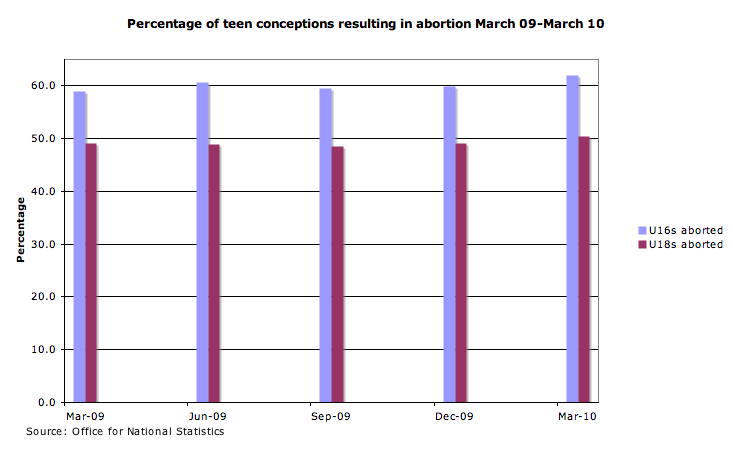
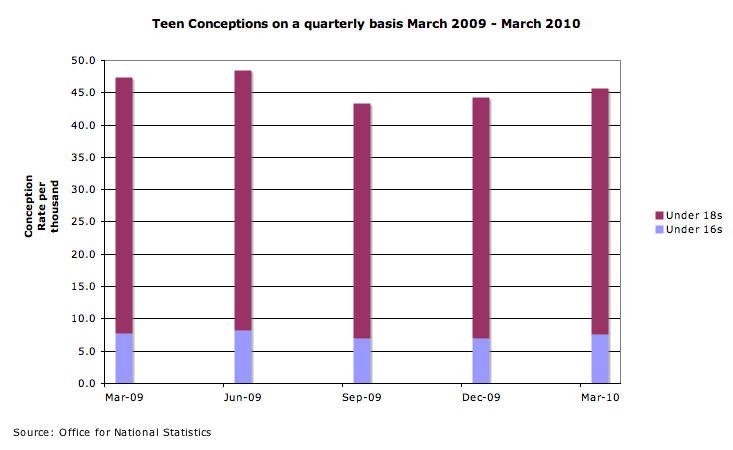
So, how are we doing now? Here’s a chart showing quarterly data from the last year, which includes the most up-to-date data which is available from March 2010.

It’s looking pretty static. No major changes, the extra £20.5 million given by Ed Balls is yet to have an impact. Both age cohorts experienced a slight rise in conceptions between March and June which over the course of the year gradually dropped to a lower rate, rose again and ended up close to where they started.

Interestingly the abortion rate in both age cohorts rose.

The abortion rate rose from 59% to 62% in under 16s and from 49% to 50.4% in under 18s, over the course of 2009.

Around 96% of abortions are carried out on the NHS. So, if we take 96% of 28,465, the total number of teen abortions carried out between March 2009 and March 2010, and multiply that figure by £500, the cost of the cheapest abortion procedure carried out by BPAS and Marie Stopes (the NHS refers/funds 91% of their abortions) that comes to a conservative total of £13.6 million.

So in 2009 we have an extra £20.5 million being spent to combat teenage pregnancy, on top of the £13.6 million being spent to carry out abortions on those for whom the strategy failed.

There are those who might argue that the £13.6 million is money well spent if it prevents welfare costs, which is a horribly cynical opinion all things considered, but nonetheless a perfectly valid position. However given that pregnancy is, in the overwhelming majority of cases, an entirely preventable condition, particularly amongst teenagers, then it could be argued that the £13.6 million is money that can ill afford to be spent, at a time of ever-shrinking resources, especially as the problem could be combated by a simple change in attitudes and behaviour.

Of course Marie Stopes and BPAS will be pushing for yet more access to contraception to teenagers at an increasingly younger age. Contraception has a notoriously high failure rate, it is estimated that around 50% of live births are unplanned, so it stands to reason that more teens being taught that sex can be ‘safe’ will result in more pregnancies and more abortions. Then that charitable organisation Marie Stopes, founded upon the principles of the wonderful lady who wrote letters of admiration to Hitler and who disinherited her son for the heinous crime of marrying a woman who wore glasses, will have more money to develop new business markets charitable ventures in developing countries. All funded by the UK taxpayer.

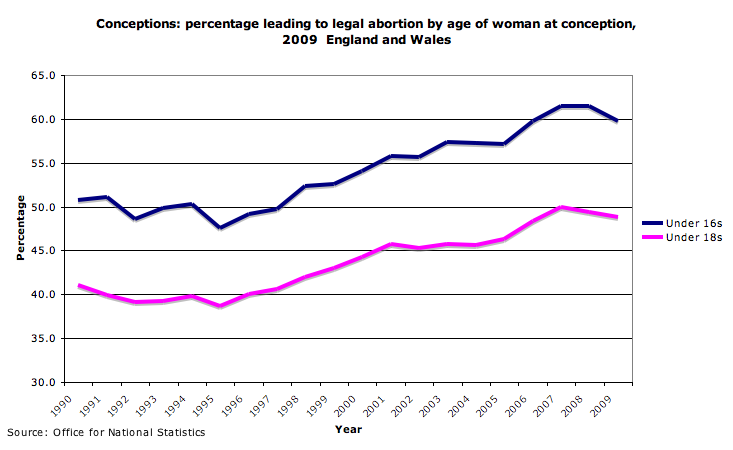
It’s a strategy that on the whole seems to be working. Have a little look at the teen conception rates resulting in abortion since 1990.

It’s fairly obvious which way the trend is going. It’s hardly surprising that the likes of BPAS are taking every single opportunity to fight to make abortion even easier to access, such as their campaign in the High Court earlier this year, to allow the abortion pill to be taken at home without medical supervision as well as attempts to change the law which currently requires the signature of two doctors, recognising that what was once safeguard against exploitation and a recognition of the seriousness of the procedure, has been reduced to nothing more than a rubber-stamping exercise.

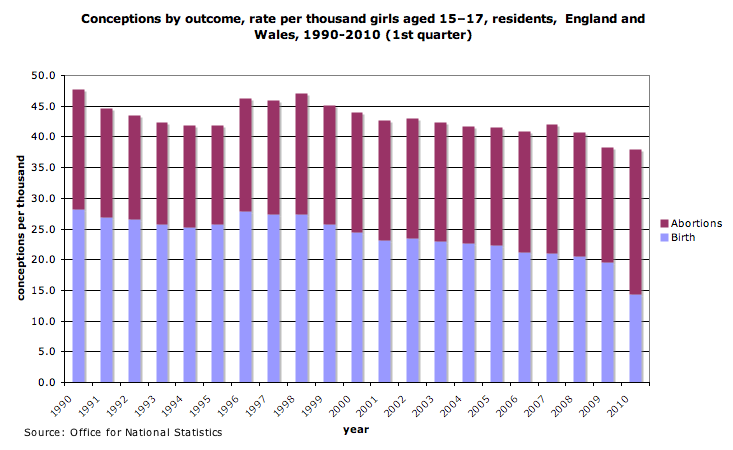
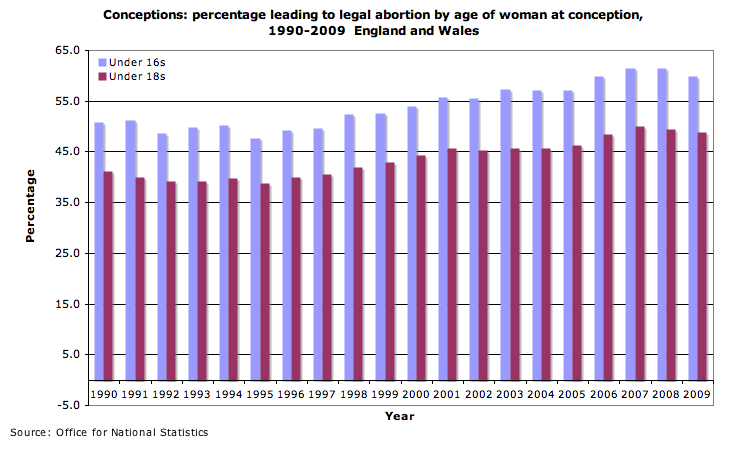
Here are a few other charts which more than adequately illustrate the point.

No wonder those in the copulationary sex education business are laughing all the way to the bank. Money to promote their product and money to pay for their product. Every year over 60% of teens under 16 and over 50% of teens under 18 will seek an abortion. Kerching kerching kerching.

Meanwhile at the other end of the fertility scale, NICE is recommending that infertile couples should be allowed three cycles of IVF on the NHS, each cycle costing approximately £2,000. The biggest cause of infertility in the UK is women leaving it too late before starting a family. The average age of the first time mother in the UK has risen to 30. By the time a woman reaches the age of 35, her fertility will be 50% less than it was at the age of 25. At 40, it will be halved again. Most NHS trusts will not accept a patient for IVF until she is at least 35, when her chances of conceiving are between 17 and 25%.

So on the one hand we are spending millions of pounds assisting teenagers to interrupt their fertility at the moment it shows signs of commencement, whilst on the other, spending millions to deal with the aftermath. Absolute madness.

I am anticipating the inevitable howls of ideology and wishing to impose my morality on other people, by suggesting that different strategies could be employed to reduce these unacceptably high numbers of teen pregnancy and abortion. Of course the idea that teenagers should abstain from sex is no more ideological than the idea that they should feel free to have sex with whomsoever they choose, at whatever age they choose and as frequently as they choose, just so long as they behave in a “responsible and safe” fashion. Indeed the idea that sex can be risk-free and harmless so long as contraception is used is nothing more than wishful thinking with downright dangerous consequences. It is obvious which ideology has the greatest impact physically, emotionally and financially.

The Swing of the Sea

I was probably rather intemperate in my rant regarding Mrs Dorries yesterday. Rudeness always undermines reason and let’s face it Nadine is something of an easy target. Upon reflection I realised that I had failed to highlight the glaring irony in her diatribe about the Archbishop of Canterbury. Her identification of the spiritual needs of Christians encapsulates the values of the Catholic Church:

 church goers across the country scream out for guidance. A church to lead and one they can follow. They want and need continuity and conformity, basic tenants upon which the church is based.

What could be more explicit than a written set of rules such as we have in the Catechism? Continuity and Conformity are indeed the very precepts of the Roman Catholic Church which follows the traditions handed down from Christ and the apostles. When Nadine stated that church-goers wanted to know Dr Williams’ views on abortion and euthanasia, that they were screaming out for guidance, she was advocating for a strict line on these issues; the Catholic Church is well-known and often criticised for its dogma regarding the sanctity of human life.

The irony is that Nadine Dorries was calling for leadership, for the Archbishop of Canterbury to be explicit in his views, but as I pointed out, his views are simply that, Anglicans must come to their own conclusions on these matters, not being bound by any formal teachings. Dr Williams has spoken out  with regards to how far society has deviated from the spirit of the 1967 Abortion Act, he has not however come down on any side of the debate, not even supporting Dorries’ bid for the reduction in the time limit for abortion, but  instead stated that “clear principles are not going to get you off the hook”.

So the answers and leadership that Nadine seeks from the Established Church in terms of life issues will not be found. I share her frustration, it is incomprehensible that the Archbishop of Canterbury is willing to be politically contentious, willing to upset his flock and give a clear indication and lead on matters of political ideology, but will not state his position when it comes to the lives of the most vulnerable. That is nothing short of tragic.

It puts me in mind of an early poem of Gerard Manley Hopkins, Heaven-Haven, written in 1864, prior to his conversion to Catholicism in 1866 and one of the few poems which survives the holocaust of his early work which he burnt upon entering the Jesuit order as it was “not belonging to my profession”.

I have desired to go
Where springs not fail,
To fields where flies no sharp and sided hail,
And a few lilies blow.

And I have asked to be
Where no storms come,
Where the green swell is in the havens dumb,
And out of the swing of the sea. 

Though the poem is ostensibly about a nun taking the veil, it is also read as an Anglo-Catholic poem. The images of nature lyrically and sensuously evoke that which must be renounced, namely the beauty of Anglican patrimony; Catholicism the place of tranquility by contrast to the ‘swing of the sea’ that is Anglicanism which shifts and changes with the tides.

I was right in my original assessment. Behind the emotive rhetoric, Nadine Dorries hit upon an element of truth, although I don’t see her becoming a nun at any time in the near future. To quote another poem of Hopkins on a similar theme, The Habit of Perfection; whilst she is in politics her lips cannot remain ‘lovely-dumb’.

If nothing else works…

A headline with which I had empathy caught my eye in today’s paper (“I hated being pregnant”). It turned out that this was, perhaps inadvertently ,something of a pro-life message.

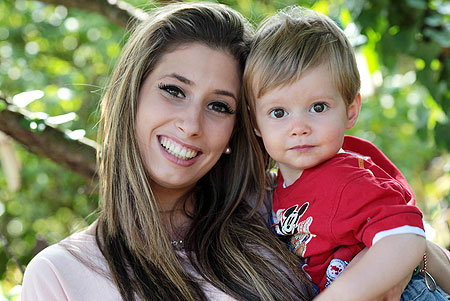
The former X-factor contestant and winner of I’m a Celebrity Get me out of Here, Stacey Solomon has just written her autobiography at the tender age of 21 in which she details her unplanned pregnancy, her struggle with post-natal depression and her rise to “fame”.

The following extract tells you everything you need to know about the state of sex education in the UK:

‘While I was there I felt sick a lot of the time. I thought I had a tummy bug. I had no reason to think I was pregnant because Dean and I had never had unprotected sex and I was having regular periods.’

It turned out she was still having periods due to low hormone levels. Despite the fact that she was experiencing classic signs of pregnancy, it did not occur to Stacey that she might be actually be pregnant because she hadn’t ever had unprotected sex. Whilst I am not going to suggest that it would have been better had Stacey abstained from sex, clearly she absolutely idolises her son, what is interesting is that her sex education had obviously included contraception, but had never mentioned that there might be any possibility of failure. She didn’t think she could be pregnant  because she had been acting “safely.”

This is precisely what those who scorn abstinence refuse to acknowledge. If you have sex, you might get pregnant, regardless of whether or not you are using contraception. A condom has a typical failure rate of 15%, which means there are 150,000 unwanted pregnancies in the first year of use for every million women.  To contextualise, using James Preece’s analogy, if a school nurse hands out condoms to 100 girls in her school, 15 of them will get pregnant in the first year. The effectiveness of the pill will also depend upon how the individual reacts to the type of pill that is prescribed, doctors tending to prescribe a generic pill unless there is any specific medical history. The pill being no protection against STDs. As I said in my previous post, the policy is indicative of a defeatist policy. “All young people are going to do it, they see their peers doing it, let’s make sure they do it safely”.

As Stacey Solomon and countless others will testify, there is no such thing as safe, risk-free sex. You have sex and unless one or the other of you have been sterilised, then you might get pregnant. This is the message that needs to be given to young people, rather than an attempt at risk management. Sex = chance of pregnancy, no matter how “careful” you think you are being.

Another horrifying aspect of Stacey’s story is that because it didn’t occur to her that she might be pregnant (presumably sex education doesn’t cover symptoms of pregnancy) she only visited her GP when she was 18 weeks who confirmed that the fetus was so developed that he could feel it.  She visited a gynaecologist for an abortion.

“I saw a gynaecologist and was given a scan. The doctor turned the screen away from me but Mum was with me and I saw tears in her eyes.‘The baby was well-formed and 18 weeks old. Having a termination would be complicated and when the doctor described exactly what would happen I knew I couldn’t go through with it.”

Many pro-choice advocates express disbelief that abortions may be carried out for social reasons following 12 weeks. Stacey’s story is a perfect example of how the spirit of the abortion law has been twisted far beyond its original aims. Here we have a young woman, with a fully formed baby, so developed that the GP is able to feel it upon external examination, with no reason to abort her child other than the fact that she was 17 and had just commenced a course at college.  If that is not a social reason, then what is?

It is a mark of our society that many people would feel that there is absolutely nothing wrong with a woman aborting a healthy 18 week old baby simply because it interfered with her future career plans. Her body her choice, although surely no-one in their right mind could argue that an 18 week old fetus is a woman’s body? A baby and the placenta do not comprise the same genetic material as the mother, therefore how a baby can be considered to be a part of the mother’s body, particularly at such a late stage in development is beyond me. As is the fact that anybody could feel that this is acceptable, that a mother has a right to kill her healthy fully formed child simply because it is inconvenient.

Even more disgusting is the fact that the gynaecologist turned the screen away so she couldn’t see her baby in an act of frightening manipulation. That’s not kindness or sensitivity, that’s an act designed to keep pregnant women in ignorance to steer them away from any recognition that this is a child, an unborn human life. Most pregnant women carrying healthy babies would not fail to be swayed by the image that they saw. This is why women considering abortions are never ever shown the ultrasound image, an act of denial which highlights the lie that is pedalled that this baby is not really a baby or is not human, being merely the “products of conception”, a term deliberately coined to dehumanise. If it’s a woman’s body, a woman’s choice, then why is she not routinely shown the ultrasound of her unborn child, in order to make her informed choice?

No doubt many fierce advocates of abortion would employ emotive language such as Stacey Solomon was “forced to give birth”. To a certain extent she was. When faced with the truth of the human life inside her, when faced with the reality of having to give birth to a dead baby, she took the only option that was available to her and continued the pregnancy which no doubt contributed to her depression both ante and post-natally. But as she testifies, she like many other women, came through it and is now devoted to her beautiful son, whose very existence has in no small measure contributed to her success. Her son will be enormously proud.

As for the issues of sex education, social abortions on demand and whether or not a woman considering abortion should be shown the ultrasound image of her unborn child, I think it’s time for a good old Blackadder quote:

‘If nothing else works, a total pig-headed unwillingness to look facts in the face will see us through.’ 

Quite.

A convenient solution?

Nadine Dorries and Frank Field have launched the Right to Know campaign this week, in a bid to ensure that women facing unplanned or crisis pregnancies are “guaranteed access to independent information and advice from someone who had no vested financial interest in the outcome of their decision.”

On the face of it things, this would seem to be a very worthy goal, I for one would certainly support legislation which entailed that women facing an unplanned pregnancy would be able to discuss all her options in anon-judgmental manner. I agree that women often feel rushed and pressurised into taking the decision to abort without access to adequate medical information and have relevant experience of being in this situation myself. Often women go into the procedure without a knowledge of what this will entail and the potential physical and emotional repercussions. If one subscribes to the notion of choice, then the information as to precisely what that choice entails needs to be presented in order for the choice to be truly free and informed.

Even the passionate campaigner for women’s rights, Laurie Penny, advocates that abortion is not talked about enough, is still taboo, and indicates that women are not given the correct information about what the procedure entails. In an article written last year for Comment is Free in support of the Marie Stopes TV advert, she states:

“women still have little notion of how to arrange a termination or what to expect until they find themselves with an unwanted pregnancy. Caitlin, 24, called the Marie Stopes helpline when she had a medical termination last year. “I was in incredible pain after taking the abortion pill at home, and I had no idea whether that pain was normal or if I was in danger,” she said. “I didn’t know what was going on – but the person on the helpline talked me through everything.”

Surely if Caitlin had been given the correct information in the first instance, she wouldn’t have been left alone in that situation and would have had a better idea of what to expect? I suspect that Laurie Penny only wishes for abortion to be discussed upon her terms, namely those of pro-choice, however if we are going to make the subject less of a taboo, then we need to be honest and clear about what it is and what it involves.

I do not subscribe to the coercive and manipulative techniques employed by a few pro-life organisations, mainly those run by evangelical Christians. There is a time and a place for evangelization, whilst not criticising those are motivated by their faith to end the slaughter of innocent children, I would number myself among those, an appeal which makes recourse to the Bible  is meaningless, unhelpful and perhaps counter-productive. For those wishing to hammer home the point that this is indeed an unborn child’s life which is at stake, again to subject a pregnant woman to gruesome images of aborted fetuses is an unpleasant and wholly unnecessary tactic, designed to cause maximum stress and induce feelings of guilt in a vulnerable pregnant woman. This is not counselling, but emotional blackmail.

A choice to continue with a pregnancy needs to be a positive choice, one taken out of faith and love, not simply because one feels too guilty to contemplate the alternative. Early on in this unplanned pregnancy, I was asked by a medic whether or not I “accepted” it, which upon reflection I found to be helpful language. Do I accept my unborn child? Couched in those terms, there could only be one answer. Accepting and acknowledging the presence of an unborn child undoubtedly helped me to come to terms with those difficult few months at the very beginning and again now, when the prospect of birth and the shadow of major blood loss is looming.

The problem with the Dorries and Field campaign is that it is, at its core, fundamentally dishonest in its stated aims. Nadine Dorries has tried and failed on more than one occasion to get the legal abortion limit, currently at 24 weeks reduced. To many on the side of the pro-life lobby, this seems a worthy goal, surely the fewer abortions, the better? Whilst it may seem a pragmatic approach to attempt to work with what we have, to attempt to reduce the amount of abortions that are performed, surely it’s better to perform 50 abortions as opposed to 100, the ends do not justify the means. If you are truly committed to the pro-life cause, then you accept that all abortions are abhorrent, all deaths of unborn children are repugnant, not that some are alright and inevitable.

Dorries and Field are being disingenuous in that they are seeking to reduce the amount of abortions performed via the back-door, claiming it is about the welfare of the women, which indeed it is, whilst their real target is to pragmatically reduce the number of abortions that are performed. If we are going to attempt to do this, we need to be straightforward and honest about it, not hoodwink the general public under the guise of women’s welfare, leaving us open to accusations of dishonesty and a scant regard for women’s best interests.

I agree that independent counselling should be mandatory, however we need to accept, that in a society that condones and encourages abortion, this independent counselling will not change the minds of many women, and will be seen by many to be a pointless obstacle, although to my mind, if it does change the heart and mind of just one woman, if it saves the life of one baby, it will be worth it. If one is determined to go ahead with a particular course of action, counselling should affirm that belief. If however you are unsure, or need clarification, or simply to discuss the barriers to your having a child, then a good counsellor should explore those barriers with you in an impartial way, to help you see whether or not they may be overcome. What a counsellor should not do, is attempt to sway you either way, but explore the decision, what it would entail and what the possible results might be. A counsellor’s role is to help you to reach the decision that is right for you. If we are being honest then we have to accept that for many women, counselling will not change their decision to abort and could be perceived as a punitive measure. I would assert that truly independent counselling is no bad thing, but it changes nothing in terms of the availability of abortion; it may provide validation and affirmation to many, it may perhaps avert the possibility of future abortion-related trauma, no sane, rational or truly compassionate person could actually desire that someone suffers as a result of their decision to abort a baby, but counselling has to be seen purely in terms of helping women understand their options and absorbing the information available, not as a surreptitious way of getting the numbers down. There are really only two ways of reducing the amount of abortions that are performed in this country, one being sensible sex education, by which I mean an abstinence plus based approach and including a physical and ethical discussion as to the realities of abortion and secondly legislation which bans the practice, or severely restricts it.

The criteria of independent counselling by someone with no vested financial interest in the abortion procedure, could be used by any organisation with a vested financial interest in ensuring the child lives, without taking into consideration the needs of the mother and further undermine the pro-life cause. All organisations who carry out such counselling, must be BACP accredited or registered, such as LIFE, for example, who have absolutely no financial interest in the continuation of the pregnancy. A BACP accreditation will not be granted to those organisations who cannot guarantee absolute impartiality. Tactics should not include emotional blackmail or manipulation, which is far more likely to inflict lasting psychological damage in a vulnerable woman, which is what Dorries and Field state they want to avoid. If they are genuine about wishing to help women, then the amendment to the health bill needs to state that counselling should be carried only by an BACP accredited organisation.

The other difficulty with Norries campaign is that whilst rightly identifying the “abortion conveyer belt”, which many woman movingly describe, from the moment the first tentative phone call is made, they feel they have sparked a chain of events which they are powerless to stop, the enquiry about the abortion itself, being taken as implicit rejection of the pregnancy, she then goes on to mention adoption as being a potential solution, stating that last year “only 400 babies were put up for adoption” as most women chose abortion as an alternative. Firstly, we as a society should be rejoicing and celebrating that fewer and fewer women are deemed unable either by themselves or others to cope with a newborn baby. Of course it is preferable that babies are adopted as opposed to aborted, however, there is some nuance missing in this message. There is absolutely no way that a civilised society should be encouraging women with unwanted pregnancies to act in a so-called responsible fashion and give up their babies for adoption. On one level this solves the many difficulties involved with IVF, the discarded fetuses, the cost and the pain of the procedure, but it still treats babies like commodities, it denies their basic rights to a relationship with their birth parents whilst solving another problem in our society, that of  infertility. I’m not knocking adoption per se, it is a wonderful and generous gift on behalf of the adoptive parents and often the birth parents alike, but it is not without its difficulties as many families involved in adoption would testify. To tout it as a solution in the fashion of Nadine Dorries is nothing short of crass.

You don’t want your baby? Well you can’t kill it, so what you should do is give it to someone who really does want it. Simple. Does she have any idea of what it must be like to give away your birth child? Would she ever have contemplated it? I doubt she has been in the position of even needing to consider giving away her children. There is a huge shortage of surrogates in the UK for a reason. Most people do not want to go through 9 months of pregnancy, bond with the unborn child in their womb and then give it away. Most who do, act either out of financial imperative or have some underlying psychological issue as opposed to pure altruism. Women do not need to be told that it is their moral duty to carry a child for 9 months, give birth to it and then instantly give it away. This happened countless times in the 50s and 60s with some tales of absolute horror and heart-break, mothers were forced and coerced  into giving away their children. Yes, adoption is better than abortion, but it should not be the very first solution that comes to mind. When the vast majority of women get to the stage of giving birth they have accepted and acknowledged the existence and presence of a child within them, they have bonded with it, nurtured it, endured physical trials and tribulations for it and most are enthusiastic about meeting their newborn. Even those women suffering from depression are given support and assistance in bonding and coping with their newborn, children are not taken away unless it is in the direst of circumstances. It is a generally accepted truth that mothers are best for their children. I cannot imagine anything worse than being separated from my baby shortly after birth. Any woman who has given birth will testify to the huge rush and surge of hormones which make you instantly bond with your baby, the love often comes later believe it or not following the shell-shock of birth, but there is an innate desire to want to hold, look at, cherish and protect the little being that you have produced. A woman should never feel compelled to give up her newborn baby and even if she feels that this is the route she is going to take, a get-out clause should always be available and open to her.

Dorries’ suggestion that more babies need to be adopted is crass, inhumane and cruel. I am tempted to note that it is indicative of a total lack of compassion and understanding of the issues involved, utilitarian, not Christian in principle. The number of adoptions in the UK should have no bearing on whether or not independent counselling is a good idea and reveals the true motives beneath this campaign. Admittedly there are problems with the adoptions process in the UK meaning that many children languish in state care homes as opposed to go to loving families, but adoption should not be the only alternative to abortion and should not be touted as the solution to the 200,000 abortions that are performed in the UK every year. Besides many infertile couples are choosing firstly to go down the route of IVF, adoption being the last resort, not least because they would prefer the experience of pregnancy and a child who is biologically theirs. Adoption seems to be a red herring if the issue of women’s welfare when considering abortion is at stake.

Actually what mothers need is time to accept and adjust to the reality of pregnancy, I always think that there is reason why pregnancy lasts what seems to be an unending age. Not only so that the baby may be adequately prepared but also so that you may adjust as well. In these last few weeks it is difficult to think of anything other than the, in my case, not-so-little baby inside you, and wonder what it’s going to look like, whilst wishing profusely that it wouldn’t kick you so hard and would hurry up and be born.

Being pro-life does not have to stem from an inherent Catholic or Christian belief. It is a perfectly natural, logical, philosophical belief, but with that in mind, Catholics need to remember that at all times, the Catholic approach to matters of health is always holistic, it is always body and soul. It is not the utilitarian approach of too many abortions, well lets see if we can kill two birds with one stone, get the abortion rate down, whilst increasing the number of adoptions. Guilt tripping women into  adoption is not the holistic solution in a society that accepts, endorses and encourages abortion and will cause an individual untold mental anguish and distress.

Pro-lifers need to ask themselves what they need to do help mothers facing crises pregnancies. This needs to go beyond acts of mere charity, it’s all very well giving money for a pram, new equipment, a temporary place to stay etc, the moses basket is going to be of negligible use in six months time. Two years after giving birth following an unplanned pregnancy, the cot is redundant, as are the baby bottles, trousseau and the buggy is on its way out. Its at that point that the interest in the baby wanes and that the woman requires the most support in terms of job options, childcare, housing, and so on. She needs to be able to have her life in some sort of order, not be resigned to a life on hand-outs or charity. She needs to be empowered and enabled to help herself, not given piecemeal bits of money and equipment.

Women with crises pregnancies are above all human as are their unborn children and both need to be treated as such, not as pity cases who need to give up their babies for the good of society and not as pariahs either. What can we do to help mothers in these situations? Some organisations do go a long way to providing training and life skills to those in need of them, admittedly, but they do not go far enough.

Trying to reduce the number of abortions performed circumvents the issue. If we want a society that rejects abortion, that recognises it for what it is, the vast majority of the Irish population do not want abortion on demand and they have the lowest maternal death rates in the EU, then we do at least need to be honest about that, rather than attempting to manipulate the numbers down. We also need to be clear, concise and truthful about the science and our sources as opposed to making spurious claims, which any decent statistician will expose. There IS compelling evidence that abortion is linked to psychological trauma, but the truth is more nuanced than sane woman has an abortion, 6 months later she is admitted to a psychiatric unit. Very often women who find themselves in the situation of facing an unplanned pregnancy, have other issues going on, which may have contributed to the unplanned pregnancy and compound the trauma experienced. If we are going to use stats we need to make sure we understand them or they have been independently verified, that they hold up to scrutiny and substantiate the story, not undermine it.

I am an idealist, I want to protect the most innocent and vulnerable in our society, including the unborn disabled child. However I want to be upfront, honest and truthful about that. I support anything that might save the life of an unborn child, but I do wish this campaign had been better thought out in the first place. That said, if I were a pro-life MP then I would support it, something is better than nothing, and credit needs to be given to Nadine Dorries in that she does feel passionately about this issue and at least she has actually made an attempt to change things, but she does need to be more transparent in her use of data and cut back on the spin, which does not help the cause.

We should all take an honest look at the factors in society which might constitute  barriers to pregnancy, then work to overcome them. Speaking from experience, a woman with an unplanned pregnancy does not want to be told what to do, pity or charity. What she wants is hope for the future with her child, a light at the end of the tunnel, the prospect that she will be able to manage and build a life for her and her baby. No contraceptive is 100% effective, nor is it possible to stop people from having sex and accidents occurring.

What we need to think about is not risk management, not the killing of humanity, or working towards a set quota of abortions or the re-distribution of babies from poor single women, to rich married ones, but how to build a society whereby a woman is not driven to feel that there is no other option other than to kill her child and that this is an acceptable choice.

Life’s purpose

Thanks to 40daysforlifeUK for forwarding this testimony on to me from an inspirational Catholic blogger, who has attended many vigils with her young family.

Amongst the stream of comments today, came this little nugget.

“If going to your anti-choice rally with your toddler and your babybump gives you purpose then I’m glad, because I think you need it.”

Firstly, it’s a prayer-vigil, not an anti-choice rally. Secondly choice is not automatically a good thing. If the choice is to kill your child rather than treat it like the human being that it undeniably is, then in those terms, yes I am undoubtedly am anti-choice and proud.

Does my life lack purpose? The purpose of my life is to build a deep and lasting relationship with God. To love my God with all my heart and soul. That sentiment will inevitably give rise to bafflement, disgust and outrage amongst many who would question whether or not that may entail putting God before one’s family, no doubt giving rise to the whole extremist issue and the idea that I have this whole God thing entirely out of proportion.

The answer is deceptively simple. Our primary purpose is to love God, but also to discern how best we may serve him. This does not preclude loving one’s friends and family. The two are not mutually exclusive. What this means in essence is to love God and put his will and desires above our own.  All of us are seeking happiness as our ultimate goal. We have to give ourselves over to God, to do his will over that which might bring us momentary happiness. This love is not an emotional feeling, to love God as he wishes us to love him means a denial of self, it means to put his will above our own, regardless of how we might think, how we might feel or what we desire.

That seems beyond the bounds of comprehension for most people and a sign that things are surely out of perspective. Actually no, it is only by loving God and doing his will that he might help us to shape our desires and love appropriately.  St Augstine famously said “Love God and do what you will”. This is often misinterpreted along the lines of “have some affection, regard for God and then do as you please. The emphasis needs to be on the first two words. Love God and then he will form the shape and pattern of the rest of your live and in him will you find happiness.

To love God means to die to yourself. To lose your sense of self. Not to become a mindless robot, but to set aside all our own thoughts, desires, emotions and desires that are contrary to God’s. Motherhood/Parenthood is an excellent example of this. Being a mother of a young baby or child entails that you have no other choice than to put yourself second the majority of the time. Your child’s needs intuitively and instinctively come first. You die to yourself. How many mothers find themselves playing endless games of tea-parties and pretend cooking and generally doing things that they would really rather not, in order that their child might benefit. At times motherhood can be a thankless task, changing the nappy of a screaming infant, or reading “that’s not my bear, it’s nose is too fluffy…look…bear…his coat is very brown isn’t it…can you feel his fluffy nose, look his ears…shall we count his paws…look white mouse…oh you’re bored, shall we sing a song now”…Face it, it’s not the epitome of glamour, not what we spent years studying for, but the rewards for our selflessness when they come, are immeasurable and more than worth the sacrifice. For me, it’s when my child opens her eyes, spies her mother and instantaneously beams the most beatific smile ever know. Or when she tries to copy  and join in the actions of Heads, Shoulders, Knees & Toes or when she points at the dog and says his name.

This is a reflection of the way we must love God and our love for our children indicative of how he loves us, unconditionally,  no matter what we do. All of us are searching for meaning and purpose in our lives. It was said of me “she uses religion as her crutch, she cannot exist without it, it’s so terribly sad, she really needs help”. I suspect that is why I am accused of lacking purpose, in that my life, my purpose, is orientated towards the love and service of God, in order that unlike the transitory things in life, he might bring me a deep and lasting happiness.

It amuses me to have my life described as “desperate”, to be implored to “seek some help” and told that my life is lacking purpose, because it doesn’t conform to others’ ideas and expectations.

I have my Lord and stemming from that has come my husband, my children, an interesting job which enables me to work from home, the opportunity to do some formal study and not least my writing, which  is beginning to bear fruit. Only today an unexpected opportunity came my way and I am absorbed in some fascinating reading and research.

Taking the train to London with my young family is undoubtedly a bit of a faff, given that I will need to lug buggy, bag of supplies and folding chair. I don’t need to do it to make myself feel any better, I’m sure everyone would understand if I decided to stay home and pray instead. But the thing is I feel so passionate about this and so sad, both for the women who are killing their babies and for the babies themselves I cannot simply stand back and do nothing. There is an opportunity to bear witness and to pray, which I cannot pass by. It doesn’t give me any purpose, I am sad that this situation is indeed necessary, but I need to do something and to support those who have gone to so much time and effort to co-ordinate and organise this vigil. If it changes the mind of just one woman then it’s a job well done.

Thank you to Clare for your inspiring example of witness.

40 Days for life. Day 1 Devotion

Day of Preparation – March 8

Intention:

Pray that our nation repents from the sin of abortion and turns back to God.

Scripture:

If My people who are called by My name will humble themselves, and pray and seek My face, and turn from their wicked ways, then I will hear from heaven, and forgive their sin and heal their land.

– 2 Chronicles 7:14

Reflection:

Not unlike God’s chosen people of Israel, we must humble ourselves, pray, seek His face, and turn from our wicked ways, if we expect God to hear from heaven, forgive our sin, and heal our land. The need for repentance has not been greater since the Supreme Court decision of Roe vs. Wade in 1973. The number one cause of death in America is the needless sacrifice of our children at the altar of convenience called abortion. Conservative estimates put the number of deaths at nearly 48 million.

And lest we think this is an issue outside the church walls, 43 percent of women obtaining abortions identify themselves as Protestant, and 27 percent identify themselves as Catholic. One in four women has at least one abortion by the age of 45 — both non-Christian and Christian alike. Where was the voice of Truth — the church?

Mary Comm of In Our Midst Ministries, Inc. sums up the issue best as she writes, “We (the church) have been an unintentional accomplice to the millions of lives lost and to the multiplied millions of lives devastated by abortion. We didn’t want them to abort. We didn’t mean for them to abort. But, because of our lack of knowledge, because of our fear, we have continued to stand by and do nothing. We, God’s hands and feet in this dark and hurting world, have been unintentional, unknowledgeable accomplice, but an accomplice nonetheless.”

May today mark the beginning of change within the church, as God’s people, in unity, seek His forgiveness.

Prayer:

Heavenly Father, we have turned our backs on you and your principles in your Word. We have allowed man to usurp Your role as God over life and the number of our days. But we come to you in brokenness and repentance over our sin. We cry out for Your mercy and ask you to remove the scourge of abortion from our land. Use us as your vessels, Lord, to bring the light of Your Truth to our nation once again. Because of Christ we pray, amen.


Home Alone

*Warning: This post is a lengthy discussion of the issues concerning Early Medical Abortion. It contains information that some may find distressing.*

Today is the final day of the High Court hearing where the British Pregnancy Advisory Service (BPAS) are challenging the Department of Health, in order that women may be allowed to take the Abortion Pill, RU486 at home. Under the current system, the woman is prescribed and given two pills at the clinic, which block the pregnancy hormones and cause the developing embryo to detach from the womb lining where it cannot survive. The second set of pills is given in the clinic 48 hours later, which will cause her to miscarry. What the BPAS wish to do is challenge the 1967 Abortion Act which states that ‘any treatment for the termination of pregnancy’ must take place in a hospital or clinic and allow women to take the second set of pills at home, their main argument being that a woman will be able to better manage ‘a natural miscarriage’ in the comfort of her own home, where she will be better physically and emotionally prepared to cope.  Ann Furedi, the Chief Executive of BPAS claims that many women describe the cramping and bleeding as a “blessed relief”. The Abortion Pill, or EMA (Early Medical Abortion) “isn’t a period, but is probably the closest thing to it there is”.

A pill-popping exercise and Post-Abortion Syndrome

Stop right there. First of all, one of the many problems with the RU486, is that it turns abortion into nothing more than a pill-popping exercise. Many will not see a problem with that, but regardless of whether or not you believe the unborn child to actually be a child and have any rights, (for a photo of a 9 week fetus click here) abortion is the destruction of unborn life. Many many women, and I know, I have spoken with enough of them, suffer lasting emotional trauma after an abortion, when the reality of their choice has kicked in. The vast majority of women who undergo an abortion do experience a measure of guilt and pain, which society does not want to recognise, because such a recognition means an identification of what abortion is. Therefore a woman struggling with the after-effects of an abortion is unable to seek support of her close friends or family, who will condemn her for two reasons, either that she had the abortion itself, or more commonly, that she is experiencing grief and pain. Society embraces and endorses abortion as being a valid lifestyle choice and so a woman who suffers unforeseen emotional consequences as a result of that choice is seen as being self-indulgent and/or undermining the validity of that choice. Phrases like “well it was for the best, it was what you wanted to do”, “it wasn’t really a baby anyway” being all too common. A woman suffering from Post Abortion Syndrome or abortion related PTSD needs to be able to vocalise her experiences to a non-judgemental listener, one who will seek to ascribe neither blame, nor validation to her decision, but simply be there to listen and also to help her find ways of marking her loss. Many women who have been through an abortion  and need help beat themselves up in almost unimaginable ways, they don’t need any more guilt than they already have. Now when you make the woman physically responsible for the ending of her pregnancy, this only compounds the potential after-effects.

(Incidentally it is worth noting that neither BPAS or Marie Stopes offer any free emotional post-procedure counselling, their websites talking about the importance of having a good friend, counselling only being available on an appointment basis, in contrast to all the major pro-life charities, who are there at the other end of the phone 24/7, free of charge. )

So that’s the issue with pill-popping, it puts the burden and responsibility back onto the woman herself and reduces a devastating procedure into the routine everyday action taking a pill to alleviate an ache or pain. The comparisons that Ann Furedi makes with a patient who suffers from, for example, high blood pressure, only seeks to trivialise the issue further and is a straw-man argument. A patient with high blood pressure needs pills or medication to alleviate or control the symptoms of his condition and hopefully cure it. Pregnancy is not an illness or disease, an unborn child is not a symptom that needs to be eliminated.

A quick, safe decision?

Let’s look at the next issue surrounding the Early Medical Abortion, namely the time limit. The RU486 may only be taken before the woman has reached 9 weeks of pregnancy, therefore woman wishing to take this option need to do so quickly, the quicker the better. I can testify, having had 2 unplanned pregnancies, that in those first early weeks, one is in an absolute state of shock. Your hormones are all over the place, you are extremely tired, emotional, terrified of the future and often unable to think clearly. Even if, as with my second child, the baby is planned, you are still rather overwhelmed and incredulous that you are pregnant. It doesn’t seem real, apart from the two lines on the stick; there is no obvious physical manifestation that you are actually carrying a child. For me the weeks between 4 and 8 are the hardest, you know that you are pregnant, but you don’t actually have anything to show for it and it’s easy to go into a state of denial, particularly as you are bound to silence, for obvious reasons.

Though I need to be wary of disclosing too much private information, I feel it is appropriate to share some information regarding my pregnancy with my first daughter. As most know, my husband is not the biological father of our eldest child. Her biological father, with whom she now enjoys a close, loving and fulfilling relationship had always been explicit that he never ever wanted to have children. When I became unexpectedly pregnant, it is not melodramatic to state that for him, it was a total and utter disaster. It soon became very clear that at some point a choice would need to be made between the child and my relationship and that the relationship would not survive a child. Both sets of parents were extremely concerned, I took many phonecalls from his father urging an abortion and my mother also put pressure on me, stating that perhaps now was not the right time. His parents were terrified of the effect of an unwanted child on their son, my parents were terrified that our relationship would split up. At some point, someone well-meaning booked me in for an appointment at Marie Stopes. I rang them to discuss the situation when I was 7 weeks pregnant, about a week after I had taken the test. They informed me that I had an appointment to be prescribed the RU486 the next day. I stated that I was unsure as to my decision, (at that point I was pro-life though not practicing my faith) briefly outlined my circumstances, i.e. unplanned pregnancy, desperately unhappy partner, worried parents and had only begun a new job 5 months previously. Their response was that it sounded like an abortion would be the best option for me, the EMA was definitely the safest and most recommended method as it wouldn’t involve surgery, however they pressed home that I was really short of time, I desperately needed to act quickly. I asked for counselling, in order that I could discuss my options more fully and their response was to give me a counseling slot, half an hour before the time I would be given the clinical slot, but they did not want to cancel the clinical slot.

I decided there and then to cancel the entire thing, knowing how rubbish I am at saying no to people, and already under enough pressure, I felt that the sheer existence of this clinical appointment, looming immediately after the counseling might tip the balance or that I might be persuaded to make a quick decision. I was also concerned that the person on the phone, did not seem willing or able to discuss the alternatives. Marie Stopes were also guilty of using the oldest salesman’s trick in the book, namely of not only emphasising my limited time, but also of stating that if I didn’t take the given appointment that they couldn’t guarantee that there would be any available in the allocated time. It was a now or never scenario. I felt enormous pressure to abort with Marie Stopes keen to endorse and facilitate the decisions of others, not once did anyone ask “how do you feel about this, have you considered keeping your baby?”

I went home in floods of tears and announced somewhat melodramatically that I was keeping the baby and although I knew he would think I was mental, that I couldn’t abort because that would mean that I would burn in hell forever! I need to add that is not my stance now, but my daughter’s birth was an enormous turning point in my journey of faith.

What got me through those incredibly awful early weeks, was the determination that I couldn’t hurt my baby and the support of a very good friend, who helped me to see that what I saw as obstacles were not really obstacles at all, and that the very worst thing I could do would be to rush into a decision. 9 weeks may seem like plenty of time, but in reality, many women do not find out until they are at least 6-7 weeks pregnant, and 2 weeks is not sufficient to get one’s head around the enormity of the decision and make any kind of rational judgement, particularly when you are being pressured by an abortion provider. It worried me that counseling was not offered for a decision of this gravity. Let’s contrast the attitude of Marie Stopes/BPAS with that of a responsible Family Planning Clinic, which my friend visited aged 17. She had suspected that she was unexpectedly pregnant, went to the FPC who confirmed this, whereupon her first reaction was “I want to get rid of it”. Admittedly this was some time ago, attitudes are now different, but she was told “you’ve just found out that you’re pregnant five minutes ago. You cannot possibly make that decision. You need to go home, have a week to think about this, spend some time and come back next week, if you still feel the same then we will discuss options”. Her daughter is now 13 years old, she also has an 11 year old and despite having been kicked out of home as a result of her pregnancy, is a qualified staff nurse.

The reality of the procedure

Pressuring women is not the responsible option. Having subsequently been motivated to do some post abortion counselling work, almost every woman I have spoken to who was prescribed the RU486, has an absolute horror story to relate. To describe the cramping and nausea as being similar to period pain is a cruel deception. Women are not properly informed as to their potential ordeal until it is too late. Clinical sanitised language is employed and it is only once women are given the second set of pills, or in some cases, pessary, are they told “what you are are about to experience is a mini labour”. Not every woman suffers from period pain, so for many this is a meaningless comparison, many women think they will just experience a mild tummy ache. I have heard stories of women in agony for hours, one that I think will stick with me forever, was of one woman who had an intuitive compulsion to walk up and down the stairs of the clinic to alleviate her terrible pain, with some nurse Ratchett type urging her back into bed and to stay still. She had a dreadful fever, was throwing up and all the nurse could say was “oh good that proves its working well”. The RU486 is a taste of labour for many women, but instead of the relief described by Ann Furedi, it is accompanied by emptiness and grief, the labour bringing home to them exactly what they have lost. Those of us who have children and have experienced the pain of labour, can also testify to the joy and wonderment when our children are finally delivered, your body having been working up to this for several hours.

Not so for women affected by the RU486, they have absolutely nothing to show for their pains and are often so scarred that they are deterred for life from ever experiencing the empowering nature of childbirth. They associate it with an ugly outcome. Though I attempt to refrain from being graphic in these matters, the outcome is horrific. Women are given a carboard kidney dish in which to “pass the sack”, which then needs to be put into a paper bag allegedly resembling a lunchsack, whereupon it is checked to ensure that it is intact. Then they are sent home with paracetamol to deal with the fall-out and get on with life.

The argument goes that it is much kinder to let women manage their abortions in the comfort of their own home. From the stories I have heard, home is the very last place that women need to be, they need medical support and assistance, even if it is of a very brusque nature. Sometimes women need serious pain relief and intervention and a clinic or hospital is undoubtedly the best place. Complications such as incomplete or failed abortions which require surgery or problems associated with bleeding are not rare. What concerns me about this, is that it will be the vulnerable who will be most at risk. Teenage girls taking this pill without the knowledge or support of their parents, quietly taking the pill all alone in the privacy of their bedrooms, experiencing excruciating pain and potentially serious complications and too scared to ask for help or support. Apparently clinics will have a manned helpline for those concerned with symptoms, but the helpline will be of no practical support if someone needs urgent medical attention. All sorts of things could happen. The so-called ease and convenience of this pill could mean that many are pressured into taking it by boyfriends or abusive partners, relatives or even pimps without the proper care and support. Worse still, it is not beyond the bounds of imagination that women may be unknowingly duped or forced into taking it, particularly given the amount of women estimated to be working illegally in the sex industry. It seems so simple, go to the clinic take a few pills, go home, then take a few more 48 hours later and problem solved. Just a little bit of tummy ache to contend with. Nothing could be further from the truth.

Many women do experience natural miscarriages at home, with a significant proportion needing follow-up medical attention. Furthermore most women who do experience a natural miscarriage have the support of friends, families and partners who understand that this is an emotionally and physically gruelling time for them, with time off work often granted for compassionate reasons. I cannot see women taking the RU846 at home being accorded anything like the same amount of support, the myth is take the pill, solve the problem and get on with life. Besides, a miscarriage is a dreadfully traumatic experience for any woman, and yes probably they are more comfortable tucked up in bed, or curled up on the sofa. Not so for the woman going through a mini labour on the quiet, who has absolutely no idea of what to expect, whether or not her pain or blood loss is normal and no-one to talk to about it, unless she can sneakily use her mobile whilst locking herself in the bathroom or bedroom, unable to physically manifest any sign that she might be in pain in case someone suspects. The bedroom or bathroom will forever be associated with horrific memories and associations, a constant reminder of her ordeal.

There is also the issue of disposal of the fetus. Existing Department of Health guidelines state that dignity and respect should be afforded to fetal tissue and to leave women to deal with this aspect not only contravenes existing guidelines but is downright cruel.

Holistic healthcare – body and soul, or an expedited solution?

This is being sold under the premise of healthcare and concern for the woman, whereas if healthcare was the main issue, proper counseling would be mandatory before any abortion takes place, so that the woman is able to fully consent to the procedure and knows exactly what to expect. Since when did mental health cease to become a healthcare issue? The whole point of the 1967 Abortion Act was to ensure that abortion was as safe as possible for women. A successful challenge would totally undermine the spirit of the act, would compromise women’s safety and put abortion safely back behind closed doors.

And if you still think that this is done in the name of altruism, consider this. BPAS charges £530 for a medical abortion, although the NHS funds 93% of abortions carried out by them. Marie Stopes charges the same, although they will let you have your consultation over the telephone  rather than face-to-face and will charge an extra £35 if you need them at the weekend. Do you think that if all of a sudden women are allowed to take their pills at home, with no medical supervision, that the prices will fall? If the challenge is successful, the clinic’s overheads are reduced, meaning plenty more money in the pot to guess what sell and promote even more speedy abortions to even more women. It’s a nice little earner for them, make no mistake. And for those who are sceptical, check out Planned Parenthood in the US. A similar “altruistic” organisation, providing choice for women, abortions given, no questions asked, who have this week been uncovered not only covering up cases of child abuse and statutory rape, but also giving advice to pimps and sex traffickers who bring in their clients for a no questions asked service.

Regardless of one’s views on abortion, today’s challenge is motivated far more by profit than altruism. If you truly care about women facing crisis pregnancies, you’ll enable them to make a properly informed, wholly consensual choice, instead of rushing them into a course of action which will have serious long-term emotional and physical repercussions. To any woman who has ever suffered a miscarriage, to equate it to being the closest thing to a period, shows how out of touch BPAS and Ms Furedi really are.