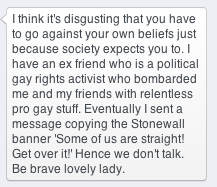
Just in case you were wondering…

As a result of Pink News’ founder Ben Cohen’s repeated online needling (latest being that I wish to oppress people’s freedoms of religion, specifically liberal and progressive Jews) one of his friends has also engaged in a two week goading.

I gave up when he posted a photograph of a man wearing fake breasts in order to be able to nurse a newborn child and talked about hiring wet nurses and denied the importance of a mothers’ loving care but nonetheless he has relentlessly continued to attempt to needle, goad and provoke some sort of intemperate comment as well as assert my homophobia.

Nothing new to see here then.

However he has gone on to write this lovely opinion piece in some obscure publication called “The Columnist” which I’ve never previously heard of. It’s entitled “Caroline Farrow IS homophobic – there I’ve said it now”. Hope this bumps up their hits a little.

A brief precis “Gay people have a right to have children. Caroline denies this, ergo she is homophobic”.  I hate gay people, want to oppress them, deny them their rights and I really should consider quite how hurtful this point of view is.

I’ve engaged with this line of debate ad nauseum, the only thing I have to say is that I am sorry if people do feel hurt by my beliefs that a child shouldn’t be deliberately deprived of a loving mum and dad, but it really doesn’t follow that I hate, despise or wish any harm on the LGBTQ* community.

A few other points of note. I’m really not as important or influential as Skylar thinks I am, flattering though it is to have an entire column and headline devoted to me.

One glaring problem is this article is that Skylar claims I cited a discredited 22 year old Australian study to claim that babies of IVF are more likely to suffer neonatal death. When I read this I scratched my head in bemusement having no memory of doing such a thing. If you read the blogpost to which Skylar refers, I linked to a Guardian article from January 2014, and stated that it is believed that babies born from IVF may suffer from more health complications. That’s a very different prospect to specifically citing a named study or claiming neonatal death. *

Another problem is this. I don’t believe that anyone straight or gay has the ‘right’ to adopt children. Anyone wishing to adopt children needs to go through the appropriate channels. While I would not campaign to restrict the ‘rights’ of any section of the community to adopt – not believing that adoption is a right, equally I support Catholic adoption agencies who will only place children with heterosexual couples in accordance with Catholic doctrine. Believing that where possible a child should be placed with a mum and dad and enjoy complementarity in parenting isn’t discriminating on the grounds of sexuality. An element of discrimination (i.e. choice or preference) is always used when deciding where to place children and which set of circumstances would provide an optimum environment. Deciding that a male/female household would be preferable to male/male one or a female/female one is not saying that individuals are inferior on the basis of their sexuality, but that children benefit from having where possible, both male and female parenting roles. Let’s spell it out – shouldn’t an adolescent girl have a mum to turn to for explanations about intimate issues in puberty, where possible? Doesn’t a young boy need a strong male role model as well as his mother?

I’d also be interested in whether or not this piece is potentially libellous. Whether or not I am homophobic is not something that a random stranger who knows nothing of my real-life friendships can pass judgement on and were he to be influential or important, I wonder whether or not I could cite that this is an attack upon my good name and reputation? In any event, 2,000 words devoted to proving my ‘homophobia’ and inviting others to comment, doesn’t seem the most insightful analysis, especially when one considers that outside of Catholic circles (and probably inside most of them) most people haven’t got the foggiest idea who I am and neither do they care.

Onwards and upwards. It all goes to prove my original point. Saying that a baby needs a mum and a dad or that marriage was between a man and woman never used to be contentious or proof of wanting to hurt people. Neither would it merit a 2,000 word opinion piece on a UK website or be thought worthy of opprobrium. What happened?

* Just before hitting publish I noticed that Skylar has in fact corrected his original piece about the IVF study and apologised for which I am grateful.

Pro-lifers need to accept it’s time for the abortion law to be reviewed

Back in January I asked,  ‘what has changed since the 1967 Abortion Act?’ What has so fundamentally changed about abortion which makes people believe that it is a woman’s human right as opposed to the spirit of the act which allowed for abortion in certain strictly proscribed circumstances to prevent a woman from having to suffer consequences from extreme social deprivation, to serious physical or mental injury and death.

In one sense, nothing has changed. An unborn child is still an unborn child, regardless of whether or not you refer to it as a foetus. The biology hasn’t changed, the consensus amongst embryologists is that human life begins at conception. When  sperm and ovum fuse a zygote is created which fulfils the four criteria needed to establish biological life:  metabolism, growth, reaction to stimuli, and reproduction. The zygote is comprised of human DNA, it is unique from any other human being in creation and the DNA will not only guide early development but determine hereditary traits. Even at its earliest stage in development the zygote exhibits characteristics which categorise it as a human organism, not merely a cluster of cells. The debate around abortion is purely philosophical, it revolves around the value that should be placed upon human life in its earliest form. 

The change in thinking and the practice of abortion has come about purely as a result of scientific technologies which have helped to shaped attitudes. In many ways pro-lifers have benefited from this. The introduction of sophisticated sonography techniques makes it very difficult to dispute the humanity of the foetus; even at 12 weeks we see what is undeniably a baby in glorious 3D technicolor. A foetal heartbeat is able to be detected at around the 6 week mark, by the age of 42 days brain waves have been recorded and the baby even has taste and teeth buds.

Logically attitudes against abortion should have hardened, however the advances have also allowed for foetal disabilities to be accurately detected which means that parents are now faced with the daunting and terrifying prospect of a child who will have an uncertain future, one that is potentially filled with traumatic medical intervention, who may never be able to enjoy a degree of independent living and whose existence will place a lot of pressure on existing family circumstances. Abortion can seem the most ‘compassionate’ course of action in these situations, medics talk only in terms of pathology and potential scenarios and rarely in terms of the equal value of all life and how even a profoundly disabled child can lead a fulfilled life and be a source of great joy and happiness. Which is why we now allow for abortion right up until birth on the basis of disability with even minor conditions such as cleft palate and club foot, qualifying as legitimate reasons to terminate a fully-formed viable infant.

Advances in reproductive technology have also softened attitudes because people will overlook ethical dilemmas or seek to justify them with superficial reasoning in their understandable desperation for children. Life beginning at conception is uncomfortable prospect for those with an interest in the many hundreds of thousands of stored and destroyed embryos. No-one wants to admit to being complicit in the denial of human rights towards the most vulnerable which is the inevitable consequence of admitting the humanity of the embryo – the lack of discernible human form is soothing balm to a pricked conscience.

And it is this lack of human form, combined with the development of the pill to induce miscarriage which helps to fool people into believing that an abortion does not really constitute the taking of human life, at least at the early stages.

This is really the major change since the 1967 act which has been one of the contributing factors which led to the huge increase in abortions.  Back in 1967 a abortion could only be carried out through surgical intervention; a prospect which daunts most women. Early stage medical abortions now account for 42% of all abortions, compared to 14% back in 2002. More women are opting for a non-surgical abortion than ever before. The same is true of first trimester abortions – 91% of all abortions in 2012 were performed under 13 weeks, compared with 57% in 2002. Pregnancy tests are also more sensitive than ever before. Tests available on the high street allow a woman to discover that she is pregnant as early as six days before her period is due.

Combined with the development of the morning-after pill and the original contraceptive pill which can act as an abortifacient, and indeed the coil, women have been conditioned or duped into believing that abortion is little more than an exercise in pill-popping to rid themselves of the potential of a baby, as opposed to what it really is: the taking of a human life.

What the recent controversy surrounding the wannabe Big Brother contestant Josie Cunningham demonstrated is that the public is still largely in tune with the spirit of the 1967 Abortion Act, although attitudes have moved on. The expressions of revulsion and hatred were not from pro-lifers but from professing pro-choicers. The overwhelming sentiment was that while a woman should be able to access an abortion, she ought to have an extremely good or ‘worthy’ reason for so doing and it should be done as soon as possible. No-one was comfortable with the idea of an abortion for a fleeting and in all likelihood damaging, brush with fame, made all the worse at the late stage of 18 week. This interview with Josie, who fortunately changed her mind, highlights quite how advanced she was in her pregnancy, she was clearly visibly pregnant and had felt the baby’s violent movements. Yet under UK law she had another 5 or 6 weeks in which to end her baby’s life.

Having participated in the debate  numerous times online now, cutting my teeth on the baby forums of doom predominated by a disproportionate liberal mindset, the prevalent attitude even amongst liberal women is that abortion is a necessary social evil which shouldn’t really be available after the first trimester unless there are compelling reasons. Polling data demonstrates that woman are far more in favour of restrictions upon abortion than men. Guardian columnist Martin Robbins tries to rationalise the difference between male and female attitudes, searching for a sociological or cultural explanation rooted in patriarchy or oppression. The answer is far simpler – women intuitively and instinctively know that abortion constitutes the taking of a human life and is bad for mother and baby alike. Which is why the pro-choice crowd seek to shout so loud and define it as a fundamental human right.

A number of recent scandals, including that of Josie Cunningham have demonstrated quite what a mess the UK abortion law is in. This was brought to a head by the pre-signing of abortion forms uncovered by both a Daily Telegraph investigation which was followed up by the Care Quality Commission. The GMC have produced a welcome clarification and response as to why no professional charges were brought – they deemed this not to be in the public interest as there had been no prosecutions.

While we can fulminate over the sorry state of affairs and lack of consequences, actually what is important is that the GMC have now clarified that the practice of pre-signing of abortion forms is not only unlawful but unacceptable. They have demanded assurances that doctors will no longer be complicit in such a practice and have warned of severe consequences. If, as the GMC contends, this pre-signing was standard clinical practice, it shows how far medical practice had slipped from the spirit of the legislation. Those campaigning for legalisation of assisted suicide ought to look at how far the practice of abortion had deviated from the medical checks and balances. Sir David Steel said that it was always intended that two doctors would see the woman, yet now we have a situation in which the second signature is nothing more than a rubber-stamp and that a woman’s wish to terminate her pregnancy should override all other considerations, including that of the right to life of her unborn child.

The good news from the GMC is that the doctors complicit in gender-selective abortions now face serious sanctions. There is a world of difference between someone who believed that they were following generally accepted clinical practice who might face losing their career and someone who wilfully ignored the letter and spirit of the law.

The GMC note that much has changed in terms of abortion since 1967, which must be dealt with by Parliament and society. Writing in the Telegraph last week, pro-choice doctor Max Pemberton has said that the law surrounding abortion is vague, paternalistic and needs updating. Equally media feminists such as Laurie Penny have said to me that they believe that the abortion law needs to change. They may well have a point, a re-examination certainly seems prudent, even if it is the source of anxiety. But the point of any re-examination must not be simply to exonerate doctors in breach of the law. If the law is indeed an ass, why is this?

The pro-life movement experienced a stagnation in the past fifteen to twenty years, although it is now undergoing a renaissance which is causing the pro-choice/pro-abortion to reignite the cultural wars and cliches about violent, judgemental, women-hating, religiously deranged pro-lifers, led by men. Part of the reason for this stagnation was the succession of  unsuccessful Parliamentary debates which brought into being legislation which gave with the one hand, lowering the age of viability from 28 to 24 weeks which had the effect of lowering the age at which a social abortion under ground C could be performed, but on the other – allowed for abortion to take place up until birth. Combined with an unsuccessful challenge to changes in the HFEA Act in 2007 and Nadine Dorries’ failed proposals regarding abortion counselling in 2011, it has seemed like Parliamentary endeavours are a lost cause.

Things are beginning to change however, not least due to a number of pertinent questions being posed by MPs from the All-Party Parliamentary Pro Life group in both houses, which are highlighting discrepancies and abuses of the law, such as the doctors who faced no action for acting with impunity.

Pro-lifers have been reluctant to engage in any more potentially damaging politics due to fear of defeat and not wanting the agenda to be dictated to by the pro-choice groups and abortion industry. And look where that has got us. A situation in which the government are planning to stealthily introduce the largest, most wholesale change to the Abortion Act since 1967, radically changing and reinterpreting the law, without any sort of public debate or consensus.

A few years ago I would have talked about the pro-life lobby tearing itself to pieces with internecine feuds. By and large, slowly but surely people are beginning to get themselves together and many groups, especially those on the ground actively helping women in crisis pregnancies, just ignore any false outrage whipped up by the abortion-supporting press and get on with their mission.

But there is still the big incrementalism versus absolutism elephant in the room. Every single Catholic and pro-lifer is agreed that abortion is a dreadful thing and therefore most are scared of the public debate because of what it might mean. Could a massive public debate and consultation surrounding the UK’s abortion law lead to further liberalisation in some form or another? Isn’t it better they argue, to keep the uneasy status quo, while working to change attitudes at a grass roots level.

Those pro-lifers who are Catholic cannot act in any way which might appear to be advocating or sanctioning abortion at any stage. But that said, it’s clear that the law is in a total mess. Ensuring that it is complied with is a great place to start and neither should we refuse the chance to participate in a debate which could lead to firmer legislation which reflects the will of the public, which is predominantly far more pro-life than pro-choice in nature. Of course there is the risk that any tightening in one area could lead to  liberalisation elsewhere, but that does not prevent the important grass-roots work from going on, nor does a support for any strengthening give implicit acceptance of early stage abortions nor consent to their liberalisation which should also be fought against. I’ve had an allegedly easy early-stage abortion, packaged as little more than a pill popping episode to bring on a heavy period – there is no way that I would advocate turning a blind eye to a liberalisation of such a horrific and damaging procedure which indisputably ended a life and threatened to destroy mine.

There are two equal and opposite errors when considering how to address the injustices of the 1967 Abortion Act.  One is too foolishly rush in with a set of unfeasible and unrealistic demands which have no chance of ever being passed into law and validate the notion of aggressive vindictive pro-lifers. The other is to stick our heads in the sand until such time as it is believed that the time is ripe for abolition; a task which gets harder with each passing year.

We should not be afraid to call for a debate which examines the issue of abortion and the law in the twenty-first century and the light of new medicine and scientific techniques. The questions for society as a whole are still as they were in 1967. Is abortion ever a right? When, if ever is it acceptable; at what stage and for what reasons?

To Charlotte – a response to an open letter

A former friend of Tara Hewitt’s has written her a courageous and moving open letter with regards to her stance on abortion, to which I would like to respond offering an alternative perspective as a post-abortive woman.

What Charlotte has to say is valuable and needs addressing – Lauren Ely writing in this month’s  First Things  said that we need to embrace and listen to the voices of all post-abortive women, women who have had an abortion must be heard rather than ignored or theorised away, even if they may be saying things which we do not want to hear.

I believe that pro-life is pro-woman; marginalising the post-abortion stories that we don’t want to hear is a similar tactic to universities and other institutions that seek to silence a pro-life point of view.

Charlotte starts off by noting Tara’s apparent change of views with surprise and sadness. It’s a reaction that I have received from some of my friends of over 20 years standing who have difficulty reconciling the fun-loving, G&T swilling, Marlboro Red-smoking party animal with the orthodox Catholic mother of 4 children. While I’ll always be fun-loving at heart (and most Catholics are, the craic at Catholic gatherings is legendary) actually I grew up, gained a different perspective and am far more contented and at peace than I was in my twenties. A change of politics is often a sign of maturity, conventional wisdom holds that people become more socially conservative with age. It takes a lot of courage to admit that your former views were misguided or just plain wrong.

The issue of abortion is not some abstract debate for me. I’m not part of any “pro-abortion lobby”, but I do believe in a woman’s right to choose. It’s a right I’ve exercised, having had an abortion in my second year of university-

The same goes for me. The issue of abortion is not an abstract debate either and if you do read this Charlotte, I’m genuinely sorry to hear that you found yourself in a situation where you felt you needed to chose an abortion. I’ve been there too.

When I had an abortion, I didn’t think of it as a right, though that may be because it was back in the late ’90s when attitudes to abortion weren’t thought of rights – the internet was in its infancy and today’s narrative of media feminism including ‘reproductive rights’ hadn’t crossed my radar.

Actually one of the things which really shocked me about the whole process was that I was well aware of the law and believed that I would really need to firmly state my case for wanting an abortion. I understood that this was a serious thing, I did believe that it was a life in theory, but also thought that by the time I had the abortion just under the 9 week stage, it was neither a ‘baby’, nor ‘human’, was not properly formed, no bigger than a grain of rice, wouldn’t feel a thing, and therefore it wasn’t quite as a bad as say, aborting a twins just 1 day shy of the 24 week limit which someone close to me had done, following severe pressure from their family. Anyway, I found that no justification was needed whatsoever, I don’t know whether or not I had counselling, I made an appointment with Marie Stopes, saw a woman in a room with a box of tissues on the table, she asked me why I wanted an abortion, I told her and she responded that I was in no position to be able to cope with a baby.

I never once thought of abortion as being a ‘right’, I was pro-choice in that I thought it was better that women could have safe legal abortions rather than die horribly at the hands of a back-street butcher. Subsequent research  and statistics illustrate that this is something of a popular myth.

Telling me that having the child (though there is no guarantee that it would have survived to term, even without a termination) would have been better is telling me that I should have been forced to be pregnant against my will, at risk to my mental and physical wellbeing, just because that’s what your moral values say. Surely, you can see how unfair that is.

I don’t know how many weeks pregnant you were but statistically speaking once you’ve got to around the 10 week mark, there’s a very good chance that your baby would have made it to term. The UK has unacceptably high levels of stillbirth (death after 24 weeks in pregnancy) compared to other countries, in 2012 1 in 200 births were to a stillborn child, but that’s still a minor risk. 1 in 7 pregnancies end in miscarriage (before 24 weeks) the vast majority occurring in the first trimester.

In terms of being forced to be pregnant against your will which could risk your mental and physical wellbeing, I completely understand. It would be lying to pretend that pregnancy does not put you under physical and mental strain, pregnant women are generally recognised to be vulnerable, they are not ill, but their bodies are working hard to provide sustenance and life support for the baby. Having an unplanned pregnancy in less than ideal circumstances is hard. I can vouch for that. But the point isn’t really about one person trying to impose their moral values on another, but accepting that the baby is a human life (certainly biologically speaking) and therefore abortion, like it or not imposes your moral values on your baby, denies that its life has any value or consequence and terminates it according to your will. It might seem unfair and an attack on bodily autonomy (although they are not a physical part of your body) for you to be prevented from having an abortion, but to be blunt, it’s equally unfair on the unborn child to have their life ended because you do not want to carry them for nine months nor give birth to them, even though you may have felt that you had compelling reasons.

I know that sounds hard and I do sympathise, remember I too have been in your place.

Pregnancy takes a huge toll on a woman’s body, and I have friends who have had conditions like hyperemesis throughout theirentire pregnancy. For them, the child at the end made it all worth it. For me, it would have been nine months of suffering to then give my child away, or raise it in completely unsuitable conditions- a double punishment, and for what? Having the audacity to have sex?

Yep, I’m not going to deny it, pregnancy does exact a massive toll on a woman’s body. I’ve had hyperemesis in all of my pregnancies which at times I have found intolerable, especially with existing toddlers to take care of. I’ve laid on my bed and howled in pain like an injured animal, I can’t go out in the early stages of pregnancy without a stash of plastic bags in my pocket to handily vomit into, throwing up into a rubbish bin on Brighton’s London Road while people walked past in disgust was not one of my finer moments. At times I would have done anything to make the relentless nausea, growing pains and headaches go away, I’ve been terrified that I wouldn’t be able to look after yet another baby or cope, but every time I’ve managed it. I’m no superhero – I think we women are much stronger than perhaps we give ourselves credit for and as you say the baby themselves is always worth it. Besides not every woman finds pregnancy a harrowing experience, some positively bloom! The physical discomfort is only ever temporary and if it were so terrible, women would never have any more than one child.

You say that you would have had to have given your baby away or raise it in unsuitable conditions. Doesn’t that make you want to fight to remedy that injustice, so that women are not forced between a rock and a hard place? Chances are you would not have wanted or been able to give your child away and though it wouldn’t have been easy, I suspect you would have coped. You talk about unsuitable conditions, society encourages us to believe that in order to thrive that a child must be born into certain ‘ideal’ situations. I often talk about this myself in that I believe that it is ideal for a child to be born to married parents and to have a mother and a father. Your situation would have been less than ideal, however many single mothers do a fabulous job and so do many non-conventional families (contrary to what people might have you believe is my stance on this).

While we shouldn’t contrive or encourage however is situations which are less than ideal. In the case of a single mother or young pregnant student – no it isn’t ideal but with the right support she can raise a baby and complete her degree. It is a disgrace that in the case of students there often really is very little practical choice, again it’s something I have personally experienced, I was told that I would not be able to bring a newborn baby to lectures and seminars and yet the nursery wouldn’t admit babies under 6 months old. Accommodation, facilities and opportunities for student parents are either non-existent or low quality. You are made to feel like a pariah. While I do not condone your decision, I can fully understand what motivated you to take it. You could have kept your baby, but it would have been too much of a self-sacrifice, which is not meant pejoratively.

Having a baby should never be thought of as punishment – that’s an attitude that’s often projected onto pro-lifers and one that horrifies me. It says that having a newborn baby is a terrible and dreadful fate whereas most women, even those in very difficult circumstances don’t ever regret their child. Having a baby will always entail some hardship and self-sacrifice, some women will find it more fulfilling than others, but we should be working for a society which always welcomes children. I don’t know of a single pro-lifer who isn’t terribly concerned about the welfare of mothers who have had an unplanned or crisis pregnancy.

I have friends from various faith groups, from Muslim to Mormon, and although many of them might not have an abortion themselves, they’re not coming after my right to.

Abortion isn’t a legal right in this country. The way the law is currently interpreted and practiced can make it seem like that, but you must fulfil one of the prescribed criteria.

You can hold, and express, whatever personal opinions you want but free speech also means the freedom to disagree with you and to hold you to account for what you say. This isn’t about your right to a religion but that you are in a position to impose your views on others who do not share them. You work as a diversity consultant for the NHS where you have an input into patient care, and you are seeking elected office where you will be able to vote on many matters of conscience like abortion and surrogacy.

Completely agree with the first sentence. I think we can accept for many people pro-life views are part and parcel of a religious view, although they can legitimately be held outside of a faith. In terms of imposing views on others – every single person in this country would like to see the law reflect, or impose, their particular viewpoint. You’d like to see the law reflect the point of view that abortion is a right and unborn babies can be terminated. I’d like the law to reflect the right to life of the unborn.

The diversity consultancy role is irrelevant, Tara is not in a position to impose her views on anyone, her input into patient care will not extend to making decisions about terminating pregnancies. There is nothing that Tara has said that would indicate that she would like to punish or cause harm to women seeking abortions or needing aftercare. The elected office is a fair point, although it should be noted that we have elected politicians who do take a similar stance to Tara and a cross-party All Party Parliamentary Pro-life Group. Being pro-life should not disbar you from entering politics though of course the voters have a right to know your views on these matters.

Women who have abortions face enough stigma and shaming, don’t be part of the problem. When you say things like this, it feels like a personal attack. From someone who was once a friend, it’s an extra kick in the teeth. I don’t need you to believe what I did was right or justified, I just need you to stop mouthing off on Twitter about how it isn’t and adding to a ‘debate’ that may one day mean a girl in my situation won’t have the choice I did. I can guarantee I would not be here today if I had been forced to go through with my pregnancy.

The meaning is clear. Charlotte, you are saying that when someone disagrees with your decision, especially if it is a friend then it feels like a personal attack. Sometimes friends have to tell the truth as they see it, a friendship that blindly affirms for the sake of peace is probably not all that genuine. My closest friends often tell me uncomfortable things that I would rather not hear, but I know that they do so with my best interests at heart. I would rather that no-one felt that they had to lie to me.

This is an attempt to shut debate down, by framing your desire not to feel uncomfortable about your abortion as being a need. But let’s talk stigma and shame for a moment.

The ONLY stigma and shame I have ever been made to feel was by two different groups of people. One was the clinic staff, who from start to finish made me feel like a shameful naughty little girl who had been exceptionally stupid. I think this is where a lot of shame comes from when it comes to abortion. Not necessarily the abortion itself (although it often kicks in later when you have a wanted pregnancy) but we are programmed to believe that pregnancy is avoidable, that sex is safe. Therefore when contraception doesn’t work as we’d hoped, whether through user error or other failure we are so used to believing that we are in control of our own fertility and bodies, that we feel stupid, especially if it was our ‘fault’ and the failure was preventable.

Part of this is historic and dare I say due to patriarchal attitudes about a girl having got herself into trouble and so on, but it’s not from the part of pro-lifers or religious people. Without exception every single person who knows that I have had an abortion have told me how sorry they are about it. There has been no judgement, only compassion and love. The ‘judgement’ that post-abortive women often feel, is more often than not projection or an over-sensitivity, drawing inferences which were not meant. Stating that all babies have a right to life is absolutely not the same thing as calling post-abortive women murderers, which is a phrase I am extremely careful not to use, not least as I don’t believe it to be true.

Pro-lifers understand the complexities of unplanned pregnancies far more than they are given credit for; one organisation I know of, literally picks up women off the street who have been chucked out of the clinic early and who are literally vomiting and fainting. They administer first aid, love compassion and care and help the woman to get home safely, i.e. what the clinics should have done. Those are not the actions of haters or judgementalists.

The judgement I have had for having an abortion came from the clinic staff and various pro-choicers as well as liberal ‘Catholics’ who have tried to use my abortion to shame me. “How can she be pro-life when she’s had an abortion herself”. “Having an abortion is not a badge of honour, I don’t know why the Catholics are patting her on the back”. “She wants to deny others the same choice she had herself”. I’ve had my abortion discussed on Twitter by a group of people I’ve never met, making huge assumptions and using it to as a weapon to undermine my credibility.

While I cannot avoid responsibility, I also know that like most women, my decision was not made in a vacuum. I really felt that there was little other choice and used sophistry to argue away the existence of my unborn child. My experience was so horrific and so damaging, that I vowed to fight that no other woman should have to go through it. It is not hypocritical because I don’t for one moment try to justify my abortion as being the right thing for me whilst arguing that nobody else should have it. I recognise that my choice was neither free and the decision was flawed. I can accept that other people will agree with this, whilst still thinking that I am a decent person. What I do know though without a shadow of a doubt, is that I would have been a great mother to the child I aborted despite the obstacles, some of which I over-estimated in my shock, panic and terror.

Can you Charlotte, really guarantee what would have happened had you continued with the pregnancy? From my experience pregnancy is often a terrifying time especially if it’s your first one and sometimes even when its planned, you can have the jitters. There are so many anxieties, your changing body, the prospect of birth, of adapting to being a mother, it’s easy to be overwhelmed by the fear of the unknown.

The letter ends with asking Tara to shut up in no uncertain terms, emphasising the idea of bodily autonomy and a woman’s right to life, one which inherently rejects that of the baby or foetus.

Poignantly in the comments, another woman confesses to having an abortion due to contraception failure, states that she believes it was the right thing, she would be a ruinous mother, but nonetheless, despite going on to have two children, she still suffers from guilt. An NHS diversity consultant condemning her, only exacerbates that.

Here’s the thing. Many women will feel guilty post-abortion because they will instinctively know that they have taken action to end the life of their child. Memories of abortion are often resurrected in subsequent pregnancies. I felt guilty after mine, not because of some sort of religious programming or cultural indoctrination (my parents are firmly pro-choice and my Catholic school didn’t go in for pro-life education) but because philosophically I think I’d always accepted life began at conception. There was also an intuitive visceral ache immediately afterwards.

But this guilt is neither deserved, nor is it imposed, it stems from the conscience which knows that a life with all it’s potential, has ended. Hence the ‘what if’. A pro-life, anti-abortion viewpoint is often painful to post-abortive women which is why they don’t wish it expressed. The ‘judgement’ or ‘condemnation’ they feel is imagined, no pro-lifers hate or condemn me or any woman who has had an abortion. A viewpoint that says ‘abortion is wrong’ confirms any anxieties or negative feelings that a woman may have had and understandably causes defensiveness.

But the upshot is not that Charlotte, or the anonymous commentator are nasty, uncaring, bad, immoral, feckless, ignorant or naive women. They made a decision to terminate the life of an unborn child,  in difficult circumstances. Making a wrong decision is not indicative of moral character or fibre. The decision may be wrong, it doesn’t follow that the person is therefore a ‘bad-un’.

Do we have to be so reliant on the affirmation of others that we have to shut or shout them down? Or is there something else deep-seated and unresolved, hence the recurrent feelings of guilt and anger?

There are plenty of secular and religious organisations out there who can help with post-abortion counselling and who do not judge women or introduce elements of guilt  but help them to talk through their feelings about and come to terms with their abortion experience. Sometimes just acknowledging the loss can prove enormously healing.

If you have read this far – thank you. For what it’s worth my faith tells me both of our children will be in heaven, praying for us.

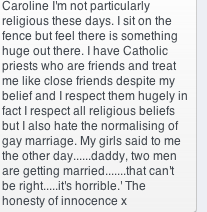
Culture Wars personified

As expected, my debate with Benjamin Cohen made it into the pages of Pink News. “Catholic disagrees with gay marriage, IVF and surrogacy” shocker! I’m not too bothered, several people expressed the perspective  that the whole affair was about Ben trying to mine some controversial quotes.

That said it’s probably worth clarifying a few points. It is not my point of view that Benjamin Cohen is transphobic and neither as the report claims, was I trying to infer that.

What I was trying to get out is that Ben (and others) clearly do have a problem with Tara and myself being friends which is why he originally intervened.


This is the nub of the matter – Catholic teaching on sexuality means that instead of attempting to understand and respect each other’s point of view, Tara along with any other LGBT advocate and myself should hate each other.

That we come together on issues of mutual agreement and that I make no attempt to hector Tara into accepting a Catholic vision of sexuality, completely undermines this narrative of Catholics (and me in particular) of being hate-filled spittle-flecked individuals trying to force or impose our faith onto other people.

There are two tactics going on here. One is to undermine our friendship by pointing out Catholic doctrine on sexuality. “How can you be friends with her, she thinks this, ergo she HATES you, ergo you must have psychological problems and be filled with self-hatred to be friends with such a woman”. Our friendship must not be accepted or validated as genuine, built upon principles of mutual trust, care and respect, but instead painted as deeply dysfunctional. It is hoped that this will have the effect of ending our friendship, enabling the hateful horrible homophobe narrative to continue to be perpetuated. It’s pretty hard to claim someone is filled with hate and loathing towards the LGBT community if they number them as friends. Actually Tara is not my only LGBT friend (I expect Pink News will ask them to all come forward and identify themselves) by any stretch of the imagination.  But then again as Ben Cohen has tweeted that any gays who oppose gay marriage for anyone other than themselves are homophobes, then a quarter of the UK LGBT population merit this label according to the Com Res poll conducted  in 2012.

The second, more disturbing tactic is to attempt to cut Tara off from the support of the LGBT community on account of her views. The whole point of this piece was to highlight a member of their community who is bold enough to publicly deviate from group think and hold her up for derision. While I roared with laughter at the piece, Tara’s views as presented seemed perfectly reasonable and mainstream and not at all outrageous or extreme, what concerned me was an attempt to undermine her job and political career, by rendering her controversial, toxic, untouchable, someone who causes upset.

Tara is not opposed purely to same-sex IVF or surrogacy, but to all of these issues as she explains in her blog. Although she has mentioned that she is an NHS diversity consultant, she never talked about her job or her employers on the internet, nor has she been anything other than crystal clear that these are her personally held views. Nonetheless her employers have been contacted for comment.

It is my understanding that the role of a diversity consultant is to ensure that employees and clients are not discriminated against by virtue of their ethnicity, disability, sexuality, gender or any other characteristic. Their job is to provide equal access to employment opportunities as well as client services and ensure that the workplace is doing all that it can to serve the diverse needs of the community.

A diversity consultant would have no say over whether or not services such as IVF should be available and if so how many cycles each couple should receive; these are policy decisions which are made by senior management and clinical staff. I have no idea whether the area of the NHS in which Tara works is even concerned with fertility treatments; she assures me this does not form a part of her role, but her professionalism means that even though she may disagree with IVF as a concept, she still needs to ensure that everyone who qualifies for it under the NHS is able to access it.

There is no discernible reason why someone who believes that every child deserves the chance of a loving mother and father and that babies shouldn’t be removed from their mothers, unless there is a compelling reason to do so, is incapable of working as a diversity consultant. Believing that the state shouldn’t conspire to engineer a situation in which children are removed from their natural parents shouldn’t impact upon one’s diversity and equality credentials.

When did we become so emotionally needy as a nation, that we are unable to cope with stiff differences of opinion or disagreement? The reason why people are agitating for Tara to be kicked out of her job is because they cannot bear the idea of a state agency employing someone in an official capacity who will not validate their desires. A couple who have used IVF or surrogacy might feel ‘judged’ knowing that someone employed within a particular NCT trust disagrees with a life decision that they have made and that would never do.

If Tara had expressed a belief in Jesus Christ, son of God who was crucified, died, was buried and rose again on the third day, people may have looked upon her perhaps rather indulgently or patronisingly, but it would have not have created the storm of outrage. Which is why the secularist lobby are keen to disassociate life issues from religious conscience, arguing that these beliefs are not integral to religion which should in any event be kept private. Only those who believe that LGBT are inferior human beings could possibly object to a child missing out on their mum or dad.

The only imposition going on here  is of one particular viewpoint or mindset as being acceptable for certain state employees. Since when did diversity mean sanctioning every single viewpoint as being equally valid? Since when did diversity not allow for believing that women are exploited by the surrogacy industry and that children should not be treated as commodities? Why should this view disbar you from working to help enable marginalised sections of society access appropriate services?

The only way to avoid damaging culture wars is to listen to and attempt to respect the views of other people, even if we do not wish to sanction or implement their ideas. Surely we can agree to disagree on some issues, while working together on areas of common consent rather than turn certain other groups into untouchables?

When Benjamin Cohen described me as an ‘anti-euqality campaigner’ he was disingenuously implying that I work hard to perpetuate inequality and suffering and trying to paint me as a singularly unpleasant person. I can live with the ostracism of Pink News readers, but it doesn’t really do much to foster positive relationships and raises the emotional temperature. This is the kind of attitude that makes people afraid to speak out for fear of being labelled as fundamentalists. Believing that marriage is not a matter of equality, does not mean that one considers other people as second class citizens and as long-term readers of my blog will remember, I have been criticised in the past by some quarters for my inherent support of the rights that civil partnerships accord and for wishing for these rights to be extended.

In my previous post I outlined precisely my position regarding surrogacy and IVF which is not based upon any wish to discriminate. I have no experience of infertility, I cannot begin to imagine how painful it must be not to be able to have children, but the existence of certain technologies or techniques in order to conceive them does not automatically justify their use. The argument is essentially a moral one about whether or not the ends justifies the means and the values we place upon human life. Can we do what we like in order to secure the outcome we want, regardless of the potential cost?

The most important thing to clear up here is accusations of being opposed to the Jewish religion as specifically alleged by Benjamin Cohen who states that I campaigned to stop liberal and progressive Synagogues from solemnising gay relationships. Firstly it’s worth noting that not all branches of Judaism support  gay marriage. Secondly, I did not specifically campaign to prevent Synagogues from solemnising gay relationships. I was part of an effort which campaigned to keep marriage defined as between a man and a woman in UK law. Synagogues, along with any other religious institution should be free to perform whatever ceremonies and rituals which their religion proscribes (with provisos surrounding physical harms). I do not adhere to the Islamic proposition that a man may have 4 wives, however I am not campaigning for Muslims to be prohibited from taking multiple spouses. Asking that the law reflects existing Judeo-Christian principles and only recognises marriage as one man and one woman, does not oppress religious freedom or prevent people from following different cultural or religious practices. Non-legal recognition or solemnisation of certain situations does not prohibit people from entering into them informally, nor does it make them illegal or against the law.

Yesterday Pope Francis tweeted the following.

He has also described gay marriage in far stronger terms than I, as being a move from the Father of Lies.

Anti-equality campaigner, opposed to Judaism, fundamentalist, or just someone who follows the teachings of the Catholic church as articulated by the Pope?

Kudos and prayers for Tara for her bravery. By daring to be friends with Catholics and supporting a pro-life point of view she has put her job on the line and has made an unlikely champion of religious freedom and rejected the frame of the culture wars.

Some fascist objections

I don’t want to spend too much time on this, but in the light of the Question Time online Twitter storm and bullying that came my way, it was suggested that I find a way of logging all the incidents/abuse that come my way as a result of defending the prospect that marriage is the union of one man and one woman for life.

The columnist who arguably was responsible for drawing a lot of heat my way is one Benjamin Cohen who according to his biography was  formerly of Channel 4 news and is now the founder of Pink News, a columnist for the Evening Standard and Gay Times. So it’s fair to note that in terms of impact and and influence, in engaging with me he is punching well below his weight. He has almost 17,000 Twitter followers and platforms in the national media. I have 2,000 followers or thereabouts and am not a regular contributor to mainstream media, aside from when I am invited on at the request of a producer or editor to explain a Catholic or socially conservative position. I don’t know whether or not my weekly Universe column counts.

In any event he has decided that I am worthy of his attention and began to follow me on Twitter following the Question Time affair. On several occasions yesterday he did that passive aggressive trick of using a full stop before my Twitter handle, before going on to misrepresent my position.

My crime – being friends with a transgender woman. Actually his ire is mainly directed onto her, for being friends with such a hateful person such as myself and because she takes a pro-life position, her view being shaped by the fact that she was adopted. Furthermore she disagrees with the concepts of surrogacy and IVF, not on religious grounds, but accepting the science that human life begins at conception. Worst still she believes that surrogacy exploits women and that every child deserves the chance of a loving mother and father.

So at time of blogging, I’ve had another non-stop 18 hours of unsolicited and unprovoked online aggression from the gay Twitterati and their supporters. Benjamin Cohen went from attacking a woman for her friendship with me, to inexplicably claiming to all his followers that I think that his lovely niece should not exist, after randomly attacking my position on IVF. He’s then gone on to justify his position that my gay friends should shun me because no one should be friends with someone who wants to deny them their rights; he would not be friends with anyone who would deny him his rights as a gay man or indeed as a Jew.

There’s a lot to unpick here, but I’ll try to address the points briefly.

1) – It is bigoted to try to undermine or dictate friendships of which you do not approve. It is more than possible to be friends with someone who takes an entirely opposite ideological point of view to yourself, accepting that they do so in good faith. I am friends with many LGBT Christians and progressive Anglicans who believe entirely different things to me on the subject of marriage and ordination of women to the priesthood, but that does not hinder our friendship or closeness.

2) Godwin’s law time. Believing that marriage should be defined as a union between a man and a woman does not equate to facism or Nazism. Marriage is not a universal human right. If it were then brothers and sisters could get married or any two people who declared a love between each other, regardless of blood ties or age. The only ostracism or turning one group into ‘untouchables’ or second-class citizens is coming from the LGBT lobby and their supporters who wish to take to the internet to undermine friendships and defend their proposition that no-one should be friends with me, or indeed anyone who takes a similar position. We must be isolated, ostracised and hated. Which is why Benjamin Cohen has repeatedly ridiculed and misrepresented my position to all his followers, to ensure that they turn their hatred and derision on me. He’s already posted a video of Lynette Burrows comparing me to her, after he debated her at the Oxford Union, saying that my language is similar to hers. This is disingenuous in that Lynette not only used sexually inappropriate language she also made some wild and unsubstantiated and provocative claims. My language and tone has been infinitely more measured. If you look at my online activity I do not go about soliciting attacks on LGBT advocates or inciting my followers to have a go at gay marriage supporters. The aggression here has been solely one-sided. I’ve had 18 hours of being compared to Nazis and specious arguments.

3) Objection to IVF does not mean that I wish babies who have been brought into this world out of existence. Furthermore my objections to it are across the board – regardless of sexuality. I object to IVF on a number of ethical grounds. The amount of sheer wastage of embryos involved in the process, as Lord Alton has noted, is on an industrial scale. I also believe that it is inefficient as a treatment. The success rates are shockingly low for a process which is emotionally and physically costly. Clinics exploit the desperation and misery of women as Professor Sir Robert Winston, one of the original pioneers agrees. I also have some scientific concern about the process, which seems to be born out by health outcomes. Children born from IVF have a greater risk of health complications and treatment cycles can prove harmful, for example it doubles the rate of non-fatal ovarian cancer in women. I don’t have a problem with the children who are conceived, rather the way in which people have gone about conceiving them. IVF is a sticking plaster, a gruelling way of circumnavigating infertility without addressing the underlying causes and in common with all issues concerning human life, a technique developed out of compassion has been exploited and distorted as being a human right.

From a Catholic point of view, I object because children have the right to be conceived from the natural embrace of their mother and father; to use IVF separates the unitive and procreative elements of sexual intercourse, which is contrary to Catholic teaching. IVF turns the child into a commodity to be made in a laboratory and makes doctors, technicians and even the sales and finance staff in the clinic, part of the conception process.

4) Surrogacy. As above, the surrogacy process once agains treats children as a commodity. The surrogacy industry exploits women as being nothing more than wombs for rent and disregards the importance of the gestational link between mother and child, which a recent study demonstrates, could be even more important than splitting the genetic link as provided by donor eggs and sperm. Basically studies are beginning to confirm the psychosomatic upset caused to mother and child alike when a child is cut off from the emotional and physical bond built up between them and their mother. We know that when a woman is subjected to high levels of stress in her pregnancy that this can have an adverse affect on the health of her unborn child. We also know that there is already a bond between an unborn child and their gestational mother, one that is not merely imaginary but assisted by hormone production. Any mother of a newborn will rave about the effects of Oxytocin, the happiness hormone, which is produced in pregnancy but also designed to be reinforced post birth, by eye-gazing, skin to skin contact and breast-feeding. As the mother of four, it’s something I have experienced repeatedly, all of my children would instantly be quietened by the simple act of my picking them up as babies, while my husband would look on in bewildered awe. I remember placing my babies next to me in my hospital bed lifting them out of fish tank provided; just lying next to me would comfort and silence a bout of crying.

As this link points out:

this oxytocin link not only facilitates key physiological processes in the baby’s development, but also helps the mother to recover after delivery. It promotes bonding patterns between the mother and neonate and creates desire for further contact. In fact, the powerful imprinting for mother and baby from the oxytocin release during breastfeeding occurs chiefly “so that mother and baby will be able to find and recognize each other in the hours and days after birth.”[1] Most importantly, studies show “the resulting high or low level of oxytocin will control the permanent organization of the stress-handling portion of the baby’s brain—promoting lasting ‘securely attached’ or ‘insecure’ characteristics in the adolescent and the adult.”[2]

All of this essential maternal-child melding and mother-to-baby recognition is proactively disrupted when the surrogate mother hands her baby over to its sociological parents. We can only guess how long the resulting love-vacuum is felt, consciously by the surrogate mother and subconsciously by the baby. Nor can we know when failure to experience this gestational link might morph into a panoply of insecure behavior on the part of the surrogate child/adolescent/adult: anti-socialism, aggression, difficulty forming lasting bonds with a mate, mental illness, and poor handling of stress.[3]

According to a study conducted by Dr Susan Golombok of Cambridge University  published in the Journal of Child Psychology and Psychiatry in 2013, children born with the help of a surrogate may have more adjustment problems – at least by the age of 7 – than those born to their mother via donated eggs and sperm. [4]

Second, this study showed that, if the sociological mother exhibited maternal distress when the surrogate child was 3 years old (particularly over whether to tell the child about his surrogate birth), this distress was predictive of adjustment problems for the 7-year-olds who, after being told of their surrogate birth, “conceivably…felt less secure when faced with their mother’s emotional problems.”

Another Golombok study [5] in 2011 revealed that the absence of a 7-year-old child’s genetic or gestational link to his sociological mother caused the mother’s interaction with her surrogate child (and vice versa) to be less warm and less mutually responsive and cooperative.

Denying that babies need their gestational mothers is damaging for mothers and babies alike. It treats babies as little more than consumer objects and women as commodities for hire. You don’t need to be a religious bigot to condemn the misery and exploitation of women engendered in countries where commercial surrogacy is rife.

5) Sperm Donation. Same with egg donation. Anything that treats another human being as a commodity to be exploited and denies the right of the child to their natural parent is morally abhorrent. Here’s the  testimony of one woman conceived by sperm donation.

All children deserve a loving mother and father. In a world which demands that we have equal numbers of women in the workplace, politics and the media, why then is the prospect that all children deserve the equality of a man and a woman parenting them deemed to be so outré?

Countless studies hold up the model of children being raised in a loving long-term stable relationship between their biological parents as being the gold standard. Every single piece of research which aims to justify surrogacy or same-gendered parents concedes this by attempting to demonstrate equality of outcomes.

Same-sex parenting and surrogacy are still a relatively new modern phenomenon. Every single study  is flawed in its objectivity, methodology and focus. David Benkof, a gay Jew like Benjamin Cohen, analyses the difficulties here. These experiences may not be representative but interviews with children brought up by same sex parents make harrowing reading.

No-one is arguing that sexuality renders you a bad parent, the argument is that children fare best being brought up in relationships with their biological mothers and fathers and that every child has an innate desire or instinct to know their identity, to know who and where they are from. This is innately accepted when children are being placed for adoption. I wonder whether in 30 years time we’ll see a glut of adults actively seeking out not only their biological parents, but also their gestational mothers?

The response from the LGBT community is to attempt to use academia and the language of pseudo-science and equality to justify their desire for children. Studies are trotted out in an attempt to prove that children are not harmed, supported by contentious gender theory which attempts to blur the differences between men and women to qualify the proposition that mothers and fathers are irrelevant. All that is needed is loving, caring ‘parents’. Because they ‘need’ to use surrogacy and sperm donation in order to have children, then to state that the rights of the children come first is deemed ignorant, hateful and worthy of derision. LGBT people have to reclaim their high-ground and narrative as perennial victims, excluded from the specious ‘human right’ of parenting through no fault of their own. They literally have no other choice but to use the body of another. That so much justification is needed, is precisely why I have termed this ‘Jurassic Park’ politics – too busy thinking about whether or not they could, to worry about whether or not they should.  To state the importance of biological parents, to want to nurture and respect the family and above all place value on human life, from the very moment of conception is not born out of any hatred or wish to marginalise. What is more important, the rights of everyone to have a child whenever they want one, or the rights of a child to have their loving mum or dad? Who are we to wilfully deny or deprive a child of that for our own selfish ends and desires?

The term phobia is bandied about a lot and people recognise that a lot of objection is based on fear. While I’m not scared of people’s private decisions regarding their sexuality, actually the notion that children do not need their loving mothers and fathers does terrify me. The notion that a woman’s body can be commoditised or used as a vehicle to provide someone else with a child, does scare me, as does the idea that it’s okay to take children away from their mothers and that the gestational link is unimportant. This profoundly damages women, along with their babies and men too. It treats human beings and human life as nothing more as a consumer product. It does not encourage errant fathers to take responsibility for their offspring for starters. If a child doesn’t really need a mother and a father, then what’s to stop the state from taking children into care to raise according to their norms of child-rearing? If a child doesn’t need it’s mum and dad, then what’s to stop a child being removed from a parent who has the wrong views or ideology and given to a more loving and ‘tolerant’ set of parents?

This might seem rather far-fetched, but I am worried about a world which wants to tell my four girls that they are not automatically the best mothers for any children that they might have. Their job is merely to produce children, but they should not be guaranteed the right to raise them. It would be the same were I to have little boys, I’d worry about their being reduced to mere sperm donors.

That people are smugly favouring Ben Cohen’s tweet about not being a second class-citizen due to his sexuality or Judaism, when I did not suggest this reprehensible idea and wishing that ‘people like you did not exist’ because I believe that no-one has a right to deliberately deprive a child of the chance of being brought up by their mum and dad, really frightens me. As does a mainstream media commentator happily describing me as a fascist or comparing my view to anti-semitism and getting his friends (including a BBC London Radio presenter) to agree and endorse that point of view.

I’m also concerned by the bullying of my friend, who is being treated as a traitor to the LGBT cause and threatened with exposés in the gay press, simply because she does not conform to the narrow-minded proscribed ‘rights’ agenda, which dictates that all people must think the same. They are also irritated that she has not only been nominated by several people to win an award for LGBT diversity and engagement, but that she wishes to pursue a political career, which is why they are going after her with such enthusiasm. A trans-woman who accepts the sanctity of life and the rights of children to be brought up by a loving mums and dads in a position of political influence? That must not be allowed.

 A gay man can be a great father, but he cannot be a mother. A lesbian can be a lovely mother, but she can’t be a father. Why is a statement that a baby particularly needs their mother, that all children need both their parents deemed to be  so radical, offensive and deemed to be up there with Nazi policy’s of mass extermination?

We live in a world in which the following statements can be uttered as truths without so much of a hint of irony.

https://twitter.com/jesszkey/status/460556781312565248

https://twitter.com/jesszkey/status/460699509878964224

Even Orwell would have found it fantastical.

This isn’t religious persecution, but illustrates my previous point about Dominic Grieve and fundamentalism. No one is having a go at me because I am Catholic, although they might use my faith to demonstrate alleged irrationality or claim that it’s proof that I want to oppress. Catholicism is an easier target than addressing the very real ethical objections, as is personal attack and smear.

Far easier to attack me as a fundamentalist, a person who wishes to repress minorities and stop them from exercising their spurious rights to children, than to tackle the issue of whether children ought to have a mum and a dad and whether or not life is an exploitable commodity.

Scary times indeed.

Update: Ben Cohen believes that this post falsely accuses him of calling me a Nazi and a fascist. He has requested my address on Twitter to pass on to his solicitor and has given me until midnight to retract.

Ben did not explicitly call me a fascist or Nazi but his tweets which made reference to his Judaism, did in my opinion imply that my views were comparable; one of his friends replied to me asking whether or not I would be friends with a fascist in the context of my friendship with a transgendered woman. Another of his followers compared my stance with racism. Someone else said that I would have been manning a machine gun in the tower at the entrance to a concentration camp in ’40’s Germany.

Combined with the fact that after my Question Time appearance one of his followers wished that I would ‘die soon and hopefully your Nazi family will follow shortly’ I interpreted these references to being compared with fascists and Nazis.

But following his threat of legal action and demands for my address, I am happy to make clear that Benjamin Cohen himself did not explicitly call me a fascist or Nazi.

To reiterate, this whole conversation was begun when Ben interjected into a brief non-related remark I made stating that both social conservatives and progressive LGBT advocates would do well to mix outside of their tribal bubbles and engage with and listen to each other.

People are still rumbling on that it’s my fault for advocating extreme views.

Sometimes the avalanche and seemingly relentless of hate and threats makes me physically shake with fear and retch.

Tonight my husband commented that people want to get me, if they could they would lock me up and throw away the key, showing no mercy. It’s unnerving to say the least.

******************************************************************************************************************************************************

[1]  http://www.thebabybond.com/BondingMatters.html (last accessed: 28/4/2014)

[2] Ibid

[3] Ibid

[4]  Golombok, Susan et al, “Children born through reproductive donation: a longitudinal study of psychological adjustment,” Journal of Child Psychology and Psychiatry54:6(2013): 653-660

[5] Golombok, Susan et al, “Families created through surrogacy: Mother-child relationships and children’s psychological adjustment at age 7,” Dev. Psychol.47:6(2011):1579-1588.  

Misplaced fear of fundamentalism

My postbag and email inbox can testify that Dominic Grieve, the Attorney General is right, Britain is a Christian country  founded upon over 1,500 years of heritage which have shaped this country’s ethics and values and Christians are increasingly reluctant to express their religious views.

Prior to the Question Time brouhaha, I regularly received correspondence in which people thanked me for speaking up in the public square, for expressing what they believed to be a solid Christian viewpoint and for articulating or standing up for certain values, which they were prohibited from doing for a number of reasons. One of the nicest letters was one received from an Anglican, who while he didn’t agree with certain Catholic points of doctrine said how refreshing it was to actually hear someone confidently state the basic Christian Trinitarian belief on live TV.

Following on from Question Time, this is the type of thing which has featured in my mail. That I know that by publishing it I am taking a risk of being reported for hate crime, is very telling:

Screenshot 2014-03-31 10.19.37

Screenshot 2014-03-31 10.19.09

I’ve also received several other comments from people stating that I ought to get off TV  for the sake of my career, that I’ll never work again, I am pigeon-holing myself into some sort of  hardline ‘right-wing’ niche and that I will struggle to ever get mainstream work.

It seems fantastical to believe that speaking out can make one an ‘untouchable’, the stuff of a dystopian or totalitarian society, but this increasingly seems to be the case. I first discovered this a few years ago cutting my apologetics teeth on the mummy forums of doom. I was such a naif, it hadn’t occurred to me that calmly and rationally setting out a mainstream orthodox Catholic point of view would be perceived as an act of subversive radicalism or would cause such anger. Neither did I realise quite how theologically illiterate we as a nation have become, or that many self-proclaimed liberal progressives have the most closed-minded and totalitarian mindset that I’ve ever witnessed. The cries of ‘bigotry’ are all projection. It was the atheists wishing to close down discussion or promulgation of a Christian viewpoint, crying out that it shouldn’t be allowed, especially not in schools. The prevailing view was that anyone who took a non relativist position, while they were entitled to do so, should be disbarred from ever expressing it in case it caused offence or upset.

As I migrated from what I believed was a non-representative microcosm niche forum, I was dismayed to discover that this is indeed the prevailing view in society, this is what most people seem to think and are prepared to violently expound. If you have a Christian point of view which encompasses a belief that marriage consists of a man and a woman or that life should be protected from the moment of conception to the point of natural death, then you are ripe for derision, a bigot or a homophobe . You should not be working in any profession with any import or influence, especially not near children or vulnerable people, and should keep your big trap firmly shut as you scan the next item of groceries through the till.

This time last year I witnessed a pro-life Catholic GP be bullied off Twitter after hardline feminists reported him to the GMC and his NHS employers for having the temerity to express that he did not agree with abortion. He is not alone. A few weeks ago, feminists in conversation with Clare Mulvany, a colleague and friend of mine, spotted that she was a qualified midwife and made a point of tagging the nursing and midwifery council into the tweets, in an attempt to threaten and intimidate her. It was, once again thought inappropriate that someone within the health care system should offer a point of view which defended the right to life of the unborn child. Then, a few days ago, another NHS employee has informed me that they too have been reported to their board after expressing a pro-life point of view, despite the fact their sphere of work does not involve direct patient contact.

It makes the mind boggle that doctors can break the law and put women at risk by recommending abortion without ever seeing or examining a patient and thus not being able to form an opinion in good faith and escape prosecution or professional consequences; and yet anyone who wishes to protect women and their unborn children is deemed ‘judgemental’ and unsuitable to be able to offer a satisfactory standard of care, even if they have an impeccable previous professional record. It should not be assumed that having a pro-life point of view makes one hostile towards others who have had abortions – most pro-lifers understand that abortion is a difficult moral choice for many; they simply wish to exercise and defend their right not to participate in the procedures as well as offer alternatives. My doctor will not routinely offer antibiotics. I understand why and feel defensive every time it is explained to me why this is a last resort. Being judgemental is part of a doctor or nurse’s remit, no-one likes being made to feel ignorant or uninformed but it is perfectly possible to politely state that you are against abortion or euthanasia on conscience grounds and still provide great care. We shouldn’t pander to narcissism or insecurity complexes by removing rights to freedom of expression. It is nonsense to assume that a medical professional’s clinical judgement will not include an element of their own personal ethics. By offering abortion on demand, the NHS can hardly be claiming to be taking an impartial view on the matter.

In terms of attitudes to Christian views same-sex marriage, we need only to look at the case of Adrian Smith, the housing officer from Trafford who was eventually vindicated but financially ruined after being demoted from his job for expressing his point of view about marriage on his Facebook page. A friend of mine attended a work course last week in which she was informed that expressing any sort of religious or social views on the internet which could cause offence would amount to gross misconduct. Employers are in effect codifying and prescribing what people can say even outside working hours. You can think what you like, but woe betide should you dare to advertise it.

Like it or not, Christians with a certain viewpoint are already feeling uncomfortable and socially constrained and are constantly being informed that their views have no place in politics or the workplace. Yet even Tony Benn, the non-Christian arch-socialist said the following in an interview with Mary Kenny:

 “How can you separate yourself From the world you live in? I can’t imagine a world where people have their religion in a water-tight compartment. Religion can’t just be a private matter.”

But that is exactly is what is being expected of Christians unless we hold ‘acceptable’ views, which is where Dominic Grieve’s remarks grate. Christians are afraid to speak up, but not because of the fear of being tarred as religious fundamentalists but  because they are afraid of the consequences for their jobs and families. Instead of being helpful, the Attorney General has increased the divide between liberal and conservative Christians, by using the broad-brush term ‘fundamentalist’ Christians which can be used as a weapon to attack anyone who doesn’t conform to the consensus.

There’s a whole other essay or blogpost in terms of comparing Catholicism to Christian fundamentalism, but it doesn’t stop people from waving it around as some kind of pejorative label. I was both amused and horrified to find myself the subject of someone’s recent Facebook status update in which they said “Caroline Farrow is not a religious nutjob, while her point of view may be homophobic, she is in fact only speaking what the Roman Catholic Church teaches” and went onto to quote Cardinal Nichols and other members of the episcopate to prove his point.

This goes some way to explain the huge amount of personal vitriol which has come my way – it’s far easier to paint me as some kind of oddball bigot, or indeed try and claim that Catholic Voices is a creepy Opus Dei led sect (despite the fact that most of us including the leaders and myself are not Opus Dei members, nor is Opus Dei the organisation portrayed by the likes of Dan Brown) because that makes it easier to dismiss what is actually being said.

By isolating and attempting to portray individuals or organisations as being in any way less than perfect (not that any public Catholic I know claims to be) it’s a great way of deflecting accusations of anti-Catholic or Christian prejudice. “You aren’t like the nice normal ones and thanks to you, you are making life very difficult for them. I don’t want to be a member of a Church which espouses the likes of you”. The point that the church is a field hospital, open to all sinners, not just an exclusive club of nice socially acceptable people with the ‘right views’ seems to have escaped them. Far easier to scream bigot, despite the fact that myself and many others have gone on record defending the rights of homosexuals to make their own private moral decisions without facing criminalisation or fear or reprisals.

But by attempting to point the finger or wave the blame at ‘fundamentalism’ without specifically identifying what he means by this term, Dominic Grieve has just pushed those of us already feeling alienated further onto the margins.

And of course any post like this, draws the inevitable ‘playing victim’ or ‘making a mockery of those who face real persecution like in Syria’ meme. Which is like telling someone who is suffering in any way to cheer up because there are always those who are worse off and whose plight is worse than yours. While this is often true, it is not always helpful, nor does it go any way to alleviate the cause of the original suffering by denying that it is not happening and is not serious.

When people believe that they cannot express a certain point of view for fear of losing their jobs or facing some sort of sanction, then we are in scary territory, even if the threat is not as real as the perception.

I received the above email, prior to going on to Sky News outside Brighton town hall on the weekend that same-sex weddings were legalised. I didn’t actually want to be there, I was shaking with nerves and in tears, it would have been much easier to stay in the garden enjoying the sunshine with my children rather than turn up like Hove’s Fred Phelps brandishing a ‘down with this kind of thing’ banner on people’s big day. It was my husband who told me to keep going, saying ‘look you’ve put your head above the parapet now, you have to continue to speak out for those people who can’t’.

I’m no great martyr for doing so, the worst thing I’ve faced, aside from the horrible person spitting at me and an unprecedented online smear and hate campaign was an aggressive man in Waitrose telling me “look you may have been on the telly but that doesn’t mean that you can block the aisle with your pram. Yes, I saw you – QUITE UNFORGETTABLE”.

But nonetheless at times I am scared and overwhelmed by threats that my children should be removed, attempts to interfere in my husband’s vocations process, malicious green ink letters sent to professional associates (fortunately always by the same set of people and known names) and I am also disappointed that the career which I had hoped to pursue either in teaching or midwifery (my dream vocation) when I set up this blog a few years ago, will no longer be open to me and neither will normal mainstream employment, once people google my name.

It is massively disappointing not to mention frightening to learn that a future career is not going to possible in a few years once my children have started school, because I have been stupid enough to open my mouth on the internet and on the media. Certainly it wasn’t my intention to build a ‘Catholic profile’ when I began blogging, I just wanted to present the vision of a happy well-adjusted woman who loved life, loved her family and above all loved God and the Church. I’ve not always managed to succeed thanks to being bogged down by trolling and smear campaigns which I should have realised were inevitable. Sometimes I wish that I had not been quite so forthcoming.

But if I feel like this as a so-called ‘professional’ Catholic, being a relatively well-known name, then goodness knows how someone else without the confidence, protection or supportive spouse that I have, must feel. We are called to live and proclaim our faith, to stand up for Gospel values which often include truths that are unpalatable to society, but this is getting increasingly more difficult for the laity, who do risk consequences. When you look at Catholic comments boxes the overwhelming majority of posters choose to remain anonymous for a reason.

This is the way of the cross, we should remember that Christ warned us that it would not be easy when analysing at Dominic Grieve’s remarks, regardless of whether or not he categorises us as fundamentalists. I suspect that is what keeps most of us going.

Life, light and love

So many unnecessary pixels are wasted on the ethics of social media, upon what people should say and how they should say it.

Here’s an inspirational young Catholic woman who is putting Evangeli Gaudium and the Gospel message of love into action. This is what Christian witness on social media should look like.

No lofty attempts at cultural analysis, no hidden political agenda, no passive-aggressive snipes, nothing but pure undiluted caritas.

Rachael Patrice has spent the past five hours attempting to show Josie Cunningham that she is loved and valued and drowning hate with love.

Awesome.

Abortion law: it’s time to get tough and crack down on renegade doctors.

A host of freedom of information requests  submitted in the wake of the Care Quality Commission’s 2012 investigation into 14 abortion clinics, has revealed that 67 doctors were referred to the General Medical Council  for disciplinary action after it was discovered that they had pre-signed piles of HSA1 abortion forms.

This practice of pre-signing abortion forms is illegal and cases should be prosecuted, as Earl Howe (under-secretary for Health) confirmed recently, speaking in a House of Lords debate on 3 April:

Addressing Lord Patten’s question, Earl Howe confirmed that pre-signed forms are a clear breach of the law and if the practice is found to be happening, a prosecution should be brought. Earl Howe also confirmed that the CQC will continue to cover the issue of pre-signed forms as part of its inspections and action will be taken against any provider where there is evidence of pre-signing. Following a later comment by Lord Patten on the lack of prosecutions that have been made for conducting gender selection abortions and pre-signing forms, Earl Howe also agreed to circulate a letter to all Peers who attended the debate outlining the follow up actions that have been taken on those issues.

According to the GMC, 67 doctors were disciplined for pre-signing following the CQC investigations in 2012, none of whom had their cases referred to the police, none of whom were removed from the medical register, and none of whom had the details of their cases made public by Fitness to Practise panels. In one case, an abortion clinic continued to use a pre-signed form four years after the doctor had left.

There isn’t much to add to Jim Dobbin MP’s statement:

This is clear evidence of the abortion-on-demand culture throughout the medical establishment. 67 doctors happily referred for abortions without knowing a single thing about the woman requesting them. Worse, at the very top, senior doctors and lawyers at the GMC decided to keep these crimes to themselves. This shames the GMC and makes a mockery of the Abortion Act.
Good practice is that two doctors see and examine the pregnant woman before making a referral, for the sake of her own health. Yet the Government is in the process of liberalising this rule. In light of these revelations, I hope that David Cameron will overturn this madness and require both doctors allowing an abortion to have seen the women they are dealing with.

Regardless of where one stands on the abortion debate, the practice of pre-signing forms is a reckless endangerment of women’s health and safety. The two-doctor rule was implemented recognising that women would be put at risk by an abortion-on-demand culture and to stop doctors from acting with impunity. Abortion is a serious medical procedure which involves either internal surgery or large doses of synthetic hormones designed to bring on labour, it is imperative that a doctor examines a woman to ensure that there are no contraindications which could jeopardise her health.

The 1967 Abortion Act recognised that abortion was a grave procedure which should only take place in certain clearly proscribed circumstances, namely if the woman was believed to be at serious medical risk as a result of her pregnancy. The two doctor rule is the check and balance designed to protect the general public, in the same way that it is a mandatory requirement that a second doctor must examine a deceased person prior to a cremation?
As a point of interest, prior to a cremation, a third doctor has to oversee the entire paperwork. Why then is a living, breathing, pregnant woman and her unborn child believed deserving of less protection, especially when we know that coerced abortion, especially on the grounds of the sex of the baby or due to domestic violence, is a very real problem.
Lord Steel, the architect of the 1967 bill has repeatedly confirmed that the intention of the Act was not to usher in a culture of abortion on demand, he has said that he never envisaged the number of abortions which take place today and in a recent email  said that ‘it was just assumed that two doctors would see the patient.’
Once again, we need to ask ourselves what has changed and why have these breaches been ignored? And while we’re asking questions, the following present themselves:
– what were the doctors’ names?

– how did the GMC develop their policy of not reporting crimes of pre-signing?

– how many pre-signed forms were discovered in each case?

– what kind of abortions were pre-signed (spurious disabilities? Social abortions?)
– how far in advance of the referral the pre-signing took place. The CQC investigations said that, in one case, a doctor whose pre-signed forms were being used had not been working at the clinic for four years prior to the referral. This must be one of the 67.


The law needs to be upheld and if not the public is entitled to a full and frank debate with regards to the protection of pregnant women,  the status  of the unborn and should demand accountability and an explanation from their elected representatives.

This weekend I have witnessed with horror the outpouring of hatred and disgust towards a vulnerable young woman who is seemingly aborting her fully-formed unborn baby so she can go on TV and pursue her quest for fleeting celebrity fame. The abuse has not come from pro-life quarters or activists, the majority of whom have either remained silent, stated that they will pray for her or have respectfully begged her to reconsider, even offering to adopt her baby in many cases. What’s been interesting is that an overwhelming majority of young people have recognised that this woman’s child is fully-formed and that while they might sanction abortion, this is only in limited reserved instances where it would appear that the woman has little other choice. The case of Josie Cunningham is clear reflection of British attitudes towards abortion; most people are repelled by an attitude which regards a baby as a disposable object and accept that by the 18 week stage, it is fully-formed and human.

The general public’s revulsion at the callous disregard for life displayed by a young woman aborting her baby, 6 weeks before the legal limit on what would appear to be a whim, is precisely what the law is supposed to reflect and indeed a recent poll of woman by Com Res demonstrated that 9 out of 10 women believed that women seeking abortion should always seek a qualified doctor. Furthermore 80% felt that women’s health would be put at risk if women seeking abortions are not seen by two doctors and 80% also said that doctors who lie about having seen patients should be prosecuted. Well over half believed that the two doctor requirement should be more rigorously policed in private clinics.

The two doctor law is what women want. 

Doctors who treat the law with impunity and put women at risk must be prosecuted. Secondly, urgent questions must be asked of the GMC’s role in all this. Independent witnesses should be appointed to Fitness to Practice panels to prevent crimes from being hushed up.

Thirdly, the remedy for all this is for two doctors to see and examine the pregnant woman. How on earth can anyone form an opinion in good faith without ever having seen a woman and how can her safety be guaranteed? These are precisely what the 1999 RSOPs required and it is absurd that the government is currently attempting to liberalise practice which only serves the best interests of the abortion providers. These measures come at a time when abortion clinics are currently suffering from a recruitment crisis and struggling to recruit enough qualified staff.

It’s difficult to see how a stealthy and undemocratic removal of checks and balances does anything other than feed a culture of abortion-on-demand, one which endangers women.

We have rightly condemned and cracked down upon the appalling practice of FGM in the UK. It’s time to do the same with abortion, which does so much harm to women, their unborn children and society as a whole.

Big Brother’s grounds for abortion

pink range rover
More valuable than a baby?

A girl named Josie Cunningham, who is by all accounts  (in)famous has given an interview in the Daily Mirror stating that she intends to abort her 18 week-old unborn child later this week, in order that she can appear on Big Brother, ‘be famous, drive a pink land rover and buy a big house.’

The story merits comment and not for the obvious reasons; from reading a little bit about her and learning that she is unclear as to whether or not the father of the baby is a premiership footballer, a friend, or a former client (who happens to be a surgeon) from a period when she was working as a prostitute escorting, it is evident that here is an extremely vulnerable young woman who is a product of our consumer culture and who has very little self-esteem or sense of worth.

There is the possibility that Josie’s public deliberations over whether or not to keep her unborn baby is part of a cynical attempt to boost her fame and manipulate Channel 5 into accepting her as a contestant, however one has to feel desperately sorry for someone who feels driven to seek attention in such dramatic fashion, as well as for her unborn baby – the equivalent of a chance or community chest card on the celebrity monopoly board, with his or her life hanging in the balance.

The most responsible course of action for any media outlet would have been to completely ignore Josie instead of attempting to validate and endorse her search for fame and attention, until she actually did anything of merit. What message does this story send out to young girls today? Get the NHS to pay for breast augmentation as Josie did, generate publicity, become an escort, have a controversial abortion and your route to fame and fortune is guaranteed?! Is this really the sort of career investment which should be funded by the taxpayer? Does the potential future tax revenue from Josie’s career allow the state to co-opt her sexual exploitation by funding her unnecessary surgery and picking up her abortion tab? Are notions of self-improvement constrained to physical appearance  or economic contributions? Is this what constitutes social responsibility?

Whatever the outcome of Josie’s decision, her life and that of her child, even if she does go ahead with the pregnancy seems set to be blighted unless she gets out of the spotlight. The public needs to unlearn its habit of eager voyeurism which feeds the public car-crash of so many celebrity lives. How is her baby going to feel knowing that their mother publicly discussed getting rid of them? What about the impact upon her other two young children?

As Josie shows no inclination of keeping a low profile, Channel 5 should accept her as a contestant on Big Brother, only on the condition that she remains pregnant. If it is in fact true that negotiations stalled following revelations of her pregnancy, as a feminist statement Big Brother ought to prove that it embraces pregnancy in the workplace. Josie’s progression through pregnancy would provide a far more diverting narrative than their usual diet of has-beens resurrecting petty dressing-room squabbles of twenty years ago.

According to a poll currently running in the Mirror, 92% respondents have said that they will not watch Big Brother if Josie appears on the show having had an abortion which demonstrates the British public’s natural antipathy towards social abortion. Contrary to feminist rhetoric it is not seen merely as a woman’s choice, but rather as a necessary evil. That so many people have expressed their disgust, shows that we see an 18 week old baby as deserving of dignity, respect and above all, life.

This also busts open the popular idea that late-stage abortions are only due to difficult circumstances, Josie demonstrates a mindset which puts her own perceived needs and ambitions above the life of her child, regardless of their stage of development. It doesn’t matter that she might have felt her little boy or girl kick and move, it is her right to end her baby’s life right up until the 24 week limit if it interferes with her ambitions or plans. The published photographs of Josie posing with a visible four-month bump containing a baby who might never be born cause distress, irrespective of whether or not one takes a Catholic or absolutist position on abortion.

While no-one should condone the online abuse that Josie has suffered, it is difficult to feel sympathy for a woman who is exploiting her decision as to whether or not to end her baby’s life to make money and it will be particularly hard to swallow for those who have experienced the agony of miscarriage or infertility. Scrolling through her timeline, the insults and negativity is not emanating from professing Catholics or Christians, but from young people who are revolted by such blatant disregard for a baby’s life.

If, as Josie claims, she wants to beat the trolls, then actually the best thing she can do is to go ahead with the baby and prove her moral fibre as well as her ability to be a good mother. Who could really enjoy a house or car purchased with cash drenched in the blood of an unborn baby?

When the abortion act was passed, Baroness Knight was jeered at and derided for her ’emotive’ speech in Parliament when she stated that the law would lead to abortion on demand and that unborn children could be disposed of on a whim. She was accused of scare-mongering.

Any doctor who signs a HSA1 form agreeing to this abortion should be prosecuted as it is a clear breech of the law. If it is illegal, as Earl Howe, under-secretary for Health has recently confirmed, to abort a baby on the grounds of gender, then how can be legal to abort one on the grounds of ‘being an impediment to a pink range rover’?

How does not appearing on a reality show as a result of being pregnant constitute a grave threat to mental health, greater than that of having a baby? Surely by aborting her baby so that she may be free to continue to sexually objectify herself and define the role of female reality TV contestants, Josie Cunningham participates in her own oppression and that of women overall?

How can this choice, especially when the potential fathers of the child have expressed their wish for him or her to be born, be in any way justified? The term ‘anti-choice’ has just lost its sting.

Through the looking-glass

MY fertility matters...
MY fertility matters…

This piece from Philippa Taylor on the excellent new conservative woman website highlights how these days it increasingly feels as though we have all walked through the looking glass.

The complexities and ramifications of the case are headache-making. How on earth have we got to a point whereby children have a biological mother and father who have no legal rights over them and are at the centre of a battle between their biological mother who has no legal rights, and two legal parents, one of whom gave birth to them, the other who came into their lives later?

As Philippa points out case law now needs to define the three different types of parent; gestational, legal and social or psychological and accord respective rights.

No-one would disagree that this is a horrendous situation but it is the inevitable consequence which denies the importance of complementarity between the sexes and treats children as a right or option which should be available for every single couple who wants one and wishes to define every single romantic relationship as ‘equal’ and worthy of being given official family status.

Broken relationships cause havoc and heartbreak for children and I speak from the perspective of one with personal experience of having to manage and mitigate the fall-out for a child. The situation is a lot better than several alternatives, I have a happy and well-adjusted child, but nonetheless it isn’t ideal for her. It would be delusional to claim otherwise and no amount of civility, maturity or friendship between the the adult parties will entirely repair the damage for the child who is forced to emotionally navigate the complexities of having biological parents who live entirely separate lives and switch into different modes or personas depending on which parent they are with as well as the upheaval of splitting their lives between two homes.

There is no easy solution. My paternal grandparents’ marriage was a casualty of World War II, and it was decided that it would be confusing for my dad growing up if he had regular contact with his father. Consequently they did not meet until my dad had reached what was then legal adulthood at the age of 21. It’s a loss that he still feels keenly. Single-parent families and step-families can and in many cases do an admirable job, but there is an additional barrier when it comes to ensuring the psychological welfare of the child.

Knowing how hard these situations are for the child, why then contrive a situation in which a child will be deprived of a mum or dad? Leaving aside the manner in which such a child is conceived or procured which infringes their intrinsic dignity, you are from the very outset creating a set of circumstances which will require compensating for, regardless of whether or not you are a single woman exercising your choice to have a child at the most opportune age, or a same-sex couple.

Right from the moment of deliberately contrived conception, one is automatically creating an extra layer of complexity for a child to negotiate as they are growing up, regardless of whether or not the parent is single or in a same sex relationship. In both cases you often end up with the situation of a woman giving birth to a child who is not biologically hers. That matters, every child has a innate longing for identity, to know who they are and where they are from, as well as a curiosity, not least in terms of hereditary dispositions.

In the case of gay parenting, if the relationship is stable and lasts the course, that’s all well and good, but as gay marriage is a relatively new phenomenon there is little in the way of firm data to indicate whether these unions are likely to be more or less long-lived than heterosexual ones. This matters, because in the case of same-sex parenting, say in the case of two males, you then have custody of a child needing to be split between two ‘dads’, only one of whom may or may not be biologically related. Then if these two men go on to find new partners, you have the case of a child who has two fathers and then two step-fathers. Arrangements become extraordinarily convoluted and onerous for the child. Of course its fair to mention that it’s not right for any child to be subject to a series of transient step-parents or families, regardless of sexuality, but neither can it be right for a child to have to divide their time between two families each comprised solely of one gender with no other example of other gender parenting modelled for them.

Yet this is the risk that is being taken and these situations will become increasingly common. For those who point to the relatively small number of people who identify as LGBT (around 1-2%) and corresponding marriages, that the number of children who could be affected might be small, doesn’t justify the situation. Doesn’t every single child deserve a loving mum and dad or do the wishes of the parent trump the needs of the child? Do we treat children of same-sex couples as being less important in terms of their rights?

Yet this attitude towards children as rights or objects is not merely confined to one section of the community. Yesterday as we were hurriedly bundling the children into a lift in town, another, slightly older couple bustled in. Looking at our family, the man noted the appearance of 4 girls and smiled benignly “ah so 4 girls then?” Yes we said, bracing ourselves for the usual “you’ve been busy, don’t you have a TV, don’t envy you when they are teenagers” banter,  when the man ventured that they too had four girls, but added “you need to do what we did, get  yourselves to the doctors for IVF for a boy.”

Not wishing to get into a protracted discussion we smiled weakly whilst exchanging wary eye-contact. There was just so much wrong with that statement, from the assumption that we only had 4 children because we were trying for a boy, the assumption that having a balance of genders in your offspring is important, that boys are better, more important and necessary than girls, so much so we ought to go in for physically, financially and emotionally costly treatment. The consequences of IVF, the wasted embryos and lives, the environmental impact and the eugenic nature  of the procedure all seemed to have escaped this guy. The fact of having four children of one sex meant that we were justified and entitled to take whatever action necessary to ensure that we had one of the opposite gender. All other ethical considerations should pale into insignificance next to our projected desire to have a boy.

The French have intuitively understood this, which is why the Manif pour Tous movement enjoyed such success. They realised that rejecting the notion of complementarity could have disastrous effects for the rights of the child, they recognised same-sex marriage as being all about imposing  gender theory of homogeneity on the wider population and blurring the differences between male and female. Gender theory, as promulgated by the likes of Judith Butler, is helpful for this cause in that in validates individual selfish desires. It allows for the importance of  gender and complementarity in child-rearing to be disregarded in order to qualify the pursuit of personal happiness. Which is what allows women to feel that their children don’t need fathers and has in turn allowed men to get away with irresponsible feckless sexual behaviour together with the idea that promiscuity can be consequence free. Sexual libertinism and gender theory are complementary; each feeds the other. Combined they produce a dystopian society which declares that children no longer need loving mothers and fathers as a way of justifying lust and all-consuming natural biological desires for children. In our brave new world a child (free of any discernible disability) and even of a specific gender is no longer a gift or blessing, but an inalienable human right and marker of equality.

Which is why we then wind up with a situation whereby a woman is jeered, booed and hissed at for attempting to point out that every child deserved a loving mother and father. There is a dissonance in a society which calls for equal numbers of men and woman in business and politics but wants to deny children the equality of a mother and father.

I’ve come in for a lot of “what about the children” mockery, but a child is not merely an object or a pet, which needs to be provided with resources from any loving or caring party in order for it to thrive. Why is the statement the needs of the child, supersede those to have a child, quite such a radical heterodoxy in twenty-first century western society? And why can’t we see that driving a coach and horses through the rights of a child and denying the importance of a child’s natural parents has terrifying implications in a state which seeks to impose its own vision of parenting and checklists upon the population, especially if they are perceived as disadvantaged.