Your mother was a hamster etc

Last night I was tired and fractious. I had spotted a very unpleasant ad hominem involving myself and my daughter. I blog because it’s my therapy, I like to let off steam and if others are entertained or interested by it, that’s an added benefit.

I was extremely hacked off about what appeared to me to be a relentless stream of anti-Catholic rhetoric. Same old “homophobia”, describing the NT as fables, telling me that I had no idea as to Christ’s sexuality yadda yadda.

So I blogged about it, I vented in order to share a touch of frustration, with others who I thought would share my exasperation.

No-one was named, no aspersions were cast on any individual characters, the site, which is publicly accessible by a google search was not named, I simply copied some of the comments that had got to me. I checked the T&Cs of the site and no such prohibitions were listed.

Cue a slew of outrage. How dare you use these comments which were to be used on a specific website (one which has major corporate sponsors) out of context and without asking permission of those who wrote them. The T&Cs and privacy policy is explicitly clear. Users are warned about submitting personal details and photographs and that if photographs are reproduced elsewhere, the site will do its best to ensure these are taken down, but that it couldn’t guarantee that this would happen. Users are also warned that the site cannot be held liable for any libel or defamation suits that might occur as a result of what is said.

Now, had I said “look Joe Bloggs of 13 Acacia Avenue is a right old so and so, look what he said, I can’t believe it”, now I can understand why folk might get upset. Had I used the comments to attack individuals then I can see people would object. However I did none of these things. I didn’t use the comments to identify anybody individually, I didn’t use them to hold individuals up to ridicule or attack their personal character or professional judgement, I simply highlighted the comments as they were and said “sheesh, take a look at this lot, it’s no wonder I have the ache”.

Had I linked to said thread, complete with user names and photos of people and their children, then yes I can see why people would have been irritated, although not in breach of the site’s T&Cs. I have not even named the site itself.

There are  comments that I have not approved, whereby the site and individuals are named. I have not approved them, precisely to keep within the T&Cs of the site and to preserve anonymity. I have defamed no-one.

I have someone quoting the Digital Management Copyright Act at me in a comment and asking all affected to contact him in order that he can assist in filing a DMCA notice to wordpress. He also mentions the site itself and says if someone from their legal department wishes to contact him to get in touch, they may do so and instructing me to remove infringing content immediately.

Interestingly no-one from the site itself has contacted me to tell me that I am in breach of any of their T&Cs, because I have not actually breached any of their guidelines or policies.

Other people are threatening to publicly libel and defame me simply because I have taken some comments that they made about me, including a desperately hurtful one about my daughter and her “illegitimacy” and made them public.

I am not unhinged, I was annoyed and having a rant to an audience who would be sympathetic to some of my frustration and hurt. It seems that the vitriol here is a little misplaced. There are those who are irritated that I took their comments from a parenting debate forum and posted them here which they didn’t expect. Alright I understand that, but admittedly no-one was named and shamed. Then there are those who simply wish to go on a personal attack and are threatening to make even more personal allegations about me and my family for no other reason than just to show that we are not perfect. Here’s the rub, we don’t claim to be. You show me one person who is without fault, without sin, without stain and I shall fall down on my knees and pray. In the public square, there is room for debate about what are the right, ideal ways to live, what is best for individuals and society as a whole, what are the principles we try to live our lives by and why these are. Very often we fall short. All anyone can do is try their best, but no-one in my family, not me, my husband, my children, our siblings, our parents, none of us claim to be perfect, without fault or flaw, all we do, is try to live our lives in the way we think best and explain why when challenged on issues such as NFP.

I can’t quite see what the point in that would be, other than to cause enormous personal hurt and distress to a family with 2 young children and a baby on the way, just to be spiteful.

I reiterate. I was upset, I vented my spleen, job done. I didn’t link to the site which had names and photos, I published a series of personal comments and ad hominem attacks which understandably enough had hurt me. I used my space to exercise my right of reply.

I suspect the anger is not only that people did not expect their comments to be published on here, but also that I wrote this post and showed up some of the comments for what they are. Why is it alright for people to say these things to me in the context of a publicly available website, with commercial sponsors which may be found on google, but I am not allowed to anonymously reference them on my personal blogsite. Should I have linked to the thread in its entirety complete with identifiable user-names and photos? Or should I have emailed various people anonymously and said “coo, look at her, what a nasty piece of work she is”. That would have been infinitely more underhand.

I think the answer given by those frothing at the mouth is that I should not have written said post. Probably not. It probably should have been one of my private crosses. I am not perfect and I don’t claim to be. But I haven’t gone out of my way to cause personal hurt and anguish to anyone. To the one person whose comment I misinterpreted, I apologise profusely, I have explained how easy it was for that to be misunderstood, coming as it did in the middle of a tirade about the perils of the Catechism.

When you accuse somebody of selfishly making their child illegitimate in order to save moral face, when you accuse them of being an extremist and make all kinds of outrageous allegations about their God and Saviour, without being even being prepared to listen to any counter-argument, then it incurs my wrath. I am not a saint, I never claim to be one, but if you don’t like seeing your words which you posted on a commercial website with thousands of visitors, held up to scrutiny on a much smaller scale and indeed anonymously, then perhaps you ought to choose them more carefully.

I have defamed and slandered no-one. That needs to be remembered.

I think we all need to calm down and move on.

Two thousand years of darkness

Apologies for the lack of recent output, I’ve been suffering from the all-too common bloggers’ block. Plus I’m a little on the tetchy side. I’m allowed to be. I’m 33 weeks pregnant, enormous,  sick, uncomfortable and consumed by lethargy.

For the last few days, I’ve been consumed by a rather ridiculous war of attrition on a baby forum. This has had something of a positive effect however, given that its helped me to form one of my Lenten resolutions. More of that shortly.

In the meantime, I’m going to link to this rather marvellous piece of advice, about how to behave when someone is wrong on the internet, courtesy of the National Catholic Register – h/t Peter Williams.  I have to confess to not always putting this into practice.

Forgive the self-indulgence, but I am going to post some choice nuggets, rather than link to the entire thread  in order to respect anonymity of posters, but I hope fellow ‘extremist’ Catholics and Christians might share both my amusement and frustration. The subject of the thread that caused such acrimony was a book that has been written which allegedly claims to “cure homosexuality”. My stance? Haven’t read the book, but generally I’m dubious as to whether or not these therapies may prove helpful. With that in mind, I have no issue with somebody who seeks to obtain psychological help or support in living a chaste lifestyle. So far so good. Problem arose when the inevitable “Catholic homophobia” was mentioned. I give you: (my words are in purple, I’ve allocated different colours to different contributers)

“God made man in his own image and I assume that meant his back end and his physical sexual urges too.”

“Being made in God’s image is not about our physical bodies, it is to do with a particular form of love, agape not eros and it’s about our capacity to reflect God’s love and his rationality. God is not a sexual being.” I don’t think you are in a position to honestly be able to say that actually! LOL!

“Natural law? Oh not this tripe again!?”

“Do you follow every aspect of the bible Caro? Letter for letter? Are there any parts you choose to ignore or interpret differently because it suits you? I don’t expect for one minute you have the guts to answer truthfully to this one but if there are parts you chose to ignore I would question why.”

You can’t even prove Jesus himself wasn’t gay/bi lets face it….

“How can you decide whether God is a sexual being? I mean who the hell are you to make a decision like that? He may be the essense of every orgasm for all you know.”

“Have you studied any theology or philosophy?” That’s irrelevent to what I am saying actually LOL!

“I don’t see why me having studied Patrology would be necessary. Its like reading a trashy paper…..it may be full of inaccuracies and ludicrous comparisions, contradictions and propaganda BUT that doesn’t mean it doesn’t have an ounce of truth within its pages.”

“I see the natural law argument as hiding behind religion. Using it as a get out for obvious homophobia.”

Would you say this to an orthodox Muslim or Jew? Would you imply this of the Prophet?  Is it alright because I’m Christian/Catholic and you think you know enough about it to pass comment. Would you dare to attempt to define the Torah to a Jew or the Koran to a Muslim and tell them they’ve got it all wrong? “How dare you not allow me to believe Jesus could have been bi-sexual or gay. Why is your interpretation of the bible any more valid than mine? Because you have a big shiny badge that says Catholic on it? What have Muslims or Jews got to do with this debate?  I hold something you don’t. A deep rooted belief system coupled with an open mind and that is worth more than a million blessings from the Vatican. Shame you won’t qualify how you know for sure Jesus was a breast man and not into men or a bit of both as I was genuinely interested.”

“Much of ‘Heat’ magazine is eye-witness.  Still doesn’t mean it’s true/correct.”

“I think thats the problem Caro. You place weight on the scriptures and I don’t. No I am not calling any religion (Jew, Muslim, Catholic) homophobic nor am I saying they are not. I am talking about YOUR views alone. I think thats pretty obvious too. I remain open to any possibility about God/Gods/Energies/Spirits/all matters spiritual. I can’t and never will say one set of beliefs is nonsense or start demanding people back up what they are saying because people devote their life to doing that and still don’t manage it so what hope has a busy mum of 3 got on an Internet forum? Besides I don’t think I can in the same way I don’t feel you have proved anything more to me by this debate. There is more to religion than scripture and following the herd.”

Cue lots of out of context C&Ping from the Catechism, in an attempt to prove how “homophobic”, terrible and generally out of date it all is. Culminating in the following personal attack, based on the teaching around divorce, that someone fished out. I actually missed this post at the time, which is probably just as well, not having the emotional energy to respond.

“So you sinned during your first marriage then? Not trying to get personal here but it is very difficult when you proudly proclaim you live by these values (and you have listed some pretty life enveloping ideals to conform to lets not pretend otherwise) and then have a marriage annulled rather than face a divorce so you can save moral face. The sad thing is in doing so you have also made your child illegitimate. I totally understand why you may choose to ignore this paragraph but you have to see that from where I am sitting I find it difficult not to question your moral integrity when you offer yourself open to exactly that.”

Then quotes from that great Doctor of the Church who was baptised Catholic, Lady Gaga. She proves that I am not like any other Catholic. How my views, which are simply that I endorse and agree with the Catechsim, are most certainly NOT mainstream Catholic. Lots of difficulty, understandably with the language used by the Catechism.

“Using the word “disorder” for homosexuality is profoundly offensive IMO – intolerance towards gay people is still homophobia however much it is dressed up in fancy words.”

“why not just say you are homophobic and don’t agree with homosexuality. It would be quicker and easier than using careful words and quoting the bible.”

“I have learnt something from this thread. I have had it confirmed to me that the Catholic Church is outdated, bigotted, unkind and elitist. It is in dire need of dragging into the modern day or it WILL be left behind and eventually die a death. I suppose all the Catholics I know must be non-extremists ones. Thank god (pardon the pun) is all I can say!”

“My children attend a Catholic school and it’s plain that the version of Catholicism practicised by most of the parents is very pragmatic (the average number of children per family is between 1 and 2 – say no more wink). The proportion of unmarried/ divorced/ remarried parents is also very high.

What’s also interesting is that extremism in religion is also strongly associated with hypocrisy among leaders, who frequently fail to practice what they preach.”

And in regards to people calling you an extremist, I didn’t say that but I expect their definition of extremist would mean someone who put religion before all other things in their life, folllowing it so closely as to affect their personal choices and decisions and restrict their daily life even if it goes against the what is right for the individual or normal and healthy in the society in which they live. It also would probably include preaching about it strongly to people and believing it is the only right way to live.

So you get the general drift. Taking into account the advice from the National Catholic Register, I realised that it was pretty much time to stop, the fate of the Church does not rest on my shoulders alone and I was indeed getting very shaky. Some of the stuff was pretty nasty and personal, and one of my rules is that I endeavour not to enter into personal attacks, although I am guilty of sarcasm at times.

The entire encounter was unnecessarily vile and unpleasant, simply C&Ping it onto here reignited some of the hurt. Of course when one mentions hurt, one is instantly accused of “delicate flower acts” etc, but generally I think people only resort to personal attacks when they have lost the debate. Why have I re-hashed? Well, firstly, because I think it’s important to demonstrate some of the virilent and wilful anti-Catholic prejudice and misunderstanding that circulates amongst those who might consider themselves liberal. Secondly, it might help to arm or prepare those who do attempt to engage in apologetics and thirdly just to explain why I was in such a terrible mood.

The main reason is that it has inspired a Lenten resolution which is not to engage in any internet forum debating whatsoever. So the anti-Catholics on that site can have free reign to engage in whatever sectarian bias takes their fancy. I will not bite. What the thread has done is to inspire some topics for future blog entries, addressing many of the varied issues that were raised. Instead of wasting my life attempting to reason with the unreasonable, subjecting myself to personal abuse and at times unbelievable ignorance and narrow-mindedness (ironic given it was me being accused of this very thing) I am going to embark on a Lenten reading programme, and will blog any thoughts or insights instead, along with various topics raised. I often get chided for the length of my posts, which are necessarily detailed and explicit, going back to basics,  however here, my gaff, my rules, I can indulge at will.

I am due to give birth on Good Friday, Holy Saturday, therefore appropriately enough for me, my Lent will end with an act of suffering and self-sacrifice together with a renewal of life. Given how increasingly busy life is inevitably going to get, my plan is to get as much spiritually out of the Lenten season as I can, take the time to read, reflect and above all pray, not waste my emotional energy upon those who do not want to hear. I also intend to play an active role in the 40 days for life campaign.

My only sadness really is that my apologetics perhaps were not adequate enough, being criticised both in terms of lexicon and length.

Still the whole encounter reminded me of  that great evil vicar sketch from Mitchell & Webb which like all great comedy is based on more than a glimmer of observational humour. Though I’ve never looked at anyone eating biscuits from the vestry and thought “you b*tch”, I cannot help but have just a little sympathy with the vicar himself. He does actually have a very good point. If only he were just a bit nicer. .

“Spiritual?  Aren’t you all entitled to your half-arsed musings on the divine. You’ve thought about eternity for 25 minutes and think you’ve come to some interesting conclusions? I stand with 2,000 years of darkness and bafflement and hunger behind me. I couldn’t give a hap’nney jizz for your internet-assembled philosophy”

When I found myself thinking these very thoughts, I knew it was time to walk away.


All in the best possible taste

I couldn’t resist ending the week on a humourous note and thus couldn’t resist the temptation to talk about Sally Bercow (Bare-cow), apologies for being a little behind the curve with this.

Whilst I will attempt to refrain from descending into cattiness, one thing struck me about this attempted PR stunt which badly backfired.

Can you imagine the reaction if, when my husband was still the serving Rector of a parish, I had posed seductively in the window of the Rectory, with the Church forming a picturesque background image, clad in nothing but a bedsheet? If I had gone on to talk about how the clanging of the bell for the Angelus served as a sexual stimulus, how the smell of the musty hassocks enlivened the erotic impulses and how many women found the idea of vicars just so sexy, that they were flocking to my husband to find out exactly what he might be wearing beneath his cassock? Imagine if the subsequent article had appeared on Page 3 of the Church Times or in the mainstream press in an attempt to prove quite what a sexy beast my husband is. I think a spot of episcopal tea and biscuits would definitely have been in the offing, along with a delightful parish in the Outer Hebrides.

A lot of people have commented how great Sally Bercow looked and how those who have objected are old fuddy duddies, wishing to use her to politically point-score against her husband. Well Sally, you really shouldn’t have given them the ammunition. Whilst being a priest is obviously not the dizzy heights as being of the Speaker of the House of Commons, the similarity is that both are symbolic positions. When a priest puts on his chasuble to conduct a service, the whole act is to emphasise the presence of Christ, not the individual. It used to be the case that priests were asked to take off jewellery and watches, in order that nothing of the individual may be discerned. A priest acts in persona Christi, and thus there is no room for personal vanity or affectation. The same principle can undoubtedly be applied to the Speaker of the House. In his position as speaker, John Bercow is allegedly a physical manifestation of democracy, he is the chief officer and highest authority of the House of Commons and must remain politically impartial at all times. The Speaker also represents the Commons to the monarch, the Lords and other authorities and chairs the House of Commons Commission.

What does it matter what the wives of such men do, given that they do not directly hold these positions? It seems to me that it’s about respecting the office itself and not bringing it into disrepute. I am sure I am by no means, not the only clergy wife to have been asked prurient questions about my private life. I was both mortified and highly amused to be asked by one of the ladies from the parish during my hen-night, (which took place after my wedding and turned out to be a ribald affair, far from my expectations) detailed questions about our wedding night. I managed to politely deflect the question without causing offence, but I could not believe that someone would have the temerity to ask such an intimate question, as well as that anyone might really be that interested! I remain circumspect about my intimate life, other than to make generalisations about how hormones can impact upon libido in common with other women, for two reasons: one, it’s absolutely no-one’s business but ours, call me old-fashioned but what goes on in a marriage bed is between husband and wife, to tell all would be like inviting a third-party in to view, and two, which is not quite so pertinent now, out of respect for my husband’s position and ministry, I need to keep my counsel on these matters.

The idea of the priest’s sexual activities could prove something of a distraction to those for whom he carries a huge responsibility and burden of care. If I were to divulge that, hypothetically, he liked to dress up as a gorilla, complete with comedy inflatable banana, to get him in the mood, do you really think that anyone would ever pay attention in a homily again? What about on those occasions where he had to give the sacrament of reconciliation (sadly increasingly rare in the Anglican Communion) or if someone needed to entrust him with a deeply personal confidence? His priestly authority could have certainly have been compromised.

I would argue the same is true of Sally Bercow. Her interview and photo-shoot sadly demeaned the office of Speaker, it seems it will be hard for him to be taken seriously again, how many House of Commons wags are going to be jibing “bong, bong, bong” and the like at him. Plus, if I’m honest, the image of him frantically bonking away to the chimes of Big Ben was more than enough to put me off my Crunchy Nut Cornflakes.

As to Mrs Bercow’s ludicrous assertions about how his position made him irresistible to other women, I would wager this has more to do with basic psychology; as most men who have been without a girlfriend for some time will testify, it’s often like famine or feast, as soon as they do find themselves a companion, suddenly it seems like the entire female population are throwing themselves at him. Reason being, that women are a canny bunch. As soon as a man has a mate, other women realise that he must actually have lots of desirable qualities, in order to have snagged himself a nice girl. There’s also the matter of forbidden fruit, contrary creatures that we are, we are always longing for the unobtainable, that which we can’t have. Of course politics may have played their part, in the same way, that a single young C of E priest must have seemed caring, dependable and reliable, but that’s only a small part of the story.

I don’t quite know what Sally was trying to achieve. If she was trying to prove how attractive and sexy she is, she managed to do that, although I can’t quite see why she felt the need and it’s probably why she attracted so many horrible misogynist and unkind comments on Guido Fawkes blog – undoubtedly many men felt threatened by her. Mind you if you are going to set yourself up as a sex object, then don’t be surprised when you are objectified, perhaps not in the way you’d expected. Was she attempting to boast about her sex life? It strikes me that is not the most efficient way of persuading people of your qualities, its more likely to attract jealousy, resentment or in my case, total bemusement. It seemed to me like the attention-seeking behaviour of an insecure teenager, proudly displaying her love bites. “Look everyone, I’m having SEX, look, sex, sex, sex, lovely, wonderful juicy, sexy sexy sex, rumpety pumpety, bumpy bumpy bump, oooh isn’t it good aren’t I empowered”. No dear, you’re just a married woman having sex with your husband, so what? I’m glad you enjoy it, I’m glad you have a nice time, that’s to be expected in a healthy and happy marriage, but it’s nothing extraordinary, believe me.

Bless her, what she was trying to do was up her public profile, but it wasn’t the most advisable idea, both in terms of her husband’s status and if she does want to be taken seriously as a political candidate, although it is almost definite that she will be either on the next episode of “I’m a Celebrity Get me out of Here” or “Loose Women”. I hear on the grapevine that there are many who are looking forward to seeing the poor woman being forced to munch on a kangaroo testicle.

All just a “storm in a bed sheet”, but I couldn’t help but splutter when she claimed that she had been “stitched up” on Twitter. What, someone had forced her to pose naked in a sheet and talk about her sex life? She had seriously been anticipating an article regarding her stance on economic policy. She was putting some figures to bed? It rather reminded me of the legendary Kenny Everett character “Cupid Stunt” whose every plot-line seemed to consist of a surprised “And suddenly ALL MY CLOTHES FALL OFF”!! Still it was all done “in the best possible taste”!!

Home Alone

*Warning: This post is a lengthy discussion of the issues concerning Early Medical Abortion. It contains information that some may find distressing.*

Today is the final day of the High Court hearing where the British Pregnancy Advisory Service (BPAS) are challenging the Department of Health, in order that women may be allowed to take the Abortion Pill, RU486 at home. Under the current system, the woman is prescribed and given two pills at the clinic, which block the pregnancy hormones and cause the developing embryo to detach from the womb lining where it cannot survive. The second set of pills is given in the clinic 48 hours later, which will cause her to miscarry. What the BPAS wish to do is challenge the 1967 Abortion Act which states that ‘any treatment for the termination of pregnancy’ must take place in a hospital or clinic and allow women to take the second set of pills at home, their main argument being that a woman will be able to better manage ‘a natural miscarriage’ in the comfort of her own home, where she will be better physically and emotionally prepared to cope.  Ann Furedi, the Chief Executive of BPAS claims that many women describe the cramping and bleeding as a “blessed relief”. The Abortion Pill, or EMA (Early Medical Abortion) “isn’t a period, but is probably the closest thing to it there is”.

A pill-popping exercise and Post-Abortion Syndrome

Stop right there. First of all, one of the many problems with the RU486, is that it turns abortion into nothing more than a pill-popping exercise. Many will not see a problem with that, but regardless of whether or not you believe the unborn child to actually be a child and have any rights, (for a photo of a 9 week fetus click here) abortion is the destruction of unborn life. Many many women, and I know, I have spoken with enough of them, suffer lasting emotional trauma after an abortion, when the reality of their choice has kicked in. The vast majority of women who undergo an abortion do experience a measure of guilt and pain, which society does not want to recognise, because such a recognition means an identification of what abortion is. Therefore a woman struggling with the after-effects of an abortion is unable to seek support of her close friends or family, who will condemn her for two reasons, either that she had the abortion itself, or more commonly, that she is experiencing grief and pain. Society embraces and endorses abortion as being a valid lifestyle choice and so a woman who suffers unforeseen emotional consequences as a result of that choice is seen as being self-indulgent and/or undermining the validity of that choice. Phrases like “well it was for the best, it was what you wanted to do”, “it wasn’t really a baby anyway” being all too common. A woman suffering from Post Abortion Syndrome or abortion related PTSD needs to be able to vocalise her experiences to a non-judgemental listener, one who will seek to ascribe neither blame, nor validation to her decision, but simply be there to listen and also to help her find ways of marking her loss. Many women who have been through an abortion  and need help beat themselves up in almost unimaginable ways, they don’t need any more guilt than they already have. Now when you make the woman physically responsible for the ending of her pregnancy, this only compounds the potential after-effects.

(Incidentally it is worth noting that neither BPAS or Marie Stopes offer any free emotional post-procedure counselling, their websites talking about the importance of having a good friend, counselling only being available on an appointment basis, in contrast to all the major pro-life charities, who are there at the other end of the phone 24/7, free of charge. )

So that’s the issue with pill-popping, it puts the burden and responsibility back onto the woman herself and reduces a devastating procedure into the routine everyday action taking a pill to alleviate an ache or pain. The comparisons that Ann Furedi makes with a patient who suffers from, for example, high blood pressure, only seeks to trivialise the issue further and is a straw-man argument. A patient with high blood pressure needs pills or medication to alleviate or control the symptoms of his condition and hopefully cure it. Pregnancy is not an illness or disease, an unborn child is not a symptom that needs to be eliminated.

A quick, safe decision?

Let’s look at the next issue surrounding the Early Medical Abortion, namely the time limit. The RU486 may only be taken before the woman has reached 9 weeks of pregnancy, therefore woman wishing to take this option need to do so quickly, the quicker the better. I can testify, having had 2 unplanned pregnancies, that in those first early weeks, one is in an absolute state of shock. Your hormones are all over the place, you are extremely tired, emotional, terrified of the future and often unable to think clearly. Even if, as with my second child, the baby is planned, you are still rather overwhelmed and incredulous that you are pregnant. It doesn’t seem real, apart from the two lines on the stick; there is no obvious physical manifestation that you are actually carrying a child. For me the weeks between 4 and 8 are the hardest, you know that you are pregnant, but you don’t actually have anything to show for it and it’s easy to go into a state of denial, particularly as you are bound to silence, for obvious reasons.

Though I need to be wary of disclosing too much private information, I feel it is appropriate to share some information regarding my pregnancy with my first daughter. As most know, my husband is not the biological father of our eldest child. Her biological father, with whom she now enjoys a close, loving and fulfilling relationship had always been explicit that he never ever wanted to have children. When I became unexpectedly pregnant, it is not melodramatic to state that for him, it was a total and utter disaster. It soon became very clear that at some point a choice would need to be made between the child and my relationship and that the relationship would not survive a child. Both sets of parents were extremely concerned, I took many phonecalls from his father urging an abortion and my mother also put pressure on me, stating that perhaps now was not the right time. His parents were terrified of the effect of an unwanted child on their son, my parents were terrified that our relationship would split up. At some point, someone well-meaning booked me in for an appointment at Marie Stopes. I rang them to discuss the situation when I was 7 weeks pregnant, about a week after I had taken the test. They informed me that I had an appointment to be prescribed the RU486 the next day. I stated that I was unsure as to my decision, (at that point I was pro-life though not practicing my faith) briefly outlined my circumstances, i.e. unplanned pregnancy, desperately unhappy partner, worried parents and had only begun a new job 5 months previously. Their response was that it sounded like an abortion would be the best option for me, the EMA was definitely the safest and most recommended method as it wouldn’t involve surgery, however they pressed home that I was really short of time, I desperately needed to act quickly. I asked for counselling, in order that I could discuss my options more fully and their response was to give me a counseling slot, half an hour before the time I would be given the clinical slot, but they did not want to cancel the clinical slot.

I decided there and then to cancel the entire thing, knowing how rubbish I am at saying no to people, and already under enough pressure, I felt that the sheer existence of this clinical appointment, looming immediately after the counseling might tip the balance or that I might be persuaded to make a quick decision. I was also concerned that the person on the phone, did not seem willing or able to discuss the alternatives. Marie Stopes were also guilty of using the oldest salesman’s trick in the book, namely of not only emphasising my limited time, but also of stating that if I didn’t take the given appointment that they couldn’t guarantee that there would be any available in the allocated time. It was a now or never scenario. I felt enormous pressure to abort with Marie Stopes keen to endorse and facilitate the decisions of others, not once did anyone ask “how do you feel about this, have you considered keeping your baby?”

I went home in floods of tears and announced somewhat melodramatically that I was keeping the baby and although I knew he would think I was mental, that I couldn’t abort because that would mean that I would burn in hell forever! I need to add that is not my stance now, but my daughter’s birth was an enormous turning point in my journey of faith.

What got me through those incredibly awful early weeks, was the determination that I couldn’t hurt my baby and the support of a very good friend, who helped me to see that what I saw as obstacles were not really obstacles at all, and that the very worst thing I could do would be to rush into a decision. 9 weeks may seem like plenty of time, but in reality, many women do not find out until they are at least 6-7 weeks pregnant, and 2 weeks is not sufficient to get one’s head around the enormity of the decision and make any kind of rational judgement, particularly when you are being pressured by an abortion provider. It worried me that counseling was not offered for a decision of this gravity. Let’s contrast the attitude of Marie Stopes/BPAS with that of a responsible Family Planning Clinic, which my friend visited aged 17. She had suspected that she was unexpectedly pregnant, went to the FPC who confirmed this, whereupon her first reaction was “I want to get rid of it”. Admittedly this was some time ago, attitudes are now different, but she was told “you’ve just found out that you’re pregnant five minutes ago. You cannot possibly make that decision. You need to go home, have a week to think about this, spend some time and come back next week, if you still feel the same then we will discuss options”. Her daughter is now 13 years old, she also has an 11 year old and despite having been kicked out of home as a result of her pregnancy, is a qualified staff nurse.

The reality of the procedure

Pressuring women is not the responsible option. Having subsequently been motivated to do some post abortion counselling work, almost every woman I have spoken to who was prescribed the RU486, has an absolute horror story to relate. To describe the cramping and nausea as being similar to period pain is a cruel deception. Women are not properly informed as to their potential ordeal until it is too late. Clinical sanitised language is employed and it is only once women are given the second set of pills, or in some cases, pessary, are they told “what you are are about to experience is a mini labour”. Not every woman suffers from period pain, so for many this is a meaningless comparison, many women think they will just experience a mild tummy ache. I have heard stories of women in agony for hours, one that I think will stick with me forever, was of one woman who had an intuitive compulsion to walk up and down the stairs of the clinic to alleviate her terrible pain, with some nurse Ratchett type urging her back into bed and to stay still. She had a dreadful fever, was throwing up and all the nurse could say was “oh good that proves its working well”. The RU486 is a taste of labour for many women, but instead of the relief described by Ann Furedi, it is accompanied by emptiness and grief, the labour bringing home to them exactly what they have lost. Those of us who have children and have experienced the pain of labour, can also testify to the joy and wonderment when our children are finally delivered, your body having been working up to this for several hours.

Not so for women affected by the RU486, they have absolutely nothing to show for their pains and are often so scarred that they are deterred for life from ever experiencing the empowering nature of childbirth. They associate it with an ugly outcome. Though I attempt to refrain from being graphic in these matters, the outcome is horrific. Women are given a carboard kidney dish in which to “pass the sack”, which then needs to be put into a paper bag allegedly resembling a lunchsack, whereupon it is checked to ensure that it is intact. Then they are sent home with paracetamol to deal with the fall-out and get on with life.

The argument goes that it is much kinder to let women manage their abortions in the comfort of their own home. From the stories I have heard, home is the very last place that women need to be, they need medical support and assistance, even if it is of a very brusque nature. Sometimes women need serious pain relief and intervention and a clinic or hospital is undoubtedly the best place. Complications such as incomplete or failed abortions which require surgery or problems associated with bleeding are not rare. What concerns me about this, is that it will be the vulnerable who will be most at risk. Teenage girls taking this pill without the knowledge or support of their parents, quietly taking the pill all alone in the privacy of their bedrooms, experiencing excruciating pain and potentially serious complications and too scared to ask for help or support. Apparently clinics will have a manned helpline for those concerned with symptoms, but the helpline will be of no practical support if someone needs urgent medical attention. All sorts of things could happen. The so-called ease and convenience of this pill could mean that many are pressured into taking it by boyfriends or abusive partners, relatives or even pimps without the proper care and support. Worse still, it is not beyond the bounds of imagination that women may be unknowingly duped or forced into taking it, particularly given the amount of women estimated to be working illegally in the sex industry. It seems so simple, go to the clinic take a few pills, go home, then take a few more 48 hours later and problem solved. Just a little bit of tummy ache to contend with. Nothing could be further from the truth.

Many women do experience natural miscarriages at home, with a significant proportion needing follow-up medical attention. Furthermore most women who do experience a natural miscarriage have the support of friends, families and partners who understand that this is an emotionally and physically gruelling time for them, with time off work often granted for compassionate reasons. I cannot see women taking the RU846 at home being accorded anything like the same amount of support, the myth is take the pill, solve the problem and get on with life. Besides, a miscarriage is a dreadfully traumatic experience for any woman, and yes probably they are more comfortable tucked up in bed, or curled up on the sofa. Not so for the woman going through a mini labour on the quiet, who has absolutely no idea of what to expect, whether or not her pain or blood loss is normal and no-one to talk to about it, unless she can sneakily use her mobile whilst locking herself in the bathroom or bedroom, unable to physically manifest any sign that she might be in pain in case someone suspects. The bedroom or bathroom will forever be associated with horrific memories and associations, a constant reminder of her ordeal.

There is also the issue of disposal of the fetus. Existing Department of Health guidelines state that dignity and respect should be afforded to fetal tissue and to leave women to deal with this aspect not only contravenes existing guidelines but is downright cruel.

Holistic healthcare – body and soul, or an expedited solution?

This is being sold under the premise of healthcare and concern for the woman, whereas if healthcare was the main issue, proper counseling would be mandatory before any abortion takes place, so that the woman is able to fully consent to the procedure and knows exactly what to expect. Since when did mental health cease to become a healthcare issue? The whole point of the 1967 Abortion Act was to ensure that abortion was as safe as possible for women. A successful challenge would totally undermine the spirit of the act, would compromise women’s safety and put abortion safely back behind closed doors.

And if you still think that this is done in the name of altruism, consider this. BPAS charges £530 for a medical abortion, although the NHS funds 93% of abortions carried out by them. Marie Stopes charges the same, although they will let you have your consultation over the telephone  rather than face-to-face and will charge an extra £35 if you need them at the weekend. Do you think that if all of a sudden women are allowed to take their pills at home, with no medical supervision, that the prices will fall? If the challenge is successful, the clinic’s overheads are reduced, meaning plenty more money in the pot to guess what sell and promote even more speedy abortions to even more women. It’s a nice little earner for them, make no mistake. And for those who are sceptical, check out Planned Parenthood in the US. A similar “altruistic” organisation, providing choice for women, abortions given, no questions asked, who have this week been uncovered not only covering up cases of child abuse and statutory rape, but also giving advice to pimps and sex traffickers who bring in their clients for a no questions asked service.

Regardless of one’s views on abortion, today’s challenge is motivated far more by profit than altruism. If you truly care about women facing crisis pregnancies, you’ll enable them to make a properly informed, wholly consensual choice, instead of rushing them into a course of action which will have serious long-term emotional and physical repercussions. To any woman who has ever suffered a miscarriage, to equate it to being the closest thing to a period, shows how out of touch BPAS and Ms Furedi really are.

Shhh…don’t mention the s-word

One of the recurrent themes of my online presence recently has been that of judgement. Not in the eschatological sense, but more of an earthly sense. “Ooooh, you’re so judgemental” goes the cry. A quick scan through some of the comments on this blog will certainly bear this out.

Taking a black and white position on various issues renders one “judgemental”. The phrase amuses and irks me in equal measure. It is undoubtedly meant as a criticism, as it is applied to mean that one is negatively judging a person, not an act, however as I have repeatedly stated, there is a world of difference between abhorrence or distaste for an act and the extension of that abhorrence to the person. It is entirely possible to condemn an act without implicitly condemning the person. An example might be the mother or father with a child who is addicted to drugs. They would abhor the habit, despise the effect of dependency upon the child, whilst their love for their child would remain unaffected.

To call someone “judgemental” is highly ironic, because that is in itself a judgement. Is it so bad to be “judgemental”? Every single one of us is judgemental, whether we like it or not. Our whole lives are centered around a series of judgements concerning what is right and what is wrong. For some, like myself, this is extremely black and white. I hold fast to the principle of the sanctity of human life and thus I would never intentionally kill anyone, which is why amongst other reasons, I could never participate in abortion, IVF or euthanasia. It has been argued that this stance leaves me lacking in compassion, because my morality is not fluid –  I would not change my mind regardless of circumstance. This is apparently a bad thing, because, if you look at my comments, it means that allegedly I am raising myself up above other people, implying that I am somehow better. Nothing could be further from the truth. Of course, by stating one’s opinions, one will incur the wrath of others who take an opposite viewpoint and see an implicit criticism of their stance, however this is a different proposition to criticism of the person or individuals. Very often people use the lesser of two evils to justify a position, however that does not render the act a desirable one, in the same way that it does not judge the person who has participated in that act. In the vast majority of cases involving life issues, there are mitigating factors, these are not cold-hearted decisions, however that does not detract from the gravity of the act themselves.

I challenge anyone who claims that they are not judgemental. All of us are, whether we admit to it or not. We make judgements throughout our lives and on a daily basis. Some of these are trivial, others more far-reaching. We make judgements on politicians, on ideologies and dare I say it on people themselves. We make judgements on the moral characters of our leaders and public figures. Though I have not watched it, it seems that the popular Channel 4 programme, Big Fat Gipsy Weddings, has incurred a huge amount of judgement upon the lifestyles and personalities of the travelling community. If we see a pregnant mother smoking a cigarette most of us make a moral judgement, regardless of whether or not we have caught her having an uncharacteristic quick one-off puff, or as happened to my husband tonight, who was sat in front of a couple who chattered non-stop throughout a silent Mass discussing whether or not they wanted burger and chips later on, he certainly made a judgement, i.e. that they clearly weren’t regular church-goers, as indeed did the lady who glared at him, thinking that he was the culprit. All of us live our lives by judgements in terms of our actions and behaviour and we invariably raise an eyebrow if we see others acting in a manner contrary to our innate codes.

This is not the same prospect as judging the state of other’s souls however, or as has been suggested, looking down on others. One of the most misquoted passages of Christian scripture is “Judge not lest ye be judged”, which is used as stick to beat Christians who take absolute positions. As in all passages from scripture it needs to be contextualised. This is not a passage that is saying “never ever have an opinion on anything or anyone”, far from it. Indeed to state that Jesus was not judgemental is to misunderstand huge swathes of the gospels. Most of Matthew’s gospel is in fact concerned with judgements and how we should make them. It is the statement immediately following “judge not lest ye be judged” that holds the interpretative key:  “or with what judgment ye judge, ye shall be judged: and with what measure ye mete, it shall be measured to you again.” What we as Christians need to refrain from, is judgement concerning the final fate of anyone. We must leave intentions, motives, and final worth to God. We are not to confuse the judgment of the actions of people, with sitting in judgment over them as to their eternal fate, and furthermore we are exhorted to remove the log in our own eyes first, to make sure that we are not hypocrites, before we may make sound and righteous judgements.

I never fail to be bemused by those who claim Jesus didn’t judge because he was happy to consort with sinners. Whilst the second part is undoubtedly true, Jesus did not come to call the righteous and was often admonished for the company he kept, prostitutes, tax collectors, lepers to name but a few of the so-called undesirables, what is clear, is that whilst retaining compassion for the individual, he always forgave the sin. So to the woman brought before him for adultery he said “neither do I condemn thee, go, and sin no more”. He was making a judgement that her previous life had been sinful, however he urged her to sin no more. This is not the same as “neither do I condemn thee, what you did was alright really and understandable in the circumstances…”

I love the tale of Zacchaeus, the tax-collector. Not only is this an example of Jesus consorting and embracing the outcast, of the casting aside the social conventions of his day, a modern day analogy would be going for tea with Nick Griffin, but also it’s a classic example of meeting the sinner where they are. Christ didn’t wait for Zacchaeus to come to him, he spied (or perhaps he knew) Zacchaeus was in the tree and came to meet him. This is one of the key elements of evangelisation. It’s meeting people where they are, acknowledging them in their journey and quest for grace, not waving about banners or statements of condemnation. But in all that, there is an acceptance by Zacchaeus that he is wrong, he is the sinner, Christ has already forgiven him before he makes his offer of reparation. Christ does not justify Zacchaeus’ actions, indeed he has already judged, however the important thing is that Zacchaeus is aware and prepared to concede that he has done wrong, without ever once seeking to make excuses for his conduct. Zacchaeus is not exempt from judgement.

The fear of imposing judgement can be inhibiting and paralyzing. One of the things of which I am frequently accused is of lacking compassion. I pray that the opposite is true. Compassion does not mean accepting all actions, lifestyles, beliefs or choices are equally valid. It’s understandable, after all this sentiment sounds kind, sympathetic, convincing and even loving. Jesus did after all, welcome everyone with open arms; when he stretched his arms open wide and died for the for the salvation of mankind, absolutely no-one was excluded from that sacrifice. No-one. If we accept the sacrifice, we have therefore accepted the reason why it was necessary, namely that big old s-word again, sin.

This is why we have to use our judgement as to what is right and what is wrong, whilst at the same time, accepting that we cannot stand in judgement upon the souls of others. We have to go and “sin no more” and without identifying what constitutes sin, how may we do this? God deals with sin, not by making allowances for it, excuses for it or lowering his expectations. He didn’t water it down, but in His perfect justice He showed us compassion, and He met His own demands on our behalf. Christ died to free us all from sin but we can’t be free from sin if we make allowances for it, or attempt to justify it. We have to repent, not make excuses for ourselves.

If we go back to Zacchaeus we see Jesus’ showing a perfect example of tolerance. Christ allowed Zacchaeus turn upside down the gossip and presumption that his townspeople had spread about him.  Then by Jesus going to his home, Jesus was welcoming Zacchaeus back into the community.  He was being inclusive. In our time, tolerance has a unique meaning.  It means being welcoming and accepting and inclusive, and, here’s the catch for our time: pretending that evil does not exist.  Contemporary society mistakenly defines inclusive to mean the sin as well as the sinner. Jesus is the pattern for how we are to be tolerant.  He did not whitewash the sins of Zacchaeus.  Zacchaeus had already come to terms already with sin in his life, and Jesus confirms him in his reformed life, and leads the townspeople to see him differently. Jesus did not affirm the sin itself and therefore conversion, a recognition of sin, was a key part of Christ’s tolerance. Somewhere along the line Zacchaeus had changed his ways.

God tells us specifically that certain things are sinful, the problem is that a lot of people don’t like it, but we are not doing anyone any favours if we deny the reality of sin. St Paul tells us “Judge everything, hang on to what is good”.

One of my favourite on-line adversaries, is always screaming at me “you can have what ever batshit, bead-rattling beliefs you like, you just have no right to impose those beliefs on other people” *puts on Rolf Harris voice – can you guess who that might be”? 😉 * I vehemently disagree with not only the wording (obviously) but also the premise. The Church has every right, and more importantly, every obligation, to tell mankind of the danger of sin and the deadly consequences of indulging in it. That’s not “imposing morality.” It is the greatest demonstration of compassion.

In being given free will, we have been given a terrible and deadly choice. We can either choose God, or choose a path that will lead us away from him. I am not motivated by hatred. I am not intolerant in that I seek to stigmatise or criminalise no-one. I would not turn away a perceived sinner as I know that I am every bit as guilty. But, by the same token, I am not afraid to call sin for what it is, and that does not render me extreme or intolerant.

I am learning that by vocalising my beliefs, I am being scorned, reprimanded and amusingly enough called un-Christian, for stating that some things are wrong and sinful. I am labelled hateful, judgemental and self-righteous. None of this deters me from the identification of sin and though upset, I am not afraid to state the truth. Sin comes to kill and destroy us, to detach us from God. I don’t understand how it is compassionate to welcome and tolerate sin which threatens eternal death.

Compassion is deep awareness and sympathy for another’s suffering. Compassion does not comprise of condoning a particular action and neither is the identification and  rejection of sin akin putting oneself on a pedestal above others. As a sinner I cannot sit in judgement upon another,  but neither must I “call evil good, and good evil, [or] change darkness into light, and light into darkness, [or] change bitter into sweet, and sweet into bitter!” It’s a very difficult tightrope we must all walk.

If the identification of sin and a refusal to consciously commit a mortal sin, renders me “judgemental”, well I guess I’m happy to live with that. Whether or not that makes me “a nasty titsponge who hides behind a sickeningly pious exterior”, “batshit”, “clinically insane” and “a religious extremist” to name but a few of the choice insults, I shall leave for God to judge. I will not respond, other than to note that the  name-calling, public defamation and bullying that I have been subjected to recently from other Christians, are not the tactics of Jesus.

EMA, Marriage and “Emancipation”

I had a slight online altercation with Johann Hari on Twitter earlier this week. Altercation is probably too strong a word, more like I insinuated that his stance was slightly foolish, he attempted to justify it and then he ignored me. Quite right too. I have to confess to a shred of disappointment that I didn’t join that elite band of Tweeps who he has blocked – “we few, we happy few, we band of brothers”…

Mr Hari had, in his infinite wisdom, exhorted his followers to join a Facebook group entitled, “I would happily sacrifice my married couples’ tax allowance to save the EMA”.

The logic behind it being that EMA currently costs the treasury £500 million per annum with the proposed married couples’ tax allowance estimated at £550 million per annum. I don’t feel particularly inclined to discuss the EMA issue, other than to note that it seemed like a charming piece of naivety to assume that the coalition who are ideologically opposed to EMA, faced with an electorate who were declining a potential tax benefit, would say, “you know what, not many of our voters are that interested in receiving their £150 per annum, so let’s just keep the EMA after all”. They’d still cut EMA regardless.

The other point that this group failed to grasp was that the £150 a year, which they quantify in terms of buying married couples a Big Mac a week between them, compared to the resources needed to attend FE, is not about providing a financial incentive to marriage. What David Cameron appears to be wishing to do, is to provide married couples with a reward, for society to grant some recognition, no matter how small, to the contribution that marriage makes to society. Whether or not this is some sort of misguided sop to attempt to appease his core voters as well as an attempt to give a nod to the religious communities who all strongly advocate marriage, particularly in terms of being the most stable environment in which to bring up children, is a matter of conjecture. Whether or not it is a worthwhile use of resources is an entirely different matter and one on which people may draw their own conclusions.

The opposition would do well to avoid claims that it’s an attempt to bribe people to get married or stay in abusive relationships; £150 will probably buy you a wedding cake and marriage licence, but that’s about it, certainly not enough to make couples commit to marriage in their droves. Equally no woman suffering from domestic abuse is likely to be swayed to stay in that relationship by the offer of £150. Many women in those situations (and I am loath to employ generalisations on this topic) are not likely to be in control of their finances and thus £150 will make no odds. I should imagine that when fleeing one’s home to a refuge with your children, taking the bare essentials, that lost £150 or Big Mac per week is going to be the last thing on one’s mind. What many detractors to the Married Couples’ Tax Allowance are against, is the idea that society might reward or recognise marriage as being the ideal, which conflicts with their personal ideology and situation and allegedly “judges” those who are not married. If the Opposition are going to fight this, they need to make a serious economic case, instead of anti-marriage rhetoric and talk of forcing women to stay in dangerous relationships. There needs to be dialogue about whether or not this would amount to unfair penalisation of single mothers and whether or not the government should legislate for private morality; not reduce the argument to a banal statement about whether or not married couples need an extra burger a week, side-stepping the entire issue.

The group itself is disingenuous in its objectives, and Johann Hari short-sighted in promoting it. When I probed him on it, he unsurprisingly patronised me by informing me that it was in the Tory party manifesto and that I needed to do some research on it. Rightyho then Johann, let’s just assume that most folk on Twitter expressing some sort of political opinion didn’t bother to acquaint themselves with party manifestos. Given that there currently is no Married Couples’ Tax Allowance for the under 75s, it is simply being discussed as a possibility in the next budget, it seems rather daft to be renouncing something that you don’t actually have. Makes you look, dare I suggest, a touch stupid.

My other niggle was that given Johann Hari is neither married or in a civil partnership, I take umbrage at him strongly suggesting that people should volunteer to relinquish a tax benefit that he himself would not be party to. “I want you to give up your extra £150 for students in FE, but I’m not going to because I don’t get it anyway”. Although, if I’m honest, I’d probably bristle at any well-paid commentator for a national newspaper telling me to give up money, given that I’m in less of a position to be able to afford it. The statement lacked integrity. His response to this was “but my taxes are going to be used to pay the new subsidy”. Sorry to let you in on a teensy wee secret Johann but death and taxes are a fact of life and there will always be disagreement as to how taxes will be spent. I’m also a taxpayer and there are plenty of things that I cannot abide my taxes going on. A democracy elects a government whom they hope will best represent their wishes on how to spend taxes and manage the economy, amongst other things.

The aspect that riled me the most however, was the attempt to rally political activism by means of a Facebook group. Don’t get me wrong, the internet and social media are extraordinarily useful tools in building online communities, gathering together support and fellowship and hopefully building coherent groups, but they are only a part of the story, only part of the armory in achieving real social and political change, no matter what one’s cause or ideology. To rely too heavily on the internet, be it blogs, social media, or both in combination is to waste opportunity. Though I find Twitter immensely useful in terms of keeping abreast of developments and in forming useful relationships and finding Catholic fellowship; one major drawback, is that too much time reading a liturgical blog can, if one is not careful, detract one from reading the source material itself. One picks up bite size chunks of this and that, without ever reading the text in its entirety, meaning that one is unable to form critical judgements, only gleaning from the opinions of others.

Reliance solely upon social media, risks, as the Pope said this week in his message for the 45th World Communications Day, enclosing ourselves in a parallel universe, and must not replace authentic human encounters. In terms of political or social activism, it can encourage laziness. In terms of spirituality it must not replace prayer or meditation, instead providing aids, such as the Universalis application, for example.

If we examine how social change has come about throughout history, it has been through cogent protest, demonstration and activism. What has had more impact, the student demonstrations and occupations, or an online protest group with say 1,000 members? It’s one thing to spout polemic on the internet, another thing to actually get up and do something, whether that be to protest, or to practically help those in need, instead of simply talking about them. Same applies for Christian spirituality. It’s not enough to go to Church every week, you need to actually live your faith by word and deed, proclaim and live the Gospel, not just tick the weekly Mass obligation box.

It is not enough to simply click “like” or “join” on a social media group and feel like you’ve done your job, if change is what you desire. The internet is not “the means of human emancipation”.

Which is why, Johann Hari, I found your exhortations more than a little lame.


Christian courtesy

The intellectual power-house and thinking woman’s crumpet known as David Allen Green has written an interesting post in today’s New Statesman.

Whilst I do not wish to re-hash the entire case with regards to the case of the B&B owners, I note that Ed West of the Telegraph echoes the point made on this blog last week, namely that the owners were not refusing the couple outright hospitality but were offering a restricted hospitality, in line with the type of hospitality on offer to all unmarried couples.

Mr Green says “The duties which one owes to strangers are central to any developed system of law, as they are to any sensible system of ethics”.

Whilst I wouldn’t dare to contradict Mr Green’s extensive professional knowledge, I would like to point out that while systems of law do incorporate duties, it is equally true that law does not exist to justify behaviour. Indeed the law prescribes both duties and limits to our behaviour. The duty of care to one’s neighbour is not automatically approving.

Mr Green continues “In both legal and ethical contexts, there is long tradition of valuing the hospitality to be given to travellers and guests.”

Again this is correct, however what Mr Green omits is that hospitality cuts both ways. Hospitality is generosity to another, opening one’s doors to another, however this does not mean that the guest is able to behave exactly how they wish. In the Judeo-Christian tradition, the responsibility of the recipient of hospitality is as important as the hospitality offered by the host. It is a two-edged sword. If we examine those cultures and traditions whereby hospitality is of vital importance, the encounter pivots upon the graciousness of the guest in the way they accept the hospitality on offer. One would not offend the host by refusing to eat the food provided – refusing to observe traditional customs, insisting on following one’s own habits and certainly one wouldn’t call the police if one felt that the hospitality on offer was different to what one had been accustomed. Hospitality is a mutual exchange.

My mother-in-law has just returned from attending her brother’s funeral in China where the rules of hospitality meant that she had to accept the hospitality that was on offer from her brother’s wife, a Chinese national. This included some funeral customs that were a complete anathema to a practicing Christian,however as a guest of her sister-in-law it was not for her to dictate the terms of the funeral, nor indeed the wake, which consisted of a Chinese karaoke party. She was welcomed as a guest into the house as a family member and thus had to accept the generous hospitality that was on offer, despite the fact  that it was contrary to her preferences.

Mr Green concludes: “So it is saddening that some followers of the very religion which gave us the parable of the Good Samaritan appear now to be completely unaware of this.”

With the greatest of respect, the parable of the Good Samaritan is not purely concerned with hospitality, but also with that greatest of Christian virtues, namely Caritas –  love for one’s neighbour, a love that enables one to put one’s fellow-man above one’s self. That does not simply mean their neighbour’s own perception of their desires first. As I have discussed in previous posts, love often entails an element of discipline.

This is where the clash of ideologies takes place. The liberal does not wish to have their physical freedoms restricted or dictated by another.

Furthermore, I do believe that it IS possible for so-called “mainstream Christians” to object to Mr Green’s statement which attempts to explain the principles of their  Christian faith to them, assuming that they have misunderstood it – something of a slightly patronising attitude. Mr Green falls into that classic trap of defining his version of what he believes Christianity to be all about, and assuming that those who disagree with this definition are by very nature extremist or ill-educated.

The commandment “Love thy neighbour as thyself” is often, understandably, thought to be the cornerstone of Christianity. To some extent it is, but as discussed above, love is not to be confused with giving free rein or licence. It also needs to be understood in the context of the commandment immediately preceding it, namely “Love the Lord your God with all your heart and with all your soul and with all your mind and with all your strength. There is no commandment greater than these.” (Mark 12: 30-32)

The second commandment cannot be taken in isolation to mean simply be nice to other people, which is how it is often misunderstood and misinterpreted. One has to be able to love God with all one’s heart and soul in order to be able to contextualize how to love one’s neighbour. Loving God includes following his commands on how we should live. To love our neighbour as ourselves is to desire for them the good that we desire for ourselves which is to follow God and to follow his commandments. God’s commandments are not those of a dictatorial, authoritarian God as the likes of Stephen Fry might have one believe. God is love and therefore his commandments are given out of love, because he desires the best for us. The things that are prohibited are ultimately the things that cause self-destruction.

This is not quite the same as be nice to each other folks version of Christianity that many liberals and perhaps poorly catechised Christians subscribe to, not being able to deal with the idea of a God who might prohibit our freedoms and our basest desires. People often perceive that their actions or desires do no harm to others and thus cannot accept the idea of a God who will not condone a deed, which as far as they are concerned, does absolutely no physical or discernable harm to anyone else.

The idea that the Christian B&B owners might have been acting out of love is unfathomable to many. As I mentioned here, the idea that a homosexual act is a sin, i.e. something that separates us from God, seems to many unpleasant. It smacks of dislike and hatred, when the reverse is true. The merest mention of sin, sends many reaching for their copy of the Guardian to fan down their waves of indignation, but in fact sin is just that – sin. An American Jesuit priest friend of mine involved in enticing me back to the fold many years ago, once recounted a story about a time he committed a mortal sin. Utterly repentant on his knees in the confessional the next day, eaten up by remorse, his kindly superior said to him “Hey son, it’s sin, that’s all it is”. Sin is obviously not desirable in that it separates us from God, but ultimately God is love and mercy: He always forgives.

Without wishing to go too far  into the realms of basic apologetics there are 2 types of sin, mortal and venial. Venial sin is accidental, like when the internet troll pushes you too far and you swear at her in the heat of the moment. It is certainly not honouring God, but neither is it pre-meditated. Mortal sin is when you deliberately and with full knowledge of what you are doing, commit serious sin. That’s it. Sexual sin is no worse than any other type, whether it be mortal or venial.

This seems to me to be the root of the issue. To a self-professed liberal like David Allen Green, the idea of saying that something is bad, seems unkind, unpleasant and not in kilter with his definition of Christianity. He is a highly principled, ferociously intelligent man of integrity and scruples who wishes to fight for the underdog. To deny a couple their double room seems deeply unkind, rooted in contempt and thus un-Christian. The reverse is true. It was an act of pure Christian love.

You’re breeding RAPTORS?!

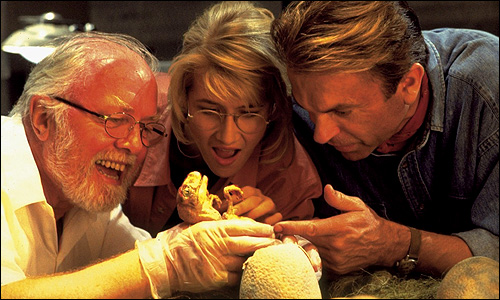
Jurassic Park ranks as one of my all-time favourite films. Not simply for its ground-breaking special effects (I remember driving home from the cinema nervously checking my rear view mirror for glimpses of the spitting one with the collar sitting on the backseat), its evocative score by John Williams, its universal appeal with classic cinematic moments of suspense, scenes of comedy, horror, pathos and schmultz in equal measure, the anthropomorphism of the dinosaurs (remember the raptor impatiently tapping her claws in the denouement kitchen scene), but just as importantly because it has always struck me as being something of an allegory of our times.

I’ll elaborate shortly, but the analogy of Jurassic Park seems particularly fitting in relation to this topic, because no doubt, to some, my musings will provoke outrage and I will indeed be compared to something out of the Jurassic or Cretaceous era, a fossil or a dinosaur with no relevance in today’s modern and enlightened society. I am already anticipating the inevitable outrage this post will undoubtedly attract.

I’ll never forget the part in the laboratory or hatchery, when having overcome his initial scepticism, and overcome by wonderment and awe at this incredible and fantastic world that has been created, Dr Grant watches a baby dinosaur hatch. His reaction is one of fascination at the miracle he sees unfolding before him through the genius of science, and as he tenderly holds the newborn creature in the palm of his hand, he enquires as to the species of the hatchling.  His response to the information: “You’re breeding RAPTORS?!”. The look of terror on his face tells a story all of its own, the potential for uncontrollable devastation has been unleashed.

Sometimes I feel like I’ve been catapulted through the cinema screen onto Isla Nublar, into a world where chaos and destruction brought about by mankind’s hubris reign. Like Dr Grant I watch the scientific developments unfolding all around me with both admiration and trepidation and an increasing sense of innate unease, wanting to cry out, to call a halt;  yet my voice is impotent, it is too late, the clock may not be turned back, and mine is anyway a solitary voice, my discomfort drowned out by cries of derision because I cannot accept, condone and embrace how man has been able to overcome the laws of nature and taken on the role of creator.

This week we have seen yet another celebrity surrogacy, with Nicole Kidman and Keith Urban having paid a surrogate to carry a child for them, with most of the mainstream media cooing over the new arrival and documenting Nicole’s ongoing battle to conceive and miscarriages in some detail. The general consensus of opinion seems to be how wonderful, there is much less condemnation than there was of Elton John, by virtue of the age of the couple, their less prolific celebrity status and the fact they are a heterosexual couple. None of these factors have any impact on my overriding impression that this is still a fundamentally flawed and potentially terrifying arrangement. I have no doubt that the couple will make great parents, it was the use of the phrase “gestational carrier”  used by the couple to thank the parent that caused me to shudder, the phrase being carefully chosen to refute any suggestion of motherhood, in order that Ms Kidman may stake her biological claim upon the child.

It cannot be right to pay women for the use of their womb, to put them through a procedure which entails considerable physical stress and risk, one which will have a life-long impact upon them. All this does is reduce a woman down to her reproductive capacity, treating her as some kind of object, in the same way that most women are objectivised in the sex industry. There is no legal transplant market in the UK, for the very same reasons. It does not matter that a potential recipient may be extremely deserving of an organ, the practice of paying someone to provide or donate an organ is rightly outlawed in order to prevent exploitation. Some people may see no harm in paying a donor huge sums of money to provide a body part, but the fact is, that the donor would only do this in a free market for a considerable fee, given that the donation would severely physically compromise them. A surrogate will undoubtedly physically compromise herself in the process of surrogacy. She may well be motivated by altruism and certainly the UK laws on surrogacy exist to prevent exploitation, but nonetheless, whether intended or not, exploitation is what surrogacy amounts to, never more so when it involves a mother carrying a child that is not genetically hers. The problem is already particularly rife in countries like India whereby women are coerced into surrogacy and paid an absolute pittance to carry and painfully deliver a child which they must then relinquish, due to economic necessity and the demands of the free market. Even in the UK where we have laws to prevent this, heart-breaking cases such as this one arise, when a woman cannot bring herself to part with her baby.

To me, nothing is more heartbreaking than a woman being legally required to give up a child that she has cherished and nurtured in her womb and brought into the world. Some women do this voluntarily, however the vast majority are enticed by the financial gain. The fact that this is not an act that most women are prepared to undergo is borne out by the fact that there is a much greater demand for surrogacy in the UK, than there are surrogates. It is argued that updating the laws will redress the balance, but in reality all this will do is encourage more women to use their bodies for the benefit of others, particularly in these times of economic hardship. Many commentators such as the Fawcett Society are keen to point out how women seem to be disproportionately affected by the cuts, agreeing to be a surrogate could be a financial lifeline for many.

Many people have argued, where is the harm, how is this hurting anyone? Well, apart from exploitation, for every live baby born via IVF,  7-10 embryos are destroyed. This is clearly problematic for anyone who believes that life begins at conception. A zygote or an embryo is no less alive than any living person. That’s an incredible amount of destruction of human life. The desire for genetic offspring of one’s own, does an inordinate amount of harm to those children languishing in care homes in desperate need of loving families. The demand for babies is making it increasingly difficult to find loving families for children barely out of toddlerhood. The introduction of a third party into the process of reproduction also overrides the rights of a child to be carried in the womb by its biological mother.

So what does this matter to me, why am I concerned with the lives of celebrities, why can’t I “live and let live”? The reason being is that what celebrities do undoubtedly sets a trend and paves the road for us normal folk. Does that sound far-fetched? Well apparently Eastenders, renowned for tackling hard-hitting social issues and dramas that affect real-life people is planning a controversial surrogacy story-line, which yes, shock horror, involves its two gay characters. More importantly Tony and Barrie Drewitt-Barlow, the first gay couple to use surrogacy in the UK, are to open the UK’s first centre to advise and guide same-sex couples through the surrogacy process. They want to match couples from Europe with surrogates and egg donors in the US, and have a centre in California (where Elton adopted) to help with this stated aim. Referring to the Elton John adoption Barrie Drewitt-Barlow said: ‘It’s positive news for gay parenting. The more high-profile the people using surrogacy to start their families, the more mainstream it becomes’. Proof that what celebrities do, has a direct impact on everyday society.

See there I go again, can’t resist bringing gay people into it, I hear them cry. Nothing to do with homophobia or hatred, simply to deny a child its biological mother is deeply immoral and denies the rights of that child to its biological mother and father. It’s strange, as I write this, I can almost sense the sharp intakes of breath, the palpable outrage, this is homophobia at its height, see look, she’s at it again, somebody do something, call the police, lets out this evil woman and her hateful rantings of course two gay men have as much right to a child as anybody else, but here’s the thing, NOBODY has a right to a child, no-one. A child, is a blessing, a gift, a privilege, not a commodity to be bought and sold to satisfy what is essentially a selfish desire to experience parenthood, without so much of a hint to the rights of a child to an identity, knowledge of its mother and father or its biological family tree. All of us have an innate desire to identify ourselves within the world around us, a longing to put ourselves into historical and biological context, an innate yearning to know who our birth parents are. A child might well feel that it was loved and wanted so much that two people paid a lot of money and went to a lot of trouble to ensure that it was created, but equally that might put a lot of pressure on the child in terms of living up to expectations and there is a more than a slight possibly that the child will grow up longing for the presence of the absent father or mother. To complicate a child’s identity by separating genetic parenthood from the gestation and raising of the child raises serious ethical concerns.

And for those who counter the idea that surrogacy whether heterosexual or homosexual has anything to do with commercialism, here are the words of Barrie Drewitt-Barlow:  

It’s aim is to bring together intended parents with egg donors and surrogates, along with donors, and offer legal advice from qualified legal professionals. I will be responsible for the assessment of intended patients and the assessments of potential egg donors and surrogates, and for helping with all legal documentation to allow each couple to bring home their baby to the UK’.

All of this comes gratis does it? No exchange of money whatsoever? All donors motivated purely by altruism? Where does it stop, will a woman who is phobic of pregnancy and childbirth have a right to pay someone else to go through the entire business for her? We have opened a Pandora’s Box of ethical dilemmas. Nightmare horrific sci-fi scenarios have become the reality, with surrogates ordered to undergo abortions and one case in Los Angeles which had an unbelievable 5 would-be parents vying for custody of a child. It seems that we are living in a world turned entirely on its head, which on the one hand sanctions the mass murder of an entire generation of unborn, with over 200,000 lives lost to abortion in the UK every year alone, and yet on the other hand, is spending huge amounts of money on technology to create babies in a laboratory which has a high rate of failure (70-80%).

Of course, given that I “fall pregnant at the merest hint of sperm” and “live in a fertile ivory” tower, absolutely invalidates any right I have to comment, according to my detractors. Because I have not directly experienced the pain, anguish and longing of infertility I am unable to comment and to describe surrogacy as a commercial arrangement is deeply offensive and hurtful to those who might wish to enter into these arrangements. As indeed it is allegedly “hurtful to question the morality of a medical procedure”!!

Just because the technology is available, it does not mean that we need to avail ourselves of it. We have the technology to annihilate entire continents thanks to the technology of nuclear weapons. Do we have a right to avail ourselves of it, simply because it exists? In previous ages, women had no other option other than to accept the cruel lot that nature had dealt them, and often managed to fulfil their motherly vocation in other ways. I can’t begin to image how it must feel to be infertile and I cannot tell women how they should manage their pain, nor can I condemn people for wanting to go to extraordinary lengths to fulfil their dreams, however I can question whether or not this is good for society as a whole.

To go back to Jurassic Park, no-one doubted that the intentions of  John Hammond, the park owner portrayed so brilliantly by Richard Attenborough were anything but benign. Admittedly, like mankind he displayed a staggering amount of hubris, but he wanted to share the wonders of modern science with the world, to encourage discovery, exploration and learning, not cause chaos and devastation. Though his intentions were laudable there were plenty of others willing to exploit the technology for their own personal gain. What he learnt was that you tamper with nature at your peril. He was guilty of nothing but naivety.

In the words of Jeff Goldblum “Too busy thinking about whether or not they could, to think about whether or not they should“…

Riddle me this

Why is it unacceptable for Peter and Hazelmary Bull to deny a double room to any couple on the grounds of their marital status, but perfectly acceptable for the clubs G.A.Y. and Heaven to refuse entry to women on the grounds that they “look too straight”?

The answer is that the Bull’s B&B will automatically fall foul of the Equality Act because they refuse to treat civil partnerships in the same way as marriage.

In many ways it is a shame that this case was brought to court, given that the couple were clearly in breach of the law and were doomed to failure from the outset, although it has brought the bigots out in force.

“We know people have deeply held ‘beliefs’ about homosexuality. That’s why we need legislation” screamed one. Orwell himself could not have written a better line about thought crime. We know that people will hold beliefs entirely separate to ours, therefore we need legislation to stop them from acting upon their morals? The function of legislation is to stop people from exercising their own free will?

Though no lawyer, it seems that the question of harm needs to come into play here. What harm is there from the proprietor of any business deciding who they may admit on their premises? It needs to be noted that the Bulls were not, in any event attempting to deny the use of their services to this couple, they were not denying them entry to the B&B, what they were doing was refusing them the use of a double room, in line with their policy. Had two separate rooms been available, then Mr Hall & Mr Preddy would have been perfectly welcome to avail themselves of the hospitality on offer. On an individual level the only “harm” caused to the couple, was that of hurt feelings and thus £1,800 apiece seems a disproportionate amount of compensation. A more realistic and just figure would have been a couple of hundred pounds between the couple to compensate them for the expenses incurred in having to arrange travel to a different hotel and the costs of a hotel room.

There is of course inherent harm in a society that wishes to negatively discriminate against people on the grounds of sexuality, race, gender or creed and no-0ne wishes to see a return to the days of hotels displaying signs stating “no Irish, no blacks” etc and thus it is important that legislation remains in place. It’s all about finding the middle ground, but this ruling does highlight the inconsistency in the law. A premises may withhold entry on the grounds on sexuality, as has happened to me in the past when out with members of gay cabin crew. I completely understand that like-minded people wish to have an environment in which they may relax and socialise without the threat of intimidation, which is why various establishments reserve the right to deny entry.

What I don’t understand is why a couple, who have a deeply-held and rational belief are penalised for running an establishment on the grounds of religion, yet another establishment is able to run their establishment on the grounds of sexuality? Why is one acceptable and not the other? Why could this couple not run their B&B according to their faith principles? Because it unfairly excluded a section of society? Could not the same principle be applied to high-profile nightclubs who refuse entry on the grounds of appearance, thus denying, as happened to me, the chance to see a certain performer? (Yes, I admit, to my everlasting embarrassment, I was attempting to see Kylie Minogue).

As a Christian I loathe the current narrative of persecution as it denigrates the suffering of those who have genuinely suffered the most horrific and abhorrent persecution, being a Christian does not entail gruesome torture and death, such as in the days of the Emperor Nero when Christians were covered in tar and pitch, crucified and set alight as human torches, through which the Emperor would stage nighttime chariot races. Nor do we face a holocaust like the one that decimated the lives of at least 6 million Jews in the middle of the twentieth century. To invite such comparisons invites justifiable ridicule and does nothing to advance the debate.

What the judgement does highlight is both the bigotry of others towards Christian beliefs, with tweeters triumphantly awarding the Bulls obscene awards amounting to “idiot of the year” couched in extremely offensive language, as well as the fact that to be a Christian is counter-cultural. Though this is to be expected, holding a counter-cultural viewpoint should not demand legislation.

The judge noted that the ruling “does affect the human rights of the defendants to manifest their religion and forces them to act in a manner contrary to their deeply and genuinely held beliefs.” and sensibly gave them leave to appeal.

This is the heart of the matter. How do we manage to balance conflicting interests in a fair and just society? How do we ensure that neither side is unfairly treated or marginalised?

It seems apparent that this particular case was a stitch-up job. The homosexual couple deliberately sought out this hotel and were determined to find offence and prove their point. It is unfortunate that due to illness on the day of the booking, the question about the couple’s marital status, which is normally pointed out to guests, was omitted. One does also have to question whether or not calling the police when one is refused entry to a premises is an instinctive or premeditated reaction?

The UK is renowned for its tolerance and diversity. We now have to ask ourselves some uncomfortable and searching questions about our identity. Are we prepared to live in a society which disbars people from entering certain professions or going into business by nature of their religious beliefs? Do we want legislation to prevent any discrimination whatsoever taking place? If so, then surely we need to make the existing legislation more consistent?

Is all discrimination bad and to be outlawed in the name of equality? Or is some discrimination better than others?

Unpicking Stanford

Peter Stanford needs to be congratulated on one of the most outstanding factually incorrect pieces of journalism regarding today’s ordination to the Catholic priesthood of the three former Anglican Bishops.

He starts as he means to go on:

“…fewer stranger sights…three Anglican bishops’ wives, in matching beige coats, one with an outsized brown hat…”

Saucer of milk, table for one Peter. Considering that he critiques the Catholic Church as being “not that keen on women”,  do I note a rather hypocritical attitude in bitchily analysing the attire of the wives? I don’t quite see what the colour of the coats or the size of the hats has to do with anything. Still lets put these upstart wives in their place.

“to the pain of the demonstrators from the Catholic Women’s Ordination movement protesting outside the cathedral’s doors”

What all two of them valiently clutching their banner? To be fair though there were also apparently two demonstrators from the Society of Saint Pius X, so lets make that a grand total of four. Jeffrey Steele was spot on earlier when he wryly observed that the tiny smattering of protesters would no doubt form the basis of at least one of the major media organisations’ coverage.

“It is the Vatican’s negative attitude to women’s ministry that formed the backdrop to the whole affair.”

Unsure where on earth to begin with this, other than, as Peter Stanford will be more than well aware, this is not about the ministry of women but fidelity to the catholic teaching which formed the ordinariate. The ordination of women, is one particular presenting issue, but to try and reduce the ordinariate and the Anglo-Catholic movement to be purely about the issue of women’s ministry is ignorant baloney. As a point of fact Andrew Burnham, one of the bishops ordained today, was very supportive of womens’ ministry in general, he did much to explore the issue of ordaining women to the diaconate within the Church of England. There was nothing about wanting a “female-free haven”, this was about accepting the truth of the Catholic faith, these men would not have converted if this was simply about the ordination of women, otherwise where are the 1333 Anglican clergy who signed the letter to the Archbishop of Canterbury in 2008 threatening to resign if women were elected to the episcopate with no safeguards? Surely if the Ordinariate was all about the issue of women clergy, these clergy would be signing up in droves? The fact that they haven’t indicates that this is not about the ordination of women. To claim otherwise is reductivist.

Stanford goes on to describe the Ordinariate as a place “where the normal rules of Catholicism don’t apply”. Sorry? Which rules are they Peter? The man has gone off his rocker. All members of the Ordinariate will have to abide by the catechism, like every other faithful Catholic. The fact that they have been admitted into the Catholic Church proves that they have accepted Catholic doctrine. There is no secret “oh well I don’t really have to agree with that part” clause, or implicit understanding that they can preach their own particular version of Catholicism. Yes, the Ordinariate will consist of a married priesthood, which is unusual, but there are rites within the Catholic Church in which it is possible to be married prior to ordination, as Peter Stanford will undoubtedly be aware. Allowing the use of Anglican patrimony for a separate rite, is not breaking any implicit rules. There are many rites within Catholicism, Roman being the most populous, and each rite will use its own patrimony whilst still coming under the jurisdiction of the Pope. What the Ordinariate has done, is to create a separate rite within the Roman Catholic Church.

The inaccuracies come thick and fast.

“In the space of 14 days, they have completed a journey that usually takes other converts seven years: 12 months to go through the Rite of Christian Initiation of Adults to become a Catholic, and six years in a seminary.”

Yet more drivel. Priest converts are not required to undertake RCIA. Some do, for others it is not deemed necessary for example,  the case of my husband, who has a Masters in Catholic Theology from Heythrop, although he did receive some personal instruction and it was ensured that he had read and understood the Catechism. In any event RCIA was not really meant for converts from other Christian denominations. It was designed for those who have not already been baptised or had any prior Christian formation. As for six years in seminary, again more imaginings. Each candidate is different, but obviously Anglican priests already have considerable knowledge, formation and experience and thus six years is not the norm, the average seems to be about 2-3 years. Anglican priest converts are not starting at the same position as say a young man of 21.

Stanford concludes that the Ordinariate was “a takeover not a merger”. Given that the Ordinariate was established as a direct result of supplication by various groups within the Anglican Church to the Vatican to create a structure that would make it possible for many of them to come home, I can hardly see how this could be likened to an aggressive takeover. Moreover no-one is compelled to join the Ordinariate, it is a benign invitation, not a legally binding order.

“When it was first announced, Nichols assured me in an interview that the biggest take-up was likely to be among unhappy Anglicans in the US and Australia, yet here we are in London.”

This may well prove to be the case, the Ordinariate may have begun in London, but we don’t yet know what the uptake is likely to be in Australia or the US, demographically speaking it is more than likely that these countries will have more members than in the UK. Does it matter whether they do or they don’t? It’s interesting that Stanford uses the word “assured”. Clearly he is frightened by the Ordinariate and sees it as something of a threat. Dare I suggest that he is terrified of an influx of  hordes of traditional-minded  properly -catechised Catholics undermining a liberal agenda?

The only puzzling thing about yesterday is why a Catholic would not wish to whole-heartedly welcome home his brethren in Christ and to lend his support to the extension of the Catholic Church in the UK.