Report from Msgr Reilly to all pro-lifers

Here is the official statement from Monsignor Philip Reilly, Director of Helpers of God’s Precious Infants. Let’s pray for similar in the UK.

OB/GYN Pavilion at the Ambulatory Surgery Center of Brooklyn has been a Center for abortions since June of 1971. It was the oldest and largest abortion clinic in New York City and for many years, in the United States, where I believe more than a quarter of a million unborn children lost their lives.
I use the verb was rather than is, since the abortion clinic was closed on Sept. 1st 2012. Obviously the pro-lifers are happy and the unborn babies are happy but so also are the owners of the abortion Center. Why are the owners happy?

The Helpers are present in prayer outside of abortion clinics not simply to save babies but to save souls. Indeed the Helpers are present not simply to witness the truth but to convert people to the truth and to change hearts. After so many years of good lay people, religious, priests and Bishops praying and fasting outside of Ambulatory Abortion clinic; after so many years of dedicated laypeople offering help by sidewalk counseling to the pregnant women entering the clinic, the Lord has granted a complete victory.

On Monday September 17th the same building will reopen under the same ownership but as the New York Center for Specialty Surgery where only true healing will take place. In this building there will be absolutely no more abortions, abortifacient contraceptives, morning after pills, RU486 etc. performed or distributed. The old owners change of heart is real and complete and all the new doctors are real doctors who will not do an abortion procedure. Praise God.

PSALM 115

Non nobis, Domine, non nobis
Sed nomini tuo da gloriam

Not to us, O Lord, not to us
but to thy Name give glory

That’s the way to do it

This is why the abortion industry doesn’t like 40 days for life or abortion clinic protests. There is evidence that they actually work.

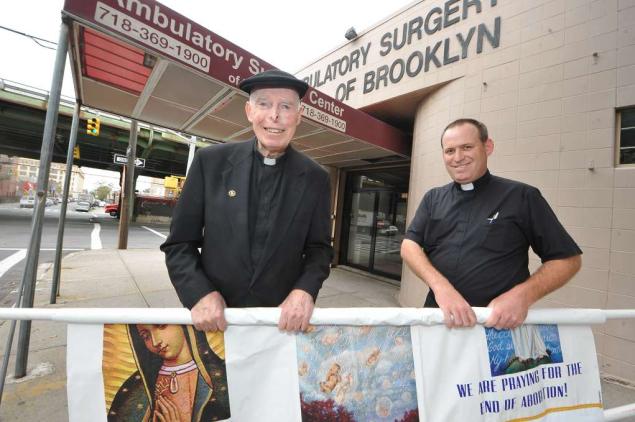
Msgr Philip J. Reilly, executive director of Helpers Of God’s Precious Infants, (left), and Father Kevin Sweeney at the Ambulatory Surgery Center of Brooklyn.
Abusive protestors?

According to this report in the New York Daily News, Sunset Park Abortion clinic has shut down and it’s all the fault of those pesky Catholics praying. The Ambulatory Specialty Surgery Center of Brooklyn on 43rd St., closed earlier this month and will reopen in October as a new medical center providing outpatient surgeries, but not abortion.

It’s interesting that pro-choicers are spinning this closure as being due to the pressure and harassment faced by those conducting clinic vigils and yet it seems odd that no legal action was taken if there was some sort of public order nuisance, threat to security or individuals.

Though we cannot downplay the importance of prayer and reparation here, I think more telling is the statement of Terry Lazar, the clinic owner who states that had the clinic attempted to continue to provide abortions, they would have “gone out of business”. Not language one would expect to hear in the UK, where pro-choicers decry the allegation that BPAS and MSI may be in the game for anything other than purely altruistic motives, whereas here the motives are clear – the abortion clinic existed to make money and provide jobs.

Now that the clinic is closing down its abortion facilities, all of a sudden they are inundated with new staff, twenty doctors have expressed interest in working there, whereas a month ago, they were struggling to recruit employees. I suspect that the decision to change direction has as much to do with economic reasons as it does the vigils, although there can be no doubt that they play a part. The vigils have no right to obstruct the public highways and will not physically be preventing people from getting to work, it’s more likely that their presence has pricked a few consciences, or perhaps that doctors don’t actually want to kill people – strange as that concept might seem!

It seems to be this shortage of doctors that proved the problem, coupled with a lack of customers. The owners can blame the clinic vigils all they like, but its more likely to be a case of simple economics, supply and demand. A rally is planned in support of another abortion clinic in New York, which is also struggling to find doctors and patients.

Even if the vigils are proving something of a deterrent effect, which as the leader of the local chapter for the National Organisation for Women, says is something she’s never previously heard of, then that can be no bad thing. Although is a woman who is so utterly desperate for an abortion, really going to be put off by a group of people displaying their opposition to her choice? Is a woman really going to seek a dangerous and illegal backstreet procedure as opposed to to braving a few allegedly vocal volunteers?

Monsignor Philip Reilly has held a Mass in celebration – I also sincerely hope that there is a Mass said for the souls of the countless babies who have died since this facility was opened.

This is exactly what clinic vigils are all about. Not hassling and harassing women, but praying for the conversions of heart, prayers which seem to be bearing fruit. With no doctors and not enough patients it seems like abortion is becoming a less and less profitable business in the USA. Let’s pray for a similar conversion in the UK. After all, if doctors don’t want to perform abortions and fewer women want to have them, then there seems little point in the clinics continuing to exist.

No wonder the industry is panicking. As one pro-choice activist anxiously tweeted “things are getting serious. Priests are celebrating closures with Mass”. May there be many more.

Feminist dissonance

A new and positive discourse seems to be emerging in Catholic circles, not just in the UK, but also amongst young Catholics in all continents, including the developing world, as to how Catholicism can counter the poisonous and popular narratives of misogyny propagated by the media and white chattering classes, and demonstrate that Catholicism offers an authentic and compelling vision of womanhood, one that offers total freedom, empowerment and is the only way that a woman may fulfil her true potential as a human being, created equal with men in the image of God.

Of concern is the way that a very narrow-minded definition of feminism, one synonymous with the misnomer of bodily autonomy, is now being globally evangelised with all the zeal of a nineteenth century missionary with the same patronising and even misogynistic attitudes, that accompanied the colonisers. If only these women in the developing world knew what was good for them, they would stop having so many children! Leaving the population agenda aside, these attitudes have been disturbingly crystallised by the Melinda Gates foundation, despite the fact that contraception is neither wanted nor needed by women in the developing world, as this open letter by a Nigerian women pleadingly testifies. Those wanting to help the plight of women in developing countries would do much better to actually listen to the voices of women in impoverished countries, rather than condescendingly deciding what is in their best interests – reinforcing and entrenching the disempowerment brought about by poverty.

The illogical, harmful and dissonant values of western feminism and sexual liberation were perfectly encapsulated in this characteristically vulgar pro-choice defence written by the 40 days for choice apologists. I’m going to disseminate it, not only to highlight the incoherence but also to ask, are these really the values that we want to be promoting to our children and exporting across the globe?

I’ve had sex with many different guys – in relationships, as one-night stands, in threesomes and foursomes and twosomes, in beds, on beaches, on trains. I’ve never had an unwanted pregnancy. – sounds like you’ve been very fortunate by all accounts, because the sexual behaviour and lifestyle would fall into the at high risk of pregnancy and/or STDs category. That’s not, to use society’s favourite verboten concept ‘judgemental’ or attacking your morals, it’s a statement of fact.
Thanks to the sterling work of teachers and parents, I’ve been taught about sexual health – great news! So you are well informed that you are participating in risky behaviour, you’ll know the risks of non-exclusive, non romantic and early sexual activity. You’ll know for example that you are at increased risk of cervical cancer, STD-related infertility, antibiotic resistant gonorrhoea and so on, before you’ve even thought about an unplanned child.

Thanks to the men I’ve slept with, I’ve never had to fight to get them to use condoms. – do most men in the Western world refuse to use condoms? Is it a struggle to get men to don prophylactics? Anecdote is not the plural of data, do we have any stats on that? Are we implying that most men are ignorant selfish misogynistic apes who don’t care whether or not they transmit disease or impregnate a woman? If we reverse the genders in that statement and say thanks to the women I’ve slept with I’ve never had to fight to get them to allow me to use condoms, does that not imply that a woman has to take sole responsibility for the consequences of sexual encounters? As does the original statement. It accepts that whatever may or may not result from sexual intercourse, it is always a woman’s responsibility. Doesn’t sound very empowered on in a woman’s favour to me. The men get off scott free!

Or, if it is a struggle to get men to use condoms, whether in the Western world (which I doubt) or more plausibly in the developing world, where there are cultural barriers to condom use, that implies that they are rather ineffective as a method of contraception. There seems little point in flooding developing countries with condoms. If one has to fight to get men to use them, sexual education is clearly not working, especially for men. So Nadine Dorries may actually have a point with her extra SRE targeted at girls then?

Thanks to sheer good luck, I’ve never been raped. – Let’s be charitable and attribute this to clumsy phrasing, but it is nonetheless offensive. Rape victims are undoubtedly victims of circumstance, be that the woman who is raped on the street, the woman who had something slipped in her drink, the wife whose husband has had one too many and refuses to take no for an answer and so on, but this just perpetuating the rape culture myth. Gender violence does undoubtedly exist and is a problem, but it is not the binary concept implied by this term. To state that it is lucky that one has never been raped, following on from a description of high risk sexual behaviour, like it or not implicitly victim blames. Is it due to her behaviour that she’s lucky never to have been raped? Or is it that all men are somehow pre-disposed to rape and she’s just fortunate never to have been a victim? In this context it is at best glib, ill-considered, and typical of the feminist genre.

It’s important to recognise the myriad things that could result in an unplanned pregnancy – the different bases that we have to cover, the balls we have to juggle, (ha unfortunate pun or turn of phrase considering the subject matter)to make sure that sex remains just sex. But most important is the base we just can’t cover – luck.

Best bit of unwitting Catholic sexual apologetics I’ve seen in ages. A tacit admission that sex is not designed to be a mere leisure activity. It is designed to be unitive, to reinforce pair bonding and procreative. Having sex could well result in pregnancy whatever you do. Stripping the emotional intimacy and potential for pregnancy from sex requires mental gymnastics and sophistry, it requires one to attempt to re-programme one’s innate inbuilt emotional responses, to condition oneself not to care about the other or get emotionally involve and it requires at least two methods of contraception or sterilisation to ensure that one doesn’t get pregnant or a disease, and even then it’s not guaranteed.

Wouldn’t a much better solution be a society in which monogamy, chastity and fidelity were valued and desirable concepts to reduce the risks of disease and in which women could be aware of their natural peak times of fertility and together make an informed choice with their partners as to whether or not to take the risk of pregnancy? If its all such a juggling act to keep sex as just sex, shouldn’t that tell us something? Sexual empowerment seems to be much harder work for women than it does men. All those threesomes, foursomes and one night stands are worth pumping one’s body full of huge doses of synthetic hormones, risking one’s long-term health and the killing of an unborn child?

Pregnancies are not solely caused by your own decisions. – yes they are. A woman who doesn’t have sex is not going to get pregnant.

As women who are desperately trying to get pregnant can tell you, one of the key deciding factors is luck. – yes, there is undoubtedly an element of circumstance when one is trying to achieve pregnancy, there are a myriad of measures one can take to attempt to maximise one’s chances of pregnancy, but there is nothing that one can do to guarantee that one becomes pregnant. There is however, something that one can do to mitigate the chances of not becoming pregnant. If you have sex and you are fertile then engaging in sex is something of a gamble, admittedly with measured risks. As the writer goes on to say: Can we beat the odds?

And so, what can we do when something as essential as sex is risky enough to make or break people’s lives? – so sex is essential now is it? We live in a culture whereby sex is essential? What happens if people don’t have sex? Do they turn into this?

No-one has ever died from not having sex. Sex is essential on a macro level for the promulgation of humankind, but not a micro level. Sex is pleasurable, feels good and is certainly important in terms of increasing intimacy in a committed relationship, but it’s not essential in terms of life or death or even overall well being, unless the writer is claiming that the significant proportion of the population who are not having sex are somehow deficient either emotionally or physically.

As for make or break, if sex really does have the ability to ruin one’s life, then abstinence sounds like the most advisable option. The idea that sex can totally transform one’s life for the better is delusional. The best sex is not merely physical but requires a level of mutual intimacy, love and trust. A relationship where sex does not constitute a stressful plate spinning act but a mutual and consensual outpouring of love.

For as long as we walk the planet we’ll be having sex. And as long as we’re having sex there will be unwanted pregnancies. As long as humankind exists, it will continue to have sex and there will always be unplanned or even unwanted pregnancies, no-one is disputing that, least of all me.

The lucky ones will avoid them, the unlucky ones won’t, but right now we’re lucky enough to have a safety net. Let’s keep it that way. – a new euphemism. Abortion is a ‘safety net’ – destroying an unborn child is a safety net when all other attempts to avoid pregnancy have failed. If the safety net is required, one needs to ask oneself why. Ultimately we need to have a safety net so that we can indulge our own selfish pleasures. A safety net implies that it is a method of last resort, there is no other option available. That means that women who are in poverty, who have been raped, who are in all kinds of reduced, straightened or desperate circumstances need a safety net as they have no other choice other than to abort their children. That’s not a status quo worth keeping and we should fight for change, otherwise we accept and promote injustice. And in all of this, where is the humanity of the unborn child? Its cloaked in euphemisms of safety nets and choices. Being killed before you have a chance to live does not sound like much of a safety net or choice to me.

According to this typical feminist perspective, being a woman is all about being a fatalist, a victim, the weaker sex. That isn’t something that chimes with my experience nor is a central principle of the pioneers of feminism, who recognised that women were equally strong, resourceful and powerful as men, but in different ways.

The early feminists fought for equality of opportunity – for women to have access to the same level of education, the same rights in the workplace, the rights to access the same choices as men. It was only through education could women begin to be on an equal playing field and enjoy equal status in society to men. That is why every woman is at heart a feminist, we don’t see ourselves as lesser beings or worthy of less opportunities.

But not every woman wants to identify as a feminist, in that some of us, I would argue most of us, do not see man as the enemy, the potential rapist of the typical feminist tropes. Our fathers, brothers, husbands and sons deserve better than being pathologised as potential rapists and aggressors. They also deserve better, as do we as women, than the sexual objectification of both genders that takes place in today’s society as a result of the libertine attitudes that prevail and dominate the sexual discourse. Sex can never be free of responsibility, this is an unobtainable Utopian ideal.

If sex cannot come without consequences, then the responsibility should always be mutual. To frame the issue as women’s bodily autonomy, (aside from the fact that bodily autonomy does not exist, a doctor won’t just cut one’s arm off because one asks him to) absolves the men from any responsibility for sex and leaves women co-opting with their own oppression. Lack of fidelity and monogamy exposes primarily women and children to poverty and exploitation and turns both genders into sex objects – simply means to require objective ends.

Francis Philips recently wondered whether or not the term feminism carried too much baggage amidst efforts to reclaim it. I think she’s right. I am leaning towards womanism, coined by the author Alice Walker, which has none of the negative connotations of white middle class feminism. Ultimately we have to recognise that women will always have different bodily functions and responsibilities to men. Men cannot bear children, nor can they breastfeed newborn babies. If we want a woman and child-friendly society, one that does not treat women as inferior, one that does not abandon them or their children to a live of poverty and deprivation, a society that acknowledges the dignity and contribution of all women to society, not just in our role of mothers, then we need the active support, co-operation and collaboration of men.

As a Catholic woman I want the same for my four daughters as for myself; access to equal education and the confidence that they can achieve whatever goals they set their minds to. I want them to take responsibility for their own fertility and bodies and I expect them to enjoy equal civil rights under the law. I want them to face every single challenge and setback that life may throw at them with confidence and grace; that they keep going in faith, hope and trust, no matter how difficult the odds.

What I don’t want is to raise weak women, who blame men for everything and who place themselves at the mercy of some fatalistic victim culture, or to expect special treatment or favours as a result of their gender thereby perpetuating a different form of inequality.

Whilst feminism continues in this vein of self-pitying victimhood and encouraging hatred of men, our companions in humanity, then strong women, who want to fight for a better future for all those struggling from oppression, should have nothing to do with it.

One in three

On the subject of imports from the abortion industry, I see the US has now picked up the rhetoric of the soft marketing messages used by the UK abortion clinics and sex education providers. The Guttmacher Institute, funded by Planned Parenthood , the US’s largest abortion provider, has launched a new 1 in 3 campaign, stating that 1 in 3 women will obtain an abortion before the age of 45. Sound familiar?

As the Right to Know campaign pointed out last year, this ‘statistic’ is trotted out time and time again, in order to validate abortion as an option. The best-selling academic and author, Dr Robert Cialdini, Professor of Psychology at Arizona State university, describes ‘social proof’ as being one of the six key principles of persuasion. People are more willing to take a certain or recommended course of action if they see evidence of others doing it, particularly if they perceive those others as being similar to themselves. So it’s highly likely that a woman considering abortion could well be persuaded by the ‘evidence’ of other women. Social proof is most influential if someone is undecided as to a particular behaviour, they look to what other people are doing and observe that as correct. A technique which is doubly effective if they identify with the other subjects in some way.

So it’s highly likely that a young person who is yet undecided as to the issue of abortion, will encounter this message on an Education for Choice website and be convinced – if one in three women are having an abortion, then it must be not only necessary, but also perfectly acceptable, surely? The same goes for a woman with an unplanned pregnancy in an ambiguous situation who is unsure of what to do. The fact that 1 in 3 women allegedly have an abortion is only there to influence her decision. Surely what other people do should be of no relevance, in terms of her own personal situation? If pro-choice is all about doing what is right for that individual woman in her particular circumstances, what does it matter what other people have done?

There is no reason to include that statistic other than to attempt to influence opinion. Still it’s very sneaky indeed. Simcha Fischer from the National Catholic Register gives some insight as to who these one in three women are.

Robyn Reed is one of the one in three. When she tried to escape from the abortion clinic where her family had dragged her, the abortionist tore off her clothes, hit her, tied her to a bed, aborted her child, and drugged her so heavily that she was unconscious for twelve hours. Reed was fifteen years old at the time. She is one of the one in three women in America who obtains an abortion.

This mother is one of the one in three. When doctors told her she would die if she didn’t abort, she refused and refused, but finally agreed to be induced early, on the condition that they would try to save her baby’s life. She delivered a son, and no one made any effort to help him. He died in her arms. Later, she discovered that he was healthy, and that she had never been at risk. She is one of the three women in America who obtains an abortion.

Here are notarized affidavits from women who were pressured into having abortions. Each of these women is one of the one in three women in America who obtains an abortion.

Here are hundreds of pages of written testimony from women who were forced or coerced into abortions. Each of these women is one of the one in three women in America who obtains an abortion.

Here and here and here are hundreds of accounts written by women who had an abortion and regret it. Over and over again, they use the phrase, “I felt like I didn’t have a choice.” Each one of these women is one of the one in three women in America who obtains an abortion. They are part of the one in three.

These are the women the Guttmacher Institute is counting when they used numbers to make the claim that women want and need abortion.

This is what the “1 in 3” Campaign seeks to normalize: pain, regret, coercion, violence, despair. It is a campaign to make women understand that abortion is normal, abortion is their fate — that they have no choice.

Personally I’d like to see the stats behind one in three. Is it really one in every three women who have had an abortion before the age of 45? How has this figure been worked out? The ONS doesn’t routinely give out statistics regarding first time and repeat abortions unless one submits a Freedom of Information request, so how can we vouch for the veracity of the figure. Is this just the number of abortions averaged out between the number of childbearing women in the UK. According to this American campaign 22% of pregnancies end in abortion, but 1 in 3 women will have one. It seems that they have done a straight averaging job here, which means women who have had repeat abortions will skew the statistics, as will women who have never fallen pregnant. I’d love to see the raw data.

Even if the figure is true, what does that say about our society? One in three women are in such desperate and dire circumstances that they have no other choice than to abort their unborn baby? Or is it that contraception fails one in three women? Whatever the answer, it’s certainly not something that anyone should be treating with a healthy dose of pragmatism, unless of course we really do live in the culture of death.

Smart Loving – reigniting the spark

My attention was drawn to the Smart Loving website in a letter by Edmund Adamus, director of Marriage and Family Life for Westminster Diocese, in this week’s Catholic Herald.

I’ve just spent some time scouting round the website which looks to be an excellent resource for single, engaged and married Catholics and Christians, whether in a relationship, looking for romance or simply wanting to reignite the spark.

Discover your unique love profile or take the quiz to discover whether your relationship needs some work to love smarter. There is also some useful information regarding spirituality and a
guide to getting started if you do not already pray as a couple and eight steps to deeper couple prayer. I cannot recommend strongly enough the benefits of praying as a couple as a way of increasing and deepening intimacy. I think many couples, especially when embarking on a relationship feel very self conscious at the idea of praying with one’s boyfriend or girlfriend, especially if the relationship doesn’t work out, or they are worried that the idea might put the other person off, but what can be more natural than wanting to help each other and walk together in one’s journey of faith and quest for holiness? To help each other deepen one’s eternal and everlasting relationship that extends beyond the mere earthly plain.

There is also a smart loving marriage seminar taking place in London, the weekend of 24 November, to enrich and empower married couples, commencing with Mass, opportunities for confession and including input from Theology of the Body.

Definitely worth attending, providing one can get babysitters!

Coming from America

Predictably enough, the pro-choice lobby has moved up a gear in response to 40daysforlife, despite the fact that no actual changes in the law are being mooted or lobbied for, with a glut of the usual rhetoric appearing on a daily basis on the internet, therefore this blog will take on even more of a pro-life bent until the end of the campaign, as much misinformation abounds.

A rather slick new website that appears to be supported by and it would seem, an initiative of the “charity” Education for Choice has sprung up. * (see note). It’s worth noting that Education for Choice masquerades as that Holy Grail of “evidenced based” information, whereas it is obvious from their website, that they are in fact all about promoting abortion. Given that they’ve managed to totally misrepresent the Roman Catholic position on abortion, falsely claiming that the Church used to accept abortion until quickening – it doesn’t inspire much confidence as to the impartial nature of the rest of their information. In any event, Education for Choice, is a wholly owned subsidiary of Brook Advisory, the “charity”, concerned with providing with sexual health advice and services. It can’t be any surprise that they are opposing anything that might present a challenge to the status quo on abortion, but it makes their false claims of 40DaysforLife being a professional political organisation, awash with cash, rather hypocritical.

The professional writer, journalist and pro-choice advocate, Sarah Ditum launches the site, with this post, riddled with inaccuracies. Ditum starts off by describing 40 Days for Life’s American roots, the standard trope de jour when talking about this issue. The point being that abortion is much more of a political hot potato in the US, than it is in the UK. This has nothing to do with clinic vigils and everything to do with the political and religious demographics of the US. Abortion should be an apolitical issue, one doesn’t need to have a tribal allegiance to either left or right wing parties to believe that the taking of an unborn human life is wrong. The pro-choicers who bemoan this, were the very ones who politicised the issue in 1967 and 1973 when campaigning for its legalisation. Those who point to America as being some sort of big bad bogeyman in terms of the abortion issue would presumably reject any of the tactics used by their pro-choice lobby, such as the setting up of a research institute funded by their biggest abortion provider?

The association with the US is repeated time and time again, to draw false analogies between the American bible-belt and the UK population. It’s a not-so subtle form of racism and superiority. Anyone who supports clinic vigils must be some kind of bible-thumping irrational redneck, is the implication. Not to mention the deliberate attempt to install fear, because in the last 40 years, eight abortion clinic workers have been killed in American since Roe v Wade, equating to two tenths of a person per year. That’s not to downplay the abortion related violence that has taken place, but the overwhelming majority of pro-life absolutely abhor all violence and killing, which is precisely the sentiment that motivates the vigils. Eight murders is 8 too many, but in a vastly populated country which has the right to bear arms enshrined in its constitution, it is likely that there will be unbalanced individuals who will take matters into their own hands, regardless of the cause. It does not automatically follow that this is likely to happen in the UK.

As anyone who attended the 40 days for Life kick-off rally on Tuesday night will attest, actually the fanatical aggression came from those on the pro-choice side, who spent a full hour ranting, chanting insults, blasphemy and screaming vile obscenities when faced with a group of people praying the rosary. The more they were ignored, the most venomous and offensive they became, the priest being a particular target of their hatred. A pro-life pagan gives her account of what happened here. As this report states, fanatical extremist violence seems to feature far more heavily from the pro-choice brigade; in America a loaded gun was pointed at the 40 days for life volunteers by an abortionist, at another location an abortion supporter tossed a homemade firebomb at them and recently we saw the attempted murder and mass shooting, averted by the bravery of a security guard at the Family Research centre in Washington DC. If American style tactics are taking place, then it would seem that it is actually the pro-lifers who are bravely putting themselves on the line in defence of the unborn.

A UK “pro-lifer” has added fuel to the fire by giving Ditum the “benefit” of their wisdom. Referring to a one-off incident where it is alleged that a volunteer filmed women entering the clinic, (he was supposedly filming for a documentary) something that 40 Days for Life does not condone and behaviour which will result in the volunteer being immediately asked to leave the vigil, said pro-lifer opined “what starts with a camera could end with a gun”. I cannot begin to dissect the motivation of someone who seeks to paint their alleged brethren in Christ who stand in silent prayerful solidarity with the unborn as crazed loonies with the potential to kill people, it’s not the kind of actions one might associate with Elizabeth Anscombe, Edith Stein or even Phyllis Bowman, but it goes without saying, that regrettable though that alleged incident was, it is not indicative of a desire to kill or even intimidate anyone and neither is it representative of the volunteers. Just as one cannot castigate the political LGBT lobby groups for the actions of an isolated gunman, anyone with a modicum of common sense can tell the difference between an over-enthusiastic cameraman and a gunman. Or are we saying that quiet prayer vigils should not occur in public places because no-one may be trusted to behave appropriately? Whilst we are on the subject of cameras however, what have BPAS got to say about the camera that they have constantly trained on the volunteers from the confines of their upstairs window? Could that end up as a gun also?

Ditum continues with her theme of intimidation and harassment despite the fact that no-one from 40 days for Life in the UK has been arrested, charged or even asked to move on by the police. Surely if women were being followed, encircled and generally harassed, there would be some evidence of this made public as well as criminal charges? A quick google maps search will throw up the location of the vigils – over the road on a public square, a good 50 yards from the clinic door. Women entering the clinic do not need to even walk ok the same side of the road as the vigil or past it. I don’t doubt for one moment that BPAS would not hesitate to call the police, press charges and display any incriminating video footage should this exist.

Other blaring inaccuracies include the statement that 40 Days for Life began in the UK in the Spring of this year – nope that’s incorrect, they commenced in the Autumn of 2010. She alludes to an email sent to her by Robert Colquhoun in which she claims that 40 days for Life house post-abortive women in the same building as women whom they are helping to keep their pregnancies – proof she says, that 40 days for Life have scant regard for women’s welfare. I’ve seen the email concerned and the most charitable interpretation is that there has been some misunderstanding on Sarah’s part. 40 Days for Life do not house post-abortive women in the same building as pregnant women – Robert was in this email attempting to set up an interview with Sarah and another journalist with 2 pregnant women who have been helped, along with the perspective of another, post-abortive woman, on the counselling and help from 40 days for life. Quite where she got the impression that they were all living together is not clear, but then again, despite the funds available to Education for Choice, she probably wasn’t paid for the piece and thus did not do the usual fact-checking.

It throws into doubt her central claim that 40 days for life don’t care for women’s wellbeing, given it’s based on this misinformation, the evidence of harassment or encirclement is absent and the US conclusions rather spurious at best. Presumably she wouldn’t have too much of a problem with the HSS bill or Obama-care – that’s one American import that’s definitely alright. Neither is there evidence that abortion clinics have shut down due to bullying. The industry is made of sterner stuff than that. Where clinics have shut down it has been due to withdrawn funding and/or losing licences to practice having been discovered being in breach of state laws governing safe practice, not due to the a group of people praying outside. Abortion clinic workers have quit the industry having had their eyes opened as to their unseemly grisly trade, not because 40 days for life have bullied or threatened them. Again evidence for this claim is missing. Of course, as Sarah rightly points out we will celebrate these conversions of hearts and minds and the closure of abortion facilities. That’s fairly obvious! And there’s the entire nub of their opposition. The US pro-life lobby has gained great momentum and had some incredible successes. No wonder 40 Days for Life is described as a noxious import – it actually works.

For an organisation that likes to tout it’s information as evidence-based, it seems clear that Education for Choice/40 Days of Choice etc opinion is firmly subjective, based on misinformation and bias. Still, all we can do is keep praying, whilst they keep desperately spinning. In the meantime, God Bless the USA – Land of the Free and Home of the Brave, where clinic vigils are lawful, successful and require courage.

Some scary American volunteers

*Brook Advisory is almost entirely funded by the UK government, proving that the word charity denotes tax status only. Still it’s good to know where tax revenue is being spent. Personally I can’t see why Brook Advisory can’t be incorporated back into the NHS and am rather concerned that it seems to be seeking to lobby to change government policy, in terms of its new campaign for more funding for sexual health in the light of government cuts. So let me get this straight, the government is funding an organisation that seeks to lobby itself for more cash. Rightyho…

Mary’s Dowry

During his inaugural address, Bishop Philip Egan the new Bishop of Portsmouth has urged Catholics to fight “the strangling counter-culture of death”. Specifically he spoke about how we as Christians must offer the salvific message of the Good News and the “civilisation of love it occasions. We must communicate imaginatively, with confidence and clarity, together with our fellow Christians, and all people of faith and good will, to the people of England, this wonderful land, Mary’s Dowry.”

It echoed the reflection issued today, on the first day of the Forty Days for Life campaign and answers the critics who ask why Christians feel the need to pray outside abortion clinics. As Christians, we are messengers, ambassadors for Christ, not coming with messages of condemnation or hate, but simply with love. Why do we stand outside clinics? It’s not to condemn or harass but to let people know that we are there, offering prayers not only for the unborn children and their mothers but also for the abortion clinic workers. Shawn Cawney, the director of Forty Days for Life in the US, testifies that it’s the prayer and peacefulness of the campaign that has affected many workers, particularly the presence of the same volunteers, day after day in all winds and weathers, that really begins to shift previously deeply entrenched attitudes. In relation to her own conversion of heart, former abortion clinic worker Jewels Green notes:

“The 40 Days for Life movement has changed the hearts and minds of not just those outside the clinic, but inside as well. For those who work inside, they feel what’s going on outside the door. That makes it easier to leave — if you know that you’ll be accepted into open, forgiving and loving arms outside.”

Clinic vigils take place for a variety of reasons and none of them are about hassling or intimidating women. The clinics are places of death and destruction of human life and so it is only natural to go and pray at the scenes where human lives are eviscerated, in the same way that vigils are held outside prisons when a sentence of death is being carried out. There is the indisputable fact that many women are influenced by the presence of the volunteers, particularly those who are feeling uncertain and especially those who are being pressurised or coerced. The very existence of the volunteers provides a last ditch opportunity for women to turn back and experience shows it is those who want to turn back, who don’t really want to abort, who are the ones to initiate contact. It is a hand outstretched in love, never a finger pointed in hate or condemnation. It is the act that is abhorrent, not the person, who is made in the same likeness and image of Christ as ourselves. The volunteers know full well that societal and personal pressures often convince women that they really do have no other choice; these are very often women living on the margins of society who literally have nothing, no access to benefits and are scratching a living, or women who simply have not been offered a true choice in terms of the opportunity to explore the options around keeping the child.

The other aspects of 40 days for life are naturally downplayed by the media, but just as important as the clinic vigils themselves, is the community outreach, prayer and fasting. The community outreach consists of attempts to engage with passers by and those in the area, again, never forcing themselves on anyone, but the offering of scientifically correct information – refusals are graciously accepted.

In terms of prayer, for those who cannot attend the vigils, it is asked that people say a rosary, or an extra rosary if it is said daily, for the intentions of Forty Days for Life. On days of prayer and fasting – the next one coming up is this Friday, 28 September, people can also offer an extra effort such as going to Mass, or an extra Mass, or attending Adoration. Another good discipline is to sign up to the mailing list to receive daily reflections, passages from Scripture and prayer intentions. Fasting can be either a total fast aside from bread and water, or an eschewing of a particular food or luxury, but it must consist of something sacrificial and not be merely a token gesture.

Bishop Kieran Conry summed up the spirit of Forty Days for Life when he called for a return to public prayer on the first Friday of every month to mark the Year of Faith, not only as a way of deepening one’s personal relationship with Christ, but also as a way of quietly and confidently witnessing your faith to those around you. As Catholics, as Christians, we are called to live our faith, which entails an element of public witness, no matter how uncomfortable it may feel to the typically reserved English psyche. We should not be ashamed to fight for a voice in the public square and we should not succumb to the secular agenda who would wish us not to manifest any symbols or practices of faith outside of our homes and churches.

What some Catholic pro-lifers forget, is that 40 Days for Life and groups such as the Good Counsel Network or Helpers of God’s Precious Infants are absolutely not about the politics but are apostolates, ones that must be supported and encouraged being wholly in accordance with church doctrine. They are truth and charity in action, a complement to what must happen in the ante-rooms and chambers of Westminster, a totally separate mission from the political manoeuvrings. As Catholics we must support and encourage good deeds and spiritual and corporal works of mercy. Politics and prayer are not mutually exclusive. We should not be afraid to display that we are motivated by faith, despite not requiring it to make a cogent watertight pro-life case to the wider world.

If we want to participate in the New Evangelisation, to articulate the message of Christ, to bring about conversion of heart, this civilisation of love and reclaim Mary’s Dowry from the chokehold of the culture of death, then the prayers, fasting and vigils that consist of the Forty Days for Life campaign is a very good place to start.

More harm than good?

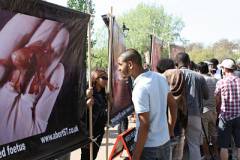
The Catholic Herald has re-opened the debate on the use of graphic imagery outside abortion clinics, in the wake of the acquittal of Andy Stephenson and Kathryn Sloane of Abort 67, who had been accused of breaching Section 5 of the Public Order Act.

The verdict was undoubtedly the correct one, whatever one thinks of the display of graphic imagery outside an abortion clinic, what is clear is that the behaviour of those from Abort 67 did not amount to harassment or threats; protestors stand quietly and tirelessly for hours on end alongside their banners, making no approach to women, passers-by or entrants of the clinic, only engaging if they are directly approached.

There is something of a tendency for some members of the pro-life camp to intellectually hold their nose at the stench of bad publicity that invariably emanates from clinic vigils, publicity that does nothing in terms of attempting to find common ground and thus win the hearts and minds of those who would currently term themselves pro-choice. Whatever one thinks of the Abort 67 campaign and tactics, there is no getting away from the fact that Andy, Kathryn and Angela from Abort 67 are all pro-life heroes. How many who call themselves pro-life are willing to put themselves out there on the line, 24/7 for five years, in all weathers, being prepared to risk abuse, fines and imprisonment for the cause of the unborn? It’s one thing to say that one is pro-life, quite another to BE pro-life – fine words butter no parsnips!

Like them or loathe them, Abort 67 have done much to highlight and yes, educate, members of the public as to the realities of abortion. Robert Wyatt, one of the witnesses for the prosecution, who claimed that he had been offended by the images, testified how his partner had not received counselling neither before nor after the procedure and were therefore unaware of the stage of development of the unborn foetus depicted on the banner. In his statement to the court, he admitted that they had believed the photograph to have been of a much older baby given that arms, legs, fingers, toes and facial features were discernible, when in fact the age of the foetus displayed was 12 weeks. These images give pause for thought, there can be no doubt that one is terminating a little human being, regardless of whether or not one believes that it is truly alive or has any rights. The case has also highlighted the fact that not all women undergoing an abortion are given counselling and raises questions as to informed consent and the information or lack of, surrounding the procedure itself and stages of foetal development.

I admit to oscillating over the issue. These images do give people pause for thought, when faced with the vivid reality of what abortion does to an unborn child, women have instead opted not to undergo this gruesome and demeaning procedure. It is hard to argue with the cogent logic of Andy Stephenson, every time I visit the Abort 67 website, (revamped as of today) I am struck, not only with stomach-churning horror, but also by the veracity, which takes considerable sophistry to deny.

The evidence from those who employ graphic imagery is not only is it extremely convincing, but that often women who are being coerced specifically request leaflets with the graphic imagery, in the hope that they can use this in an attempt to persuade whoever is exerting pressure on them. “Look it really IS a baby”. They also say that men tend to be more won over than women, an experience that seems to chime with me – Robin was won over to the pro-life cause upon viewing a graphic presentation as sixth-former. Abort 67 state that once they have visited a school, the pro-choice groups will refuse to make a counter-visit as a form of protest, the reality being that these images are extremely powerful and difficult to counter. I also know of a previously pro-choice man, who after initially reacting very violently and angrily to these images (he was a pastor and came out with a stream of uncharacteristic expletives on viewing the Abort 67 video) suddenly became a passionate pro-life advocate. Surely if the images save one life they are worth it?

For me, there is a conflict between truth and charity. I previously used the phrase ‘stomach-churning’. I find these images gruesome and distressing to look and tend not to spend much time on the Abort 67 website as a result. I live not far from the site in Brighton and I have to confess to having to fix my eyes firmly on the road when driving past. (Andy, to his credit, has now come to arrangement with the owner of the nearby nursery, so these images are no longer displayed at times when young children will be attending the nursery. Incidentally the irony of an abortion clinic siting itself almost next door to a nursery and opposite a playground seems to have been lost on many.) I don’t like the images not only because they ignore the dignity of the dead, not just because it is a tragic display of a dismembered corpse who never had an opportunity to experience life in all its richness, but also because I am squeamish. Like many, I suspect, I recoil from the images, because I can’t be doing with gruesome gore and guts. I’m the kind of person who watches medical dramas peeping through the cracks in my hands.

When I see these types of images, be they aborted babies, victims of white phosphorous, of children wounded by war or animals experimented on, no matter how heart-rending, or urgent the issue, I put my head down, walk past and emotionally disengage. It’s not that I don’t care, far from it, but personally I prefer to engage on these issues on my terms and not be confronted by images of dismembered bodies whilst walking through town with my children. I may be unusually sensitive, a plot synopsis of the Human Centipede, aided by hormones, haunted my nightmares throughout my third pregnancy, but this is why the majority of people recoil. We don’t want to engage with the contents of what is akin to a snuff movie.

What the abortion clinics don’t want to admit, is that having an abortion is, for most people, a distressing and intimate experience. Women don’t walk through the clinic doors with a sense of objective detachment. Though many might not be aware of exactly what it is they are about to undergo, or the stage of foetal development, all women will realise that, particularly if the procedure is surgical, this will be an intimate and quite probably distressing physical procedure which carries all the attendant risks of trauma. Most women will not exactly be looking forward to what goes on in the cold clinical environment of the operating theatre. The display of graphic images, ups the emotional ante and does therefore add to the trauma of a woman having an abortion. If the pro-life lobby wants to demonstrate that it cares about women, then it needs to abhor anything that might conceivably cause emotional harm and distress.

It would take a certain type of cold hearted psyche not to care about the woman in distress, the woman who is well aware of the actions she is about to undertake and yet feels she has no other choice, to state that her feelings do not matter. I know of many women who have had abortions, due to circumstances, they felt were beyond their control. Such as a someone whom I last bumped into shopping for a pram in a baby store with great excitement. I last heard that she had aborted her unborn child upon discovering that s/he had terrible congenital abnormalities. Though I can’t condone her decision, I can well understand the agony that she went through. For her the decision was not a selfish one, it was not to do with rejecting an imperfect child, she genuinely believed that she was doing the child a kindness – all she could see was a short life of pain and suffering. Though there are many counter-arguments to that, in a culture that encourages and condones the killing of disabled children, couched in the language of compassion, it is very difficult to condemn the women who are in these situations and neither should one use loaded language or do anything that might add to their distress. It was, after all, for these very rare, tragic and horrific circumstances the Abortion Act came into being, a demonstration that hard cases make bad law.

Someone said to me, that if she had seen images such as these on the day that she terminated her pregnancy (a decision she now regrets) she would have committed suicide. Very often these images can be the last straw for women, even if they don’t wish to accept that it is an unborn baby, simply a depiction of bloody surgery could be enough to induce fear and trauma on an already frightened and sad woman. I had increasing difficulty with having to drive past them in the latter stages of my pregnancy. I can also state with confidence that had I been confronted with photos of a cesarian on the morning I gave birth, I would have been in a dreadful state, so frightened was I of the operation that was yet to come.

To me, the images, whilst not threatening or abusive, do cause distress, because they could contribute to a vulnerable woman’s fear. That’s one of the real reason why the clinics don’t want them there, not only do they show the truth of the procedure, but they are a visual reminder of the blood and guts to come – as opposed to the softly worded vague “gentle suction and removal of pregnancy” terminology.

The graphic images certainly have their place, in an academic surrounding, or, as Abort 67 have done in the past, on display in Speaker’s Corner, they can be extremely useful tools for depicting the reality of abortion, but it needs to be in an environment that is mutually consensual. To put them in a very visible place, where it is difficult to escape, simply arouses anger, controversy and polarises. There is also a danger that the more they are viewed, the more they lose their shock value as the public becomes desensitised. Already the more callous pro-choicers have used comparisons of removed gallstones.

Sarah Ditum wrote a piece in last week’s Guardian about the Rights and Limits debate that took place surrounding this issue, where she posed the question whether or not pro-life and pro-choice campaigners could agree on anything. It seems we can and that some consensus can be reached. All of us can agree that those participating in clinic vigils should have a perfect right to do so, under the tenets of free speech that we hold so dear in this country. We can and will disagree as to the morality of clinic vigils. So long as they are carried out peacefully and do not harass vulnerable women then they should continue. For many women the clinic vigils are a last minute life-line, and organisations such as Good Counsel, will attest to the hundreds of women who are helped as a result of their presence. Women who are on the margins of society and who are unable to be reached before they reach the abortion clinic doors. After all organisations such as Good Counsel, don’t have either the funds or the reach of the NHS, BPAS and Marie Stopes, so it’s impossible to offer them the alternative at an earlier stage.

If we want progress to be made, if we want lives to be saved, if we don’t want the draconian legislation being threatened and lobbied for by pro-choice groups who are desperate to stop any sort of presence outside clinics, then we need to find common ground, in order that as many women and babies can be helped as possible. That means showing that we are prepared to listen and to be compassionate. That means keeping the general public on side and showing that we do understand how difficult is for women going through an unplanned or unwanted pregnancy. That means understanding that images of brutal surgery and bloodied corpses could prove enormously and needlessly distressing to an already frightened and trapped women.

What is the more appropriate response? Shock and awe tactics, or to stand, like 40 days for life, a respectful distance away, quietly praying with a sign that says “we are here to help” with specially trained pavement counsellors who are able to respectfully engage in dialogue as well as provide adequate resources to make good on the promise of help. Wise as serpents and gentle as doves.

God’s Gift

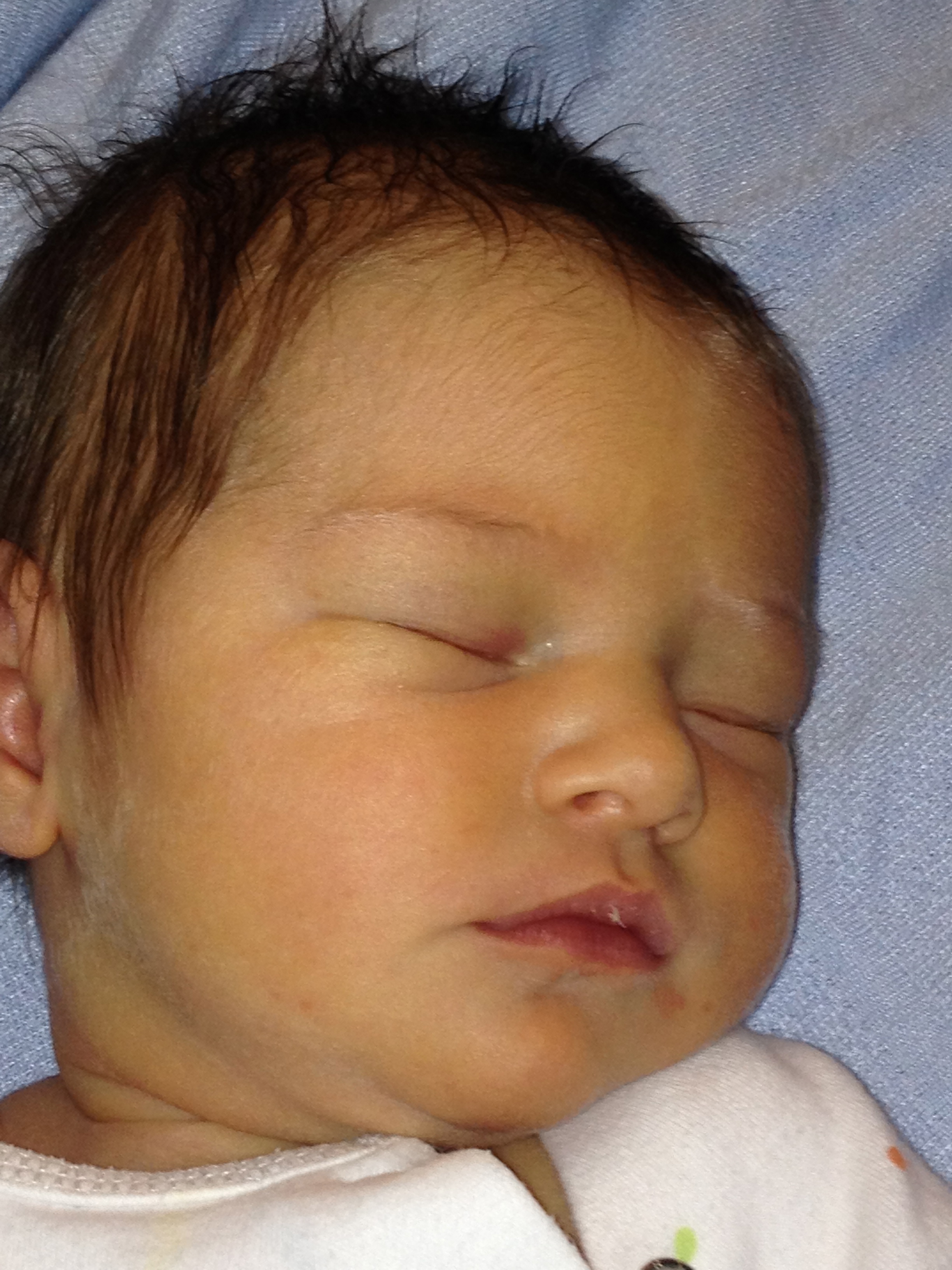
Apologies for the tardiness in posting an update, I’m just beginning to emerge from the post-natal fug. Theodora Mary Elizabeth was born on Tuesday 21st August 2012, at 3:57 pm, weighing 5lbs, 11oz, or 2580g in new-money.

Due to the high blood pressure problems that I suffered from in the latter part of pregnancy, Theodora is on the small side, especially when compared to all my other babies who weighed in at over 8lbs and sported gorgeously plump cheeks, arms and legs, so it is something of a shock having a baby who seems so absolutely tiny with not an ounce of spare flesh, with spindly lean limbs, but she is in good health, if a little jaundiced still and the pair of us are just hopefully coming out of the woods.

As for her name – it was one of those “lightbulb” moments. Right up until the moment of birth, we still had no definite idea of what to call her, other than a few ideas vaguely floating about. Theodora certainly did not feature on “the list”. It was during recovery, whilst Robin was having a cuddle, that he looked down tenderly at her, marvelling at her tiny, yet perfectly proportioned size and remarked that she really was a “teddy”. “Teddy – Theodora?!” I said, whereupon we just looked at each other and something just clicked. It just felt right, it was her. 

When I suspected that I might be pregnant, the timing could not have been worse. I had just passed my first term’s assignments at university with flying colours, having had to defer my much-wanted place once already due to an unplanned pregnancy. I knew that another pregnancy would make continuing unfeasible; I struggle with pregnancy sickness and hormonally related depression and there was no way that I would be able to mange 3 children under 3 and the demands of a full-time course, let alone the costs of the university creche for 3 children. Added to which, the term dates had changed meaning that the baby was due a week before term recommenced, the creche won’t take children under 5 months and the lecturers and faculty staff were unprepared to let me attend with a feeding baby in tow. All of which doesn’t add up to a very pro-life environment for students with unplanned pregnancies – but there’s a rant for another time.

So anyway, with waves of nausea, shaking clammy hands and tears of despair, I did the test and the two faint lines appeared. Robin, who had been in a state of total denial, followed by incomprehension, took the toddler off to Adoration and Mass, looking rather pale. I’ll never forget the look on his face upon his return, which can only be described as serene and glowing. He had an air of acceptance and even excitement, whilst I broke down in tears. “It’s going to be okay” he said, “I sat there with the Lord, I looked at Imogen, I saw how beautiful she is, I thought of our other two children and realised that this is just a gift. I know it wasn’t what we expected, I know it’s the last thing we wanted right now, I know it’s going to be tough as hell for you, I know you suffer, but I can’t help but think this is what God wanted for us”. He was terrified, knew full well how difficult the prospect of yet another pregnancy and birth so close to the other two would prove, both physically and mentally for me, and the knock on effects of that to us and our family, and yet he was overwhelmed with a sense that it was just meant to be. We had in good conscience attempted to avoid pregnancy, we had been extremely scrupulous and yet despite our best efforts, here we were about to have another child. It really did feel like God’s will and if it hadn’t been for the support of my husband, I don’t think that I would have made it intact over the past few months.

Make no mistake, this pregnancy has come at enormous cost, physically, emotionally and financially. It has taken every ounce of strength that I have had. There have been times when I didn’t actually think I could continue any longer, but with the help of my husband and the grace of God and much prayer, I have somehow found the strength to get through not only the physically debilitating effects of pregnancy, but also to pull back from the depths of despair. Though I couldn’t see it at the time, the ordeal of the past 9 months actually did more than any other traumatic events in my life to draw me closer to God; I really did experience my own personal Calvary.

So nothing could be more apt than Theodora – God’s gift, given out of love and totally perfect in every way.

Natural Family Planning

Just a quick update following today’s Sunday Morning Live.

Obviously there is quite a lot of Internet derision as I lauded the success rates of modern NFP systems, despite the fact that my last two pregnancies were unplanned – our perfectly legitimate attempts to avoid, were unsuccessful!

Here’s the thing about being open to life. One accepts that every act of intercourse is both unitive and procreative, i.e for bonding AND babies. Neither can be separated out. Every time one is intimate with one’s spouse, you accept the consequences that could result, even if those consequences are not what one was hoping for.

Having sat down with my NFP practitioner, I realised that the mistake was user error, not the system itself. What happened on the last occasion was that I had a sick bug around the time of ovulation, which threw the whole system out. Thinking I had already ovulated, with the entire family beset with illness, some observations went awry.

That’s more than enough information but the point is, like any method of ‘traditional contraception’ it didn’t work out. We accepted and welcomed the imminent arrival and are now looking forward to meeting her. Many of our non-Catholic friends and acquaintances have testified to multiple condom/pill failure. These are all intelligent people able to follow instructions on a packet. Anecdotes are not the plural of data. Contraception is not 100% effective. If you have sex, there is a chance you will have a baby, regardless of how careful you think you are being.

But here’s the crucial difference. I live in the developed western world. I know how jolly hard it is when one doesn’t space pregnancies. I’ve been either pregnant or breast-feeding continually since February 2009. This pregnancy has proved the most physically and emotionally demanding of all. I cannot begin to imagine how difficult this situation would be for a woman in the developing world. I have access to decent healthcare, ante-natal care, the ability to eat healthily, take vitamins, have clean running water and will give birth in sterile conditions. I am able to provide shelter for and feed and clothe my existing children .

A woman in the developing world has none of that. My contemporary in sub-Saharan Africa or any other impoverished country, would, in all probability die, if she were in my situation.

So what’s the answer? Accept this and give her a long lasting hormonal contraceptive jab to prevent her from having any more children? What happens if it fails? Or should that extra $4.6 billion that the Melinda Gates Foundation has acquired to prevent women from having larger families be spent on ensuring that women in the developing world have the same choices, opportunities, access to quality healthcare that women in the western world have? So that if a woman finds herself facing 3 pregnancies in 3 years, she actually has a practical and realistic choice? The choice of life, not only for her, but her family and children.

Shouldn’t aid be about helping and empowering women to raise healthy babies and choose their family size, large or small? No matter how difficult the circumstances?