11 Consultants disagree with expert Boylan on Savita Halappanavar case

Last week I received an awful lot of flack on Twitter and in other places, for my writing on the case of Savita Halapannavar. The main criticisms seemed to be that being neither Irish nor a qualified medic, I had no right or authority upon which to pass comment.

Every single medical fact I commented upon was not made without reference to highly experienced qualified doctors and midwives, all of whom were in disagreement with Dr Boylan, whose testimony that a termination would almost certainly have saved Savita’s life, was widely quoted by the pro-abort activists as being proof that the law needed to change, as it was, in his opinion, responsible for her death.

The reason that this case has needed to be scrutinised in intricate detail, is because it was so quickly seized upon by those championing abortion in Ireland, as being definitive proof that lack of abortion was leading to unnecessary deaths. What I am more than qualified to state, is that abortion devastates lives and causes infinite pain and hurt to many women, (and men) as well as ending the lives of their babies. By all accounts Savita was a lively caring, compassionate woman. The last thing she would have wanted was for more pregnant women to be vulnerable as a result of her death.

I have just received a copy of the following press release from John McGuirk which I have replicated in full.

Ends

Dear Sir:

The recent inquest on Ms Savita Halappanavar has raised important issues about hospital infection in obstetrics. Much of the public attention appears to have been directed at the expert opinion of Dr Peter Boylan who suggested that Irish law prevented necessary treatment to save Ms Halappanavar’s life. We would suggest that that this is a personal view, not an expert one.

Furthermore, it is impossible for Dr. Boylan, or for any doctor, to predict with certainty the clinical course and outcome in the case of Savita Halappanavar where sepsis arose from the virulent and multi drug-resistant organism, E.coli ESBL.

What we can say with certainty is that where ruptured membranes are accompanied by any clinical or bio-chemical marker of infection, Irish obstetricians understand that they can intervene with early delivery of the baby if necessary. Unfortunately, the inquest shows that in Galway University Hospital the diagnosis of chorioamnionitis was delayed and relevant information was not noted and acted upon.

The facts as produced at the inquest show this tragic case to be primarily about the management of sepsis, and Dr Boylan’s opinion on the effect of Irish law did not appear to be shared by the Coroner, or the jury, of the Inquest.

Obstetric sepsis is unfortunately on the increase and is now the leading cause of maternal death reported in the UK Confidential Enquiry into Maternal Deaths. Additionally there are many well-documented fatalities from sepsis in women following termination of pregnancy. To concentrate on the legal position regarding abortion in the light of such a case as that in Galway does not assist our services to pregnant women.

It is clear that maternal mortality in developed countries is rising, in the USA, Canada, Britain, Denmark, Netherlands and other European countries. The last Confidential Enquiry in Britain (which now includes Ireland) recommended a “return to basics” and stated that many maternal deaths are related to failure to observe simple clinical signs such as fever, headache and changes in pulse rate and blood pressure. Many of the failings highlighted in Galway have been described before in these and other reports.

The additional problem of multi-resistant organisms causing infection, largely as a result of antibiotic use and abuse, is a serious cause of concern and may lead to higher death rates in all areas of medicine.

Ireland’s maternal health record is one of the best in the world in terms of our low rate of maternal death (including Galway hospital). The case in Galway was one of the worst cases of sepsis ever experienced in that hospital, and the diagnosis of ESBL septicaemia was almost unprecedented amongst Irish maternity units.

It is important that all obstetrical units in Ireland reflect on the findings of the events in Galway and learn how to improve care for pregnant women. To reduce it to a polemical argument about abortion may lead to more – not fewer – deaths in the future.

Yours sincerely,

Dr. John Monaghan, DCH FRCPI FRCOG Consultant Obstetrician/Gynecologist

Dr. Cyril Thornton, MB BCh MRCOG Consultant Obstetrician/Gynecologist

Dr. Eamon Mc Guinness, MB BCh MRCOG Consultant Obstetrician/Gynecologist

Dr. Trevor Hayes, MB BCh FRCS MRCOG Consultant Obstetrician/Gynecologist

Dr. Chris King, MB DCH MRCOG Consultant Obstetrician/Gynecologist

Dr. Eileen Reilly, MB ChB MRCOG Consultant Obstetrician/Gynecologist

Prof John Bonnar, MD FRCPI FRCOG Professor Emeritus Obstetrics & Gynaecology

Prof Eamon O’Dwyer, MB MAO LLB FRCPI FRCOG Professor Emeritus Obstetrics & Gynaecology

Prof Stephen Cusack, MB BCh FRCSI Consultant in Emergency Medicine

Dr. Rory Page, MB BCh FFA RCSI Consultant Anaesthetist

Dr. James Clair, MB BCh PhD FRCPath Consultant Microbiologist

Irish lessons

I know we should no longer be surprised when it comes to politicians displaying a capacity to lie to and deceive the general public, but the behaviour of two Irish Labour TDs, Aodhan O’Riordain and Anne Ferris really takes the cake.

Today’s Irish Sunday Independent (colloquially known as the Sindo) has run an exclusive splash, revealing that last June, four months before the death of Savita Halappanavar, these two politicians were caught on tape, explicitly outlining their intentions to use the X Case, (where suicide is deemed to be a life-threatening condition and thus a reason to abort) as a ‘starting point’ to introduce liberal abortion laws into the country.

Regardless of whether one takes a pro-life or pro-choice stance, this disingenuous approach is to be condemned. Politicians are elected on the basis that they represent those who vote for them. Aodhan O’Riordian stated that the X Case was a ‘starting point’, however if he were to be asked that question on the radio, his approach would be to lie about it, denying that it was a starting point and stating that ‘it is what it is’.

“It is a starting point. Once you get that . . . then you can move . . . and of course if I’m on the radio and somebody says to me, ‘It’s a starting point for abortion on demand’, I’m gonna say, ‘No, of course it isn’t – it is what it is.'”

Anne Ferris said

We will legislate certainly for what the European Court has told us to and then we can go further than that . . . we get the first part done and then we will go on to the next bit… I would say then next term it will happen.”

The transcript of the conversation also shows Ferris promising to drink a bottle of champagne after this measure is passed. This matters, not simply because of the subject matter, but also because it is a case of blaring political hypocrisy, whereby elected politicians are once again making monkeys of the electorate, lying about their stated intent and who will no doubt later agonise over the general public’s disillusionment with politicians and voter apathy.

Lying is never acceptable, but one’s intentions with regards to abortion, (or reproductive rights if you’re on the other side of the debate) is far too important an issue to lie about to the public. The attitude on display here is nothing short of contemptuous.

When it comes to thinking about the X Case and whether abortion ought to be a remedy for those who may be suicidal, it’s worth remembering that in the case of a person who may be suicidal, this is almost always due to a perfect storm of contributing factors, of which a setback such as a crisis pregnancy provides the tipping point. People who are suicidal or who suffer from severe mental health issues are deemed to be (albeit temporarily) incapable of informed consent in law, wills and other legal contracts are deemed to be invalid, so why, all of a sudden is a threatened suicide deemed to be a valid reason to abort one’s unborn child?

There is no evidence to suggest that abortion is an effective therapy for a psychiatric problem, which needs to be solved by psychiatric means, but there is an substantial body of research suggesting that abortion has a negative impact upon mental health. Suicidal tendencies in themselves should not be confused with a medically life-threatening condition. Whilst suicide is of course life threatening, the desire to end one’s life, is not indicative that a person will necessarily follow through on their thoughts, though they do of course, require urgent help. Abortion circumnavigates the issue, confirms the woman in her despair and is not indicative of the most compassionate and caring approach. What if the woman caught up in the vortex of depression, aborts her baby and later bitterly regrets her decision, realising that her fears about her pregnancy or ability to mother her child were unfounded?

David Fergusson, a pro-choice doctor, who believes that abortion should be available on social or economic grounds, has published a peer-reviewed study in this month’s Australian and New Zealand Journal of Psychiatry, in which he reviewed the research to ascertain whether or not there were any mental health benefits to abortion. His findings were clear, as Breda O’Brien, is at pains to point out in the Irish Times:

“at the present time there is no credible scientific evidence demonstrating that abortion has mental health benefits.

The evidence will

“resurrect politically uncomfortable and socially divisive debates”. “However, it is our view that the growing evidence suggesting that abortion does not have therapeutic benefits cannot be ignored indefinitely, and it is unacceptable for clinicians to authorise large numbers of abortions on grounds for which there is, currently, no scientific evidence.”

With blatant disregard for scientific evidence as well as the views of the Irish electorate as a whole, a sizeable majority of whom wish to keep Ireland’s current laws protecting the unborn, the Irish Labour party are wishing to push and impose their ideological agenda on an unwilling public. It’s also interesting to note that 66% of voters are concerned about the EU’s potential to intervene in Irish pro-life laws.

As things currently stand, the Irish Supreme Court would be unable to accept any laws or proposals that go further than legislation on the X case, this being against the Eighth Amendment of the Constitution which reads as follows:

The State acknowledges the right to life of the unborn and, with due regard to the equal right to life of the mother, guarantees in its laws to respect, and, as far as practicable, by its laws to defend and vindicate that right.

Any legislation beyond X (and that’s accepting that suicidal people should be able to kill their unborn children to make them feel better) would require a repeal of the Eighth Amendment and a rejection of personhood.

All of which could spell trouble for Ireland’s coalition government led by Enda Kenny, leader of Fine Gael, with Labour’s Eamon Gilmore occupying the Deputy Prime Minister position. Fine Gael explicitly promised voters in 2011 that they would not legislate for abortion and over 40,000 voters have signed a pledge never again to vote for the party if they introduce abortion measures. Worryingly for Enda Kenny, John Bruton, a former Fine Gael leader and Taoiseach is one of those also publicly opposing the coalition’s abortion proposals as are several members of the Fine Gael party. What is telling is that if Ms Ferris is to be believed, the tail is very much wagging the dog, when it comes to Ireland’s coalition government, with Eamon Gilmour, apparently ordering Enda Kenny to whip Fine Gael TDs into line on the issue of abortion. Extraordinary stuff, it’s a bit like Nick Clegg trying to tell David Cameron to whip Tory MPs into line with Lib Dem thinking.

This weekend in the UK has seen the forty-fifth anniversary of the passing of the 1967 Abortion Act, which was sold to the British public on the grounds of compassion and helping women from dying in desperate circumstances. We now see over 200,000 abortions a year, more than 1 in 4 pregnancies are aborted and the numbers of those aborting under grounds F or G (to save the life of the pregnant women or to prevent grave permanent injury) are, in the words of the Department of Health, ‘exceptionally rare’. Grounds A and B that pertain to the risk of death or permanent injury of the pregnant woman account for a tenth of 1% of all abortions.

And yet, Ireland’s politicians perpetuate the myth that this is a necessary piece of legislation in order to further their own totalitarian ideology when it comes to the rights of the unborn. It’s a baffling state of affairs and one in which pro-lifers must do their best to support Ireland, whether that be via prayers or practical action. Ireland is a model of maternal care. It is the gold standard and a torch bearer for Western democracies everywhere. Ireland’s pro-life movement is cohesive, cross-party and pan-theistic, able to mobile huge numbers of people onto the streets to vocalise their support for the unborn. There are many lessons there for the UK, but equally Ireland must look to the UK as an example of how not to do things.

These revelations could be a crucial pivot in Ireland’s battle for life. What an own goal for Irish Labour and those advocating for Action on X.

Savita verdict – medical misadventure

SavitaPicVigil_large

Before going any further, we should all remember Savita’s husband Parveen Halappanavar in our thoughts and prayers. Today, the date that the inquest returned its verdict of medical misadventure following the death of his wife, they should have been celebrating their fifth wedding anniversary together with their newborn baby girl due to be be named Prasa. May they rest in peace.

There are already many disingenuous headlines in the press, stating that the inquest has ruled medical mismanagement, following the denial of an abortion to Savita, as if the two events are linked.

First of all, Savita was not denied an abortion, rather a termination of pregnancy. Though it may seem semantic, this is an important distinction. Though medically they both refer to the same end result, the term abortion is widely understood in the context of a woman who does not wish to have a baby. With women such as Savita, a termination of pregnancy is the more correct phrase, because the pregnancy and baby were accepted and welcomed. Savita wished for her pregnancy to be terminated swiftly when it became clear that she was miscarrying. She didn’t want to abort her unborn child, she wanted her miscarriage to be brought to a quick conclusion.

Savita’s request for her pregnancy to be terminated must be seen in the context of her miscarriage. The explanation given at the inquest, that this was not carried out because of the law, is an unsatisfactory one. The implication being that though there was a good medical reason to terminate the pregnancy, the law disallowed this.

Dr Katherine Astbury testified that on the Monday and the Tuesday, Savita did not appear to be unwell, though she was emotionally distressed. In these circumstances, Dr Astbury is quite correct, Irish law would not allow for a termination to take place, because there appeared to be no risk to Savita’s life. This is actually fairly reasonable. Poor prognosis for the foetus would not allow for a termination, because Ireland rightly places equal value on all life, born and unborn alike. That someone has a poor prognosis is not grounds to kill them. Patients who are given a diagnosis of a terminal or incurable disease are not then killed because the outlook looks bleak and neither are the elderly, much as people might agitate for euthanasia. Whilst there is life, there is always hope and when we take into account the fact that Savita’s pregnancy was a wanted one, so long as a life is not deemed to be at risk, then it is not morally acceptable to kill an unborn baby on the grounds that he or she is as likely going to die soon anyway.

The request to terminate the pregnancy from Savita, should not have determined what was in her best medical interests. All other things being equal, normal medical protocols dictate a conservative management (i.e. wait and see) approach. On a personal note, I can well imagine her distress and her physical pain. I was readmitted into hospital a week after my eldest child was born, suffering from retained infected placenta. When I apologised to the registrar in A&E for crying because I was in so much pain, his response was ‘madam, you have a uterine infection, it is going to hurt a lot’. In my case, despite my entreaties, they didn’t take me in for surgery for 4 days (it was Easter bank holiday weekend) preferring instead to administer IV antibiotics to cure the infection first and to see if the product would pass. Nine years on, I can still remember the pain vividly, but at least I was given the correct antibiotic treatment, though my desire to have a D&C and be back home was ignored. I can’t begin to imagine what Savita went through, especially when she had the ultrasound and could hear the heartbeat of her baby, whom she knew was shortly to die. It must have been awful for her and her husband, let’s not forget that.

But this question of abortion or termination is nonetheless the source of much misinformation. Speaking at the inquest Dr Astbury stated that had she known about Savita’s blood results on Monday or Tuesday, then she would have taken a different decision and terminated Savita’s pregnancy forthwith. Which begs the obvious question, why didn’t she? We know from the inquest that the blood test results taken from Savita at 6.33pm on the Sunday evening were immediately processed and were available on the hospital’s computer system at 6.37pm. They were not accessed until 5.24pm the next day, by an unidentified member of staff and Dr Astbury herself did not look at them until 11.24pm on the Wednesday morning, by which time Savita’s condition had severely deteriorated.

It is this delay that proved fatal for Savita. If a termination had been required, then Irish law allowed for this, the medical guidelines state that delivery of an unviable foetus may be expedited where there is real and substantial risk to the life of the woman. Sepsis would count as such a risk. Savita’s bloodcount was 16.9 (normal range 4.3 – 10.8) which should have rang alarm bells. She was definitely exhibiting signs of an infection which merited urgent further investigation which would have thrown up the presence of E.Coli. Real and substantial risk, are often confused with immediate. A woman does not have be in her death throes or dying for a real and substantial risk to be identified, simply that if a termination is not performed, there is a real and substantial risk that she will die.

With hindsight, this perhaps was the case with Savita, as she was at risk of chorioamnionitis (inflammation of the foetal membranes), once the membranes had broken on Sunday. Once this has happened there is a 30 – 40% risk of infection, which is why she was prescribed general oral antibiotics on the Monday evening. Had Dr Astbury thought Savita was at risk of this, or was exhibiting signs, then why were no further diagnostic tests peformed, in this case an amniocentesis would have confirmed whether or not chorioamnionitis was present. Regular monitoring to identify trends in the white blood cells count is also crucial.

What has confused the issue further is that Dr Peter Boylan, a doctor with a publicly stated position opposing abortion restrictions, testified as an expert witness stating that had Savita been allowed a termination earlier, it would have saved her life. It’s very difficult to know that with any certainty without recourse to a time machine. In any event the post mortem showed that it was the E.Coli bacteria that led to septic shock. The baby was not poisoning Savita’s bloodstream, though chorioamnionitis if diagnosed, requires delivery. If the baby had died then the placenta needed to be removed in order to halt the rapid of spread of infection spread via its dead blood cells. Bacterial chorio-amnionitis is exceedingly rare.

What we do know though, is that in 40 years there have been 5 cases of septic abortions, no patients have died and Savita’s case was very rare. Every year in Ireland there are sadly 14,000 miscarriages, many of them carrying an infection risk, and no maternal deaths on record where the obstetrician felt that the law was inhibiting them. Dr Sam Coulter Smith, master of the Rotunda Hospital in Dublin, says that he has terminated a pregnancy in four instances where women had been diagnosed with sepsis and in all of them the baby did not survive. It’s difficult to see then, how Irish law can be said to be putting women at risk.

The failure of Dr Astbury to discuss abortion outside of legal terms is what has proved troubling in this case. A surgical abortion would have carried with it real risks of further infection which could have proved fatal, and had Savita been given the drug misoprostel to induce delivery, this would not necessarily have made delivery any swifter or negated the need for surgical intervention. Faced with a fully dilated cervix and ruptured membranes, the medics could thought that delivery was imminent and there was therefore no need for further medical intervention at this point. They were therefore wholly wrong not to discuss this in medical terms with Savita and her her husband. Anyone would be cross if their request for a certain type of medical treatment was refused purely on legal grounds.

What is important is that today’s inquest ruled that there was medical mismanagement in the death of Savita Halappanavar. The jury had the option to deliver an a narrative verdict which would not have attributed a cause. Despite the verdict which implies failures in medical care, the judge, Dr McLoughlin, has thrown further confusion into the mix by stating the verdict did not mean that deficiencies or systems failures in University Hospital Galway contributed to Ms Halappanavar’s death; these were just findings in relation to the management of her care.

That seems to imply that there was nothing wrong with the general systems in place at University Hospital Galway, simply that the management of Savita’s individual care was unsatisfactory as we can see. One cannot help but wonder whether or not this is about offloading any legal liability that the hospital may incur in terms of compensation that might be due? After all, it was a galloping sepsis that killed Savita, stemming from the E.coli, ESBL bacteria that entered her bloodstream from the urinary tract and one that is antibiotic resistant. No-one can say with any certainty whether, even had the care been perfect, she would have survived this. Perhaps that is what the coroner is trying to convey, medical misadventure was a factor in relation to her care, but not necessarily in her death. It’s no wonder Parveen is still in the dark.

What urgently needs to be addressed is the factors behind the poor care. Did the law really make Dr Astbury too afraid to check blood results, which needed further analysis or carry out further diagnostic tests? Was the law behind the lack of regular observations, the lack of communication and the failure to realise that paracetamol administered as a painkiller could mask other symptoms? Did the law cause staff to forget that infection requires a low burden of proof? Or was it the effects of austerity measures on an already overstretched hospital struggling with lack of resources? What caused the glaring omissions and can any law be expected to cover every single permutation that might arise in the management of pregnancy or childbirth, or is this simply that medical guidelines need to be more precise and explicit?

Here is the list of the coroner’s recommendations which the jury all unanimously and strongly endorsed

* The Medical Council should say exactly when a doctor can intervene to save the life of a mother, which will remove doubt or fear from the doctor and also reassure the public;

* Blood samples are properly followed up;

* Protocol in the management of sepsis and guidelines introduced for all medical personal;

* Proper communication between staff with dedicated handover set aside on change of shift;

* Protocol for dealing with sepsis to be written by microbiology departments;

* Modified early warning score charts to be adopted by all staff;

* Early and effective communication with patients and their relatives when they are being cared for in hospital to ensure treatment plan is understood;

* Medical notes and nursing notes to be kept separately;

* No additions or amendments to be made to the medical notes of the dead person who is the subject of an inquiry.

Savita’s request for a termination to have been accepted and acted upon, simply by dint of her wishes. would have required Ireland to have legislation which is much more liberal than even that in the UK, which in practice, allows abortion on demand.
It’s no wonder that the clamours for a repeal of the Eight Amendment of the Irish Constitution, (which defends the right to life of the unborn) have already started. None of which addresses the reasons behind the catastrophic failures in care.
Savita’s treatment timeline can be accessed here.

Postscript

One thing that should be emphasised is how rare it is to have a miscarriage at 17 weeks. 0.5% of single pregnancies in women with no history of recurrent miscarriages end in spontaneous second trimester foetal loss. Sepsis is still thankfully rare. Whilst it should be on the radar as a possibility, most maternity staff will not be panicking about the possibility of sepsis when a pregnant woman presents with a UTI. In the incidence of a UTI, blood samples are tested and antibiotics administered. A normal reaction to a UTI would not be to terminate the pregnancy as a precautionary measure. UTIs are serious if left untreated but no medical protocols would consider them as a real and substantial risk to life. Even with a suspected UTI there was no reason (in the absence of blood results) for medical staff to believe that Savita was dying.

I would be seriously concerned if any medic proposed termination of pregnancy as being necessary as a precautionary measure, unless it was in the most serious and grave of circumstances. Nowhere in NICE guidelines is termination mentioned as a treatment for a bacterial infection. Savita’s death should not prompt pregnant women diagnosed with a UTI to seek abortion and neither should they worry about contracting sepsis. One thing that should be remembered is the importance of scrupulous personal hygiene in terms of preventing the spread of bacteria such as E.coli.

Spread a little happiness

(Perhaps this is what the Archbishop has in mind?)

Archbishop Vincent Nichols must be feeling quite justified. He gives a homily in which he appears to denounce blogs, saying that people are attracted to them because we love to hear complaints and are attracted to gossip, followed by a sentence saying that they should have no place in the Church, and surprise surprise, the Catholic blogosphere goes apoplectic and complains about it, thereby proving his point quite nicely.

The problem is twofold. Firstly the sentence “They should have no place in the Church” is placed (perhaps deliberately) after the sentence which explains why we are attracted to newspapers and blogs. It therefore creates an ambiguity. Is Archbishop Nichols talking about newspapers and blogs having no place in the Church, or rather gossip and complaints? Or both?

He (Pope Francis) knows that we live in a society in which complaining and gossip is a standard fare. They sell newspapers and attract us to blogs because we love hear complaints and to read gossip.

But Pope Francis is clear: they should have no place in the Church

But actually the excellent homilies from Pope Francis to which the Archbishop refers, makes no mention of newspapers and blogs, he talks about how complaining dashes hope, as well as the evils of gossip.

But is Archbishop Nichols really saying that newspapers and blogs have no place in the Church? I don’t think this can be the case, not least because the Vatican has its own newspaper and blog. It might have been more helpful had he been a little more precise, i.e. newspapers and blogs that are solely devoted to gossip and complaining have no place in the Church, although this too would have aroused ire. The Archbishop in a bit of a no-win situation whatever he says regarding blogs and the internet.

The other problem is in the assertion that people are attracted to newspapers because they are attracted to gossip and like to hear complaints. This assumes ill-will or bad intention on behalf of the reader which is not always present. I don’t read the Catholic Herald, for example, because I want to hear gossip, (not that the Herald publishes any) if I wanted ecclesial or clerical gossip there are much juicier sources, but because I like to read about what’s going on in the Catholic world as a whole and read some informed, educated and orthodox commentary from those whose opinions I might respect. The same goes for the blogs, my favourites being the priest bloggers (Valle Adurne is a particular treat, I love Fr Sean’s gentle perspectives) and the blogs I regularly read which are written by the laity, again are the opinions of those people who I respect and might well be able to add a different perspective or dimension to an issue which I have not thought about, the most recent that comes to mind is Counter-Cultural father’s outstanding posts on abortion. Likewise I don’t think one can accuse Mark Lambert‘s weekly scriptural reflections as being full of complaints or gossip. Many blogs are genuinely a place of spiritual nourishment.

So, I can well see that backs have been put up by this homily, not least because it assumes bad intent on behalf of bloggers and their readership. Frs Ray and Henry both do a good job in explaining the importance of blogs in democratising the Church as well as explaining the difference between good and bad gossip. Gossip tinged with calumny is the food of Satan.

With all that in mind, I am going to say a few words in defence of Archbishop Nichols and it is very telling that I slightly nervous and mindful of doing this. What kind of situation are we in when an orthodox Catholic is concerned by the reaction that she might receive from the blogosphere, when it comes to defending the most senior Catholic in England and trying to act in good faith?

I understand where ++Vincent is coming from, even though I don’t agree with him. Most members of the CBCEW still don’t quite ‘get’ the internet, although it’s heartening to see Bishop Egan tweeting and blogging. I suspect this is partly a generational issue as well as a not inconsiderable workload. The priest bloggers don’t blog every day, they have their flock to attend to and I’ve been watching the pattern of blogging and noticed (yes priest bloggers, I’m stalking you all) that almost all of them tend to blog in the evening, when they can finally snatch a bit of down time. I suspect that many bishops just ‘don’t get it’ and therefore all they hear about the internet is the bad stuff, i.e. the complaints, the grumbling, the ‘somebody must do something’ and it has perhaps unsurprisingly, coloured their judgement, they don’t get the positive benefits.

Plus, whilst the internet does enable voices to be heard and important concerns to be aired, as we’ve seen with the Gosnell case this week, it does also enable keyboard warriers and online zealots. The internet is a big place which has its fair share of ‘characters.’ Whereas twenty years ago folk would write letters in green ink, now we have the internet which needs discernment and filtration. Here’s a helpful piece that illustrates the usefulness (or otherwise) of Twitter for a mainstream journalist, referring to the aftermath of this week’s tragedy in Boston. Most parishes have at least one, really dedicated and loyal parishioner, who has a particular bugbear who regularly gives anyone who will listen a good earbashing about it. The problem is, that by permanently complaining and finding fault, no matter how legitimate the grievance, over time, repeated grumbling loses its impact.

Those bishops who look upon the internet with scepticism, probably equate it with a troublesome parishioner who never stops grumbling and who never has anything good to say, at least to him, only seeing the difficult or troublesome aspect. If any of them look at the comments boxes on some of the major blogs, their suspicions are confirmed, even the Catholic Herald has its share of ranters. Some coms boxes put me in mind of the bar in Mos Eisley from Star Wars. As Obi-Wan says to Luke Skywalker, “You will never find a more wretched hive of scum and villainy. We must be cautious.” It’s fair to say that charity is sometimes lacking.

So look at it from Archbishop Nichol’s point of view. Bloggers seem to be forever telling him how awful he is, what a terrible job he’s doing and speculating over whether or not he will get, or deserves a red hat. No matter how deserved bloggers might think their criticism, the Archbishop is human, as well as our father in God, that kind of thing would seriously cheese me off too, particularly when they are always threatening to complain to Rome or the Nuncio. We all need not to get carried away by a sense of power.

It’s also fair to say that there are certain blogs and bloggers who do seem to revel in gossip, naming no names. This does have the potential to be dangerous and lead people into error. We have to remember that if we are going to publish a rumour, that there are always two sides to every story, there have been occasions when I’ve read stuff and realised it to be utter bunkum, but I’m not in a position to disabuse it, because to do so would entail breaking confidences and be just as bad as the original piece. It is nevertheless frustrating to see rumour, which like all good gossip has a grain of truth in it, propagated like it is Gospel.

Should anyone be in any doubt about the attraction or power of blogs, Robin, like many Anglo-Catholics, both present and former, used to absolutely devour the blogs, especially Damian Thompson’s, at around the time Anglicanorum Coetibus was issued. It drove me absolutely potty, but is a habit which he has long since eschewed. The reason being, was like many in his position, he had no idea what was going on, didn’t actually know that many real-life Catholics or Catholic clergy and wanted some idea of what was happening and what kind of a welcome or reception he might expect from the Catholic Church should he convert, and also just to get a sense of it. Which is why again, bloggers need to be careful, many of us have crossover readers, internecine squabbling (of which I have been guilty) doesn’t create the best of impressions of UK Catholicism or do much to further the Kingdom. What frustrated me about the blog-checking habit was that to me, what bloggers were saying was utterly irrelevant as to where the Lord might be calling, but I can well see that at a time one feels out of control and uncertain about events, sinful nature leads us to try and be masters and controllers of our own destiny.

Ultimately, if we want to be taken seriously as a force (and I’m talking to myself as much as anyone else here) we need to exercise discernment and ensure that our output is always balanced, reasonable, charitable as well as orthodox and not merely a place for discontented rants or to air personal grievances, again something that I’ve learnt over time. Accusations of clericalism go both ways, neither the hierarchy, nor bloggers and the blogging community should consider themselves beyond reproach or untouchable.

We have to ensure that whatever we do on the internet lives out and advances Gospel values. Otherwise, as Pope Francis says, we run the risk of not recognising Christ walking alongside us.

Middle class mothers and MMR

MMR

Those who have ventured onto any mothers’ forums will know that the two topics most likely to end in tears, tend to be those surrounding maternal choices, such as breast versus bottle, methods of childbirth and whether or not to vaccinate.

It’s hardly surprising as these are all choices that every parent has to face at some point or another, we are emotionally invested in our side of the debate, we’ve given the matter considerable thought and are convinced that our choices are the right ones, that have been taken in the best interests of our child. Part of the nature of the human condition is that we all too often seek validation in the opinions and actions of other people and are therefore unable to cope when disagreement rears its head. A decision that runs contrary to our own, implicitly undermines our own judgement – what could be more emotive than the question of whether or not we have done the right thing by our children?

Before I go any further, I’ll set my stall out, in order  to invite condemnation/approbation on myself as necessary. All of my children have been vaccinated according to the NHS schedule of immunisations.

The issue of whether or not to vaccinate one’s children, is related to that of the pro-life cause. Rubella in pregnant women can cause miscarriage, stillbirth as well as the following birth defects – hearing loss, brain damage, cataracts and heart problems. Measles can prove equally dangerous. Mumps can cause a higher risk of miscarriage. Furthermore the MMR II Vaccine used in the UK was derived and developed from foetal tissue. Whilst the vaccine itself does not contain foetal tissue, we are not unwittingly injecting children with cells from aborted babies, the cell lines used to create the vaccines were derived from two aborted babies. This is, therefore morally problematic. This does not mean that Catholics should not have their children vaccinated, the Pontifical Academy for Life issued a statement to the effect that innocent children must not be put at risk, particularly in the case of a disease such as rubella, and thus vaccines can be used if there is no available alternative, however parents have a moral responsibility to use these where possible and also to continue to put pressure on the pharmaceutical industry. Here is a link to a website containing a list of which vaccines are derived from aborted foetal tissue and alternatives, most of which are not available in the UK. Sadly I was only made aware of the ethical difficulties involved in the manufacture of the vaccine, a few months ago, the day after my third child had received her MMR shot.

Cristina Odone wrote a particularly irksome piece yesterday, which discussed the current measles outbreak in Swansea, Wales and laid the blame squarely at the door of the middle-classes who, Odone argues, believe that their offspring are more precious and special than everyone else’s and so don’t vaccinate. The article displayed, to my mind, some unacceptable class prejudice, lampooning middle-class consumer choices as springing from a sense that they are somehow special and stating that the middle-classes secretly loved the MMR/autism scare as it validated their sense that their offspring are better than everyone else’s.

The article particularly stung for a number of reasons, not only did I recognise some of my preferred consumer choices listed, but also I was one of the parents who agonised over the decision over whether or not to vaccinate. Actually I think Cristina was entirely misguided, the reason that if I could afford to, I would shop at John Lewis, or buy the childrens’ clothes from Boden or Joules, is not because I think their products are particularly special or luxurious, they don’t pander to narcissism, but put simply, those brands tend to be understated, not especially flashy (although in the case of children’s clothes, distinctive) but mainly because they are of good quality and so last. One knows that John Lewis’ customer service is of a consistently high standard, they stand by their guarantees and treat customers well; likewise with the children’s clothes retailers, products tend to have a much longer shelf-life than their cheaper alternatives. So in the case of the children, a piece of clothing bought 9 years ago, is still in pristine condition on its 4th baby. Nothing to do with whether or not I feel my children to be special, it’s more a question of economy.

There were other unfair generalisations (both to middle and working classes) such as stating that the middle class tend to prevent their children from taking risks, and they were more likely to read or talk to their children and nurture them intellectually or feed them the requisite 5 a day portions of fruit and veg. Whilst its true that income can sometimes be a barrier to eating healthily, it doesn’t automatically follow that those on low incomes do not give their children a good diet or neglect to read or talk to them. Having money is no indicator of ability to be a good parent, this is an attitude that should be challenged.

Most parents, regardless of social class, believe their children to be special and wish to protect them from harm. All of us were alarmed by the MMR scare, which received widespread national publicity. Whilst every activity in life carries innate risks, in the case of immunisations, one is having to actively undertake a risk balancing exercise – taking one’s child to be injected requires one to be pro-active, in the sense of having to make the appointment and undertake the journey to the doctors. I suggest that this is one of the reasons behind the decline in the vaccine uptake, particularly in Swansea which isn’t noted for being an affluent middle-class area. Parents need to be wholly convinced that this is the right decision for their child, the newborn baby jabs are scheduled between the ages of 8 and 16 weeks, when one is in the post-natal baby haze, checking the baby every 2 minutes and it’s easy enough for the health visitor or midwife to jolly one off to the clinic, especially when the diseases vaccinated against are as serious as meningitis. It’s every parent’s instinct to want to protect their child from harm and thus most people don’t need much persuasion when it comes to vaccinating their fragile little newborn.

By the time the child has reached 13 months, the age at which MMR is administered, equilibrium has been recovered. People need active encouragement that there is an imperative to vaccinate. For people of my generation, who remember having mumps and German Measles as children, these diseases seem of little consequence, despite the fact we are told, that they have now mutated into something much nastier. The success of the MMR vaccine hinges solely on the fear of measles, which can have devastating effects, especially if one’s immune system is already compromised in some way. My sister had measles as a child and almost died by all accounts. For most parents it’s the risk of measles, versus the risk of the MMR and so passivity or procrastination often seems the best option.

With the withdrawal of the patents for the single vaccines, parents now have very little option, it’s either all or nothing. Whilst the arguments against the single vaccines are valid, i.e. it requires mutliple appointments which most parents don’t attend and there is the risk that a child could catch one of the diseases between vaccinations, to my mind, the government’s decision to remove this choice seems authoritarian and spiteful. No-one is demanding that the NHS gives single jabs, but there was no need to remove the option for private patients. For those who might argue about the difficulties of multiple appointments, I would argue that anyone who is concerned enough to seek out the option of single jabs, will not be taking a slapdash attitude towards their child’s health. Single jabs might well have reduced the severity of the outbreak – we’ll never know.

Andrew Wakefield has been thoroughly humiliated and discredited, but that does not mean that parents who decide against MMR should be vilified as selfish or ignorant. There are still legitimate concerns about MMR, in that many parents have horrifying testimony of the immediate effects of the vaccination upon their child, such as temporary paralysis. From my perspective, all of my children have been absolutely fine in the long-term, but they have all been extremely fractious and ill-tempered in the aftermath. But then again, when the MMR is administered, it’s not on its own. They get the MMR in one thigh and the Hib,  Pneumococcal (PCV), and Meningitis C in the other. So that’s 6 doses of vaccine all in one dose. No-one is suggesting that it’s not safe, however all vaccination is counter-intuitive and it seems a heck of a lot to inject into a little 12 or 13 month old child, who may not even be walking. When my eldest had her MMR booster, aged 5, she described how it stung and burned as it went into her. Apparently that’s a common sensation. So it’s pretty tough on parents who have to watch their child receiving a painful injection, hoping that its going to protect them from a much worse evil, and yet knowing that many people believe this to be harmful. Most of us pray that it’s going to be alright and not cause them any ill-effects in the short term, though it’s hard when your child is spiking a temperature as a direct result of their immunisations.

As Catholics, we are not statists, we don’t believe that the government or state can dictate the precise healthcare or education of our chidden. The story of my eldest’s vaccinations is a cautionary tale. Shortly before they were due to be administered I read about the thiomersal scare, in one of the newspapers. Thiomersal being the mercury based preservative, which was being linked to nerve damage and autism. (This has since been discounted in a study). I therefore specifically requested that my child received Thiomersal free injections. The Health Visitor agreed and made note, informing that since I had requested this, then my daughter would receive the vaccines. What would have happened had I not requested, I asked. “She would have received the version with the thiomersal in”, said the Health Visitor. “This is being phased out, we are switching to the new Thiomersal free vaccine, but we need to use up our stocks, so we are only giving out the new version to those who specifically ask”.  Furthermore, when my eldest was vaccinated as a baby, she was given a 3-in-1 injection. This has now been ramped up to a 5-in-1, together with a separate dose of PCV. As I said, it seems like a lot of pathogens to be loading onto a delicate 8 week old immune system, especially when babies can vary so much in terms of size and weight.

Understandably, the authorities charged with public health take a utilitarian attitude towards the population. Most children will be alright as a result of their vaccinations and they stress that we have a civic duty to protect the weakest. That’s all very well and good, but what when it’s your child who is the one affected, as people claim they have been?

We shouldn’t rush to pillory those who don’t vaccinate their children, or try to label them (I’m guilty of this, I live in Green Brighton which has a very low uptake) because though passivity is often the easiest course of action when faced with a dilemma (it’s easier to do nothing), I know of many highly intelligent, well educated and medically literate folk who have not vaccinated. It is impossible to make a fully informed choice because as @battlementclare, a qualified midwife notes, “there have been no rigorous long term studies into the effects of hyper stimulating the immature neonatal immune system with multiple foreign antigens & adjuvants known to be neurotoxic. I have to wonder whether, in protecting children against some diseases, we are increasing their likelihood of developing auto immune disorders later.” This is all true, the decision to vaccinate centres around a balancing of risks, with the additional factor that there are ethical problems inherent for Catholics in using vaccines derived from aborted foetal cell lines.

One can’t actually do right for doing wrong on this issue, my feeling has been to vaccinate, not least due to living in areas which have experienced measles outbreaks, but every time it has been with a heavy heart. After all no-one, regardless of their social class, (I suspect many of Cristina’s middle class stereotypes would probably fall into the new ‘precariat ‘ in any event) wants to inject their child with something that they have heard on the news or read in the newspapers, or anecdotally from a friend, could do their child harm. This is what Andrew Wakefield tapped into quite so successfully.

But on another note, Cristina’s article, irritating as it was, carries lessons for those of us fighting to get our point of view acknowledged and acted upon, in areas such as pro-life or the defence of marriage. It initially made me very angry as I perceived myself to be the object of undisguised scorn and contempt, identifying a little with some of her use of consumer brands, and having once being described as “all white teeth and Boden”. I guess I experienced some of what same sex couples feel when they read various pieces of unkind polemic, such as that written by notorious journalists or unkind bloggers, attacking people and their motivations, by virtue of their lifestyle. It’s a reminder to us all to play the ball, not the man, if we’re talking about why marriage shouldn’t need to change, there is no need to launch into a personal attack upon people of goodwill.

The same applies with abortion. Whilst we should always condemn the act, we need to understand and engage with the reasons behind abortion, as well as exercise understanding and compassion to those women who have aborted, instead of casting scorn, doubt and shame upon their motivations or lifestyle, particularly if we wish them to engage and have a conversion of heart. Just like Cristina’s piece on MMR, instead of considering the very good reasons that exist when it comes to vaccination, I was left feeling defensive for having worried about it, angry and not inclined to think well of Odone. It was highly counter-productive.

Ultimately every single parent is well aware of their child’s flaws or shortcomings, but we still love them fiercely and protectively no matter what and want to keep them safe from harm, whether we are members of the royal family, or on the very margins of society. Every parent is entitled to think their child is special, it’s called love and is what keeps the world turning. I’m sure there’s a metaphor about God in there somewhere.

All white teeth, Boden and middle class, but not a piece of rocket in sight... "The Vicar's Wife give her kids fruit shoots"!
All white teeth, Boden and ‘middle class’, but not a piece of rocket in sight…
“The Vicar’s Wife gives her kids fruit shoots”!

Savita: Some more facts (For the hard of understanding)

There’s a fabulous phrase from Blackadder goes Forth, that would make for a very witty inscription on a tombstone and which I employ on frequent occasions when discussing pro-abortion advocates. Uttered by General Melchett (Stephen Fry before he manifested the symptoms of irrepressible smugness) whilst discussing the progress of the Great War, he tragically and comically sums up the attitude of those directing the war, thus:

If all else fails, a total Pig-Headed unwillingness to look facts in the face will see us through

I’m thinking in particular of the continued propagation of the idea that Catholic dogma played its part in the death of Savita Halappanavar, and the insistence that a timely abortion would have saved her life.

I’m going to spell this out very simply for the terminally hard of understanding.

Sunday 21st October 2012.

Savita was admitted to Galway University Hospital. She was suffering from backache and during the day had experienced some distressing blood and fluid loss. The hospital took bloods and examined her. The blood results that would have indicated that she had an infection were never followed up on, and Savita did not manifest obvious signs of infection. Sepsis is a deadly disease with a rapid progression which medical staff need to be hyper-vigilant about when dealing with pregnant women. Its symptoms can easily be masked by other symptoms in pregnancy, such as backache, raised temperature and generally feeling unwell. Savita had a history of back problems and had herself misdiagnosed her pain earlier in the day.

Savita would appear to have been suffering from a Urinary Tract Infection, (UTI) which are very common in pregnancy, need antibiotics to treat them, but are not necessarily life threatening. Let’s add into the mix that University College Hospital Galway, was over-stretched in terms of staffing and resources, this report in 2011 names it as the worst performing hospital in Ireland for the second consecutive month with calls for the Health Minister to intervene. The hospital seems to have been suffering from chronic shortages, which is something we should bear in mind before pointing the finger.

There is no reason at this point, to believe that Savita needed an abortion, let alone that her life might be at risk.

Upon examination it appears that Savita’s membranes are bulging and her cervix can’t be felt, meaning that a miscarriage is sadly imminent. There is no reason to believe that she is at risk of infection or that she needs an abortion. Later on, in the early hours of Monday morning, her membranes rupture. Again, there is no need to think that she may need unnecessary surgery, this seems like a regular miscarriage.

Monday 22nd October 2012

By 10pm on that evening, Savita’s waters had been ruptured for a full 22 hours. She was on antibiotics every six hours. It’s not clear when these were started, it should however have been from the moment the membranes ruptured and ideally based on the results of the blood culture taken on Sunday evening.

Tuesday 23 october 2012

At 8.20 am Savita is seen by Dr Astbury who informed her that ‘that the legal position in Ireland did not permit me to terminate the pregnancy in her case at that time.’ Savita is, at that point very distressed and requesting an abortion to put an end to her ordeal. No-one can blame her. She knows that she is miscarrying her baby and wants the whole thing to be over.

My take on this, is that Dr Astbury obviously sympathises. I think that she doesn’t want to take personal responsibility, or appear harsh and uncaring, nor does she want to cast the hospital in a bad light, there is no medical reason, or so it would seem, for an abortion, this isn’t life or death, they probably didn’t have a theatre or staff available at short notice and so she fell back on the letter of the law as an explanation. It’s fair to say that the law would not allow for an abortion in these circumstances, the foetal heartbeat is present, the patient seems comfortable and stable and no doubt many of the staff would have felt uncomfortable, given that this was not medically necessary, but it seems that there was no discussion as to why the hospital were taking the conservative management approach, one that would be taken in hospitals around the world. Hospitals do not deliver pregnant women the moment their membranes rupture, they can very often be sent home to get some rest in comfort, before being readmitted within the next 48 hours, depending on protocols and individual circumstances. It seems very remiss that Dr Astbury explains this in such a perfunctory and legalistic way. Surely Savita was owed more of an explanation?

If there was a clinical need for an abortion, why did Dr Asbury not consult with any of her colleagues? In any event, Savita was described as being “upset, but not unwell”.

Later on Dr Astbury testified that had she had access to Savita’s blood results earlier, then she would have taken theraputic intervention, i.e, an abortion, earlier. So how does this delay in terms of diagnosis and identifying the infection, equate with being the fault of Catholicism or uncertainty surrounding the legal situation?

But what does not make sense, is that if an infection is present or suspected, it is a contraindication for surgery – why invade a sterile uterus with instruments and risk flooding the body with further infection? Conservative management is always the default option in the treatment of miscarriages.

Wednesday 24 October 2012

This is the day that things begin to unravel for poor Savita. At 7am her pulse is 160 per minute (normal resting heart rate is usually between 60 and 80). Her blood pressure is 100/60 mm (normal is 120/80). Her temperature is 39.6 and in addition foul smelling discharge is present, suggesting infection. The doctor on duty concurs she is suffering from probable sepsis.

An hour and half later, 8.25 am, Dr Astbury and team see Savita on their ward rounds. Swabs are taken to determine what exact infection is present. According to the Irish Times, Dr Astbury testifies thus:

At this point her temperature had come down to 37.9 degrees and her pulse to 144bpm. She said she discussed with Ms Halappanavar the concern that she had inflamed foetal membranes due to infection.

“I also informed Ms Halappanavar that if we did not identify another source of infection or if she did not continue to improve we might have no option but to consider a termination regardless of the foetal heart.”

Mr Halappanavar has said he had no knowledge this discussion had taken place. In his statement he said he was at the hospital with his wife throughout Wednesday.

Subsequent to this, Savita deteriorates further, Dr Astbury consults with a colleague who agrees that delivery is medically necessary, a scan confirms that the baby has died, she is taken into theatre where she delivers, is subsequently transferred to HDU and then ICU and dies following further subsequent deterioration just after midnight on Sunday 28 October 2012.

Savita’s husband has no recollection of the conversation that a termination might be needed regardless of the presence of a foetal heartbeat.

Let’s leave aside the comments from the midwife, who was discussing abortions in a cultural context, Ireland’s Catholicism in relation to India’s Hinduism, in response to Savita’s request for an abortion. These obviously do not dictate care. Also Savita’s request for abortion should not be considered a factor. Patients’ wishes, whilst often taken into account, do not dictate what is best medical practice, as I learnt when I was refused the option of being able to deliver my youngest baby naturally. The doctors understood, they sympathised, they could see I was distressed and terrified and they did what they could to help me be comfortable, but ultimately they would not agree to the course of action that I requested, because it was deemed to be unsafe, and interestingly more unsafe for the baby than for me. I could not force them to act against my best medical interests.

Why would an abortion be required if the Dr could not find the source of the infection? It is clear that the baby could not have been the source of the infection. This is biologically impossible. A baby would not suddenly become infected and pass this onto the mother. The baby is in a sterile environment, even after the membranes have ruptured. The inflamed foetal membranes referred to, or to give it the correct medical term, chorioamnionitis, had not been identified. If this was the concern, which would require delivery, why wasn’t this possibility examined for sooner? It all seems like amateur guesswork. Finding the source of the infection, and treating the infection is a wholly different issue as to why the baby would need to be delivered. Plus we know that Savita presented with infection at the hospital, prior to the rupture of the membranes.

And here’s the absolute crunch. Four key failures. The blood test results performed on Savita on the Sunday evening admission, were ready at 6.37pm that evening, but not read until 5.25pm the next day. They were not then accessed again until after sepsis had been diagnosed and Savita’s condition was rapidly deteriorating, two days later. When Savita started shivering at 4.15am on the Wednesday morning, the first obvious signs that sepsis was raging through her body, her vital signs should have been checked. They were not. The blood culture sample taken from Savita at 8:29 am on Wednesday 24th October was processed onto the computer system by microbiology at 9.54 am but not reviewed by Dr Astbury until 11:20am. The lab also reported that the 2nd key sepsis test should have been performed on the ward, it was not. This a lactate serum test which could have definitively confirmed the presence of sepsis. The sample was taken at 6am on the Wednesday morning and stored in an inappropriate bottle before being sent to the lab who could not process it. The lab would not, in any event have carried out this test which should have been performed at a point of care unit on the ward.

The antibiotic treatment administered to Savita between 7am and 1pm was ineffective as it was erythromycin, a variant that is resistant to E-coli, the infection that pathology determined killed her. Broader spectrum antibiotics would have been a better choice.

The indications that Savita had sepsis were subtle and overlooked, by staff who were not deliberately negligent, but who were overstretched and under-resourced.

Catholics and pro-lifers have been writing today of the horrors of Kermit Gosnell. Pro-choicers have been calling his case an exception from which no broader conclusions can be drawn. Why then, in the case of Savita Halappanavar, and in the face of all evidence to the contrary in this one-off extraordinary case, under which Irish law allowed for an abortion, are they claiming that this is evidence that the law is causing women to die in droves?

Savita died from an E.coli infection, which the likelihood is, entered her urinary tract and bloodstream, causing her to miscarry. It was this bacteria that killed her and prompt identification of it, along with the correct antibiotics that could have saved her life. Aborting her baby would have made no difference to the progress of the disease and would have risked further infection and hastened death.

As well as holding the hospital to account, Parveen should be asking questions of the pro-choicers who have chosen to cynically exploit this tragedy for their own ends. The baby did not kill Savita, the E.Coli did.

Too close for comfort

depressed_woman_c-200x200

I have a confession to make. In tweeting up a storm about the media blackout surrounding the trial of Kermit Gosnell, the Philadelphia abortionist who reportedly snipped the spines and cut the throats of babies born alive following late term abortions, I was actually being very hypocritical. I knew about this story some time ago, having seen it mentioned by US pro-lifers as well as reading about it last month in the Daily Mail and yet refrained from writing about it and raising awareness.

I’ll forgo the false modesty, I know that this blog is, on the whole, highly regarded in pro-life terms, I also know it is referred to by pro-choice advocates and activists and read by BPAS, Marie Stopes and, according to my stats, IP addresses that emanate from inside the Houses of Parliament. Over the last year, it’s become increasingly apparent that I do have a platform, which I need to remember to use wisely.

So why did I neglect to do my bit here?

1) I was scared. Last year when all the bullying nonsense was occurring, a certain tweeter was repeatedly (and falsely) claiming that I was a member of Abort 67, “an extremist, a bad egg, a fake pro-lifer who doesn’t care, who must be flushed out of the pro life movement”.

I’m not a member of Abort 67, but I’m not ashamed to state that I have enormous respect and admiration for their courage and what they are trying to achieve. Andy Stephenson doesn’t just sit about writing polemic on the Internet or chew the philosophical fat in smokey pubs, but he dedicates his entire life to trying to show people the horrors of abortion, at times risking his own personal safety and even his liberty, when he was subject to an illiberal and misguided prosecution.

Whilst I might have some reservations about the tactics of showing images outside an abortion clinic, actually I have no problem with the way Abort 67 try to reach University students on campus or lobby politically, such as outside the Houses of Parliament or at Speaker’s Corner. But I was worried that by talking about the grisly horrors of Gosnell, and the pickled human feet found in storage jars or dead babies in the freezer, I might be perceived as a sensationalist or extremist. The only coverage I’d seen was in the Daily Mail, a publication that garners much deserved disdain at times, I hadn’t read the Grand Jury report and was concerned that I would be accused of scare-mongering or spreading inaccuracies. A major tactic of pro-choicers (as I will demonstrate in a subsequent post) is to attempt to bamboozle with science and stats, nit-picking to the umpteenth degree and attempting to use semantics, in order that they can scream “liar”. I didn’t want to put my reputation on the line, or be seen to be posting graphic photos or perceived to be revelling in gore.

2) The other reason and perhaps most importantly, was that I didn’t want to think about what had gone on in Gosnell’s abattoir or engage with it. I’d read the reports and recoiled with horror. It was literally unbearable and had the capacity to drive me mad. No doubt the pop psychologists and misogynists will liberally apply the ‘hysterical’ label, but stories regarding the twisted and bloodied corpses of murdered babies, are too close to home for a woman who has had three babies in the space of as many years.

I saw the photograph of one of Gosnell’s victims which appeared without a prior warning, in yesterday’s Atlantic and had a meltdown. The photo depicted a beautiful baby girl, with a full head of black hair, all her features perfectly formed, bizarrely, her umbilical cord had been cut and clamped, and she bore a startling and uncanny resemblance to my youngest baby daughter, and in fact all of my children who were born with lustrous heads of hair and tiny delicate little features. Except she was lying there, lifeless, motionless, dead and cold, having been mercilessly killed by Grosnell, shortly after her cord was cut and clamped and she was breathing. She would never again twitch, her hands wouldn’t uncurl, her limbs wouldn’t fling out in the startle reflex, her mouth would never root around for the comfort of a nipple or teat, she would never have known the comfort of her mother’s, or any human arms, her life consisted of being prematurely forced out of her mother’s womb, then disorientated and distressed from birth, longing for warmth and food, she was brutally murdered and left like a piece of rubbish on the cold hard slab of the abortionist’s table.

It was like looking a photograph of my own babies, particularly my youngest who was born early, weighing 5lbs, less than one of the little boys who was killed, and whom Gosnell jokingly referred to as being big enough to walk to the bus stop. Like this baby, my own baby was tiny, with fragile spindly limbs and swamped by the smallest size nappy. Even the colour of the clip on the umbilicus was the same.

I broke down. There were no words. I usually grab snatches of Twitter or the net on my phone or tablet, often whilst cooking, and the initial response was like being hit in the stomach. I curled up in the foetal position on the floor by the fridge in floods of tears, completely unable to process either the image or my response to what had happened. There was a mixture of overwhelming grief, sadness, anger and despair. I wanted to kick the living daylights out of this man and anyone who may have aided or abetted him in any way. That feeling still hasn’t dissipated, nor have the questions – namely, how on earth could the people working in the clinic have brought themselves to do this, what made them so damaged as individuals that they were able to justify and disassociate themselves from their actions? How could they have become so desensitised to what was going on? What kind of society are we living in when we can allow this to happen and where most people are happy that the media do not report it?

Yesterday was a concrete manifestation of why I had deliberately avoided engaging with this and so writing about it. Because I didn’t have the courage, it was too close to home and I didn’t think I had the emotional resources to cope. I had a very disturbed night’s sleep last night and I still am struggling to rid my mind of those dreadful images as well as deal with the emotions they invoke, which make me want to do terrible things, tear my hair and clutch my head in horror. Whenever I read about dreadful cases of child abuse or murder which crop up depressingly frequently in our national press, it churns me up inside. I cannot envisage what might motivate a person to do such odious things to a little child, and it terrifies me that people can often lose control in such a way that they inflict and violate little children with acts of sickening violence and depravity. Any parent who denies having the odd flash of anger, is either a genuine saint, or lying to themselves, all of us occasionally, at the end of our tether, might speak a little more harshly to our children than we should, but what is that forces a person to cross that line and inflict acts of utter sadism? And the worst most harrowing thing, is imagining the terror and pain experienced by these little ones. Imagining their trusting little faces and lack of comprehension and fear as they are repeatedly battered or worse.

I can’t stop myself imagining the brief painful lives of these little babies, treated as human waste, what they must have gone through, and also the agonies endured by the women, many of whom suffered life changing injuries, permanent infertility, infections and two of whom died. No matter how opposed one is to abortion, we shouldn’t forget the ordeals suffered by the women, most of whom were vulnerable, either by virtue of age, or socio-economic circumstance. No woman would chose to give birth to a live baby to have him or her murdered in front of her eyes. Most women have no idea of what is entailed in a late-stage abortion until it is too late, and I would wager most women going for an abortion have no idea of what to expect, everything is couched in such vague clinical terminology involving ‘products of conception’.

I eschewed writing about Gosnell, because I didn’t want to have to process this emotionally, or deal with the horror, the images or the reaction that they would invoke. Much easier to stick one’s fingers in one’s ears and pretend that it doesn’t happen, or that this is simply an one-off aberration and not think about tiny bodies beheaded and contorted in pain, or women giving birth amongst animal faeces, with filthy tubing used for both inter uterine suction and breathing purposes and freezers and storage jars full of neonates or neonatal body parts.

I suspect that’s one of the reasons for the media blackout. Some things are just too repugnant to bear. We often read about sadistic crimes, such as those of cannibal killers, for example, or serial murders, with a sense of detachment, we can look at these monsters clinically and though be disturbed by their crimes, have a sense that these sorts of crimes are relatively rare and won’t happen to us. With Kermit Gosnell it’s different, in that he and his staff genuinely didn’t seem to have any awareness that what they were doing was in any way immoral and neither did anyone seem to wish to report it. These atrocities occurred at a state licensed abortion facility, which went un-inspected for 17 years due to the pro-choice policy of the Republican Governor of Philedelphia, Tom Ridge. This wasn’t something that just happened to people who had an unfortunate encounter or mixed with the wrong sort. This was something that happened to women who exercised their free and legal choice in one of the most developed and civilised countries in the world. This is what abortion entails. The wilful destruction of innocent human life, depriving babies of their basic right to life in an act of brutal violence, whether inside or outside of the womb. Every single member of humanity, every single person reading this post, has something in common with Gosnell’s victims, we all began the same way, we were all blastocysts, developing embryos and unborn babies too. We all went through those same stages of life, only we escaped the abortionist’s instruments because we were the lucky ones.

And like the media, and like those who knew but didn’t think to report, I sat on this story too, for my own selfish reasons, born out of fear. It once again proves Burke’s adage – all that requires for evil to triumph is that good men do nothing.

Savita, Sepsis and Statistics

Much crucial detail from the inquest into the tragic death of Savita Halappanavar is emerging in the media, which is being seized upon and manipulated by opponents of Ireland’s pro-life laws as well as those with an anti-Catholic or militant secular agenda.

The inference is clear – Catholic dogma is responsible for the death of a pregnant woman from sepsis, as evidenced, according to one tweeter, by the presence of a religious statue outside of Galway University College Hospital and the fact that many of the wards are named after saints. Something of a non-sequitur. Clearly the presence of religious symbolism, a reflection of Ireland’s cultural heritage, is indicative that patients can expect a substandard level of care, where medically unsafe and morally dubious dogma overrides the best clinical interests of the patients. Anyone attending St Thomas’s or Bart’s hospitals in London had better be on their guard!

Let’s start with the stats.

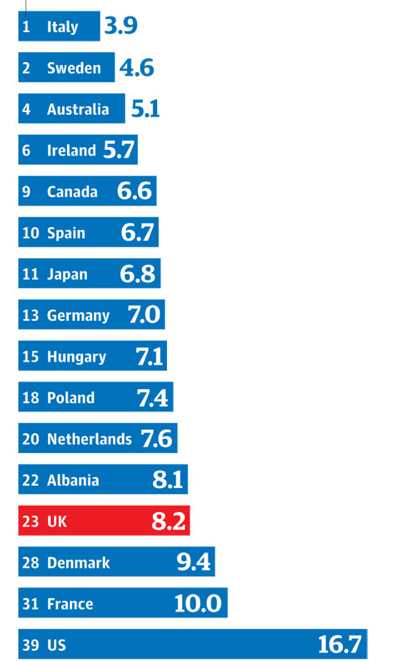
Here’s a table showing the maternal mortality ratio, the number of maternal deaths per 100,000 live births from the Guardian’s datablog, where ‘facts are sacred’.

Screen Shot 2013-04-10 at 22.52.28

So, the one of the highest rates of maternal mortality occurs in the US which rather disproves the claim that liberal abortion legislation is safer for women. Ireland, that country where women are deprived of abortion, has one of the lowest maternal death rates in the world, official stats show that on average 4,000 women in the Republic travel to the UK for an abortion every year, a figure that has been steadily decreasing from a high of 6,600 in 2001, so the blame for the UK’s relatively poor performance in the area of maternal health care, can hardly be explained away as being an Irish export. Pro-life Chile has the lowest maternal death rate in Latin America and Poland, another pro-life country also fares well.

Furthermore, more than 100 mothers have died in childbirth in London in the last five years, twice the rate of that of the rest of the country. Whilst we are all screaming about the first maternal death in 17 years at a hospital in Galway, where is the outrage about the lamentable situation in the UK, due to a desperate shortage of midwives? Surely anyone who identifies themselves as ‘pro-woman’ should be demanding to know how the government intends to remedy this increasing problem, aside from disincentivising those who may want more than two children?

Whilst on the subject of outrage, where were the candlelit vigils and expressions of anger over the death of Jessie-Maye Barlow, God rest her soul, the 19 year old mother of one, who died from septic shock following an abortion in September 2012, the inquest acknowledging that BPAS had not followed up on their aftercare and thus the fact that Jessie-Maye had failed to pass all the ‘products of conception’ was missed, leading to her death? Where were the protestations of anger that a beautiful young mother of one, with her entire life in front of her died as a direct result of medical negligence on behalf of an abortion clinic that was too busy to follow basic protocols regarding patient care?

Sepsis

Savita Halappanavar died from sepsis. According to the Royal College of Obstetricians and Gynaecologists, between 2003 and 2005 there were five maternal deaths in the UK of pregnant women from sepsis, with a baby under 24 weeks gestation. “Sadly, substandard care was identified in many of the cases, in particular lack of recognition of the signs of sepsis and a lack of guidelines on the investigation and management of genital tract sepsis. Between 2006 and 2008 sepsis rose to be the leading cause of direct maternal deaths in the UK, with deaths due to group A streptococcal infection (GAS) rising to 13 women. Severe sepsis with acute organ dysfunction has a mortality rate of 20 to 40%, which increases to 60% if septic shock develops. Studies in the non-pregnant population have found that the survival rates following sepsis are related to early recognition and initiation of treatment.”

In 2012 the RCOG published green top guidelines for treatment of sepsis in pregnancy. The guidelines state

The signs and symptoms of sepsis in pregnant women may be less distinctive than in the non- pregnant population and are not necessarily present in all cases; therefore, a high index of suspicion is necessary.

The diagnosis of sepsis must be confirmed by blood cultures and early swift administration of broad spectrum antibiotics are the key to the survival of the patient, alongside regular monitoring.

Crucially and unfortunately, this did not happen in the case of Savita, who was admitted into the hospital on the evening of Sunday 21st October. Blood tests that were taken that night, which were never followed up on, showed an elevated white blood cell count which would have been one of the key indicators that infection and indeed sepsis was present.

Whilst oral antibiotics appear to have been started on the Monday night, following the spontaneous rupture of membranes, an infection of the severity of Savita’s would have required intravenous administration. The consultant obstetrician has described the situation as a systems failure on multiple counts, not only were the blood results not followed up on, but also, the vital regular observations which may have alerted the staff to the presence of an infection sooner, were not carried out at regular intervals throughout the night, which is why the infection was only picked up in the early hours of the Wednesday morning, after Savita had taken a dramatic turn for the worse, a doctor who had come to check on her on the Tuesday evening, saw she was asleep and so left her. Once Savita’s membranes had ruptured (in the early hours of Monday morning) then she should have been checked every 4 hours for signs of infection.

The RCOG guidelines state that all staff should be aware of the signs and symptoms of potential sepsis and the rapid and potentially lethal course of the disease, which is often less distinctive in pregnant women. Therefore whilst one can reasonably assume that care was lacking, notably in the failure to follow up on the results of the blood tests, the narrative that University College Hospital Galway were knowingly refusing to treat a woman with a severe and life-threatening infection in order to prioritise the life of her baby, due to Catholic dogma reflected in the law, is an erroneous one. As the consultant testified, had they known about the sepsis or infection, they would have intervened much sooner, however Savita’s symptoms did not physically manifest until the early hours of Wednesday morning, over 48 hours since she was first admitted, whilst the signs may have been present, i.e. a slightly elevated temperature and raised pulse rate, this could also have been due to other factors, such as anxiety and it is only with hindsight and in the light of the missing bloodwork, that this can be identified as being the start of the infection.

Speaking to the inquest, Savita’s husband has reported that doctors seemed nonchalant on Tuesday, certainly there was no cause for concern, or reason to think that her life might be at stake.


Abortion to treat Sepsis – a red herring

Savita’s sepsis stemmed from an antibiotic resistant strain of E-coli, an issue that is in itself concerning. Pathology has indicated that the infection most likely originated in her urinary tract and tallies with the backache that she complained of, prior to admission to hospital. Aborting the baby would not have cured Savita of her infection and indeed in these situations, surgery is to be avoided if at all possible, as it runs the very real risk of spreading the infection further and causing death.

Whilst the hospital had failed to spot the infection, they had noted that an inevitable miscarriage was taking place. Savita, understandably, was very distressed, and wished for her ordeal to be over, as opposed to the interminable wait for nature to take its course and allegedly requested an abortion on the Tuesday morning, following the ultrasound to determine the baby’s progress.

Upon admission to hospital on the Sunday night, it was noted that no cervix could be felt, hence Savita was fully dilated and hence the premature delivery of the baby was imminent, which would mean that the baby would not survive. Later on, her membranes ruptured, meaning that the protective sac of fluid surrounding the baby completely drained, a situation which would likely result in the death of the baby and spontaneous natural delivery.

This is where the confusion sets in, which is being exploited to the max by the abortion lobby. Firstly, that Savita was fully dilated, was as a direct result of the infection which was in her urinary tract. The unborn baby was in a sterile sac of waters and therefore not the cause of the infection. The dilated cervix did not cause her infection either. An open or dilated cervix will not cause an infection, as any woman who has ever had more than one baby, or indeed a smear test will testify. Once you have had a baby, the cervix never fully closes. When I was pregnant with my eldest child, I was dilated by 2cm for a good week before I delivered. An open cervix does not make one more ripe for infection.

The infection risk is posed when the membranes or waters have ruptured, normally hospitals will be wanting a woman to deliver within 48 hours of this occurring in order to minimise risk of infection to the newborn baby. Clearly in Savita’s case this would not have applied, but if her waters broke on the Sunday night, it was not unreasonable for no action to have been taken on the Tuesday, the medics obviously thought that delivery or natural miscarriage would take place swiftly and that conservative management was the safest option in the circumstances.

Whilst Savita may have requested a termination, this may well not have been in her best medical interests.

The unborn baby was not the cause of the sepsis and so there was no good reason to terminate it as Savita’s life did not seem to be at risk. Dr. Hema Divakar, President-elect of the Federation of Obstetric and Gynaecological Societies of India speaking to the Hindu Times said:

“Delay or refusal to terminate the pregnancy does not in itself seem to be the cause of death. Even if the law permitted it, it is not as if her life would have been saved because of termination. Severe septicaemia with disseminated intravascular coagulation (DIC), a life-threatening bleeding disorder which is a complication of sepsis, major organ damage and loss of the mother’s blood due to severe infection, is the cause of death in Savita’s case. This is what seems to have happened and this is a sequence which cannot be reversed just by terminating the pregnancy.”

Catholicism and the law

It seems to me that there is something of a cop-out or buck passing exercise going on here. Dr Katherine Astbury, the doctor in charge of Savita’s care, told the inquest that in Ireland it is not legal to terminate a foetus on the grounds of poor prognosis for the foetus, but also admitted that she did not once clarify the legal situation with her colleagues or think to do so.

The law in Ireland does not prevent a termination from being carried out, if the life of the mother is at risk and as Dr Astbury testified, had she known the severity of the situation she would have intervened earlier, although from what we know now, an abortion could well have made the situation a lot worse. It seems obvious, that Dr Astbury perhaps sought to take shelter in the law as opposed to exercise her own moral and clinical judgement. No law can be formulated that will cover all the possible permutations and complications that might arise from real-life pregnancy management and so doctors can’t ever be entirely freed from having to make theraputic and ethical decisions. Whilst doctors might have to work within the law, they also need to exercise clinical judgement which will invariably and inevitably involve ethics.

The law in Ireland is clear, section 21:4 of the Medical Council Guide for Registered Practitioners says this:

“In current obstetrical practice, rare complications can arise where therapeutic intervention (including termination of a pregnancy) is required at a stage when, due to extreme immaturity of the baby, there may be little or no hope of the baby surviving. In these exceptional circumstances, it may be necessary to intervene to terminate the pregnancy to protect the life of the mother, while making every effort to preserve the life of the baby.”

So there was no legal reason why the pregnancy could not have been terminated were Savita’s life deemed to be at risk. One has to wonder why Dr Astbury couched her response to Savita’s request in purely legal terms? This was not simply about what the law proscribed, but medically speaking, conservative management of delivery is the safest approach, in the absence of any other pressing clinical factors. Theatre was obviously felt to be unnecessary at this stage, the cervix had dilated, the membranes had ruptured, delivery could not be far off, there was still a foetal heartbeat, the prognosis for the baby was poor, but there was no pressing need to abort medically, as well as legally. Why were the medical reasons not explained to her – that it was presented purely in legal terms seems to be a total failure of communication and gave the Halappanavar’s the impression that best clinical practice was being hampered by the law. The only people qualified to judge on whether or not an abortion should be performed were the doctors, not the lawyers and if any conflict had been perceived, why was this not instantaneously taken up with the hospital’s legal team, who would have been well versed in the ethics.

The Irish Catholic Bishops, responding to the case, said this:

The Catholic Church has never taught that the life of a child in the womb should be preferred to that of a mother. By virtue of their common humanity, a mother and her unborn baby are both sacred with an equal right to life.

– Where a seriously ill pregnant woman needs medical treatment which may put the life of her baby at risk, such treatments are ethically permissible provided every effort has been made to save the life of both the mother and her baby.

Which is why the conjecture over potential situations coming from all sides is unhelpful. Catholic teaching is very clear. Mother and baby have an equal right to life, whilst a baby must never be directly killed in order to save the life of a mother (and I cannot envisage a single situation where that would be necessary), a mother may receive treatment such as in the case of an ectopic pregnancy or a cancer diagnosis, which may put the life of her unborn baby at risk, or may end a baby’s life as an indirect consequence.

‘This is a Catholic country’

This was the comment made by Ann Maria Burke, a midwife manager, in response to a conversation with Savita, who stated that in India, a Hindu country, an abortion would be possible. Now is not the place to discuss India’s abortion record, especially when it comes to baby girls or how that reflects Hinduism, which treats all life as sacred, but as Ms Burke now admits, the remark was regrettable and had nothing to do with medical care. The remark perhaps smacks of racism, or was made in the context of a general conversation pertaining to religious and cultural attitudes, but tellingly the midwife was not directing the care of Mrs Halpannavar, nor was she dictating hospital policy. She was trying to explain the reason behind Ireland’s pro-life laws, which whilst they might stem from and be in accordance with Ireland’s Catholic history, do not indicate that Ireland is currently a country that is governed by those in accordance with the Catholic Church, quite the opposite Enda Kenny the current Taoiseach is doing all that he can to put distance between himself and the Vatican. Moreover Catholic moral theology would not sanction the delivery of a non viable baby as a direct cure for a pregnant woman, and is therefore slightly at odds with the letter of Irish law.

Conclusion

Had the initial blood tests been followed up on, and 4 hourly observations undertaken, then perhaps the tragedy may not have unfolded in the way that it did. What seems clear is that the infection was present upon admittance to hospital and that it is unlikely that an abortion would have cured the infection and potentially could have hastened Savita’s death. The unborn baby could not have been the source of the infection and by the time that the infection was noted, things had already progressed too far. The infection was obviously incredibly aggressive and Savita’s condition deteriorated so rapidly on Wednesday 24 October, that the decision as to whether or not to abort became moot. According to the inquest, septic shock was diagnosed at 1.20pm, two hours later, Savita’s already dead baby was delivered in theatre, so the conservative approach would have been the correct one, nature had taken its course swiftly, within the normal 48 hour window.

There is no indication that the hospital was ignoring the plight or symptoms of a critically ill woman with sepsis in order to rigorously follow the letter of the law regarding her unborn baby, when the law already allowed for an abortion to take place in these circumstances. Until the early hours of Wednesday morning, there was no obvious manifestation of infection, to those caring for her. It was only then that seriousness of the situation became glaringly apparent.

The issues here are about an awareness of sepsis. That is what Parveen Halappanavar, Savita’s husband should be angry about. This is the issue that he should fight for in his wife’s memory, as well as suing the hospital for their negligence in following up on her blood tests. Understandably he wanted his wife’s distress to be alleviated by an abortion, a procedure that may well not have been in her best interests either physically or emotionally. That the hospital could only explain this in legal terms is as great a dereliction of care and duty as it was not to have chased her blood results or carried out her observations.

Ireland’s abortion laws may change as a result, unborn babies will die and no action will be taken to address the urgent problem of sepsis diagnoses, nor indeed the worrying spread of ESBL bacteria that killed Savita. Abortion won’t cure sepsis or aid its diagnosis. It may however mean that more women and babies are exposed to the deadly bacteria. Savita’s memory deserves better.

Women as Witnesses

For those who haven’t seen it over there, here’s my thoughts on the remarks made at Pope Francis’ General Audience today. This theme of women and motherhood and what that means, is going to need much more analysis and apologetics.

Quite early on in this blog, I had several non-denominational Christians as well as general enquiries, wanting to drill down a bit further into the notion of women as mothers. The inherent dignity, importance and value of motherhood needs to be emphasised, whilst taking care not to alienate women who are not physical mothers, as being some sort of lesser beings, or somehow lacking in innate femininity. It’s a tricky tightrope, whilst the goods of motherhood must be reclaimed, care must be taken not to fetishise mothers in an unhelpful way either.

Here’s the post anyway.

Speaking in his General Audience today, Pope Francis emphasised the importance and role that women have to play within the Catholic Church, as unselfish communicators of the Gospel.

The women are driven by love and know how to accept this proclamation with faith: they believe, and immediately transmit it, they do not keep it for themselves. They cannot contain the joy of knowing that Jesus is alive, the hope that fills their heart.

Contrasting the implicit faith of the women who are the first human witnesses to the Resurrection with that of the male Apostles, Pope Francis says:

The Apostles and disciples find it harder to believe in the Risen Christ, not the women however! Peter runs to the tomb, but stops before the empty tomb; Thomas has to touch the wounds of the body of Jesus with his hands.

The very act of returning to the tomb, to anoint the body of Christ is a manifestation of this faith and also trust. Why did they return to the tomb? They would have been aware that the tomb entrance was sealed by an enormous boulder that would have been impossible for them to roll away without some assistance, as well as the fact that guards were posted at the tomb’s entrance, who were unlikely to have been amenable. And yet still they trusted.

Reinforcing the historicity of the Gospel accounts, Pope Francis reminds us of Christ’s radicalism. Women were not considered credible or reliable legal witnesses in first century Palestine, this was a role reserved to Elders or men over thirty, and yet it was to women that Christ first manifested his Resurrection, as a reward for their faith and in recognition of their love.

This is beautiful, and this is the mission of women, of mothers and women, to give witness to their children and grandchildren that Christ is Risen! Mothers go forward with this witness! What matters to God is our heart, if we are open to Him, if we are like trusting children. But this also leads us to reflect on how in the Church and in the journey of faith, women have had and still have a special role in opening doors to the Lord, in following him and communicating his face, because the eyes of faith always need the simple and profound look of love

Beautiful and inspirational. What can be more important than being witnesses to the Resurrection and the love of God? Those very first witnesses, who were so convinced by what they had seen and so determined to spread the Good News, to the extent that they would lay down their lives and suffer the most excruciating and painful deaths, played a crucial and key role in the development of the faith. Women are called to witness, whether that be as physical or spiritual mothers, to pass down and impart the joy of the faith to their children and in their families, in a way that only they know how. That the Pope has chosen to affirm and link women with motherhood should not be overlooked.

Christ called Mary Magdalene by name in the garden in acknowledgement of her simple and uncomplicated love, faith and trust. Furthermore Mary Magdalene is no plaster saint or unrealistic model of womanhood. Her lack of inhibition and emotive displays are often embarrassing or discomforting and yet Christ loves because of her innate feminine authenticity and total lack of guile and self-awareness. Whilst Our Lady set the pattern of motherhood, in the encounter in the garden, we see Christ conferring a vital vocation upon St Mary Magdalen as the first female missionary.

Traditionally depicted as beautiful, sensuous and possessing an unrestrained yet totally pure love of the Lord, she accepts her vocation through a direct encounter with Christ, with no thoughts as to what may be in it for her in terms of status, earthly or material reward, and neither does she stop to compare herself with the Apostles. She has no need. Christ has already reaffirmed her equality, as St Mark awkwardly relates. Not only does Christ make his first appearance to a woman, but one who was once demonically possessed.

St Mary Magdalene allowed herself to be won over by Christ and gave herself over to him whole-heartedly and he rewarded, affirmed and entrusted himself to her in all of her femininity.  This is the message for contemporary women today.

Bank holiday fun – Liebster Award

I was delighted to see that Lazarus had nominated me for a Liebster Award, not only because I really enjoy his blog and find him a voice of common sense and sanity on the blogosphere, but because it gives me an opportunity to unashamedly prattle on about myself. Which probably tells you all you need to know. I also saw I’d been nominated by Rhoslyn Thomas and was tempted to naughtily pick and choose on questions, but Lazarus got there first. I’ll give Rhos a plug anyway because she deserves one. Young, pro-life, Welsh traddie. What’s not to like?

Liebster-Award

The point of the award is to encourage blogs to link to each other and so boost their profiles and traffic.

Here’s what you do:

1) Post the Liebster award graphic on your site. (Google to find it if needed)
2) Thank the blogger who nominated the blog for a Liebster Award and link back to their blog.
3) The blogger then writes 11 facts about themselves so people who discover their blog through the Liebster post will learn more about them.
4) In addition to posting 11 fun facts about themselves, nominated bloggers should also answer the 11 questions from the post of the person who nominated them.
5) The nominated blogger will in turn, nominate 9 other blogs with 200 or less followers (We’re guessing for our nominees) for a Liebster award by posting a comment on their blog and linking back to the Liebster post.
6) The nominated blogger will create 11 questions for their nominated blogs to answer in their Liebster post.

So, done the first two tasks. Here’s the eleven facts about me. (I go on a bit, I didn’t include that brevity or conciseness is not my forte).

  1. One of the most surreal things I’ve ever done is approach Paul O’Grady of Lily Savage fame, in the Telephone Bar in Bangkok and throw water at him. He didn’t mind, it was Thai New Year which is celebrated by sprinkling water over other people as a sign of good luck. In recent times it has degenerated into a giant 3 day city-wide water fight, where gangs of adolescents prowl the city on the backs of jeeps and motorbikes, with industrial water tanks strapped to their backs connected to elaborate water pistols, in order to drench passers-by. Probably something of a mating ritual, but if you ever go to Bangkok around the time of Thai New Year, be sure to wear either a swimming cossie or plastic overalls.
  2. My skills of prophecy are summarised by the occasion I looked at a battered old orange 737 sitting on the tarmac at Gatwick airport in 1997 and opined “No Frills airlines. That’ll never work”
  3. Fr John Glynn of I watch the Sunrise, fame, was the priest in charge of my school. He used to stalk the Alyosius Corridor, singing and smiling and leant his guitar against the altar. I used to confuse him with Ralph McTell.
  4.  My favourite book of the Aeneid is Book VI. It evokes memories of GCSE Latin and moments of Billy Bunter-esque stupidity in class. Virgil describes an eclectic mix of characters including “The hundred armed Gyles Brandreth” and, much to the amusement of privileged Essex boarding school pupils, with terribly middle-class names, a ferryman called “Sharon”.
  5. I’ve always wanted to give Cathy and Heathcliffe a hearty slap.
  6. I can’t touch vodka following an unfortunate incident involving Highlander II, popcorn on an empty stomach, a litre of Blue label Smirnoff, a chincilla and a poodle who resembled Roly in Eastenders.
  7. If I had to chose a final meal it would be infinite oysters, with a dipping sauce made out of shallots and red-wine vinegar, a dash of lemon and tabasco, washed down with Veuve Cliquot served the temperature of liquid nitrogen.
  8.  I have to work a lot harder on the asceticism and Evangelical Poverty thing.
  9.  I will forever harbour an unashamed crush on the young Stiff Pilchard Cliff Richard in his heyday. Cor. 

  10.  I’d like to have the sublime Faure’s Requiem at my funeral and wangle a way of getting in the Cantique de Jean Racine also.
  11.  Compline is my favourite part of the Divine Office. It hands everything over to God at the end of the day.

So here are the questions I had to answer:

What inspired the title of your blog?

My name. Original huh?! Actually, it was originally called asnailinmypocket, which was a favourite phrase of mine back in the day, being an equivalent to Monty Python’s hovercraft full of eels. Very often in my days as a flight attendent, we’d operate domestic European flights for a non-English airline, between cities such as Cologne and Dresden. I once told an unsuspecting German with no command of English, that I had ‘a snail in my pocket and I think I’m about to use my vest’, instead of telling him to stow his hand luggage under the seat in front of him, much to the hilarity of my colleague. He seemed to get the gist. Perhaps it was the hand gestures? Anyway the phrase stuck and it was the first thing that came to mind when setting up the blog and summed me up. Random, surreal and probably quite juvenile.

What is your personal favourite post on your blog?

No idea, although I’d like to think that I’ve done some very solid investigative pro-life writing. BPAS are regular readers. *waves* 🙂

What has been the most popular (most viewed) post on your blog?

Oh lawks, not sure we should go there. It was the Babyworld post of DOOM. To cut a long story short, I used to be a member of a Mumsnet type website called Babyworld, which had a ‘Discus, Debate and Deliberate’ forum. In the run up to the Papal Visit, things got extremely heated and being the only practicing Catholic in a forum predominated by liberal mummies was something of a recipe for disaster. They simply didn’t get it and I should have realised that it was always going to be a waste of time.

There were threads upon threads of the usual old cliches and every single time, I tried to bust the myths or engage in any sort of apologetics – KAPOW, they’d all go nutty. I remember one member who indignantly C&Ped huge chucks of the Catechism, in order to heap her scorn and vitriol upon this disgusting religion and its doctrine.

Others just couldn’t work me out. On the one hand I seemed this perfectly nice, reasonable, quite fun woman, who didn’t walk about dressed like a member of the Amish, but there I was espousing hateful bigotry and homophobia. At one point it was suggested that I was brainwashed or had cognitive dissonance “I don’t think Caroline hates gay people, she obviously doesn’t, she seems a nice person, but her attitude is homophobic and that causes her problems, which is why she tries to explain it away”.

Finally, my patience blew during yet another homophobic Catholic church debate (I think people decided to deliberately start inflammatory threads) during which posters posted the most inane and theologically illiterate statements I’d ever seen, which were as hilarious as they were offensive. “Face it, you can’t tell me whether or not Jesus was a breast or a bum man with any certainty”, said one, and in my frustration and amusement, I C&Ped some of the choicest comments onto here for the delectation of my gentle readers, along with the Bad Vicar sketch from Mitchell and Webb. Well, it was funny, a bunch of women screeching about how terrible Catholicism was, how they had spent some time in Rome and decided that I had read too many books and therefore wasn’t ‘spiritual’, reminded me of the classic line about “hastily assembled internet philosophies”.

Anyway, they didn’t like it much, linked the blog to Babyworld and the stats went stratospheric. Much silliness ensued about petitioning WordPress to get the site taken down for breaching copyright (despite the fact I’d done nothing illegal and hadn’t mentioned identities) and a huge amount of cross comments, for taking their comments about Christ’s alleged sexual preferences out of context!

I left shortly afterwards, it all got a bit much and I lost patience with the “oh no, my child’s Christian school is teaching them that God exists and about the crucifixion and Resurrection, how very dare they”, but they still link to here from time to time, bless them.Christian mummies, stay away from mainstream mummy forums, no good can come of it, unless you are married to Giles Fraser.

Which post on your blog has attracted most comments?

This one. About finding out I was pregnant, the week that Robin left the Anglican Church.

What other hobbies or interests (beyond blogging) are you prepared to admit to?

Not that much time, with the children, so it’s mainly reading and playing the piano. Beethoven Sonatas with their crashing chords can be most Cathartic, but tend to wake the children. I also love Bach prelude and fuges as well as Mozart sonatas. I adore ragtime, probably not very PC, but I’d like to be able to play Debussy’s Golliwog’s Cakewalk without making any mistakes before I shuffle off this mortal coil. It’s fiendishly difficult.

What’s your favourite song?

Cemetry Gates by The Smiths. Timeless and with puns worthy of Philip Sidney.  Perhaps the wittiest and cleverest pop song there is. It is a deliberate paradox, being the embodiment of the traits that it knocks- pretentious and pseudo-intellectual and reminding us that all writers and fans of literature and the arts are self-conscious, angst-ridden inadvertent plagiarists at heart.

What’s your favourite novel?

I’m going to cheat, because I can’t possibly chose. Three of Maupassant’s short-stories, Boule de Suif, La Parure and En Famille. All tragi-comic, demonstrating his immense ability as an original story-teller, who describes his subjects and their physical and mental flaws with affectionate, painstaking and earthy detail. Maupassant holds up an uncomfortable and discomforting mirror to human nature. Though none of these stories have an aspect of redemption, they demonstrate the nature of sin. When I recently re-read them, the compelling subtext for me, was how they highlighted the necessity of Christ’s sacrifice on the cross.

Actually upon re-reading that, I should say, Brideshead Revisited because it sparked my return back to the Catholic Church. When my eldest was born, I spent hours sat nursing her with a book in hand. One of them was Brideshead which I had never previously got around to. As I turned the back cover, tears were streaming down my face and I thought to myself, “well it’s too late for me, but I am going to make darned sure that my daughter is saved” and resolved to have her baptised. I then attended the local baptism course and things progressed from there.

Complete this sentence: ‘I think religion is….’

I’ll go with St Augustine’s definition. I think religion is the thing that binds us to God in voluntary subjugation.

How good a dancer are you?

Dreadful. I don’t do dancing, unless it’s of the Gay Gordons, or the basic ballroom variety that we had to learn at school. I am hopelessly uncoordinated, more embarrassing that your grandad and don’t enjoy it at all. I never know what to ‘do’.

Which do you prefer: tea or coffee?

Tea. Coffee is the devil’s own brew.

Have you ever been a smoker? (Of tobacco…!)

Yes. I used to smoke an unhealthy amount of Marlboro Reds. I still crave a cigarette whenever I have a gin and tonic in my hand, but on those occasions where I’ve grabbed a crafty puff of someone else’s, have wanted to throw up. I gave up in 1998, following the smoking ban on long-haul flights. My smoking habit was never curbed by the cost of cigarettes, seeing as I used to be able to buy them very cheaply in various destinations. At one stage I had a stash of about 2,000 in my room, for personal use, and never had to husband or ration cigarettes due to spiralling costs, unlike British smokers. It was easy-come, easy-go. I figured that if I could manage on a flight to Sidney without a puff, then, it was just a matter of gradually extending the period of time.

So now I have to nominate 9 other blogs with under 200 readers. That’s the hard part. I don’t tend to do compare and contrast on stats, so really I’ve no idea whether that’s readers or subscribers or what? I’d love to ask some of the priests such as Fr Ray Blake, whether or not he used to practice playing and pretending he was celebrating Mass as a little boy, or whether Joseph Shaw is secretly scared of spiders, but I guess that would be disrespectful and they have well over two hundred readers, so my list is a little random. I’m struggling, because most of those whom I would nominate, have already participated

  1. MyBattlementofRubies – my absolute heroine of all time. Clare, Catholic Homeschooling mother of six who has the most fabulous turn of phrase along with buckets of wit and common sense.
  2. Abudance of Rainbows – Lovely, lovely Lucy
  3. Laurence England – who doesn’t need the plug, but has written some outstanding stuff of late, and hasn’t yet participated
  4. James Preece – Oi James, put down your Latin books, forget the gerundives and answer some inane questions. Your public demands it
  5. Five feet above sea level – this is swiftly becoming a must-read, the wonderful and inspirational Katherine Rickards.
  6. A Miscellany of Musings – ‘The Idle Rambler’

And erm, I give up. Feel free to join in by all accounts, if questions inspire.

  1. Do you have a favourite Evangelist?
  2. What are the best and worst aspects of blogging?
  3. If you were able to choose your final meal, or God forbid you were on Death Row, what would it be?
  4. Favourite Saint?
  5. What book do you have on your bedside cabinet?
  6. What has been the most popular post on your blog?
  7. Which blogpost has attracted the most comments?
  8. What did you want to be when you were a small child?
  9. If you had a Harry Potter invisibility cloak for one day, what would you do?
  10. What inspired the title of your blog
  11. Favourite prayer or novena?

And that’s me done.